💧 Herbicide Formulations and Application Methods
Understand the 9 types of herbicide formulations (EC, WP, G, WSC and more), soil vs foliar application methods, band application cost savings, herbigation, and directed vs protected spray techniques.
From Laboratory to Field
The previous lesson covered herbicide types, trade names, and the 10 classification systems. Now we move from what herbicides are to how they are prepared and applied in the field. A herbicide's formulation determines how it mixes with water, how it reaches the target weed, and how effective it will be.
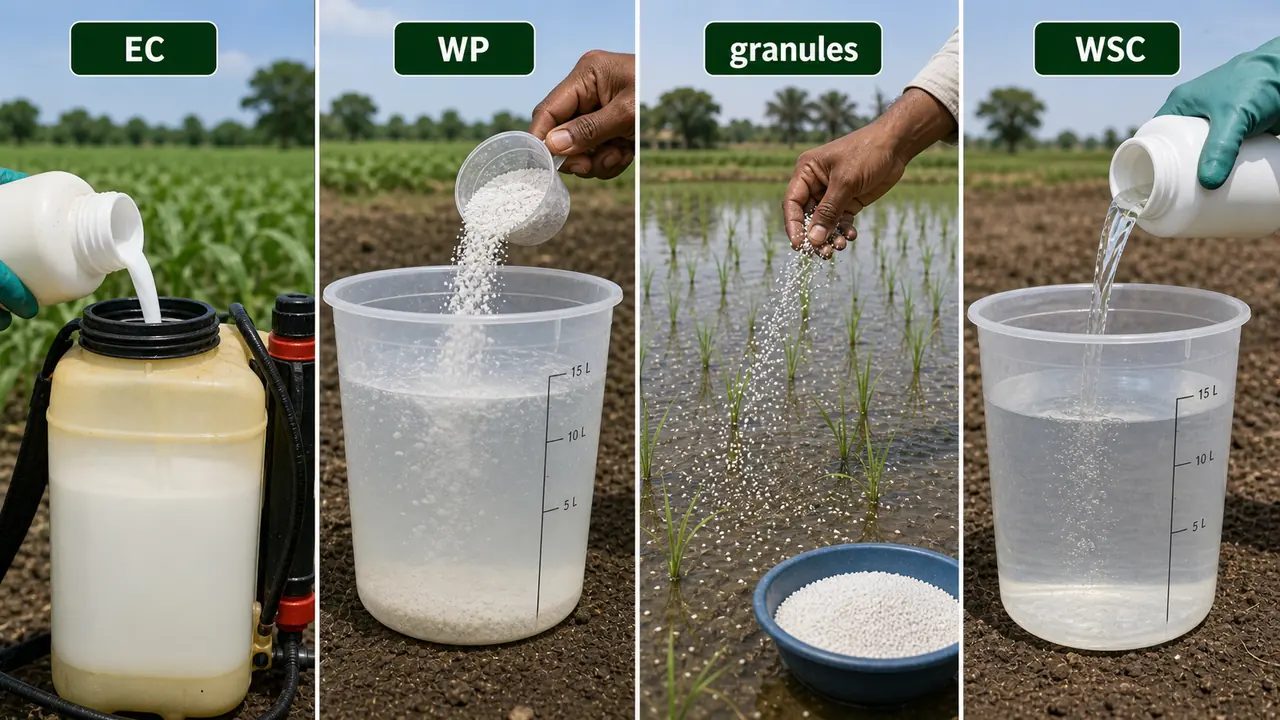
Pure (technical grade) herbicides may be solid crystals, oily liquids, or volatile compounds. Imagine trying to spray pure pendimethalin -- a thick, sticky paste -- uniformly across a 5-acre wheat field. It is practically impossible. This is why herbicides must be processed into formulations: carefully engineered products that are safe to handle, easy to mix with water, and effective when applied in the field.
This lesson covers:
- 9 formulation types -- EC, WP, G, WSC, SP, D, WDG, F, and pellets
- Active Ingredient and Acid Equivalent -- calculation methods
- Absorption pathways -- apoplast (root) vs symplast (shoot)
- Selectivity mechanisms -- differential absorption, translocation, deactivation
- Application methods -- 6 soil methods and 5 foliar methods
- Adjuvants -- surfactants, stickers, activators, and more
Types of Herbicide Formulations

Each formulation type is designed for specific application conditions. The abbreviation on the product label tells you the formulation type.
Pro Content Locked
Upgrade to Pro to access this lesson and all other premium content.
Charged once for one year · ₹1188 total
Save ₹100/month vs ₹2388/year launch price
- All Agriculture & Banking Courses
- AI Lesson Questions (100/day)
- AI Doubt Solver (50/day)
- Glows & Grows Feedback (30/day)
- AI Section Quiz (20/day)
- 22-Language Translation (100/day)
- Recall Questions (20/day)
- AI Quiz (15/day)
- AI Quiz Paper Analysis (100/day)
- AI Step-by-Step Explanations (100/day)
- Spaced Repetition Recall (FSRS)
- AI Tutor
- Immersive Text Questions
- Audio Lessons — Hindi & English
- Mock Tests & Previous Year Papers
- Summary & Mind Maps
- XP, Levels, Leaderboard & Badges
- Generate New Classrooms
- Voice AI Teacher (AgriDots Live)
- AI Revision Assistant
- Knowledge Gap Analysis
- Interactive Revision (LangGraph)
🔒 Secure one-time yearly payment via Razorpay · No hidden fees
From Laboratory to Field
The previous lesson covered herbicide types, trade names, and the 10 classification systems. Now we move from what herbicides are to how they are prepared and applied in the field. A herbicide's formulation determines how it mixes with water, how it reaches the target weed, and how effective it will be.
Pure (technical grade) herbicides may be solid crystals, oily liquids, or volatile compounds. Imagine trying to spray pure pendimethalin -- a thick, sticky paste -- uniformly across a 5-acre wheat field. It is practically impossible. This is why herbicides must be processed into formulations: carefully engineered products that are safe to handle, easy to mix with water, and effective when applied in the field.
This lesson covers:
- 9 formulation types -- EC, WP, G, WSC, SP, D, WDG, F, and pellets
- Active Ingredient and Acid Equivalent -- calculation methods
- Absorption pathways -- apoplast (root) vs symplast (shoot)
- Selectivity mechanisms -- differential absorption, translocation, deactivation
- Application methods -- 6 soil methods and 5 foliar methods
- Adjuvants -- surfactants, stickers, activators, and more
Types of Herbicide Formulations
Each formulation type is designed for specific application conditions. The abbreviation on the product label tells you the formulation type.
| Formulation | Abbreviation | How It Works | Mixing with Water | Example |
|---|---|---|---|---|
| Emulsifiable Concentrate | EC | Herbicide dissolved in organic solvent with an emulsifier (adjuvant); mixes uniformly with water | Forms an emulsion (milky liquid) | Butachlor EC |
| Wettable Powder | WP | Herbicide adsorbed on inert carrier, finely ground into powder | Forms a suspension (not solution); needs constant agitation | Atrazine WP |
| Granules | G | Active ingredient mixed with inert carrier (sand, clay, corn cobs) shaped into granules | Applied directly without water -- ideal for flooded fields | Alachlor G |
| Water Soluble Concentrate | WSC | Herbicide dissolves completely in water | Forms a true solution; no agitation needed | Paraquat WSC |
| Soluble Powder | SP | Powder that dissolves in water | True solution | 2,4-D sodium salt, Dalapon |
| Dust | D | Fine powder for direct application | No water mixing needed | -- |
| Water-Dispersible Granules | WDG / DF | Dry flowable granules that disperse readily in water | Combines advantages of WP and G | -- |
| Flowable / Aqueous Suspension | F / L / AS | Finely ground solid particles suspended in water | Liquid suspension | Atrazine F |
| Pellets / Tablets | P / TB | Compressed solid forms | Slow release or targeted application | -- |
Key Comparison: EC vs WP
| Feature | EC (Emulsifiable Concentrate) | WP (Wettable Powder) |
|---|---|---|
| Physical form | Liquid concentrate | Dry powder |
| Mixing result | Emulsion (milky) | Suspension (particles floating) |
| Agitation needed | Minimal | Constant (particles settle) |
| Most tested? | Yes -- most common formulation | Yes -- frequently compared with EC |
TIP
Exam favourite: EC forms an emulsion (two liquids mixed), WP forms a suspension (solid particles in liquid). Remember: EC = Emulsion, WP = particles in Water (suspension).
Active Ingredient (AI) and Acid Equivalent (AE)
The Active Ingredient (AI) is the chemical responsible for herbicidal activity, expressed as % by weight or volume.
- Example: Atrazine 80 WP = 80% active ingredient + 20% inert carriers/additives.
The Acid Equivalent (AE) is the theoretical yield of parent acid from a salt or ester formulation. AE is always less than or equal to AI.
- 2,4-D sodium salt AE = 92.5%
Calculation Examples
Q: Product has 80% AE. How much formulation for 2 kg AE/ha? A: 100/80 x 2 = 2.5 kg/ha
Q: Apply 0.5 kg AI/ha of Atrazine 80%. Quantity needed? (a) 0.40 (b) 0.48 (c) 0.52 (d) 0.62 kg/ha A: 100/80 x 0.5 = 0.625 = 0.62 kg/ha
Mode of Action: Absorption Pathways
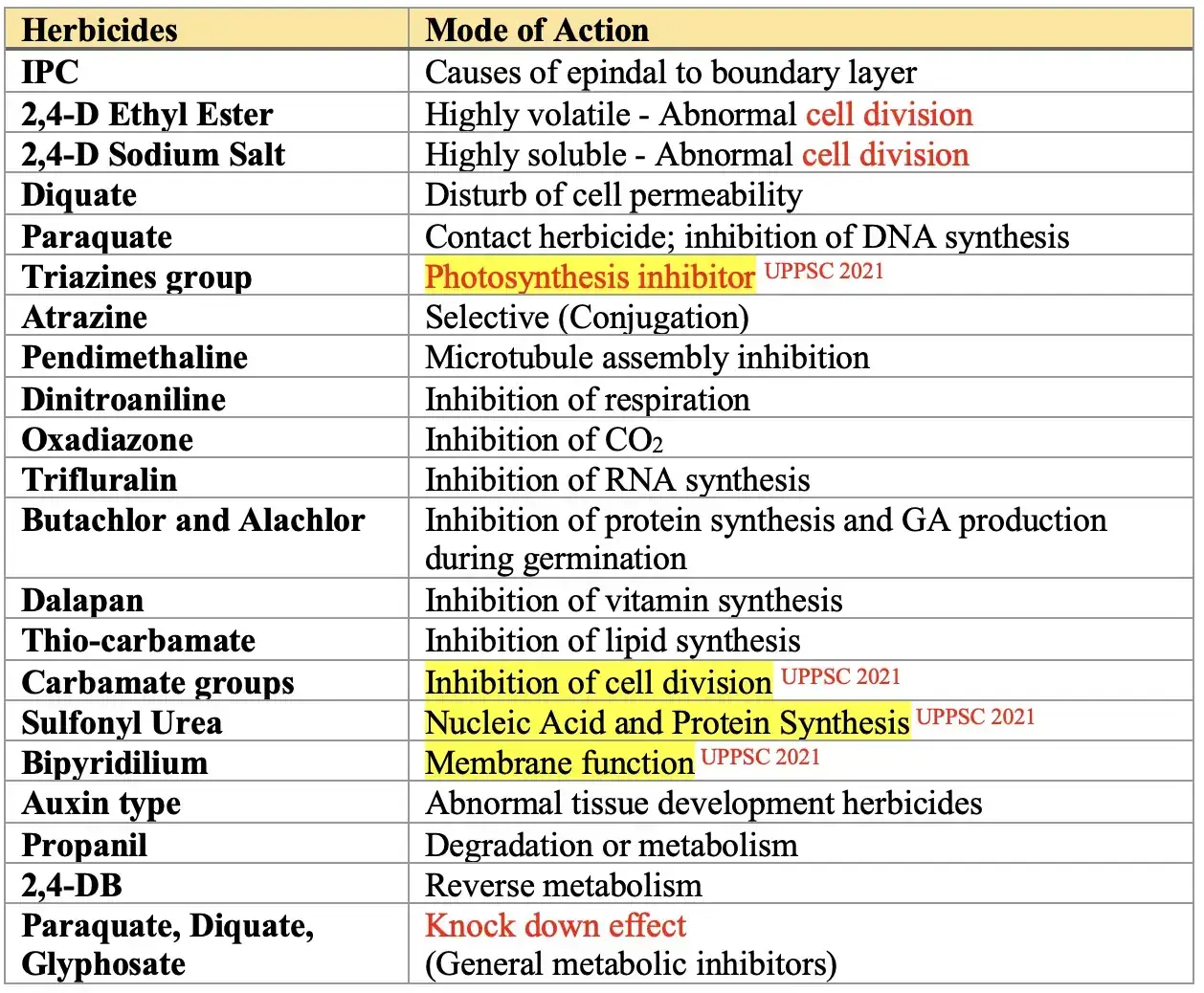
How herbicides enter and move through plants determines their effectiveness.
| Pathway | Absorption Route | Transport System | Examples |
|---|---|---|---|
| Apoplast | Through roots | Non-living cell walls (xylem) | Soil-applied herbicides |
| Symplast | Through shoots and foliage | Living cells via plasmodesmata (phloem) | Foliar herbicides |
NOTE
Herbicides are absorbed faster in young plants due to thinner cuticle, more active metabolism, and faster growth rate.
Herbicide Selectivity Mechanisms
Selectivity is the differential response of plants to a herbicide. More toxicant must reach the site of action in active form inside target plants than in non-target plants.
Three Mechanisms of Selectivity
| Mechanism | Explanation | Example |
|---|---|---|
| Differential absorption | Crop and weed absorb at different rates (cuticle, root differences) | Thick waxy cuticle of maize resists absorption |
| Differential translocation | Same absorption but different internal movement | -- |
| Differential deactivation | Most common mechanism; crop breaks down herbicide into non-toxic compounds faster | Rice metabolises Bensulfuron rapidly |
Metabolism
Change in molecular structure inside the plant yields non-toxic compounds.
Conjugation
Coupling of intact herbicide with plant cell constituents, locking it in a non-toxic, immobile form.
- Maize and millets deactivate Atrazine/Simazine by conjugation via enzyme Glutathione-S-Transferase
- Grasses and Convolvulus conjugate 2,4-D with glucose (glucoside)
Protoplasmic Resistance
Intrinsic resistance of cell protoplasm to a specific herbicide -- the plant's cells are inherently tolerant.
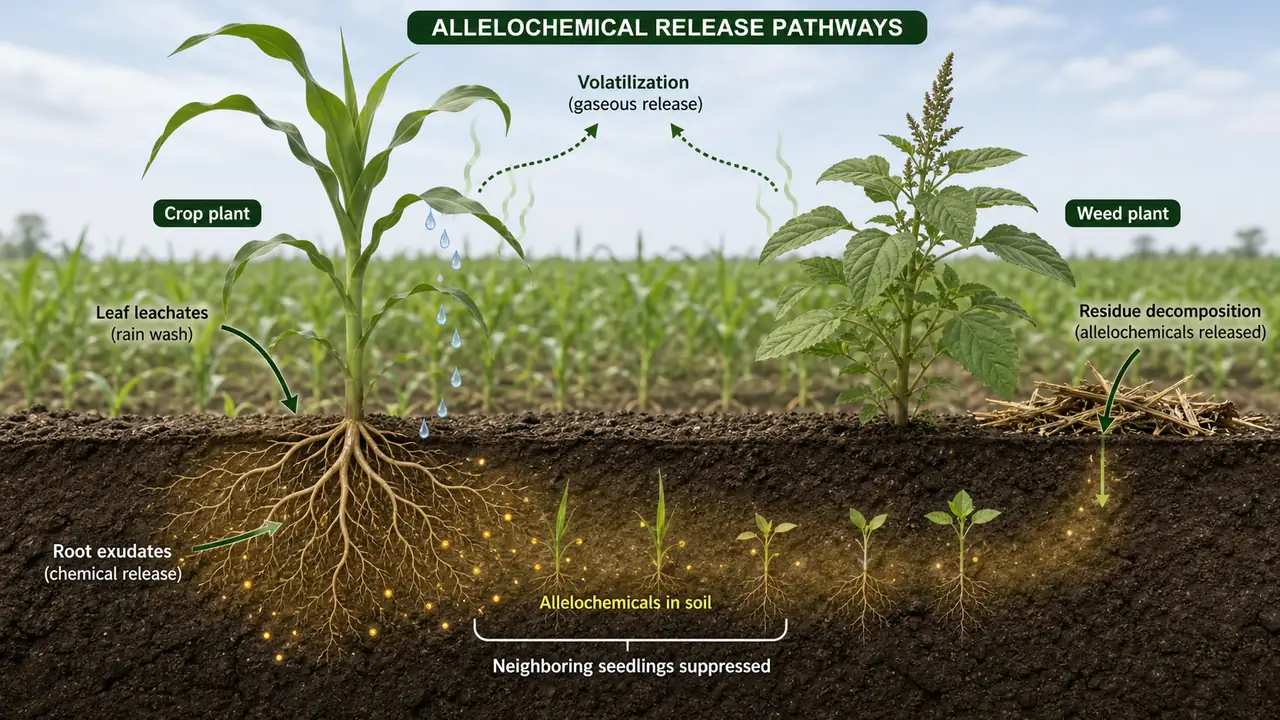
Methods of Herbicide Application
Knowing the formulation and selectivity of a herbicide is only half the picture. The method of application determines whether the herbicide reaches the target weed effectively while sparing the crop. Herbicides are applied in two fundamentally different ways depending on the target:
| Approach | Target | Absorption Pathway |
|---|---|---|
| Soil application | Weed roots in treated soil | Root absorption |
| Foliar application | Weed leaves and stems | Leaf/stem absorption |
Soil Application Methods
A. Surface Application
Herbicide is sprayed or broadcast uniformly on the soil surface. It may be left undisturbed or incorporated by tillage to prevent volatilisation and photo-decomposition.
Example: Fluchloralin -- left undisturbed under irrigated conditions (moisture keeps it stable) / incorporated under rainfed conditions (to prevent gaseous loss).
B. Subsurface Application
Herbicide applied in a concentrated band at 7-10 cm below the soil surface using special nozzles under a sweep hood. Targets perennial weeds with deep root systems.
Examples:
- Carbamate herbicides to control Cyperus rotundus
- Nitrate herbicides to control Convolvulus arvensis
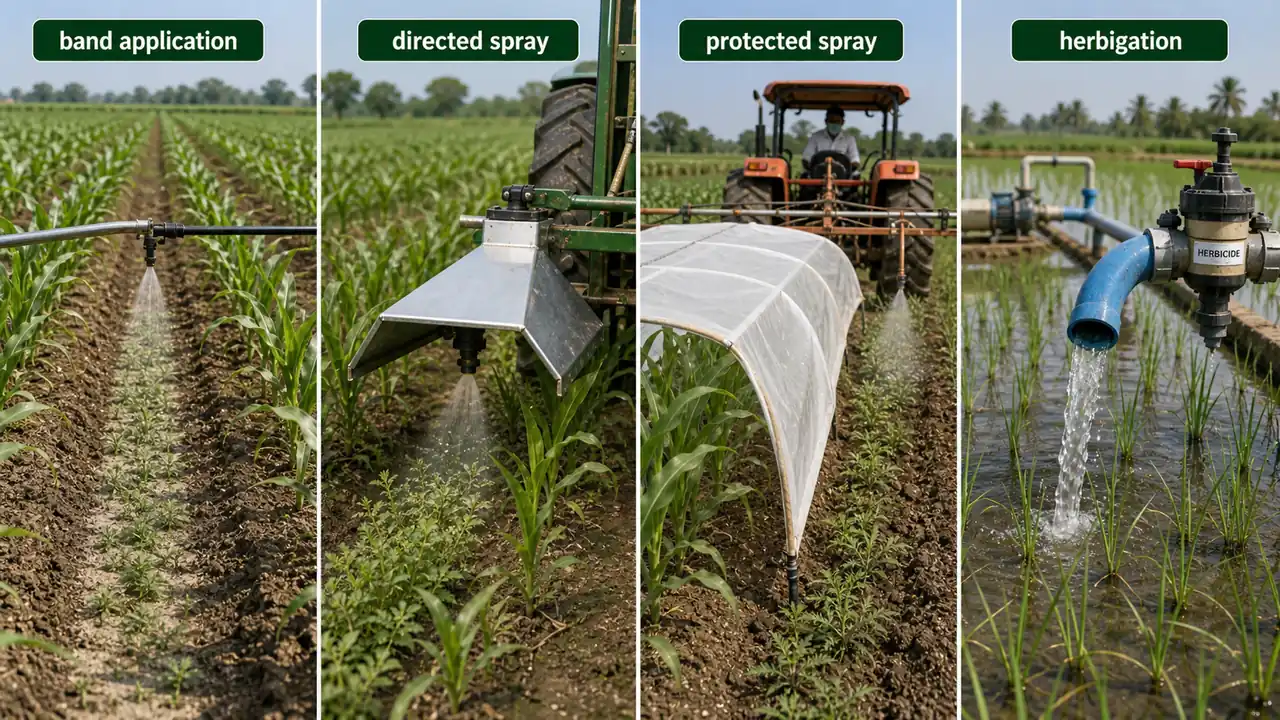
C. Band Application
Herbicide applied in a restricted band along crop rows, leaving inter-row space untreated. Inter-rows are then cultivated mechanically.
Cost saving calculation: When a 30 cm wide band is applied over rows spaced 90 cm apart, only one-third of the field receives herbicide -- saving two-thirds of herbicide cost.
TIP
Exam calculation: Band width / Row spacing = fraction treated. 30/90 = 1/3 treated, so 2/3 cost saved. This formula can be applied to any band width and row spacing combination.
D. Fumigation
Volatile chemicals applied into soil produce toxic gas that destroys nearly all organisms (weeds, seeds, nematodes, pathogens). A drastic treatment for high-value crops.
Examples: Methyl bromide, Metham -- used in nursery beds and greenhouse soils.
E. Lay-by Application
Herbicide applied after last cultivation (e.g., after earthing up). Used in crops like sugarcane where no further mechanical weeding is possible.
F. Herbigation
Herbicides applied along with irrigation water through surface or sprinkler irrigation systems. Saves labour and ensures uniform distribution.
| Region | Herbicide + Crop |
|---|---|
| India | Butachlor 4G through irrigation for chillies and tomato |
| Western countries | EPTC with sprinkler irrigation in lucerne |
Foliar Application Methods
A. Blanket Spray
Uniform application over the entire standing crop. Since both crop and weeds are contacted, only highly selective herbicides can be used.
Example: Spraying 2,4-D Ethyl Ester in rice three weeks after transplanting -- kills broadleaf weeds but spares rice (a grass).
B. Directed Spray
Spray directed onto weeds between crop rows while carefully avoiding the crop canopy using protective hoods or band devices.
Example: Spraying glyphosate (non-selective) between sugarcane rows using a hood to control Cyperus rotundus without damaging the cane.
C. Protected Spray
Non-selective herbicides applied after physically covering crop plants with polyethylene covers. Effective but expensive and laborious -- used only for high-value crops.
Example: Spraying glyphosate in jasmine, cassava and banana plantations.
D. Spot Treatment
Targeted application on specific spots or patches with serious weed infestation. Uses specialised equipment like the rope wick applicator and herbicide glove (wipe-on technique).
E. Basal Application
Bark is removed at the stem base (30 cm) and a drenching herbicide spray is applied to kill trees. Used for woody weed and tree removal in plantation management.
Comparison: Foliar Application Methods
| Method | Selectivity of Herbicide | Crop Protection Mechanism | Cost |
|---|---|---|---|
| Blanket spray | Must be highly selective | Herbicide selectivity itself | Low |
| Directed spray | Can be non-selective | Hood shields crop canopy | Medium |
| Protected spray | Can be non-selective | Polyethylene covers on crop | High |
| Spot treatment | Can be non-selective | Applied only on weed patches | Variable |
| Basal application | Non-selective | Applied to bark-stripped stem base | Variable |
NOTE
Directed spray and Protected spray both allow non-selective herbicides in standing crops. The difference: directed spray uses hoods to avoid the crop, while protected spray physically covers the crop.
Adjuvants
No herbicide formulation is complete without adjuvants -- the support chemicals that make the active ingredient work better in field conditions. Adjuvants are substances added to herbicides to improve performance without increasing innate herbicidal activity.
Uses of Adjuvants
- Improve selectivity to non-target plants
- Make herbicide safer for users
- Prolong shelf life
- Reduce drift hazards
Types of Adjuvants
| Type | Function | Examples |
|---|---|---|
| Surfactants | Modify surface properties -- wetting, spreading, penetration (largest class) | Non-ionic most common; dual hydrophilic + lipophilic nature |
| Emulsifiers | Disperse oil-based concentrates into stable droplets in water | Used in EC formulations |
| Dispersants | Keep WP particles in suspension | -- |
| Solvents / Coupling agents | Solubilise insoluble herbicides | PEG for 2,4-D; benzene, xylene |
| Humectants (Hygroscopic) | Prevent rapid drying; extend absorption time | Glycerol |
| Stickers | Hold herbicide on leaf; prevent rain wash-off | Petroleum oils, Citowett |
| Compatibility agents | Allow mixing of otherwise incompatible chemicals | Compex (pesticide + fertilizer mixes) |
| Activators (Synergists) | Amplify herbicidal action beyond individual effect | NH4 fertilizers enhance 2,4-D phytotoxicity |
| Drift control agents | Increase droplet size to reduce airborne drift | Invert emulsions (water-in-oil) |
| Thickening agents | Make spray viscous; larger droplets less prone to drift | Na-alginate, Decagin |
| Anti-foaming agents | Eliminate excess foam during mixing/agitation | Silicone polymers |
TIP
Exam tip: Surfactants are the largest class of adjuvants. Activators/Synergists (like ammonium fertilizers) enhance herbicidal action -- NH4 salts mixed with 2,4-D increase its phytotoxicity.
Summary Cheat Sheet
| Concept / Topic | Key Details |
|---|---|
| Most common formulation | EC (Emulsifiable Concentrate) — forms emulsion |
| WP mixing | Forms suspension — needs constant agitation |
| Granules advantage | No water needed — ideal for flooded paddy |
| Band application saving | 30 cm band in 90 cm rows saves 2/3 herbicide cost |
| Subsurface depth | 7-10 cm below soil surface |
| Herbigation in India | Butachlor 4G for chillies and tomato |
| Blanket spray | Requires only highly selective herbicides |
| Directed spray | Uses hood to shield crop; allows non-selective herbicide |
| Protected spray | Polyethylene covers on crop; allows non-selective herbicide |
| Spot treatment | Applied only on weed patches |
| Soil methods (6) | Surface, Subsurface, Band, Fumigation, Lay-by, Herbigation |
| Foliar methods (5) | Blanket, Directed, Protected, Spot treatment, Basal |
| Fumigation | Gaseous herbicide injected into soil |
| EC forms | Emulsion when mixed with water |
| AI example | Atrazine 80 WP = 80% AI + 20% inert |
| Acid Equivalent | 2,4-D Na salt AE = 92.5% |
| Apoplast | Root absorption (non-living cell walls) |
| Symplast | Shoot/foliar absorption (living cells, plasmodesmata) |
| Fastest absorption | Young plants (thinner cuticle) |
| Most common selectivity | Differential deactivation |
| Glutathione-S-Transferase | Maize enzyme for Atrazine conjugation |
| Lay-by application | After last cultivation (sugarcane) |
| Basal application | Bark removed at 30 cm stem base; drench spray to kill trees |
| Largest adjuvant class | Surfactants |
| Activator example | NH4 fertilizers enhance 2,4-D phytotoxicity |