🧪 Herbicides: Types, Trade Names and 10 Classification Systems
Master the 22 common herbicides with trade names and application timing, plus all 10 classification systems -- by selectivity, translocation, chemical family, toxicity colour codes, residual action and more.
The Chemical Revolution in Weed Control
The previous lessons covered preventive, cultural, mechanical, and biological weed control methods. Now we enter the fifth and most commercially significant category: chemical control using herbicides. Herbicides account for over 45% of all pesticides used globally, and understanding their types and classification is essential for both field application and competitive exams.
In the wheat fields of Haryana during the 1990s, Phalaris minor (canary grass) had become so resistant to isoproturon -- the only herbicide farmers used -- that yields were crashing. The crisis forced scientists to introduce new herbicides like sulfosulfuron and clodinafop from entirely different chemical families. This story illustrates why understanding herbicide classification is not just academic -- it is essential for managing resistance, selecting the right product, and protecting crops.
This lesson covers:
Pro Content Locked
Upgrade to Pro to access this lesson and all other premium content.
Charged once for one year · ₹1188 total
Save ₹100/month vs ₹2388/year launch price
- All Agriculture & Banking Courses
- AI Lesson Questions (100/day)
- AI Doubt Solver (50/day)
- Glows & Grows Feedback (30/day)
- AI Section Quiz (20/day)
- 22-Language Translation (100/day)
- Recall Questions (20/day)
- AI Quiz (15/day)
- AI Quiz Paper Analysis (100/day)
- AI Step-by-Step Explanations (100/day)
- Spaced Repetition Recall (FSRS)
- AI Tutor
- Immersive Text Questions
- Audio Lessons — Hindi & English
- Mock Tests & Previous Year Papers
- Summary & Mind Maps
- XP, Levels, Leaderboard & Badges
- Generate New Classrooms
- Voice AI Teacher (AgriDots Live)
- AI Revision Assistant
- Knowledge Gap Analysis
- Interactive Revision (LangGraph)
🔒 Secure one-time yearly payment via Razorpay · No hidden fees
The Chemical Revolution in Weed Control
The previous lessons covered preventive, cultural, mechanical, and biological weed control methods. Now we enter the fifth and most commercially significant category: chemical control using herbicides. Herbicides account for over 45% of all pesticides used globally, and understanding their types and classification is essential for both field application and competitive exams.
In the wheat fields of Haryana during the 1990s, Phalaris minor (canary grass) had become so resistant to isoproturon -- the only herbicide farmers used -- that yields were crashing. The crisis forced scientists to introduce new herbicides like sulfosulfuron and clodinafop from entirely different chemical families. This story illustrates why understanding herbicide classification is not just academic -- it is essential for managing resistance, selecting the right product, and protecting crops.
This lesson covers:
- History -- first herbicide use in India (1937) and the 2,4-D breakthrough
- 22+ common herbicides -- trade names and application timing
- 10 classification systems -- time, method, selectivity, mobility, structure, family, spectrum, residual action, toxicity, duration
History and Usage of Herbicides in India
| Milestone | Year | Detail |
|---|---|---|
| First herbicide use in India | 1937 | Punjab; Sodium Arsenite against Carthamus oxycantha |
| Breakthrough in selective weed control | 1945 | 2,4-D & MCPA discovered (USA & England) by P.W. Zimmerman & A.E. Hitchcock |
| First chemical herbicide concept in India | -- | Paraquat used in tea plantations |
Key Facts on Herbicide Usage
| Fact | Detail |
|---|---|
| 3/4 of Indian herbicides used in | Plantation crops (tea, coffee) |
| Herbicides NOT used in | Fodder crops (residue harmful to livestock) |
| Herbicide share in developed countries | > 45% of total pesticides |
| Herbicide share in India | Only 8% (average 40 g/ha/year) |
| Japan herbicide use | 5,000 g/ha/year |
| MCPB | For broadleaf weeds in legumes UPPSC 2021 |
NOTE
2,4-D and MCPA (1945) were the first selective herbicides -- they kill broadleaf weeds in cereals while leaving grasses unharmed. This discovery launched the modern era of chemical weed control.
Common Herbicides and Trade Names
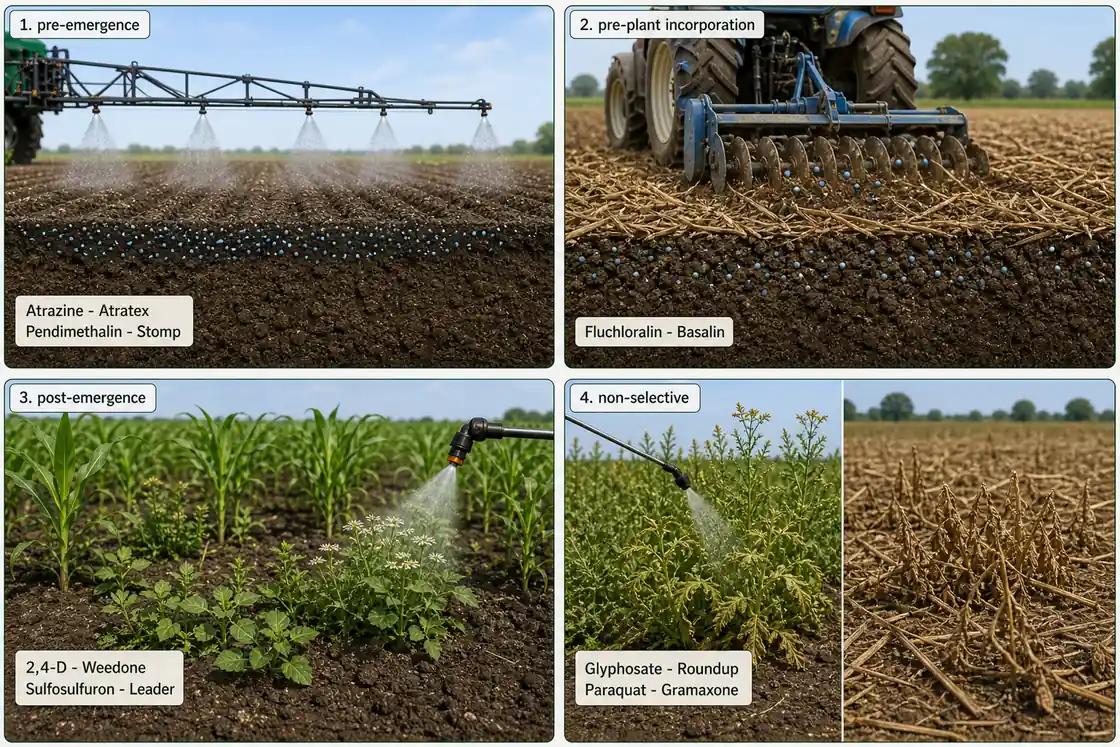
This reference table is critical for exams. Know the common name, trade name, and time of application.
| S.No. | Herbicide | Trade Name | Time of Application |
|---|---|---|---|
| 1 | Atrazine | Atratex | Pre-emergence |
| 2 | Alachlor | Lasso | Pre-emergence |
| 3 | Butachlor | Mechate | Pre-emergence |
| 4 | Pendimethalin | Stomp | Pre-emergence |
| 5 | Oxyfluorfen | Goal | Pre-emergence |
| 6 | Metribuzin | Sencor | Pre-emergence |
| 7 | Fluchloralin | Basalin | Pre-Plant Incorporation |
| 8 | Monuron | Telvar | Pre-Plant Incorporation |
| 9 | Dalapon | Dowfon | Post-emergence |
| 10 | Isoproturon | Roque | Post-emergence |
| 11 | Nitrofen | Tok-E-25 | Post-emergence |
| 12 | Metsulfuron | Escort | Post-emergence |
| 13 | Propanil | Stamp F-34 | Post-emergence |
| 14 | Sulfosulfuron | Leader | Post-emergence |
| 15 | Benthiocarb | Bolero, Saturn | Post-emergence |
| 16 | Glyphosate | Roundup | Post-emergence |
| 17 | 2,4-D | Plantguard, Weedone | Post-emergence |
| 18 | Imazethapyr | Guard | Post-emergence |
| 19 | Paraquat | Sweep, Gramaxone | Non-selective |
| 20 | Metalochlor | Dual | -- |
| 21 | Oxadiazon | Ronstar | -- |
| 22 | Lectophan | Cobra | -- |
| 23 | Acifluorfen | Blazer | Post-emergence |
| 24 | Acrolein | Aqualin, Weedazol | -- |
| 25 | Anilophos | Azalin | Pre-emergence |
| 26 | Chlorimuron-ethyl | Classic, Kloben | Post-emergence |
| 27 | Chlosulfuron | Glean | Post-emergence |
| 28 | Chlorimuron + Metasulfuron | Almix | Post-emergence |
| 29 | Diuron | Karmex | Pre-emergence |
| 30 | Ethoxy sulfuron | Sunrise | Post-emergence |
| 31 | Linuron | Afalan | Pre-emergence |
| 32 | Fenoxaprop-ethyl | Puma super, Whip super, Rice star | Post-emergence |
| 33 | 2,4-DB | Butoxone | Post-emergence |
TIP
Memory aids for trade names: Stomp (Pendimethalin) -- stomps weeds before they emerge. Roundup (Glyphosate) -- rounds up and kills everything. Leader (Sulfosulfuron) -- leads the post-emergence charge in wheat.
NOTE
Isoproturon is versatile -- used as pre-emergence against jointed goatgrass and as post-emergence in wheat. This dual usage is frequently asked.
10 Classification Systems of Herbicides
Just as weeds are classified using 12 systems (Lesson 2), herbicides are classified in 10 different ways. Each system highlights a different property -- application timing, selectivity, chemistry, persistence, or toxicity. Exam questions can draw from any of these systems, so all ten must be understood.
1. Based on Time of Application
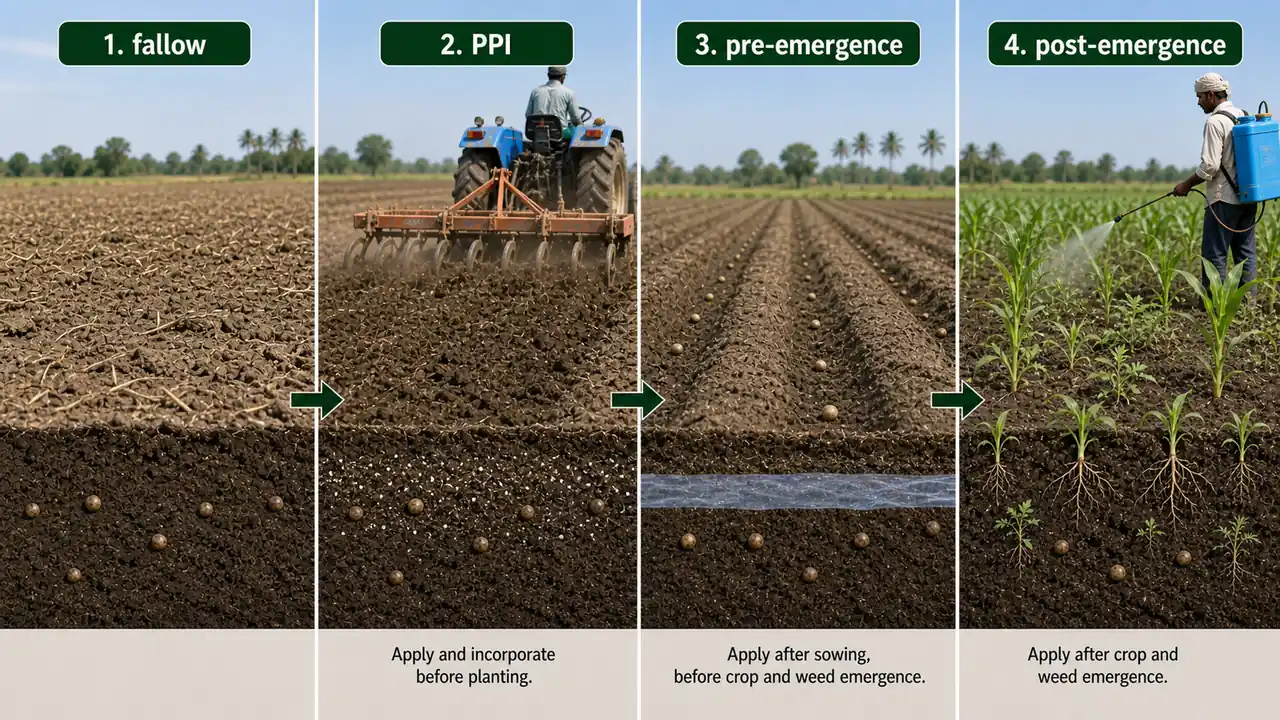
The most practical classification -- tells you when to apply relative to crop planting and emergence.
| Timing | Definition | Herbicides |
|---|---|---|
| Fallow application | Applied > 10 days before sowing; higher dose for problematic weeds in fallow fields | Controls established weed populations before crop season |
| Pre-Plant Incorporation (PPI) | Applied before planting; must be incorporated into soil due to high volatility | Fluchloralin, Alachlor (soil); Glyphosate, Paraquat, EPTC, Monuron, Diuron, Fenuron (foliage) |
| Pre-emergence (PE) | Applied after sowing but before emergence; forms a chemical barrier on soil surface | Trifluralin, Atrazine, Pendimethalin, Butachlor, Thiobencarb, Pretilachlor, Simazine, Alachlor |
| Post-emergence | Applied after emergence of both crop and weeds; must be selective in crops | 2,4-D, Glyphosate, Paraquat, 2,4,5-T, MCPA, MCPB, Propanil, Dalapon, MSMA |
TIP
Sequence to remember: PPI -> PE -> Post-E (Before planting -> After sowing but before emergence -> After emergence). Think of it as chronological order in the crop calendar.
2. Based on Method of Application
| Type | Target | Examples |
|---|---|---|
| Soil applied | Act through roots and underground parts | Fluchloralin, Pendimethalin |
| Foliage applied | Active on leaves and stems | Glyphosate, Paraquat |
| Both soil and foliage active | Enter through roots or leaves | 2,4-D, Atrazine, Picloram |
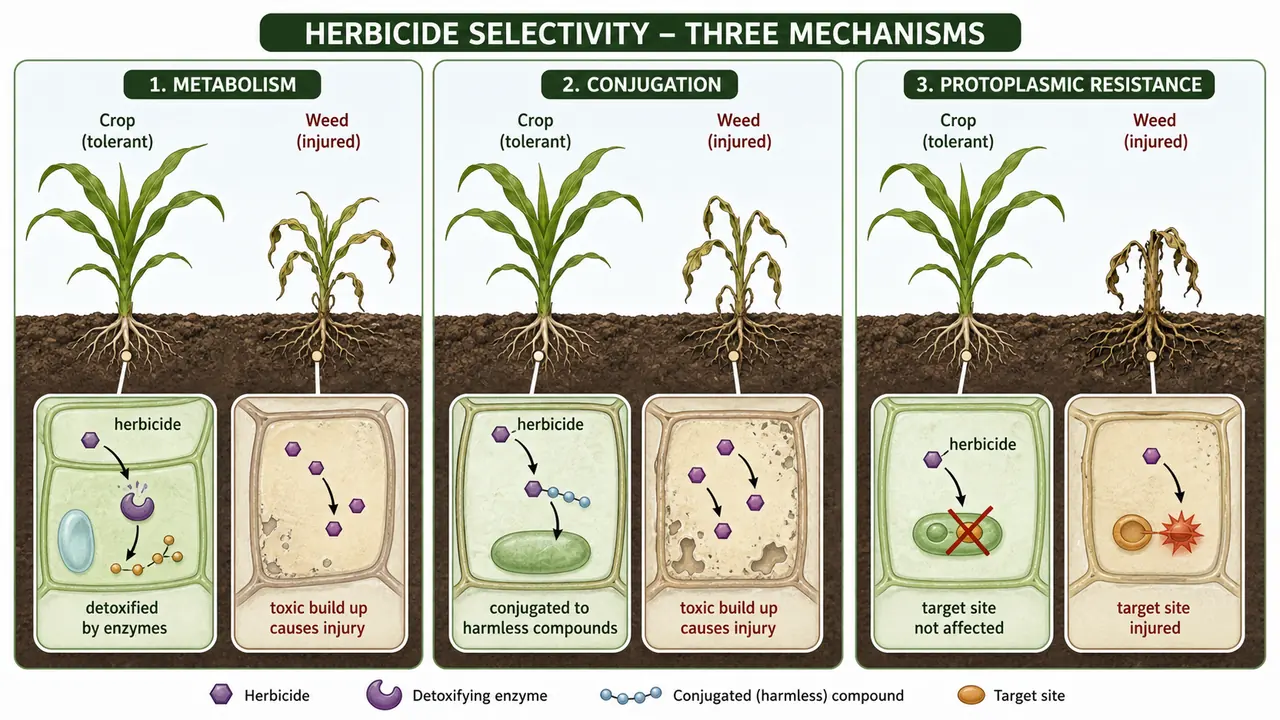
3. Based on Mode of Action (Selectivity)
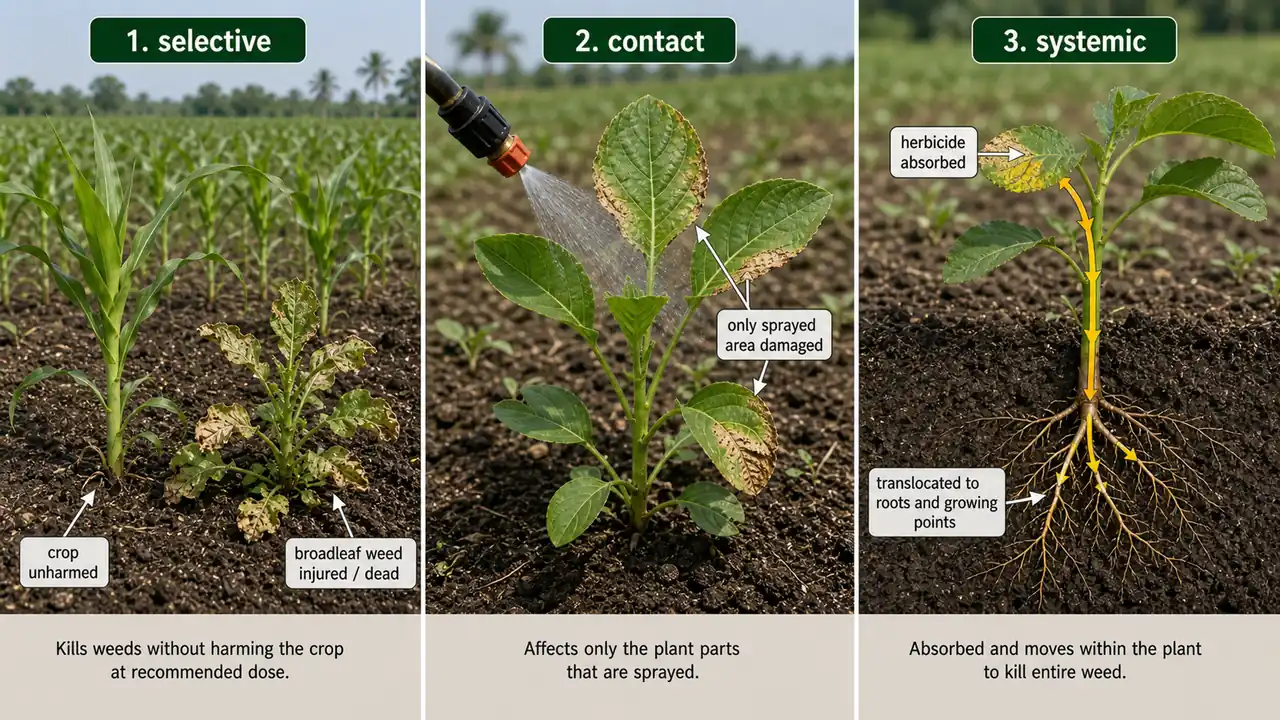
Selectivity is the ability to kill weeds without harming the crop -- the most important practical classification.
| Type | Definition | Examples |
|---|---|---|
| Selective | Kills target weeds without injuring the crop at recommended doses | Atrazine, 2,4-D, Isoproturon, Fluchloralin, Pendimethalin |
| Non-selective | Destroys all vegetation -- both weeds and crops | Diquat, Glyphosate, Paraquat |
NOTE
Selectivity is dose-dependent. Atrazine at 0.5-1.0 kg/ha is selective in sorghum; at 10 kg/ha it becomes non-selective. Simazine and Diuron behave similarly.
IMPORTANT
Mnemonic for non-selective herbicides -- "DGP": Diquat, Glyphosate, Paraquat. These are used in fallow fields, non-crop areas, or with protective hoods.
4. Based on Mobility (Translocation)
| Type | Movement | Kill Pattern | Examples |
|---|---|---|---|
| Contact | Does NOT move in the plant | Kills only parts directly touched | Paraquat, Diquat, Propanil |
| Translocated (Systemic) | Moves through xylem and/or phloem | Kills entire plant including roots | Glyphosate, 2,4-D, Atrazine, Pendimethalin, Metribuzin |
NOTE
Atrazine is unique -- it is both systemic and contact in action, making it one of the most versatile herbicides.
5. Based on Molecular Structure
| Type | Description |
|---|---|
| Organic compounds | Carbon-based: dinitrophenols, chlorophenoxy compounds, carbamates, amides |
| Inorganic compounds | Non-carbon-based: inorganic salts, synthetically produced (older, largely replaced) |
6. Based on Chemical Nature / Composition
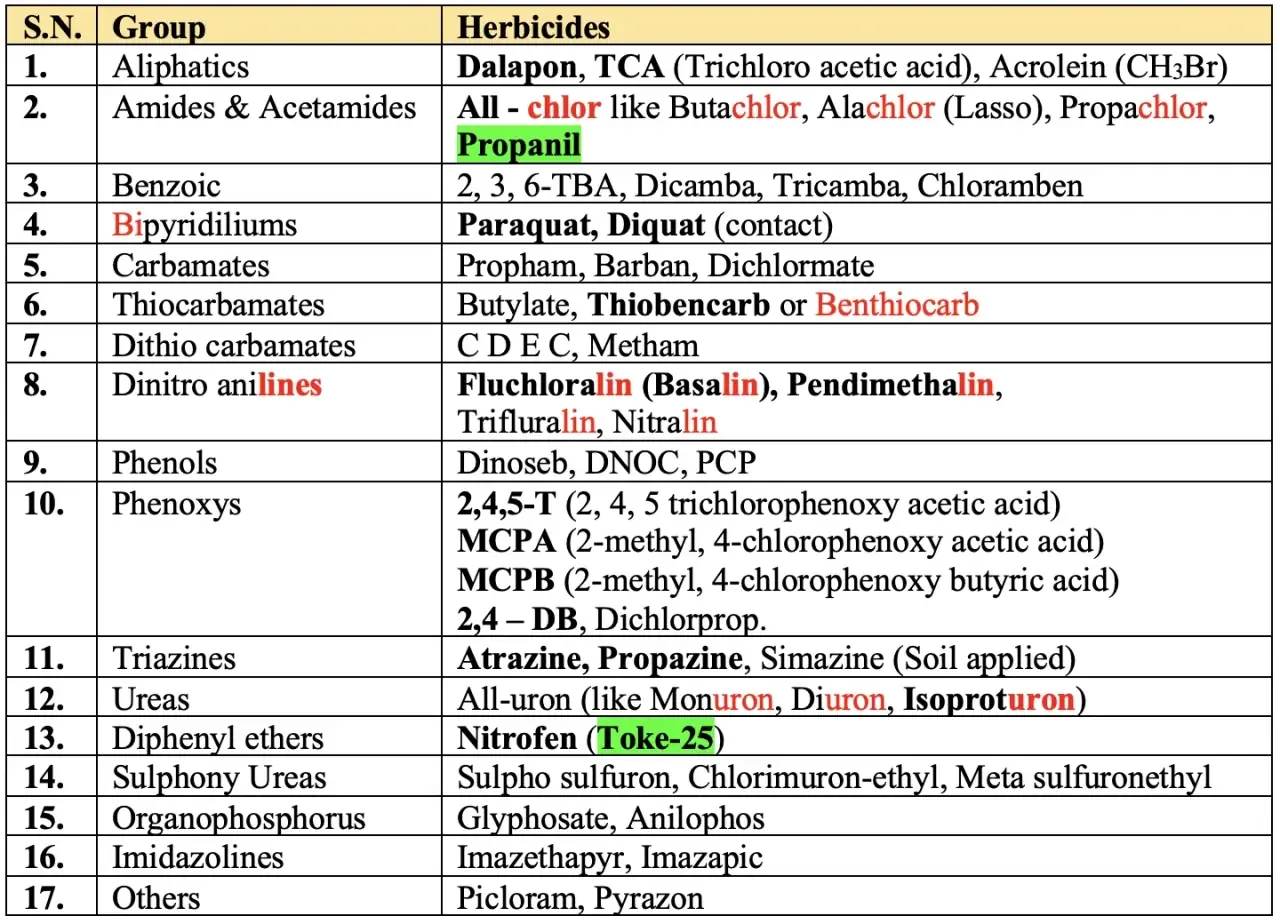
The most detailed classification, grouping herbicides by chemical family. Members of the same family often share modes of action.
Inorganic herbicides (oldest, rarely used):
- Acids: Arsenic acid, arsenious acid, arsenic trioxide, sulphuric acid
- Salts: Borax, copper sulphate, ammonium sulphate, Na chlorate, Na arsenite, copper nitrate
Organic herbicides:
| Chemical Group | Examples |
|---|---|
| Aliphatics | Dalapon, TCA |
| Amides | Alachlor, Butachlor, Propanil |
| Bipyridilliums | Paraquat, Diquat |
| Dinitroanilines | Fluchloralin, Pendimethalin |
| Phenoxy acids | 2,4-D |
| Thiocarbamates | Benthiocarb / Thiobencarb |
| Triazines | Atrazine, Metribuzin, Terbutryn, Simazine |
| Phenyl Ureas | Monuron, Diuron |
| Sulfonylureas | Metsulfuron, Sulfosulfuron |
| Unclassified | Glyphosate (unique structure) |
TIP
Exam tip: Paraquat and Diquat belong to Bipyridilliums -- both are non-selective contact herbicides. Triazines (Atrazine, Simazine) are the most persistent in soil.
7. Based on Spectrum of Weed Control
| Type | Description | Examples |
|---|---|---|
| Narrow spectrum | Active on a limited number of species | 2,4-D (kills only broadleaf weeds and sedges, not grasses); Metoxuron, Difenzoquat, Diclofop |
| Broad spectrum | Controls a wide range of weed flora | Glyphosate, Paraquat |
NOTE
2,4-D is a narrow-spectrum herbicide -- it selectively kills broadleaf weeds and sedges while leaving grasses unharmed, making it ideal for cereal crops (which are grasses).
8. Based on Residual Action in Soil
Critical for crop rotation planning -- residual herbicides can damage sensitive follow-up crops.
| Type | Definition | Examples |
|---|---|---|
| Residual | Maintain phytotoxic effects for weeks to months | Atrazine, Pendimethalin, Isoproturon, Metribuzin, Trifluralin, 2,4-D, Simazine, Alachlor, EPTC |
| Non-residual | Inactivated immediately upon contact with soil (adsorbed to soil colloids) | Paraquat, Glyphosate, Diquat, Amitrol |
Persistence of common herbicides in soil:
| Herbicide | Persistence |
|---|---|
| Flazifop-p-butyl | 1 week |
| Benazit | 2 weeks |
| Glyphosate, Paraquat, 2,4-D | 1 month |
| Alachlor | 1-2 months |
| Atrazine | 2-8 months |
| Diuron | 2+ months |
WARNING
Atrazine has the longest persistence (up to 8 months) among common herbicides. This can cause carryover damage to sensitive crops in the next season. Always consider the rotation crop before using persistent herbicides.
9. Based on Toxicity (LD50 and Colour Codes)

Toxicity is measured using LD50 -- the dose that kills 50% of test animals. Lower LD50 = higher toxicity. India uses a colour-coded label system.
| Category | LD50 Oral (mg/kg) | LD50 Dermal (mg/kg) | Label Colour | Label Word |
|---|---|---|---|---|
| Extremely Toxic | 1-50 | 1-200 | Bright Red | Poison |
| Highly Toxic | 51-500 | 201-2000 | Bright Yellow | Poison |
| Moderately Toxic | 501-5000 | 2001-20000 | Bright Blue | Danger |
| Slightly Toxic | >5000 | >20000 | Bright Green | Caution |
TIP
Colour order -- most to least toxic: Red -> Yellow -> Blue -> Green. Think of a traffic signal going from "STOP/DANGER" (red) to "SAFE/GO" (green).
10. Based on Duration of Weed Control (Non-Crop Situations)
| Feature | Temporary Soil Sterilant | Permanent Soil Sterilant |
|---|---|---|
| Duration | 15-16 weeks only | Two or more seasons/years |
| Examples | Methyl bromide, carbon disulphide | Triazines, sodium chlorate |
| Used in | Nursery beds for rice, tobacco, vegetables | Industrial and non-cropped areas |
WARNING
Permanent soil sterilants make the soil completely unfit for plant growth for extended periods. They should never be used in agricultural fields intended for crop production.
All 10 Classification Systems at a Glance
| # | Basis | Key Categories to Remember |
|---|---|---|
| 1 | Time of application | PPI, Pre-emergence, Post-emergence |
| 2 | Method of application | Soil applied, Foliage applied, Both |
| 3 | Selectivity | Selective vs Non-selective (DGP) |
| 4 | Mobility | Contact vs Translocated (systemic) |
| 5 | Molecular structure | Organic vs Inorganic |
| 6 | Chemical family | Triazines, Bipyridilliums, Phenoxy acids, etc. |
| 7 | Spectrum | Narrow (2,4-D) vs Broad (Glyphosate) |
| 8 | Residual action | Residual (Atrazine 2-8 months) vs Non-residual (Paraquat) |
| 9 | Toxicity | Red > Yellow > Blue > Green |
| 10 | Duration (non-crop) | Temporary (15-16 weeks) vs Permanent sterilant |
TIP
Master mnemonic for 10 systems -- "TiMSeM CoSpeR ToxDu": Time, Method, Selectivity, Mobility, Composition, Spectrum, Residual action, Toxicity, Duration. Add "Molecular structure" to complete the set.
Herbicide Selection Guide: Which Herbicide for Which Crop-Weed Situation?
Practical decision table for IBPS AFO aspirants:
| Crop | Dominant Weed Problem | Recommended Herbicide | Timing | Mode of Action |
|---|---|---|---|---|
| Wheat | Phalaris minor (gullidanda) | Sulfosulfuron 25 g/ha or Clodinafop 60 g/ha | Post-emergence (30-35 DAS) | ALS inhibitor / ACCase inhibitor |
| Wheat | Broadleaf weeds (Chenopodium, Melilotus) | 2,4-D 500 g/ha or Metsulfuron 4 g/ha | Post-emergence (30-35 DAS) | Auxin mimic / ALS inhibitor |
| Rice (transplanted) | Mixed weeds | Butachlor 1.5 kg/ha or Pretilachlor 750 g/ha | Pre-emergence (3-5 DAT) | Cell division inhibitor |
| Rice (DSR) | Grasses + sedges | Pendimethalin 1 kg/ha (PE) + Bispyribac 25 g/ha (PoE) | PE at sowing + PoE at 20-25 DAS | Seedling root inhibitor + ALS inhibitor |
| Soybean | Mixed weeds | Pendimethalin 1 kg/ha | Pre-emergence | Seedling root inhibitor |
| Sugarcane | All weed types | Atrazine 2 kg/ha | Pre-emergence (3 DAP) | Photosynthesis inhibitor |
| Non-cropped area | Total vegetation kill | Glyphosate 1-2 kg/ha or Paraquat 0.5 kg/ha | Post-emergence (any time) | Amino acid synthesis inhibitor / Contact kill |
Resistance management rule: Never use the same herbicide (or same mode of action group) for >3 consecutive seasons. Rotate between ALS inhibitors, ACCase inhibitors, and auxin mimics. The Phalaris minor crisis in Haryana (isoproturon resistance, 1990s) is the textbook example of what happens when this rule is ignored.
Toxicity colour code (Central Insecticides Board):
- 🔴 Red = Extremely toxic (e.g., Paraquat)
- 🟡 Yellow = Highly toxic
- 🔵 Blue = Moderately toxic
- 🟢 Green = Slightly toxic (e.g., Glyphosate)
Summary Cheat Sheet
| Concept / Topic | Key Details |
|---|---|
| 10 classification systems | Time, Method, Selectivity, Mobility, Structure, Family, Spectrum, Residual, Toxicity, Duration |
| PPI | 1 day before sowing |
| Pre-emergence | 1-4 DAS |
| Post-emergence | 30-40 DAS |
| Selective examples | 2,4-D, Atrazine, Butachlor, Pendimethalin, Isoproturon |
| Non-selective (DGP) | Paraquat, Diquat, Glyphosate |
| Contact herbicide | Kills only touched tissue |
| Systemic/Translocated | Moves through plant; good for perennials |
| Paraquat persistence | Zero (inactivated on soil contact) |
| Longest persistent | Chlorfenac |
| Atrazine persistence | 2-8 months |
| Narrow spectrum | 2,4-D (only broadleaf) |
| Broad spectrum | Glyphosate (all weeds) |
| Toxicity label order | Red > Yellow > Blue > Green |
| Temporary soil sterilant | 15-16 weeks; methyl bromide; for nursery beds |
| Permanent soil sterilant | 2+ seasons; triazines, sodium chlorate; non-crop areas only |
| First herbicide in India | 1937, Punjab, Sodium Arsenite vs Carthamus oxycantha |
| 2,4-D discovery | 1945 by P.W. Zimmerman & A.E. Hitchcock |
| Herbicide share in India | 8% of total pesticides (40 g/ha/year) |
| Fallow application | > 10 days before sowing |
| Dose-dependent selectivity | Atrazine 0.5-1.0 kg/ha selective; 10 kg/ha non-selective |
| MCPB | Broadleaf control in legumes |
| Mnemonic | TiMSeM CoSpeR ToxDu for 10 systems |