🐛 Biological Control of Weeds
Learn classical biological control agents and their target weeds, criteria for successful bioagents, the population dynamics cycle, and bioherbicides/mycoherbicides with comparison tables and exam mnemonics.
When a Moth Saved a Continent
The previous lesson covered preventive, cultural, and mechanical methods of weed control -- approaches that rely on physical force, agronomic manipulation, or management practices. This lesson introduces the fourth category: using living organisms to suppress weeds. Biological control is fundamentally different because it harnesses natural predator-prey relationships rather than human labour or chemicals.
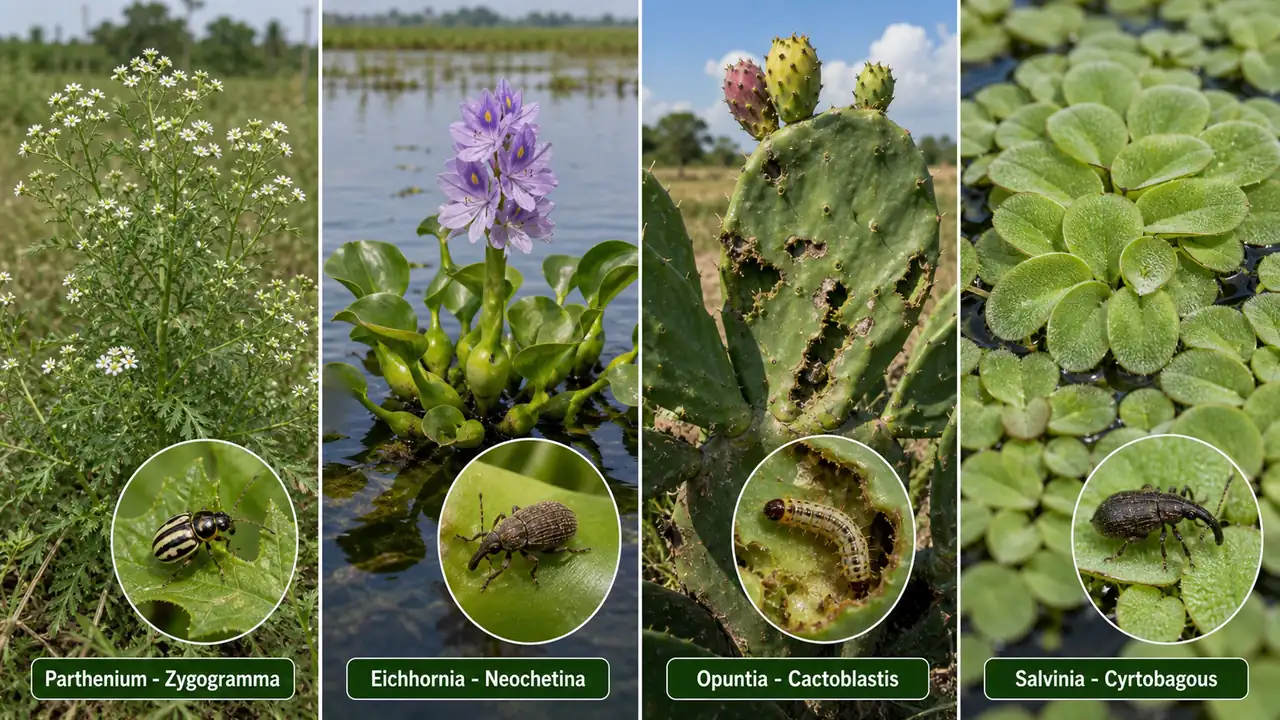
In early 20th-century Australia, prickly pear cactus (Opuntia spp.) had invaded over 24 million hectares of grazing land, rendering it useless. No chemical or mechanical method could handle such a vast infestation. Then, in 1925, the moth Cactoblastis cactorum was introduced from South America. Within a decade, the cactus was reduced to scattered patches. This remains one of the most spectacular success stories of biological weed control.
This lesson covers:
- Classical biological control -- insect, fish, snail, and mite bioagents
- Criteria for successful bioagents -- host-specificity, hardiness, feeding habit
- Population dynamics cycle -- how biocontrol reaches equilibrium
- Bioherbicides/mycoherbicides -- Devine, Collego, and spray-on biocontrol
What is Biological Control?
Biological control is the utilization of natural living organisms -- insects, herbivorous fish, disease organisms, and competitive plants -- to limit weed growth. It is an environmentally friendly approach that harnesses natural predator-prey relationships.
Pro Content Locked
Upgrade to Pro to access this lesson and all other premium content.
Charged once for one year · ₹1188 total
Save ₹100/month vs ₹2388/year launch price
- All Agriculture & Banking Courses
- AI Lesson Questions (100/day)
- AI Doubt Solver (50/day)
- Glows & Grows Feedback (30/day)
- AI Section Quiz (20/day)
- 22-Language Translation (100/day)
- Recall Questions (20/day)
- AI Quiz (15/day)
- AI Quiz Paper Analysis (100/day)
- AI Step-by-Step Explanations (100/day)
- Spaced Repetition Recall (FSRS)
- AI Tutor
- Immersive Text Questions
- Audio Lessons — Hindi & English
- Mock Tests & Previous Year Papers
- Summary & Mind Maps
- XP, Levels, Leaderboard & Badges
- Generate New Classrooms
- Voice AI Teacher (AgriDots Live)
- AI Revision Assistant
- Knowledge Gap Analysis
- Interactive Revision (LangGraph)
🔒 Secure one-time yearly payment via Razorpay · No hidden fees
When a Moth Saved a Continent
The previous lesson covered preventive, cultural, and mechanical methods of weed control -- approaches that rely on physical force, agronomic manipulation, or management practices. This lesson introduces the fourth category: using living organisms to suppress weeds. Biological control is fundamentally different because it harnesses natural predator-prey relationships rather than human labour or chemicals.
In early 20th-century Australia, prickly pear cactus (Opuntia spp.) had invaded over 24 million hectares of grazing land, rendering it useless. No chemical or mechanical method could handle such a vast infestation. Then, in 1925, the moth Cactoblastis cactorum was introduced from South America. Within a decade, the cactus was reduced to scattered patches. This remains one of the most spectacular success stories of biological weed control.
This lesson covers:
- Classical biological control -- insect, fish, snail, and mite bioagents
- Criteria for successful bioagents -- host-specificity, hardiness, feeding habit
- Population dynamics cycle -- how biocontrol reaches equilibrium
- Bioherbicides/mycoherbicides -- Devine, Collego, and spray-on biocontrol
What is Biological Control?
Biological control is the utilization of natural living organisms -- insects, herbivorous fish, disease organisms, and competitive plants -- to limit weed growth. It is an environmentally friendly approach that harnesses natural predator-prey relationships.
Key principles:
- Biological control cannot eradicate weeds completely, but can significantly reduce populations to manageable levels
- Not useful for all types of weeds -- works only where a specific, host-restricted agent is available
- Introduced (exotic) weeds are the best targets because they arrived without their natural enemies
- Biocontrol as a discipline started in the year 1900
Classical Biological Control Agents
This is the most important table for competitive exams -- memorise the weed-bioagent pairs carefully.
| Target Weed | Bioagent | Type | Notes |
|---|---|---|---|
| Lantana camara (Ghaneri) | Crocidosema lantana | Moth | First weed ever controlled by a bioagent (in Hawaii) |
| Lantana camara | Teleonemia scrupulosa | Lantana bug (Tingid) | Used in Australia |
| Opuntia spp. (Prickly pear) | Cactoblastis cactorum | Moth | Used in Australia -- spectacular success |
| Opuntia spp. | Dactylopius indicus / D. tomentosus | Cochineal scale insect | Used in South India; 40,000 ha recovered in Tamil Nadu & Maharashtra |
| Alternanthera philoxeroides (Alligator weed) | Agasicles hygrophyla | Flea beetle | Used in USA |
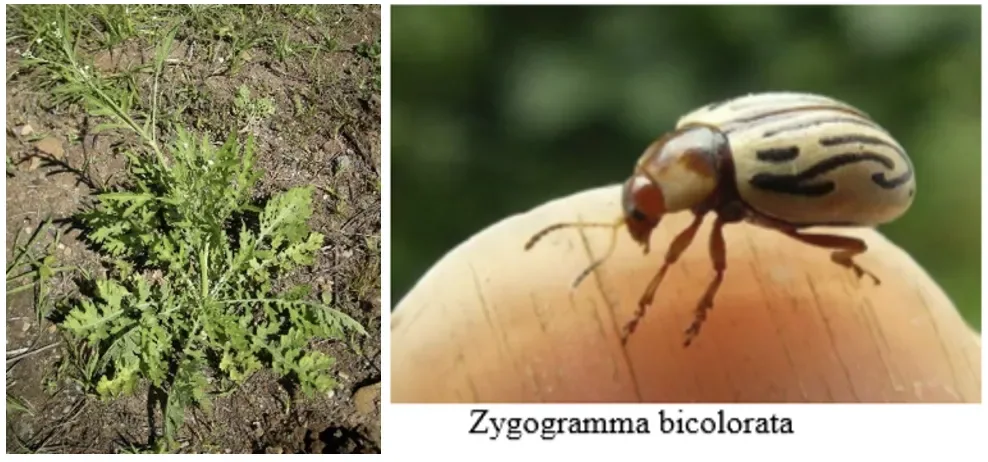
| Parthenium hysterophorus (Congress grass) | Zygogramma bicolorata | Chrysomelid beetle | Leaf-feeding; introduced in India to combat Parthenium |
| Cuscuta spp. (Dodder) | Melanagromyza cuscutae | Fly | -- |
| Cyperus rotundus (Nut grass) | Bactra verutana | Moth borer | -- |
| Ludwigia parviflora | Altica cyanea | Steel blue beetle | Weed was completely destroyed |
| Eichhornia crassipes (Water hyacinth) | Neochetina eichhorniae / N. bruchi | Beetles | -- |
| Eichhornia crassipes (Water hyacinth) | Sameodes albiguttalis | Moth | Additional bioagent for water hyacinth |
| Salvinia molesta | Cyrtobagous salviniae | Curculionid beetle | Used in Kerala; feeds on buds and rhizomes |
| Salvinia molesta | Paulinia acuminata | -- | -- |
TIP
Quick recall -- the "Big Four": Lantana = first biocontrol success (Crocidosema). Opuntia in Australia = Cactoblastis. Parthenium in India = Zygogramma. Water hyacinth = Neochetina.
Other Classical Bioagent Types
Beyond insects, several other organism groups serve as effective bioagents:
Herbivorous Fish
| Fish | Target | Key Detail |
|---|---|---|
| White Amur (Ctenopharyngodon idella) | Aquatic weeds (general) | Grows more than its body weight per year, can reach up to 50 kg; highly effective for aquatic weed management |
| Common Carp | Submerged aquatic weeds | Feeds on submerged vegetation while foraging |
Snails
| Snail | Target Weeds | Notes |
|---|---|---|
| Marisa cornuarietis | Water hyacinth, Salvinia | Feeds on roots and leaves of floating aquatic weeds |
Mites
| Mite | Target Weed | Notes |
|---|---|---|
| Tetranychus desertorum | Opuntia (Prickly pear) | Host-specific mite attacking cactus tissue |
IMPORTANT
Why classical biocontrol is mainly for non-cropped areas: Insecticides and fungicides applied in crop fields kill bioagents along with pests. This makes classical biocontrol impractical in intensively managed cropped areas -- it works best in forests, wastelands, and water bodies.
Criteria for a Successful Bioagent
Not every organism qualifies as a biocontrol agent. Four criteria must be met:
| Criterion | Why It Matters | Test |
|---|---|---|
| Host-specificity | Must NOT attack economic plants | Must pass the starvation test (prefers to starve rather than feed on non-host) |
| Hardiness | Must survive in the new environment | Free from its own parasites and predators |
| Feeding habit | Should target critical organs | Agents attacking flowers, seeds or boring into stems are most effective; root feeders best for perennials |
| Ease of multiplication | Must build populations fast enough to suppress the weed | Reproduces readily in the new environment |
TIP
Mnemonic -- "HHFE": Host-specific, Hardy, Feeding habit (target reproductive/structural parts), Easy multiplication.
How Classical Biocontrol Works -- The Population Cycle
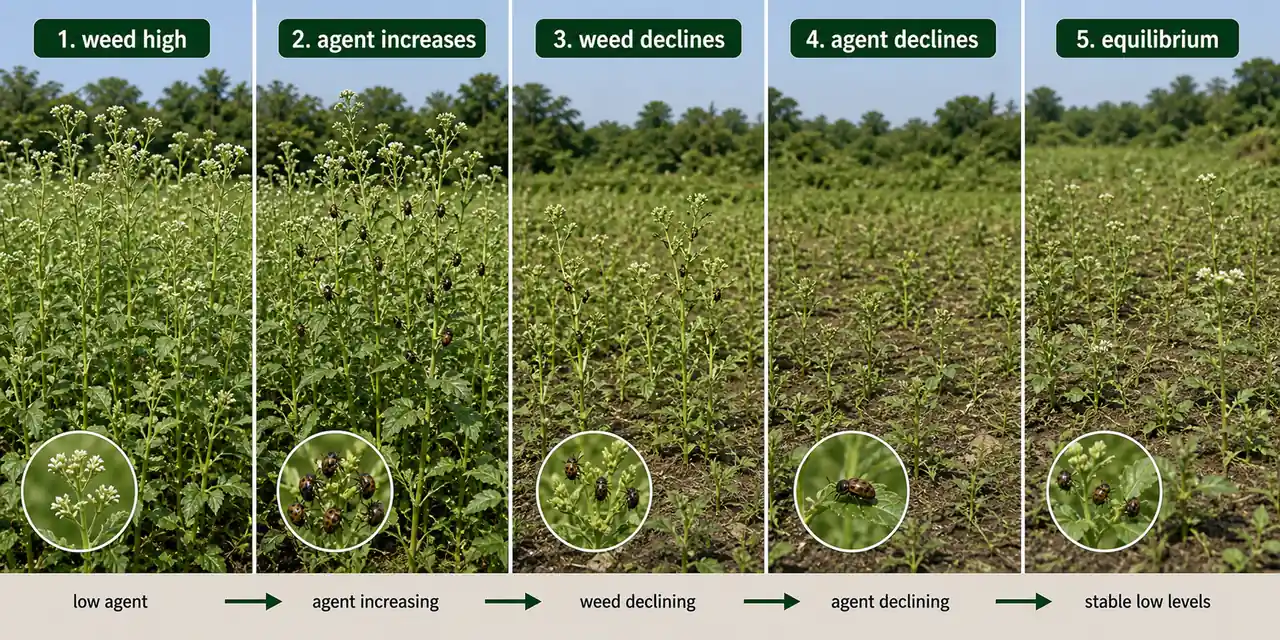
The mechanism follows a predictable population dynamics cycle:
| Stage | What Happens |
|---|---|
| 1. Introduction | Suitable exotic bioagent released into weed-infested area |
| 2. Multiplication | Bioagent reproduces and reduces weed population |
| 3. Decline | As food (weed) becomes scarce, bioagent population declines from starvation |
| 4. Recovery | With reduced grazing pressure, weed population partially recovers |
| 5. Equilibrium | Both populations stabilise at a low balanced level |
This cyclic process is inherently slow-operating (takes years). Currently used mainly in non-cropped areas (forests, wastelands, water bodies) where immediate weed-free conditions are not required.
NOTE
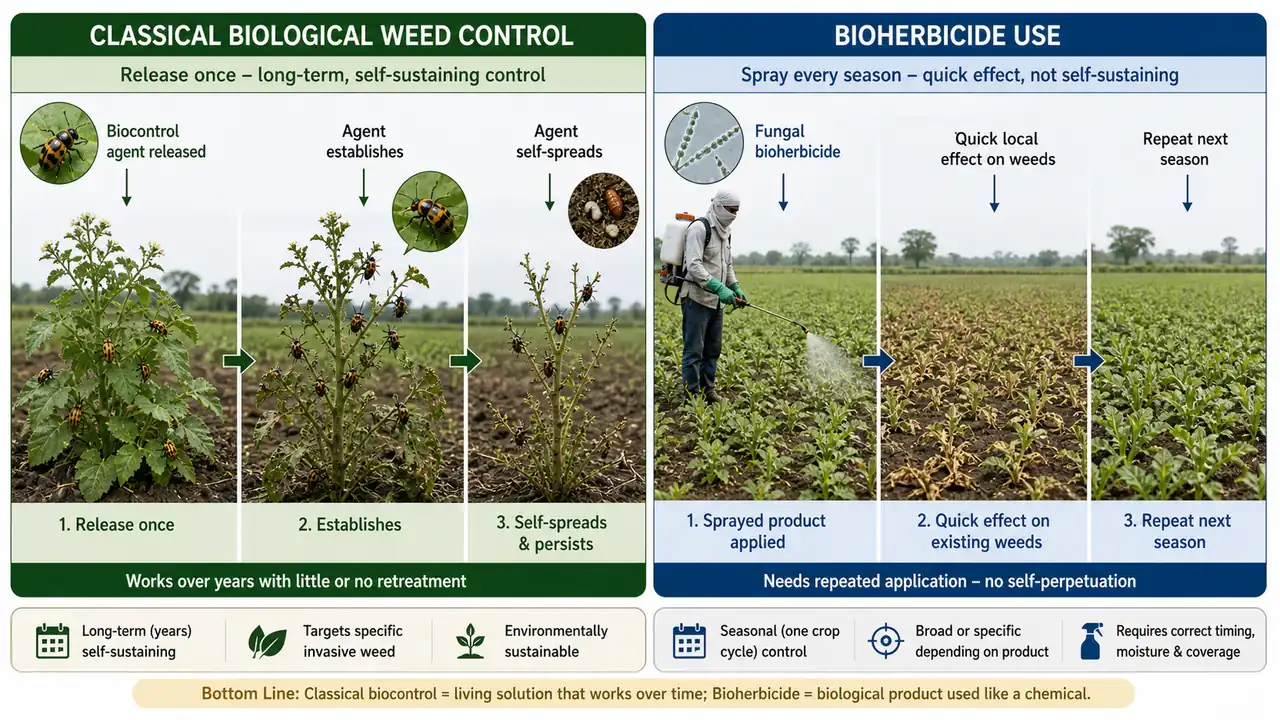
Unlike chemical control, classical biocontrol is a one-time investment -- once established, the bioagent population is self-sustaining and does not require repeated application.
Bioherbicides / Mycoherbicides
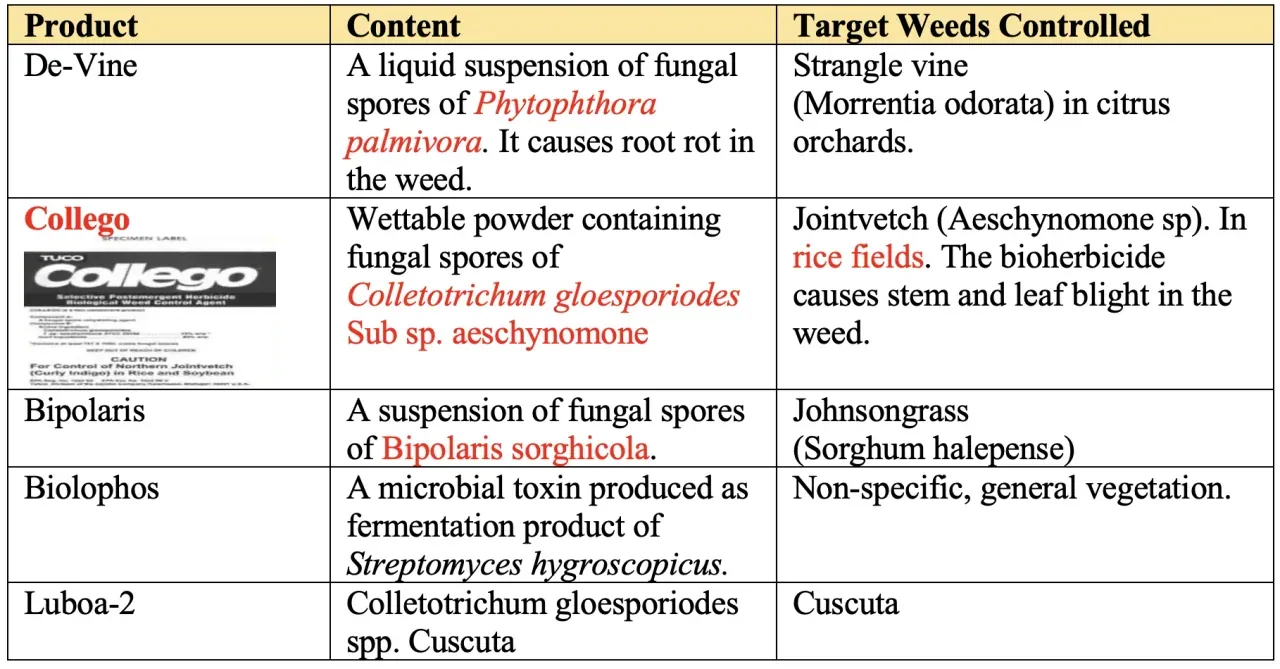
Bioherbicides are plant pathogens cultured artificially and formulated into sprayable products -- used like a chemical herbicide. Since most are based on fungal pathogens, they are often called mycoherbicides.
| Product | Active Organism | Disease Caused | Target Weed | Crop Protected |
|---|---|---|---|---|
| Devine (1st commercial bioherbicide) | Phytophthora palmivora | Root rot | Strangle vine (Morrenia odorata) | Citrus |
| Collego | Colletotrichum gloeosporioides | Stem & leaf blight | Joint vetch (Aeschynomene virginica) | Rice, Soybean |
| Bipolaris | Bipolaris sorghicola | -- | Johnson grass (Sorghum halepense) | -- |
| Biophos | Streptomyces hygroscopicus | Microbial toxin (fermentation) | Non-specific | General |
IMPORTANT
Devine was the first commercially available bioherbicide in the world. This is a commonly tested fact.
Bioherbicide vs Classical Biocontrol -- Key Comparison
| Feature | Bioherbicide | Classical Biocontrol |
|---|---|---|
| Activity scope | Only current weed population | Cyclic, self-perpetuating over time |
| Retreatment | Required every season (like a chemical) | No retreatment needed once established |
| Selectivity | Can be selective like a chemical herbicide | Not typically selective |
| Speed | Relatively fast (within a season) | Slow (years to reach equilibrium) |
| Commercial interest | High (recurring sales generate revenue) | Low (public sector, one-time release) |
| Use area | Cropped areas | Mainly non-cropped areas |
TIP
Exam distinction: Bioherbicide = "spray every season like a chemical." Classical biocontrol = "release once, self-sustaining." Think of bioherbicide as a biological chemical and classical biocontrol as a living solution.
Summary Cheat Sheet
| Concept / Topic | Key Details |
|---|---|
| First weed biocontrolled | Lantana (Crocidosema lantana, Hawaii) |
| Most spectacular success | Opuntia in Australia (Cactoblastis cactorum) |
| Parthenium bioagent (India) | Zygogramma bicolorata (chrysomelid beetle) |
| Land recovered (Opuntia) | 40,000 ha in Tamil Nadu & Maharashtra |
| Weed completely destroyed | Ludwigia parviflora by Altica cyanea |
| Best targets | Exotic/introduced weeds (no natural enemies) |
| Key bioagent criterion | Host-specificity (starvation test) |
| First commercial bioherbicide | Devine (Phytophthora palmivora) |
| Biocontrol started | Year 1900 |
| Bioherbicide vs Classical | Bioherbicide = spray every season; Classical = release once, self-sustaining |
| Classical investment | One-time (self-sustaining cycle) |
| White Amur fish | Ctenopharyngodon idella — grows > body weight/year, up to 50 kg; aquatic weeds |
| Snail bioagent | Marisa cornuarietis vs water hyacinth, Salvinia |
| Mite bioagent | Tetranychus desertorum vs Opuntia |
| Sameodes albiguttalis | Moth bioagent for water hyacinth |
| Bioherbicide use area | Cropped areas |
| Classical biocontrol area | Mainly non-cropped areas (insecticides/fungicides kill bioagents in crop fields) |