🍶 White Revolution - Operation Flood, Anand Model, NDDB and Dairy Development in India
Complete story of India's White Revolution covering Key Village Scheme (1952), Anand Pattern cooperatives, Operation Flood (Phase I-III), NDDB, Dr. Verghese Kurien's contribution, AMUL model, and key dairy development institutes for IBPS AFO, NABARD Grade A, and FCI exams.
Historical Build-Up to the White Revolution
Key Village Scheme (KVS)
- After Independence the first organized attempt to develop village cattle on an effective scale was initiated with the launch of key village scheme (KVS) in 1952 during first five-year plan. This scheme marked India's earliest systematic effort to improve cattle through scientific methods at the grassroots level.
- KVS is a general comprehensive scheme drawn up by Government of India for development of cattle population in India by employing scientific methods for improvement of cattle viz., Artificial insemination, Grading & selective breeding, Formulation of co-operative societies for marketing the pure breed cattle and development of feed & fodder. These interventions laid the foundation for future dairy development programmes in the country.
Intensive Cattle Development Project (ICDP)
- Launched in 1964-65.
- It envisaged provision of a package of improved practices to the cattle owner to affect a breakthrough in milk production. The ICDP took a more holistic approach than KVS by combining breeding, feeding, healthcare, and marketing support into a single package for farmers, aiming to demonstrate that scientific dairy management could dramatically boost milk yields.
Operational Flood
IMPORTANT
Pro Content Locked
Upgrade to Pro to access this lesson and all other premium content.
₹99 charged monthly · Cancel anytime
- All Agriculture & Banking Courses
- AI Lesson Questions (100/day)
- AI Doubt Solver (50/day)
- Glows & Grows Feedback (30/day)
- AI Section Quiz (20/day)
- 22-Language Translation (100/day)
- Recall Questions (20/day)
- AI Quiz (15/day)
- AI Quiz Paper Analysis (100/day)
- AI Step-by-Step Explanations (100/day)
- Spaced Repetition Recall (FSRS)
- AI Tutor
- Immersive Text Questions
- Audio Lessons — Hindi & English
- Mock Tests & Previous Year Papers
- Summary & Mind Maps
- XP, Levels, Leaderboard & Badges
- Generate New Classrooms
- Voice AI Teacher (AgriDots Live)
- AI Revision Assistant
- Knowledge Gap Analysis
- Interactive Revision (LangGraph)
🔒 Secure via Razorpay · Cancel anytime · No hidden fees
Historical Build-Up to the White Revolution
Key Village Scheme (KVS)
- After Independence the first organized attempt to develop village cattle on an effective scale was initiated with the launch of key village scheme (KVS) in 1952 during first five-year plan. This scheme marked India's earliest systematic effort to improve cattle through scientific methods at the grassroots level.
- KVS is a general comprehensive scheme drawn up by Government of India for development of cattle population in India by employing scientific methods for improvement of cattle viz., Artificial insemination, Grading & selective breeding, Formulation of co-operative societies for marketing the pure breed cattle and development of feed & fodder. These interventions laid the foundation for future dairy development programmes in the country.
Intensive Cattle Development Project (ICDP)
- Launched in 1964-65.
- It envisaged provision of a package of improved practices to the cattle owner to affect a breakthrough in milk production. The ICDP took a more holistic approach than KVS by combining breeding, feeding, healthcare, and marketing support into a single package for farmers, aiming to demonstrate that scientific dairy management could dramatically boost milk yields.
Operational Flood
IMPORTANT
World's Largest Dairy Development Programme — Operation Flood is officially the world's largest dairy development programme, implemented by NDDB under the leadership of Dr. Verghese Kurien (Father of White Revolution / "Milkman of India"). It was funded by the World Food Programme (WFP), which donated surplus butter oil and skim milk powder from the EEC (European Economic Community). These donated products were sold to urban consumers in India, and the proceeds were used to build dairy infrastructure — a self-financing model that required no direct government cash outlay. Dr. Kurien also received the Padma Vibhushan, Ramon Magsaysay Award, and World Food Prize for this work.
-
In 1965, the NDDB (National Dairy Development Board) was created in response to then Prime Minister Lal Bahadur Shastri call, which drew up a project called "Operation Flood" in late sixties. This was a visionary initiative born from the success of the Amul cooperative model in Gujarat.
-
Launched in 1970, Operation Flood has helped dairy farmers direct their own development, placing control of the resources they create in their own hands. By empowering farmers through cooperatives, the programme ensured that the benefits of dairy development reached the actual producers rather than middlemen.
-
A National Milk Grid links milk producers throughout India with consumers in over 700 towns and cities, reducing seasonal and regional price variations while ensuring that the producer gets fair market prices in a transparent manner on a regular basis. This Milk Grid was a revolutionary concept that connected rural producers with urban consumers across the country.
-
It was a project of National Dairy Development Board (NDDB), which was the world's biggest dairy and rural development program. No other country has implemented a dairy programme of such scale and ambition.
-
The bedrock of Operation Flood has been Village Milk producers' co-operatives, which procure milk and provide inputs and services, making modern management and technology available to members. These village-level cooperatives became the primary building blocks of the entire dairy revolution.
-
Operation Flood's objectives included:
- Increase milk production ("a flood of milk")
- Augment rural incomes
- Fair prices for consumers by reducing middle man
-
It was launched in 3 phases:
| Phase | Details |
|---|---|
| Operational Flood I (1970-80) | Operation Flood linked 18 of India's premier milksheds with consumers in India's four major metropolitan cities: Delhi, Mumbai, Kolkata, and Chennai. Set up Mother Dairies in metro cities to handle bulk milk processing and retail. |
| Operational Flood II (1981-85) | Expanded to 136 milk sheds and 290 towns. Improved veterinary care and Artificial Insemination (AI) services for crossbreeding. By the end of 1985, a self-sustaining system of 43,000 village cooperatives covering 4.25 million milk producers had become a reality. |
| Operational Flood III (1985-96) | Enabled dairy cooperatives to expand and strengthen the infrastructure required to procure and market increasing volumes of milk. Focus on making cooperatives fully self-sustaining; strengthened NDDB and the Anand model. Increased emphasis was given to research and development in animal health and animal nutrition. |
NOTE
Memory aid for phases: Phase I = 18 milksheds → 4 metros (1970–81). Phase II = 136 milksheds → 290 towns (1981–85). Phase III = self-sustaining cooperatives (1985–96).
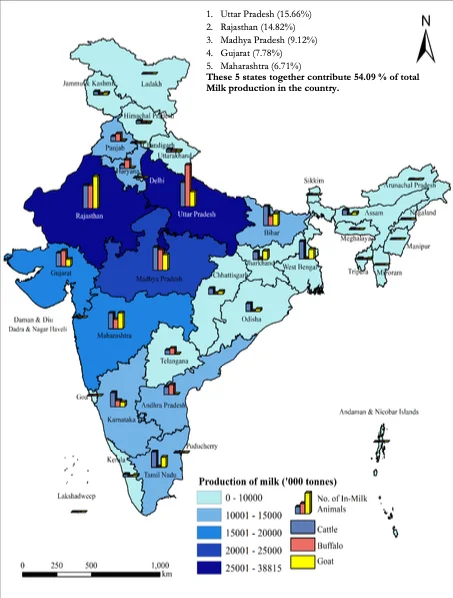
- It transforms India from a milk-deficient nation into the world's largest milk producer, surpassing the USA in 1998. This was one of the most significant agricultural achievements in India's post-independence history. India's current milk production is approximately 239 million tonnes/year (2023–24), up from ~230 MT in 2022-23, with buffalo milk ~57% and cow milk ~43% of the total. Top producing states: UP, Rajasthan, MP, Gujarat, AP.
NOTE
India's milk output has grown at ~6% CAGR over the past decade — roughly double the global average growth rate of ~2-3%. This is not accidental: it is the direct result of the cooperative infrastructure built during Operation Flood, combined with ongoing government investment in breed improvement (RGM, NMBP) and disease control (NADCP). The cooperative model ensures that productivity gains at the farm level translate into income gains for farmers, not just profits for processors.
- National Milk Grid: Linking milk producers throughout India. The grid ensures that surplus milk from one region can be transported to deficit areas, stabilising prices across the country.
- Operation Flood was the program behind the White Revolution.
- Father: Verghese Kurien. Fondly called the "Milkman of India", Dr. Kurien dedicated his life to empowering Indian dairy farmers through cooperative institutions. He worked closely with Tribhuvandas Patel (first chairman of Kaira District Cooperative), who laid the grassroots foundation on which Kurien built the national programme. Note: Dr. M.S. Swaminathan is the Father of the Green Revolution — do not confuse with Kurien's White Revolution.
Anand Model and Cooperative Institutions
Birth of Amul
 - Anand Milk Union Limited (Gujarat)
- *"Amul" derives from the Sanskrit word **"Amulya"** meaning "priceless".*
- It all began when milk became a symbol of protest
- Inspired by the freedom movement, founded in 1946 to stop the exploitation by middlemen. The initiative was championed by **Sardar Vallabhbhai Patel**, who encouraged farmers in the Kaira district to unite against **Polson Dairy**, which was exploiting them by paying very low prices. Farmers united to form a cooperative, taking control of milk procurement and marketing from exploitative private dairy contractors.
- **THE THREE-TIER "ANAND MODEL":**
- The Amul Model of dairy development is a three-tiered structure with the dairy cooperative societies at the **village level** federated under a milk union at the **district level** and a federation of member unions at the **state level**. This **hierarchical structure** ensures efficient milk collection, processing, and marketing while keeping farmers at the centre of decision-making.
- Anand Milk Union Limited (Gujarat)
- *"Amul" derives from the Sanskrit word **"Amulya"** meaning "priceless".*
- It all began when milk became a symbol of protest
- Inspired by the freedom movement, founded in 1946 to stop the exploitation by middlemen. The initiative was championed by **Sardar Vallabhbhai Patel**, who encouraged farmers in the Kaira district to unite against **Polson Dairy**, which was exploiting them by paying very low prices. Farmers united to form a cooperative, taking control of milk procurement and marketing from exploitative private dairy contractors.
- **THE THREE-TIER "ANAND MODEL":**
- The Amul Model of dairy development is a three-tiered structure with the dairy cooperative societies at the **village level** federated under a milk union at the **district level** and a federation of member unions at the **state level**. This **hierarchical structure** ensures efficient milk collection, processing, and marketing while keeping farmers at the centre of decision-making.
TIP
Three-Tier Anand Model — exam favourite:
- Tier 1 (Village Level): Village Dairy Cooperative Society (VDCS) — primary unit; individual farmers are members; handles milk collection.
- Tier 2 (District Level): District Milk Union (DMU) — collects milk from VDCSs, processes it, and markets in the district.
- Tier 3 (State Level): State Milk Federation — apex body; handles national-level marketing (e.g., GCMMF — Gujarat Cooperative Milk Marketing Federation — markets the Amul brand).
- Establishment of a direct linkage between milk producers and consumers by eliminating middlemen
- Milk Producers (farmers) control procurement, processing and marketing
- Professional management
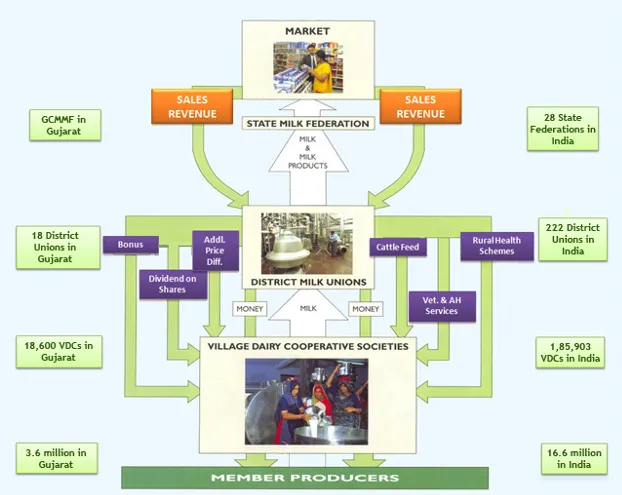
- This helps in eliminating not only internal competition but also ensuring economies of scale. By pooling resources, even the smallest dairy farmer benefits from modern processing facilities and brand marketing.
- This structure was first evolved at Amul in Gujarat and thereafter replicated all over the country under the Operation Flood Programme, it is known as the 'Amul Model' or 'Anand Pattern' of Dairy Cooperatives. Today, the Amul brand is one of the most recognised dairy brands in the world.
- The "Amul Girl" mascot was created in 1967 and is one of India's longest-running advertising campaigns. Key brand extensions include Amul Butter, Amul Milk Powder, and Amul Ice Cream, all marketed by GCMMF.
- Current Chairman of Amul (GCMMF): Shamalbhai B Patel (elected 2022)
GCMMF — Scale and Global Reach
IMPORTANT
GCMMF crossed ₹72,000+ crore turnover in 2023-24, making Amul the largest FMCG brand in India by revenue — overtaking FMCG giants in the dairy segment. This is a landmark for the cooperative model: a farmer-owned organisation now leads India's FMCG sector.
Why this matters conceptually: When Operation Flood was designed in the 1960s, critics argued that a cooperative run by smallholder farmers could never compete with private corporations in terms of quality, scale, or marketing. GCMMF's ₹72,000+ crore turnover directly refutes this — it is the strongest empirical evidence that the Anand cooperative model works at scale.
Amul's international expansion:
- Amul USA and Amul UK — Amul has established an international retail presence, exporting butter, cheese, and ghee to Indian diaspora communities and mainstream retail markets.
- This makes Amul one of the very few developing-country cooperatives to successfully build a global brand.
- Export context: India's dairy export potential has historically been constrained by FMD-free market access restrictions (discussed in NADCP section). As India progresses toward FMD eradication by 2030, Amul's global footprint is positioned to expand significantly into FMD-sensitive markets (EU, USA, Japan).
National Dairy Development Board (NDDB)
- NDDB is an autonomous body established by government of India in 1965. It got registered under the societies registration act and public trusts act. NDDB was established in Anand, Gujarat, close to the birthplace of the cooperative movement.
- The Main purpose of establishing NDDB was to replicate the Anand Pattern model in rest of the country. NDDB has been instrumental in transforming India into the world's largest milk-producing nation.
The major objectives of the NDDB are:
- To make available, on request, the information, skills and technical services needed to increase production of milk and dairy, technical inputs to speed up procurement, processing and distribution of milk.
- To provide manpower services for dairy and allied projects by organizing technical programmes for training personnel.
- To conduct research in the field of dairying and animal husbandry.
Modern Dairy Transformation
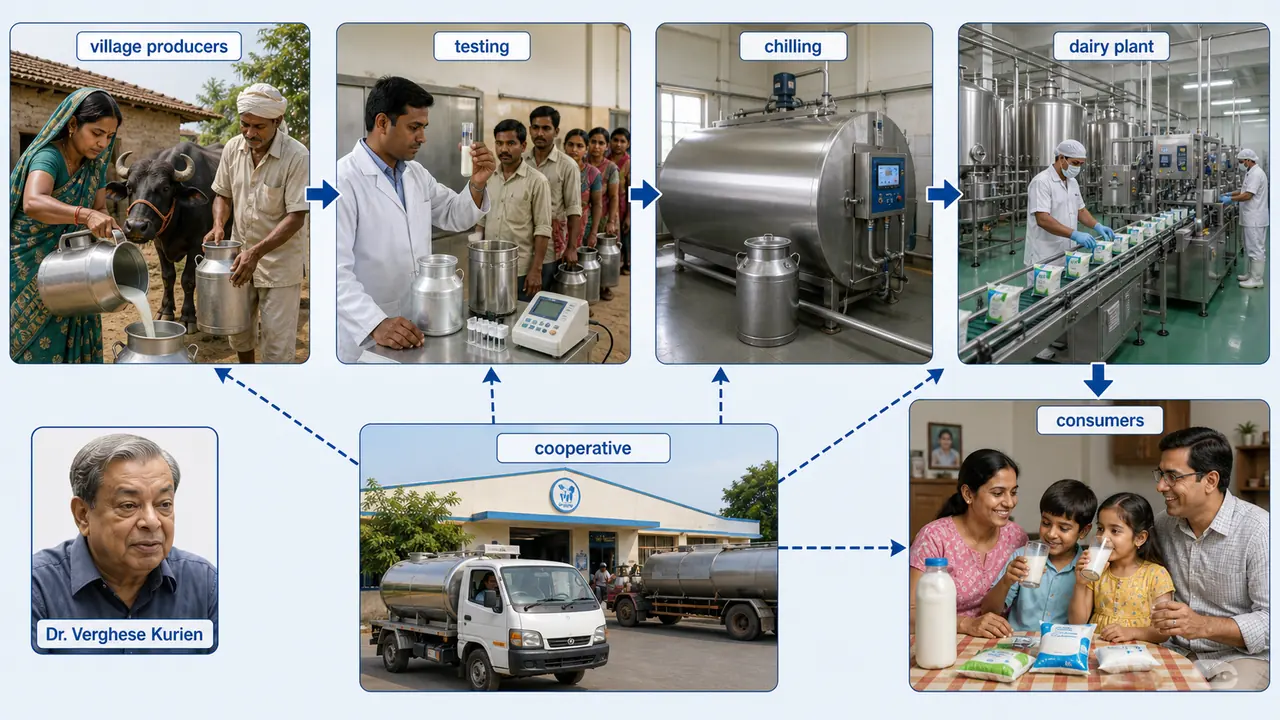
White Revolution 2.0
The current policy push is now being described in official material as White Revolution 2.0. This gives the old White Revolution chapter a modern continuation.
Important dates
- SOP launch: 19 September 2024
- formal launch: 25 December 2024
- implementation period: 2024-25 to 2028-29
Main policy direction
White Revolution 2.0 aims to:
- strengthen dairy cooperatives
- expand employment
- increase women's participation
- raise milk procurement through organised dairy systems
By March 2026, PIB also highlighted the target architecture of creating 75,000 new dairy cooperative societies over five years.
In exam language, the easiest way to frame it is:
- Operation Flood / White Revolution 1.0 = historic cooperative dairy transformation
- White Revolution 2.0 = modern cooperative expansion and procurement strengthening
Digital Dairy Systems
The dairy sector is no longer only about cattle breeds, milk routes, and cooperatives. It is also becoming a digital service and traceability system.
PIB-backed digital dairy figures
The January 2026 PIB release on dairy digitisation reported:
- 35.68 crore+ animals issued Pashu Aadhaar under NDLM
- 17.3 lakh+ milk producers across 54 milk unions linked to AMCS
- around 198 milk unions and 15 federations using i-DIS
Why these tools matter
- better livestock traceability
- transparent milk collection
- stronger cooperative data systems
- faster and more credible producer payments
This is the dairy counterpart of digital public infrastructure in crop agriculture.
Current Dairy Data, Schemes, and Institutions
Livestock Census & Dairy Statistics
NOTE
20th Livestock Census (2019) — key numbers for MCQs (use until 21st census results publish in 2025–26):
- Total cattle: 302.79 million
- Total buffalo: 109.85 million
- Total livestock: 535.78 million
- Total poultry: 851.81 million
- Crossbred cattle increased by 26.9% since the 19th census
21st Livestock Census launched October 2024 — India's first fully digital census. Results expected 2025–26. Until then, 20th census numbers remain the official exam-safe figures.
India is the world's largest milk producer (since 1998) with ~239 million tonnes/year (2023–24). Buffalo milk contributes ~57%; cow milk ~43%.
BAHS 2025 update
One of the most testable recent dairy data points is the Basic Animal Husbandry Statistics (BAHS) 2025 update referenced in official policy material:
- milk output: 247.87 million tonnes
- per-capita milk availability: 485 grams/day
These numbers are likely to be used in:
- current-affairs MCQs
- trend questions on dairying
- interview answers on India's livestock economy
Key Government Schemes for Dairy & Animal Husbandry
IMPORTANT
Schemes frequently asked in exams:
- DIDF (Dairy Infrastructure Development Fund): Outlay ₹10,881 crore; for building/upgrading milk processing and chilling infrastructure.
- AHIDF (Animal Husbandry Infrastructure Development Fund): Outlay ₹15,000 crore; for processing, value addition, and cattle feed plants in the private sector.
- Kisan Credit Card (KCC): Extended to animal husbandry and fisheries in 2018–19 to provide working capital credit to farmers.
- PM Matsya Sampada Yojana: Note — this scheme is for fisheries development, NOT dairy. Do not confuse with dairy schemes.
Institutes
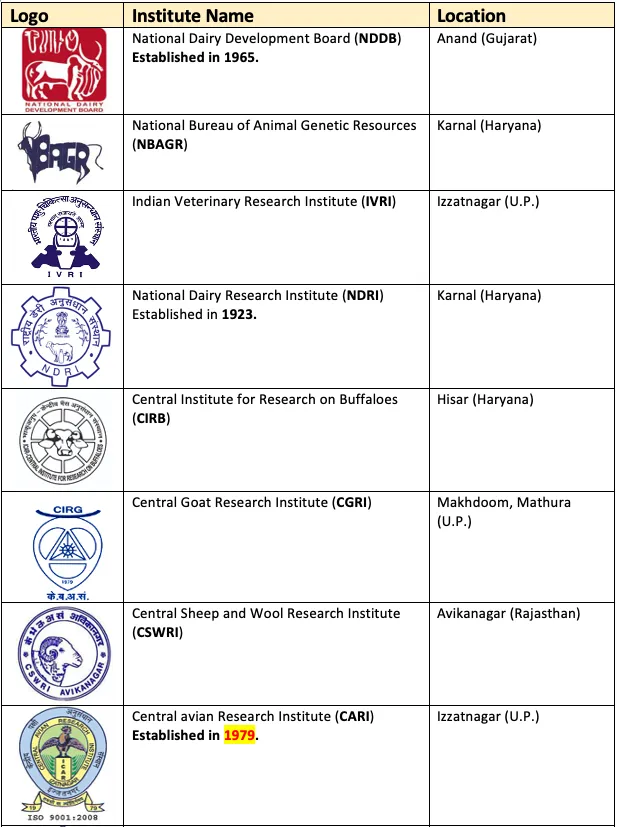
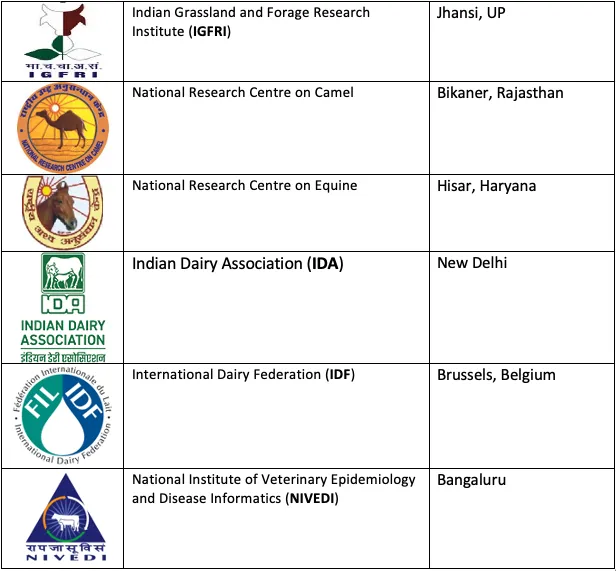
Familiarity with these key institutions and their locations is frequently tested in competitive examinations. Each institute plays a specialised role in research, development, and training related to animal husbandry and dairying.
Days
World Milk Day
- World Milk Day is observed on 1 June every year by the United Nations. It was established by the FAO (Food and Agriculture Organization) to recognise the importance of milk as a global food and to celebrate the dairy sector.
National Milk Day
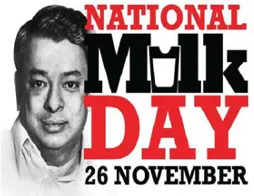
- Observed on 26th November
- Birth anniversary of Verghese Kurien, the Father of White Revolution in India. This day honours the extraordinary contribution of Dr. Kurien to India's dairy sector and serves as a reminder of the power of cooperative-led development.
White Revolution Timeline
| Year | Event |
|---|---|
| 1946 | Amul (AMUL) founded in Kaira, Gujarat |
| 1952 | Key Village Scheme (KVS) launched |
| 1964-65 | ICDP launched |
| 1965 | NDDB established in Anand, Gujarat |
| 1970 | Operation Flood Phase I launched (18 milksheds → 4 metros) |
| 1981 | Operation Flood Phase II launched (136 milksheds → 290 towns) |
| 1985 | Operation Flood Phase III launched (self-sustaining cooperatives) |
| 1996 | Operation Flood Phase III concluded |
| 1998 | India surpassed USA as world's largest milk producer |
| 2024 | White Revolution 2.0 SOP launched (19 Sept) |
| 2024 | White Revolution 2.0 formally launched (25 Dec) |
TIP
Key dates to remember: Amul = 1946, KVS = 1952, NDDB = 1965, Operation Flood = 1970, India #1 in milk = 1998. Father: Verghese Kurien. World Milk Day = 1 June, National Milk Day = 26 November.
Explore More 🔭
🟢 https://www.youtube.com/watch?v=63VNzRb-8ls
🟢 https://www.youtube.com/watch?v=DBtNPgYWjKU
🟢 https://www.youtube.com/watch?v=1CR3hS5Y-PI
🟢 https://www.youtube.com/watch?v=-LFedl1ed6c
References
2 sources • [1] [2]
References
Summary Cheat Sheet
| Concept / Topic | Key Details |
|---|---|
| Key Village Scheme (KVS) | Launched 1952 (1st Five Year Plan); first organised cattle development attempt |
| ICDP | Intensive Cattle Development Project; launched 1964–65; package of improved practices |
| Operation Flood | Launched 1970; world's biggest dairy & rural development programme |
| Operation Flood phases | Phase I (1970–81): 18 milksheds → 4 metros; Phase II (1981–85): 136 milksheds → 290 towns; Phase III (1985–96): self-sustaining cooperatives |
| Operation Flood funding | WFP donated butter oil + skim milk powder (EEC surplus); sold to urban consumers; proceeds built dairy infra |
| India #1 in milk | Surpassed USA in 1998; current production ~239 MT/year (2023–24); ~6% CAGR |
| White Revolution 2.0 | SOP launched 19 Sept 2024; formal launch 25 Dec 2024; period 2024-25 to 2028-29 |
| White Revolution 2.0 target | 75,000 new dairy cooperative societies over five years |
| Father of White Revolution | Dr. Verghese Kurien ("Milkman of India"); awards: Padma Vibhushan, Ramon Magsaysay, World Food Prize |
| Tribhuvandas Patel | First chairman of Kaira District Cooperative; worked with Kurien |
| Green Revolution father | Dr. M.S. Swaminathan — different from White Revolution |
| NDDB | National Dairy Development Board; est. 1965; HQ: Anand, Gujarat |
| NDDB purpose | Replicate Anand Pattern (Amul model) across India |
| AMUL founded | 1946 in Kaira district, Gujarat; to stop middlemen exploitation |
| Anand Model | Three-tier cooperative: Tier 1 = VDCS (village), Tier 2 = DMU (district), Tier 3 = State Milk Federation |
| Anand Model principles | Producer-owned, professional management, eliminates middlemen |
| GCMMF | Gujarat Cooperative Milk Marketing Federation — apex body marketing the Amul brand nationally |
| Amul Girl mascot | Created 1967; one of India's longest-running ad campaigns |
| "Amul" meaning | Sanskrit "Amulya" = priceless |
| AMUL origin | Sardar Vallabhbhai Patel initiative; against exploitation by Polson Dairy |
| Current AMUL Chairman | Shamalbhai B Patel |
| 20th Livestock Census (2019) | Cattle: 302.79M; Buffalo: 109.85M; Total livestock: 535.78M; Poultry: 851.81M |
| 21st Livestock Census | Launched Oct 2024; first digital census; results 2025–26 |
| BAHS 2025 milk output | 247.87 million tonnes |
| BAHS 2025 per-capita milk availability | 485 g/day |
| DIDF | Dairy Infrastructure Development Fund — ₹10,881 crore; for cooperatives; 6.5% loan via NABARD |
| Dairy Sahakar | NDDB scheme; launched 31 Oct 2021; ₹5,000 crore; cooperative dairy infra |
| AHIDF | Animal Husbandry Infrastructure Development Fund — ₹15,000 crore; private sector; 3% interest subvention |
| KCC for AH & Fisheries | Kisan Credit Card extended to animal husbandry + fisheries in 2018–19 |
| GCMMF turnover | ₹72,000+ crore (2023–24); largest FMCG brand in India by revenue |
| Pashu Aadhaar | 35.68 crore+ animals |
| AMCS linkage | 17.3 lakh+ milk producers across 54 milk unions |
| i-DIS usage | About 198 milk unions and 15 federations |
| Amul global | Amul USA + Amul UK launched; export constrained by FMD-free market access (eradication target: 2030) |
| National Milk Grid | Links producers with consumers in 700+ towns/cities |
| World Milk Day | 1 June (FAO, United Nations) |
| National Milk Day | 26 November (birth anniversary of Verghese Kurien) |
| White Revolution = | Operation Flood programme |
| Key timeline | 1946 (Amul) → 1952 (KVS) → 1965 (NDDB) → 1970 (Op. Flood) → 1998 (India #1) |
Lesson Doubts
Ask questions, get expert answers