🩰 Beneficial Insects in Agriculture
Parasitoids, predators, pollinators, weed killers, soil builders, scavengers, and insects useful as drugs, food, dyes, and in scientific research
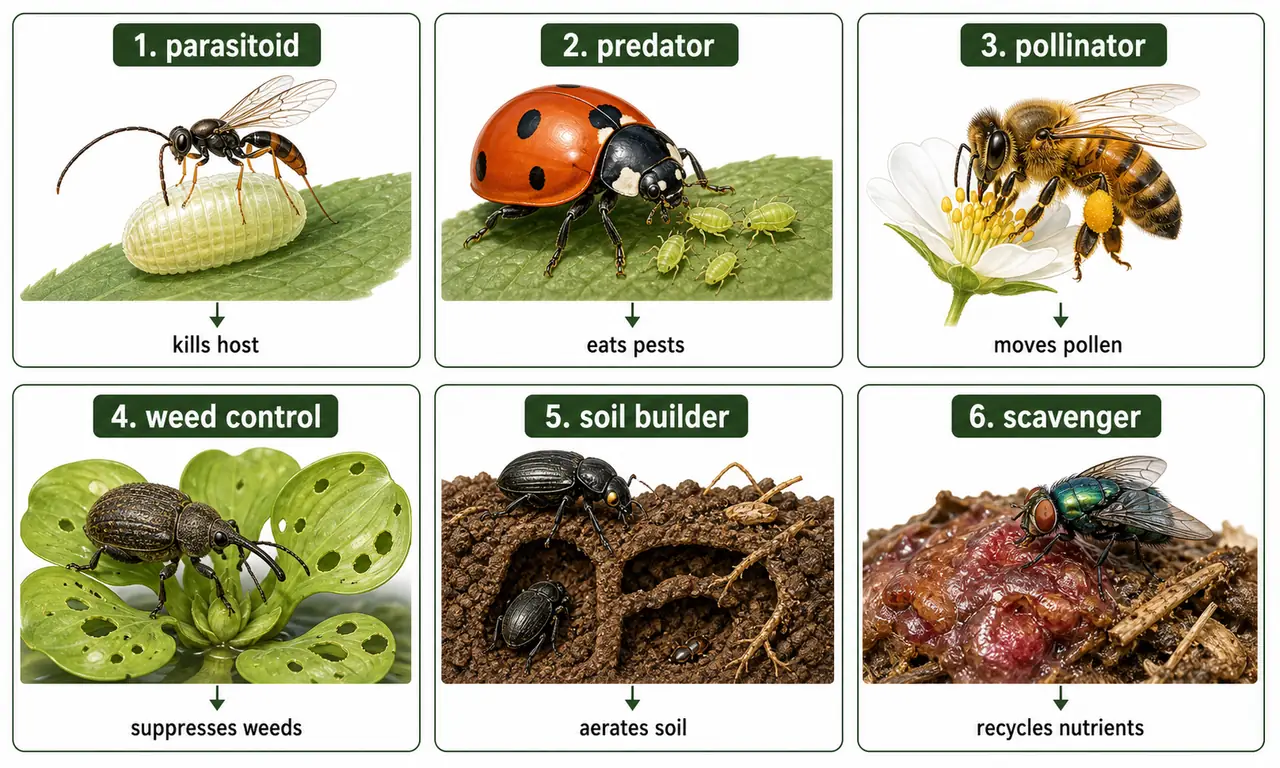
The previous sub-sections covered three commercially managed beneficial insects -- honey bees (apiculture), silkworms (sericulture), and lac insects (lac culture). Now we broaden the view to the full spectrum of beneficial insects across agriculture and human life.
A cotton farmer in Gujarat watches a ladybird beetle (coccinellid) devour aphids on his crop, saving him the cost of an insecticide spray. In a sunflower field in Karnataka, honey bees are responsible for most of the pollination that turns flowers into oil-rich seeds. On a lake in Kerala, tiny weevils are eating through water hyacinth, clearing waterways without a single drop of herbicide. Insects are not always pests -- many of them are incredibly beneficial to agriculture and human life. Understanding beneficial insects is essential for anyone studying Integrated Pest Management (IPM) or agriculture.
Categories of Beneficial Insects
| Category | Role | Key Examples |
|---|---|---|
| Parasitoids | Kill pests by completing life cycle in/on host | Egg, larval, and pupal parasitoids |
| Predators | Capture and devour harmful insects | Coccinellids, praying mantis |
| Pollinators | Transfer pollen for crop reproduction | Honey bees, bumble bees |
| Weed killers | Feed on and destroy weeds | Dactylopius, Neochetina, Zygogramma |
| Soil builders | Tunnel through soil, improve aeration | Ants, beetles, crickets, collembola |
| Scavengers | Feed on dead/decaying matter, recycle nutrients | Rove beetles, carrion beetles, flies |
| Useful products | Provide drugs, food, dyes, ornaments | Honey bees (venom), blister beetles, silk moths |
| Scientific research | Model organisms for genetics, forensics | Drosophila, blow flies |
1. Helpful Insect Parasitoids
- Small insects that feed and live on harmful insects, completing their life cycle in a host and killing it. They are powerful biological control agents.
- Classified by the host stage they attack:
| Type | Target Stage | Effect |
|---|---|---|
| Egg parasitoids | Eggs of pests | Prevent hatching entirely |
| Larval parasitoids | Larvae (most destructive pest stage) | Kill larvae during feeding phase |
| Pupal parasitoids | Pupae (immobile stage) | Kill during transformation |
- Integral part of Integrated Pest Management (IPM) programmes, reducing dependence on chemical pesticides.
TIP
Pro Content Locked
Upgrade to Pro to access this lesson and all other premium content.
₹99 charged monthly · Cancel anytime
- All Agriculture & Banking Courses
- AI Lesson Questions (100/day)
- AI Doubt Solver (50/day)
- Glows & Grows Feedback (30/day)
- AI Section Quiz (20/day)
- 22-Language Translation (100/day)
- Recall Questions (20/day)
- AI Quiz (15/day)
- AI Quiz Paper Analysis (100/day)
- AI Step-by-Step Explanations (100/day)
- Spaced Repetition Recall (FSRS)
- AI Tutor
- Immersive Text Questions
- Audio Lessons — Hindi & English
- Mock Tests & Previous Year Papers
- Summary & Mind Maps
- XP, Levels, Leaderboard & Badges
- Generate New Classrooms
- Voice AI Teacher (AgriDots Live)
- AI Revision Assistant
- Knowledge Gap Analysis
- Interactive Revision (LangGraph)
🔒 Secure via Razorpay · Cancel anytime · No hidden fees
The previous sub-sections covered three commercially managed beneficial insects -- honey bees (apiculture), silkworms (sericulture), and lac insects (lac culture). Now we broaden the view to the full spectrum of beneficial insects across agriculture and human life.
A cotton farmer in Gujarat watches a ladybird beetle (coccinellid) devour aphids on his crop, saving him the cost of an insecticide spray. In a sunflower field in Karnataka, honey bees are responsible for most of the pollination that turns flowers into oil-rich seeds. On a lake in Kerala, tiny weevils are eating through water hyacinth, clearing waterways without a single drop of herbicide. Insects are not always pests -- many of them are incredibly beneficial to agriculture and human life. Understanding beneficial insects is essential for anyone studying Integrated Pest Management (IPM) or agriculture.
Categories of Beneficial Insects
| Category | Role | Key Examples |
|---|---|---|
| Parasitoids | Kill pests by completing life cycle in/on host | Egg, larval, and pupal parasitoids |
| Predators | Capture and devour harmful insects | Coccinellids, praying mantis |
| Pollinators | Transfer pollen for crop reproduction | Honey bees, bumble bees |
| Weed killers | Feed on and destroy weeds | Dactylopius, Neochetina, Zygogramma |
| Soil builders | Tunnel through soil, improve aeration | Ants, beetles, crickets, collembola |
| Scavengers | Feed on dead/decaying matter, recycle nutrients | Rove beetles, carrion beetles, flies |
| Useful products | Provide drugs, food, dyes, ornaments | Honey bees (venom), blister beetles, silk moths |
| Scientific research | Model organisms for genetics, forensics | Drosophila, blow flies |
1. Helpful Insect Parasitoids
- Small insects that feed and live on harmful insects, completing their life cycle in a host and killing it. They are powerful biological control agents.
- Classified by the host stage they attack:
| Type | Target Stage | Effect |
|---|---|---|
| Egg parasitoids | Eggs of pests | Prevent hatching entirely |
| Larval parasitoids | Larvae (most destructive pest stage) | Kill larvae during feeding phase |
| Pupal parasitoids | Pupae (immobile stage) | Kill during transformation |
- Integral part of Integrated Pest Management (IPM) programmes, reducing dependence on chemical pesticides.
TIP
Exam Distinction: A parasitoid kills its host (used in biocontrol). A parasite lives on/in its host without necessarily killing it. Praying mantis is a predator, NOT a parasite or parasitoid.
2. Predators
- Large insects that capture and devour harmful insects. Predators are typically larger than their prey and consume multiple prey individuals.
- Examples: Coccinellids (ladybird beetles -- feed voraciously on aphids, scale insects, mites), Praying mantis (ambush predator of various insects).
| Insect | Prey on |
|---|---|
| Lady Bug | Aphids, Whitefly |
| Green Lacewings | Aphids, Whitefly, Leafhoppers, Mealybug |
| Braconid Wasps | Caterpillars, Aphids |
| Praying Mantis | Aphids, Beetles, Crickets & Grasshoppers, Mites, Butterflies. Immature stages like larvae, caterpillars, grubs, and nymphs |
3. Pollinators
- Many cross-pollinated plants depend on insects for pollination (transfer of pollen from anther to stigma) and fruit set.
- Honey bees are the most important pollinating insects globally, contributing to the yield of fruits, vegetables, oilseeds, and many other crops (e.g., sunflower, mustard, apple).
- Pollination by beetles = Cantharophily — beetles visit dull-coloured, strongly scented, bowl-shaped flowers
4. Weed Killers (Biological Weed Control)
Insects that feed on weeds, killing them and reducing the need for herbicides.
| Weed | Biocontrol Agent | Significance |
|---|---|---|
| Prickly Pear (Opuntia) | Cochineal insect, Dactylopius tomentosus | One of the greatest classical biological control success stories (Australia, India) |
| Water Hyacinth | Weevils: Neochetina eichhorniae + N. bruchi; Mite: Orthogalumna terebrantis | Controls one of the world's worst aquatic weeds |
| Parthenium (P. hysterophorus) | Beetle: Zygogramma bicolorata | Controls this highly allergenic and invasive weed |
- Related content covered in Agronomy Course - Weed Management
5. Soil Builders
- Soil insects (ants, beetles, cutworm larvae, crickets, collembola) make tunnels that facilitate aeration and allow air and water to penetrate deeper into the soil -- vital for healthy root development.
- After death, they become good manure, adding organic matter and nutrients back to the soil.
- Earthworm = the natural tiller of soil — improves soil structure, aeration, drainage, and nutrient availability through burrowing and casting activity (note: earthworms are not insects but are the classic "natural tiller" answer in exams)
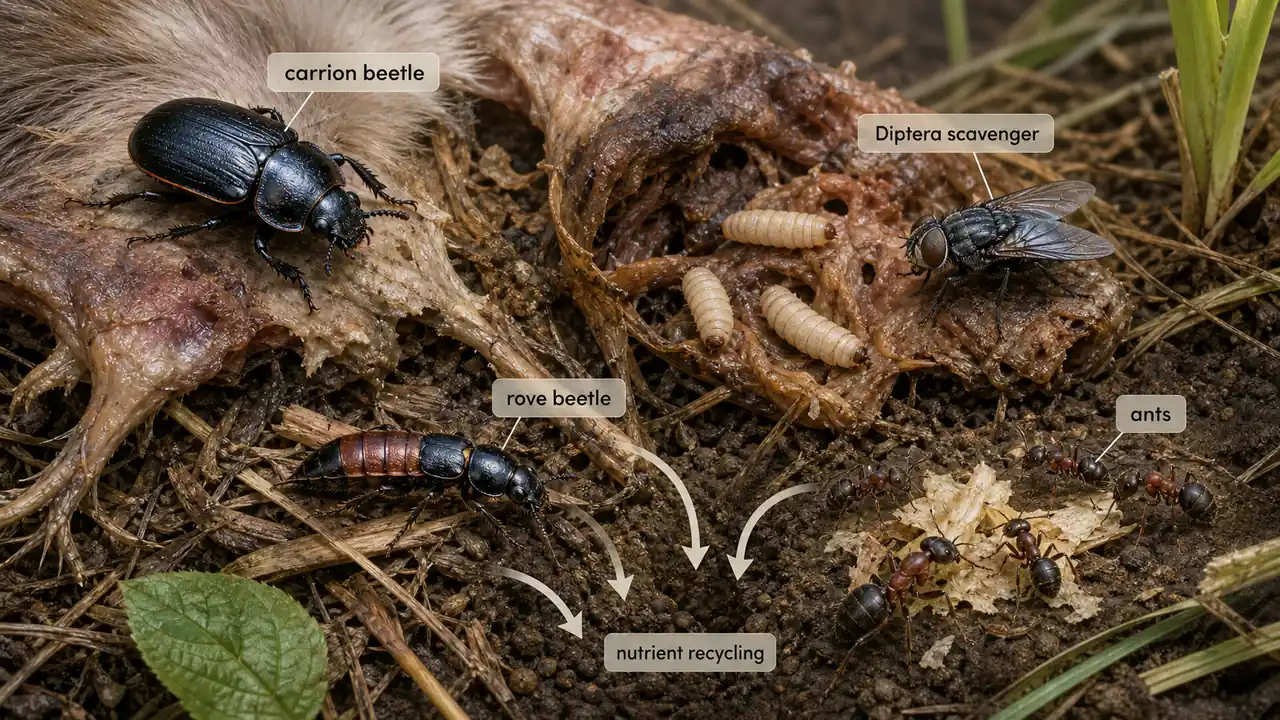
6. Scavengers
- Feed on dead and decaying matter, acting as nature's cleanup crew and recycling nutrients.
- Without scavengers, dead organisms and waste would accumulate, creating health hazards.
| Order | Key Scavenger Groups |
|---|---|
| Coleoptera (beetles) | Rove, chafer, darkling, skin, carrion, jewel, water scavenger, powder post beetles (largest number of scavenger species) |
| Diptera (flies) | Sand flies, hover flies, root maggot flies |
| Isoptera | Termites (white ants) |
| Hymenoptera | Ants |
7. Useful as Drugs, Food, and Ornaments
Medicinal Uses
| Source | Product | Use |
|---|---|---|
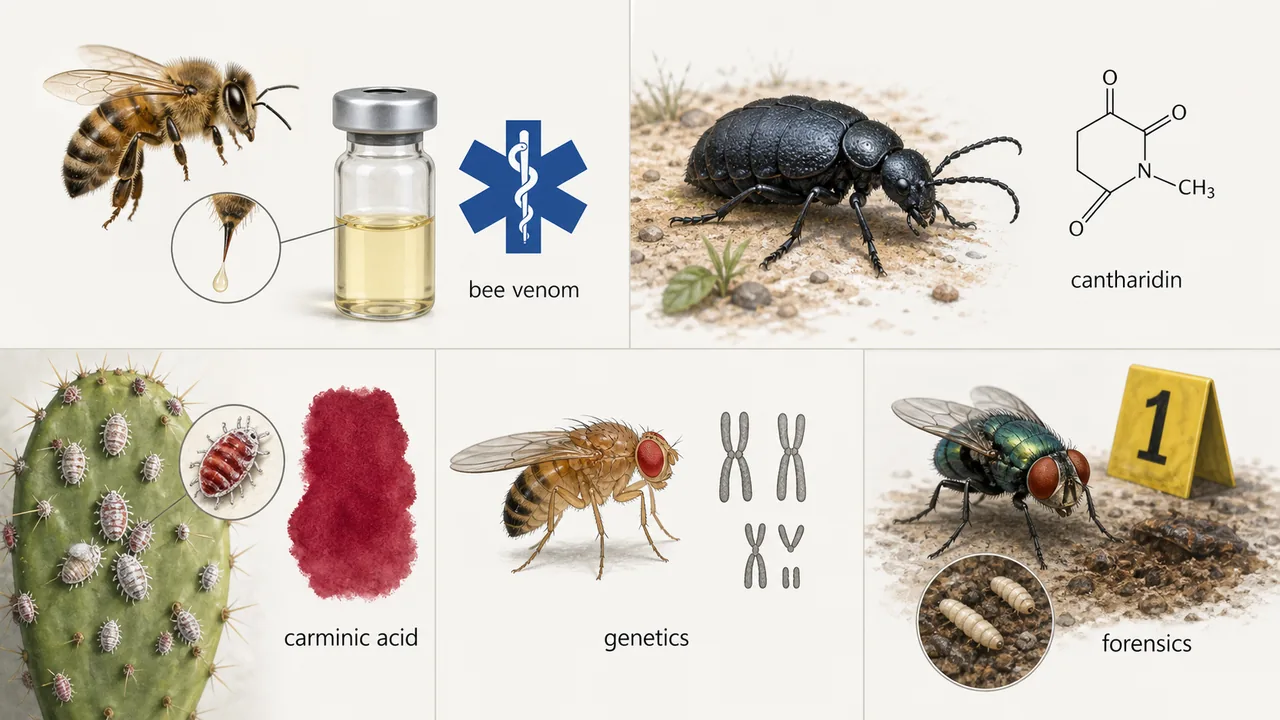
| Honey bee sting (venom) | Formic acid, melittin | Apitherapy -- remedy for rheumatism and arthritis |
| Blister beetle | Cantharidin (from haemocoel + accessory glands of male genitalia) | Hair tonic, dermatology (wart treatment) |
Food
- Entomophagy (eating insects) is common in Asia, Africa, and Latin America.
- Examples: grasshoppers, termites, moth pupae -- rich in protein, fats, and minerals.
- Aquatic insects are used as fish food in freshwater ecosystems.
Dyes and Chemical Products
| Product | Source | Use |
|---|---|---|
| Carminic acid (crimson dye) | Dactylopius ceylonicus (cochineal insect) | Textiles, cosmetics, food colouring |
| Anthroquinone | Present in cochineal red and lac | Textile and pharmaceutical industries |
| Tannic acid (30-70%) | Insect galls | Leather tanning, ink manufacturing |
| Indole Acetic Acid (IAA) | Insect galls | Plant growth hormone (auxin) |
TIP
Exam Fact: Insect galls contain 30-70% tannic acid AND Indole Acetic Acid (IAA). IAA is a plant growth hormone (auxin) -- a fascinating intersection of insect and plant biology.
Ornaments and Entertainment
- Butterfly wing patterns inspire fashion and design.
- Iridescent beetle wings used in jewelry and decorative ornaments.
- Entomological collecting is both a hobby and a scientific endeavour contributing to understanding insect biodiversity.
8. Scientific Research
| Organism | Field | Contribution |
|---|---|---|
| Drosophila (fruit fly) | Genetics | One of the most important model organisms; contributed to discoveries of gene linkage and chromosomal inheritance |
| Mosquitoes | Toxicology | Used in toxicological studies and pesticide testing |
| Blow flies | Forensics | Used to estimate time of death in criminal investigations (forensic entomology) |
Master Comparison Table
| Category | Key Example | Agricultural Benefit |
|---|---|---|
| Parasitoids | Trichogramma (egg parasitoid) | Biological pest control |
| Predators | Coccinellids (ladybird beetles) | Devour aphids, scale insects |
| Pollinators | Honey bees | 80% of insect pollination; crop yield increase |
| Weed killers | Zygogramma bicolorata | Controls Parthenium weed |
| Soil builders | Ants, beetles, collembola | Soil aeration, nutrient recycling |
| Scavengers | Carrion beetles, blow flies | Decomposition, hygiene |
| Products | Honey, silk, lac, cantharidin | Food, fibre, dyes, medicine |
| Research | Drosophila melanogaster | Genetics model organism |
Summary Table
| Key Fact | Answer |
|---|---|
| Parasitoid vs. parasite | Parasitoid kills the host; parasite usually does not |
| Praying mantis is a | Predator (not a parasite) |
| Prickly Pear biocontrol | Dactylopius tomentosus (cochineal insect) |
| Water Hyacinth biocontrol | Neochetina eichhorniae + N. bruchi (weevils) |
| Parthenium biocontrol | Zygogramma bicolorata (beetle) |
| Crimson dye from | Dactylopius ceylonicus (carminic acid) |
| Cantharidin from | Blister beetle (haemocoel + male genitalia glands) |
| Fruit sucking moth egg-laying | Lays eggs on Weeds — not on the main crop; adult moth migrates to fruit crops to feed |
| Tannic acid in insect galls | 30-70% |
| IAA in insect galls | Indole Acetic Acid (plant auxin) |
| Most important genetics model | Drosophila melanogaster |
| Forensic entomology uses | Blow flies (estimate time of death) |
| Bee venom therapy | Apitherapy (rheumatism, arthritis) |
TIP
Quick Exam Recall: Praying mantis = predator (NOT parasite). Water hyacinth = Neochetina weevils. Prickly pear = Dactylopius. Parthenium = Zygogramma. Insect galls = tannic acid (30-70%) + IAA. Cantharidin = blister beetle. Drosophila = genetics. Blow flies = forensics.
References
1 source
References
Quick Reference: Which Beneficial Insect for Which Pest?
exams field officer's guide to recommending biocontrol agents:
| Pest Problem | Beneficial Insect to Release | Type | How It Works |
|---|---|---|---|
| Bollworm/stem borer eggs | Trichogramma spp. | Egg parasitoid | Lays eggs inside pest eggs; pest never hatches |
| Mealybug on cotton/citrus | Cryptolaemus montrouzieri | Predator (ladybird) | Both larvae and adults eat mealybugs voraciously |
| Aphids on vegetables | Chrysoperla carnea (lacewing) | Predator | Larva called "aphid lion" — eats 400+ aphids in its lifetime |
| Scale insects on citrus | Chilocorus nigritus | Predator (ladybird) | Feeds on armoured scale insects |
| Pyrilla on sugarcane | Epiricania melanoleuca | Parasitoid | Larva feeds on adult pyrilla; release 4000-5000 cocoons/ha |
| Cottony cushion scale | Rodolia cardinalis (Vedalia beetle) | Predator | First biocontrol success story (1888, California) |
| Water hyacinth (weed) | Neochetina weevils | Weed biocontrol | Adults feed on leaves; larvae bore stems |
| Prickly pear cactus (weed) | Dactylopius ceylonicus (cochineal) | Weed biocontrol | Feeds on cactus pads; classic success in India |
Key principle: Parasitoids kill the host (always). Parasites usually don't kill the host. Predators eat multiple prey. This distinction is the most tested fact in biocontrol questions.
Summary Cheat Sheet
| Concept / Topic | Key Details |
|---|---|
| Parasitoid vs Parasite | Parasitoid kills host; parasite usually does not |
| Egg parasitoids | Prevent pest hatching entirely (e.g., Trichogramma) |
| Larval parasitoids | Kill larvae during feeding phase |
| Predators | Larger than prey; consume multiple individuals (e.g., Coccinellids, Praying mantis) |
| Praying mantis classification | Predator — NOT a parasite or parasitoid |
| Pollinators | Honey bees = most important; 80% of insect pollination |
| Prickly Pear biocontrol | Dactylopius tomentosus (cochineal insect) — classical success |
| Water Hyacinth biocontrol | Weevils Neochetina eichhorniae + N. bruchi; mite Orthogalumna terebrantis |
| Parthenium biocontrol | Beetle Zygogramma bicolorata |
| Soil builders | Ants, beetles, crickets, collembola — tunnels improve aeration |
| Scavengers – Coleoptera | Rove, carrion, darkling, skin, jewel, water scavenger beetles |
| Scavengers – Diptera | Sand flies, hover flies, root maggot flies |
| Scavengers – Isoptera | Termites (white ants) |
| Cantharidin | From blister beetle (haemocoel + male genitalia glands); hair tonic, dermatology |
| Entomophagy | Eating insects — grasshoppers, termites, moth pupae |
| Carminic acid (crimson dye) | From Dactylopius ceylonicus (cochineal insect) |
| Tannic acid in insect galls | 30-70%; used in leather tanning, ink |
| IAA in insect galls | Indole Acetic Acid — plant growth hormone (auxin) |
| Apitherapy | Bee venom for rheumatism and arthritis |
| Drosophila melanogaster | Model organism for genetics research |
| Blow flies | Used in forensic entomology — estimate time of death |