👩❤️👩 Insect Reproductive System
Male and female reproductive anatomy, seven types of reproduction (oviparity, viviparity, parthenogenesis, polyembryony, and others), and their agricultural significance
In the previous lesson, we studied sense organs -- how insects detect and respond to their environment. Now we examine the system that drives population growth: the reproductive system and the diverse strategies insects use to multiply.
Aphids are among the most difficult crop pests to control, and the reason lies in their extraordinary reproductive strategy. During warm summer months, female aphids reproduce through parthenogenesis -- giving birth to live female nymphs without mating, each already carrying developing embryos inside. A single aphid can produce a colony of millions in just weeks. Then, as winter approaches, they switch to sexual reproduction to generate genetic diversity for survival. This alternation of reproductive modes is one reason why aphid populations can explode so rapidly on crops like mustard, wheat, and cotton.
This lesson covers:
- Female and male reproductive anatomy -- ovaries, testes, accessory glands
- Seven types of reproduction -- oviparity, viviparity, parthenogenesis, polyembryony, and others
- Agricultural significance -- how reproductive strategies drive pest population dynamics
Overview
Why this matters for pest management: An insect's reproductive strategy directly determines how fast its population can explode. A single pair of houseflies, if all offspring survived, could produce enough descendants in one season to cover the Earth several metres deep. Understanding reproduction modes helps predict population build-up and time control interventions.
Pro Content Locked
Upgrade to Pro to access this lesson and all other premium content.
Charged once for one year · ₹1188 total
Save ₹100/month vs ₹2388/year launch price
- All Agriculture & Banking Courses
- AI Lesson Questions (100/day)
- AI Doubt Solver (50/day)
- Glows & Grows Feedback (30/day)
- AI Section Quiz (20/day)
- 22-Language Translation (100/day)
- Recall Questions (20/day)
- AI Quiz (15/day)
- AI Quiz Paper Analysis (100/day)
- AI Step-by-Step Explanations (100/day)
- Spaced Repetition Recall (FSRS)
- AI Tutor
- Immersive Text Questions
- Audio Lessons — Hindi & English
- Mock Tests & Previous Year Papers
- Summary & Mind Maps
- XP, Levels, Leaderboard & Badges
- Generate New Classrooms
- Voice AI Teacher (AgriDots Live)
- AI Revision Assistant
- Knowledge Gap Analysis
- Interactive Revision (LangGraph)
🔒 Secure one-time yearly payment via Razorpay · No hidden fees
In the previous lesson, we studied sense organs -- how insects detect and respond to their environment. Now we examine the system that drives population growth: the reproductive system and the diverse strategies insects use to multiply.
Aphids are among the most difficult crop pests to control, and the reason lies in their extraordinary reproductive strategy. During warm summer months, female aphids reproduce through parthenogenesis -- giving birth to live female nymphs without mating, each already carrying developing embryos inside. A single aphid can produce a colony of millions in just weeks. Then, as winter approaches, they switch to sexual reproduction to generate genetic diversity for survival. This alternation of reproductive modes is one reason why aphid populations can explode so rapidly on crops like mustard, wheat, and cotton.
This lesson covers:
- Female and male reproductive anatomy -- ovaries, testes, accessory glands
- Seven types of reproduction -- oviparity, viviparity, parthenogenesis, polyembryony, and others
- Agricultural significance -- how reproductive strategies drive pest population dynamics
Overview
Why this matters for pest management: An insect's reproductive strategy directly determines how fast its population can explode. A single pair of houseflies, if all offspring survived, could produce enough descendants in one season to cover the Earth several metres deep. Understanding reproduction modes helps predict population build-up and time control interventions.
- Insects are generally bisexual (separate sexes -- distinct males and females).
- This is the norm, called gonochorism.
- Rare exceptions:
- Gynandromorph: Abnormal individual with secondary sexual characters of both male and female on different body parts (e.g., mutant Drosophila).
- Hermaphrodite: Both male and female gonads in one organism (e.g., cottony cushion scale). True hermaphroditism is extremely rare in insects.
- The reproductive system has internal genitalia (gonads and ducts) and external genitalia (visible structures for mating and egg-laying).
Female Reproductive System
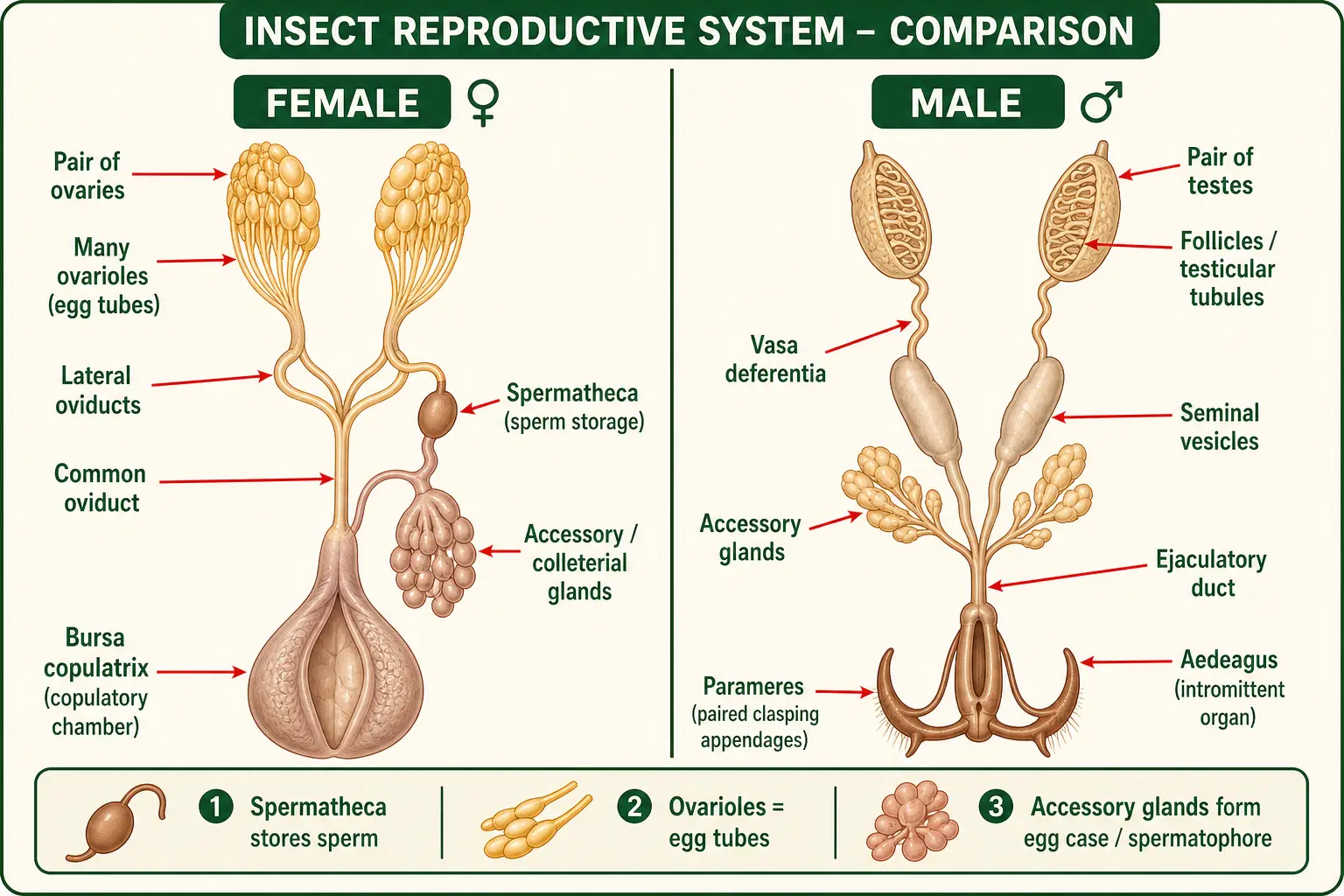
| Organ | Function |
|---|---|
| A pair of ovaries | Each contains a bundle of egg tubes called ovarioles (functional units of egg production). Number varies: 1 per ovary in tsetse flies to 2,000+ in queen termites |
| Lateral oviducts (paired) | Collect mature eggs from ovarioles and transport them toward the common oviduct |
| Common (Median) oviduct | Single tube formed by junction of lateral oviducts; eggs pass to outside |
| Spermatheca | Storage organ for sperm received during mating. Queen honeybees store sperm for years. Sperm released to fertilise eggs as they pass through |
| Accessory glands (Colleterial glands) | Produce secretions for forming egg cases (ootheca), attaching eggs to substrates, or protective coatings |
| Bursa copulatrix (Genital chamber / Vagina) | Receives male aedeagus during copulation; site of sperm transfer |
- In the typical female insect, the external genital opening lies just below the anus and is associated with the 8th and 9th abdominal segments.
Ovariole Organisation
- Each ovariole acts as an independent egg-production tube within the ovary.
- The upper germarium is the region where oogonia and early oocytes originate.
- The lower vitellarium is the region where developing oocytes enlarge, accumulate yolk, and move toward the oviduct.
| Ovariole type | Key feature | Typical example |
|---|---|---|
| Panoistic | Trophocytes (nurse cells) absent; oocytes develop without a separate nurse-cell cluster | Grasshoppers and many primitive insects |
| Polytrophic | Each oocyte is accompanied by its own nurse cells that move along with it in the ovariole | Butterflies, moths, and many flies |
| Telotrophic | Nurse cells remain at the apical end of the ovariole and stay connected to growing oocytes by cytoplasmic strands | True bugs and some beetles |
Male Reproductive System
| Organ | Function |
|---|---|
| A pair of testes | Each contains sperm tubes (follicles / testicular tubules) where spermatogenesis occurs |
| Vasa deferentia (paired) | Transport mature sperm from testes to ejaculatory duct |
| Seminal vesicles | Sac-like storage for mature sperm before ejaculation |
| Ejaculatory duct | Single median duct through which sperm is expelled during copulation |
| Accessory glands | Produce seminal fluid (mixed with sperm = semen). In many insects, form a spermatophore (protein-rich sperm capsule). Called mushroom glands in cockroaches and mantids |
| External genitalia | Aedeagus (intromittent organ for sperm transfer) + Parameres (clasping structures to hold female) |
- In the typical male insect, the genital opening is associated mainly with the 9th abdominal segment.
- The ovaries and testes of insects such as grasshopper are of mesodermal origin.
- In standard gametogenesis recall, one primary spermatocyte ultimately gives rise to four spermatozoa; the overall process is spermatogenesis, with the spermatid-to-spermatozoon transformation forming its terminal maturation phase.
- Sperm transfer in insects may be intragenital (the common route through the aedeagus), haemocoelous traumatic insemination into the body cavity (as in bed bug), or external transfer in primitive forms such as silverfish.
Physiology of Reproduction
Seven Types of Reproduction
The diversity of reproductive strategies is a key factor in insect evolutionary success -- and in the difficulty of pest management.
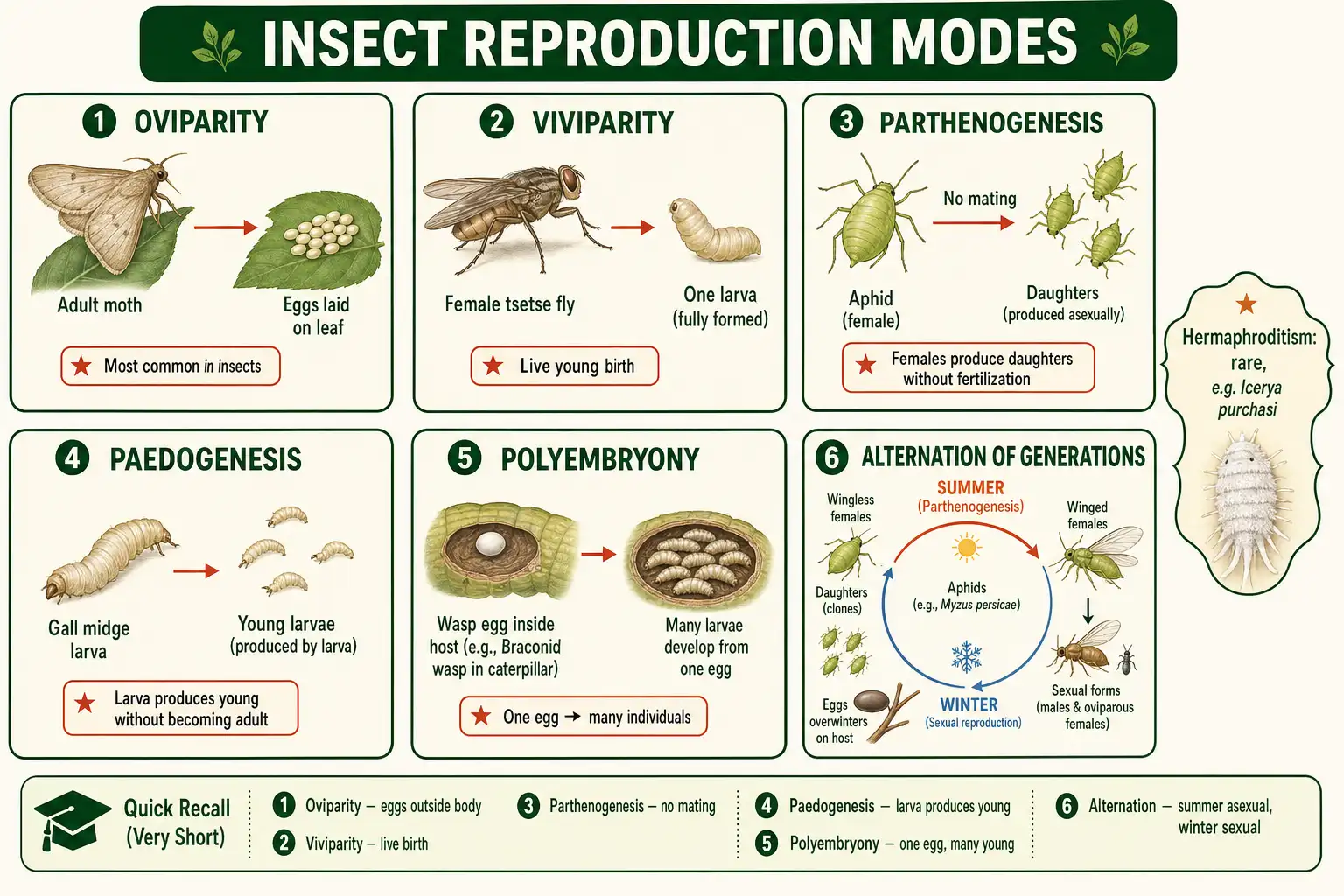
1. Oviparity (Egg-Laying)
| Feature | Detail |
|---|---|
| Definition | Female lays eggs on substrates (singly or in groups); embryos develop and hatch outside the mother |
| Prevalence | Most common mode in insects |
| Protection | Chorion (hardened outer shell) protects embryo |
| Examples | Moths, butterflies |
2. Viviparity (Live Birth)
| Feature | Detail |
|---|---|
| Definition | Female gives birth to live young instead of laying eggs; embryonic development completed within the female |
| Nourishment | Embryo gets nourishment from the mother |
| Prevalence | Relatively uncommon |
| Examples | Tsetse fly, some cockroaches, aphids (in certain phases) |
Main Viviparity Patterns
| Type | Core idea | Example |
|---|---|---|
| Ovoviviparity | Eggs hatch just before or soon after being laid, so the young appear to be born alive | Thrips |
| Pseudoplacental viviparity | Developing embryo is nourished by placenta-like maternal tissues in the genital tract | Aphids |
| Haemocoelous viviparity | Embryo develops freely in maternal haemolymph and absorbs nutrients directly | Strepsiptera, gall midges |
| Adenotrophic viviparity | Larva feeds on maternal accessory-gland or "milk-gland" secretion within the uterus; in Glossina (tsetse fly), the accessory glands are modified into these nutritive milk glands | Tsetse fly |
3. Parthenogenesis (Virgin Birth)
| Feature | Detail |
|---|---|
| Definition | Females reproduce without fertilisation / without males |
| Causes | Genetic characters, failure to find mate, hormonal changes, weather factors |
| Advantage | Every individual can produce offspring → doubles reproductive potential vs. sexual reproduction |
| Agricultural impact | Aphid populations can explode rapidly because no mating is needed |
| Example | Aphids (summer parthenogenesis) |
Important Parthenogenesis Subtypes
| Type | Outcome | Example |
|---|---|---|
| Arrhenotoky | Unfertilised eggs produce males only | Bees |
| Thelytoky | Unfertilised eggs produce females only | Aphids |
| Amphitoky / Deuterotoky | Unfertilised eggs may produce both males and females | Classical mixed-sex category |
| Facultative parthenogenesis | Parthenogenesis occurs, but is not obligatory | Bees in old exam-oriented recall |
4. Paedogenesis / Neoteny (Reproduction by Immature Stages)
| Feature | Detail |
|---|---|
| Definition | Immature insects (larvae) give birth to young ones |
| Cause | Hormonal imbalance |
| Effect | Dramatically shortens generation time |
| Note | Most paedogenetic insects also reproduce by parthenogenesis |
| Example | Cecidomyiids (gall midges) |
5. Polyembryony (Many Embryos from One Egg)
| Feature | Detail |
|---|---|
| Definition | A single egg produces two or more embryos |
| Advantage | One egg laid inside a host can give rise to hundreds or thousands of genetically identical offspring |
| Agricultural significance | Extremely important in biological control -- parasitoid wasps multiply rapidly inside pest hosts |
| Example | Endoparasitic Hymenoptera like Platygaster |
6. Hermaphroditism (Both Sexes in One Individual)
| Feature | Detail |
|---|---|
| Definition | Both male and female gonads present in one individual |
| Types | Functional (both gonad types work; e.g., Icerya purchasi -- cottony cushion scale) and Non-functional (both present but only one works; e.g., stonefly Perla marginata) |
| Prevalence | Extremely rare in insects |
7. Alternation of Generations (Cyclical Parthenogenesis)
| Feature | Detail |
|---|---|
| Definition | Alternation between parthenogenetic and sexual reproduction across generations |
| Strategy | Parthenogenesis in favourable conditions (summer) for rapid population growth; sexual reproduction before harsh conditions (winter) for genetic diversity and survival |
| Example | Aphids -- parthenogenesis in summer, sexual reproduction in winter |
Other: Castration (Social Regulation of Reproduction)
| Feature | Detail |
|---|---|
| Definition | Reproductive capacity of colony members is regulated by caste development |
| Mechanism | Well-developed ovaries → queens; well-developed testes → drones; underdeveloped ovaries → workers |
| Control by | Queen pheromones and nutritional differences |
| Example | Honeybees, other social insects |
Comparison of Reproductive Types
| Type | Fertilisation? | Eggs/Young? | Speed | Example |
|---|---|---|---|---|
| Oviparity | Yes (sexual) | Eggs | Normal | Moths, butterflies |
| Viviparity | Yes | Live young | Normal | Tsetse fly |
| Parthenogenesis | No | Eggs or live young | Very fast | Aphids (summer) |
| Paedogenesis | No | Young from larvae | Extremely fast | Gall midges |
| Polyembryony | Yes (one egg) | Many from one egg | Very fast | Parasitoid wasps |
| Hermaphroditism | Self or cross | Eggs | Normal | Cottony cushion scale |
| Alternation | Both modes | Both | Seasonal switching | Aphids (annual cycle) |
Additional Reproductive Facts
- Fecundity vs fertility: Fecundity refers to the rate or capacity of a female to produce ova / eggs, whereas fertility refers to the rate at which she produces new individuals / viable offspring.
- Thelytoky = form of parthenogenesis where unfertilised eggs develop into females only. Common in some Hymenoptera (e.g., certain parasitoid wasps and scale insects).
- Appendicular ovipositor absent: Housefly and fruit fly do not have the typical appendicular ovipositor. In housefly, the terminal telescopic abdominal segments act as a pseudo-ovipositor; in fruit flies, the elongated abdomen ends in a pointed structure used to pierce the fruit rind during oviposition.
- Ovipositor modifications: In worker honeybees, the ovipositor is modified into a sting; in crickets it is typically needle-like; in mustard sawfly it is saw-like.
- Hydropyle = a specialised region of the grasshopper/locust egg chorion through which the embryo absorbs water from moist soil.
- This explains why locusts and grasshoppers select moist, sandy patches for oviposition — soil moisture is essential for egg development.
- Gastrulation = early embryonic process involving invagination of mesoderm and endoderm within the ectoderm to form the three primary germ layers; the starting point of internal organ formation in the insect embryo.
Embryonic Development Inside the Egg
- The full development from egg to adult is the insect life cycle, but the development that occurs inside the egg is the true embryonic / pre-embryonic development.
- During early cleavage, each daughter nucleus becomes surrounded by a small halo of cytoplasm, forming an energid (sometimes called a cleavage cell in old exam notes).
- When these energids migrate to the egg periphery and form a continuous cellular layer, that layer is called the blastoderm.
- Some energids remain in the yolk or move back into it; these are called vitellophages.
- The ventral blastoderm thickens to form the germ band, which later develops into the embryo proper.
- The dorsal thin part of the blastoderm forms the extra-embryonic membrane called the serosa, while the small ventral cavity associated with the germ band is called the amnion.
- Movement of the embryo within the yolk is called blastokinesis. The posterior-to-anterior movement is anatrepsis, while the ventral-to-dorsal movement is katatrepsis.
- During segmentation and organogenesis, the three germ layers produce their main organ systems:
| Germ layer | Major derivatives in insects |
|---|---|
| Ectoderm | Integument, tracheal system, foregut, hindgut, nervous system |
| Mesoderm | Muscles, circulatory system, haemocytes, fat body, gonads, heart |
| Endoderm | Midgut |
- Final emergence of the young insect from the egg is called eclosion.
Exam Tips
"Insects are generally hermaphrodite" is INCORRECT. Insects are generally bisexual (gonochoristic -- separate sexes). Hermaphroditism is extremely rare.
Parthenogenesis = reproduction WITHOUT males/fertilisation. Aphids in summer. Remember: "Parthenogenesis = Parthenon (Greek temple of the virgin goddess)."
Polyembryony = many embryos from ONE egg. Critical for biological control by parasitoid wasps.
Spermatheca stores sperm (not eggs). Queen honeybee stores sperm for years.
Aphid reproductive cycle: Parthenogenesis (summer, rapid) → Sexual reproduction (winter, genetic diversity). The "alternation of generations."
Mushroom glands = male accessory glands of cockroach and mantids. Named for their shape.
Spermatophore = protein-rich sperm capsule produced by male accessory glands for sperm transfer.
Summary Cheat Sheet
| Concept | Key Detail |
|---|---|
| Sex determination | Generally bisexual (separate sexes); hermaphroditism extremely rare |
| Gynandromorph | Sexual mosaic (male + female characters in one individual) |
| Female organs | Ovaries (ovarioles) → lateral oviducts → common oviduct → bursa copulatrix; spermatheca for sperm storage |
| Male organs | Testes (follicles) → vasa deferentia → seminal vesicles → ejaculatory duct; accessory glands (spermatophore) |
| Oviparity | Egg-laying; most common mode |
| Viviparity | Live birth; tsetse fly |
| Parthenogenesis | No fertilisation; aphids (summer); rapid population growth |
| Paedogenesis | Reproduction by larvae; cecidomyiids |
| Polyembryony | Many embryos from one egg; parasitoid wasps; key for biocontrol |
| Alternation of generations | Parthenogenesis (summer) + Sexual (winter); aphids |
| Spermatheca | Stores sperm; queen honeybee stores for years |
| Ovarioles per ovary | 1 (tsetse fly) to 2,000+ (queen termite) |
| Female genital opening | Associated with 8th and 9th abdominal segments |
| Male genital opening | Associated mainly with 9th abdominal segment |
| Grasshopper gonads | Mesodermal in origin |
| One primary spermatocyte | Produces four spermatozoa |
| Intragenital insemination | Common transfer through aedeagus |
| Haemocoelous insemination | Traumatic transfer into body cavity |
| Fecundity | Egg-producing capacity / rate |
| Fertility | Production of viable offspring |
| Germarium | Upper ovariole region where early oocytes originate |
| Vitellarium | Lower ovariole region where oocytes enlarge and accumulate yolk |
| Pseudo-ovipositor | Telescopic terminal abdominal segments of housefly used in oviposition |
| Energid | Cleavage nucleus surrounded by a halo of cytoplasm |
| Blastoderm | Continuous peripheral cell layer formed by migrated energids |
| Vitellophage | Energid remaining in or returning to yolk |
| Germ band | Thickened ventral blastoderm that forms the embryo |
| Serosa | Dorsal extra-embryonic membrane |
| Amnion | Small ventral embryonic cavity / covering associated with germ band |
| Blastokinesis | Movement of embryo within yolk |
| Anatrepsis | Posterior-to-anterior embryonic movement |
| Katatrepsis | Ventral-to-dorsal embryonic movement |
| Eclosion | Hatching / emergence from the egg |
| Panoistic ovariole | Nurse cells absent |
| Polytrophic ovariole | Each oocyte travels with its own nurse cells |
| Telotrophic ovariole | Nurse cells remain at apex and connect by cytoplasmic strands |
TIP
Next: The next lesson covers the endocrine system -- the glands and hormones that regulate moulting, metamorphosis, and reproduction.
References
1 source
References
Lesson Doubts
Ask questions, get expert answers