🪱 Aphelenchid Nematodes -- Foliar, Mushroom, and Red Ring
Above-ground nematodes -- white tip of rice, mushroom nematode, chrysanthemum nematode, strawberry crimp, and red ring disease of coconut
In the previous lesson, we covered the citrus nematode -- a semi-endoparasite of roots. Now we shift to nematodes that break the underground rule entirely: the aphelenchid nematodes parasitise leaves, buds, seeds, and even tree trunks.
While most plant parasitic nematodes attack roots hidden underground, the aphelenchid nematodes parasitise above-ground plant parts. A rice farmer noticing bleached white leaf tips, a chrysanthemum grower finding deformed flowers, or a mushroom producer watching his yield collapse -- all may be dealing with nematodes from this unique group. Their above-ground habits require completely different management approaches.
This lesson covers:
- White tip disease of rice -- A. besseyi, seed-borne
- Mushroom nematode -- A. composticola, mycophagous
- Foliar nematodes -- chrysanthemum and strawberry parasites
- Red ring nematode -- R. cocophilus, insect-vectored, under quarantine
Overview
- Aphelenchoides = resembling Aphelenchus; from Greek apheles (smooth) + enchus (stylet).
- Commonly called Leaf and Bud Nematodes or Foliar Nematodes.
- Unlike most PPNs that attack roots, these parasitise aerial plant parts.
- Among the economically important aphelenchids, Aphelenchoides is the principal genus reported from India.
White Tip Disease of Rice
Causal Organism: Aphelenchoides besseyi
| Feature | Details |
|---|---|
| First report (India) | Dastur, 1934 (epidemic form in Central Provinces, MP) |
| Distribution in India | Predominantly eastern and southern states |
| Disease type | Seed-borne -- nematodes survive in quiescent stage between glumes and grain |
| Feeding type | Ectoparasite (feeds from outside plant surface) |
| Spread favoured by | High humidity (nematodes need moisture film to move on plant surfaces) |
Diagnostic Symptom
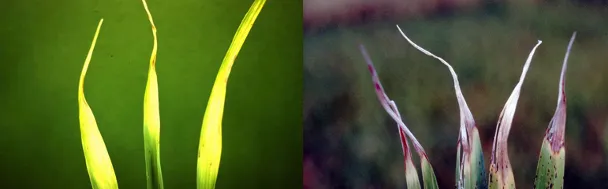
The upper 3--5 cm of the leaf tip turns white or pale yellow at the tillering stage -- the hallmark symptom giving the disease its name.
Pro Content Locked
Upgrade to Pro to access this lesson and all other premium content.
Charged once for one year · ₹1188 total
Save ₹100/month vs ₹2388/year launch price
- All Agriculture & Banking Courses
- AI Lesson Questions (100/day)
- AI Doubt Solver (50/day)
- Glows & Grows Feedback (30/day)
- AI Section Quiz (20/day)
- 22-Language Translation (100/day)
- Recall Questions (20/day)
- AI Quiz (15/day)
- AI Quiz Paper Analysis (100/day)
- AI Step-by-Step Explanations (100/day)
- Spaced Repetition Recall (FSRS)
- AI Tutor
- Immersive Text Questions
- Audio Lessons — Hindi & English
- Mock Tests & Previous Year Papers
- Summary & Mind Maps
- XP, Levels, Leaderboard & Badges
- Generate New Classrooms
- Voice AI Teacher (AgriDots Live)
- AI Revision Assistant
- Knowledge Gap Analysis
- Interactive Revision (LangGraph)
🔒 Secure one-time yearly payment via Razorpay · No hidden fees
In the previous lesson, we covered the citrus nematode -- a semi-endoparasite of roots. Now we shift to nematodes that break the underground rule entirely: the aphelenchid nematodes parasitise leaves, buds, seeds, and even tree trunks.
While most plant parasitic nematodes attack roots hidden underground, the aphelenchid nematodes parasitise above-ground plant parts. A rice farmer noticing bleached white leaf tips, a chrysanthemum grower finding deformed flowers, or a mushroom producer watching his yield collapse -- all may be dealing with nematodes from this unique group. Their above-ground habits require completely different management approaches.
This lesson covers:
- White tip disease of rice -- A. besseyi, seed-borne
- Mushroom nematode -- A. composticola, mycophagous
- Foliar nematodes -- chrysanthemum and strawberry parasites
- Red ring nematode -- R. cocophilus, insect-vectored, under quarantine
Overview
- Aphelenchoides = resembling Aphelenchus; from Greek apheles (smooth) + enchus (stylet).
- Commonly called Leaf and Bud Nematodes or Foliar Nematodes.
- Unlike most PPNs that attack roots, these parasitise aerial plant parts.
- Among the economically important aphelenchids, Aphelenchoides is the principal genus reported from India.
White Tip Disease of Rice
Causal Organism: Aphelenchoides besseyi
| Feature | Details |
|---|---|
| First report (India) | Dastur, 1934 (epidemic form in Central Provinces, MP) |
| Distribution in India | Predominantly eastern and southern states |
| Disease type | Seed-borne -- nematodes survive in quiescent stage between glumes and grain |
| Feeding type | Ectoparasite (feeds from outside plant surface) |
| Spread favoured by | High humidity (nematodes need moisture film to move on plant surfaces) |
Diagnostic Symptom
The upper 3--5 cm of the leaf tip turns white or pale yellow at the tillering stage -- the hallmark symptom giving the disease its name.
Management
Hot water treatment: 52--55 degrees C for 10--15 minutes -- kills quiescent nematodes in seed without affecting germination. This is the primary recommended control measure.
Other Host Recall
In India, A. besseyi is also linked with floral malady of tuberose, especially from West Bengal and Odisha, where nematode feeding in the ovary can produce the woolly symptom remembered as "nematode wool."
Mushroom Nematode
Causal Organism: Aphelenchoides composticola
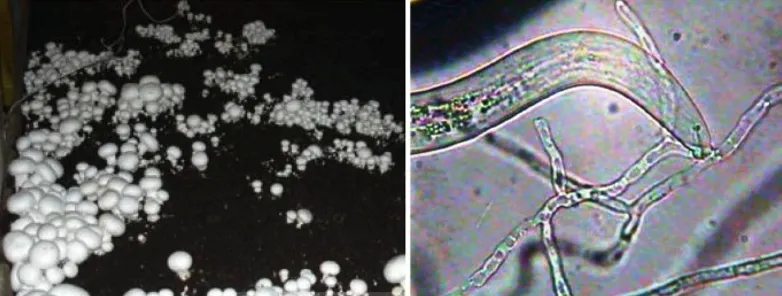
- A mycophagous (fungus-eating) nematode that feeds on fungal mycelium rather than plant tissue.
- Severely affects button mushroom (Agaricus bisporus) by destroying the mycelial network needed for fruiting body production.
- Causes drastic reduction in mushroom yield in commercial production.
- Another mycophagous mushroom-associated species remembered in exam notes is Aphelenchoides swarupi.
Foliar Nematodes
Two important species parasitise leaves and buds with a unique dual feeding behaviour: they feed ectoparasitically on buds and endoparasitically on leaves (moving through mesophyll tissue between veins).
Chrysanthemum Nematode: Aphelenchoides ritzemabosi
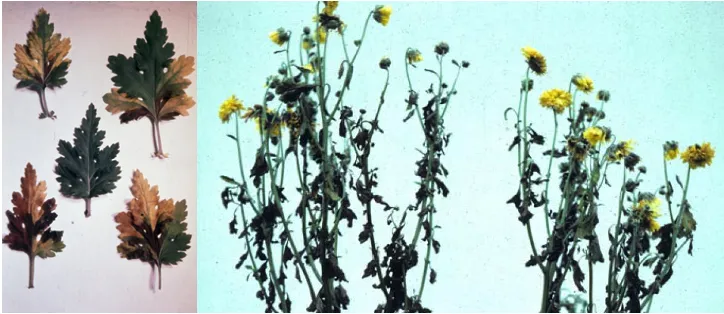
- Feeds on buds, causing undersized and distorted flowers of chrysanthemum.
- Devastating for ornamental crops where flower quality determines market value.
Strawberry Nematode: Aphelenchoides fragariae
- Known as Spring crimp or Strawberry nematode.
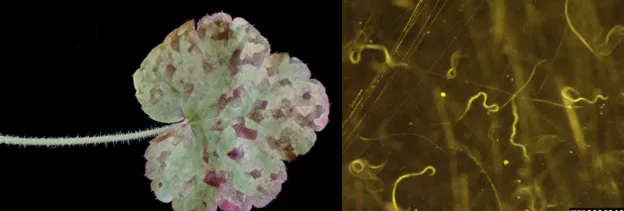
- Causes spring crimp and summer crimp -- crinkling and distortion of leaves in respective seasons.
- Feeding on crown buds results in a blind plant -- the growing point is destroyed, preventing flower and fruit production.
- Also involved in the cauliflower disease complex with Clavibacter fascians (bacterium).
Red Ring Nematode
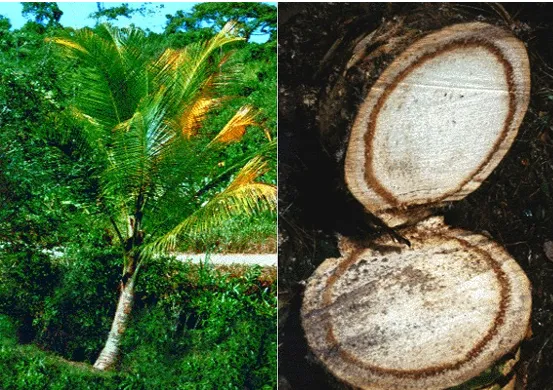
Causal Organism: Rhadinaphelenchus cocophilus
- Causes Red Ring Disease of Coconut in Central and South America and Caribbean islands.
- Not reported from India -- but is under quarantine regulation to prevent introduction.
Unique Transmission
The nematode is transmitted by the palm weevil (Rhynchophorus palmarum) -- an insect vector. The weevil carries nematodes along with diseased tissue and deposits them in leaf axils of healthy palms. This is a remarkable example of insect-nematode association.
Diagnostic Symptom
When the trunk is cut in cross-section, a conspicuous ring of reddish necrotic tissue is visible about 3 cm beneath the stem surface -- giving the disease its name. The reddish colour results from necrosis and oxidation caused by nematode feeding in the stem cortex.
Pine Wood Nematode
Causal Organism: Bursaphelenchus xylophilus
- Causes pine wilt disease, a destructive wilt of pine trees.
- The dauer stage is carried from tree to tree by the pine sawyer beetle (Monochamus alternatus).
- After entry, the nematode spreads through the resin canals, disrupting water movement and leading to rapid wilting and death of susceptible pines.
Comparison: Aphelenchid Nematodes at a Glance
| Species | Common Name | Host | Disease/Symptom | Key Feature |
|---|---|---|---|---|
| A. besseyi | Rice leaf nematode | Rice | White tip (3--5 cm bleached leaf tip) | Seed-borne; ectoparasite |
| A. composticola / A. swarupi | Mushroom nematodes | Button mushroom | Mycelium destruction, reduced fruiting | Mycophagous (fungus-eating) |
| A. ritzemabosi | Chrysanthemum nematode | Chrysanthemum | Distorted, undersized flowers | Ecto on buds, endo on leaves |
| A. fragariae | Strawberry nematode | Strawberry | Spring/summer crimp; blind plant | Cauliflower disease complex with bacteria |
| R. cocophilus | Red ring nematode | Coconut | Red ring in trunk cross-section | Transmitted by palm weevil (insect vector) |
| B. xylophilus | Pine wood nematode | Pine | Pine wilt | Dauer stage vectored by pine sawyer beetle |
Summary Table
| Feature | Key Fact |
|---|---|
| Unique trait of aphelenchids | Parasitise above-ground plant parts (leaves, buds, trunks) |
| White tip of rice | A. besseyi; seed-borne; 3--5 cm white leaf tips |
| White tip distribution (India) | Mainly eastern and southern rice-growing states |
| White tip management | Hot water: 52--55 degrees C, 10--15 minutes |
| Other host note for A. besseyi | Tuberose floral malady; "nematode wool" in ovary |
| Mushroom nematodes | A. composticola and A. swarupi; mycophagous; damage Agaricus bisporus mycelium |
| Foliar nematode feeding | Ecto on buds, endo on leaves |
| Chrysanthemum nematode | A. ritzemabosi; distorted flowers |
| Strawberry nematode | A. fragariae; spring/summer crimp; blind plants |
| Red ring disease | R. cocophilus; coconut; NOT in India; under quarantine |
| Red ring vector | Palm weevil (Rhynchophorus palmarum) -- insect-transmitted |
| Pine wood nematode | B. xylophilus; pine wilt; vectored by Monochamus alternatus |
| Quarantine nematodes (India) | Globodera rostochiensis and Rhadinaphelenchus cocophilus |
TIP
Exam mnemonic -- "White Mushroom Chrysanthemum Strawberry Red" (WMCSR) for aphelenchid nematodes: White tip (A. besseyi), Mushroom (A. composticola), Chrysanthemum (A. ritzemabosi), Strawberry crimp (A. fragariae), Red ring (R. cocophilus -- palm weevil vector).
References
- Dropkin, V.H. 1980. Introduction to plant nematology. John Wiley and sons, INC. New York.
- Singh, R.S and Sitaramaiah, K. 1994. Plant pathogens. The plant parasitic nematodes. Oxford & IBH Pub. Co. Pvt. Ltd. New Delhi.
- Walia, R. K and Bajaj, H. K (2014). Textbook of Introductory Plant Nematology. Directorate of Knowledge Management in Agriculture, ICAR, New Delhi.
- Kumar, V., Khan, M.R. & Walia, R.K. Crop Loss Estimations due to Plant-Parasitic Nematodes in Major Crops in India. Natl. Acad. Sci. Lett. 43, 409-412 (2020).
- Figure 1: Source: A: Maggenti, 1981, B-E: Franklin, 1973
Summary Cheat Sheet
| Concept / Topic | Key Details |
|---|---|
| Unique trait of aphelenchids | Parasitise above-ground plant parts (leaves, buds, trunks) |
| White tip of rice | A. besseyi; seed-borne; 3--5 cm white leaf tips |
| White tip distribution (India) | Mainly eastern and southern rice-growing states |
| White tip management | Hot water: 52--55 degrees C, 10--15 minutes |
| Other host note for A. besseyi | Tuberose floral malady; "nematode wool" in ovary |
| Mushroom nematodes | A. composticola and A. swarupi; mycophagous; damage Agaricus bisporus mycelium |
| Foliar nematode feeding | Ecto on buds, endo on leaves |
| Chrysanthemum nematode | A. ritzemabosi; distorted flowers |
| Strawberry nematode | A. fragariae; spring/summer crimp; blind plants |
| Red ring disease | R. cocophilus; coconut; NOT in India; under quarantine |
| Red ring vector | Palm weevil (Rhynchophorus palmarum) -- insect-transmitted |
| Pine wood nematode | B. xylophilus; pine wilt; vectored by Monochamus alternatus |
| Quarantine nematodes (India) | Globodera rostochiensis and Rhadinaphelenchus cocophilus |
TIP
Next: Lesson 06 covers the burrowing nematode (Radopholus similis) -- banana decline, yellows disease of black pepper, and spreading decline of citrus.