🍬 Carbohydrates: Classification, Sugars, and Starch
Understand carbohydrate types (monosaccharides, oligosaccharides, polysaccharides), starch structure, and glucose–glycogen regulation — with agricultural examples and exam tips.
Why Carbohydrates Matter in Agriculture
When a rice grain fills with starch during the milking stage, or a sugarcane stalk accumulates sucrose to 14% of its weight, carbohydrates are at work. They are the primary products of photosynthesis and the main energy source stored in seeds, tubers, and fruits. Breeding programmes for cereals, potato, and sugarcane directly target carbohydrate content and quality — making this topic foundational for agricultural science.
What Are Carbohydrates?
Carbohydrates are organic compounds with the empirical formula (CH₂O)n — literally "hydrates of carbon." They are the most abundant organic molecules in plants.
- Carbohydrates are also described as polyhydroxy aldehydes or ketones or their derivatives.
- In nutrition and metabolism, carbohydrates are the first source of energy; fats are used next and proteins only when the other two are depleted.
- The term biochemistry is classically associated with Carl Neuberg (1903), who is widely remembered in exam-oriented history notes as the Father of Biochemistry.
- In the history of biochemistry, the synthesis of urea by Wohler (1828) is important because it was the first organic compound synthesized from inorganic substances.
| Role in Plants | Examples |
|---|---|
| Structural material | Cellulose, Hemicellulose (cell walls of all plant tissues) |
| Energy storage | Starch (in seeds, tubers, bulbs) |
| Conjugated forms | Glycosides (sugars linked to non-carbohydrate molecules) |
| In animals | Glycoproteins (carbohydrates + proteins) |
- The dry substance of plants is composed of 50–80% carbohydrates.
- The ratio of yield of photochemical products to total quanta absorbed is called Quantum yield.
Agricultural example: When wheat grain matures, starch accumulates in the endosperm — the starch content (and its amylose:amylopectin ratio) determines flour quality for chapati vs. bread making.
Starch
- Starch is a polysaccharide with formula (C₆H₁₀O₅)n, consisting of many glucose monomers joined by glycosidic bonds.
- Found especially in seeds, bulbs, and tubers.
- C:H:O ratio in carbohydrates = 1:2:1.
Classification of Carbohydrates
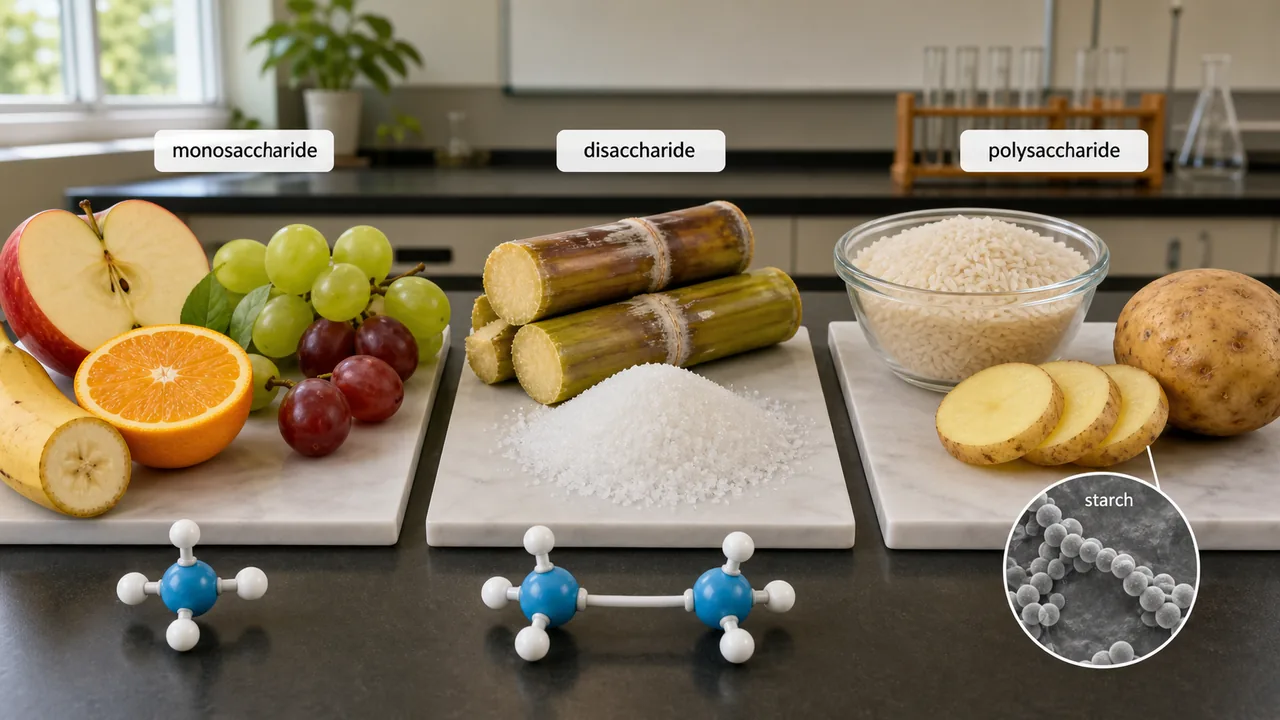
| Category | No. of Sugar Units | Solubility | Taste | Reducing Nature |
|---|---|---|---|---|
| Monosaccharides | 1 | Soluble | Sweet | All reducing |
| Oligosaccharides | 2–10 | Soluble | Sweet | Some reducing, some non-reducing |
| Polysaccharides | 10+ | Insoluble | Tasteless | Non-reducing |
1. Monosaccharides (One Sugar Unit)
- Crystalline, soluble in water, and sweet in taste.
- Their water solubility comes from the presence of multiple hydroxyl (-OH) groups, which readily form hydrogen bonds with water.
- Examples: Glucose, Fructose, Galactose.
- Fructose is the sweetest among all sugars.
- All monosaccharides are reducing in nature.
- Monosaccharides may behave as either aldoses or ketoses depending on whether they carry an aldehyde or ketone group.
- When the terminal reference carbon carries the hydroxyl group on the right side, the sugar is classified as a D-sugar; when it lies on the left side, it is an L-sugar. In nature, D-sugars are far more common.
- Glyceraldehyde is the simplest aldose sugar and serves as the classical reference compound for representing D and L forms of sugars.
Agricultural note: Fructose is the dominant sugar in honey and many ripe fruits. Fruit sweetness is a breeding target in crops like mango and grapes.
Common Carbon-Number Classification of Monosaccharides
| Carbon skeleton | Aldose examples | Ketose examples |
|---|---|---|
| Triose (3C) | Glyceraldehyde | Dihydroxyacetone |
| Pentose (5C) | Xylose, Arabinose, Ribose, Deoxyribose | Ribulose, Xylulose |
| Hexose (6C) | Glucose, Galactose, Mannose | Fructose |
Exam cue: This table helps connect the common one-line recalls that xylose is a pentose, ribose and deoxyribose are nucleic-acid pentoses, and fructose is the standard ketohexose.
Common Sugar Names Asked in Exams
| Common name | Sugar |
|---|---|
| Fruit sugar | Fructose |
| Grape sugar / Corn sugar / Dextrose | Glucose |
| Wood sugar | Xylose |
| Cane sugar / Table sugar | Sucrose |
2. Oligosaccharides (2–10 Sugar Units)
Powdery or crystalline, soluble in water, and sweet in taste. Examples include Raffinose and Stachyose.
Disaccharides (Two Sugar Units)
| Sugar | Composition | Linkage | Key Fact | Agricultural Relevance |
|---|---|---|---|---|
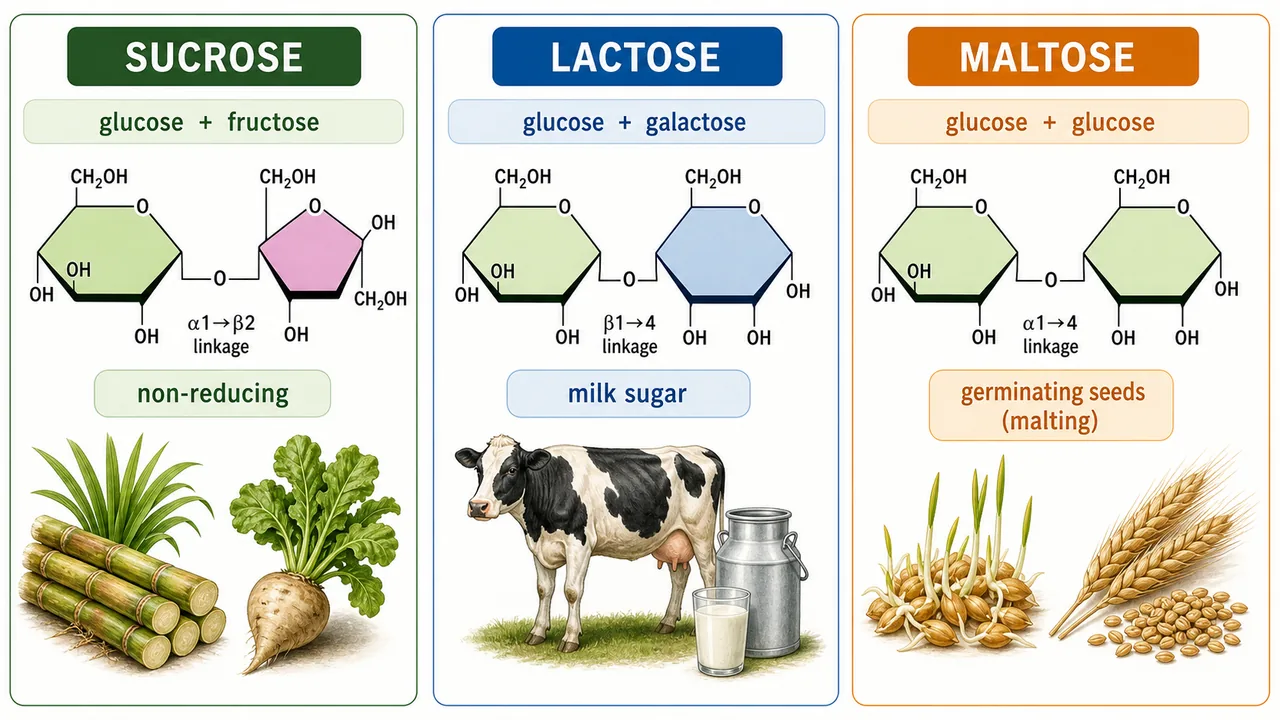
| Sucrose | Glucose + Fructose | alpha-(1→2)-beta | Non-reducing sugar; also called invert sugar parent disaccharide because hydrolysis yields an equimolar glucose-fructose mix | The sugar extracted from sugarcane and sugar beet; also the principal translocated sugar in most plants |
| Lactose | Glucose + Galactose | beta-(1→4) | Milk sugar | Important in dairy farming |
| Maltose | Glucose + Glucose | alpha-(1→4) | Found in germinating seeds; also appears as an intermediate product during starch digestion | Produced during malting of barley (beer and whisky production) |
| Trehalose | Glucose + Glucose | alpha-(1→1) | Non-reducing disaccharide | Commonly recalled from fungi, yeasts, and the haemolymph of insects |
IMPORTANT
Sucrose is the only common disaccharide that is non-reducing. Lactose and Maltose are reducing sugars. This is frequently tested!
NOTE
A sugar is called reducing when it has a free aldehyde or ketone group available to react. Sucrose is non-reducing because the reactive groups of both monosaccharides are tied up in the glycosidic bond, so it does not show mutarotation.
-
On hydrolysis, sucrose yields glucose + fructose in equal proportion; this mixture is classically called invert sugar.
-
In plant metabolism, sucrose is especially important because it serves as the major transport form of carbohydrate in the phloem, linking source leaves with developing sinks such as grains, fruits, roots, and storage organs.
Trisaccharides
- Three monosaccharide units.
- Example: Raffinose (Glucose + Fructose + Galactose), Melezitose.
Tetrasaccharides
- Four monosaccharide units.
- Example: Stachyose (1 Glucose + 1 Fructose + 2 Galactose).
Agricultural note: Raffinose and stachyose in soybean and pulses cause flatulence. Breeding for low raffinose content is an active area of pulse improvement.
3. Polysaccharides (10+ Sugar Units)
- Insoluble in water, tasteless, linear or branched.
- Serve as structural components, nutrients, and stored energy.
- Non-reducing in nature.
| Polysaccharide | Found in | Function | Iodine Test Colour |
|---|---|---|---|
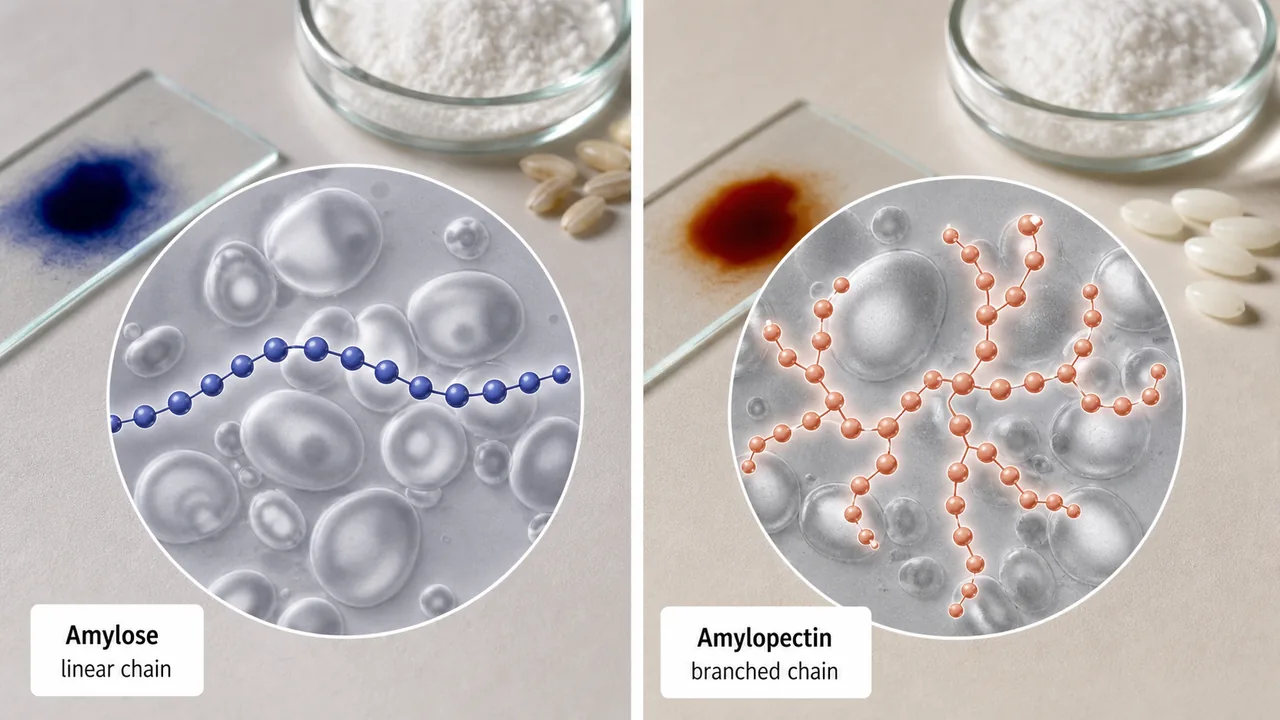
| Starch (Amylose) | Plants (seeds, tubers) | Energy storage | Deep blue |
| Starch (Amylopectin) | Plants (seeds, tubers) | Energy storage | Red |
| Glycogen | Animal cells only | Energy storage | — |
| Cellulose | Plant cell walls | Structural support | — |
TIP
Memory aid for iodine test: Amylose = Blue (alphabetical order), Amylopectin = Red.
- The iodine test is the standard quick test used to detect the presence of starch in a sample.
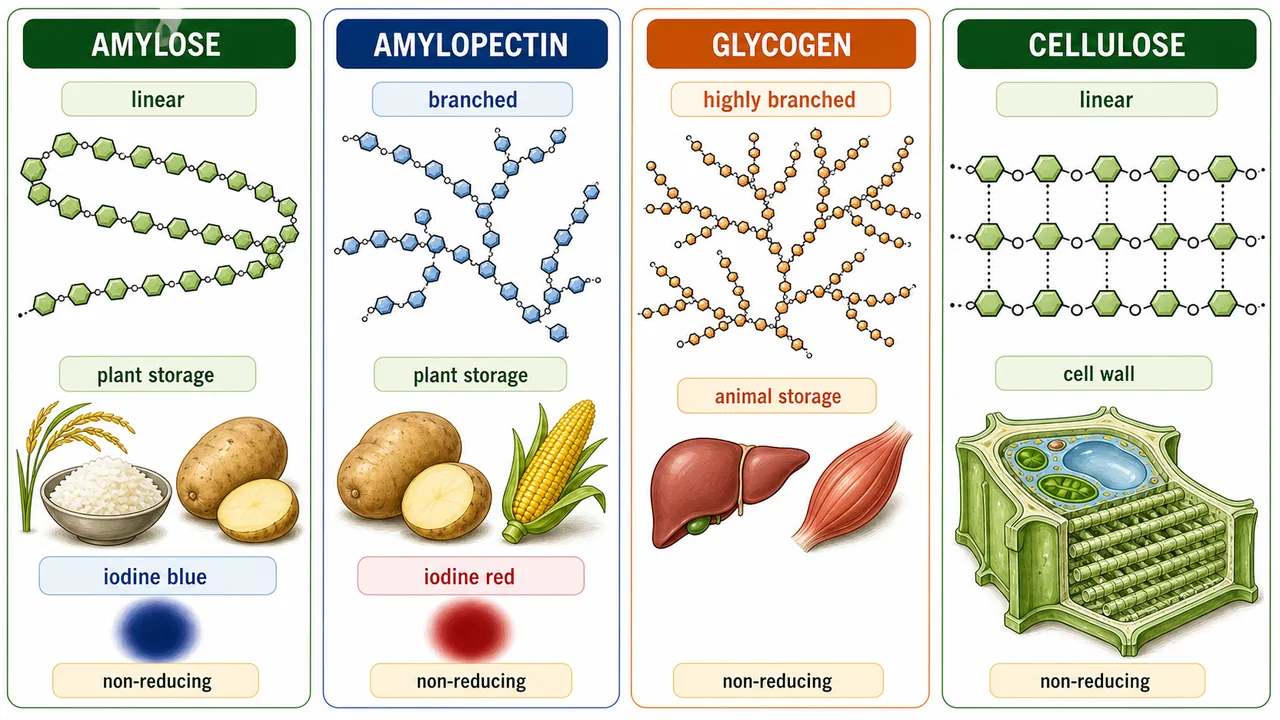
Agricultural application: Waxy rice varieties have nearly 100% amylopectin (sticky texture), while non-waxy varieties have 20–30% amylose (fluffy texture). Breeders select for amylose content to match consumer preferences.
Another Way to Classify Polysaccharides
| Classification basis | Type | Meaning | Examples |
|---|---|---|---|
| Repeating unit | Homopolysaccharides | Built from one kind of monosaccharide | Starch, Cellulose, Glycogen, Inulin, Chitin |
| Repeating unit | Heteropolysaccharides | Built from more than one kind of monosaccharide | Hemicellulose, Pectin |
| Function | Storage polysaccharides | Store food reserve | Starch in plants, Glycogen in animals, Inulin in some plants |
| Function | Structural polysaccharides | Provide structure | Cellulose, Hemicellulose, Pectin |
Important Structural Facts Often Asked Directly
- Amylose is a mostly linear polymer of alpha-D-glucose linked by alpha-(1,4) bonds and forms about 20% of common starch.
- Amylopectin is branched, contains alpha-(1,4) bonds in the main chain and alpha-(1,6) branch points, and forms about 80% of common starch; branch points are classically recalled at roughly every 25-30 glucose residues.
- Glycogen is the animal storage polysaccharide and is often called animal starch; it is built from alpha-D-glucose, has alpha-(1,4) linkages in the main chain and alpha-(1,6) branch points, and is branched more frequently than starch, commonly recalled at about every 10 glucose units.
- Cellulose is a linear polymer of beta-D-glucose linked by beta-(1,4) bonds; it is the most abundant organic substance in nature and humans cannot digest it because they lack cellulase.
- Important building blocks to remember:
- Starch and glycogen: alpha-D-glucose
- Cellulose: beta-D-glucose
- Chitin: N-acetylglucosamine
- Pectin: galacturonic acid
- Hemicellulose commonly contains xylose along with sugars such as arabinose, mannose, and galactose
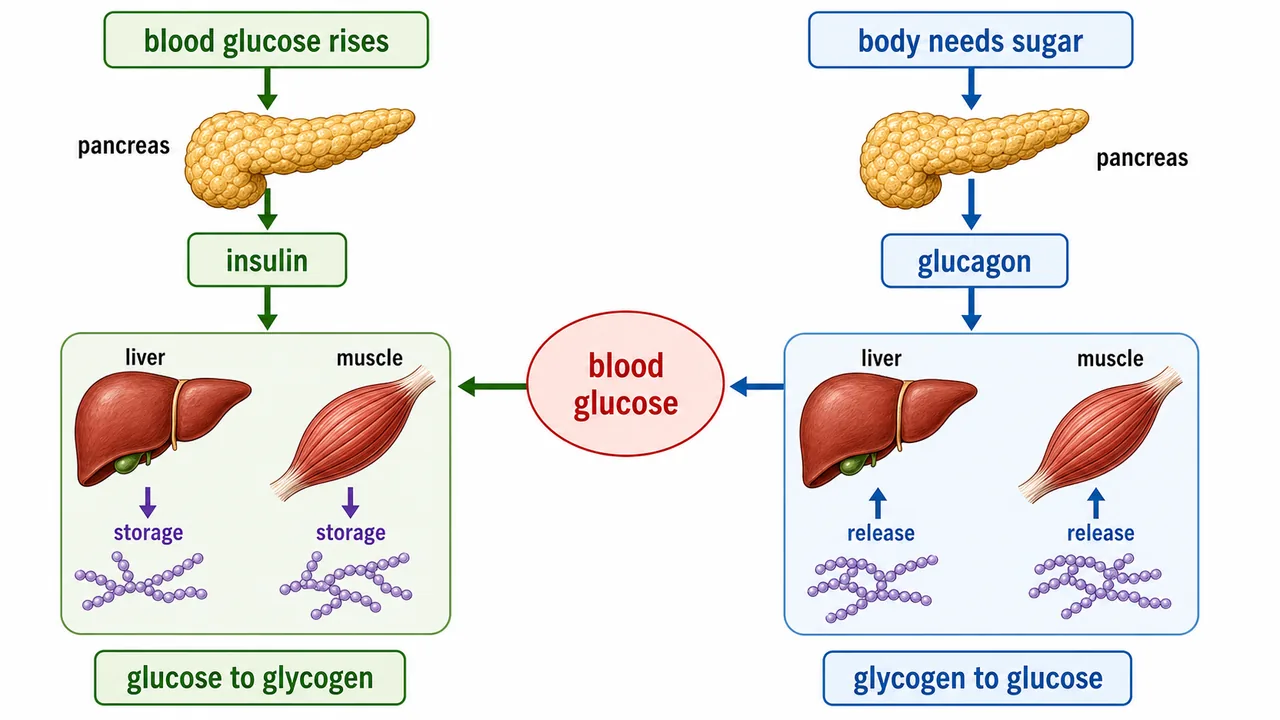
Glucose and Glycogen in the Human Body
Understanding sugar metabolism is relevant for nutrition-focused agricultural questions:
| Condition | Hormone | Source | Action |
|---|---|---|---|
| Blood glucose rises | Insulin | Pancreas | Converts glucose → glycogen (storage) |
| Body needs sugar | Glucagon | Pancreas | Converts glycogen → glucose (release) |
- Glucose is the sugar present in blood, used for energy.
- Glycogen is the stored form in liver and muscles.
WARNING
Glycogen vs Starch MCQ trap: Both are storage polysaccharides, but Glycogen is found in animals (liver and muscle) while Starch is found in plants (seeds, tubers, bulbs). Glycogen does NOT occur in plants.
NOTE
Insulin lowers blood sugar (glucose → glycogen). Glucagon raises blood sugar (glycogen → glucose). Both are produced by the pancreas. (exams Mains 2023)
Summary Cheat Sheet
| Concept / Topic | Key Details |
|---|---|
| Carbohydrate general formula | (CH₂O)n — "hydrates of carbon" |
| Early biochemistry milestone | Wohler (1828) synthesized urea from inorganic substances |
| Carbohydrate content in plants | 50–80% of dry weight |
| C:H:O ratio | 1:2:1 |
| Monosaccharides | 1 sugar unit; soluble, sweet, all reducing |
| Fructose | Sweetest of all sugars (monosaccharide) |
| Oligosaccharides | 2–10 sugar units; soluble, sweet |
| Sucrose | Glucose + Fructose; only common non-reducing disaccharide |
| Lactose | Glucose + Galactose; milk sugar |
| Maltose | Glucose + Glucose; found in germinating seeds |
| Trehalose | Glucose + Glucose; non-reducing, found in fungi / yeasts / insects |
| Raffinose | Trisaccharide (Glc + Fru + Gal); causes flatulence in pulses |
| Stachyose | Tetrasaccharide (1 Glc + 1 Fru + 2 Gal) |
| Polysaccharides | 10+ units; insoluble, tasteless, non-reducing |
| Starch formula | (C₆H₁₀O₅)n; stored in seeds, bulbs, tubers |
| Amylose + Iodine | Deep blue / blue-black colour |
| Amylopectin + Iodine | Red colour |
| Waxy rice starch | Nearly 100% amylopectin (sticky) |
| D vs L sugar basis | Position of terminal OH in reference projection |
| Aldose vs ketose basis | Presence of aldehyde vs ketone group |
| Fruit sugar | Fructose |
| Grape / corn sugar | Glucose (Dextrose) |
| Wood sugar | Xylose |
| Cellulose | Structural polysaccharide of cell walls |
| Glycogen | Animal storage polysaccharide (not in plants) |
| Homopolysaccharides | Starch, cellulose, glycogen, inulin, chitin |
| Heteropolysaccharides | Hemicellulose, pectin |
| Insulin hormone | Converts glucose → glycogen; lowers blood sugar |
| Glucagon hormone | Converts glycogen → glucose; raises blood sugar |
| Both hormones produced by | Pancreas |
| Quantum yield | Ratio of photochemical products to total quanta absorbed |
| Glycosidic bonds | Link glucose monomers in starch |
Lesson Doubts
Ask questions, get expert answers