🥩 Proteins and Amino Acids
Understand protein structure, amino acid classification, essential amino acids, deficient amino acids in crops, and protein types — with agricultural examples and exam mnemonics.
Why Proteins Matter in Agriculture
When a nutritionist says "pulses are protein-rich but deficient in methionine" or a plant breeder develops Quality Protein Maize (QPM) with enhanced lysine and tryptophan, they are dealing with protein biochemistry. Protein content and amino acid composition determine the nutritional quality of crops — a central concern in biofortification programmes aimed at fighting malnutrition. Understanding proteins is also essential because all enzymes that drive metabolic processes in crops are proteins.
What Are Proteins?
Proteins are the most versatile macromolecules in living systems, serving as structural components, enzymes, hormones, and antibodies.
| Feature | Detail |
|---|---|
| Name suggested by | Berzelius (1838) |
| Building blocks | Amino acids (polymers of amino acids) |
| Bond between amino acids | Peptide bond |
| Functions | Structure, enzyme catalysis, hormones, antibodies, muscle building, tissue repair |
- Proteins were first studied in early chemistry by Mulder, and the word "protein" traces to the Greek word proteios, conveying the idea of something of primary importance.
- Proteins are nitrogenous biomolecules built mainly from C, H, O, N and often S; the classical recall value for nitrogen content is about 16%.
- Storage proteins are especially important in agriculture because cereals are rich in prolamins while many pulses are rich in globulins.
Amino Acids
Amino acids are organic compounds containing both an amino group (−NH₂) and a carboxylic acid group (−COOH). They are the building blocks of all proteins.

- About 300 amino acids occur in nature.
- Only 20 amino acids are required by the human body — 10 essential and 10 non-essential.
- Sulphur-containing amino acids are commonly recalled as methionine, cysteine, and the disulfide-linked form cystine.
- Amino acids can exist in both D and L forms, but proteins in living systems predominantly use the L-form.
- Amino acids in solution often behave as zwitterions because they carry both positive and negative charges.
Essential Amino Acids
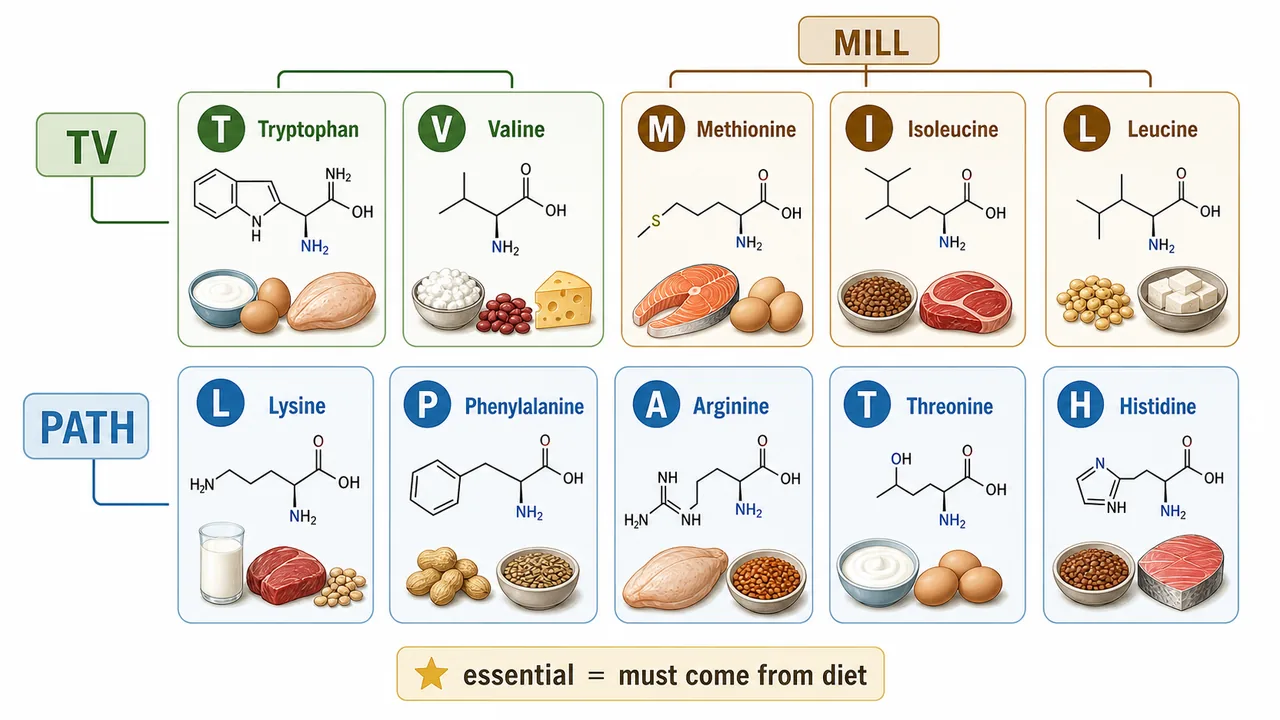
Essential amino acids cannot be synthesised in the human body and must come from the diet. There are 10 essential amino acids.
- In older nutrition-oriented agriculture recall, arginine and histidine are often highlighted as especially important essential amino acids during childhood growth.
- Because of that age-related nuance, some compact lists mention 9 essential amino acids when arginine is not counted separately for the adult requirement framing.
TIP
Mnemonic: "TV MILL PATH" Tryptophan, Valine, Methionine, Iso-leucine, Leucine, Lysine, Phenyl-alanine, Arginine, Threonine, Histidine
The 10 non-essential amino acids commonly listed in introductory agriculture biochemistry are alanine, asparagine, aspartic acid, glutamic acid, glutamine, glycine, proline, serine, cysteine, and tyrosine.
Frequently Asked Amino Acid Facts
- Glycine is the simplest amino acid and the only common amino acid that is achiral / optically inactive.
- Because its alpha carbon carries two hydrogen atoms, glycine is also described as the only common amino acid treated as symmetric.
- Glycine also has a characteristically sweet taste.
- Proline is classically remembered as the only common amino acid with a distinctly cyclic side-chain arrangement.
- In older biochemistry one-liners, alanine is commonly associated with muscle tissue.
- Common non-polar amino acids include glycine, alanine, methionine, phenylalanine, and tryptophan.
- In basic biochemical grouping, non-polar amino acids are generally treated as more hydrophobic, whereas polar amino acids are usually more hydrophilic.
- Standard textbook examples of acidic amino acids are aspartic acid and glutamic acid, while lysine, arginine, and histidine are the classic basic amino acids.
- In simple charge-based classification, the acidic group is remembered as carrying a net negative charge more readily, whereas the basic group is remembered as carrying a net positive charge more readily under physiological conditions.
- The standard aromatic-amino-acid trio is phenylalanine, tyrosine, and tryptophan.
- Sulphur-containing amino acids are classically grouped as methionine, cysteine, and cystine, which is why methionine deficiency matters so much in crop protein quality.
- Cysteine contains a sulphydryl (-SH) group, which is why it can participate directly in forming stabilizing disulfide bonds.
- When two cysteine residues are linked through oxidation of their sulphydryl groups, the resulting disulfide-linked form is called cystine.
- In exam-style biochemical recall, insulin is commonly cited as a sulphur-containing hormone because its polypeptide chains are linked by disulfide bonds.
- Common examples of non-protein / non-standard amino acids include ornithine, citrulline, and taurine.
- In nitrogen-metabolism recall, ornithine, citrulline, and arginine are the classic amino acids linked with the urea (ornithine) cycle.
Deficient Amino Acids in Crops
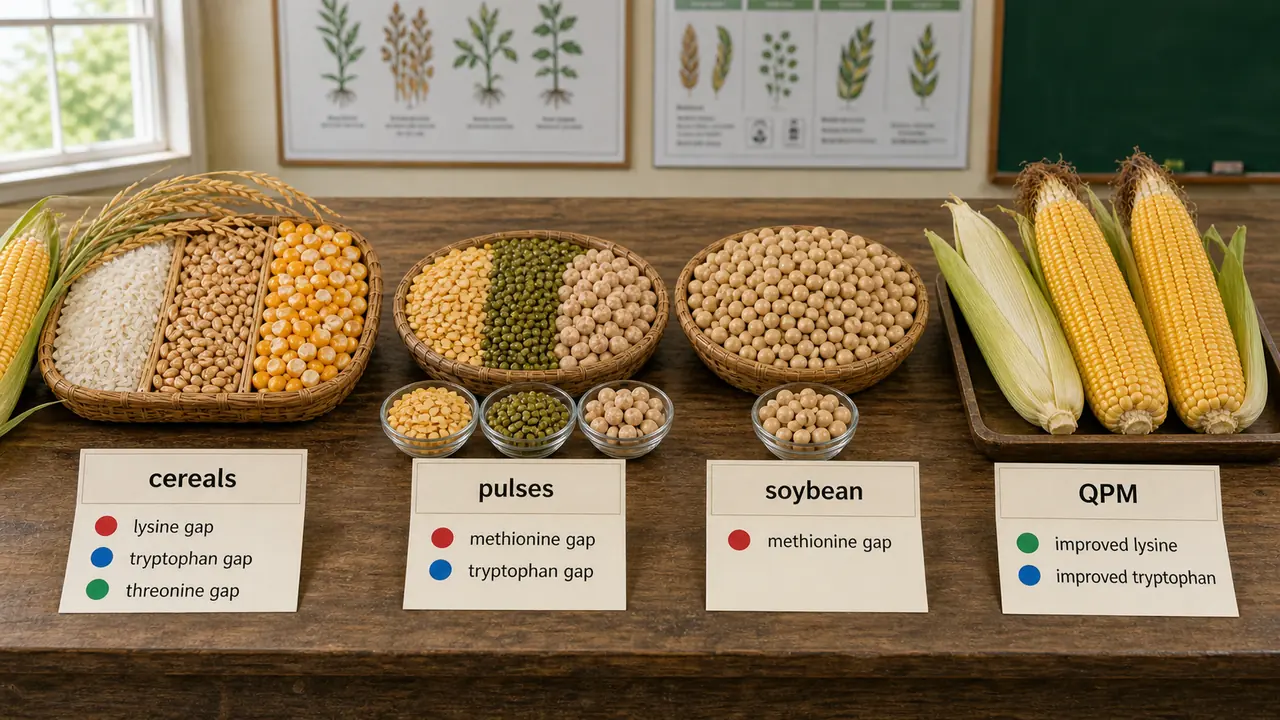
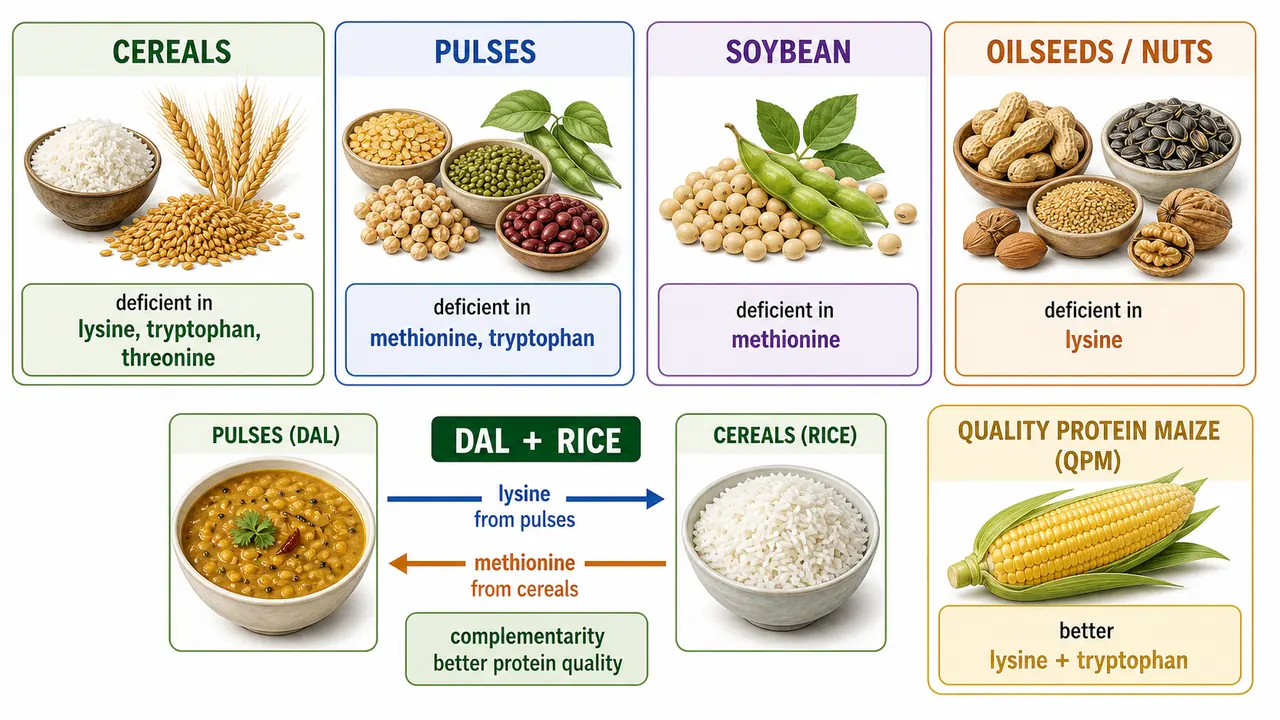
This table is very frequently tested in competitive exams (IBPS AFO, ICAR, NABARD Grade A, and FCI):
| Crop | Deficient Amino Acid | Breeding Implication |
|---|---|---|
| Soybean | Methionine | Breeding for high-methionine soybean is an active research area |
| Green leafy vegetables | Methionine | — |
| Leaves & Grasses | Methionine | Affects fodder quality for livestock |
| Nut & Oil seeds | Lysine | — |
| Pulses | Methionine & Tryptophan | Complementary with cereals (eat dal + rice together) |
| Cereals | Tryptophan, Threonine, Lysine | QPM (Quality Protein Maize) developed with enhanced lysine and tryptophan |
IMPORTANT
Methionine is the most commonly deficient amino acid across crops (soybean, leafy vegetables, leaves, grasses, pulses). Lysine is deficient in cereals and oilseeds.
Agricultural insight: The traditional Indian diet of dal (pulses) + rice (cereal) achieves complementary amino acid balance — pulses supply lysine (deficient in cereals) while cereals supply methionine (deficient in pulses). This is the biochemical basis of balanced vegetarian nutrition.
Essential Fatty Acids
The most important nutritionally discussed unsaturated fatty acids in agriculture are oleic, linoleic, linolenic, and arachidonic. Among these, the fatty acids classically treated as truly essential because the body cannot synthesize them adequately are linoleic acid and alpha-linolenic acid. Arachidonic acid may become conditionally important because it can be formed from linoleic acid, while oleic acid is nutritionally important but not essential.
TIP
A common memory list is OLLA: Oleic acid, Linoleic acid, Linolenic acid, Arachidonic acid This list is useful for remembering major unsaturated fatty acids, but it should not be confused with the narrower physiological definition of essential fatty acids.
Agricultural note: Linoleic and linolenic acids are abundant in oilseed crops like linseed, sunflower, and soybean. Breeding for optimal fatty acid profiles is key in edible oil improvement.
Classification of Proteins
A. Simple Proteins
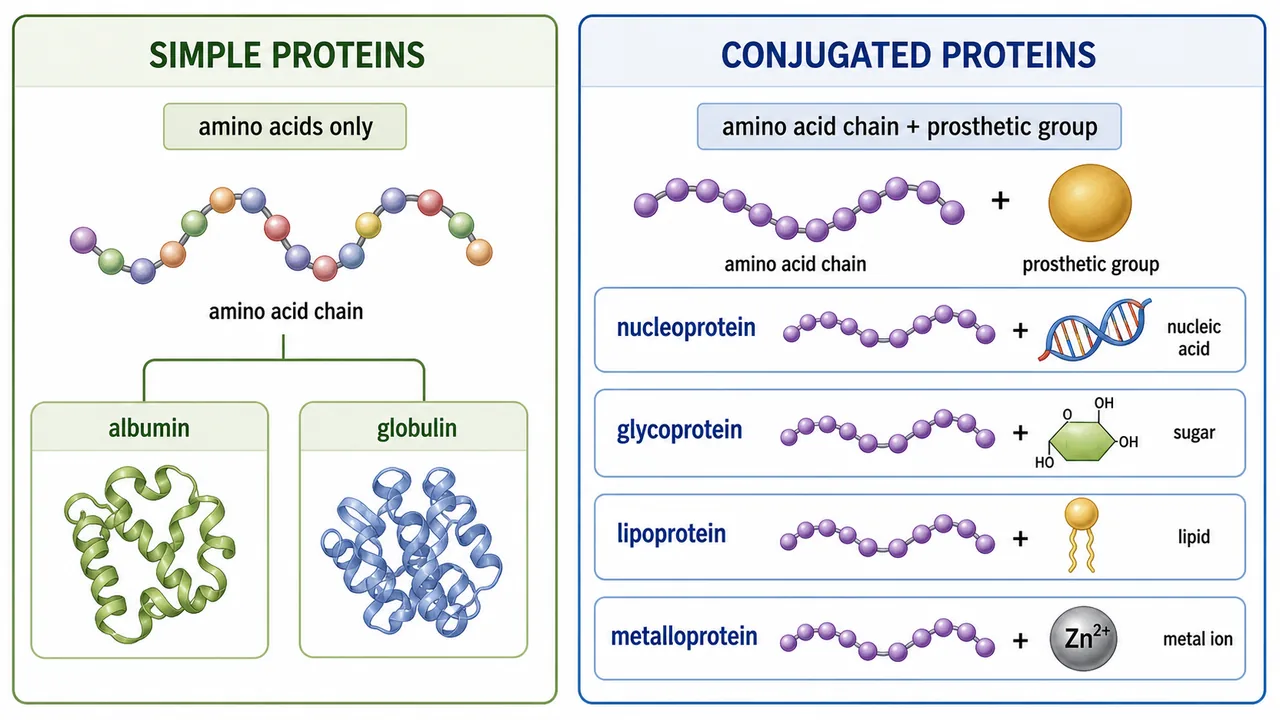
- Contain only amino acids.
- Common recalls include Albumin, Globulin, Prolamin, Histones, and Albuminoids.
- In simple solubility one-liners, albumins are remembered as water-soluble, while fibrous proteins such as keratin are treated as water-insoluble.
B. Conjugated Proteins
- Contain non-amino acid components (called prosthetic groups) in addition to amino acids.
| Type | Prosthetic Group | Example | Agricultural Relevance |
|---|---|---|---|
| Nucleoproteins | Nucleic acid | Chromosomes | Basis of all genetic material |
| Chromoproteins | Pigment-bearing group | Phytochrome | Light perception and signaling in plants |
| Glycoproteins | Sugar units | Mucin | Cell recognition and signalling |
| Lipoproteins | Lipids | HDL, LDL | Fat transport; cell-membrane association in basic recall |
| Metalloproteins | Metal ions | Hemoglobin (Fe) | Iron-containing; oxygen transport |
| Phosphoproteins | Phosphate-containing group | Casein | Storage and nutritional protein example |
NOTE
Simple proteins = only amino acids. Conjugated proteins = amino acids + prosthetic groups (metals, lipids, sugars, or nucleic acids).
Protein Functions Often Asked in Crop and Nutrition Context
| Function type | Example |
|---|---|
| Catalytic proteins | Enzymes |
| Regulatory proteins | Hormones such as insulin |
| Protective proteins | Antibodies / globulins |
| Storage proteins | Globulins in pulses, prolamins in cereals, albumin in egg, and casein in milk |
| Transport proteins | Hemoglobin carries oxygen in blood; myoglobin binds and facilitates oxygen handling in muscle tissue |
| Structural / contractile proteins | Keratin in nails, hair, and wool; Collagen in connective tissue; Actin and Myosin in muscle contraction |
| Fibrous / special protective proteins | Fibroin and sericin in silk; elastin in elastic tissues; antifreeze glycoproteins as cold-protection recalls in fish |
Levels of Protein Structure
| Level | Main idea | Major stabilizing force |
|---|---|---|
| Primary | Linear sequence of amino acids | Peptide bonds |
| Secondary | Local folding such as helix or sheet | Hydrogen bonds |
| Tertiary | Overall 3D shape of one polypeptide chain | H-bonds, hydrophobic interactions, ionic bonds, disulfide bridges |
| Quaternary | Association of multiple polypeptide chains | Interactions between subunits of multi-chain proteins |
Summary Cheat Sheet
| Concept / Topic | Key Details |
|---|---|
| Protein named by | Berzelius (1838); polymers of amino acids |
| Bond linking amino acids | Peptide bond (covalent) |
| Amino acids in nature | ~300 total; only 20 needed by body |
| Essential amino acids count | 10 (cannot be synthesised by body) |
| Amino acids especially emphasized for children | Arginine and Histidine |
| Predominant amino-acid form in living proteins | L-form |
| Amino acid ionic form in solution | Zwitterion |
| Essential AA mnemonic | TV MILL PATH (Tryptophan, Valine, Methionine, Isoleucine, Leucine, Lysine, Phenylalanine, Arginine, Threonine, Histidine) |
| Commonly listed 10 non-essential amino acids | Alanine, Asparagine, Aspartic acid, Glutamic acid, Glutamine, Glycine, Proline, Serine, Cysteine, Tyrosine |
| Non-polar vs polar tendency | Non-polar = more hydrophobic; polar = more hydrophilic |
| Acidic amino acids | Aspartic acid, Glutamic acid |
| Basic amino acids | Lysine, Arginine, Histidine |
| Sulphur-containing amino acids | Methionine, Cysteine, Cystine |
| Simplest / achiral amino acid | Glycine |
| Only common cyclic amino acid | Proline |
| Aromatic amino acids | Phenylalanine, Tyrosine, Tryptophan |
| Oxidized disulfide form of cysteine | Cystine |
| Sulphur-containing hormone recall | Insulin |
| Non-protein amino acid examples | Ornithine, Citrulline, Taurine |
| Soybean deficient in | Methionine |
| Pulses deficient in | Methionine & Tryptophan |
| Cereals deficient in | Tryptophan, Threonine, Lysine |
| Oilseeds / Nuts deficient in | Lysine |
| Green leafy vegetables deficient in | Methionine |
| QPM (Quality Protein Maize) | Enhanced lysine & tryptophan content |
| Dal + Rice complementarity | Pulses supply lysine; cereals supply methionine |
| Kwashiorkor | Classic disease of severe protein deficiency |
| Proteome | Entire protein complement of a cell, tissue, or organism |
| Proteomics | Large-scale study and analysis of the proteome |
| Major unsaturated fatty acids often grouped together | Oleic, Linoleic, Linolenic, Arachidonic |
| Truly essential fatty acids | Linoleic and alpha-linolenic acid |
| Conditionally important fatty acid | Arachidonic acid (can be formed from linoleic acid) |
| Simple proteins | Contain only amino acids (e.g., Albumin, Globulin) |
| Conjugated proteins | Amino acids + prosthetic groups |
| Primary structure stabilised by | Peptide bonds |
| Secondary structure stabilised by | Hydrogen bonds |
| Tertiary structure stabilised by | H-bonds, ionic bonds, hydrophobic interactions, disulfide bonds |
| Nucleoproteins | Prosthetic group = nucleic acid (chromosomes) |
| Glycoproteins | Prosthetic group = sugar units |
| Lipoproteins | Prosthetic group = lipids (HDL, LDL) |
| Metalloproteins | Prosthetic group = metal ions (e.g., Hemoglobin with Fe) |
Lesson Doubts
Ask questions, get expert answers