🧬 Nucleic Acids, Enzymes, Vitamins, and Lipids
Understand DNA, RNA, enzyme characteristics, vitamin classification, lipid types, and dietary fibre through agricultural examples and clear conceptual explanations.
Why These Biomolecules Matter in Agriculture
When a plant pathologist uses PCR to detect a virus in a potato sample, the technique relies on the biochemistry of nucleic acids. When a seed scientist tests lipase activity to assess seed viability, they are measuring enzyme function. When a nutritionist promotes biofortified crops rich in Vitamin A (golden rice, orange-fleshed sweet potato), they are applying knowledge of vitamins. And when an oilseed breeder improves the fatty acid profile of mustard, they are working with lipids. These four biomolecule classes underpin much of agricultural science.
NOTE
The term biochemistry was introduced by Carl Neuberg (1903), who is often remembered as the father of biochemistry.
Enzymes
Enzymes are special classes of proteins that act as biological catalysts — they speed up chemical reactions without being consumed.
| Feature | Detail |
|---|---|
| First enzyme discovered | Payen (diastase / amylase-related activity, 1833) |
| First enzymatic activity discovered by | Buchner (Zymase from yeast — the first enzyme found) |
| Term "enzyme" coined by | W. Kuhne (1878) |
| Lock and key model | Proposed by Fisher; introduced by Koshland |
- A classic milestone in enzyme chemistry is the work of J.B. Sumner (1926), who purified and crystallized urease. This helped establish that enzymes are fundamentally proteinaceous in nature, apart from later-recognized catalytic RNAs such as ribozymes.
- In standard history recall, the discovery of catalytic RNA is linked with Altman and Cech, which is why a ribozyme is remembered as the exceptional catalytic molecule that is not a protein.
Characteristics of Enzymes
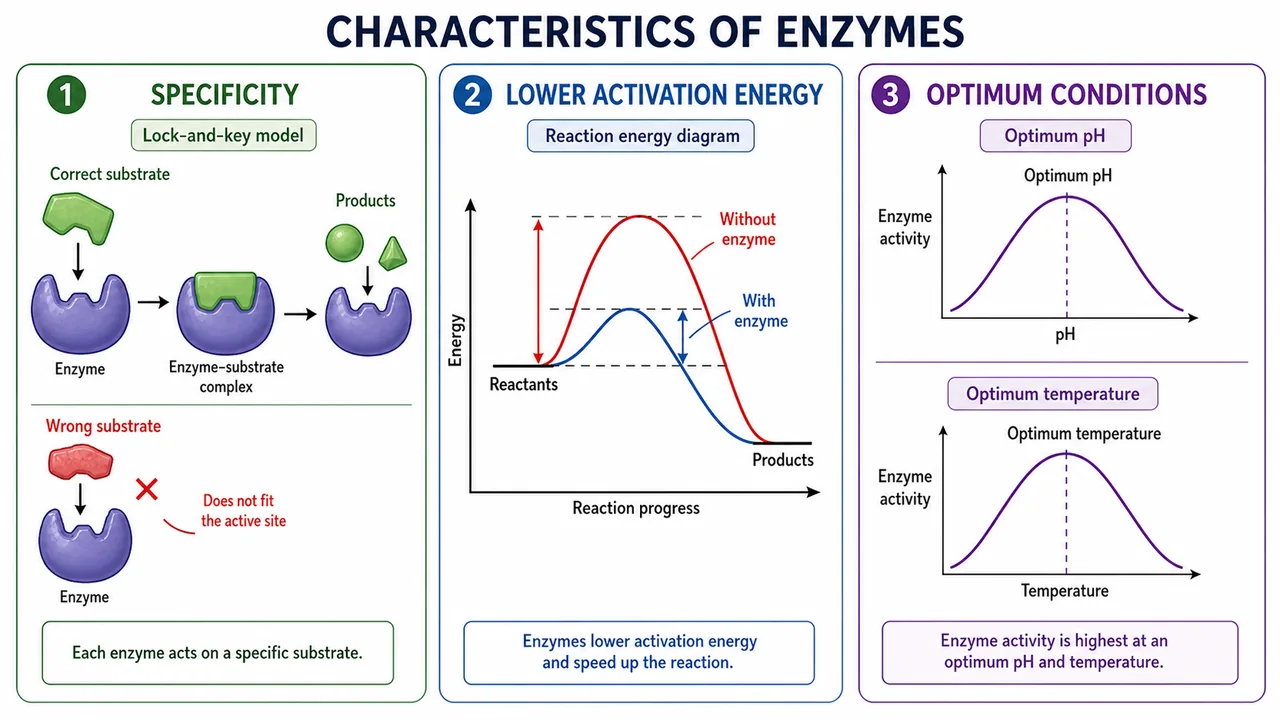
- Specific, proteinaceous, colloidal in nature.
- Sensitive to temperature and pH (each enzyme has an optimum).
- Often described as thermolabile and amphoteric because their protein nature makes them heat-sensitive and capable of acid-base behavior.
- Do not change the equilibrium of a reaction — only speed it up.
- Work by lowering the activation energy.
- Required only in very small quantities and generally regain their original state after the reaction cycle.
- In enzyme classification language, a hydrolase catalyzes bond cleavage by the addition of water, so enzymes such as amylase, lipase, and trypsin are all examples of hydrolytic enzymes acting on starch, fats, and proteins respectively.
- In ATP-linked biosynthetic reactions, enzymes named synthetases or ligases are classically described as joining two molecules together with energy input from ATP hydrolysis. A standard agricultural biochemistry example is glutamine synthetase, a key enzyme in the assimilation of ammonia into organic form.
IMPORTANT
Enzymes are NOT consumed in reactions and do NOT change equilibrium — they only speed up the reaction by lowering the activation energy. This distinction is frequently tested.
Agricultural example: Amylase enzymes in germinating barley break down starch into maltose — the basis of the malting industry. Cellulase enzymes are used in biofuel production from crop residues. Lipase activity in stored oilseeds indicates rancidity (important for seed quality testing).
- The idea of an optimum pH becomes very intuitive when digestion enzymes are compared: pepsin works best in the strongly acidic environment of the stomach, whereas trypsin functions best under alkaline conditions in the intestine.
- In basic enzyme kinetics, the rate first rises as substrate concentration increases, but then approaches a limit when the available enzyme molecules become saturated. This classical relationship is described as a rectangular-hyperbola type curve in introductory biochemistry.
Factors Affecting Enzyme Activity
- Substrate concentration: reaction rate rises first and then levels off once all active sites become occupied.
- Enzyme concentration: increasing enzyme amount raises the rate only while substrate remains available in excess.
- Temperature: the classical recall is Q10 ≈ 2, meaning the rate often roughly doubles for each 10°C rise within the workable range; many introductory notes place the optimum range around 30-40°C, while many enzymes are strongly inactivated above about 55-60°C.
- pH: many enzymes work best near a moderate range around pH 7-8, but important exceptions include pepsin at low pH and trypsin under alkaline conditions.
- Water: low moisture suppresses enzyme action in dry seeds, whereas hydration during germination activates enzyme systems.
- Inhibitors and activators: chemical environment can either suppress or enhance catalysis.
- A standard agricultural example is glyphosate, which inhibits EPSP synthase in the shikimate pathway, disrupting aromatic-amino-acid synthesis and thereby killing susceptible weeds.
Apoenzyme, Cofactor, Coenzyme, and Holoenzyme
- Many enzymes work as a combined system rather than as protein alone.
- The protein part of an enzyme is called the apoenzyme.
- The required non-protein helper is called a cofactor.
- When the cofactor is an organic molecule that associates loosely with the enzyme, it is called a coenzyme. Common examples include NAD, NADP, and ATP.
- When the non-protein component remains tightly bound to the enzyme, it is commonly described as a prosthetic group.
- In many enzyme systems, the required helper may also be a metal activator such as Fe, Mg, Mn, or Zn, which is why cofactors are not limited to organic coenzymes alone.
- When the apoenzyme is combined with its required cofactor, the complete active unit is called a holoenzyme.
| Term | Meaning |
|---|---|
| Apoenzyme | Protein part alone; inactive by itself in many enzyme systems |
| Cofactor | Non-protein component needed for enzyme activity |
| Coenzyme | Organic cofactor, often vitamin-derived and loosely bound |
| Prosthetic group | Non-protein component that is tightly bound to the enzyme |
| Holoenzyme | Complete active enzyme = apoenzyme + cofactor |
Specificity of Enzymes
| Type of specificity | Meaning | Classical example |
|---|---|---|
| Absolute specificity | Acts on a single substrate only | Urease acting on urea |
| Group specificity | Acts on a group of related substrates with similar bonds | Amylase acting on starch-like alpha-linked glucans |
| Optical specificity | Distinguishes between stereochemical forms | Maltase acting on the alpha but not the beta glycosidic form |
Simple vs Conjugated Enzymes
- Simple enzymes are composed only of protein. Common recall examples include trypsin, pepsin, amylase, and urease.
- Conjugated enzymes require a protein part plus a non-protein component, which connects directly with the apoenzyme-cofactor-holoenzyme framework above.
Inducible vs Constitutive Enzymes
- Inducible enzymes appear mainly in the presence of their relevant substrate or signal. A standard plant example is nitrate reductase.
- Non-inducible / constitutive enzymes are produced more continuously as part of the cell's basic metabolic machinery.
Six Major Enzyme Classes
The International Union of Biochemistry (IUB) grouped enzymes into six major classes.
| Class | Main role | Classical examples |
|---|---|---|
| Oxidoreductases | Catalyze oxidation-reduction reactions | Alcohol dehydrogenase, peroxidase, cytochrome oxidase, nitrate reductase |
| Transferases | Transfer functional groups between molecules | Hexokinase |
| Hydrolases | Break bonds with the addition of water | Invertase / sucrase, amylase, lipase, phosphatase, pepsin, trypsin |
| Lyases | Remove groups without hydrolysis, often forming double bonds | Carboxylase, aldolase, fumarase |
| Isomerases | Interconvert optical, positional, or geometrical isomers | Retinene isomerase |
| Ligases | Join molecules using energy from high-energy bonds | Glutamine synthetase, DNA ligase |
Mechanism of Enzyme Action
- The active site is the region of an enzyme where the substrate binds and catalysis occurs.
- The transient intermediate stage between substrate and product is called the transition state.
- Activation energy is the minimum energy needed for substrate molecules to reach that transition state.
- Reaction rate increases as activation energy falls, which is why enzymes accelerate reactions by providing a lower-energy pathway.
- The classical lock-and-key model is linked with Emil Fischer (1894), while the induced-fit hypothesis was proposed by Koshland (1959).
- Isoenzymes / isozymes are multiple molecular forms of an enzyme that catalyze the same reaction within a species or even within a single cell type; lactate dehydrogenase is the standard example.
Vitamins as Cofactors and Coenzymes
- Many vitamins function as parts of coenzymes, which help enzymes transfer electrons, carbon groups, or other chemical fragments.
- Biotin is especially important in carboxylation reactions and is a classic example of a vitamin acting through coenzyme function.
- In direct vitamin-biochemistry recall, pantothenic acid is linked with coenzyme A (CoA), while niacin is linked with the electron-transfer coenzymes NAD and NADP.
- The language of metabolites, pathways, and coenzymes is central to biochemistry because enzymes do not act in isolation; they act inside linked metabolic networks.
Vitamins
- The term vitamin was introduced by Casimir Funk (1912).
- Vitamins mainly act as cofactors for enzymatic activity.
- Vitamins are required only in small quantities for proper growth and development, and unlike carbohydrates, fats, or proteins, they do not themselves provide energy.
- In standard agricultural biochemistry classification, the sulphur-containing vitamins are commonly identified as thiamine and biotin.
- Niacin is classically linked with tryptophan because it can be synthesized from tryptophan in the body.
- Among the B-complex vitamins, vitamin B12 is the one classically noted for containing cobalt.
- Vitamin A is classically associated with the early discovery work of McCollum and Davis (1913).
- Introductory nutrition recall commonly treats the total number of well-defined vitamins as 13.
- Vitamins C and E are the standard antioxidant-vitamin recall pair.
- Vitamin D is often described as functioning in a hormone-like manner, and its active physiological form is remembered as calcitriol.
Classification of Vitamins
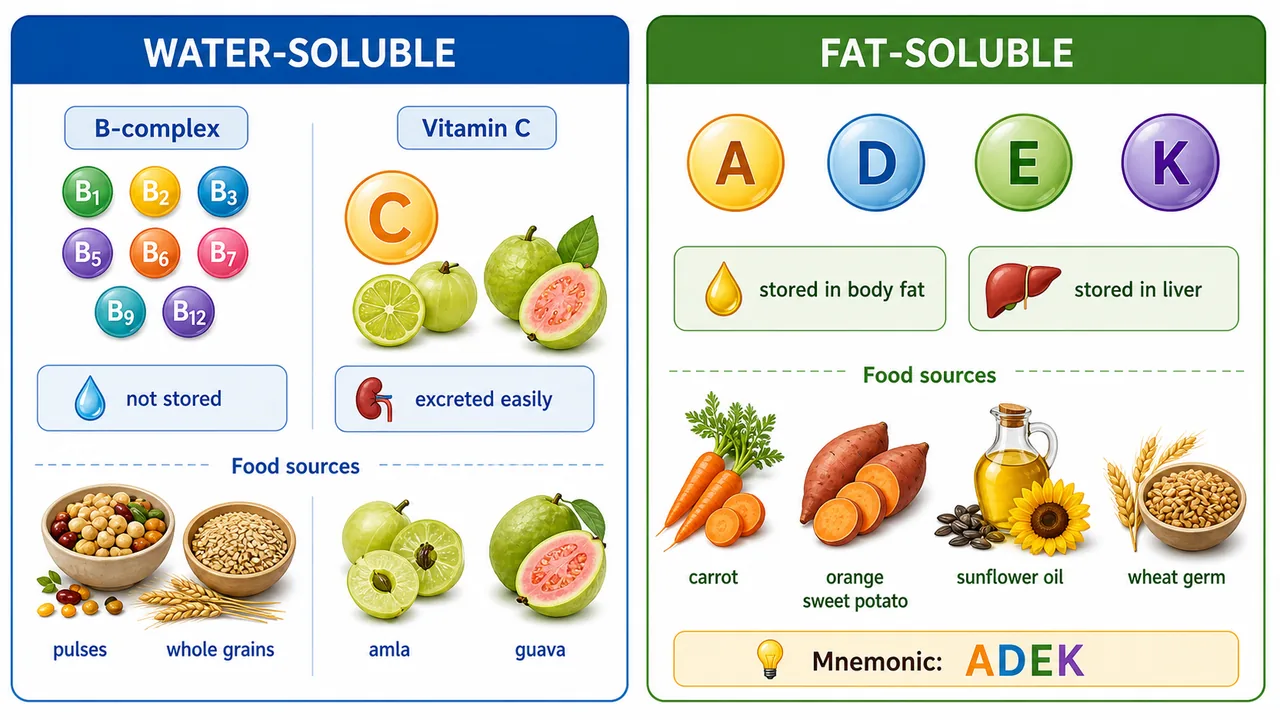
| Type | Vitamins | Key Feature |
|---|---|---|
| Water soluble | Vitamin B complex & Vitamin C | Excreted easily; not stored in body |
| Fat soluble | Vitamin A, D, E, K | Stored in body fat and liver |
TIP
Memory aid for fat-soluble vitamins: "ADEK" — A, D, E, K. Everything else (B complex, C) is water-soluble.
Agricultural connection: Biofortification breeding programmes target vitamin content in crops:
- Vitamin A → Golden Rice (beta-carotene enriched), orange-fleshed sweet potato
- Vitamin C → Amla (Indian gooseberry), guava
- Vitamin E → Sunflower and wheat germ oil
Nucleic Acids
Nucleic acids are polymers of nucleotides joined by phosphodiester bonds.

Functions:
- Transmission of hereditary characters from parents to offspring.
- Synthesis of proteins.
Types: DNA (Deoxyribose Nucleic Acid) and RNA (Ribose Nucleic Acid).
Components of Nucleic Acids
| Component | Examples |
|---|---|
| Sugar | Ribose (RNA) or Deoxyribose (DNA) |
| Phosphate group | Phosphoric acid |
| Nitrogenous bases | Purines (A, G) and Pyrimidines (T, C, U) |
| Term | Definition |
|---|---|
| Nucleoside | Sugar + Nitrogenous base |
| Nucleotide | Nucleoside + Phosphate group |
Nitrogenous Bases
| Type | Bases | Ring Structure |
|---|---|---|
| Purines | Adenine (A), Guanine (G) | Double ring |
| Pyrimidines | Thymine (T), Cytosine (C), Uracil (U) | Single ring |
Base Pairing Rules (Chargaff's Rules):
- Adenine (A) pairs with Thymine (T) — 2 hydrogen bonds
- Guanine (G) pairs with Cytosine (C) — 3 hydrogen bonds
- In RNA, Thymine is replaced by Uracil (A pairs with U)
IMPORTANT
A–T (2 H-bonds) and G–C (3 H-bonds) base pairing is fundamental. In RNA, Uracil replaces Thymine.
Mnemonic: Pure As Gold = Purines are Adenine and Guanine.
DNA (Deoxyribonucleic Acid)
| Feature | Detail |
|---|---|
| Sugar | Deoxyribose (pentose) |
| Location | Nucleus, Chloroplast, Mitochondria |
| Function | Protein synthesis; hereditary material |
| Status | Hereditary material in almost all organisms |
RNA (Ribonucleic Acid)
| Feature | Detail |
|---|---|
| Sugar | Ribose |
| Location | All living cells (mostly in cytoplasm) |
| Function | Coding, decoding, gene expression; protein synthesis via translation |

Types of RNA
| Type | Full Name | Function |
|---|---|---|
| tRNA | Transfer RNA | Carries amino acids to ribosome |
| mRNA | Messenger RNA | Carries genetic code from DNA to ribosome |
| rRNA | Ribosomal RNA | Structural component of ribosomes (most abundant) |
Agricultural relevance: RNA viruses cause many major crop diseases — rice tungro, tomato spotted wilt, potato virus Y. Detection of these viruses using RT-PCR (Reverse Transcriptase PCR) is based on understanding RNA structure.
Lipids
Lipids are organic compounds containing hydrogen, carbon, and oxygen atoms that form the structural framework of cell membranes and serve as energy reserves.
- Lipids are defined as esters of glycerol and fatty acids (triglycerides).
- In practical chemical definition, lipids are insoluble or only sparingly soluble in water but dissolve readily in non-polar solvents such as chloroform or benzene.
- Include: fats, waxes, sterols, fat-soluble vitamins, monoglycerides, and phospholipids.
- Because lipids are highly reduced energy-storage molecules, they supply far more energy per unit weight than carbohydrates or proteins.
- In practical nutrition recall, the gross calorific value sequence is commonly stated as fat (about 9.45 kcal/g) > protein (about 5.65 kcal/g) > carbohydrate (about 4.1 kcal/g).
- The more physiologically used energy values are usually remembered as fat 9 kcal/g, carbohydrate 4.1 kcal/g, and protein 4 kcal/g.
- This is why fats are commonly described as supplying a little more than twice as much energy per unit weight as carbohydrates or proteins.
- Fats and oils also have a lower specific gravity than water, which is why they typically float on water.
- Lipids are also important for the absorption of fat-soluble vitamins, especially A, D, E, and K, and for the formation of steroid hormones.
Types of Lipids
In classical biochemistry classification, lipids are often grouped as simple lipids, compound lipids, and derived lipids. This older framework is still useful because it separates reserve fats from membrane lipids and from lipid-derived components.
| Type | Composition | Key Role |
|---|---|---|
| Triglycerides | Glycerol + 3 fatty acids | Energy storage (oils in seeds) |
| Phospholipids | 2 fatty acids + Glycerol + Phosphate group | Cell membrane structure (polar lipids) |
| Glycolipids | Glycerol + Fatty acids + Carbohydrates | Cell recognition |
- Simple lipids are chiefly neutral fats and waxes, built mainly from fatty acids esterified with alcohols.
- In older classification language, these reserve fats and waxes are often grouped under simple / neutral lipids and treated as the main saponifiable storage lipids.
- Compound lipids include phospholipids and glycolipids, where the basic lipid unit is combined with phosphate or carbohydrate groups.
- In the same older wording, compound / complex lipids are also treated as saponifiable lipids because they still contain hydrolysable fatty-acid linkages.
- Derived lipids refers to lipid-derived substances such as fatty acids, sterols, and related hydrolysis products that arise from or function alongside the major lipid classes.
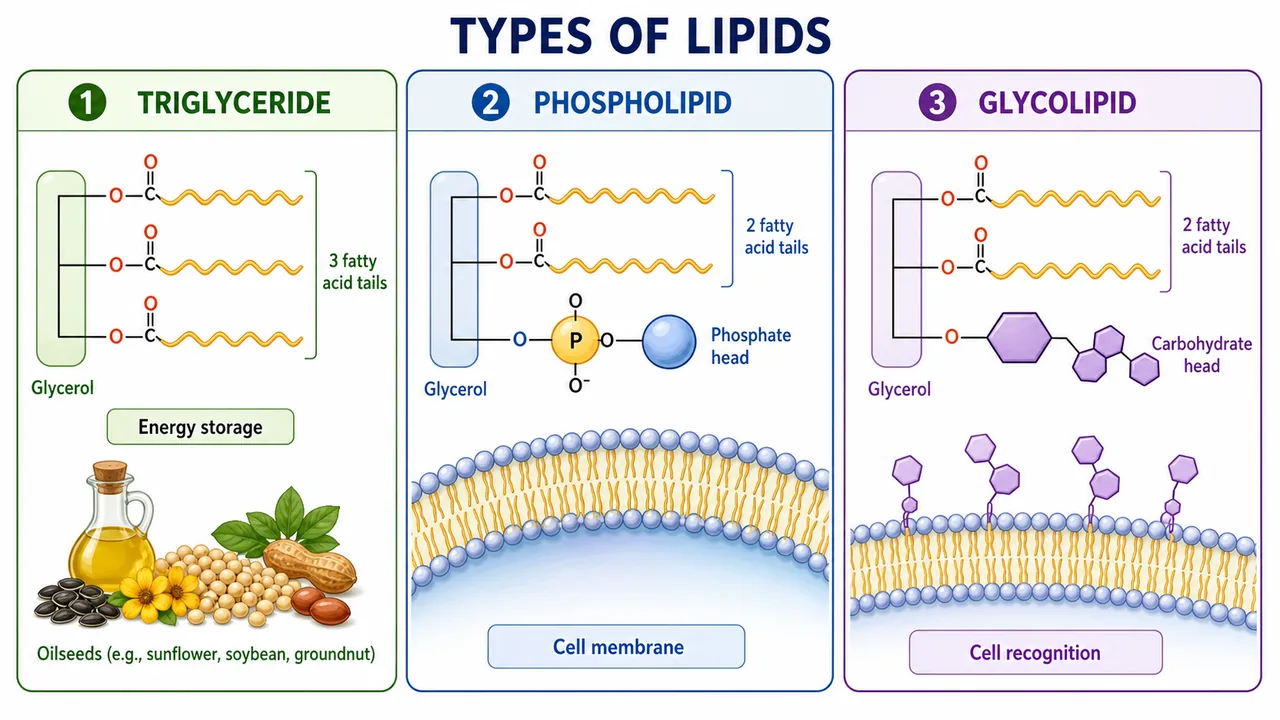
Agricultural connection: The oil content and fatty acid composition of oilseed crops (groundnut, mustard, sunflower, soybean) are primary breeding targets. High oleic acid varieties are preferred for better shelf life and heart health.
Waxes and Lipid Storage Examples
- Waxes differ from ordinary triglyceride fats because they are formed from long-chain fatty acids combined with long-chain monohydric alcohols, rather than with glycerol.
- This is why waxes usually serve more protective or surface-related roles, while triglycerides are the dominant reserve lipids in seeds and many storage tissues.
- A classic natural example is beeswax, which contains myricyl palmitate.
- In agriculture-linked examples, jojoba oil is often discussed as a liquid wax rather than a typical edible oil.
- In many oil-bearing plants, reserve lipids are concentrated in the seed endosperm, while oil palm is a useful contrast because oil occurs both in the mesocarp (palm oil) and in the kernel/endosperm (palm kernel oil).
- In compact edible-oil recall, coconut oil is classically associated with a high proportion of lauric acid.
- In compact edible-oil recall, palm oil is classically associated with a relatively high proportion of palmitic acid.
- Among animal sterols, cholesterol is the standard major example, and it is commonly recalled as a precursor for vitamin D, estrogen, and testosterone.
- Hydrolysis of fats is catalyzed by lipase, the standard enzyme recall paired with lipid breakdown.
Fatty Acids: Saturated vs Unsaturated
| Type | Key feature | Agriculture relevance |
|---|---|---|
| Saturated fatty acids | No double bonds | Usually more stable and less reactive |
| Unsaturated fatty acids | One or more double bonds | Important for edible oil quality, nutrition, and oxidative stability |
TIP
Oilseed quality questions often revolve around whether a variety has more oleic, linoleic, or linolenic acid. The underlying logic is the same: more unsaturation changes nutrition, shelf life, and processing behavior.
- As a broad physical trend, fats richer in saturated fatty acids tend to be more solid at room temperature, whereas oils richer in unsaturated fatty acids tend to remain more liquid at room temperature.
- In the same simple contrast, fats are usually described as solid at room temperature, whereas oils are liquid because of their higher unsaturation.
- In direct fatty-acid recall, the classic saturated fatty acid examples are lauric, myristic, palmitic, and stearic acid. These are commonly used as reference examples when contrasting solid fats with more unsaturated edible oils.
- In direct unsaturated-fatty-acid examples, oleic, erucic, linoleic, linolenic, and arachidonic acid are the standard names students are expected to recognize quickly.
- Monounsaturated fatty acids (MUFA) carry a single double bond; the standard recall examples are oleic acid and erucic acid.
- When two or more double bonds are present, the fatty acid is described as polyunsaturated (PUFA). In this exam-oriented context, linoleic acid and alpha-linolenic acid are the most familiar plant-linked examples.
- In compact PUFA examples, linoleic, linolenic, and arachidonic acid are the usual trio.
- In direct fatty-acid nomenclature recall, alpha-linolenic acid is classically treated as an omega-3 fatty acid, while linoleic acid is treated as an omega-6 fatty acid.
- Among the unsaturated fatty acids encountered in introductory notes, oleic acid and linoleic acid are often highlighted as especially abundant in nature.
- Arachidonic acid is also remembered as the major biochemical precursor for prostaglandins.
- In food-processing terms, hydrogenation adds hydrogen across the double bonds of unsaturated fatty acids, converting a more liquid oil into a more solid fat; this is the classical logic behind products such as vanaspati.
- In practical nutrition and food-processing discussions, partial hydrogenation is also linked with the formation of trans fats, which are generally considered undesirable because they worsen the health profile of the final fat.
- In practical industrial-agriculture recall, linseed oil is the classic drying oil used in paints and varnishes.
Oil Quality Constants and Rancidity
- Stored fats and oils are also judged by a few standard chemical constants that reflect chain length, unsaturation, and deterioration.
| Constant | What it measures | Practical meaning |
|---|---|---|
| Saponification value | Milligrams of KOH required per gram of fat or oil | Higher values are associated with fats containing relatively shorter-chain fatty acids |
| Iodine value | Grams of iodine absorbed by 100 g of fat or oil | Indicates the degree of unsaturation; higher value means more double bonds |
| Reichert-Meisel (R.M.) value | Millilitres of 0.1 N alkali needed to neutralize the water-soluble steam-volatile fatty acids from a standard fat sample | Useful in dairy-fat analysis; a fall in R.M. value can indicate adulteration of butter or ghee with non-milk fat |
| Polenske value | Millilitres of 0.1 N alkali needed to neutralize the water-insoluble steam-volatile fatty acids from a standard fat sample | Complements the R.M. value when characterizing fats containing volatile fatty-acid fractions |
| Acid value | Milligrams of KOH required to neutralize the free fatty acids in 1 g of fat or oil | Reflects the amount of free fatty acids formed during decomposition or storage |
- An increase in free fatty acids usually means the oil is undergoing hydrolytic deterioration.
- For this reason, a rising acid value is used as a practical indicator of rancidity in stored fats and oils.
Vitamins — Deficiency Diseases and Agricultural Sources
| Vitamin | Chemical Name | Deficiency Disease | Rich Agricultural Source |
|---|---|---|---|
| Vitamin A | Retinol | Night blindness, Xerophthalmia | Carrot, Papaya, Mango |
| Vitamin B₁ | Thiamine | Beriberi | Whole grains, Legumes |
| Vitamin B₂ | Riboflavin | — | Almonds, mushrooms, leafy vegetables |
| Vitamin B₃ | Niacin | Pellagra | Groundnut, Meat |
| Vitamin B₆ | Pyridoxine | — | Avocado, poultry, fish |
| Vitamin B₇ | Biotin | — | Walnut, peanut, egg yolk |
| Vitamin B₉ | Folic acid | Megaloblastic anaemia | Green leafy vegetables, Pulses |
| Vitamin B₁₂ | Cyanocobalamin | Pernicious anaemia | Fish, eggs, poultry, meat, dairy products |
| Vitamin C | Ascorbic acid | Scurvy | Amla, Citrus, Guava |
| Vitamin D | Calciferol | Rickets, Osteomalacia | Sunlight, Fish liver oil |
| Vitamin E | Tocopherol | Reproductive failure | Vegetable oils, Wheat germ |
| Vitamin K | Phylloquinone | Haemorrhage | Green leafy vegetables, Soybean |
- Vitamin D can be synthesized in the skin when it is exposed to UV-B sunlight, which is why sunlight itself is treated as a physiologically important source.
- Severe deficiency states are often summarized as impaired red-blood-cell or haemoglobin status in the anaemia-linked vitamins, especially folate and B₁₂.
- Raw egg white can contribute to biotin deficiency because the protein avidin binds biotin strongly and reduces its availability.
- In enzyme-measurement recall, the SI unit of enzyme activity is the katal (kat).
- In amino-acid analysis, the classical color reaction used for quantitative estimation is the ninhydrin test.
TIP
Most asked: Vitamin A = Night blindness. B₁ = Beriberi. B₃ = Pellagra. C = Scurvy (richest source in India = Amla). D = Rickets. K = Haemorrhage.
Primary and Secondary Plant Metabolites
- Primary metabolites are compounds directly required for normal growth, development, and core metabolism. Carbohydrates, proteins, lipids, and nucleic-acid related intermediates fall into this basic metabolic category.
- Secondary metabolites are organic compounds that are not directly part of the plant's primary growth processes, but they are still biologically important in defence, signalling, stress response, and ecological interaction.
- Secondary metabolites are often synthesized when plants respond to pathogens, herbivores, environmental stress, or interactions with other organisms.
- In plant-defence language, such responses are often initiated by elicitor signals, which stimulate the plant to activate defence pathways and increase the production of protective secondary metabolites.
| Group | Common examples | Main ecological or practical role |
|---|---|---|
| Alkaloids | Nicotine, caffeine, quinine, atropine, morphine, codeine, cocaine | Defence, medicinal use, physiological activity |
| Phenolics | Anthocyanins, tannins, lignin, coumarins | Pigmentation, defence, structural support, aroma |
| Terpenoids | Essential oils, resins, carotenoid-related compounds | Defence, attraction, fragrance, plant protection |
- In plants, many phenolic compounds arise through the shikimate pathway or through the acetate-malonate pathway.
- Lignin is built from aromatic alcohol units such as p-coumaryl alcohol, coniferyl alcohol, and sinapyl alcohol, and contributes to rigidity and mechanical support in plant tissues.
- The classic medicinal example of an alkaloid is quinine, obtained from the bark of the Cinchona tree.
- Tannins are astringent phenolic compounds and are classically associated with the tanning of animal hides into leather.
- Coumarin is a phenolic compound associated with the characteristic aroma of freshly cut grasses.
- Additional source-use recalls often paired with alkaloids include atropine from belladonna, reserpine from Rauvolfia serpentina, and the anticancer compounds vinblastine / vincristine from Catharanthus roseus (periwinkle).
- A classic economic example of a plant isoprenoid product is natural rubber from the latex of Hevea brasiliensis.
Dietary Fibre
- Defined as the sum of lignin and polysaccharides that are not digested by human digestive enzymes.
- Important for digestive health.
NOTE
Dietary fibre = lignin + non-digestible polysaccharides. It is often discussed alongside lipids in nutrition contexts. (exams 2023)
Agricultural note: High-fibre crops include whole grains (oats, barley), pulses, and millets. Breeding for appropriate fibre content is important for both human nutrition and animal fodder quality.
Summary Cheat Sheet
| Concept / Topic | Key Details |
|---|---|
| Enzyme definition | Biological catalysts; special class of proteins |
| First enzymatic activity | Discovered by Buchner (Zymase from yeast) |
| Term "enzyme" coined by | W. Kuhne (1878) |
| Lock and key model | Proposed by Fisher; introduced by Koshland |
| Enzymes work by | Lowering activation energy; do NOT change equilibrium |
| Enzyme nature | Proteinaceous, colloidal, specific to substrate |
| Apoenzyme | Protein part of an enzyme |
| Cofactor | Non-protein component required for activity |
| Coenzyme | Organic cofactor such as NAD, NADP, ATP |
| Metal activator examples | Fe, Mg, Mn, Zn |
| Holoenzyme | Complete active enzyme = apoenzyme + cofactor |
| Term "vitamin" coined by | Funk |
| Vitamins act as | Cofactors for enzymatic activity |
| Biochemistry term introduced by | Carl Neuberg (1903) |
| Vitamin especially linked with coenzyme role in carboxylation | Biotin |
| Fat-soluble vitamins | A, D, E, K (mnemonic: ADEK) |
| Water-soluble vitamins | B complex & C; excreted easily, not stored |
| Sulphur-containing vitamins | Thiamine and Biotin |
| Nucleic acids | Polymers of nucleotides joined by phosphodiester bonds |
| Nucleoside | Sugar + Nitrogenous base |
| Nucleotide | Nucleoside + Phosphate group |
| Purines | Adenine (A) & Guanine (G) — double ring |
| Pyrimidines | Thymine (T), Cytosine (C), Uracil (U) — single ring |
| A–T base pairing | 2 hydrogen bonds |
| G–C base pairing | 3 hydrogen bonds |
| RNA vs DNA bases | Uracil replaces Thymine in RNA |
| DNA sugar & location | Deoxyribose; in nucleus, chloroplast, mitochondria |
| DNA function | Hereditary material; protein synthesis |
| tRNA | Carries amino acids to ribosome |
| mRNA | Carries genetic code from DNA to ribosome |
| rRNA | Structural component of ribosomes; most abundant RNA |
| Lipids definition | Esters of glycerol and fatty acids (triglycerides) |
| Gross calorific value order | Fat > Protein > Carbohydrate |
| Physiological fuel values | Fat 9 kcal/g; Carbohydrate 4.1 kcal/g; Protein 4 kcal/g |
| Phospholipids | 2 fatty acids + glycerol + phosphate; form cell membranes |
| Saturated fatty acids | No double bonds |
| Unsaturated fatty acids | One or more double bonds |
| Waxes | Long-chain fatty acids + long-chain monohydric alcohols |
| Classic liquid wax example | Jojoba oil |
| Oil palm storage contrast | Oil in mesocarp and kernel/endosperm |
| Saponification value | mg of KOH needed per gram of fat/oil |
| Iodine value | Measure of the degree of unsaturation |
| Acid value | Measure of free fatty acids and storage deterioration |
| Fats and oils in water | Usually float because their specific gravity is lower than water |
| Dietary fibre | Lignin + non-digestible polysaccharides |
| Vitamin A deficiency | Night blindness, Xerophthalmia — source: Carrot, Papaya, Mango |
| Vitamin B₁ deficiency | Beriberi — source: Whole grains, Legumes |
| Vitamin B₃ deficiency | Pellagra — source: Groundnut, Meat |
| Vitamin C deficiency | Scurvy — richest source in India: Amla |
| Vitamin D deficiency | Rickets, Osteomalacia — source: Sunlight |
| Vitamin K deficiency | Haemorrhage — source: Green leafy vegetables, Soybean |
| Vitamin D synthesis | Skin can synthesize it on exposure to UV-B sunlight |
| Raw egg white and biotin | Avidin binds biotin and can reduce its availability |
| SI unit of enzyme activity | Katal (kat) |
| Quantitative amino-acid test | Ninhydrin test |
| Secondary metabolites | Compounds important in defence, signalling, and stress response |
| Major secondary-metabolite groups | Alkaloids, Phenolics, Terpenoids |
| Quinine source | Cinchona bark |
| Tannin | Astringent phenolic used in tanning leather |
| Coumarin | Phenolic compound linked with freshly cut grass aroma |
| Lignin | Structural phenolic polymer contributing rigidity to plant tissues |
Lesson Doubts
Ask questions, get expert answers