🧪 Biotechnology: Key Terms and Applications
Understand biotechnology fundamentals — key terms (cDNA, GMO, electroporation, transposons), colour-coded application areas, and agricultural biotechnology — with exam tips and summary table.
Why Biotechnology Matters in Agriculture
India's Bt cotton revolution — where insect-resistant cotton transformed the country from a net importer to the world's largest cotton producer — is a direct product of biotechnology. From tissue culture that produces millions of disease-free banana plantlets, to molecular markers that help breeders select drought-tolerant rice varieties without waiting years for field trials, biotechnology tools have become indispensable in modern agriculture. This lesson covers the foundational terms and application areas you need to master.
-
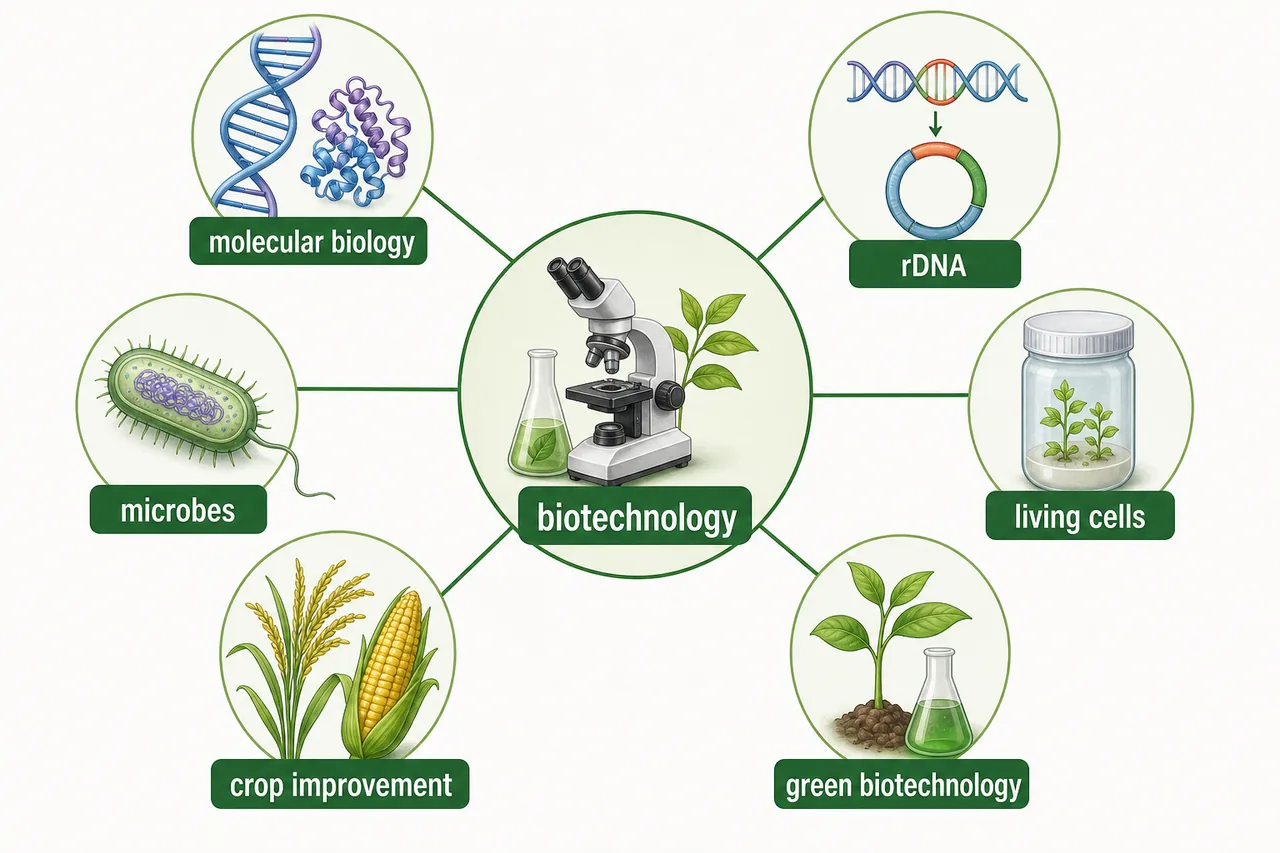
The term 'biotechnology' is composed of two Greek words, Bios + technologia, in which bios means life and technologia means systematic treatment. In essence, biotechnology is the science of harnessing living systems and their components to develop products and processes that benefit humanity.
-
Biotechnology is the applied use of molecular biology and recombinant DNA Technology. These two disciplines form the backbone of modern biotechnology, enabling scientists to understand, manipulate, and utilize genetic material at the molecular level.
-
It is the controlled use of biological agents, such as microorganisms or cellular components, for beneficial use. This means that biotechnology leverages naturally occurring biological processes and directs them toward solving practical problems in agriculture, medicine, industry, and the environment.
NOTE
"Any technological application that uses biological systems, living organisms, or derivatives thereof, to make or modify products or processes for specific use".
-
Biotechnology is the practice of using plants, animals and micro-organisms such as bacteria, as well as biological processes - such as the ripening of fruit or the bacteria that break down compost - to some benefit to humans. This broad definition highlights that biotechnology is not limited to high-tech laboratories -- even traditional practices like fermentation (used in making curd, bread, or alcohol) are forms of biotechnology.
-
The term 'Biotechnology' was coined by Karl Ereky in 1919. Biotechnology aims to improve genetic makeup, phenotypic performance, and multiplication rates of economic plants; and exploit plant cells for useful products or services. Karl Ereky, a Hungarian agricultural engineer, first used the term to describe the integration of biology with technology for large-scale production.
-
Some exam-relevant biotechnology institutions and milestones are also worth keeping together with the basic definition. In India, the Department of Biotechnology (DBT) was created in February 1986. Important centres include ICAR-National Institute for Plant Biotechnology (NIPB), New Delhi, ICAR-Indian Institute of Agricultural Biotechnology (IIAB), Ranchi, Jharkhand, and the International Centre for Genetic Engineering and Biotechnology (ICGEB) with centres at New Delhi and Trieste (Italy).
-
A few additional India-focused institution recalls commonly attached to biotechnology objective questions are: BARC at Trombay, Mumbai, IISc at Bengaluru, CCMB at Hyderabad, and research institutes such as CDRI and NBRI at Lucknow.
-
Biotechnology related to Agriculture is known as Green biotechnology. This branch focuses on developing improved crop varieties, enhancing pest resistance, boosting nutritional quality, and increasing overall agricultural productivity through genetic and cellular techniques.
-
In vitro is a biochemical process or reaction taking place in a test tube (in lab). The Latin term literally means "in glass," referring to experiments performed outside a living organism under controlled laboratory conditions.
-
In vivo is a biological process or reaction taking place in a living cell or organism. This Latin term means "within the living," and refers to processes occurring naturally inside a plant, animal, or microorganism.
TIP
Remember the distinction: In vitro = "in glass" (lab conditions), In vivo = "in life" (inside living organisms). This distinction appears frequently in exam questions.

-
DNA ligase is an enzyme that closes nicks or discontinuities in one strand of double stranded DNA by creating a bond. Think of DNA ligase as molecular glue -- it seals gaps in the DNA backbone, which is essential during both DNA replication and recombinant DNA technology.
-
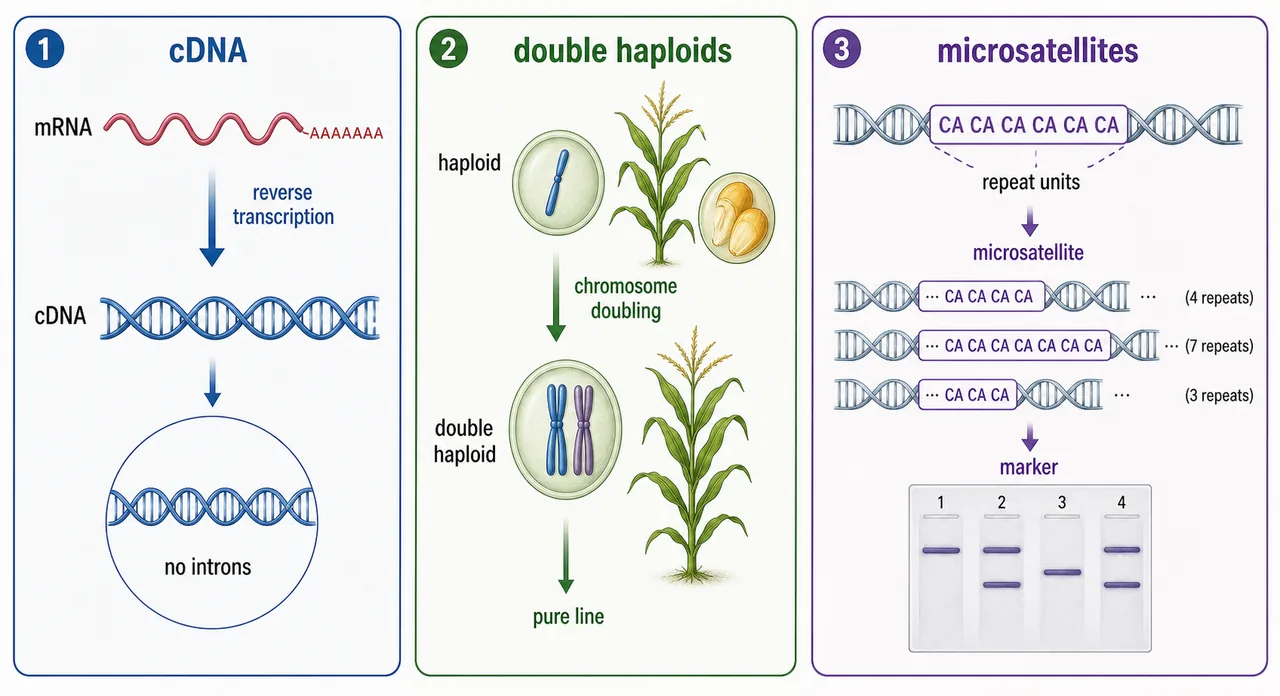
cDNA is a complementary DNA, a fragment of DNA which has been produced from an RNA sequence by reverse transcription. Messenger RNA is commonly used to synthesize cDNA. The significance of cDNA is that it represents only the coding sequences (exons) of a gene, since the introns have already been removed during RNA processing. This makes cDNA extremely useful for gene cloning and expression studies.
-
DNA or Genetic fingerprinting is a technique in which an individual's DNA is analyzed to reveal the pattern of repetition of particular nucleotide sequences throughout the genome. The unique pattern of DNA fragments is identified by Southern hybridization or polymerase. This technique produces a unique genetic profile for each individual (except identical twins), making it invaluable for identity verification, paternity testing, and forensic investigations.
-
Double haploids are individuals derived from haploid gametes and carry two identical chromosomes. Double haploid technology is especially useful in plant breeding because it allows breeders to achieve complete homozygosity in a single generation, dramatically reducing the time needed to develop pure lines.
-
Microsatellite - DNAs consist of repetitions of extremely short units. These short tandem repeats (typically 1-6 base pairs repeated multiple times) are scattered throughout the genome and are highly polymorphic, making them excellent molecular markers for genetic studies, diversity analysis, and marker-assisted selection.
- Electroporation is a technique that uses electric discharge to produce pores on the cell membrane for intake of recombinant DNA. By applying a brief, high-voltage electrical pulse, the cell membrane temporarily becomes permeable, allowing foreign DNA to enter the cell. Once the pulse stops, the membrane reseals, trapping the DNA inside.

- Electrophoresis is a technique that separates charged molecules (DNA, RNA, proteins) on the basis of relative migration in an appropriate matrix (such as agarose, polyacrylamide) subjected to an electric medium. Smaller molecules move faster through the gel matrix, while larger molecules migrate more slowly. This allows scientists to sort and visualize DNA fragments by size -- a critical step in techniques like DNA fingerprinting, RFLP analysis, and gene cloning.

-
Embryogenesis is the process of formation of somatic embryos from callus. In tissue culture, somatic embryogenesis refers to the development of embryo-like structures from somatic (non-reproductive) cells, bypassing the normal fertilization process. This is a powerful tool for mass propagation of plants.
-
Genetic Transformation: Genetic transformation is the heritable change in a cell or organism brought about by the uptake and establishment of introduced DNA. When foreign DNA is successfully integrated into the host genome and is passed on to subsequent generations, the organism is said to be stably transformed. This is the foundation for creating transgenic organisms.
-
GMO: A Genetically Modified or transgenic plant is a plant that has a novel combination of genetic material obtained through the use of modern biotechnology. A transgenic crop plant contains a gene or genes which have been artificially introduced instead of the plant acquiring them through pollination. These genes are introduced with a view to expressing a novel trait which is not normally found in the given species. Examples include crops engineered for insect resistance (Bt crops), herbicide tolerance, and improved nutritional content (such as Golden Rice enriched with Vitamin A).
-
Hybridization is the crossing of two genotypically different plants. This is one of the most fundamental techniques in plant breeding, aimed at combining desirable traits from two different parent plants into a single improved variety.
-
Somatic hybridization is the crossing of plants through fusion of somatic cells. Unlike conventional hybridization which relies on sexual reproduction, somatic hybridization involves the fusion of protoplasts (cells without cell walls) from two different species. This technique can overcome sexual incompatibility barriers, allowing breeders to combine traits from species that cannot naturally cross-pollinate.
-
Chromomere is a serially aligned bead or granule of eukaryotic chromosome formed from local coiling of continuous DNA thread. These bead-like structures are visible under the microscope during certain stages of cell division and represent regions of tightly coiled chromatin.
-
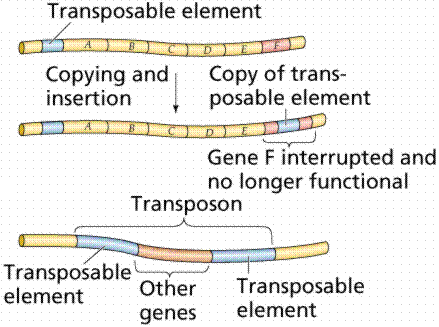
Jumping gene or Transposon: A movable genetic element. A DNA element which has the ability to move from one chromosome position to another. It can insert at random into plasmids or the bacterial chromosome independently of the host cell recombination system. Transposons were first discovered by Barbara McClintock in maize, and they play important roles in genome evolution, gene regulation, and are now used as tools in genetic engineering for insertional mutagenesis.
General applications of biotechnology
Biotechnology has a remarkably wide range of applications across multiple sectors. Understanding these application areas helps appreciate the transformative impact of biotechnology on modern life.
IMPORTANT
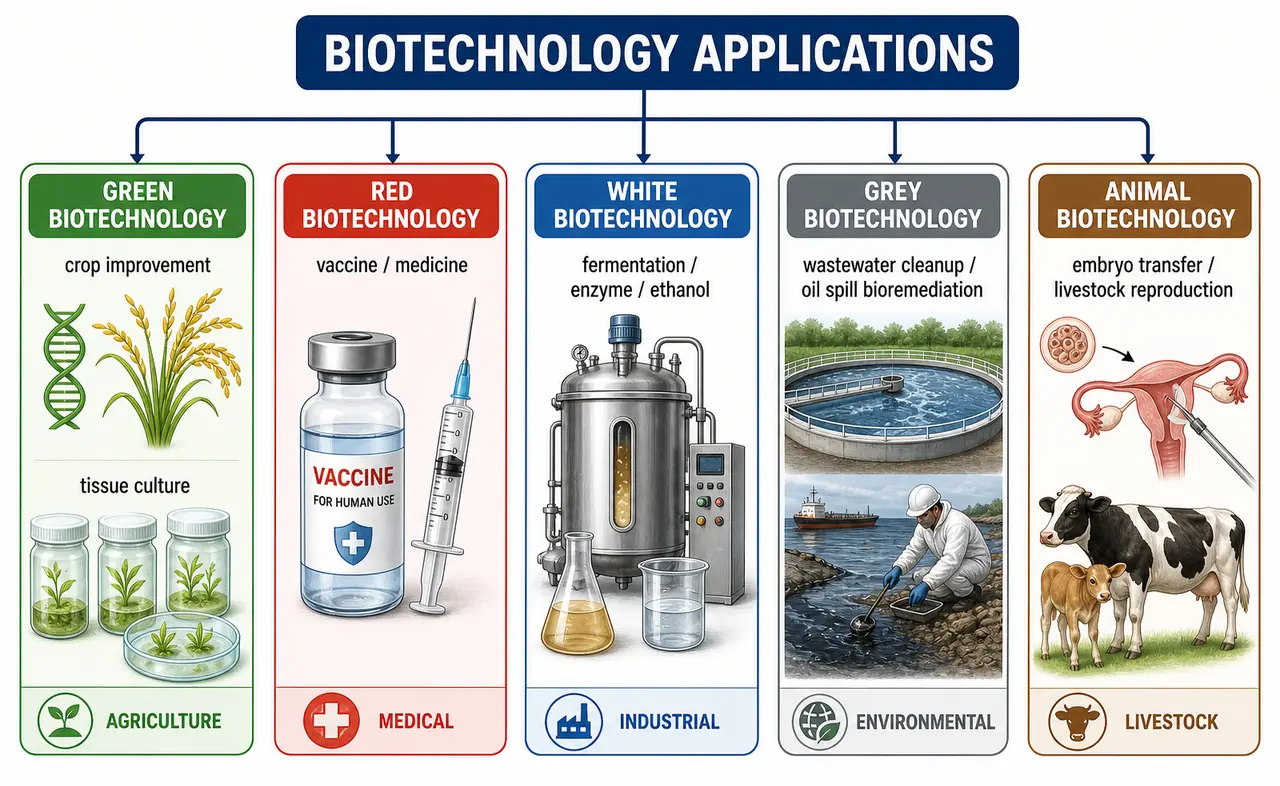
Different colors of biotechnology denote different application areas: Green (agriculture), Red (medical), White (industrial), Grey (environmental). This color coding is a common exam topic.
-
Medical biotechnology concerns the production of monoclonal antibodies, synthetic vaccines, valuable drugs (insulin, interferon), gene therapy, DNA fingerprinting, etc. Medical biotechnology has revolutionized healthcare by enabling the production of life-saving drugs through recombinant DNA technology -- for instance, human insulin is now produced by genetically engineered bacteria, replacing the earlier practice of extracting it from animal pancreases.
-
In compact medical-biotechnology recall, the hybridoma technique for producing monoclonal antibodies is associated with Kohler and Milstein, the first recombinant human insulin is remembered as Humulin, and gene therapy is classically summarized as replacement of a harmful or defective gene with a functional one.
-
Industrial biotechnology concerns the production of ethanol, lactic acid, glycerine, citric acid, acetone, antibiotics (penicillin, streptomycin, erythromycin, mitomycin), enzymes (amylase, protease, lipase), single cell protein, fuel and extraction of minerals. This branch, also called white biotechnology, uses living cells and enzymes to synthesize products that are more environmentally friendly and energy-efficient than traditional chemical manufacturing.
-
Animal biotechnology concerns the production of transgenic animals, test tube babies, human induced super ovulation and embryo splitting, etc. Techniques such as embryo transfer, cloning, and in vitro fertilization have significantly advanced animal breeding and reproductive science.
-
Environmental biotechnology concerns sewage treatment, deodorization of human excreta, degradation of petroleum and other oil spills, detoxification of wastes, bio-control of plant disease and pests. This field uses microorganisms and biological processes for bioremediation -- the cleanup of contaminated environments -- making it a vital tool for sustainable environmental management.
-
The standard oil-spill degradation example repeatedly paired with environmental biotechnology is Pseudomonas putida.
-
Plant biotechnology concerns embryo culture, clonal multiplication, recovery of virus or pathogen free stock, germplasm conservation, isolation of homozygous lines, isolation of stable somaclonal variants, gene transfer for insect resistance, and molecular markers for linkage mapping. Plant biotechnology is at the heart of modern crop improvement, offering tools that complement and accelerate conventional plant breeding methods.
-
Forest biotechnology is a growing field of study that has many potential benefits for humankind and our environment. Trees are keystone species in many environments and are necessary for the maintenance of healthy forests and for restoration of damaged ecosystems. Forest biotechnology applies techniques like tissue culture, genetic engineering, and molecular markers to improve tree species for timber, pulp, biofuel production, and ecosystem restoration.
Summary Cheat Sheet
| Concept / Topic | Key Details |
|---|---|
| Term Biotechnology coined by | Karl Ereky in 1919 (Hungarian agricultural engineer) |
| Indian biotech milestone | DBT created in February 1986 |
| Important biotech institutes | NIPB (New Delhi), IIAB (Ranchi, Jharkhand), ICGEB (New Delhi & Trieste) |
| Biotechnology = | Applied use of molecular biology + recombinant DNA technology |
| Green biotechnology | Agriculture-related biotechnology |
| Red biotechnology | Medical (monoclonal antibodies, vaccines, gene therapy) |
| White biotechnology | Industrial (ethanol, antibiotics, enzymes) |
| Grey biotechnology | Environmental (bioremediation, sewage treatment) |
| In vitro vs In vivo | "In glass" (lab) vs "in life" (living organism) |
| DNA ligase | "Molecular glue" — seals nicks in DNA backbone |
| cDNA | Complementary DNA from mRNA via reverse transcription; lacks introns |
| DNA fingerprinting | Unique genetic profile via repetitive sequences; Southern hybridization |
| Double haploids | Complete homozygosity in one generation |
| Microsatellite | Short tandem repeats (1–6 bp); highly polymorphic markers |
| Electroporation | Electric pulse creates pores for DNA entry into cells |
| Electrophoresis | Separates molecules by size in gel; smaller = faster migration |
| Embryogenesis (somatic) | Formation of embryos from callus (non-reproductive cells) |
| GMO definition | Novel gene combination via modern biotech (e.g., Bt crops, Golden Rice) |
| Hybridization | Crossing two genotypically different plants |
| Somatic hybridization | Protoplast fusion; overcomes sexual incompatibility barriers |
| Transposons (jumping genes) | Discovered by Barbara McClintock in maize |
| Chromomere | Bead-like structures of coiled chromatin on chromosomes |
| Plant biotechnology applications | Embryo culture, clonal multiplication, virus-free stock, gene transfer |
| Forest biotechnology | Tissue culture + genetic engineering for tree improvement |