👑 Principles of Biotechnology: Enzymes and Tools
Understand the enzymes and tools of genetic engineering — restriction endonucleases, ligase, vectors, passenger DNA, cDNA, and synthetic DNA — with agricultural applications and exam tips.
Why These Tools Matter in Agriculture
When scientists created Bt cotton by inserting a bacterial gene into the cotton genome, they used restriction endonucleases (molecular scissors) to cut the Bt gene out, a vector (Ti plasmid) to carry it, and DNA ligase (molecular glue) to seal it in place. These tools — enzymes, vectors, and passenger DNA — are the fundamental toolkit of genetic engineering. Mastering them is essential for understanding how transgenic crops, molecular markers, and gene cloning work.
IMPORTANT
Among many, the two core techniques that enabled the birth of modern biotechnology are: 1. Genetic Engineering and 2. Maintenance of sterile (microbial contamination-free) ambience.
These two pillars work hand-in-hand: genetic engineering provides the methods to manipulate DNA, while maintaining a sterile environment ensures that the biological materials being worked with remain free from unwanted microbial contamination that could compromise experiments.
Tools and Techniques of Genetic Engineering
- Genetic engineering involves cutting of desired segments of DNA and pasting of this DNA in a vector to produce a recombinant DNA (rDNA). This "cut and paste" analogy captures the essence of the process -- specific DNA sequences are precisely excised and joined to create new combinations of genetic material that do not exist naturally.

- The biological tools used in the synthesis of recombinant DNA include enzymes, vehicle or vector DNA, passenger DNA and host cells. Each of these tools plays a specific and essential role in the genetic engineering process, and understanding them is key to mastering biotechnology.
Enzymes
Enzymes are the molecular workhorses of genetic engineering. Different types of enzymes perform different functions -- from opening cells, to cutting DNA, to synthesizing new strands, to joining fragments together.
Lysing enzyme
-
These enzymes are used for opening the cells to get DNA for genetic experiments. Before any DNA manipulation can begin, the DNA must first be extracted from the cell. Lysing enzymes break open the cell to release its contents.
-
Bacterial cell wall is commonly dissolved with the help of lysozyme. Lysozyme specifically targets the peptidoglycan layer of bacterial cell walls, breaking it down and allowing access to the DNA inside.
Cleaving enzyme
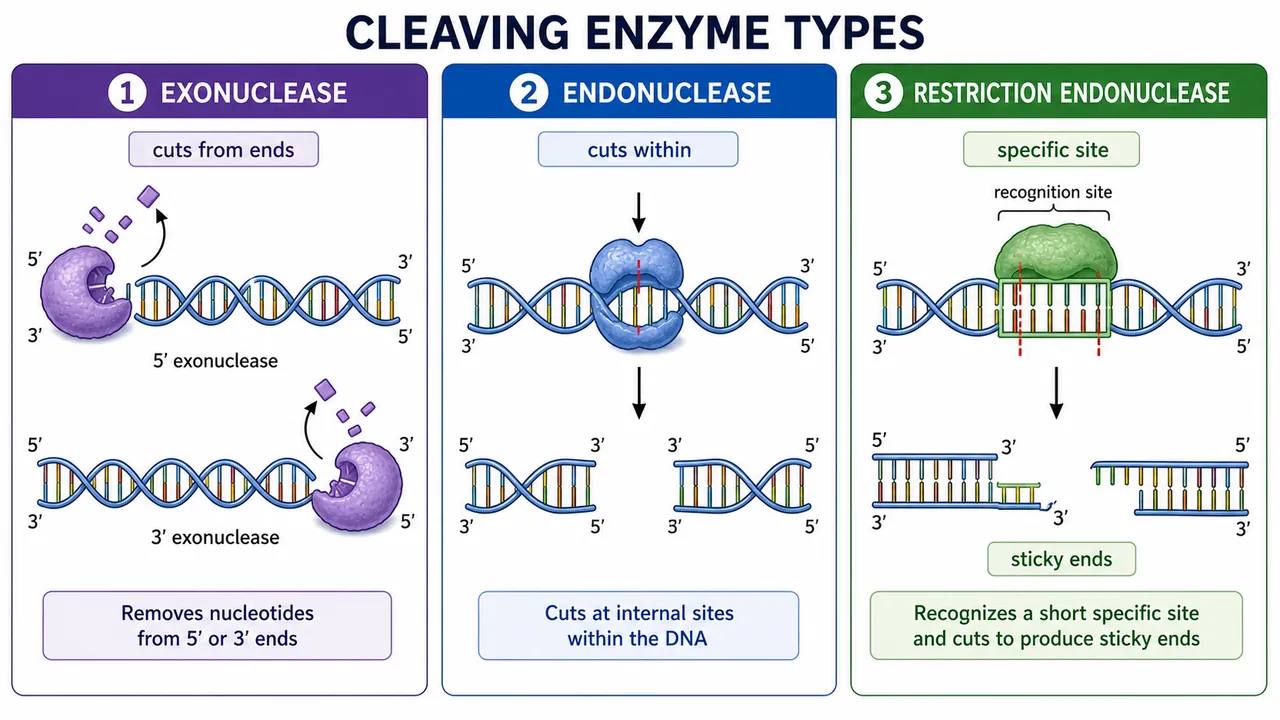
These enzymes are used for cutting DNA molecules. Cleaving enzymes are of three types:
-
Exonucleases cut off nucleotides from 5' or 3' ends of a DNA molecule. These enzymes work by nibbling away at the exposed ends of a DNA strand, removing one nucleotide at a time. They are useful for trimming DNA fragments to the desired length.
-
Endonucleases break the DNA duplex at any point except the ends. Unlike exonucleases, endonucleases cut within the DNA molecule, breaking internal phosphodiester bonds. They provide a way to make cuts in the middle of a DNA strand.
-
Restriction Endonucleases cleave the DNA duplex at specific points in such a way that the fragments possess short single-stranded free ends. These enzymes scan DNA molecules for a particular sequence, usually of four to six nucleotides. Once it finds this recognition sequence, it stops and cuts the strands. This is also known as enzyme digestion, e.g. AVA I, Bam HI, Eco RI, Hae III, Bgl II etc. For example, a restriction endonuclease EcoRI (from Escherichia coli) recognizes the base sequence GAATTC/CTTAAG in the DNA duplex and cleaves its strands between G and A. Restriction endonucleases are the most important of all cleaving enzymes in genetic engineering because of their remarkable specificity -- they act like highly precise molecular scissors that always cut at exactly the same recognition site. In older biotechnology recall, the first discovered restriction endonuclease is commonly linked with the Hind group from Haemophilus influenzae, preserving the historical cue that the earliest characterized restriction enzymes came from bacterial host-defense systems. In direct history-style MCQs, the first recognized restriction-enzyme discovery is usually tied to Smith and Nathans (1970), while the phrase restriction enzyme itself is associated with Meselson and Yuan (1968).
TIP
Remember the three types of nucleases by their cutting location: Exo = cuts from the ends, Endo = cuts in the middle, Restriction Endo = cuts at specific recognition sequences.
-
Restriction enzymes are used in recombinant DNA technology because they can be used in vitro to recognize and cleave within specific DNA sequences typically consisting of 4 to 8 nucleotides. This specific 4 to 8 nucleotide sequence is called the restriction site and is usually palindromic, meaning that the DNA sequence is the same when read in a 5' to 3' direction on both DNA strands. E.g. AND MADAM DNA. A palindromic sequence is one that reads the same on both strands when read in the same direction (5' to 3'), just like the word "MADAM" reads the same forwards and backwards.
-
As a result the DNA fragments produced by cleavage with these enzymes have short single-stranded overhangs at each end -- these kinds of ends are called sticky or cohesive ends because base pairing between them can stick the DNA molecule back together again. These sticky ends are extremely useful in genetic engineering because they allow DNA fragments from different sources (cut with the same restriction enzyme) to be easily joined together through complementary base pairing.
-
In most routine genetic-engineering work, the commonly used enzymes belong to Type II restriction endonucleases because they cut at defined recognition sites; older recall tables pair this class with the cofactor Mg2+.
-
Not all restriction cuts produce overhangs: some enzymes such as EcoRV and AluI generate blunt ends, whereas enzymes like EcoRI or HindIII generate sticky / cohesive ends.
-
The naming logic of enzymes such as EcoRI is also frequently tested: the letters come from the genus, species, and strain of the source bacterium, and the Roman numeral marks the order of identification.
Synthesizing enzymes
These enzymes are used to synthesize new strands of DNA, complementary to existing DNA or RNA templates. They are of two types:
-
Reverse transcriptase helps in the synthesis of complementary DNA (cDNA) strands on RNA templates. This enzyme is naturally found in retroviruses (like HIV) and works "in reverse" of the normal flow of genetic information (DNA to RNA). It enables scientists to create a DNA copy of any mRNA, which is invaluable for studying gene expression and creating cDNA libraries. In direct laboratory recall, reverse transcriptase used for cDNA preparation is classically linked with Avian Myeloblastosis Virus (AMV), and the reverse-transcription idea is historically associated with Temin and Baltimore.
-
DNA polymerase helps in the synthesis of complementary DNA (cDNA) strands on DNA templates. DNA polymerase reads an existing DNA strand and builds a new complementary strand by adding nucleotides one by one. This enzyme is essential in techniques like PCR (Polymerase Chain Reaction), which amplifies specific DNA sequences millions of times.
- Another classic synthesizing enzyme is terminal transferase, which adds nucleotides directly to the 3' end of a DNA molecule without needing a standard template-driven extension pattern.
Joining enzymes
-
These enzymes help in joining the DNA fragments. After DNA has been cut with restriction enzymes and the desired fragments have been selected, joining enzymes are needed to seal the fragments together into a continuous strand.
-
For example DNA ligase from Escherichia coli is used to join DNA fragments. DNA ligase catalyzes the formation of a phosphodiester bond between the 3'-hydroxyl end of one nucleotide and the 5'-phosphate end of another, effectively sealing the gap in the DNA backbone.
-
Joining enzymes are, therefore, called molecular glues. Just as restriction endonucleases are called "molecular scissors," DNA ligase is called "molecular glue" because it bonds DNA fragments together to create stable recombinant DNA molecules.
NOTE
The "scissors and glue" analogy: Restriction endonucleases = molecular scissors (cut DNA), DNA ligase = molecular glue (join DNA). This is a core concept tested in exams.
Alkaline phosphatases
- These enzymes cut off the phosphate group from the 5' end of linearized circular DNA and prevent its recircularization. This is an important step in cloning because when a vector (like a plasmid) is cut with a restriction enzyme, the two ends can rejoin without incorporating the desired insert DNA. By removing the phosphate groups with alkaline phosphatase, the vector cannot self-ligate, ensuring that it will only close when the insert DNA (which still has its phosphate groups) is incorporated.

Vehicle DNA or Vector DNA
- The DNA used as carrier for transferring a fragment of foreign DNA into a suitable host is called vehicle or vector DNA. Vectors are essential tools because they provide the means of delivery for the gene of interest into the host cell, and they also contain the necessary genetic elements (like origin of replication and selectable markers) to ensure the foreign DNA is maintained and expressed.
- One of the essential vector elements is the origin of replication (ori), the site from which DNA replication begins and the feature that allows the vector to multiply inside a suitable host.
Vectors for cloning genes in plants and animals
-
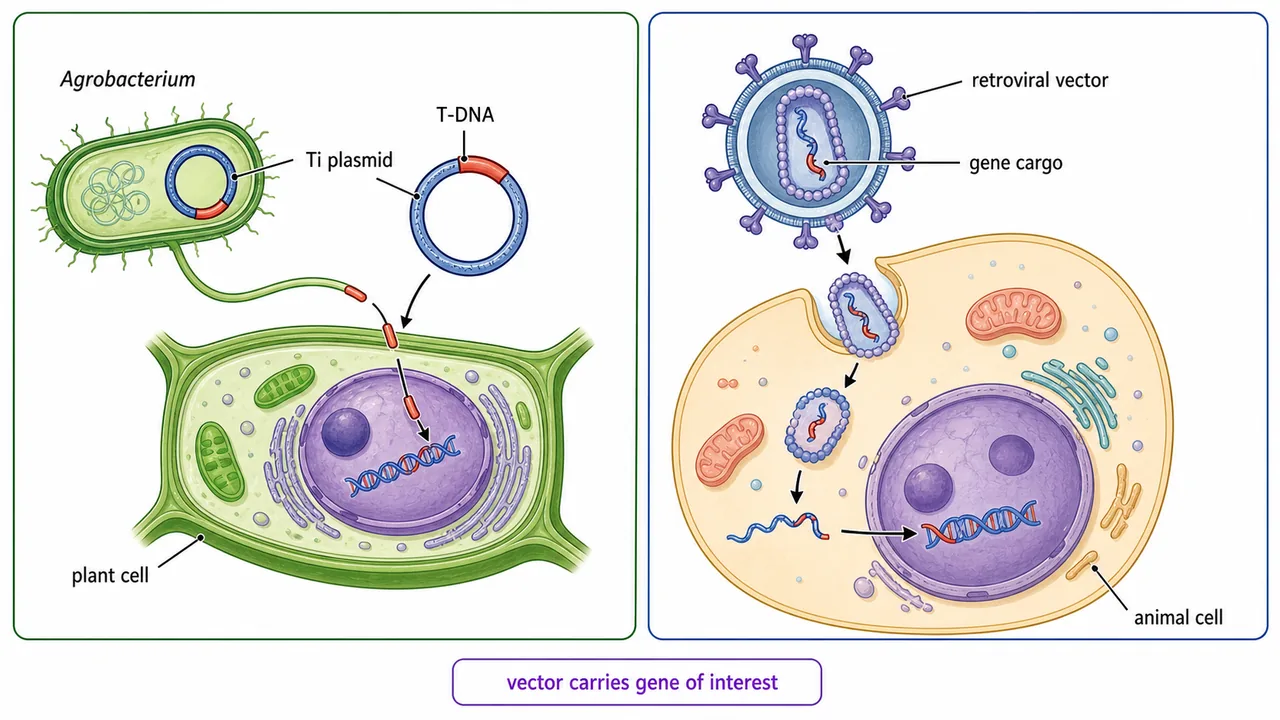
Agrobacterium tumefaciens, a pathogen of several dicot plants, delivers a piece of DNA known as T-DNA to transform normal plant cells into a tumor. In nature, this bacterium causes crown gall disease by inserting its T-DNA (Transfer DNA) into the plant cell's genome, which then directs the plant cell to produce nutrients (opines) that only the bacterium can use.
-
Similarly Retroviruses in animals have the ability to transform normal cells into cancerous cells. Retroviruses insert their genetic material into the host genome as part of their natural life cycle, and this property has been harnessed for gene delivery in animal systems.
-
A better understanding of the art of delivering genes by pathogens in their eukaryotic hosts has generated knowledge to transform these tools of pathogens into useful vectors for delivering genes of interest to humans. Scientists recognized that these natural gene-delivery systems could be repurposed for beneficial applications.
-
The tumor inducing (Ti) plasmid of Agrobacterium tumefaciens has now been modified into a cloning vector which is no longer pathogenic to the plants but is still able to use the mechanisms to deliver genes (disarmed) and are now used to deliver desirable genes into plant cells. The key modification involves removing the tumor-causing genes from the T-DNA while retaining the border sequences that are essential for DNA transfer. This creates a "disarmed" vector that can still deliver genes but no longer causes disease.
-
In textbook one-liners, transfer of the T-region / T-DNA is specifically described as being mediated by genes located in the virulence (vir) region of the Ti plasmid. This is the regulatory-transfer machinery that makes Agrobacterium such an effective natural gene-delivery system.
-
In exam recall tables, Agrobacterium tumefaciens is paired with the Ti plasmid and crown gall disease, while Agrobacterium rhizogenes is paired with the Ri plasmid and hairy root disease. Because Agrobacterium naturally transfers DNA into plant genomes, it is often described as a natural genetic engineer.
-
So, once a gene or a DNA fragment has been ligated into a suitable vector it is transferred into a bacterial, plant or animal host (where it multiplies).
Some examples of vectors
-
Plasmid: They are extra chromosomal DNA segments found in bacteria which can replicate independently. Plasmids can be taken out of bacteria and made to combine with desired DNA segments by means of restriction enzymes and DNA ligase. A plasmid carrying DNA of another organism integrated with it, is known as recombinant plasmid or hybrid plasmid or chimeric plasmid. Plasmids are the most commonly used vectors in genetic engineering due to their small size, ease of manipulation, and ability to replicate independently within bacterial cells.
-
In direct historical recall, the term plasmid is associated with Joshua Lederberg. A plasmid that can either replicate independently or integrate into the bacterial chromosome is described as an episome; the classical example is the F factor of E. coli.
-
Among practical cloning plasmids, pBR322 is a classic vector carrying ampicillin-resistance and tetracycline-resistance markers, while pUC18 is remembered as a smaller ampicillin-selectable derivative used for convenient cloning work.
-
Virus: The DNA of certain viruses is also suitable for use as a vehicle DNA. Bacteriophage (bacterial virus) has been used to transfer the gene for beta-galactosidase from Escherichia coli to human cells. Lambda phage has been used for transferring lac genes of E. coli into haploid callus of tomato. Viral vectors can carry larger DNA inserts than plasmids and have the natural ability to infect cells and deliver their genetic payload efficiently.
-
In compact vector recall, commonly cited phage systems include lambda phage and M13 phage. Related hybrid vector types include phagemids and cosmids, while large-insert systems are classically represented by YAC and BAC. A shuttle vector is designed with replication features that let it function in more than one host background.
Passenger DNA
-
It is the DNA which is transferred from one organism into another by combining it with the vehicle DNA. The passenger DNA carries the gene of interest -- the specific gene that the researcher wants to introduce into the host organism.
-
The passenger DNA can be complementary, synthetic or random. Each type of passenger DNA has different characteristics and applications depending on the goals of the experiment.
Complementary DNA (cDNA)
-
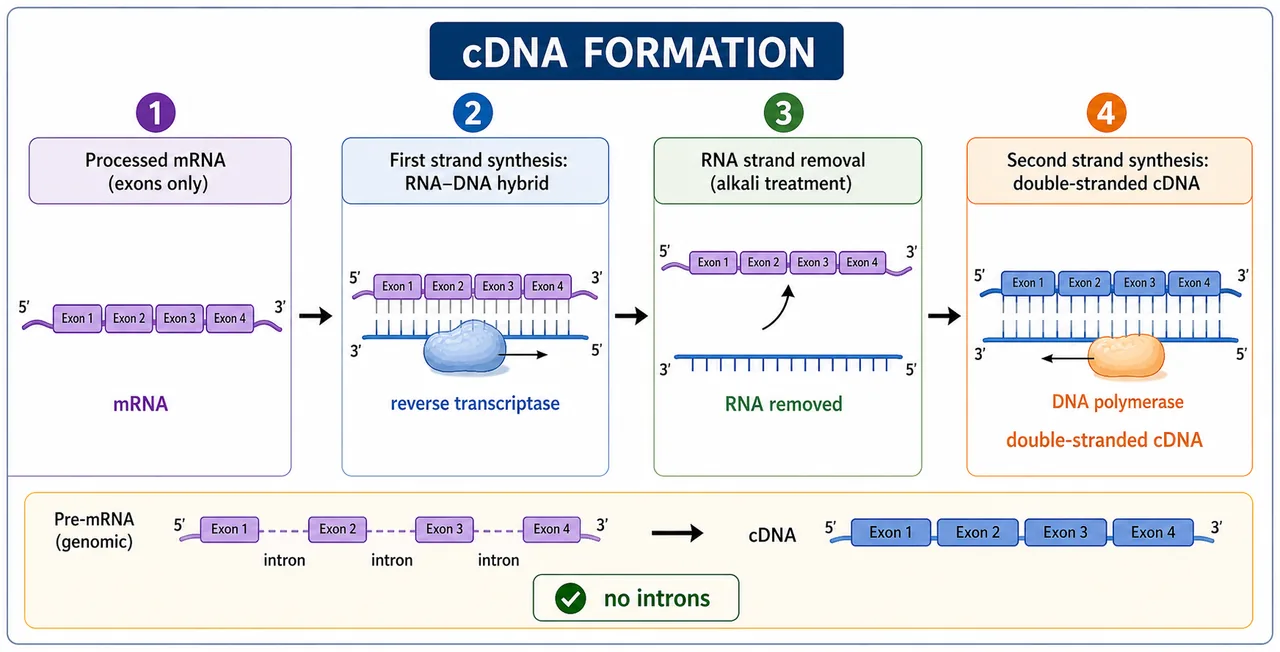
It is synthesized on mRNA template with the help of reverse transcriptase and necessary nucleotides. The process begins by isolating the mRNA corresponding to the gene of interest from the cell.
-
The DNA strand is then separated from the hybrid RNA-DNA complex by using alkali. The alkali degrades the RNA strand, leaving behind the single-stranded cDNA.
-
A complementary DNA strand is then synthesized over the template of cDNA with the help of DNA polymerase. This step produces double-stranded cDNA, which is now ready for insertion into a vector.
-
cDNA formed through reverse transcription is shorter than the actual or in vivo gene because of the absence of introns or non-coding regions. This is a crucial distinction -- since mRNA has already been processed (introns removed, exons spliced together), the cDNA represents only the coding sequence of the gene. This makes cDNA ideal for expressing genes in foreign hosts that may not have the machinery to process introns.
IMPORTANT
cDNA vs genomic DNA: cDNA lacks introns (only exons), making it shorter and ideal for gene expression in foreign hosts. Genomic DNA contains both introns and exons.
Synthetic DNA (sDNA)
-
It is synthesized with the help of DNA polymerase on a DNA template. Synthetic DNA can also be chemically synthesized in the laboratory using automated DNA synthesizers.
-
Kornberg (1961) synthesized the first synthetic DNA from a mixture of deoxyribonucleotide triphosphates, DNA polymerase enzyme, metal ions and a segment of viral DNA. This was a landmark achievement that demonstrated DNA could be created outside a living cell, earning Kornberg the Nobel Prize in Physiology or Medicine (1959).
-
Khorana (1968) synthesized the first artificial gene (DNA) without a template. They synthesized the gene coding for yeast alanine t-RNA which contained only 77 base pairs. However, it did not function in the living system. In 1979, Khorana was able to synthesize a functional tyrosine t-RNA gene of E. coli with 207 nucleotide pairs. Since then a number of genes have been synthesized artificially. Khorana's work demonstrated that it is possible to chemically construct entire genes from scratch, a capability that has since evolved into the modern field of synthetic biology.
-
Random DNA: It refers to small fragments formed by breaking a chromosome with the help of restriction endonucleases. These fragments represent a random sampling of the genome and are used to create genomic libraries, which contain fragments representing the entire genome of an organism.
Summary Cheat Sheet
| Concept / Topic | Key Details |
|---|---|
| Two core techniques of biotech | Genetic engineering + sterile ambience |
| rDNA = | Cutting desired DNA + pasting into vector → recombinant DNA |
| Four biological tools | Enzymes, vector DNA, passenger DNA, host cells |
| Lysozyme | Lysing enzyme; dissolves bacterial cell wall |
| Exonuclease | Cuts from 5' or 3' ends of DNA |
| Endonuclease | Cuts within DNA (not at ends) |
| Restriction endonuclease | Cuts at specific palindromic sequences (4–8 bp); "molecular scissors" |
| EcoRI recognition site | GAATTC / CTTAAG; cuts between G and A |
| Sticky / cohesive ends | Single-stranded overhangs after restriction digestion |
| Reverse transcriptase | Synthesizes cDNA on RNA template (from retroviruses) |
| DNA polymerase | Synthesizes complementary strand on DNA template |
| DNA ligase | "Molecular glue" — joins DNA fragments via phosphodiester bonds |
| Alkaline phosphatase | Removes 5' phosphate; prevents vector self-ligation |
| Vector / Vehicle DNA | Carrier for foreign DNA (plasmids, phages, Ti plasmid) |
| Agrobacterium tumefaciens | Delivers T-DNA into plant cells; disarmed for use as vector |
| Passenger DNA | The desired gene to be transferred |
| cDNA | Made from mRNA via reverse transcriptase; lacks introns |
| Kornberg (1961) | Synthesized first synthetic DNA (Nobel Prize 1959) |
| Khorana (1968) | First artificial gene without template; 77 bp yeast alanine tRNA |
| Palindromic sequence | Reads same on both strands 5'→3' (e.g., GAATTC) |
| Random DNA | Fragments from restriction digestion; used for genomic libraries |