🎋 Plant Biotechnology: Tissue Culture and Genetic Engineering
Understand plant tissue culture techniques, totipotency, genetic engineering methods, and their applications in crop improvement — with agricultural examples and exam tips.
Why Plant Biotechnology Matters in Agriculture
India's banana industry produces millions of disease-free plantlets each year through tissue culture — a single shoot tip can generate thousands of genetically identical plants in a few months, something impossible through conventional propagation. Similarly, genetic engineering gave us insect-resistant Bt cotton and virus-resistant papaya. Plant biotechnology combines these two powerful disciplines — tissue culture and genetic engineering — to accelerate crop improvement far beyond what traditional breeding alone can achieve.
-
Plant biotechnology exploits plant cells or their constituents for generating useful products or services for the benefit of mankind. It is a branch of science that applies cellular and molecular techniques to improve plants and plant products for human welfare, including food security, medicine, and industry.
-
It includes two broad disciplines viz., Tissue culture and Genetic engineering. Tissue culture deals with growing plant cells, tissues, or organs under controlled laboratory conditions, while genetic engineering involves the direct manipulation of DNA to introduce desirable traits into plants.
Plant tissue culture or In-vitro culture
- It is multiplication of cells of a large number of plants placed in appropriate environment conditions with required nutrients. This technique allows the rapid production of genetically identical plants (clones) from a small piece of plant material, all under sterile laboratory conditions.
- Plant tissue culture is the in-vitro cultivation of plants, seeds, or plant parts on nutrient media under aseptic conditions. Here, aseptic means the culture is maintained free from unwanted microbial contamination.

-
The ability of plant cells/tissue to develop into a complete plant is known as totipotency. This remarkable property means that even a single plant cell contains all the genetic information necessary to regenerate an entire organism, given the right conditions and growth signals.
-
It is the cultivation of plant organs, tissue, embryo, seeds, protoplasts or cells in test tubes on artificial media. The artificial media provides all the essential nutrients, vitamins, and growth regulators that the plant material needs to grow and differentiate.
-
It reduces more than half of the time taken in conventional breeding programmes. This significant time saving makes tissue culture an extremely valuable tool for accelerating crop improvement and bringing new varieties to farmers much faster than traditional methods.
-
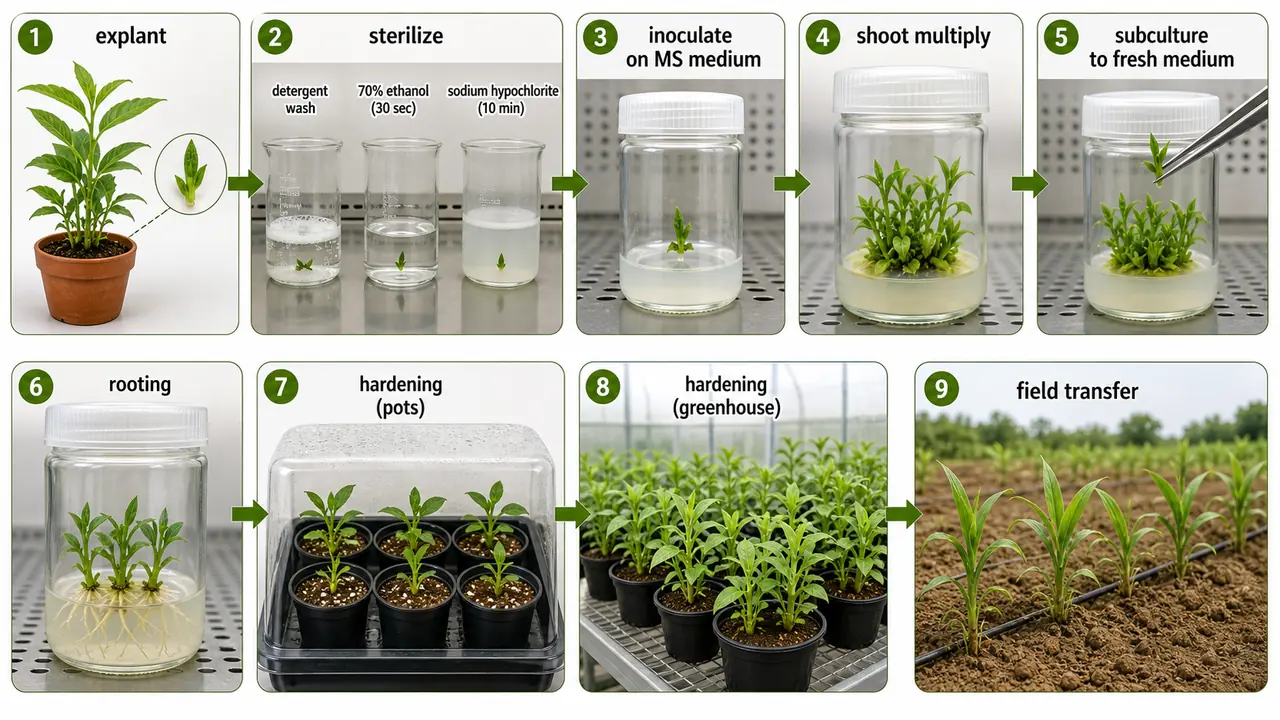
Explant is an excised fragment of a tissue or an organ used to start tissue culture. The choice of explant is crucial for the success of tissue culture -- commonly used explants include shoot tips, leaf segments, nodal segments, and root tips, depending on the species and the objective of the culture.
Techniques of Tissue Culture
-
Micropropagation is in vitro multiplication of plants from a small tissue explant. This technique is widely used for the commercial production of ornamental plants, fruit trees, and other high-value crops, enabling the production of thousands of identical plants from a single parent in a relatively short time.
-
For rapid clonal multiplication, the most suitable plant part is usually the bud or nodal region. Micropropagation is especially popular in banana, date palm, oil palm, and orchids because it enables mass multiplication, production of true-to-type plants, and year-round propagation independent of season. Older exam-style notes also stress that tissue culture makes it possible to screen a large number of cells in a small space.
-
Surface sterilization: The explant (the plant or plant part excised for the in vitro cultivation) is surface sterilized to eliminate contaminants using Sodium Hypochlorite [NaOCl] @ 1-2% or Mercuric Chloride @ 0.1% solution. Surface sterilization is a critical first step because any bacterial or fungal contamination can quickly overrun the culture and destroy the experiment.
-
Other disinfectants that may be used for surface sterilization include calcium hypochlorite and bromine water, alongside sodium hypochlorite and mercuric chloride.
-
Different materials in the tissue-culture laboratory are sterilized by different methods. Hot air oven is used for empty glassware and metallic tools at about 160-180°C for 2-4 hours. Autoclaving is used for culture media at about 121.6°C, 15 psi, for 18-20 minutes. Filter sterilization is preferred for thermolabile compounds such as vitamins, amino acids, hormones, and plant extracts. Metallic instruments such as forceps, needles, and spatulas may also be sterilized by dipping in 95% ethanol followed by flaming, while the laminar-airflow work surface is commonly wiped with 70% alcohol.
-
The laminar-airflow chamber is used to create an aseptic working environment, so that explants and media can be handled with minimal contamination from airborne microorganisms.
-
Hot-air sterilization is also suitable for culture vessels, Petri plates, and some heat-stable plasticware such as Teflon items. Filter sterilization commonly uses a bacterial-proof membrane filter, while UV sterilization may be used for the work area or selected disposable plasticware. One practical drawback of autoclaving is that it may slightly alter the pH of the medium.
-
Nutrient Medium: It is a medium containing salts, trace elements, vitamins, carbon sources, growth regulators (2,4-D @ 0.5-0.2 mg/L is commonly used). Organic supplements like coconut water are added and a gelling agent such as agar-agar is used. In routine plant tissue culture, agar is commonly used at roughly 0.5-1.0% to convert the medium into a supportive gel. Generally B-5 medium (Gamborg et al.) or MS medium (Murashige and Skoog) are used. The MS medium is the most widely used basal medium in plant tissue culture worldwide, providing a carefully balanced mix of macro- and micro-nutrients essential for plant cell growth.
-
Culture media may be solid or semi-solid (the most common form, because the tissue remains supported on agar) or liquid. Liquid media are especially used in suspension culture, where cells or small aggregates grow while suspended in the nutrient solution rather than on a solid surface.
-
The medium commonly used carbon source is sucrose. Since cultured plant tissues are generally not photosynthetic (they are grown in controlled light or dark conditions), they require an external carbon source like sucrose to meet their energy needs.
-
In routine plant tissue culture, MS medium is the most widely used medium, sucrose is the preferred carbon source (often around 2.5%), thiamine (vitamin B1) is the most commonly used vitamin, and glycine is a common amino-acid supplement. Agar is generally used as the gelling agent at about 0.5-1.0%, and the optimum pH of the medium is usually close to 5.8. Agar itself is a polysaccharide obtained from red algae such as Gelidium and Gracilaria.
-
Agar-agar solidifies at about 42°C, which is why medium can be poured while warm and then set into a stable semi-solid matrix.
-
In practical media-preparation recall, a pH much above 6 tends to give an overly hard medium, while a pH below 5 may not permit satisfactory solidification.
-
Sub-culturing: Transferring of tissue to fresh/new media after a stipulated time. Usually sub-culturing is done after every 4-6 weeks. However, the suspension cultures are sub-cultured after every 3-14 days. Sub-culturing is necessary because the nutrients in the medium get depleted over time, and metabolic waste products accumulate, which can inhibit further growth.
-
Re-culture: Process by which a cell monolayer or a plant explant is transferred without subdivision into a fresh medium. Unlike sub-culturing, re-culturing does not involve dividing the tissue -- the entire culture is simply moved to fresh medium to continue growth.
-
Plant regeneration and transfer to soil: First the transfer of cultured plant is done in small pots and then to greenhouse and finally in soil. Transfer is done when roots and shoots appear. This process is called hardening or acclimatization, and it is one of the most critical stages in tissue culture. The plantlets must gradually adjust from the high humidity, controlled environment of the laboratory to the variable conditions of the outside world.
WARNING
Hardening/acclimatization is the most vulnerable stage in tissue culture. Many plantlets are lost during this transition if not handled carefully with gradual changes in humidity and light.
Classification of Tissue Culture Techniques
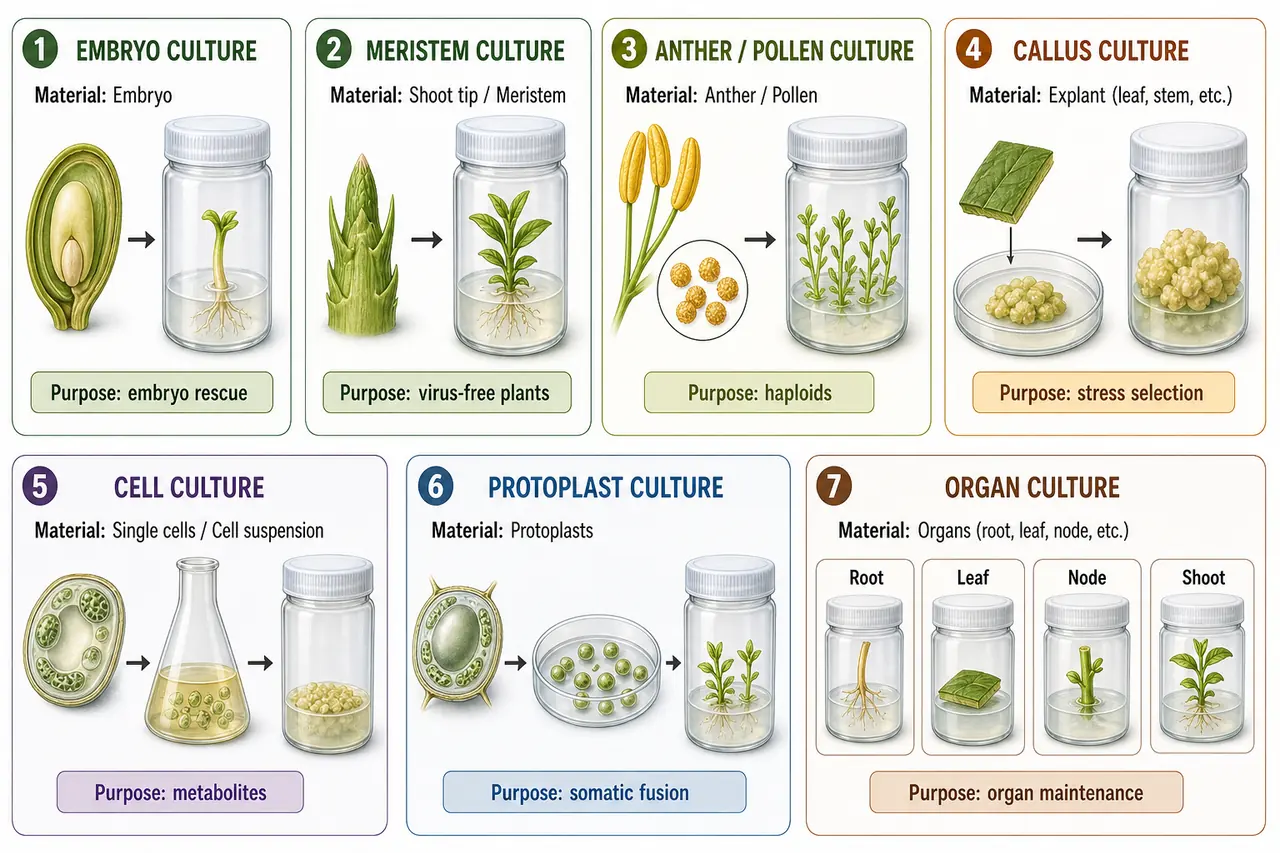
Understanding the different types of tissue culture techniques is essential, as each serves a specific purpose in plant biotechnology and crop improvement.
-
Embryo culture: Young embryo is removed from developing seeds and planted on a suitable nutrient medium in vitro, with the goal of obtaining viable seedlings/plants. It is applied in differentiation studies and somaclonal variations. Embryo culture is particularly useful in overcoming seed dormancy and rescuing embryos from interspecific crosses where the endosperm fails to develop properly.
-
Meristem culture: It is the culture of the apical meristem or shoot tip under sterile conditions. It is applied in micropropagation and production of virus free plants. Meristematic tissues (the actively dividing cells at the growing tips of shoots and roots) are typically virus-free because viruses spread through the vascular system and have not yet reached these rapidly dividing cells. This makes meristem culture the primary technique for producing disease-free planting material. A classic milestone was the production of virus-free Dahlia by Morel and Martin (1952).
-
In direct exam-style recall, meristem culture is also associated with the elimination or strong reduction of viroids, MLOs / phytoplasma-like organisms, and sometimes associated bacterial or fungal contaminants from planting material.
-
A related sterile-propagation technique is micrografting, which is especially associated in exam material with citrus and orchids. It combines a tiny shoot tip or meristem with a young seedling rootstock under controlled conditions.
-
In compact history-style recall, early micrografting work is also linked with Morel and Martin.
TIP
Meristem culture is the go-to technique for producing virus-free plants. The meristematic tip is virus-free because viruses cannot keep up with the rapid cell division at the growing point.
-
Seed culture: Culture of seeds in vitro to generate seedlings/plants. This technique is useful for species with low germination rates or seeds that require specific conditions to break dormancy.
-
Anther or Pollen culture: In this technique, haploid plants are obtained from pollen grains by placing anthers or pollen into a suitable medium. This technique is used to obtain haploid plants. Haploid plants contain only one set of chromosomes (instead of the usual two), and when their chromosomes are doubled (using chemicals like colchicine), they produce completely homozygous plants in a single generation -- a process that would otherwise take 6-7 generations of conventional inbreeding.
-
Production of haploids through anther or pollen culture is also called androgenesis. In India, this method is classically associated with Guha and Maheshwari (1964) in Datura innoxia, and the N6 medium is a standard medium for anther culture.
-
In compact haploid-production recall, other routes often listed alongside androgenesis are ovary culture, unfertilized ovule culture, certain forms of wide hybridization, and the Bulbosum technique used classically in barley and wheat improvement.
-
Callus culture: Callus is basically a more or less non-organized tumor tissue, which usually arises on wounds of differentiated tissue and organs. This culture is used in cryopreservation of germplasm, in vitro cell selections for resistance to biotic and abiotic stresses. Callus is an undifferentiated mass of cells that can be induced to form shoots, roots, or embryos by manipulating the ratio of plant growth regulators (particularly auxins and cytokinins) in the culture medium. Because callus is comparatively easy to initiate and maintain, it is also one of the most widely used culture forms in plant biotechnology.
-
Older competitive-exam books often ask the hormone effects directly as one-liners: high cytokinin relative to auxin induces shoot formation (caulogenesis), high auxin relative to cytokinin induces root formation (rhizogenesis), and an intermediate or near-balanced ratio favours callus formation.
NOTE
Auxin:Cytokinin ratio controls organ formation (Skoog & Miller): High auxin : low cytokinin = root formation. Low auxin : high cytokinin = shoot formation. Equal ratio = callus proliferation (undifferentiated growth).
-
In the historical development of plant tissue culture, the classic work of Skoog and Miller established that organ formation in culture can be directed by the relative balance of auxin and cytokinin, which is why this ratio remains the conceptual key to regeneration from callus.
-
Nucellus culture: Nucellus culture has been utilized to study factors responsible for formation of adventive embryos. The nucellus is the tissue surrounding the embryo sac within the ovule. Culturing nucellar tissue can produce genetically identical embryos (nucellar seedlings), which is valuable for propagating polyembryonic species like citrus.
-
Cell culture: The growing of individual cells that have been obtained from an explant tissue or callus. It is applied in synthesis of new chemical substances, production of useful metabolites. Cell cultures, especially cell suspension cultures, allow researchers to study plant cell behavior at the individual cell level and are used to produce valuable secondary metabolites such as alkaloids, flavonoids, and terpenoids.
-
Suspension culture is commonly divided into:
- Batch culture — cells grow in a fixed volume of liquid medium
- Continuous culture — fresh medium is supplied and culture is maintained in a steady state for a longer period
-
Protoplast culture: Protoplasts are cells without a cell wall. Culture of protoplasts and fusion of protoplasts from different strains. The cell wall is removed using enzymes like cellulase and pectinase, leaving behind a naked cell bounded only by the plasma membrane. Protoplast fusion (also called somatic hybridization) allows the combination of genetic material from two different species, even those that are sexually incompatible.
-
In older plant-biotechnology exam notes, the most commonly cited method of protoplast culture is the plating method.
-
The term protoplast refers to the naked plant cell obtained after removal of the cell wall. Early work on protoplast isolation is associated with Klercker (mechanical method) and Cocking (enzymatic method). In enzymatic isolation, pectinase/macerozyme dissolves the middle lamella and cellulase removes the cell wall. In older recall tables, leaf mesophyll tissue is commonly cited as the most suitable starting tissue for protoplast isolation.
-
Among the common fusion-inducing chemicals (fusogens), PEG is the most widely used. Older exam books may also list sodium nitrate (NaNO3), polyvinyl alcohol, dextran, and calcium ions under high pH as examples of fusogens.

- Organ culture: Culture of an organ in vitro in a way that allows development and/or preservation of the originally isolated organ. This technique maintains the three-dimensional structure and function of the organ, making it useful for studying organ development, differentiation, and the effects of various substances on organ function.
Totipotency
-
Totipotency is the capability of an isolated single cell to multiply and differentiate into a multicellular organism. This is one of the most fundamental concepts in plant biotechnology -- it means that every living plant cell has the full genetic potential to develop into a complete, functional plant.
-
Tissue culture is purely based on the totipotency of cells. Without totipotency, it would be impossible to regenerate whole plants from isolated cells, tissues, or organs in the laboratory.
-
The term totipotency itself was coined by T. H. Morgan (1901), while its plant tissue culture demonstration is linked with Haberlandt's early work.
-
Haberlandt first demonstrated the totipotency of cells in 1902. Gottlieb Haberlandt, an Austrian botanist, is considered the father of plant tissue culture. Although his initial experiments with isolated cells did not result in cell division, his visionary idea that single plant cells should be capable of developing into complete organisms laid the theoretical foundation for all modern tissue culture work.
-
In the Indian context, Guha and Maheshwari are remembered as pioneers of Indian plant tissue culture because of their foundational work in haploid production. In direct exam-style recall, the pair may also be asked as the father / leading pioneers of Indian plant tissue culture.
Tissue-Culture Problem Areas and Variation
-
Browning or blackening of the culture medium is mainly due to the leaching of phenolic compounds from the cut surfaces of explants. It can be reduced by frequent sub-culturing, use of antioxidants such as citric acid, adsorption by activated charcoal, and sometimes incubation in the dark.
-
Vitrification (or hyperhydricity) is the brittle, glassy, water-soaked appearance of in-vitro-grown shoots. It can often be reduced by lowering the relative humidity in vessels and by reducing excessive cytokinin, ammonium, or salt concentration in the medium.
-
Transplantation shock refers to the high mortality that may occur when tissue-culture-derived plants are shifted to soil. High humidity, gradual hardening, partial defoliation, and antitranspirants help reduce this problem.
-
Somaclonal variation means the heritable variation seen among plants regenerated through tissue culture. The term was introduced by Larkin and Scowcroft (1981). This variation can be useful in crop improvement because it creates selectable variability even without sexual recombination.
-
Some frequently cited somaclonal variants include Pusa Jaikisan (BIO-902) in mustard, Bio-13 in citronella, and Ratan (BIO L-212) in lathyrus.
-
In standard variety-recall wording, Pusa Jaikisan (BIO-902) is linked with V.L. Chopra at IARI, New Delhi.
-
Additional recall tags from exam books: Bio-13 is linked with CIMAP, Lucknow, while Ratan (BIO L-212) is remembered for its low neurotoxin content in lathyrus.
-
Other named somaclonal-variation examples that sometimes appear in objective exams include Ono in sugarcane for resistance to Fiji disease, Velvet Rose in geranium, and Scarlet in sweet potato.
Embryo Rescue, Synthetic Seeds, and Somatic Hybridization
-
Embryo culture is especially useful in embryo rescue, where immature embryos from wide crosses are cultured to overcome post-fertilization barriers and prevent embryo abortion. Monnier medium is a standard medium associated with embryo culture.
-
Post-fertilization barriers in interspecific or intergeneric crosses can be overcome by embryo culture, ovule culture, or ovary culture, depending on which stage of seed development is failing.
-
Orchid seeds are a classic plant-biotechnology exception because they contain little or no stored food reserve and often have incompletely developed embryos. This is why orchids are so often cited as crops that respond especially well to in-vitro germination and micropropagation.
-
Ovule and ovary culture can also help in wide hybridization work. Maheshwari isolated and cultured ovules of Papaver somniferum. Haploid production from unfertilized ovules or ovaries is called gynogenesis.
-
In orchids, natural germination usually depends on a symbiotic fungal association, but fertilized ovules cultured in vitro can germinate without that association.
-
Somatic embryogenesis is the development of embryos from somatic tissues rather than from the zygote. When a somatic embryo or shoot bud is encapsulated to form a bead-like propagule, it is called an artificial seed or synthetic seed. The concept is associated with Murashige, the encapsulating material is commonly calcium alginate, and ABA is often used during synthetic-seed production.
-
A practical way to prepare synthetic seeds is to drop about 2% sodium alginate containing the propagule into calcium chloride solution, where the bead hardens by forming calcium alginate.
-
In cryopreservation-style recall, commonly cited cryoprotectants include DMSO, glycerol, and ethylene glycol, which help reduce freezing injury in stored biological material.
-
In-vitro pollination and fertilization are used to overcome pre-fertilization barriers in distant hybridization. Standard examples are Kanta et al. (1962) for in-vitro pollination in Papaver somniferum and Kranz et al. (1990) for in-vitro fertilization in maize.
-
Somatic hybridization involves fusion of protoplasts followed by culture and plant regeneration. The first somatic hybrid is associated with tobacco and with the work of Carlson. The classic intergeneric example is pomato (potato + tomato) developed by Melchers (1978). Based on chromosome contribution, somatic hybrids may be symmetric, asymmetric, or cybrids (cytoplasmic hybrids).
-
In older biotechnology exam wording, a cybrid is defined more explicitly as a product carrying the nucleus of one parent but cytoplasm derived from two different parents.
Genetic Engineering
-
Change in the genetic constitution of cells by introduction or elimination of specific genes using molecular biology techniques is known as Genetic engineering. This is a non-sexual method of gene transfer. Unlike conventional breeding which relies on sexual crosses and natural recombination, genetic engineering allows scientists to precisely target and transfer individual genes, even across species boundaries.
-
Genetic engineering is the artificial manipulation, modification and recombination of DNA or other nucleic acid molecules in order to modify an organism or population of organisms. Genetic engineering works through recombinant DNA technology. This technology essentially involves cutting DNA at specific sites, joining DNA fragments from different sources, and introducing the resulting recombinant DNA into a host organism where it can be expressed.
-
Genetic engineering allows the use of several desirable genes in a single event and reduces the time to introgress novel genes into elite background. This means breeders can stack multiple beneficial traits (such as insect resistance, disease resistance, and improved quality) into a crop variety simultaneously, rather than having to introduce them one at a time through multiple breeding cycles.
-
Biotechnology has provided several unique opportunities to develop transgenic plants with novel genes that include:
- Access to novel molecules
- Ability to change the level of gene expression
- Capability to change the expression pattern of genes
- Develop transgenic plants with novel genes
-
Paul Berg -- Father of genetic engineering.
- He transferred the gene of SV-40 virus (Simian Virus) into E. coli with the help of lambda phage (Nobel Prize - 1980). Paul Berg's groundbreaking work in 1972 demonstrated that DNA from different organisms could be combined, opening the door to the entire field of recombinant DNA technology.
-
The concept of genetic engineering was the outcome of two very significant discoveries made in bacterial research. These were:
- Presence of extra-chromosomal DNA fragments called plasmids in the bacterial cell which replicate along with chromosomal DNA of the bacterium. Plasmids are small, circular DNA molecules that exist independently of the main bacterial chromosome. Their ability to self-replicate and carry additional genes made them ideal candidates for use as vectors (carriers) in genetic engineering.
- Presence of enzymes called restriction endonucleases which cut DNA at specific sites. These enzymes are, therefore, called 'molecular scissors'. Restriction endonucleases recognize specific palindromic sequences in DNA and cut both strands at precise locations, allowing scientists to isolate specific genes and create DNA fragments with predictable ends.
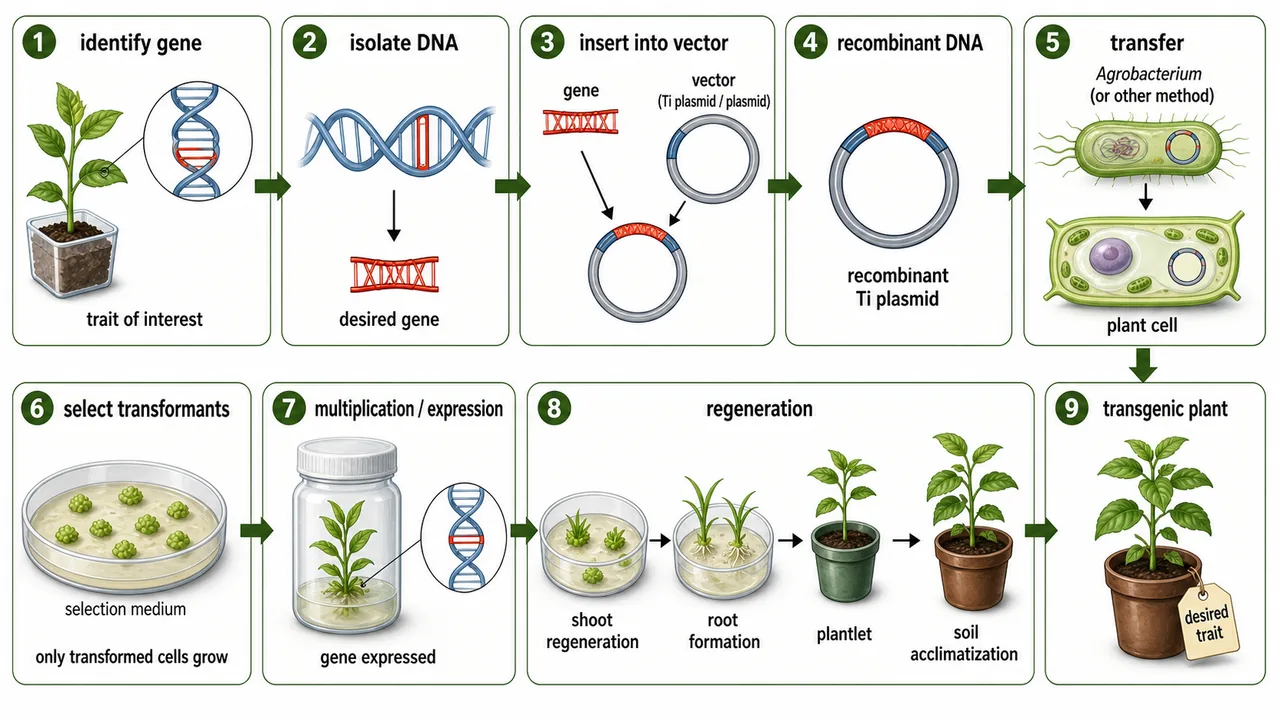
- It involves the following steps:
- Identification and isolation of desired genes
- Insertion of desired gene into a DNA of suitable vector
- Introduction of the recombinant DNA into suitable organism for multiplication
- Selection of host cells carrying the desired recombinant vector
- Multiplication/Expression/Integration of desired gene in the host
- Insertion of recombinant gene into the organism concerned
Each of these steps requires specialized tools and techniques. The entire process, from gene identification to final expression in the target organism, represents a carefully orchestrated sequence that forms the core of modern genetic engineering.
- Because recombinant DNA technology can move genes across natural reproductive barriers, it is also discussed with a parallel biosafety perspective. In direct exam-style biotechnology recall, the major concerns include the possible spread of new diseases or allergens, unintended ecological effects such as gene escape into related populations, and broader uncertainty about long-term environmental interactions. This is why modern genetic engineering is paired not only with productivity benefits but also with containment, testing, and regulatory evaluation.
Applications of Genetic Engineering
Genetic engineering has opened up transformative possibilities across agriculture and beyond. Some key applications include:
- Development of insect resistance in trees.
- Development of disease resistance in trees.
- Development of herbicide resistance in plants.
- Improvement of seed storage proteins in trees.
- Production of novel chemicals.
- Production of edible vaccines (antithrombin production -- Hirudin by B. napus)
These applications demonstrate how genetic engineering can address critical challenges in agriculture, from reducing crop losses due to pests and diseases, to improving nutritional quality, and even enabling plants to serve as biofactories for producing valuable pharmaceutical compounds.
Summary Cheat Sheet
| Concept / Topic | Key Details |
|---|---|
| Plant biotechnology two disciplines | Tissue culture + Genetic engineering |
| Totipotency | Any plant cell can develop into a complete plant |
| Totipotency coined by | T. H. Morgan (1901) |
| Totipotency demonstrated by | Haberlandt (1902) — father of plant tissue culture |
| Indian tissue culture pioneers / father-recall pair | Guha and Maheshwari |
| Explant | Excised tissue/organ used to start culture |
| Micropropagation | In vitro clonal multiplication from small explant |
| Best explant for micropropagation | Bud / node |
| Common micropropagation crops | Banana, date palm, oil palm, orchids |
| Surface sterilization agents | NaOCl (1–2%) or HgCl₂ (0.1%) |
| Dry heat sterilization | Hot air oven: 160-180°C for 2-4 h |
| Wet heat sterilization | Autoclave: 121.6°C, 15 psi, 18-20 min |
| Common nutrient media | MS medium (Murashige & Skoog), B-5 (Gamborg) |
| Physical forms of culture media | Solid / semi-solid most common; liquid used in suspension culture |
| Carbon source in media | Sucrose (cultured tissues are non-photosynthetic) |
| Common media details | Thiamine, glycine, agar 0.5-1.0%, optimum pH 5.8 |
| Sub-culturing interval | Every 4–6 weeks (suspension cultures: 3–14 days) |
| Hardening / Acclimatization | Gradual transfer from lab to greenhouse to soil |
| Meristem culture | Apical meristem / shoot-tip culture for virus-free plants |
| Meristem culture milestone | Morel and Martin (1952) — virus-free Dahlia |
| Anther / Pollen culture | Produces haploid plants; doubled by colchicine |
| Androgenesis in India | Guha and Maheshwari (1964) in Datura innoxia |
| Popular anther-culture medium | N6 medium |
| Callus culture | Undifferentiated cell mass; used for cryopreservation |
| Auxin:Cytokinin ratio | High auxin = roots; high cytokinin = shoots; equal = callus |
| Browning of medium | Due to phenolic leaching from explants |
| Vitrification | Glassy, water-soaked shoots in vitro |
| Somaclonal variation | Tissue-culture-derived heritable variation; Larkin & Scowcroft (1981) |
| Protoplast culture | Cells without wall; enables somatic hybridization |
| First protoplast isolation | Klercker (mechanical), Cocking (enzymatic) |
| Classical protoplast-culture method | Plating method |
| Common protoplast fusogen | PEG |
| Embryo culture | Rescues embryos from wide crosses; overcomes dormancy |
| Embryo-culture medium | Monnier medium |
| Orchid seed special case | Very little or no stored food; often relies on fungal association in nature, so responds well to in-vitro germination |
| Wide-cross post-fertilization rescue | Embryo culture, ovule culture, or ovary culture depending on failure stage |
| Nucellus culture | Produces genetically identical embryos (citrus) |
| Gynogenesis | Haploids from unfertilized ovule / ovary culture |
| Ovule-culture recall example | Maheshwari cultured ovules of Papaver somniferum |
| Synthetic seed | Encapsulated somatic embryo; calcium alginate, often ABA |
| Synthetic-seed preparation | About 2% sodium alginate bead hardened in calcium chloride |
| Somatic hybrid types | Symmetric, asymmetric, cybrid |
| Classic somatic hybrid | Pomato by Melchers (1978) |
| Paul Berg | Father of genetic engineering; Nobel Prize 1980 |
| Restriction endonucleases | "Molecular scissors" — cut DNA at specific sites |
| Plasmids | Extra-chromosomal DNA; self-replicating; used as vectors |
| Genetic engineering steps | Identify gene → insert into vector → transform host → select → express |
| Applications | Insect/disease/herbicide resistance, seed protein improvement, edible vaccines |