📟 Recombinant DNA Technology and PCR
Understand rDNA technology processes, PCR steps, gene cloning, and applications like Quality Protein Maize — with agricultural examples and exam tips.
Why rDNA Technology Matters in Agriculture
When plant pathologists need to detect a specific virus strain in a potato field within hours, they use PCR — a technique born from recombinant DNA technology. When breeders developed Quality Protein Maize (QPM) by transferring the Opaque-2 gene, they used rDNA technology to identify and clone the gene. From disease diagnostics to gene cloning to developing transgenic crops, rDNA technology is the engine driving modern agricultural biotechnology.
Processes of Recombinant DNA Technology
Recombinant DNA technology is a series of carefully orchestrated steps that allow scientists to combine DNA from different sources and introduce it into a host organism. The initial stages involve extracting and preparing the DNA molecules that will be used.
-
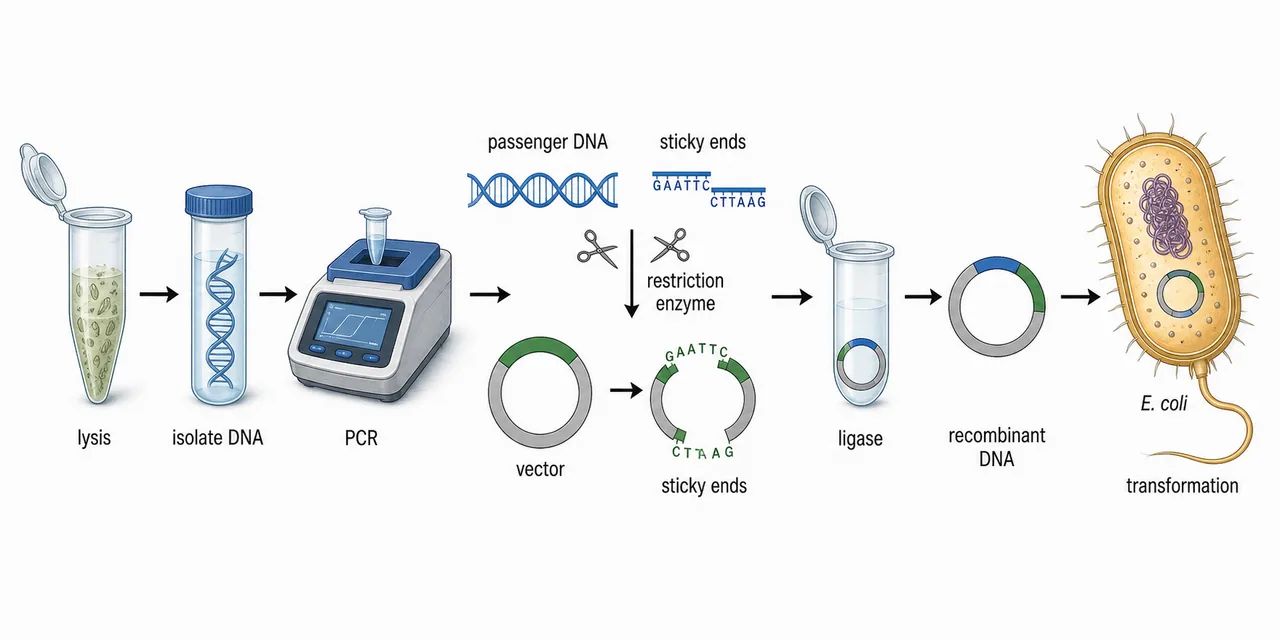
The DNAs which are to be used as passenger DNA and the vehicle DNA are extracted out of their cells by lysing the cells with the suitable enzyme. Lysing enzymes (such as lysozyme for bacteria) break open the cell walls and membranes, releasing the cellular contents including the DNA.
-
The extracted DNAs are isolated from other cell contents by ultra-centrifugation and purified. Ultra-centrifugation spins the cell lysate at extremely high speeds, separating molecules based on their density and size. This allows the DNA to be separated from proteins, lipids, RNA, and other cellular debris.
-
Amplification of the gene of interest using PCR. Once the DNA of interest has been identified, it needs to be multiplied (amplified) to produce enough copies for further manipulation. This is where PCR becomes indispensable.
PCR-technology
-
Polymerase Chain Reaction technology. PCR is one of the most revolutionary techniques in molecular biology, enabling the rapid amplification of specific DNA sequences from minute quantities of starting material.
-
This technique was invented by Kary Mullis (1933). Kary Mullis, an American biochemist, conceived the idea of PCR while driving along the California coast -- a moment of insight that would transform biology forever.
-
In 1993 Kary Mullis received the Nobel Prize for Chemistry for PCR. The Nobel Prize was awarded in recognition of the enormous impact PCR had on science, medicine, forensics, and countless other fields.
-
PCR is a method for amplifying a specific region of a DNA molecule without the requirement for time-consuming cloning procedures. This means that instead of inserting a gene into bacteria and waiting for them to replicate, PCR can produce millions of copies of a target DNA sequence in just a few hours using a simple laboratory machine called a thermal cycler.
-
PCR reaction takes place in an Eppendorf tube. These are small, thin-walled plastic tubes (typically 0.2 mL) that allow for rapid heat transfer, which is essential since PCR involves repeated cycles of heating and cooling.

-
Using PCR-technique, very low content of DNA available from samples of blood or semen or any other tissue or hair cell can be amplified many times and analysed. The ability to work with extremely small DNA samples makes PCR invaluable in forensic science, medical diagnostics, paternity testing, and archaeological studies.
-
Taq Polymerase is isolated from Thermus aquaticus bacterium. Thermus aquaticus is a bacterium that naturally lives in hot springs and hydrothermal vents, where temperatures can exceed 70-80 degrees Celsius. Because this bacterium thrives in extreme heat, its DNA polymerase enzyme is thermostable -- it does not denature (break down) at the high temperatures used in PCR.
IMPORTANT
Taq Polymerase from Thermus aquaticus is the key enzyme that made PCR practical. Its heat resistance allows it to survive the denaturation step (94 degrees C), unlike normal DNA polymerases that would be destroyed.
NOTE
Other heat-stable polymerases: Pfu Polymerase (from Pyrococcus furiosus) has proofreading ability (3'→5' exonuclease), producing more accurate copies. Vent Polymerase (from Thermococcus litoralis) also has proofreading capability for high-fidelity amplification.
Steps In PCR
PCR works through repeated cycles of three temperature-dependent steps. Each cycle approximately doubles the amount of target DNA, leading to exponential amplification. A typical PCR run involves 25-35 cycles.
-
Denaturation: (94 degrees C) In this step the double stranded DNA molecule is heated to 94 degrees C. So double stranded DNA becomes single stranded and each single stranded DNA functions as a template. The high temperature breaks the hydrogen bonds between the complementary base pairs, causing the two strands of the DNA double helix to separate completely.
-
Annealing: (54 degrees C) In this step two primer DNAs are attached at the 3' end of single stranded DNA. The temperature is lowered to allow the short, synthetic oligonucleotide primers to bind (anneal) to their complementary sequences on the template DNA. The primers define the boundaries of the DNA region to be amplified.
-
Extension: (72 degrees C) In this process Taq polymerase enzyme synthesizes a DNA strand over the template. PCR is an automatic process because Taq polymerase enzyme is heat resistant. At this optimal temperature for Taq polymerase activity, the enzyme extends the primers by adding nucleotides to the 3' end, synthesizing a new complementary strand along each template. This is where the actual DNA copying takes place.
TIP
Memorize the PCR temperatures: 94 (Denaturation) → 54 (Annealing) → 72 (Extension). Think of it as "hot-warm-medium" -- you first melt the DNA apart, then let primers stick, then let the enzyme build.

-
Before the cutting step, it helps to distinguish the major enzyme classes involved. Nucleases are enzymes that break down nucleic acids. An exonuclease removes nucleotides progressively from one or both free ends of a DNA or RNA strand, whereas an endonuclease cuts within the polynucleotide chain. The enzymes used in recombinant DNA work are mainly restriction endonucleases, because they recognize particular DNA sequences and cut at defined internal sites.
-
Both the passenger and vehicle DNAs are then cleaved by using the same restriction endonuclease so that they have complementary sticky ends. Using the same enzyme ensures that both the gene of interest and the vector have matching overhangs that can pair together through complementary base pairing.
-
The complementary sticky ends of the passenger and vehicle DNAs are joined with ligase enzyme. This gives rise to a recombinant DNA. The DNA ligase enzyme seals the nicks in the DNA backbone by forming phosphodiester bonds, creating a stable, continuous recombinant DNA molecule.

-
The recombinant DNA is now inserted into a host cell such as Escherichia coli. The bacteria to be used as hosts should be without plasmids. E. coli is the most widely used host organism in genetic engineering due to its rapid growth rate, well-understood genetics, and ease of manipulation. Using plasmid-free bacteria ensures there is no interference from existing plasmids.
-
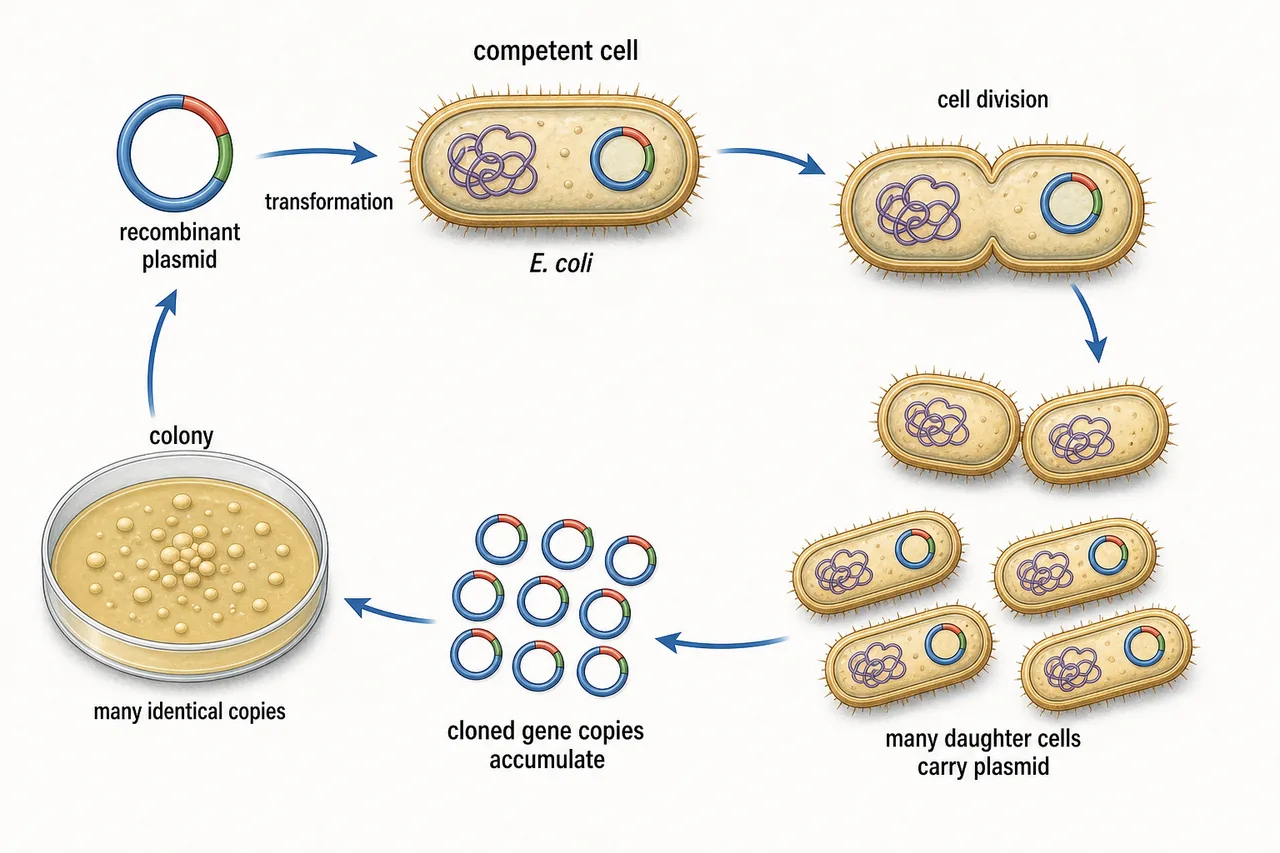
The host cells are treated with calcium chloride or lysozyme. It creates transient (temporary) pores in their wall and makes the latter permeable to recombinant DNA. This process is called transformation. The calcium chloride treatment makes the bacterial cell membrane temporarily permeable (the cells are said to be "competent"), allowing the recombinant DNA to pass through.
-
The recombinant DNA is added to the culture in which such bacteria are growing. The recombinant DNA is taken up by the bacteria. It replicates when the host bacteria divide and gives rise to multiple copies of recombinant DNA. As the bacterial population grows through cell division, each daughter cell inherits a copy of the recombinant DNA, effectively producing a clone of the desired gene.
Gene Cloning
-
Gene cloning is isolating a gene and producing identical copies -- a technique of genetic engineering by which a gene sequence with many identical copies is replicated. The term "cloning" comes from the Greek word klon, meaning "twig" or "slip," reflecting the idea of producing identical copies. Gene cloning is fundamental to biotechnology because it provides an unlimited supply of a specific gene for study, manipulation, or application.
-
E. coli is a bacterium used in genetic engineering for its small size. E. coli's fast doubling time (approximately 20 minutes under optimal conditions), simple nutritional requirements, and thoroughly characterized genome make it the workhorse organism of molecular biology and gene cloning.
Recombinant DNA technology
-
Technology of DNA molecules means the joining or recombining of two pieces of DNA from two different species. The techniques allow an investigator to biologically purify (clone) a gene from one species by inserting it into the DNA of another species, where it is replicated along with the host DNA. This cross-species gene transfer is what makes recombinant DNA technology so powerful -- it breaks the species barrier that exists in conventional breeding, allowing genes from virtually any organism to be expressed in another.
-
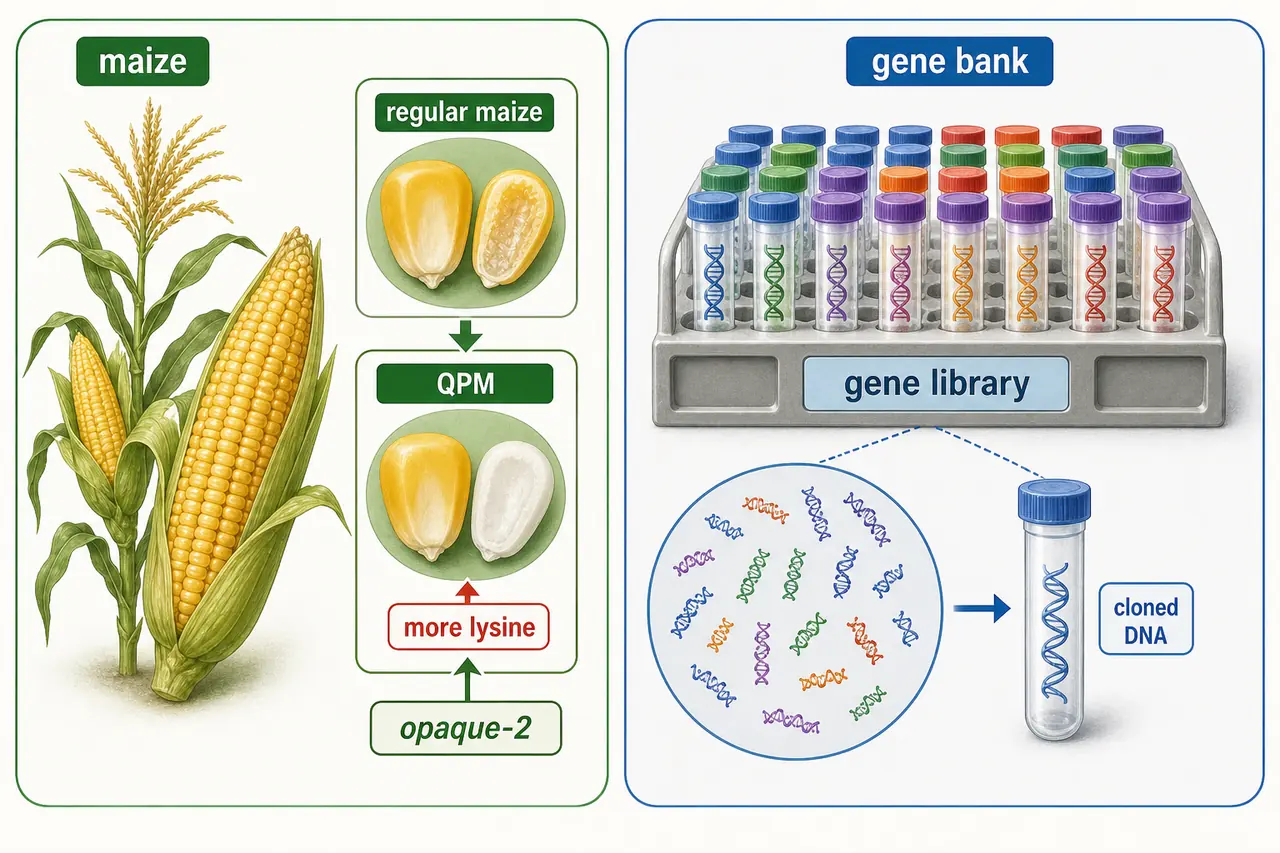
By using recombinant DNA technology, Opaque-2 gene is transferred to maize genotype, which is responsible for higher amount of lysine in maize and produces varieties i.e. Ratan, Shakti, Protina. The Opaque-2 gene modifies the protein composition of maize endosperm, increasing the proportion of lysine and tryptophan -- two essential amino acids that are normally deficient in regular maize. This improvement significantly enhances the nutritional value of maize, especially important for populations that depend on it as a staple food.
-
Gene bank is a group of genes or cloned DNA fragments. A gene bank (also called a gene library or genomic library) is a collection of cloned DNA fragments that together represent the entire genome of an organism. It serves as a repository from which specific genes can be identified and retrieved for further study or application.
-
In direct cloning terminology, a genomic library represents the full genome cloned in self-replicating vectors, whereas a cDNA library contains only sequences that were actually transcribed into mRNA in the sampled cells. When a particular clone is searched from such a library, the classical screening term is colony hybridization.
Summary Cheat Sheet
| Concept / Topic | Key Details |
|---|---|
| rDNA Technology | Joining DNA from two different species into a host |
| rDNA process steps | Extract DNA → isolate (ultracentrifugation) → amplify (PCR) → cut → ligate → transform |
| PCR full form | Polymerase Chain Reaction |
| PCR invented by | Kary Mullis — Nobel Prize 1993 (Chemistry) |
| PCR vessel | Eppendorf tube (0.2 mL) in thermal cycler |
| Denaturation temperature | 94°C — separates double-stranded DNA |
| Annealing temperature | 54°C — primers bind to 3' end of template |
| Extension temperature | 72°C — Taq polymerase synthesizes new strand |
| PCR cycles | Typically 25–35 cycles |
| Taq polymerase source | Thermus aquaticus (hot spring bacterium); heat-stable |
| Pfu polymerase | From Pyrococcus furiosus; has proofreading ability |
| Sticky ends joined by | DNA ligase → produces recombinant DNA |
| Host organism for cloning | Escherichia coli (doubling time ~20 minutes) |
| Host cell treatment | Calcium chloride or lysozyme → temporary pores → transformation |
| Gene cloning | Isolating a gene and producing identical copies in host |
| Opaque-2 gene in maize | Increases lysine content; varieties: Ratan, Shakti, Protina |
| Gene bank / Gene library | Collection of cloned DNA fragments representing entire genome |
| PCR applications | Disease diagnostics, forensics, paternity testing, MAS |