🧬 Genetic Material: DNA, RNA, Gene Concepts, and Genetic Code
Master DNA and RNA as genetic material, gene concepts (operon, cistron), and the genetic code — with agricultural examples, comparison tables, and exam-focused mnemonics.
Why Genetic Material Matters in Agriculture
When scientists developed Bt cotton by inserting a bacterial gene into cotton DNA, or when breeders use molecular markers to select disease-resistant rice lines without waiting for the disease to appear, they are working directly with genetic material. The discovery that DNA (not protein) carries hereditary information transformed agriculture — enabling marker-assisted selection, genetic engineering, and genomics-based crop improvement. Understanding DNA, RNA, genes, and the genetic code is essential for modern plant breeding and biotechnology.
What Is Genetic Material?
Genetic material consists of nucleic acids — the molecules that store and transmit hereditary information.
| Nucleic Acid | Full Name | Role |
|---|---|---|
| DNA | Deoxyribose Nucleic Acid | Primary genetic material in all cellular organisms |
| RNA | Ribose Nucleic Acid | Genetic material in some viruses; carries DNA's instructions in all organisms |
In plants, DNA is not confined to the nucleus alone; it is also present in mitochondria and chloroplasts, which is why plants show important forms of cytoplasmic inheritance.
Pro Content Locked
Upgrade to Pro to access this lesson and all other premium content.
Charged once for one year · ₹1188 total
Save ₹100/month vs ₹2388/year launch price
- All Agriculture & Banking Courses
- AI Lesson Questions (100/day)
- AI Doubt Solver (50/day)
- Glows & Grows Feedback (30/day)
- AI Section Quiz (20/day)
- 22-Language Translation (100/day)
- Recall Questions (20/day)
- AI Quiz (15/day)
- AI Quiz Paper Analysis (100/day)
- AI Step-by-Step Explanations (100/day)
- Spaced Repetition Recall (FSRS)
- AI Tutor
- Immersive Text Questions
- Audio Lessons — Hindi & English
- Mock Tests & Previous Year Papers
- Summary & Mind Maps
- XP, Levels, Leaderboard & Badges
- Generate New Classrooms
- Voice AI Teacher (AgriDots Live)
- AI Revision Assistant
- Knowledge Gap Analysis
- Interactive Revision (LangGraph)
🔒 Secure one-time yearly payment via Razorpay · No hidden fees
Why Genetic Material Matters in Agriculture
When scientists developed Bt cotton by inserting a bacterial gene into cotton DNA, or when breeders use molecular markers to select disease-resistant rice lines without waiting for the disease to appear, they are working directly with genetic material. The discovery that DNA (not protein) carries hereditary information transformed agriculture — enabling marker-assisted selection, genetic engineering, and genomics-based crop improvement. Understanding DNA, RNA, genes, and the genetic code is essential for modern plant breeding and biotechnology.
What Is Genetic Material?
Genetic material consists of nucleic acids — the molecules that store and transmit hereditary information.
| Nucleic Acid | Full Name | Role |
|---|---|---|
| DNA | Deoxyribose Nucleic Acid | Primary genetic material in all cellular organisms |
| RNA | Ribose Nucleic Acid | Genetic material in some viruses; carries DNA's instructions in all organisms |
In plants, DNA is not confined to the nucleus alone; it is also present in mitochondria and chloroplasts, which is why plants show important forms of cytoplasmic inheritance.
Key Discoveries
| Scientist(s) | Year | Discovery |
|---|---|---|
| Miescher | 1868 | First isolated nucleic acids ("nuclein") from WBC pus |
| Avery, MacLeod & McCarty | 1944 | Proved DNA (not protein) is the genetic material (transforming principle in E. coli) |
| A. Kornberg | 1959 | First in vitro synthesis of DNA (discovered DNA polymerase; Nobel Prize) |
| S. Ochoa | 1959 | In vitro synthesis of RNA (discovered polynucleotide phosphorylase; Nobel Prize) |
| H.G. Khorana & K.L. Agrawal | — | First artificial synthesis of a complete functional gene (alanine tRNA gene from yeast) |
Exam tip: The Avery-MacLeod-McCarty experiment (1944) is one of the most frequently asked discoveries. Remember: "AMM proved DNA, not protein".
Gene Concepts — Evolution of Understanding
One Gene–One Enzyme Hypothesis
- Proposed by Beadle & Tatum (1943) using biochemical mutants of Neurospora crassa (red bread mould).
- Each gene codes for one specific enzyme.
- Later refined to "one gene–one polypeptide" (not all gene products are enzymes; some proteins have multiple polypeptide chains coded by different genes).
Progression of the concept:
- One gene → One enzyme
- One gene → One protein
- One gene → One polypeptide chain
- One cistron → One polypeptide
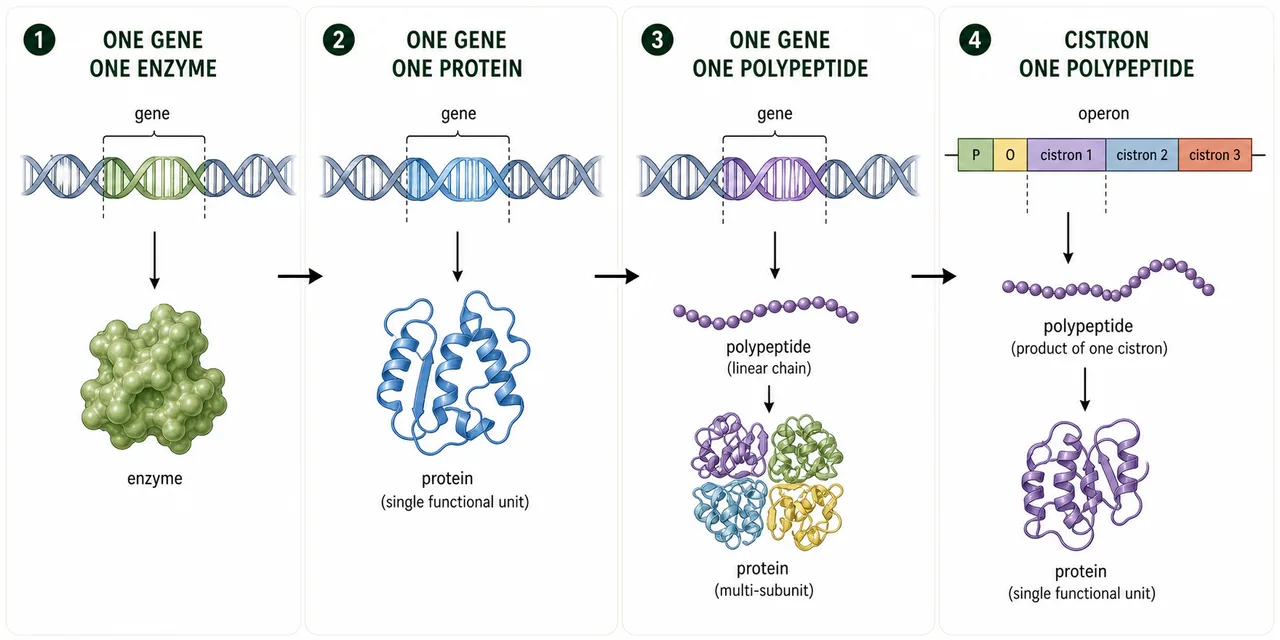
Operon Concept
- Given by Jacob & Monod (Nobel Prize 1965).
- Explains how gene expression is regulated in prokaryotes.
- Classic example: lac operon in E. coli — genes are switched on/off together in response to environmental signals (e.g., presence of lactose).
| Regulatory part | Role in the lac operon |
|---|---|
| Promoter (P) | DNA region where RNA polymerase binds to begin transcription |
| Operator (O) | DNA region where the repressor binds to block transcription |
| Repressor (lacI product) | Protein that prevents transcription when lactose is absent |
- In the absence of lactose, the repressor remains attached to the operator, so RNA polymerase cannot effectively transcribe the structural genes needed for lactose utilization.
- In the presence of lactose, its inducer form allolactose binds to the repressor and changes its shape, causing it to detach from the operator.
- Once the operator is freed, RNA polymerase can transcribe the lac genes and the cell can produce enzymes needed to metabolize lactose.
- This is why the lac operon is treated as an inducible operon: it becomes active when the relevant substrate is available.
- Full expression of the lac operon is strongest when lactose is present and glucose is scarce. When glucose is abundant, catabolite repression keeps lac-gene expression low even if lactose is available.
Gene Fine Structure
- Established by Benzer using bacteriophage T4.
- Showed that genes are not indivisible — they can be mapped into smaller functional regions.
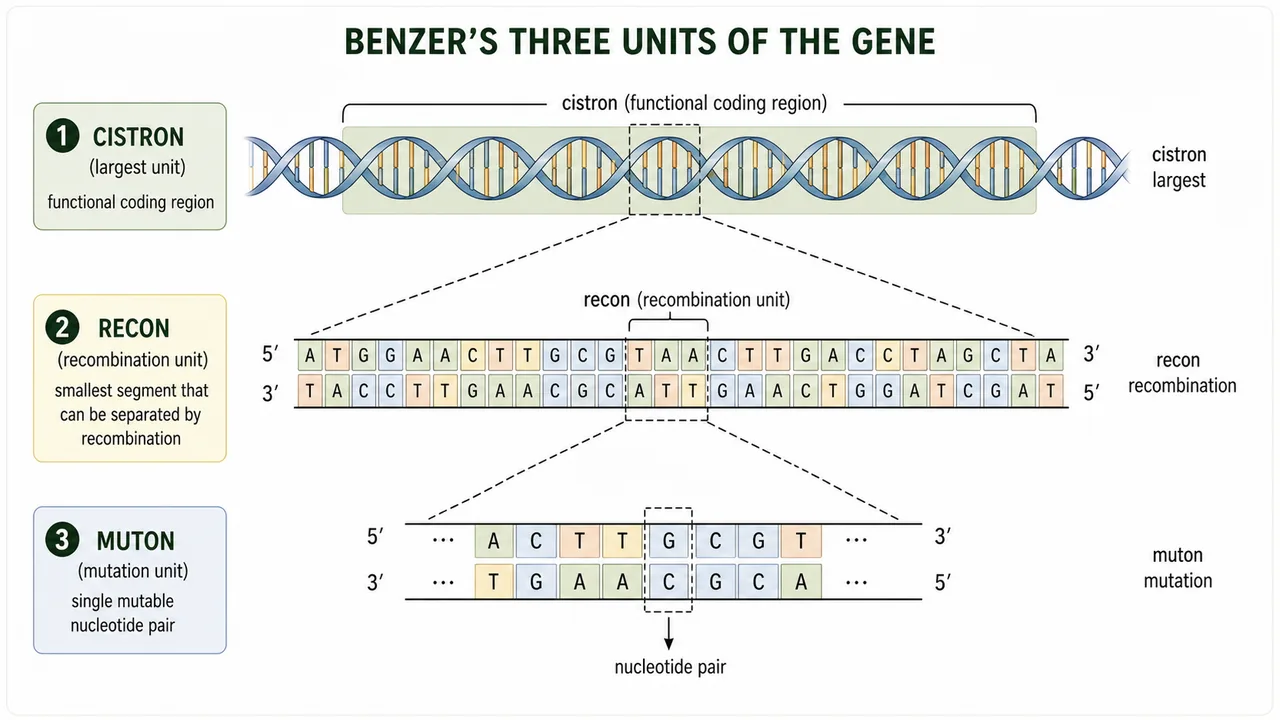
Benzer's Three Units of the Gene
| Unit | Definition | Size | Key Fact |
|---|---|---|---|
| Recon | Smallest unit of recombination | 1–2 nucleotide pairs | Recombination can occur between adjacent nucleotides |
| Muton | Smallest unit of mutation | Single nucleotide pair (smallest) | Even a point mutation can alter gene function |
| Cistron | Functional unit of the gene | Hundreds of nucleotide pairs (largest) | Equivalent to "gene" in modern usage; codes for one polypeptide |
Mnemonic: Size order = Recon < Muton < Cistron (alphabetical order R-M-C matches smallest to largest).
Structure of DNA
Watson-Crick Model (1953)
- Proposed by J.D. Watson & F.H.C. Crick.
- X-ray diffraction data by Wilkins and Rosalind Franklin (Photo 51).
- Nobel Prize (1962): Watson, Crick, and Wilkins.
Double Helix Features
| Parameter | Value |
|---|---|
| Two antiparallel strands | 5'→3' and 3'→5' |
| Backbone | Sugar-phosphate on the outside |
| Bases | On the inside; form hydrogen bonds |
| A–T | 2 hydrogen bonds |
| G–C | 3 hydrogen bonds (more thermally stable) |
| Distance between base pairs | 3.4 Å |
| Base pairs per turn | 10 |
| Length per turn | 34 Å |
| Helix diameter | 20 Å |

- Adjacent nucleotides in a strand are joined by phosphodiester bonds, while the bond between a sugar and its nitrogenous base is a glycosidic bond.
- The common Watson-Crick form is B-DNA, a right-handed helix and the predominant biologically active form in living cells; Z-DNA is a left-handed helix, while C-DNA and D-DNA are less common conformational variants.
Chargaff's Rules
- A = T and G = C; total purines (A+G) = total pyrimidines (T+C).
- (A+T)/(G+C) = Base pair ratio — unique to each species (biochemical fingerprint).
- The two strands are complementary (not identical) and run antiparallel.
- Knowing one strand's sequence automatically reveals the other — this is the basis of DNA replication and transcription.
Agricultural application: Base pair ratio and G-C content affect DNA melting temperature (Tm), which is critical when designing PCR primers for molecular markers used in crop breeding (SSR, RAPD, SNP markers).
DNA Replication in Brief
- DNA replication is semiconservative, meaning each daughter DNA molecule carries one parental strand and one newly synthesized complementary strand.
- This model was demonstrated experimentally by Meselson and Stahl (1958).
- Replication occurs during the S phase of the cell cycle and depends on the complementarity of the two antiparallel strands.
- In prokaryotes such as bacteria, the chromosome is usually circular; this circular form was classically demonstrated in E. coli by Cairns (1963). By contrast, most eukaryotic nuclear chromosomes are linear, although mitochondrial and chloroplast DNA remain circular.
Replication Machinery and Strand Logic
- Helicase opens the double helix at the replication fork, while topoisomerase / DNA gyrase relieves torsional strain ahead of the fork.
- Single-strand binding proteins (SSBs) stabilize the separated strands so they do not re-anneal immediately.
- Primase synthesizes the short RNA primer required to start DNA synthesis.
- DNA polymerases can extend DNA only in the 5' to 3' direction.
- In bacteria, DNA polymerase III is the main replicative polymerase, while DNA polymerase I removes RNA primers and helps fill the resulting gaps.
- The leading strand is synthesized continuously, whereas the lagging strand is synthesized discontinuously as Okazaki fragments, which are later joined by DNA ligase.
- DNA replication proceeds bidirectionally from an origin, producing two replication forks.
Structure of RNA
| Feature | DNA | RNA |
|---|---|---|
| Sugar | Deoxyribose | Ribose |
| Strands | Double-stranded (helical) | Usually single-stranded (can fold into 3D shapes) |
| Bases | A, T, G, C | A, U, G, C |
| Genetic role | Primary genetic material (all cellular organisms) | Genetic material in some plant viruses and bacteriophages |
| Virus | Type of RNA |
|---|---|
| Plant Viruses | |
| Turnip yellow mosaic virus (TYMC) | Single stranded |
| Wound tumour | Double stranded |
| Animal viruses | |
| Influenza virus | Single stranded |
| Rous Sarcoma | Single stranded |
| Poliomyelitis | Single stranded |
| Reovirus | Double stranded |
| Bacteriophages | |
| MS 2, F 2, r 17 | Single stranded |

Types of RNA
| Type | Category | Feature |
|---|---|---|
| Genetic RNA | Viral genomes | Self-replicating via RNA-dependent RNA synthesis (enzyme: RdRp) |
| Non-genetic RNA | mRNA, tRNA, rRNA | Synthesised on DNA template; carry out DNA's instructions |
- In organisms that have both DNA and RNA, the RNA performs non-genetic roles (messenger, transfer, ribosomal).
- Classical examples often pair TMV with single-stranded RNA and Reovirus with double-stranded RNA.
- The clover-leaf model of tRNA is associated with Holley (1965).
- In objective-style recall, mRNA is often treated as about 5-10% of total cellular RNA, tRNA as about 10-15%, and rRNA as roughly 80%; rRNA is the most abundant and structurally stable RNA class.
- tRNA is double-stranded but non-helical in its secondary structure and carries the anticodon that pairs with the codon on mRNA.
Agricultural example: Many devastating crop diseases are caused by RNA viruses — rice tungro, tomato spotted wilt, wheat streak mosaic. Understanding RNA replication (RdRp) is the basis for developing antiviral strategies in crops.
Flow of Genetic Information
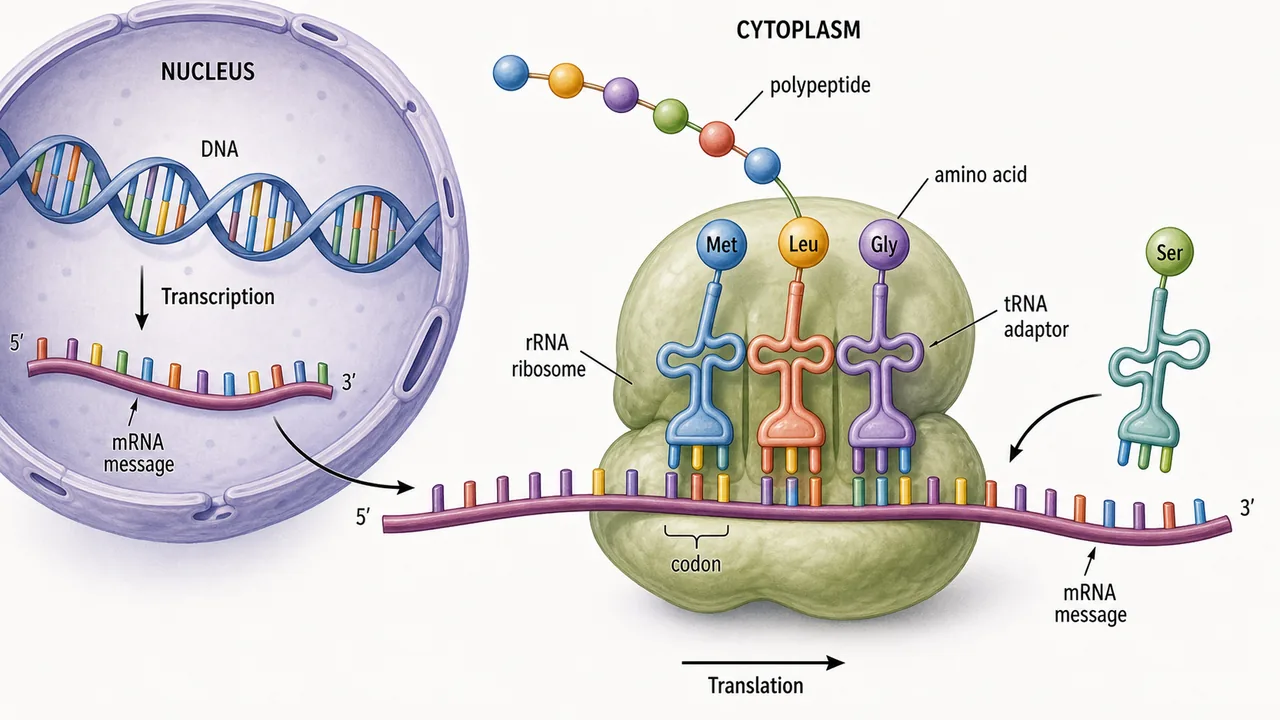
- The central dogma, associated with Francis Crick (1958), describes the usual flow of information as DNA -> RNA -> Protein.
- Transcription synthesizes RNA on a DNA template, and translation uses that RNA message to build a protein on ribosomes.
- In eukaryotes, the primary transcript is commonly called hnRNA (pre-mRNA). It is processed by removal of introns, joining of exons, addition of a 5' cap, and addition of a 3' poly-A tail before export for translation.
- In prokaryotes, a single major RNA polymerase synthesizes the main RNA classes, whereas eukaryotes divide this work among RNA polymerases I, II, and III.
The Genetic Code
Deciphering the Code
- Holley, Khorana, and Nirenberg — Nobel Prize in Physiology or Medicine (1968).
- DNA's genetic information is written in a language of 4 bases (A, T, G, C) but must code for 20 amino acids in proteins.
- The coded message on DNA is called a cryptogram; it is transmitted via mRNA to ribosomes.
Why Triplet Code?
| Code Type | Combinations | Sufficient for 20 amino acids? |
|---|---|---|
| Singlet (1 base) | 4¹ = 4 | No |
| Doublet (2 bases) | 4² = 16 | No |
| Triplet (3 bases) | 4³ = 64 | Yes (with 44 redundant codons) |
An anticodon is the complementary triplet on tRNA that matches the mRNA codon, ensuring the correct amino acid is delivered.

Five Properties of the Genetic Code
IMPORTANT
Memorise these five properties — they are tested repeatedly in competitive exams.
| Property | Meaning | Example |
|---|---|---|
| Triplet | Each codon = 3 bases | Minimum requirement to code 20 amino acids |
| Degenerate | Multiple codons for same amino acid (synonyms) | Arg, Ser, Leu each have 6 codons; all CC- codons = proline |
| Non-overlapping | Each base belongs to only one codon | No base is shared between adjacent codons |
| Comma-less | No spacers or punctuation between codons | Ribosome reads continuously, 3 bases at a time |
| Universal | Same code in all organisms | From bacteria to humans; minor exceptions in mitochondrial DNA |
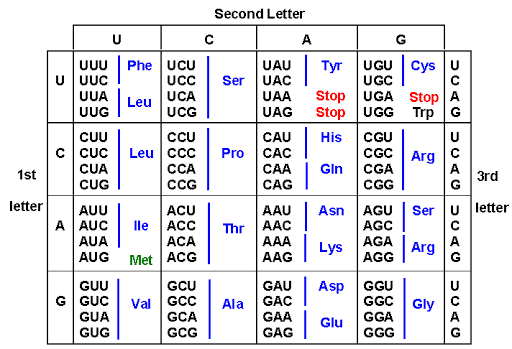
Additional property:
- Ambiguous — under abnormal conditions (e.g., streptomycin), a codon may code for a different amino acid. This is NOT a normal feature of translation.
Mnemonic for code properties: "TDN-CU" — Triplet, Degenerate, Non-overlapping, Comma-less, Universal.
Start and Stop Codons
| Type | Codons | Name | Function |
|---|---|---|---|
| Start | AUG | — | Initiates translation; codes for methionine |
| Stop | UAA | Ochre | Terminates translation |
| Stop | UAG | Amber | Terminates translation |
| Stop | UGA | Opal | Terminates translation |
Mnemonic for stop codons: "U Are Annoying, U Are Gone, U Go Away" — UAA, UAG, UGA.
Degeneracy benefit in agriculture: Because of code degeneracy, many point mutations in the third codon position are silent (do not change the amino acid). This provides a buffer against harmful mutations in crop genomes, contributing to genetic stability across generations.
Explore More
- Genetic Code and Codons Explained
- Transcription and Translation Overview
- Gene Expression: From DNA to Protein
Summary Table
| Topic | Key Fact | Exam Pointer |
|---|---|---|
| DNA as genetic material | Proved by Avery, MacLeod & McCarty (1944) | Transforming principle in E. coli |
| Nucleic acids first isolated | Miescher (1868) from WBC pus | Called it "nuclein" |
| In vitro DNA synthesis | A. Kornberg (Nobel 1959) | Discovered DNA polymerase |
| In vitro RNA synthesis | S. Ochoa (Nobel 1959) | Polynucleotide phosphorylase |
| Artificial gene synthesis | Khorana & Agrawal | Alanine tRNA gene from yeast |
| One gene–one enzyme | Beadle & Tatum (1943) on Neurospora | Refined to one gene–one polypeptide |
| Operon concept | Jacob & Monod (Nobel 1965) | lac operon in E. coli |
| Gene fine structure | Benzer (phage T4) | Recon < Muton < Cistron |
| DNA model | Watson & Crick (1953; Nobel 1962) | Double helix; 3.4 Å/bp; 10 bp/turn |
| Chargaff's Rules | A=T, G=C | Base pair ratio is species-specific |
| Genetic code | Triplet, degenerate, universal | 64 codons for 20 amino acids |
| Start codon | AUG (methionine) | Initiates translation |
| Stop codons | UAA, UAG, UGA | Ochre, Amber, Opal |
| Degeneracy | Multiple codons per amino acid | Wobble position provides mutation buffer |
Summary Cheat Sheet
| Concept / Topic | Key Details |
|---|---|
| Nucleic acids first isolated by | Miescher (1868) — "nuclein" from WBC pus |
| DNA proved as genetic material | Avery, MacLeod & McCarty (1944) |
| In vitro DNA synthesis | A. Kornberg (Nobel 1959); discovered DNA polymerase |
| In vitro RNA synthesis | S. Ochoa (Nobel 1959); polynucleotide phosphorylase |
| Artificial gene synthesis | Khorana & Agrawal — alanine tRNA gene from yeast |
| One gene–one enzyme | Beadle & Tatum (1943) on Neurospora crassa |
| Modern refinement | One gene → one polypeptide |
| Operon concept | Jacob & Monod (Nobel 1965); lac operon in E. coli |
| Benzer's units (size order) | Recon (1–2 bp) < Muton (1 bp) < Cistron (hundreds bp) |
| Recon | Smallest unit of recombination |
| Muton | Smallest unit of mutation |
| Cistron | Functional unit = gene; codes for one polypeptide |
| DNA double helix | Watson & Crick (1953); Nobel Prize 1962 |
| X-ray data by | Wilkins & Rosalind Franklin (Photo 51) |
| A–T = 2 H-bonds | G–C = 3 H-bonds (more stable) |
| DNA dimensions | 3.4 Å/bp, 10 bp/turn, 34 Å/turn, 20 Å diameter |
| Chargaff's Rules | A=T, G=C; (A+T)/(G+C) = species-specific ratio |
| RNA vs DNA | RNA: ribose, single-stranded, uracil replaces thymine |
| RdRp | RNA-dependent RNA polymerase; replicates viral RNA genomes |
| Genetic code deciphered by | Holley, Khorana, Nirenberg (Nobel 1968) |
| Triplet code | 4³ = 64 codons for 20 amino acids |
| Code properties | Triplet, Degenerate, Non-overlapping, Comma-less, Universal |
| Start codon | AUG (methionine) |
| Stop codons | UAA (ochre), UAG (amber), UGA (opal) |