🧶 Nucleus: Structure, Chromosomes, and Nucleic Acids
Understand the nucleus, nucleolus, RNA polymerases, chromosome structure, and the building blocks of DNA and RNA — with agricultural examples, comparison tables, and exam tips.
Why the Nucleus Matters in Agriculture
The nucleus is the command centre of every plant cell. It contains the DNA that determines whether a rice variety is dwarf or tall, whether a wheat line resists rust or succumbs to it, and whether a cotton plant produces long or short fibres. When plant breeders make a cross, they are essentially combining the nuclear DNA of two parents to create new genetic combinations. Understanding nuclear structure — chromosomes, genes, and nucleic acids — is the foundation of all genetics and plant breeding.
Discovery and Structure
| Feature | Detail |
|---|---|
| Name origin | Latin "Kernel" — the central core of the cell |
| Discovered by | Robert Brown (1833) — while studying orchid cells |
| Envelope | Double membrane (lipoprotein) with nuclear pores |
| Size | 5–25 µm |
- In direct exam-style recall, the nucleus is treated as the largest cell organelle. Older objective books may add that the next largest organelle is usually chloroplast in plant cells and mitochondrion in animal cells.
The nuclear envelope consists of two concentric lipid bilayer membranes perforated by nuclear pores that regulate the transport of mRNA, ribosomal subunits, and proteins between the nucleus and cytoplasm.
Pro Content Locked
Upgrade to Pro to access this lesson and all other premium content.
Charged once for one year · ₹1188 total
Save ₹100/month vs ₹2388/year launch price
- All Agriculture & Banking Courses
- AI Lesson Questions (100/day)
- AI Doubt Solver (50/day)
- Glows & Grows Feedback (30/day)
- AI Section Quiz (20/day)
- 22-Language Translation (100/day)
- Recall Questions (20/day)
- AI Quiz (15/day)
- AI Quiz Paper Analysis (100/day)
- AI Step-by-Step Explanations (100/day)
- Spaced Repetition Recall (FSRS)
- AI Tutor
- Immersive Text Questions
- Audio Lessons — Hindi & English
- Mock Tests & Previous Year Papers
- Summary & Mind Maps
- XP, Levels, Leaderboard & Badges
- Generate New Classrooms
- Voice AI Teacher (AgriDots Live)
- AI Revision Assistant
- Knowledge Gap Analysis
- Interactive Revision (LangGraph)
🔒 Secure one-time yearly payment via Razorpay · No hidden fees
Why the Nucleus Matters in Agriculture
The nucleus is the command centre of every plant cell. It contains the DNA that determines whether a rice variety is dwarf or tall, whether a wheat line resists rust or succumbs to it, and whether a cotton plant produces long or short fibres. When plant breeders make a cross, they are essentially combining the nuclear DNA of two parents to create new genetic combinations. Understanding nuclear structure — chromosomes, genes, and nucleic acids — is the foundation of all genetics and plant breeding.
Discovery and Structure
| Feature | Detail |
|---|---|
| Name origin | Latin "Kernel" — the central core of the cell |
| Discovered by | Robert Brown (1833) — while studying orchid cells |
| Envelope | Double membrane (lipoprotein) with nuclear pores |
| Size | 5–25 µm |
- In direct exam-style recall, the nucleus is treated as the largest cell organelle. Older objective books may add that the next largest organelle is usually chloroplast in plant cells and mitochondrion in animal cells.
The nuclear envelope consists of two concentric lipid bilayer membranes perforated by nuclear pores that regulate the transport of mRNA, ribosomal subunits, and proteins between the nucleus and cytoplasm.
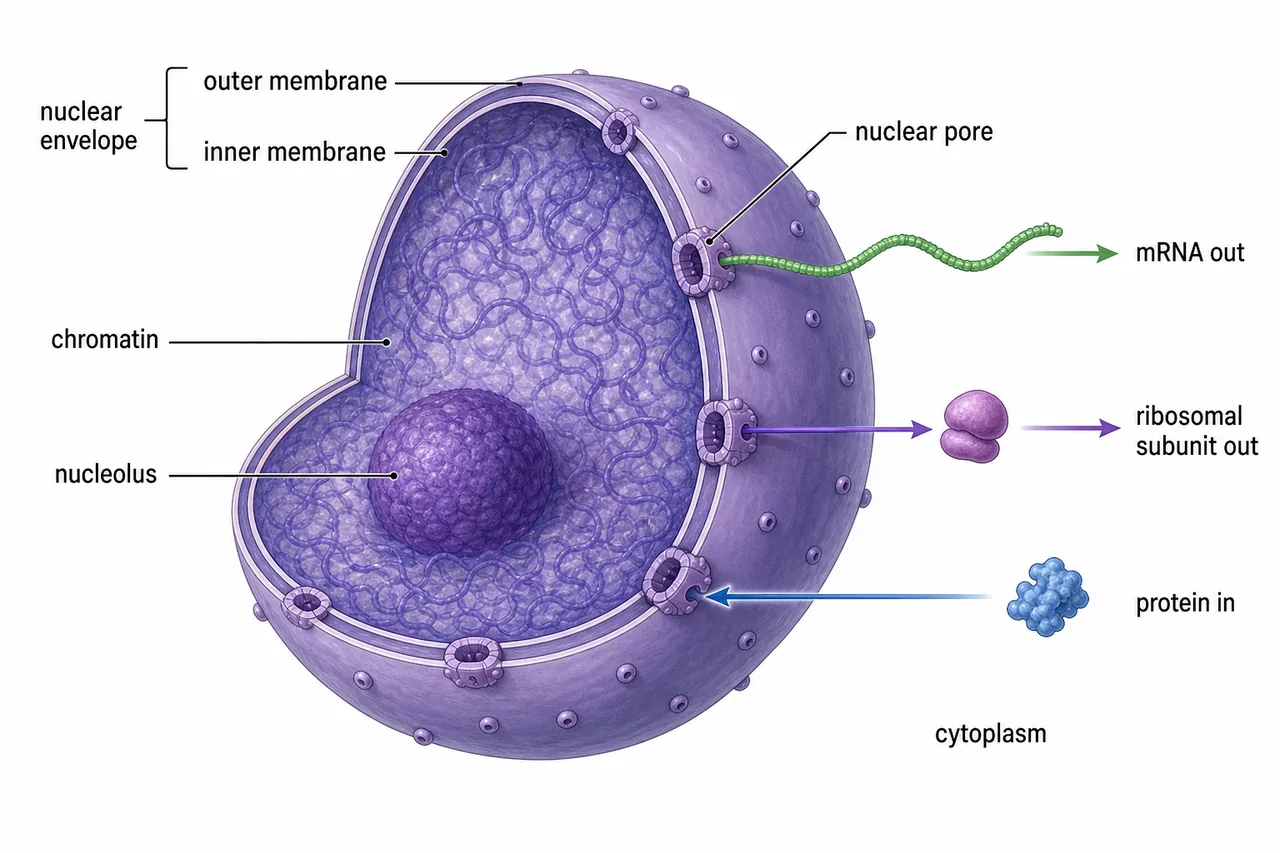
Agricultural connection: Robert Brown discovered the nucleus while studying orchid cells — orchids are today one of the most commercially valuable horticultural crops, and understanding their nuclear biology is essential for orchid breeding and tissue culture.
Where Is the Nucleus Absent?
IMPORTANT
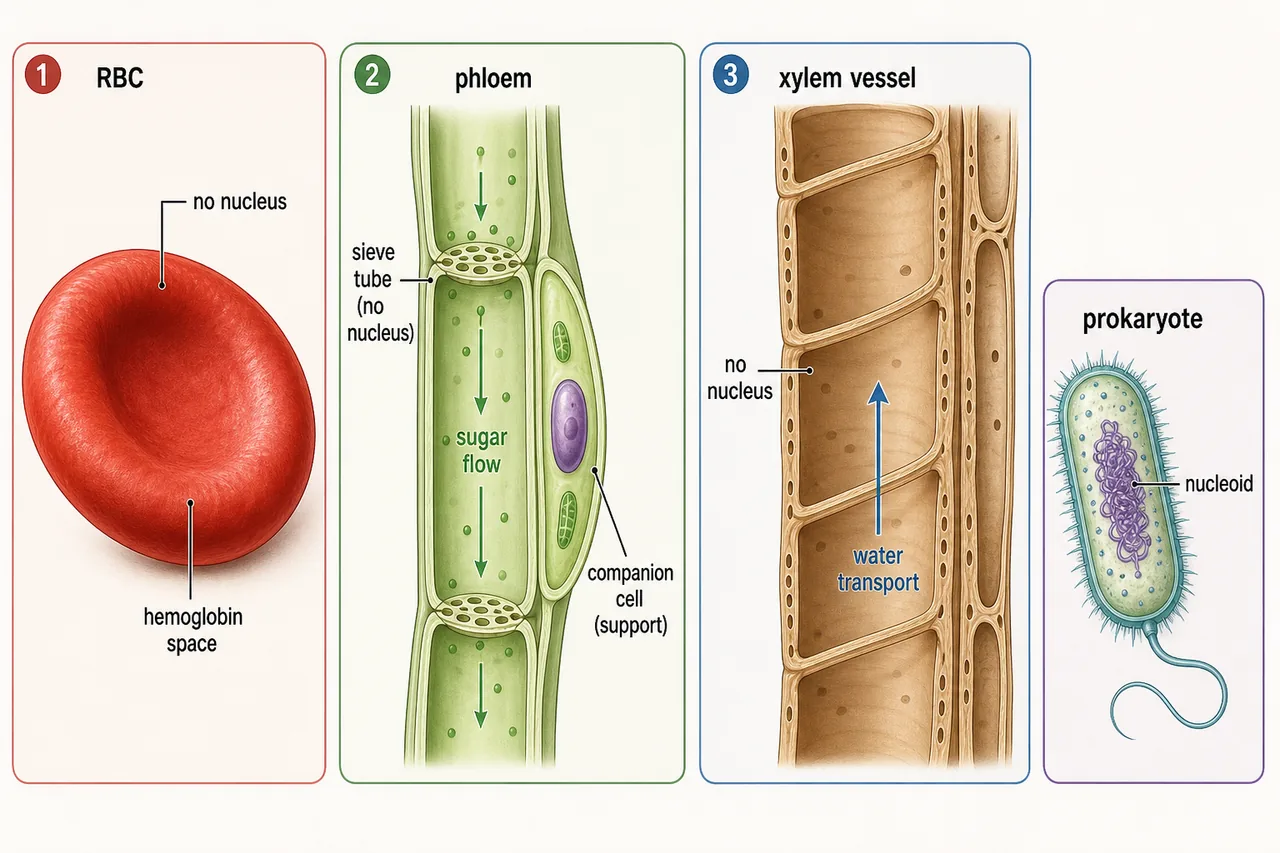
"Nucleus absent in mature RBCs, sieve tubes, and xylem" is a frequently asked exam question (IBPS AFO, NABARD Grade A, and ICAR).
| Cell Type | Reason for Absence | Functional Consequence |
|---|---|---|
| Bacteria and cyanobacteria | Prokaryotes — DNA exists as nucleoid (no membrane) | Classified as prokaryotic |
| Mature mammalian RBCs | Lost during maturation | More space for haemoglobin; cannot divide or repair |
| Sieve tube cells (phloem) | Lost at maturity | Remain alive; depend on companion cells for support |
| Xylem vessels/tracheids | Dead at maturity | Hollow tubes for efficient water transport |
Agricultural relevance: Phloem sieve tubes transport sucrose from source (leaves) to sink (developing grains). Their nucleus-free structure maximises the flow channel, which directly affects grain filling in cereals.
Nuclear Contents
Nucleoplasm
The nucleoplasm (nuclear sap / karyolymph / karyofluid) is the semi-fluid, gel-like matrix inside the nucleus. It provides the medium for chromatin, the nucleolus, and nuclear reactions.
Chromatin and Chromosomes
- Chromatin = DNA + histone proteins + non-histone proteins — the loosely coiled, thread-like form of genetic material during interphase (allows DNA to be accessible for transcription).
- A standard history recall point is that the term chromatin is associated with Walter Flemming (1879).
- During cell division, chromatin condenses into compact, rod-like chromosomes for equal distribution to daughter cells.
- The darkly stained, tightly packed part of chromatin is called heterochromatin, while the lighter, more transcriptionally active part is called euchromatin.
- Chromosomes contain stretches of DNA called genes — the hereditary units that carry information for protein synthesis.
- DNA is the hereditary material; genes control enzyme production → metabolic activities → traits.
Nucleolus
| Feature | Detail |
|---|---|
| Shape | Spheroidal; densest structure in the nucleus |
| Membrane | Non-membrane-bound |
| Discovered by | Fontana (1781) |
| Composition | Rich in RNA; also contains DNA |
| Main function | Synthesise ribosomal RNA (rRNA) |
| Chromosomal attachment | Nucleolar Organiser Region (NOR) — contains rRNA genes |
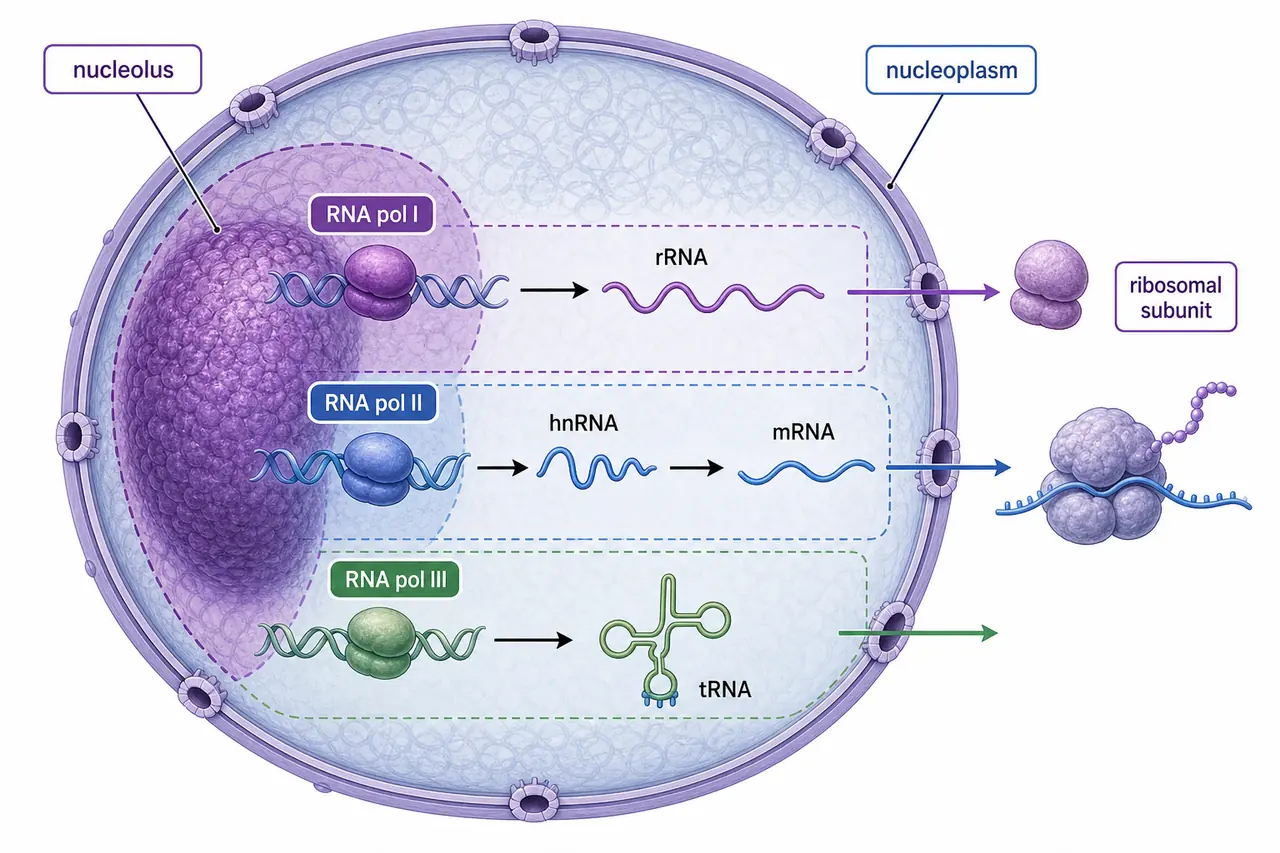
The nucleolus assembles ribosomal subunits around the NOR before exporting them to the cytoplasm for protein synthesis.
RNA Polymerases in Eukaryotes
| Enzyme | Location | Product | Function |
|---|---|---|---|
| RNA Polymerase I (A) | Nucleolus | rRNA | Transcribes large rRNA molecules (28S, 18S, 5.8S) |
| RNA Polymerase II (B) | Nucleoplasm | HnRNA (precursor of mRNA) | Processed via capping, polyadenylation, splicing → mature mRNA |
| RNA Polymerase III (C) | Nucleoplasm | tRNA (sRNA) | Small RNAs essential for translation |
Mnemonic: "I = ribosomal, II = messenger, III = transfer" — numbering matches product size (rRNA largest, tRNA smallest).
Chromosomes

Discovery and Naming
| Year | Scientist | Contribution |
|---|---|---|
| 1875 | Strasburger | First observed chromosomes as fine threads during plant cell division |
| 1888 | Waldeyer | Named them "Chromosome" (chroma = colour + soma = body) — stained with basic dye |
| — | Morgan | Proved chromosomes carry genes (using Drosophila) UPPSC 2021 |
Key Terms
| Term | Meaning |
|---|---|
| Homozygous | Identical alleles for a trait (AA or aa) Exams |
| Heterozygous | Different alleles for a trait (Aa) |
| Homologous chromosomes | Same size, shape, gene sequence; one from each parent |

Chromosome Number
- Chromosome number is species-specific and constant across generations.
- Examples: Human 2n = 46; Rice 2n = 24; Wheat 2n = 42; Maize 2n = 20.
- A karyotype is the characteristic chromosome complement of a species, arranged systematically by number, size, shape, and centromere position.
| Feature | Prokaryotes | Eukaryotes |
|---|---|---|
| Number | Single | Multiple |
| Shape | Circular | Rod-shaped (linear) |
| Name | Genophore | Chromosome |
| Histones | Absent (naked DNA) | Present (DNA wound around histones) |

- The basic nucleosome core contains a histone octamer made from two copies each of H2A, H2B, H3, and H4, while H1 acts as a linker histone helping stabilize the next level of packing.
- Most normal chromosomes are monocentric (one centromere), while acentric and dicentric chromosomes usually arise through chromosomal aberrations.
Centromere Position and Chromosome Shape
| Type | Centromere position | Typical appearance |
|---|---|---|
| Metacentric | Near the middle | Two nearly equal arms |
| Submetacentric | Slightly off-centre | One short arm and one longer arm |
| Acrocentric | Close to one end | Very short arm and one very long arm |
| Telocentric | At the terminal end | Effectively one visible arm |
Special Chromosome Forms
- Polytene chromosomes are giant chromosomes produced by repeated DNA replication without normal cell division (endoreduplication / endomitosis); they are classically studied in the salivary glands of dipteran larvae.
- Lampbrush chromosomes are giant meiotic chromosomes seen in growing oocytes, especially during the extended diplotene stage, where their lateral loops reflect active transcription.
Agricultural example: Wheat has 2n = 42 (hexaploid — three ancestral genomes combined). Understanding chromosome number and ploidy level is essential when making wide crosses in wheat breeding programmes.
Nucleic Acids — Building Blocks
Nucleotide vs. Nucleoside
| Term | Composition |
|---|---|
| Nucleoside | Sugar + Nitrogenous base |
| Nucleotide | Sugar + Nitrogenous base + Phosphate (H₃PO₄) |
| Relationship | Nucleotide = Nucleoside + Phosphoric acid |
Nucleotides are the monomers of nucleic acids, linked by phosphodiester bonds.
Nitrogenous Bases
| Base | Type | Ring Structure | Found in |
|---|---|---|---|
| Adenine (A) | Purine | Double ring | DNA and RNA |
| Guanine (G) | Purine | Double ring | DNA and RNA |
| Cytosine (C) | Pyrimidine | Single ring | DNA and RNA |
| Thymine (T) | Pyrimidine | Single ring | DNA only |
| Uracil (U) | Pyrimidine | Single ring | RNA only |
Mnemonic: Pure As Gold = Purines are Adenine and Guanine. Pyrimidines (C, T, U) have the smaller, single ring — think "CUT the Py" (C, U, T are pyrimidines).
Base Pairing Rules
- In DNA: A always pairs with T (purine + pyrimidine) → maintains uniform helix width of 20 Å.
- G always pairs with C.
DNA Structure — Watson-Crick Model
- Proposed by J.D. Watson & F.H.C. Crick (1953).
- Wilkins and Rosalind Franklin provided X-ray diffraction data (Photo 51).
- Nobel Prize (1962): Watson, Crick, and Wilkins.
Key Features of the Double Helix
| Parameter | Value |
|---|---|
| Two antiparallel strands | One runs 5'→3', the other 3'→5' |
| Backbone | Sugar-phosphate on the outside |
| Bases | On the inside, forming hydrogen bonds |
| A–T bonds | 2 hydrogen bonds |
| G–C bonds | 3 hydrogen bonds (more stable) |
| Distance between base pairs | 3.4 Å |
| Base pairs per turn | 10 |
| Length per turn | 34 Å |
| Helix diameter | 20 Å |

Chargaff's Rules
- A = T and G = C; total purines (A+G) = total pyrimidines (T+C).
- (A+T)/(G+C) = Base pair ratio — unique to each species.
- Higher G-C content → higher thermal stability (melting temperature Tm).
Agricultural application: Understanding DNA melting temperature is important in PCR-based molecular markers (SSR, RAPD) used in marker-assisted selection (MAS) for crop improvement.
The two strands are complementary (not identical) — knowing one strand's sequence reveals the other. This complementarity is the basis of DNA replication and transcription.
Explore More
Summary Table
| Topic | Key Fact | Exam Pointer |
|---|---|---|
| Nucleus discovery | Robert Brown, 1833, orchid cells | Latin "Kernel" |
| Nuclear envelope | Double membrane with pores | Lipoprotein; regulates molecular traffic |
| Nucleus absent in | Mature RBCs, sieve tubes, xylem | Prokaryotes have nucleoid (no membrane) |
| Nucleolus | Synthesises rRNA; non-membrane-bound | Attached to NOR; discovered by Fontana (1781) |
| RNA Pol I | Nucleolus → rRNA | |
| RNA Pol II | Nucleoplasm → HnRNA (mRNA precursor) | |
| RNA Pol III | Nucleoplasm → tRNA | |
| Chromosome named by | Waldeyer, 1888 | "Coloured body" — basic dye staining |
| Genes on chromosomes | Proved by Morgan (Drosophila) | Chromosomal Theory of Inheritance |
| Purines | A, G (double ring) | "Pure As Gold" |
| Pyrimidines | C, T, U (single ring) | T in DNA only; U in RNA only |
| DNA model | Watson & Crick, 1953 | Nobel Prize 1962 (with Wilkins) |
| Chargaff's Rules | A=T, G=C | Base pair ratio is species-specific |
| DNA dimensions | 3.4 Å between bases; 10 bp/turn; 20 Å diameter | 34 Å per complete turn |
| G-C vs. A-T | G-C has 3 H-bonds (more stable) | Higher G-C = higher melting temperature |
Summary Cheat Sheet
| Concept / Topic | Key Details |
|---|---|
| Nucleus discovered by | Robert Brown (1833) — orchid cells |
| Name origin | Latin "Kernel" |
| Nuclear envelope | Double membrane (lipoprotein) with nuclear pores |
| Nucleus size | 5–25 µm |
| Nucleus absent in | Bacteria, mature RBCs, sieve tubes, xylem vessels |
| Nucleoplasm | Semi-fluid matrix inside nucleus (karyolymph) |
| Chromatin | DNA + histone and non-histone proteins; condenses into chromosomes during division |
| Nucleolus | Synthesises rRNA; non-membrane-bound; discovered by Fontana (1781) |
| NOR | Nucleolar Organiser Region; contains rRNA genes |
| RNA Pol I → rRNA | Located in nucleolus |
| RNA Pol II → HnRNA/mRNA | Located in nucleoplasm |
| RNA Pol III → tRNA | Located in nucleoplasm |
| Chromosomes first seen by | Strasburger (1875) |
| "Chromosome" named by | Waldeyer (1888) — chroma (colour) + soma (body) |
| Genes on chromosomes proved by | Morgan (using Drosophila) |
| Homozygous | Identical alleles (AA or aa) |
| Heterozygous | Different alleles (Aa) |
| Prokaryote chromosome | Single, circular, no histones = genophore |
| Eukaryote chromosome | Multiple, linear, with histones |
| Nucleoside | Sugar + nitrogenous base |
| Nucleotide | Nucleoside + phosphate |
| Purines | Adenine (A), Guanine (G) — double ring |
| Pyrimidines | Cytosine (C), Thymine (T), Uracil (U) — single ring |
| DNA double helix | Watson & Crick (1953); Nobel 1962 |
| DNA dimensions | 3.4 Å/bp, 10 bp/turn, 20 Å diameter |
| Chargaff's Rules | A=T, G=C; (A+T)/(G+C) = species-specific |