⨵ Meiosis: Stages, Crossing Over, and Calculations
Master meiosis I and II, prophase I sub-stages, crossing over, and cell division calculations — with agricultural examples, comparison tables, and exam mnemonics.
Why Meiosis Matters in Agriculture
Every time a plant breeder crosses two varieties of wheat — say a high-yielding parent with a disease-resistant parent — the magic of meiosis is at work. Meiosis halves the chromosome number to produce pollen and ovules, and through crossing over and independent assortment, it shuffles genes to create new combinations. This genetic variation is the raw material that breeders select from to develop improved crop varieties. Without meiosis, hybridisation-based crop improvement would be impossible.
What Is Meiosis?
Meiosis is a specialised cell division that produces gametes (sex cells) with half the chromosome number (2n → n). It consists of two successive divisions:
| Division | Type | Key Event |
|---|---|---|
| Meiosis I (Karyokinesis I) | Reductional division | Homologous chromosomes separate → 2n becomes n |
| Interkinesis | Brief rest | No DNA replication |
| Meiosis II (Karyokinesis II) | Equational division (like mitosis) | Sister chromatids separate |
End result: Four genetically different, haploid (n) daughter cells from one diploid (2n) parent cell.
Pro Content Locked
Upgrade to Pro to access this lesson and all other premium content.
Charged once for one year · ₹1188 total
Save ₹100/month vs ₹2388/year launch price
- All Agriculture & Banking Courses
- AI Lesson Questions (100/day)
- AI Doubt Solver (50/day)
- Glows & Grows Feedback (30/day)
- AI Section Quiz (20/day)
- 22-Language Translation (100/day)
- Recall Questions (20/day)
- AI Quiz (15/day)
- AI Quiz Paper Analysis (100/day)
- AI Step-by-Step Explanations (100/day)
- Spaced Repetition Recall (FSRS)
- AI Tutor
- Immersive Text Questions
- Audio Lessons — Hindi & English
- Mock Tests & Previous Year Papers
- Summary & Mind Maps
- XP, Levels, Leaderboard & Badges
- Generate New Classrooms
- Voice AI Teacher (AgriDots Live)
- AI Revision Assistant
- Knowledge Gap Analysis
- Interactive Revision (LangGraph)
🔒 Secure one-time yearly payment via Razorpay · No hidden fees
Why Meiosis Matters in Agriculture
Every time a plant breeder crosses two varieties of wheat — say a high-yielding parent with a disease-resistant parent — the magic of meiosis is at work. Meiosis halves the chromosome number to produce pollen and ovules, and through crossing over and independent assortment, it shuffles genes to create new combinations. This genetic variation is the raw material that breeders select from to develop improved crop varieties. Without meiosis, hybridisation-based crop improvement would be impossible.
What Is Meiosis?
Meiosis is a specialised cell division that produces gametes (sex cells) with half the chromosome number (2n → n). It consists of two successive divisions:
| Division | Type | Key Event |
|---|---|---|
| Meiosis I (Karyokinesis I) | Reductional division | Homologous chromosomes separate → 2n becomes n |
| Interkinesis | Brief rest | No DNA replication |
| Meiosis II (Karyokinesis II) | Equational division (like mitosis) | Sister chromatids separate |
End result: Four genetically different, haploid (n) daughter cells from one diploid (2n) parent cell.
- Before meiosis, DNA replicates during pre-meiotic interphase so each chromosome has two sister chromatids.
- Discovered by Strasburger; term given by Farmer & Moore.
Meiosis I — Reductional Division
Prophase I (Longest Stage)
Prophase I is where the most important genetic events occur — synapsis, crossing over, and chiasma formation. It has five sub-stages.
TIP
Remember the five sub-stages with the mnemonic: L-Z-P-D-D (Leptotene, Zygotene, Pachytene, Diplotene, Diakinesis). Or think: "Lovely Zebras Play During Dusk".
(a) Leptotene (Leptonema / Bouquet Stage)
- Chromosomes appear as long, thin threads (lepto = thin).
- Each chromosome is longitudinally single with bead-like chromomeres (discovered by Balbiani).
- Chromosome ends (telomeres) may cluster on one side of the nucleus → bouquet arrangement.
- Because of this clustering pattern, leptotene is also commonly recalled as the bouquet stage.
Agricultural analogy: Just as seeds are laid out before sowing, leptotene is when chromosomes first become visible and begin to organise themselves.
(b) Zygotene (Zygonema / Stage of Synapsis)
- Homologous chromosomes pair along their entire length — this process is called synapsis or syndesis.
- The protein structure holding them together is the synaptonemal complex; objective-style recall often links it with Moses and Fawcett.
- Each paired unit = bivalent (2 homologous chromosomes) = tetrad (4 chromatids).
- Nuclear membrane and nucleolus are present.
Key definition: Homologous chromosomes = chromosomes with the same size, shape, and gene sequence, but alleles may differ (one maternal, one paternal).
NOTE
Pairing at meiosis between two or more non-homologous chromosomes in an allopolyploid is called allosyndesis. Exams
(c) Pachytene (Pachynema)
- Chromosomes become thick and short (pachy = thick).
- Chromonemata split longitudinally into chromatids → each bivalent now clearly shows four chromatids (tetrad stage).
- Centromere does NOT split — chromatids remain joined.
- Dehydration and condensation of chromosomes occurs.
The most important event — Crossing Over:
- Exchange of genetic material between non-sister chromatids of a tetrad.
- Crossing over is the primary source of genetic recombination and hereditary variation.
- Stern and Hotta (1969): endonuclease enzyme breaks the chromatid → broken ends from non-sister chromatids exchange → ligase enzyme seals the new connections.
- A small amount of repair DNA synthesis occurs.
- Crossing over frequency between two genes increases with the physical distance between them — this is the basis of genetic mapping.
- Unit of genetic map = centimorgan (1 cM = 1% crossing over).
- First genetic map prepared by Sturtevant (using Drosophila, the "queen of genetics").
- Nuclear membrane and nucleolus are present.
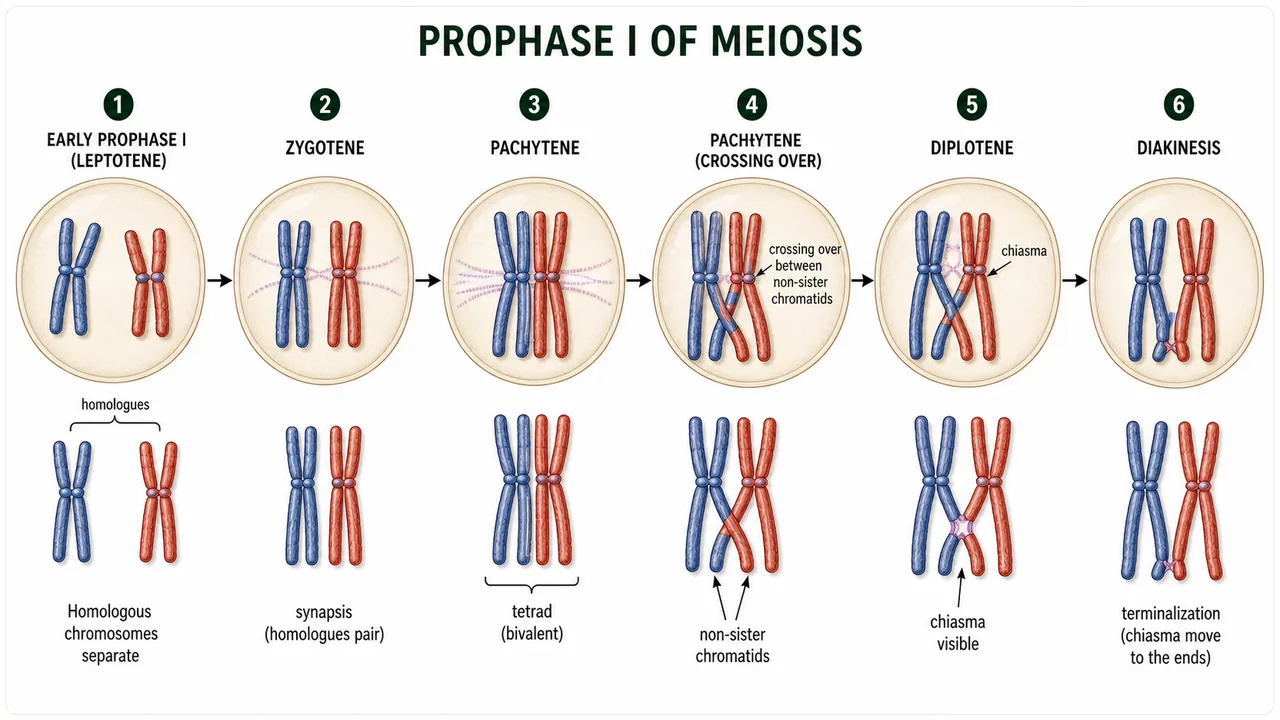
Agricultural significance: Crossing over breaks linkage between undesirable and desirable genes. For example, a breeder trying to transfer disease resistance from a wild relative into cultivated rice relies on crossing over to separate the resistance gene from unwanted wild-type traits.
(d) Diplotene (Diplonema)
- Homologous chromosomes begin to repel each other and move apart.
- The synaptonemal complex disappears.
- The points where crossing over occurred remain visible as X-shaped structures called chiasmata (singular: chiasma) — the physical evidence of crossing over.
- Terminalization of chiasmata begins — chiasmata slide towards the chromosome ends.
- Nuclear membrane and nucleolus are present.
(e) Diakinesis
- The end of prophase I.
- Terminalization is the characteristic feature — chiasmata have moved to the very tips of chromosomes.
- It is the best sub-stage for counting the number of bivalents — chromosomes are maximally condensed and well-separated.
- Nuclear membrane and nucleolus disappear — marking the transition to metaphase I.

Prophase I Sub-Stages at a Glance
| Sub-stage | Meaning | Key Event | Nuclear Membrane | Nucleolus |
|---|---|---|---|---|
| Leptotene | Thin thread | Chromosomes become visible; chromomeres | Present | Present |
| Zygotene | Paired/yoked | Synapsis; synaptonemal complex forms | Present | Present |
| Pachytene | Thick | Crossing over; tetrad stage | Present | Present |
| Diplotene | Double | Chiasmata visible; repulsion begins | Present | Present |
| Diakinesis | Moving through | Terminalization; best for counting bivalents | Disappears | Disappears |
Metaphase I
- Nuclear membrane and nucleolus are absent.
- Bivalents align at the equator (not individual chromosomes as in mitosis).
- Chiasmata are completely terminalized (essentially absent).
- Spindle fibres connect to centromere on one side only — each homologue is pulled to a different pole.
- Random orientation of bivalents → basis of independent assortment.
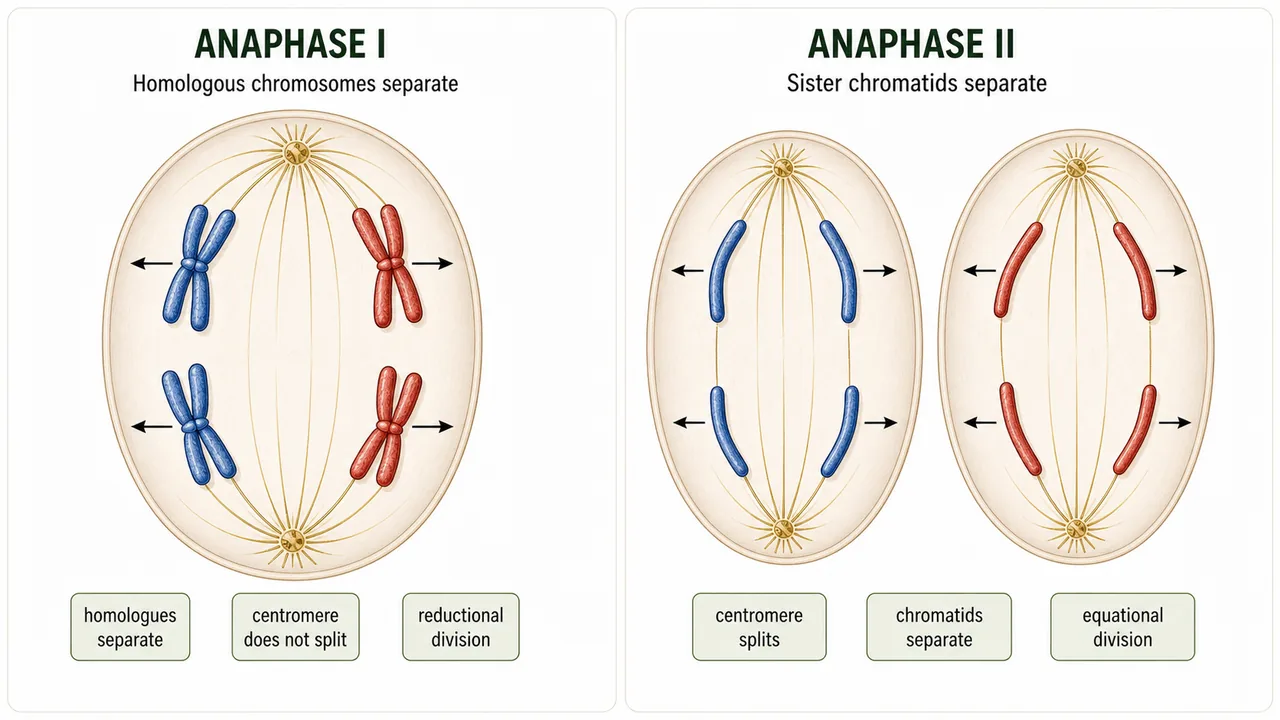
Anaphase I
IMPORTANT
In Anaphase I, centromere does NOT divide (homologues separate). In Anaphase II, centromere DOES divide (sister chromatids separate). This distinction is a favourite exam question.
- Centromere does not divide — this is the critical difference from mitotic anaphase.
- Homologous chromosomes separate and move to opposite poles.
- Reduction in chromosome number occurs: 2n → n.
- Each pole receives one complete set of chromosomes.
- A tetrad separates into diads (each diad = one pair of chromatids).
- In plant genetics shorthand, the first segregation is emphasized at anaphase I, while the final chromatid-level segregation is completed at anaphase II.
- Nuclear membrane and nucleolus are absent.
Telophase I
- Chromosomes reach their respective poles.
- Nuclear membrane and nucleolus reform.
- Two haploid (n) daughter nuclei are formed.
- Each chromosome still has two sister chromatids joined at the centromere.
Interkinesis
- Brief resting period between meiosis I and meiosis II.
- Nuclear membrane and nucleolus become prominent.
- No DNA replication — this is crucial. If DNA replicated again, the purpose of reduction division would be defeated.
Meiosis II — Equational Division (Similar to Mitosis)
Meiosis II separates the sister chromatids so each of the four final daughter cells receives a single copy of each chromosome.
Metaphase II
- Individual chromosomes (each with two chromatids) line up at the equator.
- Centromeres are exactly on the equatorial plane.
- Spindle fibres attach on both sides (like mitosis).
- Nuclear membrane and nucleolus are absent.
Anaphase II
- Centromere splits — sister chromatids are pulled to opposite poles.
- Identical to mitotic anaphase.
Telophase II
- Nuclear membrane and nucleolus reappear.
- Cytokinesis completes the division.
- Four haploid daughter cells are produced, each genetically unique.

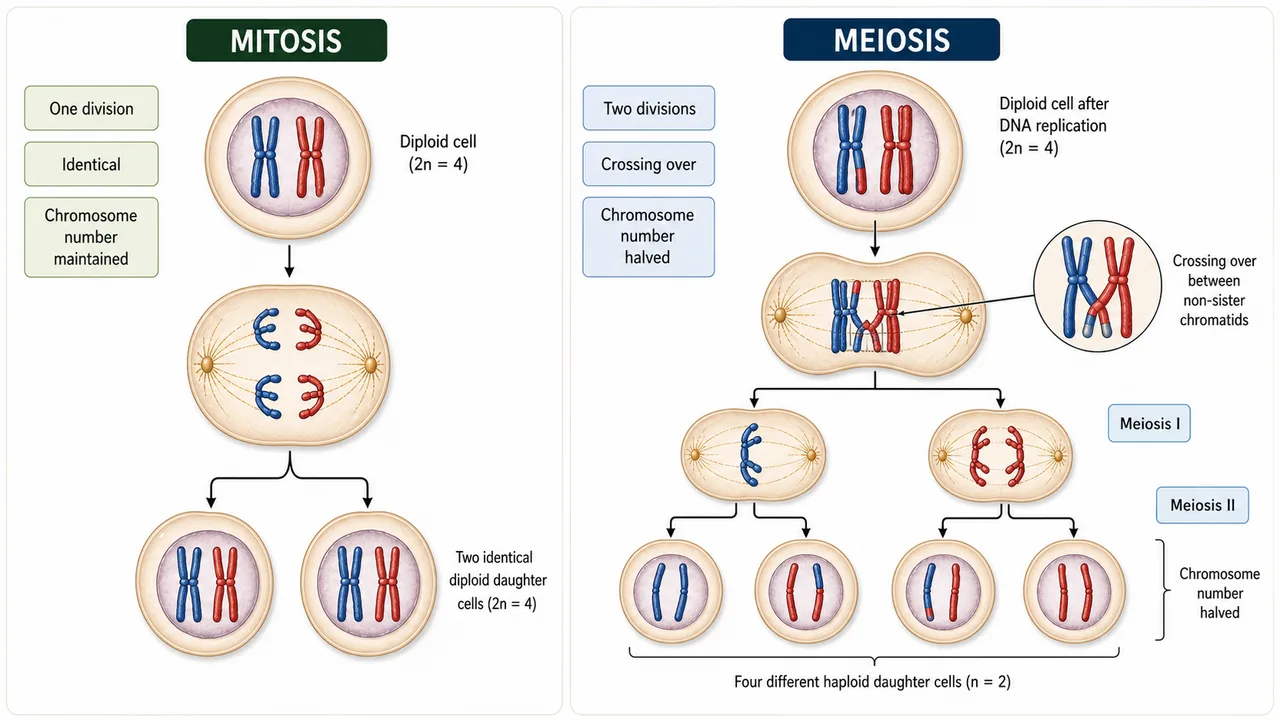
Mitosis vs. Meiosis
| Feature | Mitosis | Meiosis |
|---|---|---|
| Occurs in | Somatic cells | Reproductive cells |
| Divisions | One | Two |
| Daughter cells | 2, identical | 4, different |
| Chromosome number | Maintained (2n) | Halved (n) |
| Synapsis | No | Yes (zygotene) |
| Crossing over | No | Yes (pachytene) |
| Centromere splits | Anaphase | Anaphase II only |
Cell Division Calculations
IMPORTANT
These formulae are frequently tested in competitive exams (IBPS AFO, NABARD Grade A, and ICAR).
1. Number of Meioses for Pollen Formation
Number of meioses = n⁄4
Where n = number of pollen grains needed.
Each pollen mother cell (PMC) undergoes one meiosis to produce 4 pollen grains.

2. Number of Meioses for Seed Formation
Number of meioses = n + n⁄4
Where n = number of seeds.
Two meiotic events are needed for each seed: one in the megaspore mother cell (ovule) and one in the pollen mother cell (for pollen).
Example: For 100 seeds:
| Source | Meioses Required |
|---|---|
| 100 ovules | 100 meioses |
| 100 pollen grains (÷ 4) | 25 meioses |
| Total | 125 meioses |
3. Number of Meioses for Ovule Formation
Number of meioses = n
Where n = number of ovules required, because each functional ovule ultimately traces back to one meiotic event in the megaspore mother cell.
3. Number of Mitoses
Number of mitoses = n - 1
Where n = number of cells produced from a single starting cell.
Example: To produce 8 cells from 1 cell → 8 - 1 = 7 mitotic divisions.
Endosperm Ploidy
| Plant Group | Endosperm Ploidy | Reason |
|---|---|---|
| Angiosperms | 3n (triploid) | 2 polar nuclei (n+n) + 1 sperm (n) = 3n |
| Gymnosperms | n (haploid) | Develops from female gametophyte before fertilisation |

Agricultural connection: The triploid endosperm of angiosperms is the nutritive tissue of cereal grains (rice, wheat, maize). Its composition (starch, protein, oil) is a primary target in crop quality breeding.
Summary Table
| Topic | Key Fact | Exam Pointer |
|---|---|---|
| Meiosis overview | 2n → n; two divisions; 4 different cells | Reductional (I) + Equational (II) |
| Prophase I stages | L-Z-P-D-D | "Lovely Zebras Play During Dusk" |
| Synapsis | Homologous pairing at zygotene | Synaptonemal complex holds them together |
| Crossing over | Non-sister chromatids exchange at pachytene | Endonuclease cuts, ligase seals; basis of genetic mapping |
| Chiasma | X-shaped; visible at diplotene | Physical evidence of crossing over |
| Terminalization | Characteristic of diakinesis | Chiasmata move to chromosome tips |
| Best stage for counting bivalents | Diakinesis | Maximally condensed and well-separated |
| Anaphase I vs. II | I: centromere does NOT split; II: centromere splits | Favourite exam question |
| Pollen meiosis formula | n/4 | 1 PMC → 4 pollen grains |
| Seed meiosis formula | n + n/4 | Ovule meiosis + pollen meiosis |
| Mitosis formula | n - 1 | n = number of cells produced |
| Angiosperm endosperm | 3n (triploid) | 2 polar nuclei + 1 sperm |
Summary Cheat Sheet
| Concept / Topic | Key Details |
|---|---|
| Meiosis | 2n → n; two divisions; produces 4 genetically different haploid cells |
| Meiosis I | Reductional division — homologues separate |
| Meiosis II | Equational division (like mitosis) — chromatids separate |
| Discovered by | Strasburger; term by Farmer & Moore |
| Interkinesis | Brief rest between I & II; no DNA replication |
| Prophase I sub-stages | L-Z-P-D-D (Leptotene, Zygotene, Pachytene, Diplotene, Diakinesis) |
| Leptotene | Thin threads; chromomeres visible (discovered by Balbiani) |
| Zygotene | Synapsis — homologues pair; synaptonemal complex forms |
| Bivalent = Tetrad | 2 homologous chromosomes = 4 chromatids |
| Pachytene | Crossing over — exchange between non-sister chromatids |
| Crossing over enzymes | Endonuclease cuts; ligase seals (Stern & Hotta, 1969) |
| centiMorgan | 1 cM = 1% crossing over frequency; map unit |
| First genetic map by | Sturtevant (using Drosophila) |
| Diplotene | Chiasmata visible (X-shaped); homologues repel |
| Diakinesis | Terminalization complete; best for counting bivalents |
| Anaphase I | Centromere does NOT split; homologues separate → 2n → n |
| Anaphase II | Centromere splits; sister chromatids separate |
| Allosyndesis | Pairing between non-homologous chromosomes in allopolyploid |
| Asynapsis | Homologues fail to pair → sterility |
| Desynapsis | Homologues pair but separate prematurely → reduced fertility |
| Pollen meiosis formula | n/4 (1 PMC → 4 pollen grains) |
| Seed meiosis formula | n + n/4 (ovule + pollen meioses) |
| Mitosis formula | n − 1 (n = cells produced from 1 cell) |
| Angiosperm endosperm | 3n (triploid): 2 polar nuclei + 1 sperm |
| Gymnosperm endosperm | n (haploid): from female gametophyte |