🫁 Cell Organelles: Structure and Function
Master mitochondria, plastids, chloroplasts, ER, ribosomes, Golgi body, lysosomes, and other organelles — with agricultural examples, comparison tables, and exam tips.
Why Cell Organelles Matter in Agriculture
Inside every leaf cell of a rice plant, chloroplasts capture sunlight and convert it into sugars. In the root cells of the same plant, mitochondria break down those sugars to fuel nutrient uptake from the soil. When a plant breeder develops a high-yielding variety, the efficiency of these organelles is what ultimately determines how much grain the plant produces. Understanding organelle function is therefore the foundation of crop physiology, breeding, and biotechnology.
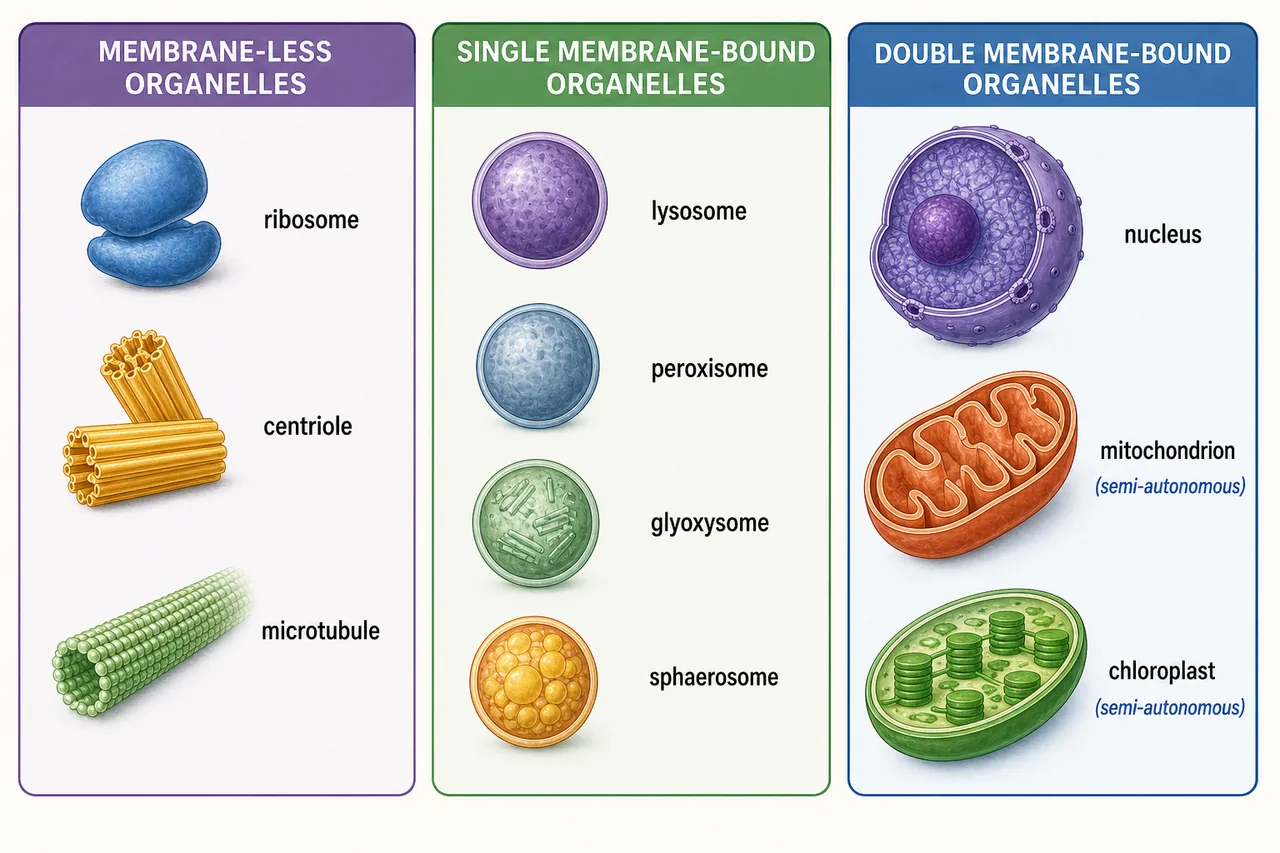
Organelle Classification by Membrane
TIP
Organelle nicknames for quick recall: Mitochondria = "Power house", Chloroplast = "Kitchen of the cell", Lysosome = "Suicidal bag", Golgi = "Post office of the cell".
| Category | Organelles |
|---|---|
| Membrane-less | Ribosome, Centriole, Centrosome, Microtubules |
| Single membrane-bound | Peroxisomes, Lysosomes, Sphaerosome, Glyoxysomes |
| Double membrane-bound | Nucleus, Mitochondria, Chloroplast |
Mnemonic for double-membrane: "NMC" — Nucleus, Mitochondria, Chloroplast. The last two are semi-autonomous (contain their own DNA and ribosomes).
Mitochondria — Power House of the Cell
- The primary site of ATP production through aerobic respiration.
- ATP = Energy currency of the cell.
- First observed by Kolliker (1853); later identified by Altman in 1886 as Bioplast.
- Named "mitochondria" by C. Benda (1898) — from Greek mitos (thread) + chondrion (granule).

Metabolic Reactions and Their Locations
| Process | Site | Details |
|---|---|---|
| Glycolysis | Hyaloplasm (cytosol) | First step; occurs OUTSIDE mitochondria |
| Krebs cycle | Mitochondrial matrix | Breaks down acetyl-CoA; releases electrons |
| Electron transport + ATP synthesis | Inner membrane (oxysomes/F1 particles) | Oxidative phosphorylation; produces bulk of ATP |
- Enzymes are in the intermembrane space and on the inner membrane (cristae).
- Contains own DNA (0.02%), RNA (3–4%), and 70S ribosomes → semi-autonomous.
- Supports the Endosymbiotic Theory: mitochondria evolved from ancient free-living prokaryotes.
Agricultural connection: During grain filling in wheat and rice, mitochondrial respiration in developing seeds provides the energy needed to convert sucrose into starch. Efficient mitochondria = better grain filling.
Pro Content Locked
Upgrade to Pro to access this lesson and all other premium content.
Charged once for one year · ₹1188 total
Save ₹100/month vs ₹2388/year launch price
- All Agriculture & Banking Courses
- AI Lesson Questions (100/day)
- AI Doubt Solver (50/day)
- Glows & Grows Feedback (30/day)
- AI Section Quiz (20/day)
- 22-Language Translation (100/day)
- Recall Questions (20/day)
- AI Quiz (15/day)
- AI Quiz Paper Analysis (100/day)
- AI Step-by-Step Explanations (100/day)
- Spaced Repetition Recall (FSRS)
- AI Tutor
- Immersive Text Questions
- Audio Lessons — Hindi & English
- Mock Tests & Previous Year Papers
- Summary & Mind Maps
- XP, Levels, Leaderboard & Badges
- Generate New Classrooms
- Voice AI Teacher (AgriDots Live)
- AI Revision Assistant
- Knowledge Gap Analysis
- Interactive Revision (LangGraph)
🔒 Secure one-time yearly payment via Razorpay · No hidden fees
Why Cell Organelles Matter in Agriculture
Inside every leaf cell of a rice plant, chloroplasts capture sunlight and convert it into sugars. In the root cells of the same plant, mitochondria break down those sugars to fuel nutrient uptake from the soil. When a plant breeder develops a high-yielding variety, the efficiency of these organelles is what ultimately determines how much grain the plant produces. Understanding organelle function is therefore the foundation of crop physiology, breeding, and biotechnology.
Organelle Classification by Membrane
TIP
Organelle nicknames for quick recall: Mitochondria = "Power house", Chloroplast = "Kitchen of the cell", Lysosome = "Suicidal bag", Golgi = "Post office of the cell".
| Category | Organelles |
|---|---|
| Membrane-less | Ribosome, Centriole, Centrosome, Microtubules |
| Single membrane-bound | Peroxisomes, Lysosomes, Sphaerosome, Glyoxysomes |
| Double membrane-bound | Nucleus, Mitochondria, Chloroplast |
Mnemonic for double-membrane: "NMC" — Nucleus, Mitochondria, Chloroplast. The last two are semi-autonomous (contain their own DNA and ribosomes).
Mitochondria — Power House of the Cell
- The primary site of ATP production through aerobic respiration.
- ATP = Energy currency of the cell.
- First observed by Kolliker (1853); later identified by Altman in 1886 as Bioplast.
- Named "mitochondria" by C. Benda (1898) — from Greek mitos (thread) + chondrion (granule).
Metabolic Reactions and Their Locations
| Process | Site | Details |
|---|---|---|
| Glycolysis | Hyaloplasm (cytosol) | First step; occurs OUTSIDE mitochondria |
| Krebs cycle | Mitochondrial matrix | Breaks down acetyl-CoA; releases electrons |
| Electron transport + ATP synthesis | Inner membrane (oxysomes/F1 particles) | Oxidative phosphorylation; produces bulk of ATP |
- Enzymes are in the intermembrane space and on the inner membrane (cristae).
- Contains own DNA (0.02%), RNA (3–4%), and 70S ribosomes → semi-autonomous.
- Supports the Endosymbiotic Theory: mitochondria evolved from ancient free-living prokaryotes.
Agricultural connection: During grain filling in wheat and rice, mitochondrial respiration in developing seeds provides the energy needed to convert sucrose into starch. Efficient mitochondria = better grain filling.
Plastids
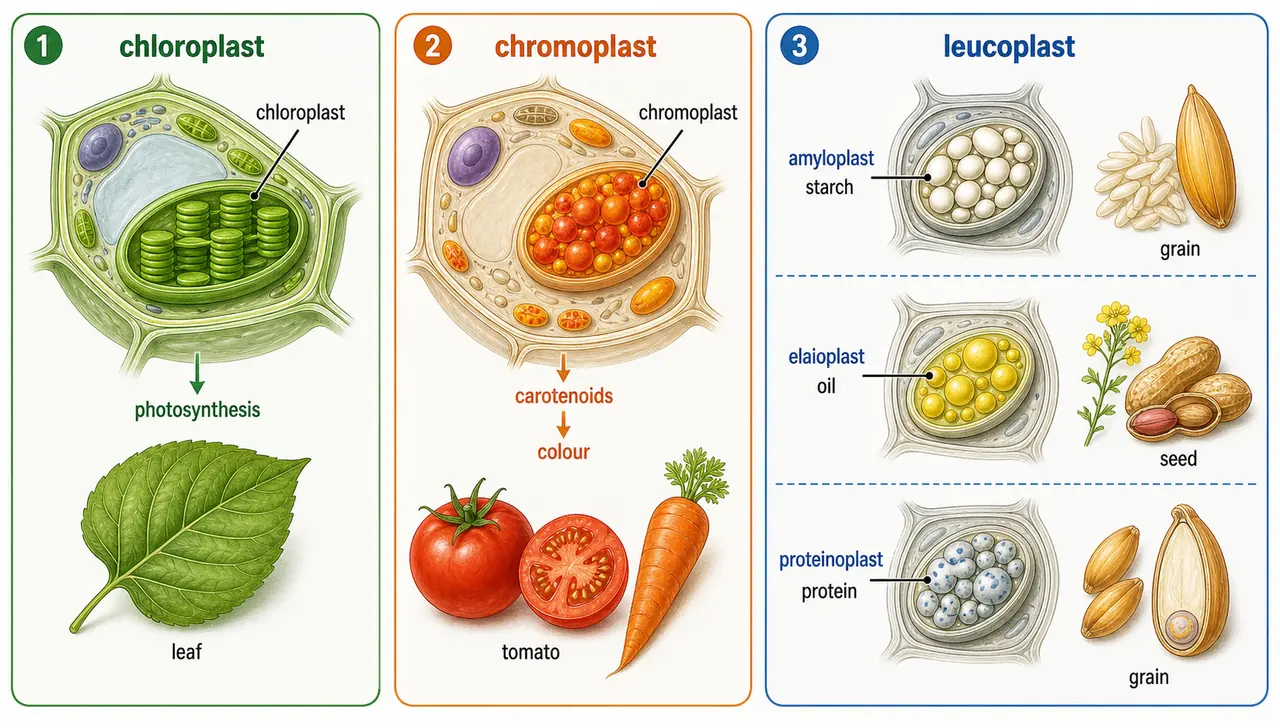
Classified by Schimper (1885) based on pigment content:
- In older exam one-liners, the term plastid is commonly linked with Ernst Haeckel, while Schimper is the standard name for the practical pigment-based classification used in plant cell biology.
| Plastid | Colour | Function | Agricultural Example |
|---|---|---|---|
| Chloroplast | Green | Photosynthesis | Leaf mesophyll of all crops |
| Chromoplast | Red/Yellow/Orange | Attract pollinators and seed dispersers | Tomato (lycopene), carrot (carotene), marigold |
| Leucoplast | Colourless | Food storage | Potato tubers, cereal grains |
Types of Leucoplasts
| Type | Stores | Agricultural Example |
|---|---|---|
| Amyloplast | Starch | Potato tubers, rice grains |
| Elaioplast | Oils | Groundnut, mustard seeds |
| Aleuronoplast/Proteinoplast | Protein | Aleurone layer of wheat and rice |
Chlorophyll and Plant Pigments
| Pigment | Colour | Formula | % in Green Plants |
|---|---|---|---|
| Chlorophyll a | Blue-black | C₅₅H₇₂O₅N₄Mg | 65% (a + b combined) |
| Chlorophyll b | Green-black | C₅₅H₇₀O₆N₄Mg | |
| Xanthophyll | Yellow | C₄₀H₅₆O₂ | 29% |
| Carotene | Yellowish-orange | C₄₀H₅₆ | 6% |
- Carotene + Xanthophyll = carotenoid pigments — accessory pigments that provide photoprotection.
- Chromoplasts contain only carotenoids (no chlorophyll).
Pigment Classification
| Category | Solubility | Location | Examples |
|---|---|---|---|
| Plastid pigments | Lipid-soluble (organic solvents) | Plastid membranes | Chlorophyll, carotenoids |
| Sap pigments | Water-soluble | Vacuoles | Anthocyanin — red/purple/blue in flowers and beets; colour changes with pH |
Agricultural note: Carotenoid content is a breeding target in crops like golden rice (beta-carotene enriched), orange-fleshed sweet potato, and biofortified maize.
Chloroplast Structure

A chloroplast has two distinct regions:
| Region | Structures | Reaction Type |
|---|---|---|
| Grana (thylakoid stacks) | Quantasomes containing chlorophyll | Light reactions → ATP + NADPH |
| Stroma (matrix) | Enzymes including RuBISCO | Dark reactions (Calvin cycle) → sugar fixation |
- RuBISCO (Ribulose-1,5-bisphosphate carboxylase/oxygenase) is the most abundant protein on Earth.
- Grana are interconnected by stroma lamellae (intergranal lamellae).
- Contains own DNA (0.5%), RNA (3–4%), and 70S ribosomes → semi-autonomous (Endosymbiotic Theory).
Exam tip: Light reactions = Grana (thylakoids); Dark reactions = Stroma. This is one of the most commonly asked distinctions.
Endoplasmic Reticulum (ER)

- Dense network of double membrane structures forming an intracellular transport system.
- Ultrastructure first reported by Porter (1948).
- Origin from nuclear membranes; dynamic (can be broken down and reconstructed).
- Undergoes partial fragmentation during cell division.
Types of ER
| Type | Feature | Primary Function |
|---|---|---|
| Rough ER (RER) | Ribosomes attached | Protein synthesis for secretion/membranes |
| Smooth ER (SER) | No ribosomes | Lipid synthesis, steroid production, detoxification |
Functions of ER
- Mechanical support (endoskeleton) — gives shape to the cell.
- Increases surface area for metabolic reactions.
- Intracellular transport of proteins and other molecules.
- Formation of cell plate and nuclear membrane during division.
- RER → protein synthesis; SER → lipid synthesis and membrane biogenesis.
- SER in muscle cells (sarcoplasmic reticulum) → stores Ca²⁺ for muscle contraction.
- SER in liver cells → detoxification of drugs and poisons.
Ribosomes (RNA Particles)
- Composition: rRNA (40–60%) + Protein (40–60%) — no lipid → membrane-less organelle.
- First observed by Claude (1943) as "microsomes"; isolated by Palade (1956, Nobel Prize).
- Term "ribosomes" coined by R.B. Robert (1958).
| Organism | Ribosome Size | Subunits |
|---|---|---|
| Prokaryotes & chloroplasts | 70S | 50S + 30S |
| Eukaryotes (cytoplasm) | 80S | 60S + 40S |
- Higher Mg²⁺ → subunits associate; lower Mg²⁺ → subunits dissociate.
- S values are not directly additive (depend on both mass and shape).
Types of RNA
| RNA | % of Total | Key Feature |
|---|---|---|
| mRNA (messenger) | 5–10% | Carries genetic instructions; blueprint for proteins |
| tRNA (transfer/sRNA) | 10–15% | Smallest; clover-leaf shape; carries amino acids |
| rRNA (ribosomal) | 80% | Most abundant and most stable; structural core of ribosomes |
Protein Synthesis in Two Steps
- Transcription — DNA → mRNA (in nucleus, by RNA polymerase)
- Translation — mRNA → Protein (at ribosomes in cytoplasm)


Golgi Body (Dictyosome)
- Discovered by Camillo Golgi (1898) using silver staining in nerve cells.
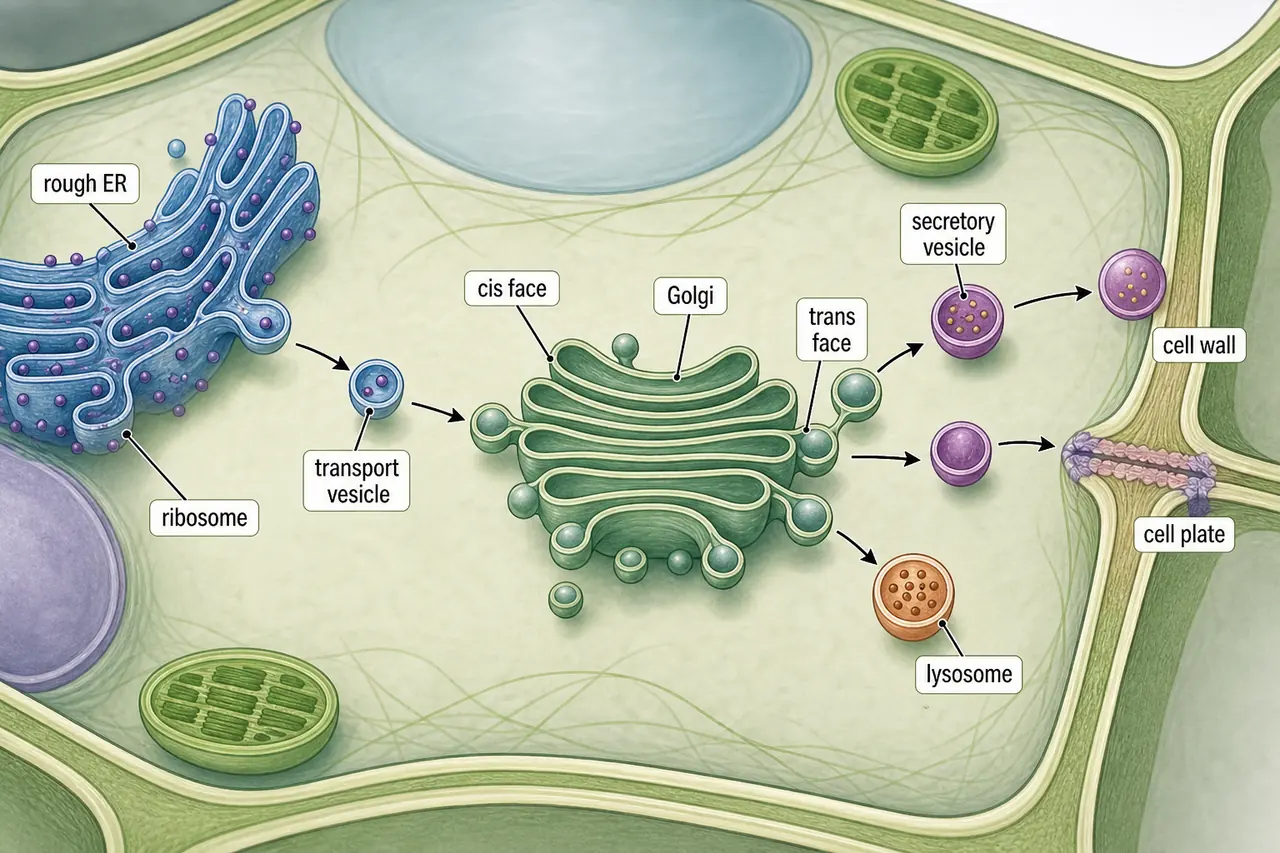
- Stacks of flattened sacs (cisternae); called dictyosomes in plants.
- Polarity: cis face (receiving, near ER) → trans face (shipping, near plasma membrane).
- Origin from ER (transition vesicles).
- Acrosomes on sperm heads are derived from Golgi apparatus.
Exam contrast: In standard plant-cell one-liners, sphaerosomes and glyoxysomes are treated as characteristically plant-associated microbodies, whereas peroxisomes occur in both plant and animal cells.

Functions
| Function | Detail |
|---|---|
| Packaging | Store, modify, and condense proteins from ribosomes ("post office of cell") |
| Cell plate formation | Golgi vesicles merge to form new cell wall during plant cell division |
| Glycosylation | Add sugars to proteins → glycoproteins |
| Lysosome production | Package digestive enzymes into membrane-bound vesicles |
- In older plant-cell exam material, Golgi bodies are also linked with the processing and export of cell-wall materials, especially hemicellulose and other matrix polysaccharides used during wall formation. Some revision books extend this recall to wall constituents such as lignin in the broader secretory pathway sense.

Lysosome — Suicidal Bag of the Cell

- Lysis = digestion; Soma = body → "digestive bodies".
- Single membrane-bound vesicles containing hydrolytic enzymes (hydrolases).
- Formed from Golgi (directly) and ER (indirectly).
- Discovered by De Duve (1955, Nobel Prize 1974).
- Mainly found in animals; also in Neurospora (a fungus used in genetic studies).
- Their digestive enzymes function best in an acidic internal environment of roughly pH 4.5-5.0, which is why lysosomes can carry out controlled intracellular digestion without the whole cytoplasm behaving the same way.
Functions
- Intracellular digestion of macromolecules.
- Defense — fuse with phagosomes to destroy bacteria and viruses.
- Autophagy — during starvation, digest own organelles → "suicidal bag" / cell autolysis.
- In the same older cell-biology framing, lysosomes are also tied to the breakdown of cellular waste; when their hydrolytic enzymes digest the cell's own worn-out components the process is discussed as autophagy, and when self-digestion extends to the cell itself it is described as autolysis.
Other Organelles and Inclusions
Spherosomes
- Single membrane-bound; mainly in plants.
- Function: fat metabolism — abundant in oilseeds (groundnut, mustard, sunflower).
Peroxisomes and Glyoxysomes
- Peroxisomes are single-membrane microbodies present in both plant and animal cells.
- They contain oxidative enzymes such as catalase and peroxidase, which help detoxify the hydrogen peroxide generated during cellular metabolism.
- In plants, peroxisomes are remembered as the main site of photorespiration, functioning in close coordination with chloroplasts and mitochondria.
- Glyoxysomes are specialized plant microbodies, especially important in germinating oil-rich seeds, where stored fats are converted into carbohydrate through the glyoxylate-cycle logic to support early seedling growth before photosynthesis becomes effective.
Exam contrast: Sphaerosomes and glyoxysomes are classically treated as plant-associated microbodies, while peroxisomes are found in both plants and animals.
Microsomes
- Artificial structures — fragments of ER + ribosomes formed during cell lysis.
- Used as in vitro models to study ER function and protein synthesis.
Vacuole

- Most prominent in mature plant cells; may occupy up to 90% of cell volume.
- Bounded by a single membrane called tonoplast; contains cell sap (salts, sugars, pigments, waste).
- Functions: osmoregulation, nutrient storage, maintaining turgor pressure.
- Because the central vacuole occupies so much of the mature plant cell, it also plays a direct role in maintaining overall cell shape and cell volume.
Agricultural relevance: Turgor pressure keeps crop plants upright. Water stress causes turgor loss → visible as wilting (leaf rolling in rice, drooping in sunflower).
Plasmodesmata

- Microscopic channels found only in plants; discovered and named by Strasburger (1903).
- Origin from ER; allow direct cell-to-cell communication.
- All connected protoplasts = symplast (continuous living network).
Centrosome
- Present near nucleus in animal cells and some plant groups (Chlamydomonas, gymnosperms).
- Contains two centrioles (nine triplets of microtubules, 9+0 arrangement).
- Functions as MTOC (microtubule organising centre); produces astral rays during cell division.
Ergastic Substances
- Non-living cell inclusions: starch, sugar, fats, oils, pigments, crystals (calcium oxalate), tannins, resins.
- Metabolic products, not part of living protoplasm.
Summary Table
| Organelle | Key Nickname/Feature | Membrane | Exam Pointer |
|---|---|---|---|
| Mitochondria | Power house; ATP production | Double | Semi-autonomous; glycolysis in hyaloplasm, NOT mitochondria |
| Chloroplast | Kitchen of cell; photosynthesis | Double | Light rxn = grana; dark rxn = stroma; RuBISCO |
| Nucleus | Control centre; hereditary material | Double | Absent in mature RBCs, sieve tubes, xylem |
| Ribosome | Protein factory | None | 70S (prokaryotes) / 80S (eukaryotes); no lipid |
| ER (Rough) | Protein synthesis | Single (network) | Ribosomes attached; origin from nuclear membrane |
| ER (Smooth) | Lipid synthesis, detoxification | Single (network) | No ribosomes; important in liver cells |
| Golgi body | Post office; packaging | Single (stacks) | Forms cell plate and lysosomes |
| Lysosome | Suicidal bag; intracellular digestion | Single | De Duve (1955); autophagy during starvation |
| Vacuole | Storage; turgor pressure | Single (tonoplast) | Up to 90% of plant cell volume |
| Spherosome | Fat metabolism | Single | Abundant in oilseeds |
| Peroxisome | H2O2 detoxification; photorespiration | Single | Catalase-containing microbody in plants and animals |
| Glyoxysome | Seed-fat to carbohydrate conversion | Single | Important in germinating oilseeds |
| Centrosome | MTOC; spindle formation | None | Two centrioles per centrosome |
| Plasmodesmata | Cell-to-cell communication | — | Plants only; form symplast |
- Sphaerosomes are especially important in plant cells because they are involved in lipid storage and mobilisation. They are characteristically abundant in oil-rich seeds, which makes them agriculturally relevant in crops such as groundnut, mustard, and sunflower.
Summary Cheat Sheet
| Concept / Topic | Key Details |
|---|---|
| Double membrane organelles | Nucleus, Mitochondria, Chloroplast (NMC) |
| Single membrane organelles | Peroxisomes, Lysosomes, Sphaerosome, Glyoxysomes |
| Membrane-less organelles | Ribosome, Centriole, Centrosome, Microtubules |
| Mitochondria = "Power house" | First observed by Kolliker (1853); Altman = bioplast (1886); Benda named it (1898) |
| ATP = | Energy currency of cell |
| Glycolysis location | Hyaloplasm (cytosol) — NOT mitochondria |
| Krebs cycle location | Mitochondrial matrix |
| ETC + ATP synthesis | Inner membrane (oxysomes / F1 particles) |
| Mitochondria = semi-autonomous | Own DNA (0.02%), RNA, 70S ribosomes |
| Plastids classified by | Schimper (1885) |
| Older plastid-name recall | Commonly linked with Ernst Haeckel |
| Chloroplast early textbook recall | Commonly linked with Schimper |
| Chloroplast | Green; photosynthesis |
| Chromoplast | Red/yellow/orange; only carotenoids |
| Sphaerosome | Lipid storage and mobilisation; especially important in oilseeds |
| Leucoplast types | Amyloplast (starch), Elaioplast (oil), Aleuronoplast (protein) |
| Chlorophyll a | Blue-black; C₅₅H₇₂O₅N₄Mg; 65% of pigments |
| Xanthophyll | Yellow; 29%; Carotene = orange; 6% |
| Anthocyanin | Water-soluble sap pigment in vacuoles |
| Grana (thylakoids) | Light reactions → ATP + NADPH |
| Stroma | Dark reactions (Calvin cycle); contains RuBISCO |
| RuBISCO | Most abundant protein on Earth |
| Rough ER | Ribosomes attached; protein synthesis |
| Smooth ER | No ribosomes; lipid synthesis, detoxification |
| Ribosome sizes | 70S (50S+30S) prokaryotes; 80S (60S+40S) eukaryotes |
| rRNA = 80% of total RNA | Most abundant and most stable |
| Golgi body | "Post office"; discovered by Camillo Golgi (1898) |
| Golgi functions | Packaging, cell plate, glycosylation, lysosome production |
| Lysosome | "Suicidal bag"; De Duve (1955); single membrane |
| Vacuole | Up to 90% of plant cell; bounded by tonoplast |
| Spherosomes | Fat metabolism; abundant in oilseeds |
| Plasmodesmata | Plant cell-to-cell channels; Strasburger (1903); form symplast |