⨵ Mitosis: Stages and Significance
Learn the stages of mitosis (prophase, metaphase, anaphase, telophase) and cytokinesis — with agricultural examples, comparison tables, and exam-focused mnemonics.
Why Mitosis Matters in Agriculture
Every time a farmer takes a sugarcane cutting and plants it, the new plant grows entirely through mitosis — cell after cell dividing to produce genetically identical copies. Tissue culture, the technique that produces millions of disease-free banana plantlets from a single meristem, also relies on mitosis. Understanding this process helps plant scientists control growth, maintain varietal purity, and develop clonal propagation methods for important crops.
What Is Mitosis?
Mitosis is the type of cell division that produces two genetically identical daughter cells from a single parent cell. It is responsible for growth, development, repair, and asexual reproduction.

- The term comes from the Greek word "mitos" (thread), referring to the thread-like appearance of chromosomes during division.
- In plant-cell cytology recall, Strasburger is commonly associated with the early discovery and study of cell division in plants, while Flemming remains the standard name attached to the term and classical study of mitosis.
- Mitosis consists of two main processes:
- Karyokinesis — nuclear division
- Cytokinesis — cytoplasmic division
TIP
Pro Content Locked
Upgrade to Pro to access this lesson and all other premium content.
Charged once for one year · ₹1188 total
Save ₹100/month vs ₹2388/year launch price
- All Agriculture & Banking Courses
- AI Lesson Questions (100/day)
- AI Doubt Solver (50/day)
- Glows & Grows Feedback (30/day)
- AI Section Quiz (20/day)
- 22-Language Translation (100/day)
- Recall Questions (20/day)
- AI Quiz (15/day)
- AI Quiz Paper Analysis (100/day)
- AI Step-by-Step Explanations (100/day)
- Spaced Repetition Recall (FSRS)
- AI Tutor
- Immersive Text Questions
- Audio Lessons — Hindi & English
- Mock Tests & Previous Year Papers
- Summary & Mind Maps
- XP, Levels, Leaderboard & Badges
- Generate New Classrooms
- Voice AI Teacher (AgriDots Live)
- AI Revision Assistant
- Knowledge Gap Analysis
- Interactive Revision (LangGraph)
🔒 Secure one-time yearly payment via Razorpay · No hidden fees
Why Mitosis Matters in Agriculture
Every time a farmer takes a sugarcane cutting and plants it, the new plant grows entirely through mitosis — cell after cell dividing to produce genetically identical copies. Tissue culture, the technique that produces millions of disease-free banana plantlets from a single meristem, also relies on mitosis. Understanding this process helps plant scientists control growth, maintain varietal purity, and develop clonal propagation methods for important crops.
What Is Mitosis?
Mitosis is the type of cell division that produces two genetically identical daughter cells from a single parent cell. It is responsible for growth, development, repair, and asexual reproduction.
- The term comes from the Greek word "mitos" (thread), referring to the thread-like appearance of chromosomes during division.
- In plant-cell cytology recall, Strasburger is commonly associated with the early discovery and study of cell division in plants, while Flemming remains the standard name attached to the term and classical study of mitosis.
- Mitosis consists of two main processes:
- Karyokinesis — nuclear division
- Cytokinesis — cytoplasmic division
TIP
Remember the four stages of karyokinesis in order: P-M-A-T (Prophase, Metaphase, Anaphase, Telophase). Metaphase is the best stage for chromosome study.
I. Karyokinesis (Nuclear Division)
Karyokinesis has four stages. At each stage, pay attention to what happens to the chromosomes, nuclear membrane, nucleolus, and spindle fibres.
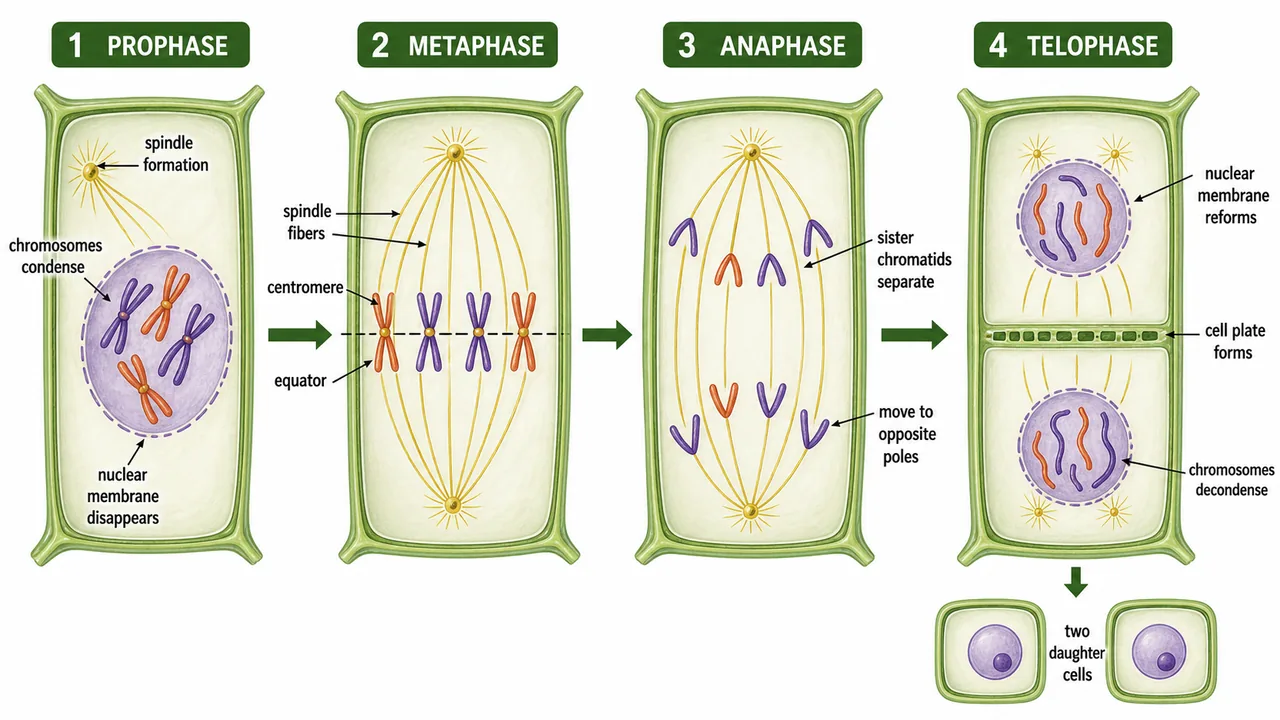
Prophase — "Chromosomes Appear"
- Nucleolus and nucleus are prominent at the start.
- Chromatin begins to condense and coil → visible as distinct, elongated chromosomes (chromonemata formation).
- Each chromosome has two sister chromatids (DNA replicated during S-phase) joined at the centromere.
- Towards the end: nuclear membrane and nucleolus begin to disappear; spindle fibres start forming.
Agricultural analogy: Think of prophase as the "seed preparation" stage — just as a farmer prepares seeds before sowing, the cell prepares its chromosomes (condensing and organising them) before dividing.
Metaphase — "Chromosomes Line Up"
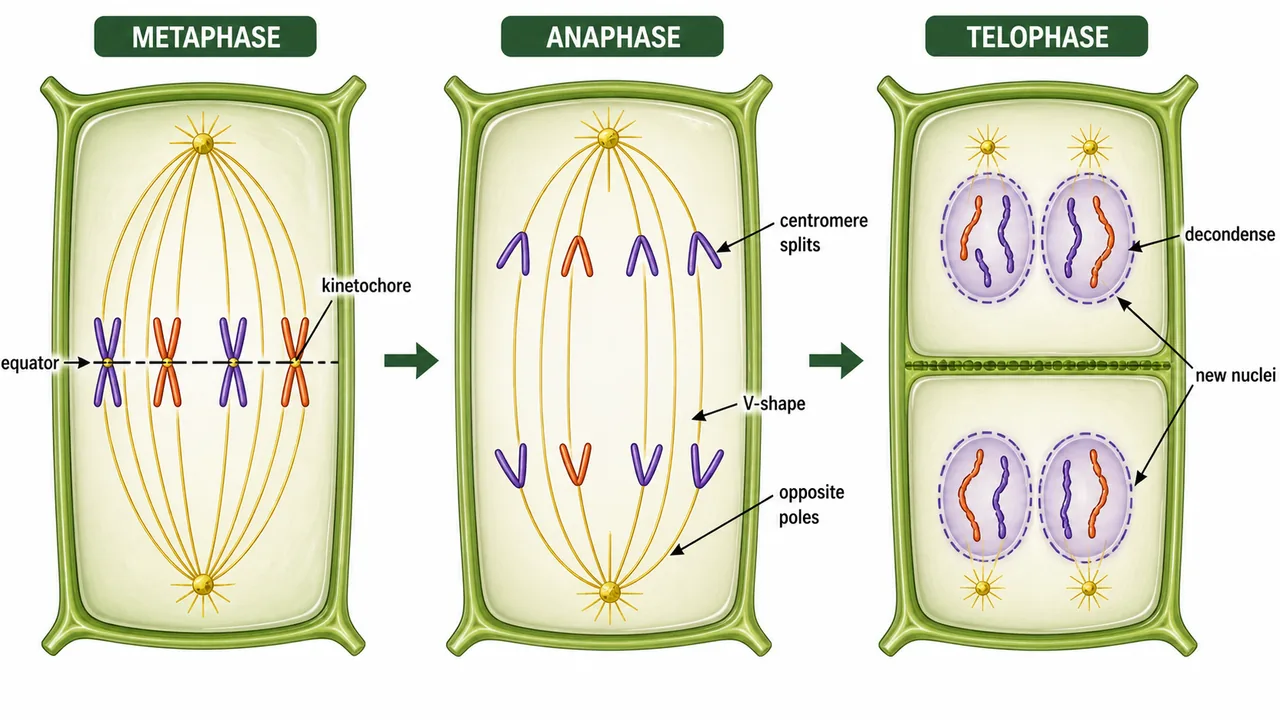
- Best stage for the study of chromosomes — they are at their most condensed, thickest, smallest, and clearest.
- Nuclear membrane and nucleolus are completely absent.
- Chromosomes are arranged at the equator (metaphase plate) — an imaginary plane equidistant from the two poles.
- Centromere is exactly on the equatorial line.
- Spindle fibres attach to the kinetochore (protein structure on centromere) from both poles — this bipolar attachment ensures balanced pulling forces.
Exam tip: Karyotyping (study of chromosome number, shape, and size) is always performed at metaphase because chromosomes are most clearly visible. This is how plant breeders verify ploidy levels in crop varieties.
Anaphase — "Chromosomes Separate"
- Nuclear membrane and nucleolus are absent.
- Centromere divides — the key event of anaphase. Sister chromatids become individual chromosomes.
- Separated chromosomes are pulled to opposite poles by shortening spindle fibres.
- Chromosomes appear V-shaped (centromere leads, arms trail behind).
- Longitudinal splitting of centromere ensures equal distribution.
Telophase — "Nucleus Reforms"
- Nuclear membrane and nucleolus reappear (reverse of prophase).
- Chromosomes decondense (uncoil) back into chromatin, resuming gene expression.
- At the end: two genetically identical nuclei exist within the same cell.
II. Cytokinesis (Cytoplasmic Division)
Cytokinesis follows karyokinesis and physically separates the cell into two daughter cells.
| Feature | Plant Cells | Animal Cells |
|---|---|---|
| Mechanism | Cell plate formation | Cleavage furrow formation |
| How it works | Golgi vesicles accumulate at cell centre → fuse to form cell plate → grows outward to meet existing cell wall | Ring of contractile proteins (actin + myosin) pinches membrane inward → deepens until cell splits |
| Direction | Centre → outward (centrifugal) | Outside → inward (centripetal) |

Agricultural connection: During seed development, rapid mitosis and cytokinesis in the endosperm produce the starchy tissue that fills the grain. The cell plate mechanism is what builds the walls of these new endosperm cells.
Stages at a Glance
| Stage | Nuclear Membrane | Nucleolus | Chromosome State | Key Event |
|---|---|---|---|---|
| Prophase | Disappearing | Disappearing | Condensing; two chromatids per chromosome | Chromatin → visible chromosomes |
| Metaphase | Absent | Absent | Most condensed; at equator | Best stage for chromosome study |
| Anaphase | Absent | Absent | V-shaped; moving to poles | Centromere splits; chromatids separate |
| Telophase | Reappearing | Reappearing | Decondensing back to chromatin | Two identical nuclei formed |
| Cytokinesis | Present (in each nucleus) | Present | Chromatin form | Cell plate (plants) / cleavage furrow (animals) |
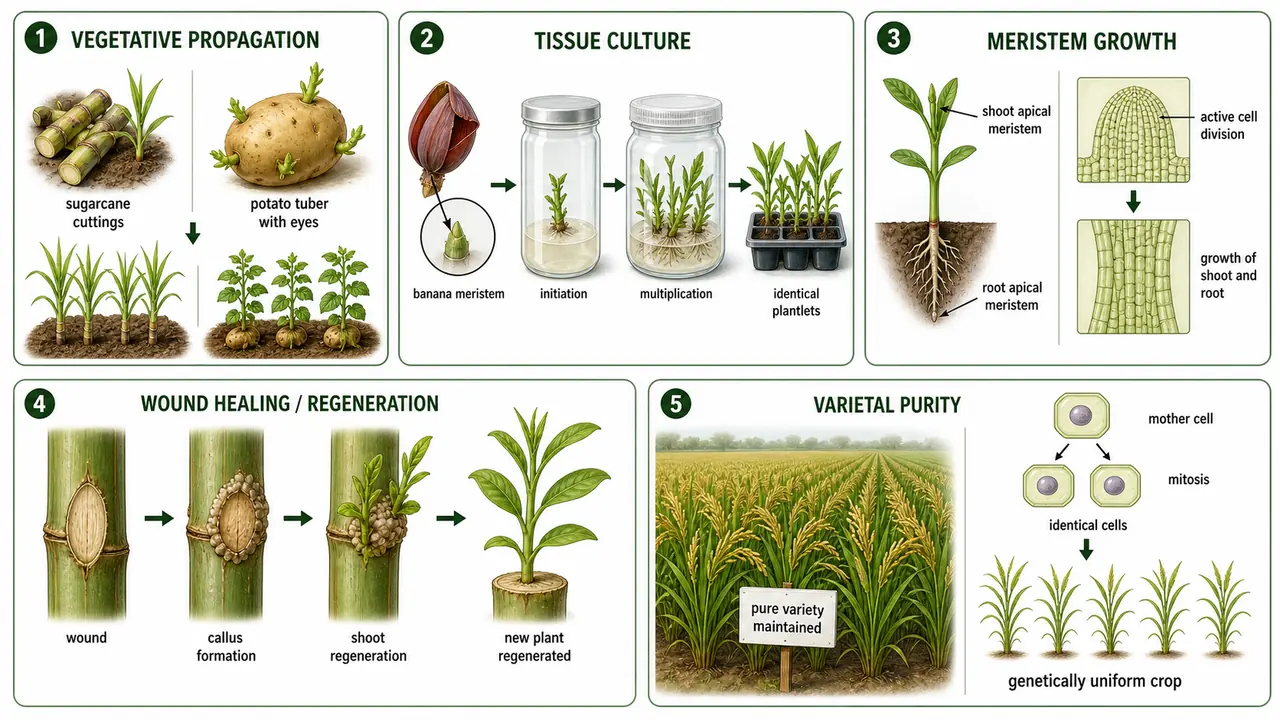
Agricultural Significance of Mitosis
| Application | How Mitosis Is Involved |
|---|---|
| Vegetative propagation | Cuttings (sugarcane), runners (strawberry), tubers (potato) — all grow via mitosis |
| Tissue culture | Millions of identical plantlets from a single meristem tip (banana, orchid, date palm) |
| Maintaining varietal purity | Mitosis produces genetically identical cells — no variation introduced |
| Root and shoot growth | Apical meristems divide by mitosis to elongate roots and stems |
| Wound healing | Damaged plant tissues regenerate through mitotic cell division |
Summary Table
| Topic | Key Fact | Exam Pointer |
|---|---|---|
| Definition | Equational division; 2 identical daughter cells | Growth, repair, asexual reproduction |
| Term coined by | Walter Flemming (1882) | From Greek mitos = thread |
| Stages order | P-M-A-T | Mnemonic: "Please Meet At Ten" |
| Best stage for chromosome study | Metaphase | Chromosomes most condensed; karyotyping done here |
| Centromere splits at | Anaphase | V-shaped chromosomes move to poles |
| Cytokinesis in plants | Cell plate (centre → outward) | Golgi vesicles form the plate |
| Cytokinesis in animals | Cleavage furrow (outside → inward) | Actin-myosin contractile ring |
Summary Cheat Sheet
| Concept / Topic | Key Details |
|---|---|
| Mitosis | Equational division; produces 2 identical daughter cells |
| Term by | Walter Flemming (1882) — Greek mitos = thread |
| Two processes | Karyokinesis (nucleus) + Cytokinesis (cytoplasm) |
| Stages order | P-M-A-T (Prophase, Metaphase, Anaphase, Telophase) |
| Prophase | Chromatin condenses into chromosomes; nuclear membrane disappears |
| Metaphase | Best stage for chromosome study; chromosomes at equator; most condensed |
| Karyotyping | Done at metaphase — chromosome number, shape, size |
| Anaphase | Centromere splits; sister chromatids move to opposite poles; V-shaped |
| Telophase | Nuclear membrane & nucleolus reappear; chromosomes decondense |
| Cytokinesis in plants | Cell plate formation (centre → outward); Golgi vesicles |
| Cytokinesis in animals | Cleavage furrow (outside → inward); actin-myosin ring |
| Mitosis role | Growth, repair, vegetative propagation |
| Maintains | Same chromosome number (2n → 2n) |
| No crossing over | No synapsis; daughter cells are genetically identical |
| Vegetative propagation | Sugarcane cuttings, potato tubers — all via mitosis |
| Tissue culture | Millions of identical plantlets from single meristem (mitosis-based) |
| Spindle fibres attach to | Kinetochore on centromere from both poles |