🧬 Genetics: Key Terms, Variation, Heredity, and Gene
Understand the foundations of genetics — variation, heredity, genotype vs phenotype, gene structure, and the history of hereditary thought — with agricultural examples and exam tips.
Why Genetics Matters in Agriculture
When a plant breeder crosses a high-yielding but disease-susceptible wheat variety with a low-yielding but rust-resistant one, genetics explains how the offspring inherit traits from both parents. The entire foundation of crop improvement — from Mendel's pea experiments to modern marker-assisted selection — rests on understanding heredity (how traits are passed on) and variation (why offspring differ from their parents). Without genetic variation, there would be nothing for breeders to select from.
What Is Genetics?
- The word "Genetics" derives from the Greek root "gene", meaning to grow into or to become.
- The term was coined by W. Bateson. UPPSC 2021
- Bateson also coined the terms homozygous and heterozygous.
- Genetics = the study of heredity and variation.
- Heredity = traits transmitted from generation to generation (e.g., grain colour, plant height).
- Variation = differences among individuals of the same species.
High-Yield One-Liners from Classical Genetics
| Fact | Answer |
|---|---|
| Father of Genetics | Gregor Johann Mendel |
| Father of Modern / Experimental Genetics | T.H. Morgan |
| "Queen of Genetics" | Drosophila |
| "Drosophila of the plant kingdom" | Neurospora |
| "Drosophila of crop plants" | Maize |
| Study of radiation effects on living systems | Actinobiology |
| Father of radiation genetics / actinobiology | H.J. Muller |
| Father of eugenics | Francis Galton |
- The branch cytogenetics focuses on the study of chromosomes and their behavior in heredity, linking visible chromosome structure with genetic principles. In older exam-oriented recall tables, the term itself is commonly associated with Muller.
- Actinobiology is the study of the effects of radiation on living organisms, which is why Muller is tied both to radiation genetics and to the classical actinobiology label.
Variation
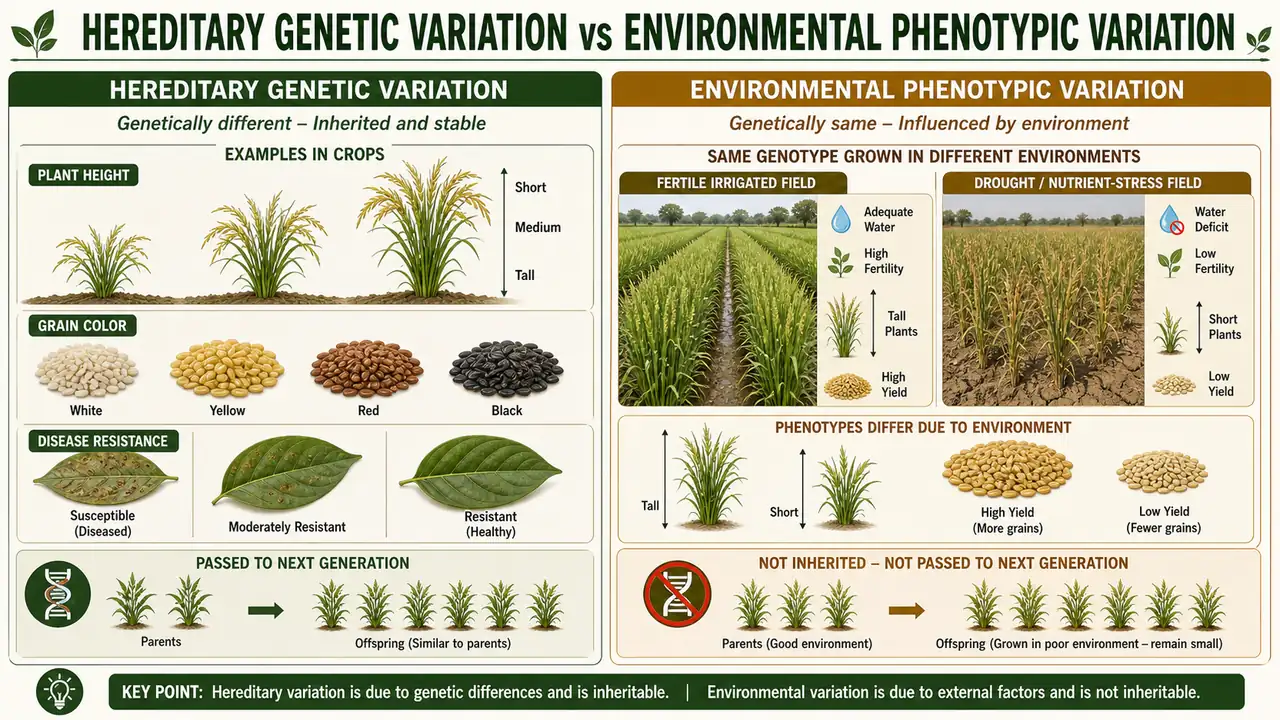
Hereditary (Genetic) Variation
- Variations in inherited traits that are transmitted across generations.
- Caused by sexual reproduction (independent assortment + crossing over) and mutation (new alleles).
- Examples: stripe patterns in zebra, neck length differences in giraffes.
- Identical twins share the same DNA, so they show no hereditary variation between them.
Environmental (Phenotypic) Variation
- Entirely due to environment; temporary and not inherited.
- Affects only the phenotype (observable appearance), not the genotype (genetic constitution).
- Examples: darker skin from sun exposure (not inherited); a tall plant becoming dwarf under water/nitrogen stress.
Agricultural example: Two rice plants with the same genotype may produce very different yields if one is grown in fertile irrigated soil and the other in poor rainfed conditions. The genetic potential is the same, but the environment modifies expression.
Pro Content Locked
Upgrade to Pro to access this lesson and all other premium content.
Charged once for one year · ₹1188 total
Save ₹100/month vs ₹2388/year launch price
- All Agriculture & Banking Courses
- AI Lesson Questions (100/day)
- AI Doubt Solver (50/day)
- Glows & Grows Feedback (30/day)
- AI Section Quiz (20/day)
- 22-Language Translation (100/day)
- Recall Questions (20/day)
- AI Quiz (15/day)
- AI Quiz Paper Analysis (100/day)
- AI Step-by-Step Explanations (100/day)
- Spaced Repetition Recall (FSRS)
- AI Tutor
- Immersive Text Questions
- Audio Lessons — Hindi & English
- Mock Tests & Previous Year Papers
- Summary & Mind Maps
- XP, Levels, Leaderboard & Badges
- Generate New Classrooms
- Voice AI Teacher (AgriDots Live)
- AI Revision Assistant
- Knowledge Gap Analysis
- Interactive Revision (LangGraph)
🔒 Secure one-time yearly payment via Razorpay · No hidden fees
Why Genetics Matters in Agriculture
When a plant breeder crosses a high-yielding but disease-susceptible wheat variety with a low-yielding but rust-resistant one, genetics explains how the offspring inherit traits from both parents. The entire foundation of crop improvement — from Mendel's pea experiments to modern marker-assisted selection — rests on understanding heredity (how traits are passed on) and variation (why offspring differ from their parents). Without genetic variation, there would be nothing for breeders to select from.
What Is Genetics?
- The word "Genetics" derives from the Greek root "gene", meaning to grow into or to become.
- The term was coined by W. Bateson. UPPSC 2021
- Bateson also coined the terms homozygous and heterozygous.
- Genetics = the study of heredity and variation.
- Heredity = traits transmitted from generation to generation (e.g., grain colour, plant height).
- Variation = differences among individuals of the same species.
High-Yield One-Liners from Classical Genetics
| Fact | Answer |
|---|---|
| Father of Genetics | Gregor Johann Mendel |
| Father of Modern / Experimental Genetics | T.H. Morgan |
| "Queen of Genetics" | Drosophila |
| "Drosophila of the plant kingdom" | Neurospora |
| "Drosophila of crop plants" | Maize |
| Study of radiation effects on living systems | Actinobiology |
| Father of radiation genetics / actinobiology | H.J. Muller |
| Father of eugenics | Francis Galton |
- The branch cytogenetics focuses on the study of chromosomes and their behavior in heredity, linking visible chromosome structure with genetic principles. In older exam-oriented recall tables, the term itself is commonly associated with Muller.
- Actinobiology is the study of the effects of radiation on living organisms, which is why Muller is tied both to radiation genetics and to the classical actinobiology label.
Variation
Hereditary (Genetic) Variation
- Variations in inherited traits that are transmitted across generations.
- Caused by sexual reproduction (independent assortment + crossing over) and mutation (new alleles).
- Examples: stripe patterns in zebra, neck length differences in giraffes.
- Identical twins share the same DNA, so they show no hereditary variation between them.
Environmental (Phenotypic) Variation
- Entirely due to environment; temporary and not inherited.
- Affects only the phenotype (observable appearance), not the genotype (genetic constitution).
- Examples: darker skin from sun exposure (not inherited); a tall plant becoming dwarf under water/nitrogen stress.
Agricultural example: Two rice plants with the same genotype may produce very different yields if one is grown in fertile irrigated soil and the other in poor rainfed conditions. The genetic potential is the same, but the environment modifies expression.
Continuous vs. Discontinuous Variation
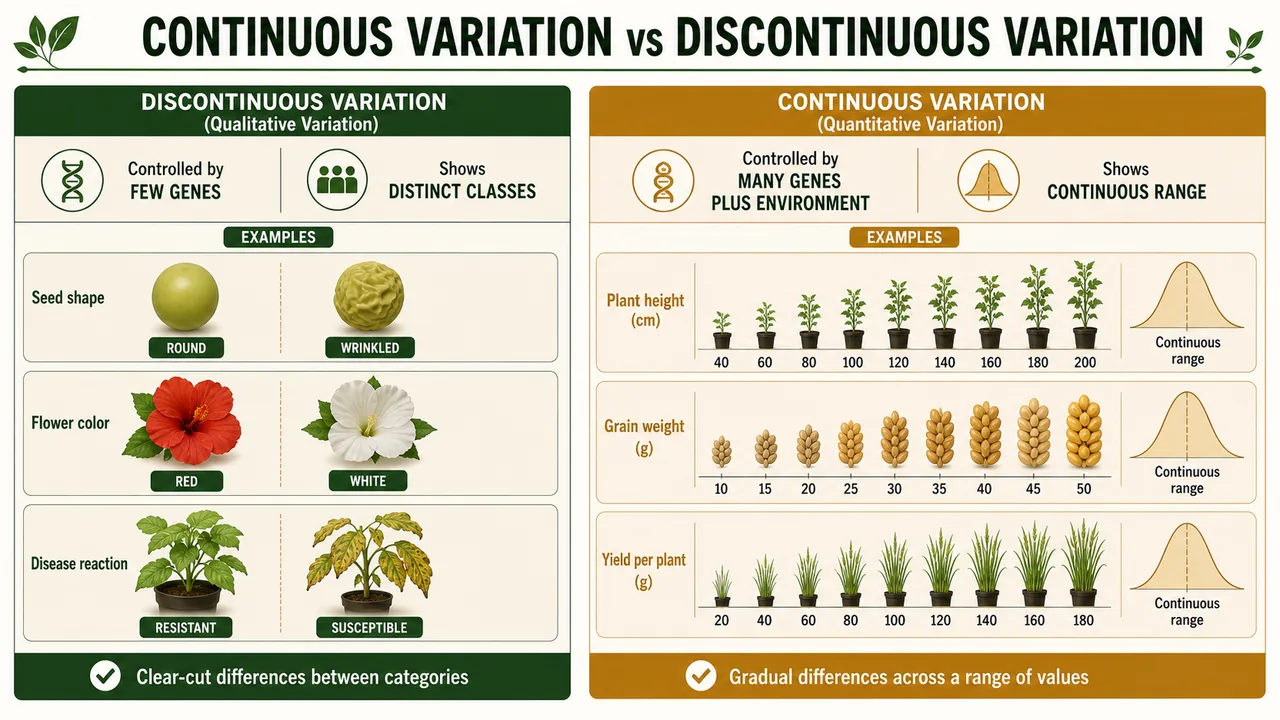
| Type | Description | Inheritance Pattern | Examples |
|---|---|---|---|
| Discontinuous | Distinct categories; no intermediates | One or few genes (qualitative traits) | Blood groups, flower colour (red/white), seed shape (round/wrinkled) |
| Continuous | Complete range from one extreme to another; bell-shaped distribution | Many genes (polygenic inheritance) + environment | Height, yield, milk production, grain weight |
Agricultural significance: Most economically important traits in crops (yield, drought tolerance, grain quality) show continuous variation — making their improvement more complex than simple qualitative traits.
- The classical explanation for quantitative / polygenic inheritance is the multiple-factor hypothesis, proposed by Yule (1906). In this view, many genes with small additive effects act together to produce a graded phenotypic range rather than sharply separated classes.
- A standard teaching example is kernel colour in wheat, where several contributing genes together produce a continuous series of colour intensities.
Causes of Genetic Variation
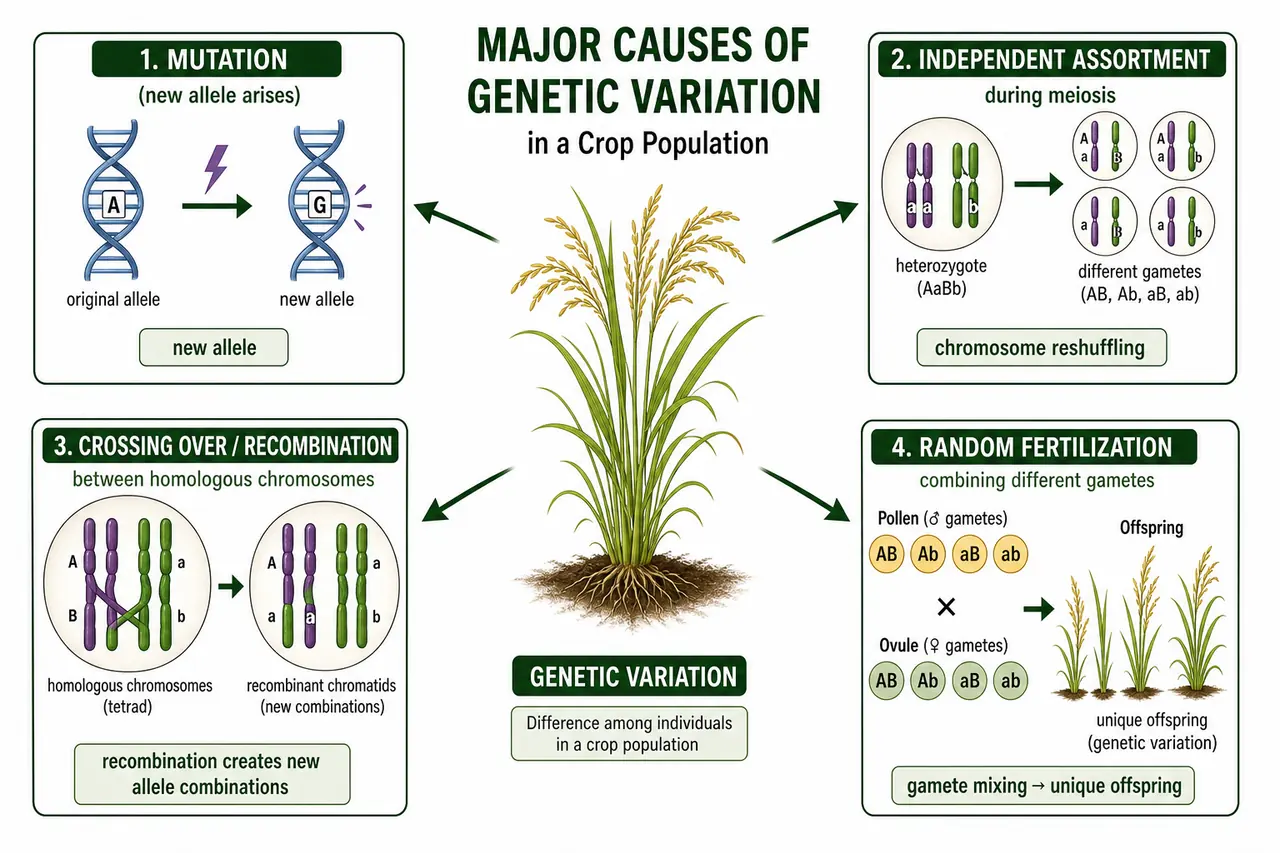
| Cause | How It Creates Variation |
|---|---|
| Mutation | Creates entirely new alleles; ultimate source of all variation |
| Random mating | Mixes alleles freely in the population |
| Random fertilisation | Each offspring is genetically unique |
| Independent assortment | Homologous chromosomes distributed randomly during meiosis |
| Crossing over (Recombination) | Reshuffles alleles on homologous chromosomes |
| Polyploidy | Changes chromosome number and generates new variation |
| Migration / gene flow | Introduces alleles from outside populations |
| Selection | Changes allele frequencies by favouring certain genotypes |
- A mutagen is any physical or chemical agent capable of inducing a mutation.
- The deliberate or spontaneous process through which such mutation is produced is called mutagenesis.
- In basic mutation direction terminology, a forward mutation means change from the wild type to a mutant state, while a backward (reverse) mutation means return from the mutant state toward the wild type.
- A spontaneous mutation arises naturally without any deliberately identified mutagenic treatment, whereas an induced mutation appears after exposure to a mutagen such as radiation or a chemical agent.
- In phenotype-based mutation classification, a macro-mutation is usually discussed as a relatively large, more easily visible change often tied to one or a few genes, whereas a micro-mutation refers to smaller-effect variation more often associated with polygenic systems.
- As a general rule, mutations are random in origin but heritable once established in the germ line. Most are neutral or harmful, while only a small fraction become directly useful in crop improvement.
- Classical mutation history often links Hugo de Vries with the term mutation and mutation theory through his work on Oenothera, H.J. Muller with X-ray induced mutation in Drosophila, and L.J. Stadler with induced mutation studies in crop plants such as maize and barley.
- In applied breeding, mutation breeding is most valuable when breeders need a new trait variant but cannot readily find that variation in the available germplasm; it is especially useful in self-pollinated and vegetatively propagated crops where a single improved mutant can be fixed directly.
- In practical mutation breeding, the most useful mutagen dose is an optimum dose that creates a high mutation frequency while keeping survival reasonably high. This is often discussed relative to LD50 — the dose that kills about 50% of treated material.
- Mutation breeding is commonly used to strengthen an already good variety by correcting one or two weaknesses, to create disease resistance, to generate male-sterile lines for hybrid seed production, and to introduce novel variation into clonally propagated crops.
- A bud or somatic mutation arises in non-reproductive tissue. Such mutations can be perpetuated clonally in vegetatively propagated crops, but they are not transmitted through ordinary sexual reproduction unless reproductive tissue is involved.
Importance of Variation
- Variation causes evolution and is the basis of heredity.
- Enables adaptation to environmental changes — essential for species survival.
- In agriculture, genetic variation is the raw material for all breeding programmes.
Heredity: Genotype and Phenotype
- Johannsen (1909) formulated the genotype-phenotype concept and coined the terms gene, genotype, and phenotype.
- Mendel used the word factor for the hereditary unit; later genetics adopted the modern word gene.
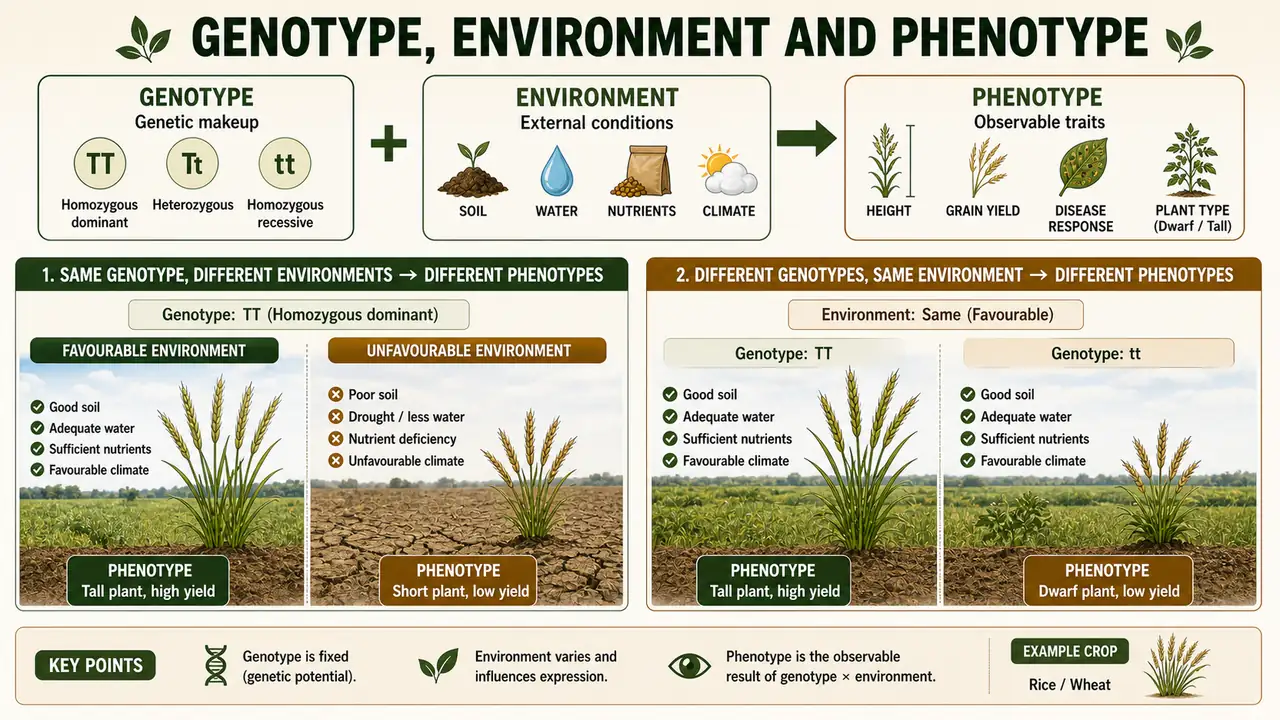
| Term | Definition | Example |
|---|---|---|
| Genotype | Sum total of an organism's hereditary information (genetic makeup) | TT, Tt, tt |
| Phenotype | Observable features produced by genotype × environment interaction | Tall, dwarf |
| Phenocopy | Two identical phenotypes from different genotypes under different environments | Drosophila wing phenocopies |
Key formula: Phenotype = f(Genotype + Environment)
Exam tip: Johannsen coined three terms — gene, genotype, phenotype. He also renamed Mendel's "factors" as "genes."
Gene — The Hereditary Unit
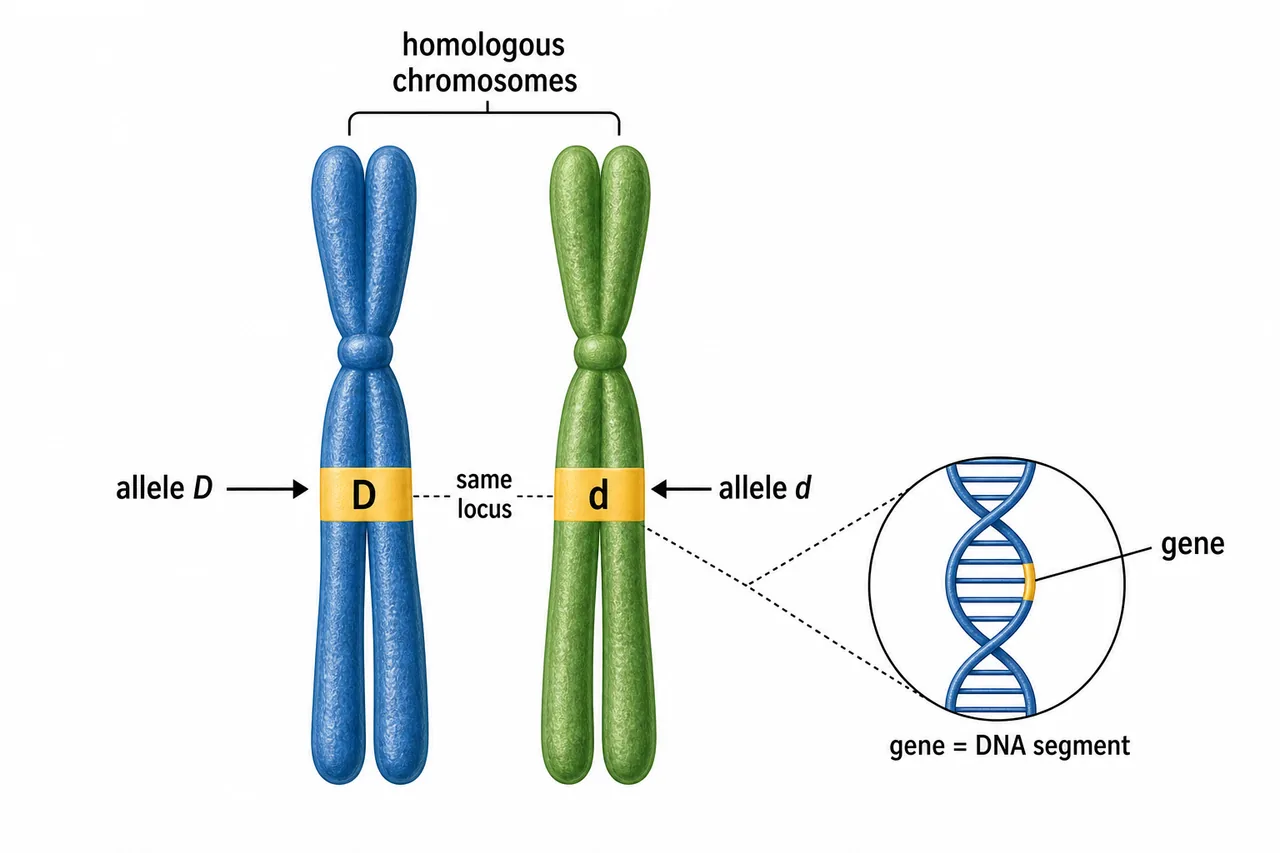
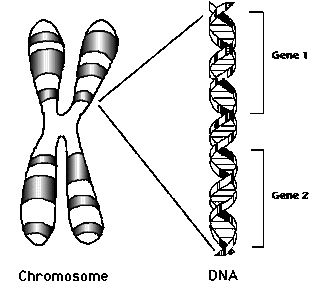
- A gene is the smallest functional unit of inheritance — chemically, a segment of DNA that controls the synthesis of a polypeptide (enzyme/protein).
- Genes are linearly arranged on chromosomes — the chromosome is the bearer; the gene is the passenger.
- Mendel called genes "factors"; Johannsen renamed them.
- Genes exist in pairs (one from each parent) with two forms: dominant and recessive.
- The idea that genes are particulate in nature came from Mendel's interpretation of inheritance.
Key Gene-Related Terms
| Term | Definition |
|---|---|
| Genome | Haploid set of chromosomes — the complete genetic blueprint |
| Allele (Allelomorph) | Alternative forms of the same gene at corresponding positions on homologous chromosomes |
| Homozygous | Two identical alleles (DD, dd, TT, tt) — breeds true |
| Heterozygous | Two different alleles (Dd, Tt) — shows dominant phenotype but carries recessive |
| Hemizygous | Only one copy of a gene is present |
- In classical fine-structure genetics, a gene may be discussed at three related levels: a cistron as the functional unit responsible for one polypeptide or functional product, a recon as the smallest unit within which recombination is not detected, and a muton as the smallest unit at which mutation can occur. In modern molecular terms, these all point back to progressively finer interpretation of the DNA segment we call a gene.
- Barbara McClintock (1983, Nobel Prize) discovered transposable elements (jumping genes) in maize — genes that can move around the genome.
- The term allele is associated with Bateson, and is a shortened form of allelomorph.

Chromosome Types
| Type | Function | Discovery |
|---|---|---|
| Autosome | Carries genes for general body characters | — |
| Allosome (Sex chromosome) | Carries genes for sex determination (X, Y) | Discovered by McClung |
- In standard recall, McClung identified the sex chromosome in grasshopper.
- Holandric genes are located on the Y-chromosome — inherited exclusively from father to son.
- Centromere (Kinetomere) = the "driver" of the chromosome — attachment point for spindle fibres during cell division.
- Chromosomal Theory of Inheritance: Genes are located on chromosomes — postulated by Sutton and Boveri.
- Chromosome-history recall often adds that Strasburger (1875) described chromosomes as thread-like structures, and Waldeyer (1888) later gave the name chromosome.
- A classic cytology fact is that Haplopappus gracilis is remembered for a very low chromosome number, 2n = 4.
- For morphology, chromosomes are most condensed during mitotic metaphase, making it the standard stage for chromosome-shape study.
History of Hereditary Thought
| Scientist | Theory | Key Idea |
|---|---|---|
| Aristotle | Spontaneous generation | Living organisms arise from non-living matter |
| Swammerdam & Bonnet | Preformation | Miniature human (homunculus) already present in egg/sperm; older exam recall may attach the year 1669 |
| Wolf | Epigenesis | Undifferentiated substance differentiates after fertilisation |
| Lamarck | Inheritance of acquired characters | Acquired traits passed to offspring (e.g., blacksmith's arms) |
| Darwin | Pangenesis + Natural Selection | Body parts produce "gemmules" transported to gametes; survival of the fittest |
| Weismann | Germplasm theory | Disproved pangenesis (cut mice tails for 22 generations — tails still inherited); only germplasm changes are heritable |
| Mendel | Laws of inheritance | Factors (genes) segregate and assort independently |
Other Classical Theories of Heredity Often Asked by Name
| Theory | Scientist | Key idea |
|---|---|---|
| Preformation theory | Swammerdam and Bonnet | Organism pre-exists in miniature form; older recall tables may attach 1669 |
| Epigenesis | K.F. Wolff | Structures differentiate gradually after fertilisation |
| Pangenesis / gemmules | Charles Darwin | Body parts contribute gemmules to heredity |
| Germplasm theory | Weismann | Only germplasm changes are inherited |
| Inheritance of acquired characters | Lamarck | Acquired traits pass to offspring |

Weismann's Germplasm Theory
- The body has two parts: somatoplasm (body) and germplasm (reproductive cells).
- Changes affecting somatoplasm but not reaching germplasm are not heritable.
- Somatoplasm dies with the individual, but germplasm is immortal — it passes from generation to generation.
- This principle is crucial: only changes in reproductive cells (germline) can be inherited.
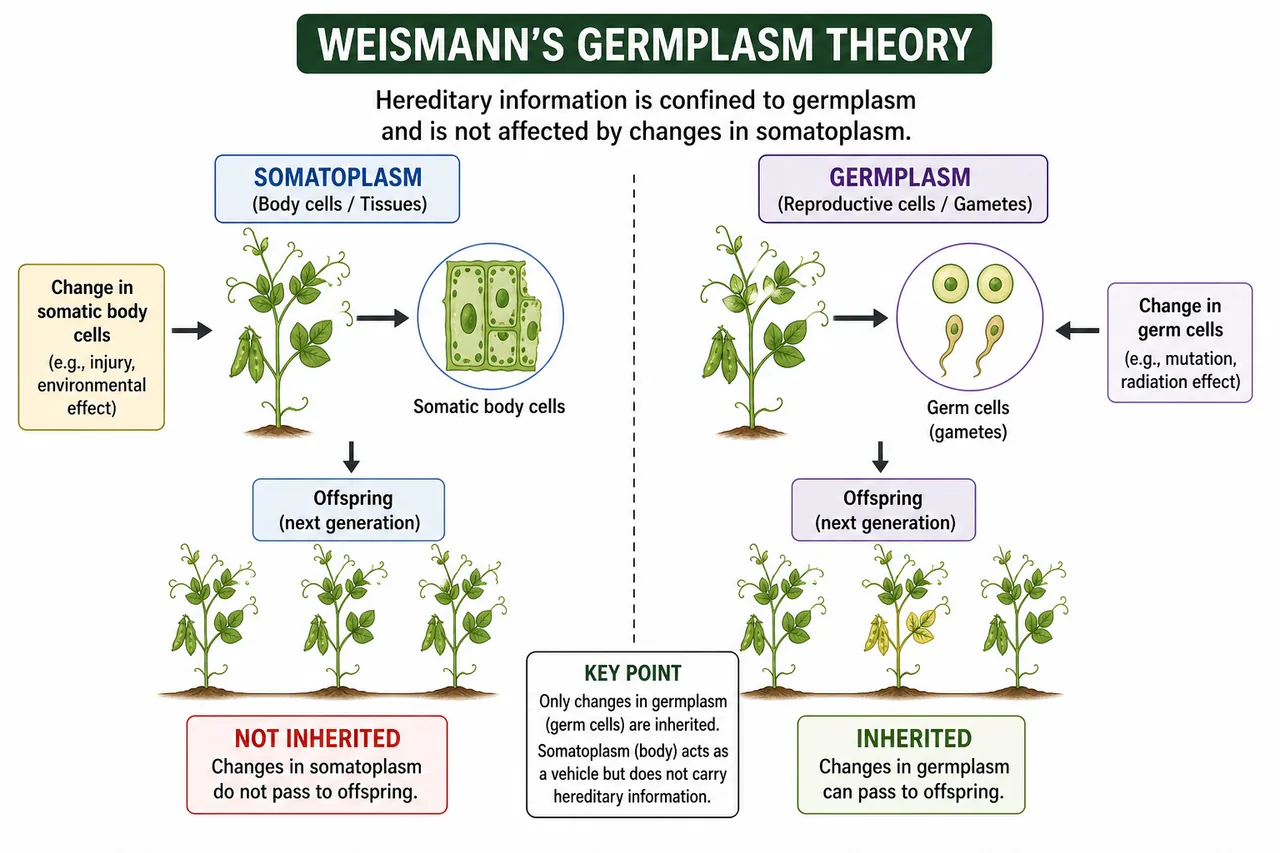
Agricultural application: When a farmer exposes seeds to gamma rays for mutation breeding, the mutations must occur in the germplasm (reproductive cells) to be inherited. Mutations in somatic tissue alone will not pass to the next generation.
Physical Basis of Heredity
- Mendel used the term factor for the genetic unit; Johannsen's term gene is now universally used.
- Genes are located on chromosomes in a linear order.
- Each species has a fixed chromosome number (e.g., rice 2n = 24, wheat 2n = 42).
- Body cells are diploid (2n) — two sets of homologous chromosomes (one from each parent).
- Gametes are haploid (n) — produced through meiosis.
- Homologous chromosomes carry genes for the same traits at the same loci, though alleles may differ.
Important Historical Milestones in Genetics
| Scientist | Contribution |
|---|---|
| Mendel | Fundamental principles of heredity |
| Avery, MacLeod, and McCarty (1944) | DNA, not protein, is the transforming principle |
| Hershey and Chase (1952) | Confirmed DNA as genetic material using T2 bacteriophage and E. coli |
| Beadle and Tatum | One gene-one enzyme hypothesis |
| Ingram | One gene-one polypeptide idea |
| Freese | Terms transition and transversion |
| Sharp | Split gene concept and RNA splicing; helped establish the exon-intron organization of many eukaryotic genes |
- Important naming milestones in molecular genetics include Flemming (1879) for the term chromatin, Friedrich Miescher (1869) for the first isolation of nucleic material as nuclein, and Altmann (1889) for popularising the term nucleic acid.
NOTE
The Hershey-Chase experiment used radioactive 32P to label DNA and 35S to label protein, specifically in the classic T2 bacteriophage - E. coli system.
Chromatin, Nucleic Acids, and Genetic Information Flow
- Chromatin is the nucleoprotein complex that makes up chromosomes. It contains DNA associated with histone and non-histone proteins.
- The repeating structural unit of chromatin is the nucleosome, described by Kornberg. In this arrangement, DNA winds around a histone core.
- More condensed, darkly stained chromatin is called heterochromatin, while the lighter, more transcriptionally active portion is called euchromatin.
Nucleic Acids
- Nucleic acids are polynucleotides that store, transmit, and express hereditary information.
- Their basic unit is the nucleotide, which contains:
- a pentose sugar
- a phosphate group
- a nitrogenous base
- A nucleoside is only sugar + base, while a nucleotide is nucleoside + phosphate.
| Component | DNA | RNA |
|---|---|---|
| Sugar | Deoxyribose | Ribose |
| Bases | A, T, G, C | A, U, G, C |
| Typical structure | Usually double-stranded helix | Usually single-stranded |
| Main role | Long-term storage of hereditary information | Transfer and expression of genetic information |
- Purines are adenine and guanine.
- Pyrimidines are cytosine, thymine, and uracil.
- In DNA, adenine pairs with thymine and guanine pairs with cytosine. In RNA, uracil replaces thymine.
- During DNA replication, each original DNA strand acts as a template strand for synthesis of a new complementary daughter strand.
- This is why DNA replication is described as semiconservative: each daughter DNA molecule contains one parental strand and one newly synthesized strand.
- A point mutation (gene mutation) is a change in the nucleotide sequence of a gene, commonly through substitution, insertion, or deletion of bases.
- In mutation terminology, a transition means substitution of one purine by another purine or one pyrimidine by another pyrimidine.
- A transversion means substitution of a purine by a pyrimidine or a pyrimidine by a purine.
- When nucleotides are inserted into or deleted from a coding sequence in a way that shifts triplet grouping, the result is a frameshift mutation, which alters the downstream reading frame during translation.
- Mutagens are often grouped conceptually into:
- Physical mutagens, such as X-rays, gamma rays, and UV radiation
- Chemical mutagens, such as EMS, DMS, MMS, NMU, and base analogues like 5-bromouracil
- Among non-ionizing radiations, the standard exam recall for the most mutagenically effective UV wavelength is about 254 nm (2540 A).
- Acridine dyes such as proflavin and acriflavin are classically linked with frameshift mutations because they intercalate between DNA bases.
From Gene to Protein
- A gene stores information in the sequence of its nitrogenous bases.
- During transcription, this DNA information is copied into RNA by RNA polymerase.
- During translation, the sequence carried by mRNA is read on ribosomes to assemble a chain of amino acids.
- A codon is a sequence of three nucleotides on mRNA that specifies one amino acid or a translation signal.
- The matching three-base sequence on tRNA is called the anticodon. Codons on mRNA are read in the 5' to 3' direction, while anticodons align with them in an antiparallel manner.
- The usual start codon is AUG, which initiates translation and codes for methionine.
- The standard stop (nonsense) codons are UAA, UAG, and UGA; they signal termination of protein synthesis.
- Because there are four nucleotide bases arranged in triplets, the genetic code has 64 possible codons for 20 standard amino acids plus start/stop signals.
- The wobble hypothesis, associated with Francis Crick (1966), explains why the third base of a codon can sometimes pair flexibly, which helps account for the degeneracy of the genetic code.
- This flow of information from DNA -> RNA -> protein explains how hereditary information becomes visible as structure, metabolism, and phenotype.
Agricultural connection: Whether the trait is grain colour, disease resistance, or enzyme activity in seed germination, the observed phenotype ultimately depends on how genetic information is transcribed and translated into functional proteins.
Operon Concept
- In prokaryotes, gene expression is often regulated through the operon concept, explained by Jacob and Monod (1961).
- The classic example is the lac operon of Escherichia coli, which controls enzymes needed for lactose metabolism.
- In simple exam wording:
- when lactose is absent, the repressor blocks transcription at the operator
- when lactose is present, repression is lifted and the structural genes can be expressed
- A compact vocabulary set to remember is:
- Promoter = site where RNA polymerase binds
- Operator = regulatory DNA site where the repressor acts
- Repressor = protein that suppresses transcription in the absence of the inducer
Summary Cheat Sheet
| Concept / Topic | Key Details |
|---|---|
| Genetics = | Study of heredity and variation |
| Term coined by | Bateson (1905) |
| Father of Genetics | Gregor Mendel |
| Heredity | Transmission of traits from parents to offspring |
| Variation | Differences among individuals of same species |
| Hereditary variation | Caused by genetic changes; heritable; basis of breeding |
| Environmental variation | Non-heritable; caused by environment |
| Continuous variation | Quantitative traits; many genes (e.g., height, yield) |
| Discontinuous variation | Qualitative traits; few genes (e.g., flower colour) |
| Causes of genetic variation | Mutation, recombination, crossing over |
| Additional variation sources | Polyploidy, migration, selection |
| Genotype | Genetic makeup (e.g., TT, Tt, tt) |
| Phenotype | Observable features = Genotype + Environment |
| Terms coined by | Johannsen (1909) — gene, genotype, phenotype |
| Gene | Hereditary unit; segment of DNA on chromosome |
| Allele | Alternative forms of same gene at same locus |
| Genome | Haploid set of chromosomes |
| Homozygous | Identical alleles (TT, tt); true-breeding |
| Heterozygous | Different alleles (Tt); shows dominant phenotype |
| Hemizygous | Single copy of gene present |
| Transposable elements | Discovered by Barbara McClintock (1983 Nobel) in maize |
| DNA as transforming principle | Avery, MacLeod, McCarty |
| DNA confirmed by bacteriophage work | Hershey and Chase |
| Chromatin | DNA + histone and non-histone proteins |
| Nucleosome | Repeating structural unit of chromatin |
| Nucleotide | Sugar + base + phosphate |
| Nucleoside | Sugar + base |
| Purines | Adenine, Guanine |
| Pyrimidines | Cytosine, Thymine, Uracil |
| DNA sugar / RNA sugar | Deoxyribose / Ribose |
| Transcription | DNA information copied into RNA by RNA polymerase |
| Translation | mRNA read on ribosomes to build protein |
| Codon | Sequence of 3 nucleotides coding for one amino acid or signal |
| Operon concept | Jacob & Monod (1961); classic model of prokaryotic gene regulation |
| Lac operon | Controls lactose metabolism in E. coli |
| Autosomes | Non-sex chromosomes |
| Holandric genes | On Y-chromosome; father-to-son only |
| Germplasm theory | Weismann — only germline changes are heritable |
| Natural Selection | Darwin — survival of the fittest |