👨👧 Dominance, Multiple Alleles, and Gene Interaction
Understand types of dominance, multiple alleles (blood groups, self-incompatibility), penetrance, expressivity, pleiotropy, lethality, and epistasis — with agricultural examples and modified dihybrid ratios.
Why Dominance and Gene Interaction Matter in Agriculture
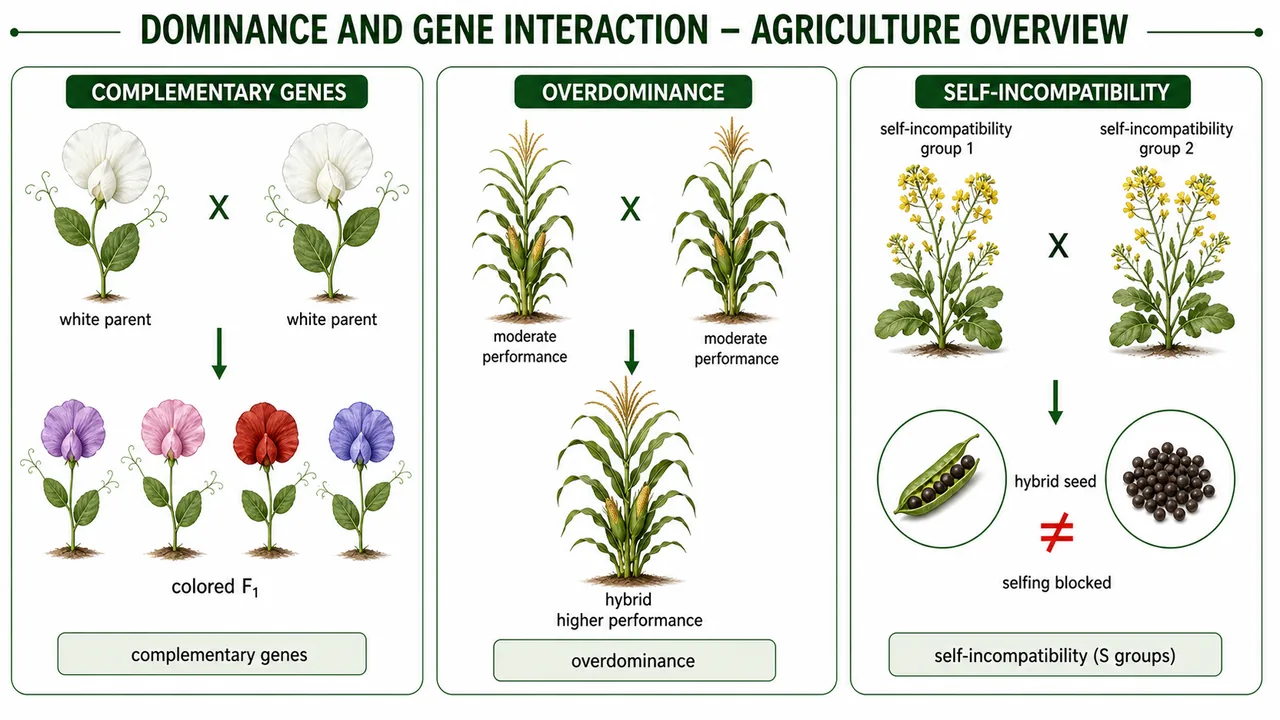
When a plant breeder crosses two white-flowered sweet pea varieties and gets coloured flowers in F1, Mendel's simple 3:1 ratio cannot explain it — gene interaction (complementary genes, 9:7 ratio) can. When a hybrid maize plant outperforms both parents in yield, overdominance is one explanation. And when breeders use self-incompatibility alleles in Brassica crops to produce hybrid seed without manual emasculation, they are exploiting multiple alleles. Understanding these concepts is essential for predicting breeding outcomes beyond simple Mendelian inheritance.
Types of Dominance
| Type | F2 Ratio | Key Feature | Example |
|---|---|---|---|
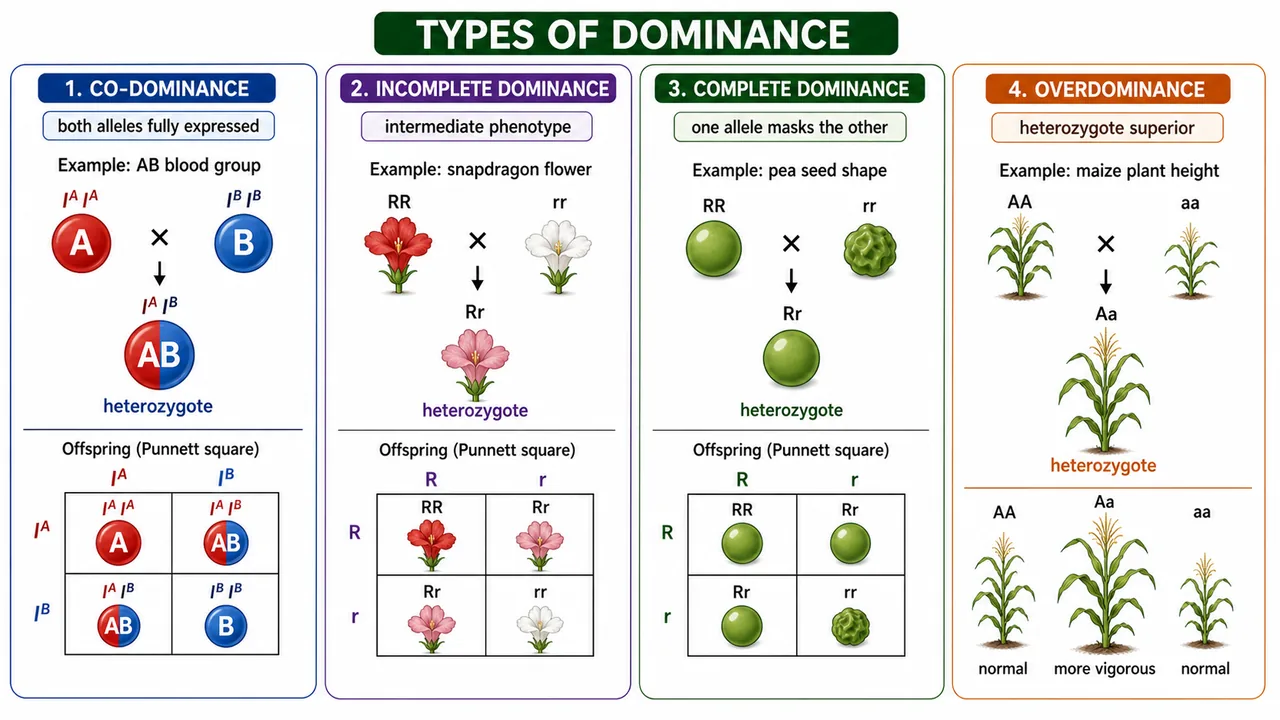
| Co-dominance | 1 : 2 : 1 | Both alleles express fully in heterozygote | ABO blood groups (AB type has both antigens) |
| Incomplete dominance | 1 : 2 : 1 | Heterozygote shows intermediate phenotype | Snapdragon: Red x White → Pink |
| Complete dominance | 3 : 1 | Dominant allele fully masks recessive | Pea: Round (RR, Rr) vs. wrinkled (rr) |
| Overdominance | — | Heterozygote is superior to either homozygote | Maize pigmentation; related to heterosis |
Co-dominance (No Dominance)
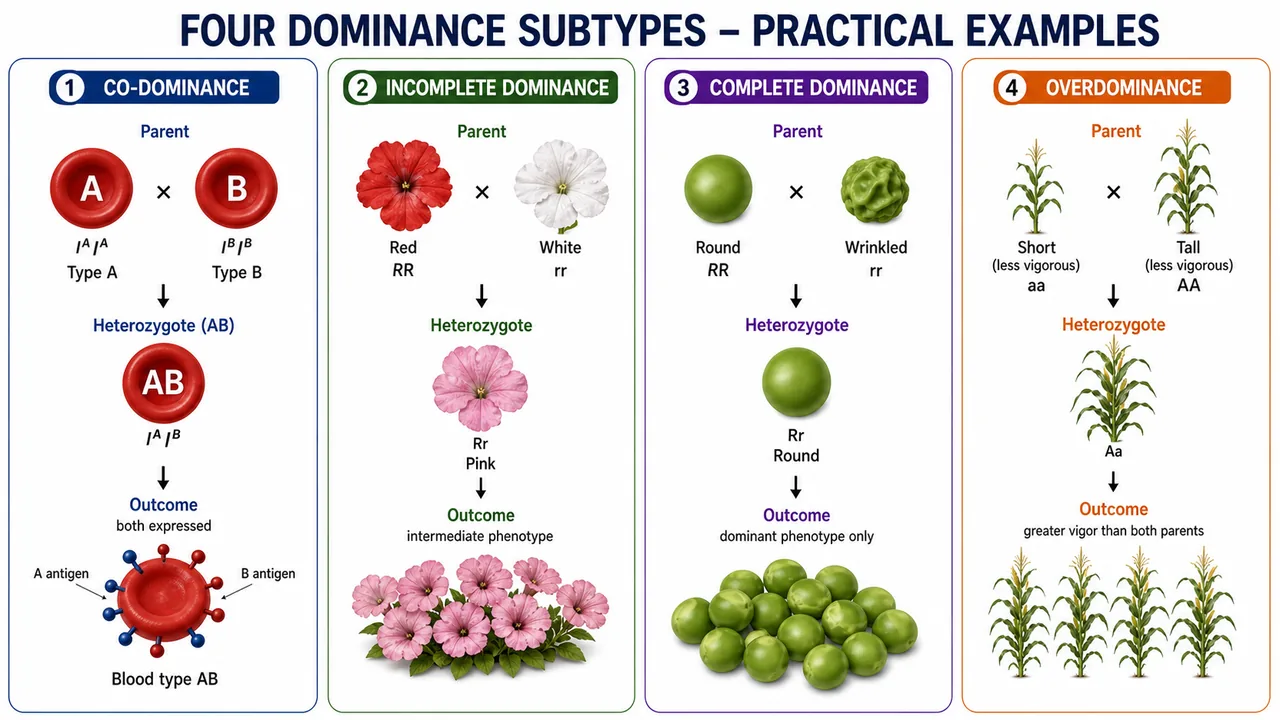
- Both alleles express simultaneously in the heterozygote — neither masks the other.
- Example: AB blood group — I^A I^B genotype produces both antigen A and antigen B on red blood cells.
- Phenotypic ratio = genotypic ratio = 1 : 2 : 1 (each genotype produces a distinct phenotype).
Incomplete (Partial) Dominance
- The dominant allele does not fully suppress the recessive allele; the heterozygote is intermediate.
- Example: Snapdragon (Antirrhinum majus) — Red (RR) x White (rr) → Pink (Rr) in F1. F2 = 1 Red : 2 Pink : 1 White.
- Pink arises because a single dose of the red allele produces only half the pigment.
- In older descriptive genetics notes, this intermediate heterozygous appearance is sometimes loosely described as blending inheritance at the phenotype level, even though the underlying alleles themselves remain discrete and segregate again in F2.
Complete Dominance
- One allele completely masks the other. Heterozygote (Tt) looks exactly like homozygous dominant (TT).
- Example: Round vs. wrinkled seeds in pea — F2 ratio = 3:1 (Mendel's observation).
Overdominance
- The heterozygote is phenotypically superior to either homozygous parent.
- Example: In maize, heterozygotes show more pigmentation than either homozygote.
- Overdominance is one proposed genetic explanation for hybrid vigour (heterosis) — why hybrid crops often outyield their inbred parents.
Agricultural significance: Understanding dominance type determines how a breeder handles selection. With complete dominance, a test cross is needed to distinguish TT from Tt. With incomplete dominance, all three genotypes are phenotypically distinct.
Multiple Alleles
A single gene may have more than two alleles in a population. While any individual carries at most two alleles, the population can harbour many.
Characteristic Features
| Feature | Explanation |
|---|---|
| Same locus | All alleles occupy the same chromosomal position |
| One per chromosome | Only one allele at the locus per chromosome |
| Same character | All alleles control the same trait (different expressions) |
| No crossing over between them | Crossing over occurs between different loci, not within the same locus |
| Wild type usually dominant | Wild-type allele produces functional protein; mutants produce altered versions |
| Monohybrid F2 ratios | Confirms single-gene inheritance |
Examples of Multiple Alleles
1. ABO Blood Groups in Humans
- Discovered by Karl Landsteiner (1900) — Nobel Prize.
- Landsteiner is also remembered in objective-style recall as the Father of blood group.
- Controlled by gene "I" with three alleles: I^A, I^B, and i.
- I^A and I^B are co-dominant to each other; both are dominant over i.
- The standard ABO system therefore gives a compact recall count of 3 alleles, 6 genotypes, and 4 phenotypes.
| Blood Group | Genotype(s) | Antigens Present |
|---|---|---|
| A | I^A I^A or I^A i | Antigen A |
| B | I^B I^B or I^B i | Antigen B |
| AB | I^A I^B | Both A and B (co-dominance) |
| O | ii | Neither |

- A closely related blood-group recall is the Rh factor (Rhesus factor), classically associated with Karl Landsteiner and Alexander Wiener from work using rhesus monkeys.
- In older biology terminology, hematology is the study of blood itself, whereas serology focuses on antigen-antibody reactions in serum.
- Exam-oriented human-blood facts often include: O negative as the universal donor and AB positive as the universal recipient.
2. Coat Colour in Rabbits
- Four alleles of gene 'C' produce four phenotypes.
- Dominance hierarchy: C (agouti) > c^ch (chinchilla) > c^h (himalayan) > c (albino).

3. Self-Incompatibility Alleles in Plants
- Gene 'S' with multiple alleles (S₁, S₂, S₃, S₄, ...) — some species have hundreds of S alleles.
- When pollen carries the same S allele as the pistil, pollen tube growth is inhibited → prevents self-fertilisation.
- First described in tobacco; also found in Brassica, radish, tomato, potato.
Agricultural application: Plant breeders exploit self-incompatibility in Brassica crops (cabbage, cauliflower, mustard) to produce hybrid seed without manual emasculation — saving enormous labour costs.
Penetrance and Expressivity
| Concept | Question It Answers | Definition |
|---|---|---|
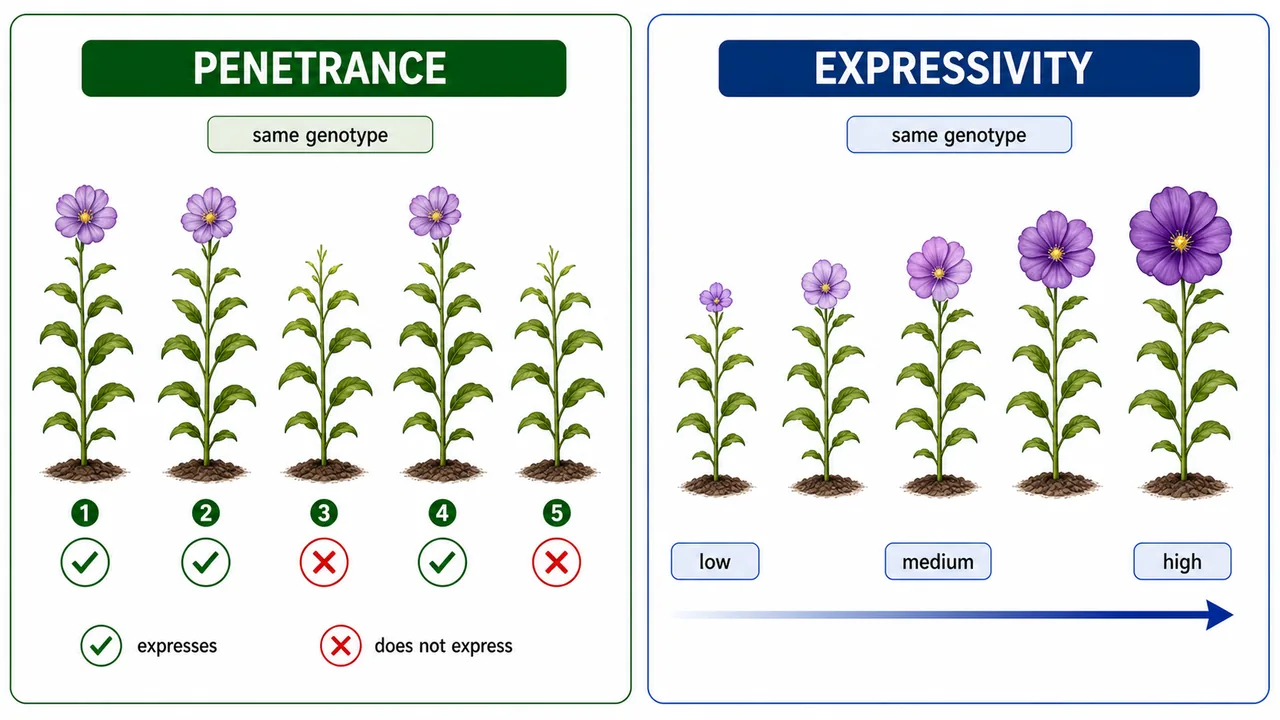
| Penetrance | Does the gene express at all? | Proportion of individuals with a genotype who show the expected phenotype |
| Expressivity | How strongly does it express? | Degree/range of phenotypic variation among those who express the trait |
- Complete penetrance: All individuals with the genotype show the phenotype.
- Incomplete penetrance: Some individuals with the genotype do not show the phenotype.
- Example of incomplete penetrance: Genes for diabetes mellitus — not everyone carrying the genes develops the disease (environmental factors like diet and lifestyle also matter).
- Example of variable expressivity: Polydactyly (extra fingers) — may appear on one hand but not the other in the same individual.
- Some older genetics notes also describe threshold characters, where expression appears only beyond a particular environmental limit; a standard example is a barley mutant that becomes albino below about 8°C.
- Both are influenced by genetic background and environment.
Pleiotropy
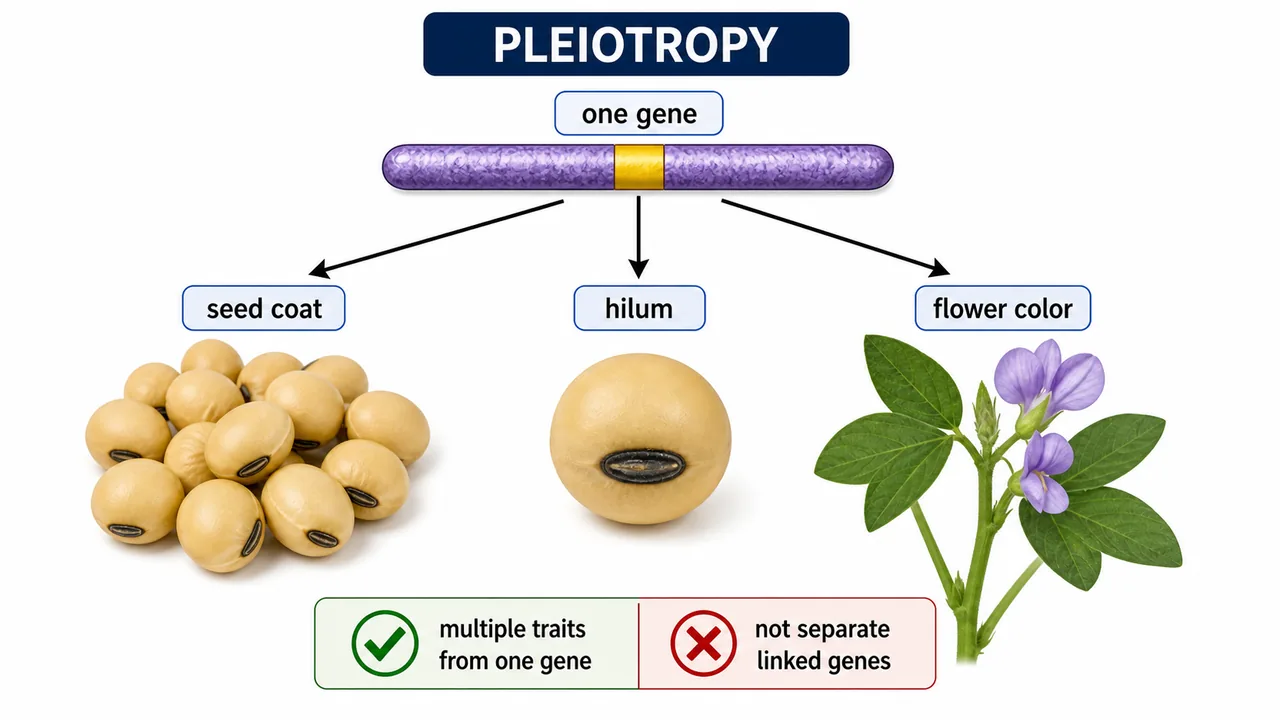
- A single gene influences more than one phenotypic trait — called multiple effect of a single gene.
- Occurs because the gene product (protein/enzyme) may participate in multiple biochemical pathways.
- Example: Phenylketonuria (PKU) — a single defective gene causes accumulation of phenylalanine, affecting brain development, skin pigmentation, and other metabolic processes simultaneously (collectively called a syndrome).
Agricultural example: In soybean, the gene controlling seed coat colour also affects hilum colour and flower colour — a classic case of pleiotropy that breeders must account for.
Lethality
- Lethal genes cause death of certain genotypes prematurely.
- Example: In mice, dominant allele Y (yellow coat) is lethal in homozygous state (YY die).
- Expected 1:2:1 ratio is modified to 2 : 1 (only Yy yellow and yy non-yellow survive).

Agricultural note: Lethal genes exist in crops too. In barley, certain chlorophyll-deficient mutants are lethal in homozygous state — seedlings die because they cannot photosynthesise.
Gene Interaction — Modified Dihybrid Ratios
When two or more genes affect the same trait, the classic 9:3:3:1 dihybrid ratio gets modified. UPPSC 2021
- A simple first split is:
- Additive gene action = alleles contribute cumulatively to the phenotype
- Non-additive gene action = the final phenotype depends on dominance, epistasis, or other non-linear interaction
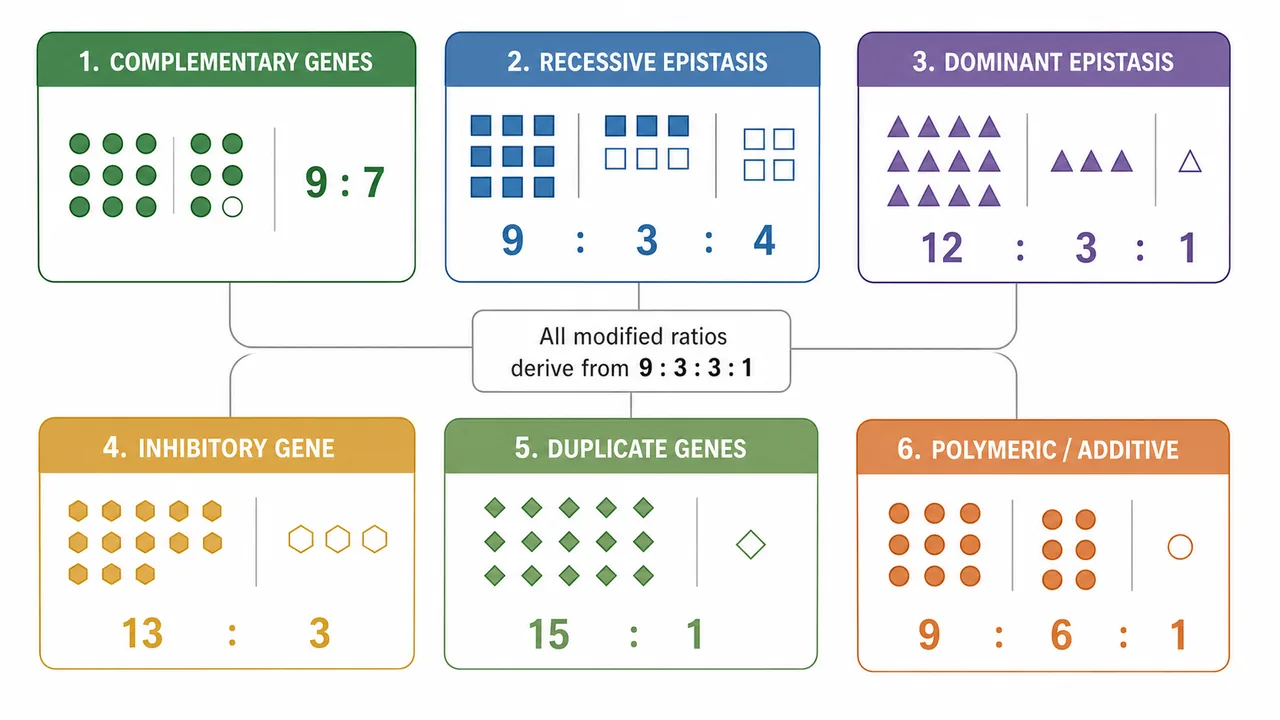
| Interaction Type | F2 Ratio | Example |
|---|---|---|
| Complementary genes | 9:7 | Flower colour in sweet pea |
| Recessive epistasis | 9:3:4 | Coat colour in mice |
| Dominant epistasis | 12:3:1 | Coat colour in dogs |
| Inhibitory gene | 13:3 | Seed colour in maize |
| Duplicate genes | 15:1 | Capsule shape in shepherd's purse |
| Polymeric/Additive | 9:6:1 | Coat colour in Duroc-Jersey pigs |
Complementary Genes — 9 : 7
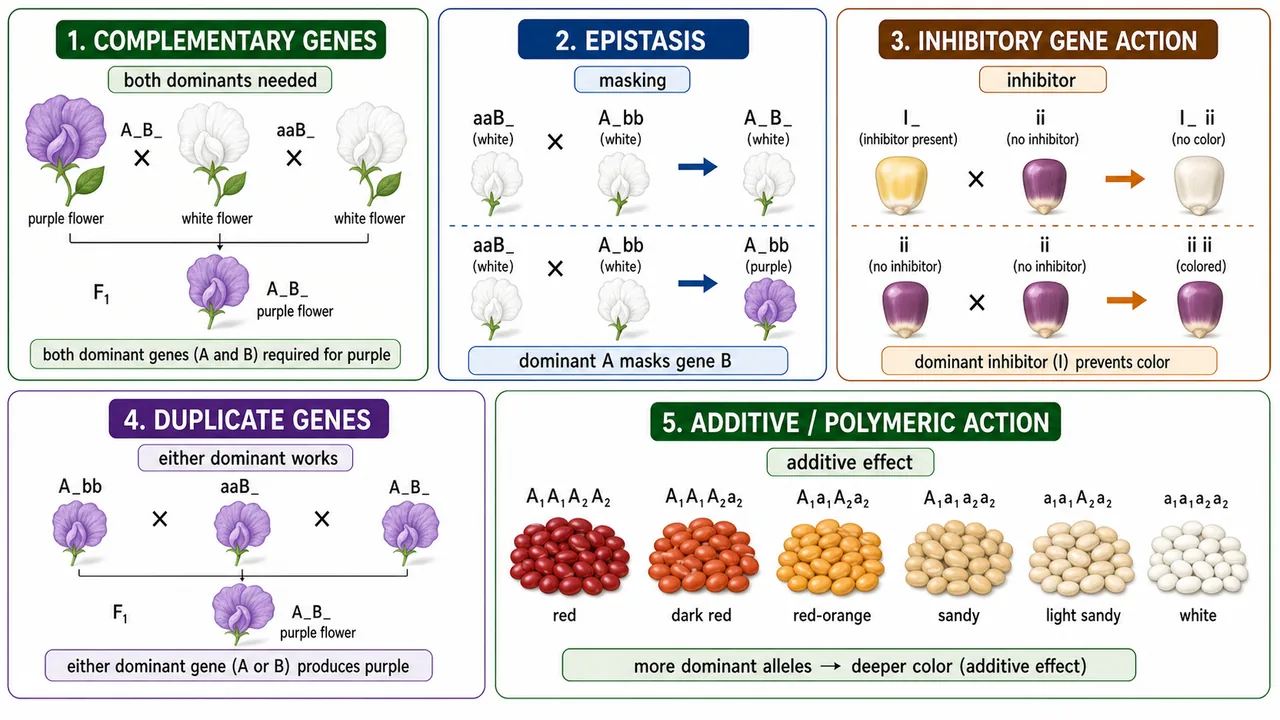
- Discovered by Bateson & Punnett in sweet pea (Lathyrus odoratus).
- Both dominant alleles (from two genes) must be present together for colour. If either is homozygous recessive → white.
Epistasis — One Gene Masks Another
Key distinction: Dominance = interaction between alleles of the same gene (intragenic). Epistasis = interaction between alleles of different genes (intergenic).
- In older genetics recall, the term epistasis is associated with William Bateson.
| Type | F2 Ratio | Mechanism | Example |
|---|---|---|---|
| Recessive epistasis | 9 : 3 : 4 | Homozygous recessive at one locus masks the other | Coloured x Albino mice → 9 Agouti : 3 Coloured : 4 Albino |
| Dominant epistasis | 12 : 3 : 1 | Single dominant allele at one locus masks the other | White x White dogs → 12 White : 3 Black : 1 Brown |
Inhibitory Gene Action — 13 : 3
- One dominant inhibitory gene suppresses expression of another dominant gene (does not produce its own phenotype).
- Example: Seed colour in maize — 13 white : 3 red.
Duplicate Genes (Duplicate Epistasis) — 15 : 1
- Either gene in dominant state independently produces the same phenotype.
- Only double homozygous recessive shows the alternative phenotype.
- Observed by G.H. Shull in shepherd's purse (Capsella) — 15 triangular : 1 top-shaped. exams 2019
Polymeric/Additive Gene Action — 9 : 6 : 1
- Both genes contribute additively to the phenotype.
- Example: Duroc-Jersey pig coat colour — 9 red : 6 sandy : 1 white.
- Both dominants present = full expression (red). One dominant from either gene = intermediate (sandy). Neither = minimal (white).
Agricultural significance: Polymeric/additive gene action is the foundation of quantitative genetics — most crop traits (yield, grain weight, plant height) are governed by many genes with small additive effects.
Summary Cheat Sheet
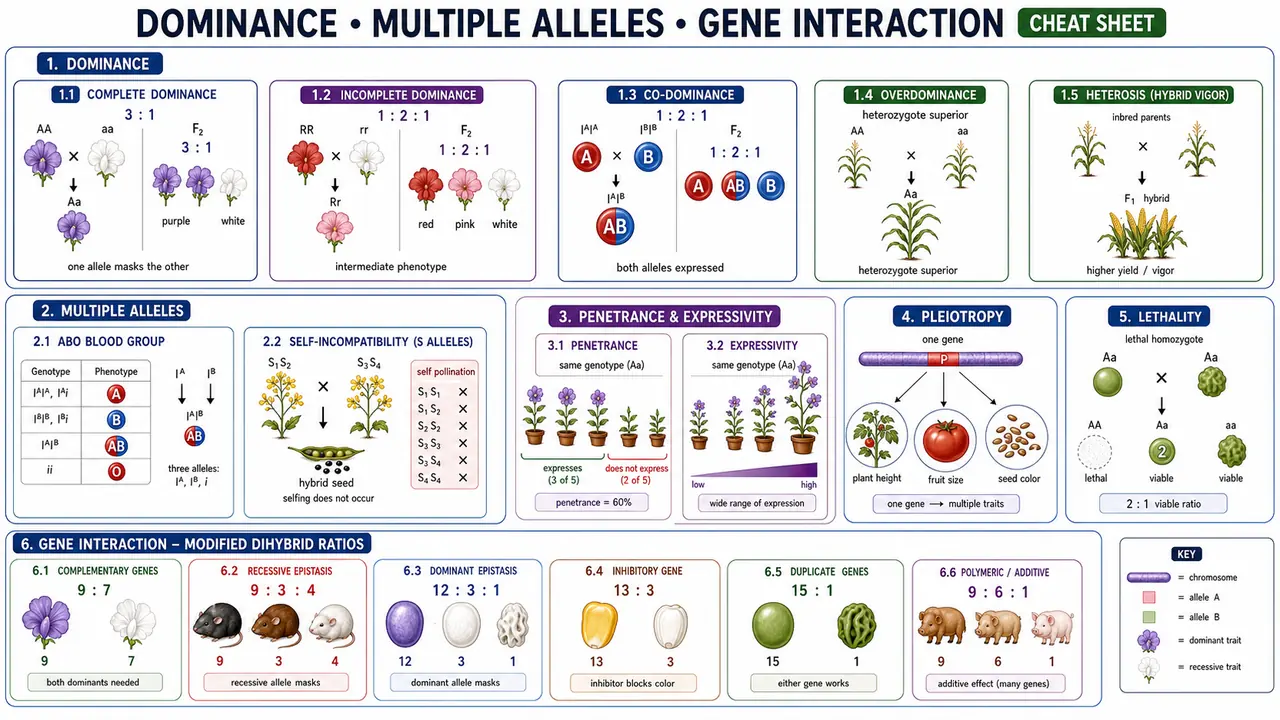
| Concept / Topic | Key Details |
|---|---|
| Complete dominance | One allele masks other; F2 = 3:1 (Mendel's pea traits) |
| Incomplete dominance | Intermediate phenotype; F2 = 1:2:1 (Snapdragon: red x white → pink) |
| Co-dominance | Both alleles expressed fully; F2 = 1:2:1 (AB blood group) |
| Overdominance | Heterozygote superior to both homozygotes; basis of heterosis |
| Multiple alleles | >2 alleles in population; max 2 per individual |
| ABO blood groups | I^A, I^B (co-dominant), i (recessive); 4 phenotypes from 3 alleles |
| Rabbit coat colour | 4 alleles: C > c^ch > c^h > c (dominance series) |
| Self-incompatibility alleles | Prevent self-fertilisation; used for hybrid seed in Brassica |
| Penetrance | % of individuals with genotype showing phenotype |
| Expressivity | Degree of phenotypic expression (e.g., polydactyly) |
| Threshold character | Expression appears beyond an environmental limit; barley mutant may turn albino below about 8°C |
| Pleiotropy | One gene → multiple traits (e.g., PKU syndrome) |
| Lethality | Lethal genotype dies; F2 ratio = 2:1 (Yellow mice: YY lethal) |
| Complementary genes | 9:7 (sweet pea flower colour) |
| Recessive epistasis | 9:3:4 (coat colour in mice) |
| Dominant epistasis | 12:3:1 (coat colour in dogs) |
| Inhibitory gene | 13:3 (seed colour in maize) |
| Duplicate genes | 15:1 (capsule shape in Capsella) |
| Polymeric / Additive | 9:6:1 (Duroc-Jersey pig colour) |
| All modified ratios derive from | Standard 9:3:3:1 dihybrid ratio |