👨⚖️ Mendel's Laws of Inheritance
Understand Mendel's work on garden pea, the three laws of inheritance (segregation, dominance, independent assortment), monohybrid and dihybrid crosses, test cross, and deviations — with agricultural examples and exam tips.
Why Mendel's Laws Matter in Agriculture
Every time a plant breeder crosses a disease-resistant variety with a high-yielding one and predicts the outcome in F2, they are applying Mendel's laws. The 3:1 ratio in a monohybrid cross tells the breeder how many plants to grow to find the desired homozygous recombinant. The test cross is used routinely to verify whether a promising plant is true-breeding (homozygous) before releasing it as a variety. Mendel's principles remain the bedrock of all breeding programmes — from rice and wheat to cotton and pulses.
Gregor Mendel — Father of Genetics
- Mendel is known as the Father of Genetics. UPPSC 2021
- He formulated the Theory of Inheritance through experiments on garden pea in the 1860s.
- Mendel worked on pea for about seven years (1856-1863), presented his findings in 1865, and published them in 1866.
- Mendelian laws were rediscovered in 1900 by Hugo de Vries, Carl Correns, and Erich von Tschermak.
Why Garden Pea (Pisum sativum)?
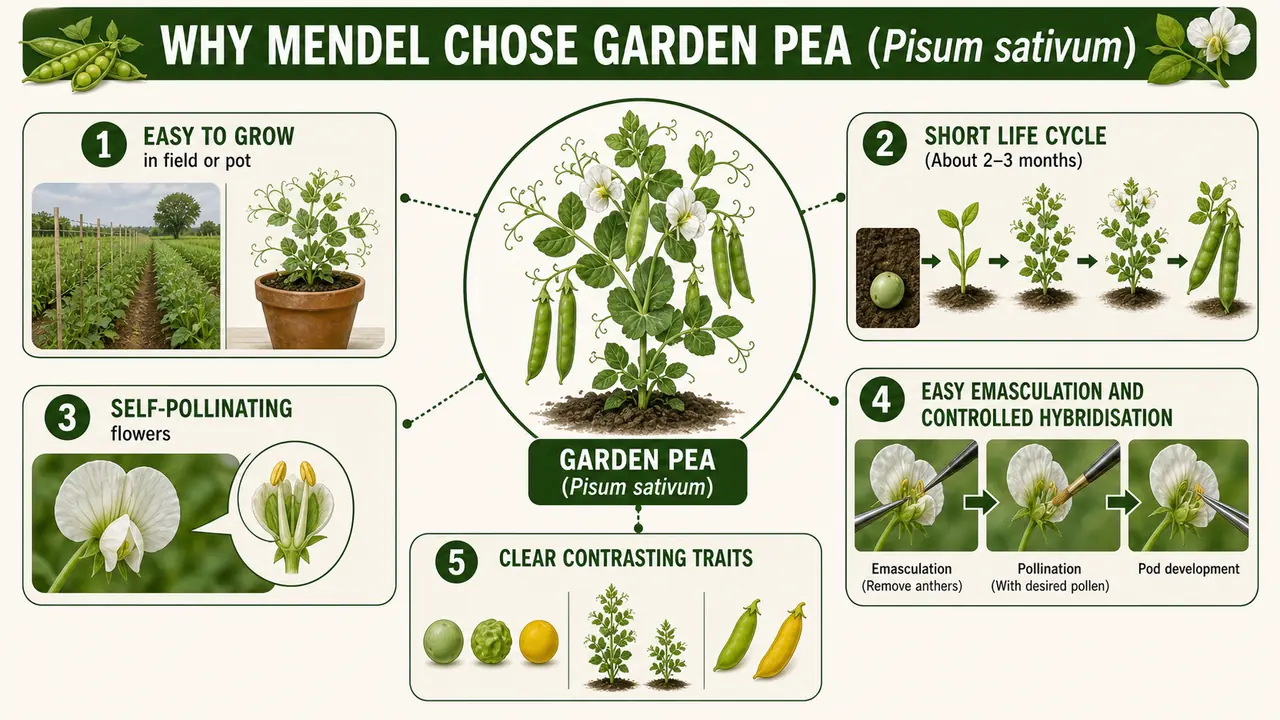
Mendel chose the garden pea because it offered several advantages:
Pro Content Locked
Upgrade to Pro to access this lesson and all other premium content.
Charged once for one year · ₹1188 total
Save ₹100/month vs ₹2388/year launch price
- All Agriculture & Banking Courses
- AI Lesson Questions (100/day)
- AI Doubt Solver (50/day)
- Glows & Grows Feedback (30/day)
- AI Section Quiz (20/day)
- 22-Language Translation (100/day)
- Recall Questions (20/day)
- AI Quiz (15/day)
- AI Quiz Paper Analysis (100/day)
- AI Step-by-Step Explanations (100/day)
- Spaced Repetition Recall (FSRS)
- AI Tutor
- Immersive Text Questions
- Audio Lessons — Hindi & English
- Mock Tests & Previous Year Papers
- Summary & Mind Maps
- XP, Levels, Leaderboard & Badges
- Generate New Classrooms
- Voice AI Teacher (AgriDots Live)
- AI Revision Assistant
- Knowledge Gap Analysis
- Interactive Revision (LangGraph)
🔒 Secure one-time yearly payment via Razorpay · No hidden fees
Why Mendel's Laws Matter in Agriculture
Every time a plant breeder crosses a disease-resistant variety with a high-yielding one and predicts the outcome in F2, they are applying Mendel's laws. The 3:1 ratio in a monohybrid cross tells the breeder how many plants to grow to find the desired homozygous recombinant. The test cross is used routinely to verify whether a promising plant is true-breeding (homozygous) before releasing it as a variety. Mendel's principles remain the bedrock of all breeding programmes — from rice and wheat to cotton and pulses.
Gregor Mendel — Father of Genetics
- Mendel is known as the Father of Genetics. UPPSC 2021
- He formulated the Theory of Inheritance through experiments on garden pea in the 1860s.
- Mendel worked on pea for about seven years (1856-1863), presented his findings in 1865, and published them in 1866.
- Mendelian laws were rediscovered in 1900 by Hugo de Vries, Carl Correns, and Erich von Tschermak.
Why Garden Pea (Pisum sativum)?
Mendel chose the garden pea because it offered several advantages:
| Advantage | Why It Mattered |
|---|---|
| Easy to culture (field or pot) | Practical for repeated experiments |
| Short life cycle | Multiple generations observable quickly |
| Highly self-pollinating | Parental lines were naturally pure-breeding (homozygous) |
| Well-defined contrasting characters | Clear, easily distinguishable trait forms |
| Easy emasculation and hybridisation | Flower structure allowed controlled crosses |
Why Mendel Succeeded When Earlier Workers Did Not
- He studied one pair of contrasting characters at a time.
- He selected traits showing clear dominant and recessive forms.
- He used a crop that was naturally self-pollinated but easy to cross manually.
- He maintained pedigree records and counted large enough progenies.
- He worked with characters that behaved largely as if they were independent.
Historical bridge: Before Mendel, workers such as Goss and Knight on pea and Kolreuter on tobacco had already used hybridization, but they did not isolate one contrasting trait at a time with the same statistical clarity that made Mendel's ratios visible.
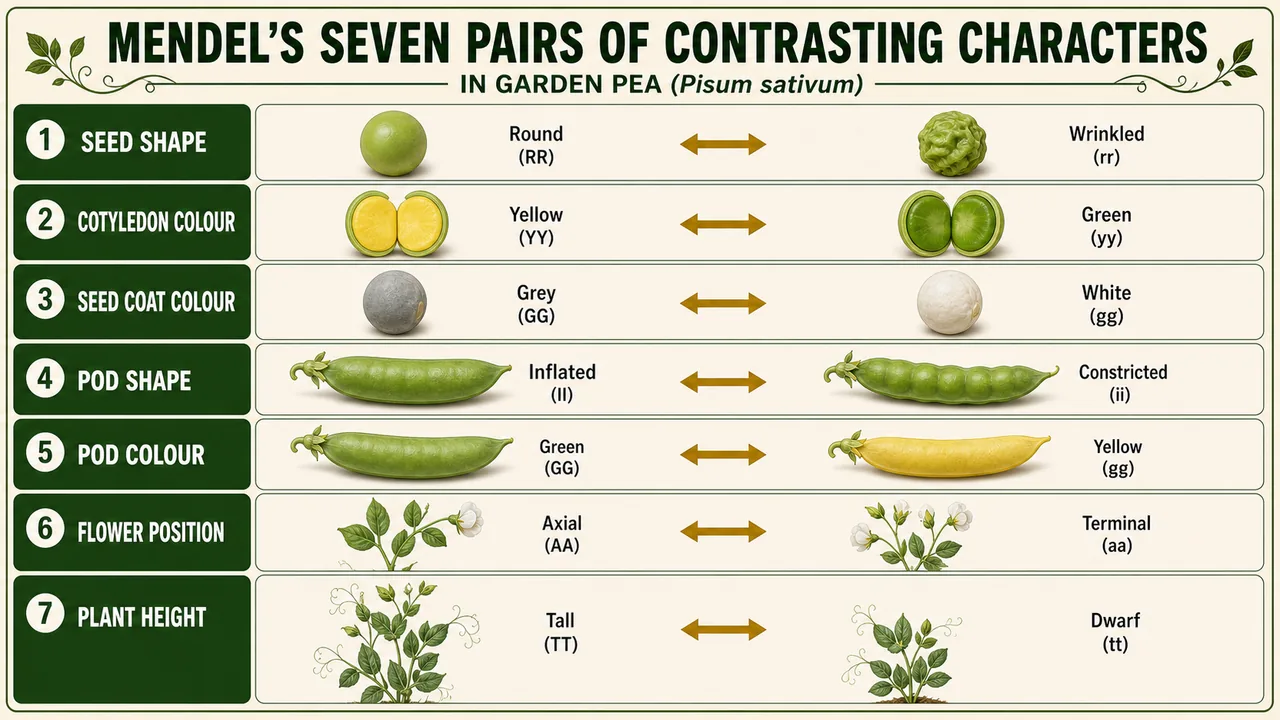
Mendel selected seven pairs of contrasting characters for his study.
| Plant Parts | Characters | Dominant | Recessive |
|---|---|---|---|
| Seed | Shape | Round | Wrinkled |
| Cotyledon colour | Yellow | Green | |
| Seed coat colour | Grey | White | |
| Pod | Pod shape | Inflated | Constricted |
| Pod colour | Green | Yellow | |
| Stem | Position of pod | Axial | Terminal |
| Plant height | Tall | Dwarf |
NOTE
The classic seven pea characters are distributed across only four chromosomes, but they behaved independently enough in Mendel's experimental material to reveal simple inheritance ratios.
Key to Mendel's Success
Previous workers studied organisms as a whole complex of characters and failed to find patterns. Mendel succeeded because he:
- Studied one character at a time — simplified analysis and revealed clear ratios.
- Selected seven contrasting pairs with clearly distinguishable forms.
- Chose characters that were independent (on different chromosomes, no linkage).
- Kept meticulous records with large sample sizes for statistical significance.
- Used appropriate symbols and terminology.
- Applied controlled crossing through emasculation and bagging.
Mendel's Observations (Monohybrid Cross)
- Crossed tall (TT) x dwarf (tt) pea plants.
- F1 generation: All plants were tall → tall is dominant over dwarf.
- F2 generation (F1 selfed): Tall : Dwarf = 3 : 1.
- F2 genotypic ratio = 1 : 2 : 1.
- The same 3:1 ratio appeared in all seven contrasting traits.
- Reciprocal crosses gave identical results (pollen or egg source did not matter).
Reciprocal cross: When the same two parents are crossed again with their sexes reversed, the cross is called a reciprocal cross. In Mendel's pea traits, reciprocal crosses supported the same basic inheritance pattern because these traits were not sex-linked.
| S.No. | Structure | Character | Dominant | Recessive | F₂ Ratio |
|---|---|---|---|---|---|
| 1 | Seed | Shape | 5475 Round | 1850 Wrinkled | 2.96:1 |
| 2 | Cotyledon | Colour | 6022 Yellow | 2001 Green | 3.01:1 |
| 3 | Seed coat | Colour | 705 Grey | 224 White | 3.15:1 |
| 4 | Pod | Shape | 882 Inflated | 299 Constricted | 2.95:1 |
| 5 | Unripe Pods | Colour | 428 Green | 152 Yellow | 2.82:1 |
| 6 | Flower | Position | 651 Axial | 207 Terminal | 3.14:1 |
| 7 | Plant | Length | 787 Tall | 277 Dwarf | 2.84:1 |
| Total | 14,949 | 5010 | 2.98:1 or 3:1 |
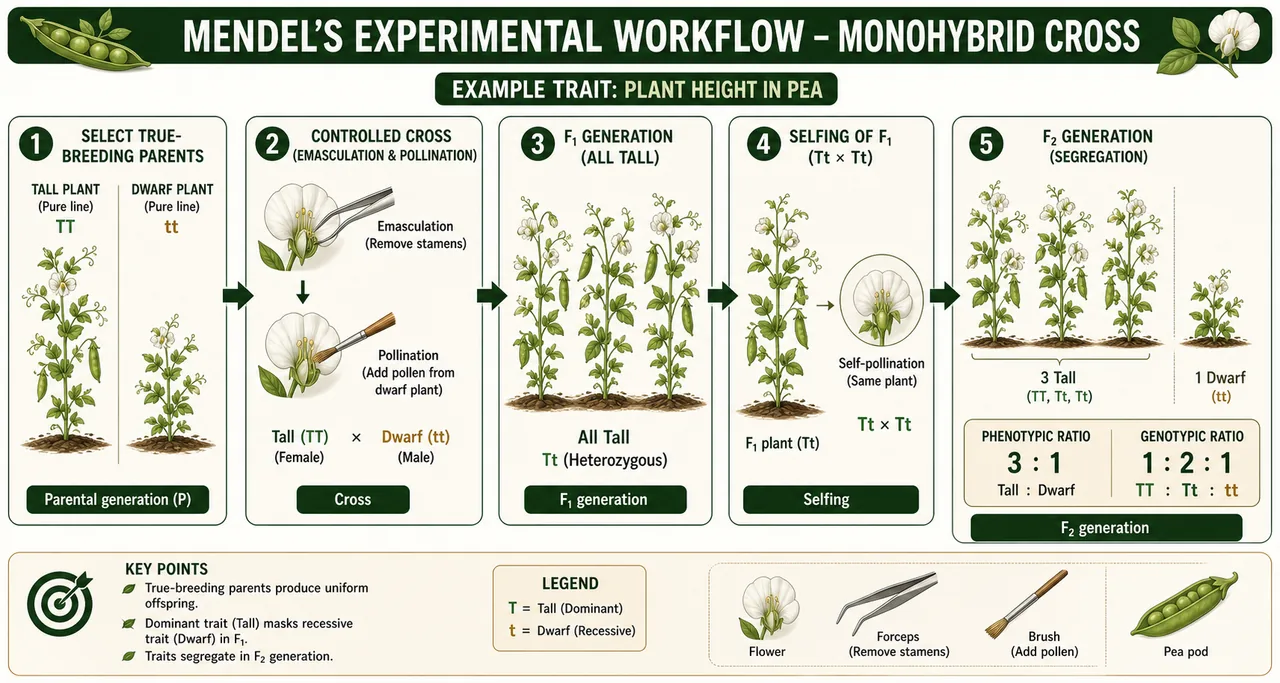
Agricultural insight: The 3:1 ratio means that in an F2 population of 1000 plants, about 250 will be homozygous for the recessive trait — the breeder can directly identify and select them by phenotype.
Punnett Square and Fork-Line Logic
- The Punnett square / checkerboard method is used to visualize possible gamete combinations.
- For n heterozygous gene pairs:
- gamete types = 2^n
- F2 genotypic classes = 3^n
- F2 zygotic combinations = 4^n
TIP
Example: AaBbCc gives 2^3 = 8 types of gametes.
The Three Laws of Mendel
TIP
Mendel's three laws: (1) Segregation, (2) Dominance, (3) Independent Assortment. The Law of Segregation is the most fundamental.
Mendel's work was rediscovered in 1900 independently by Hugo de Vries (Dutch), Carl Correns (German), and Erich von Tschermak (Austrian).
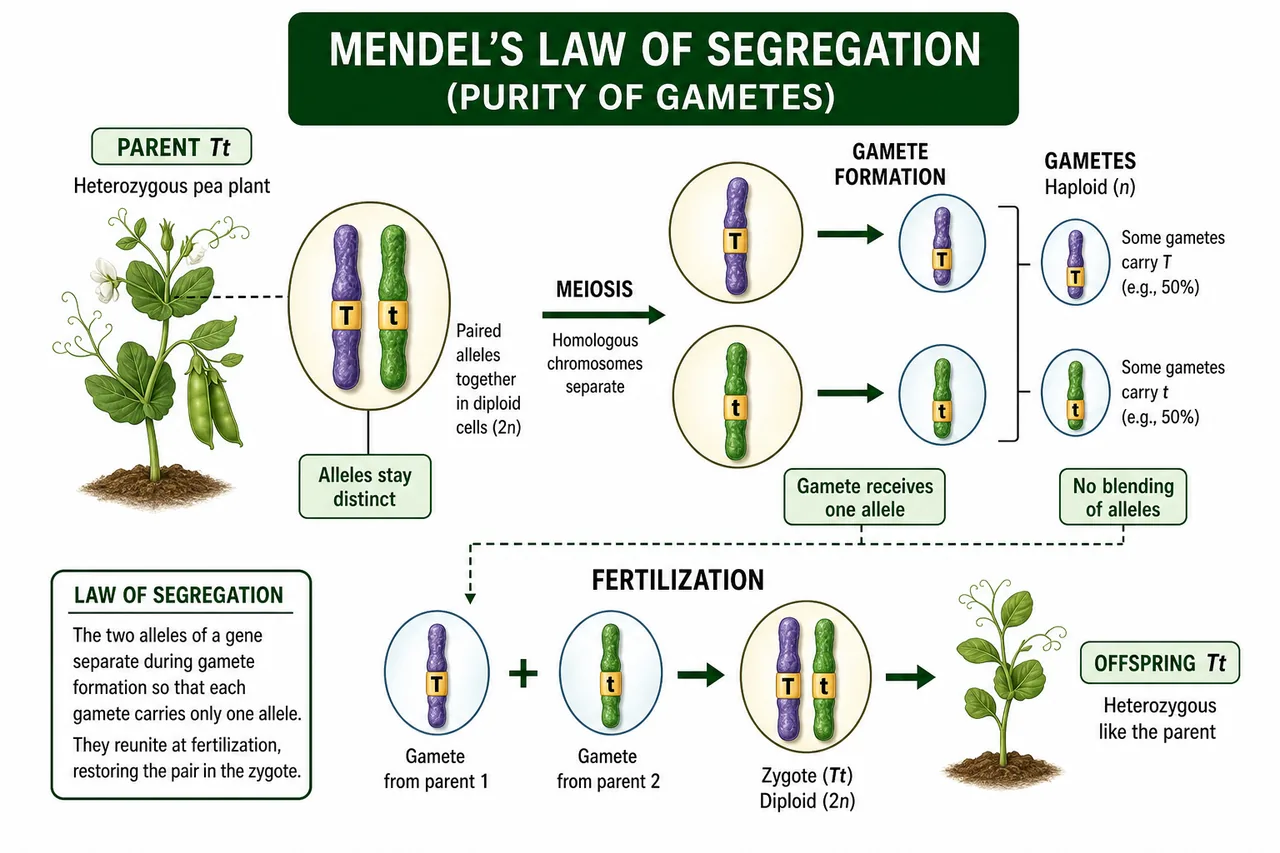
1. Law of Segregation (Purity of Gametes)
The most fundamental law of genetics:
In a heterozygous individual, the dominant and recessive alleles remain together without mixing. During gamete formation, the two alleles separate (segregate) so that each gamete receives only one allele.
Four principles underlying segregation:
- Each hereditary character is determined by a gene (Mendel's "factor").
- Genes occur in pairs (two alleles — one from each parent).
- During gamete formation, alleles separate so each gamete gets only one allele (occurs during meiosis).
- At fertilisation, the diploid number is restored (one allele from each parent).
Key point: The word "pure" in "purity of gametes" means alleles do not contaminate each other — T and t remain distinct in a Tt plant.
Homozygous, Heterozygous, and Hemizygous

| Term | Definition | Example |
|---|---|---|
| Homozygous | Identical alleles at both loci; true-breeding | TT, tt, DD, dd |
| Heterozygous | Different alleles; shows dominant phenotype | Tt, Dd |
| Hemizygous | Only one allele present (no corresponding allele on partner chromosome) | X-linked genes in males (XY) |
- Number of gamete types = 2ⁿ (n = number of heterozygous gene pairs).
2. Law of Dominance (Uniformity of F1)
In a cross between two contrasting varieties, only one trait (the dominant trait) appears in F1. The other trait (recessive) is masked in F1 but reappears in F2.
- All F1 individuals are uniform (same heterozygous genotype) → also called Law of Uniformity of First Filial Generation.
- F1: All tall (Tt). F2: Tall : Dwarf = 3 : 1.

3. Law of Independent Assortment
Alleles for different characters segregate independently of each other during gamete formation, provided the genes are on different chromosomes (not linked).
- Mendel crossed yellow round (YYRR) x green wrinkled (yyrr) pea.
- F1: All yellow round (YyRr).
- F2: Four phenotypic classes in the ratio 9 : 3 : 3 : 1.
- In a classic dihybrid cross, F1 produces 4 kinds of gametes and F2 gives 16 combinations.
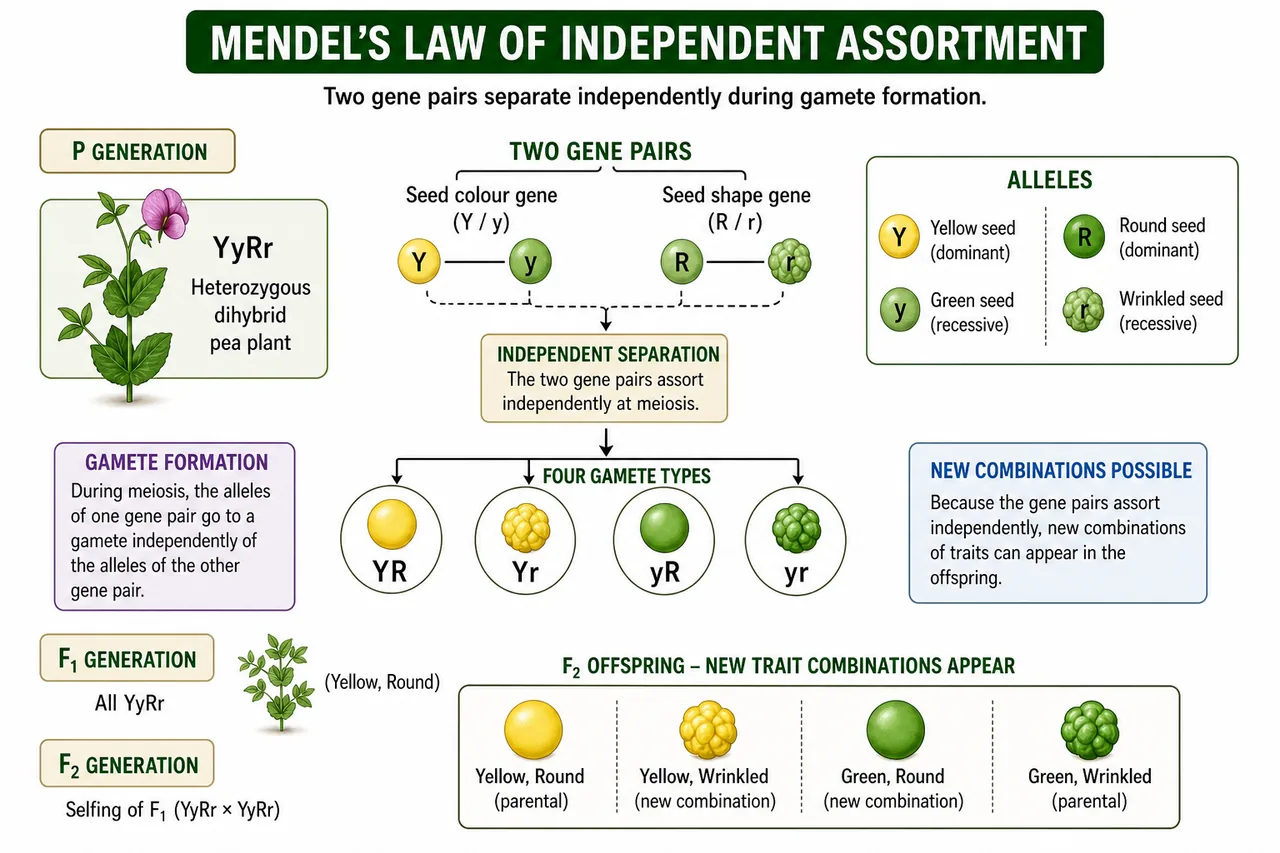

The Punnett Square (checkerboard) is used to work out all possible gamete combinations and predict offspring ratios.
Agricultural application: Independent assortment is why breeders can combine desirable traits from different parents. For example, crossing a high-yielding but susceptible parent with a low-yielding but resistant parent can produce F2 plants that are both high-yielding AND resistant.
Cross Types and Ratios
| Cross Type | Characters | F2 Phenotypic Ratio | F2 Genotypic Ratio | Gamete Types |
|---|---|---|---|---|
| Monohybrid | 1 pair | 3 : 1 | 1 : 2 : 1 | 2 |
| Dihybrid | 2 pairs | 9 : 3 : 3 : 1 | 1:2:2:4:1:2:1:2:1 (9 classes) | 4 |
| Trihybrid | 3 pairs | 27:9:9:9:3:3:3:1 | — | 8 (64 F2 combinations) |
Exam formula: For n heterozygous gene pairs: gamete types = 2ⁿ, F2 combinations = 4ⁿ.
Back Cross and Test Cross
| Cross Type | Definition | Purpose |
|---|---|---|
| Back cross | F1 crossed with either parent | Transfer desired gene into a specific genetic background (backcross breeding) |
| Test cross | F1 crossed with the homozygous recessive parent only | Determine whether an individual is homozygous or heterozygous |
IMPORTANT
Every test cross is a back cross, but every back cross is not a test cross.
How the Test Cross Works
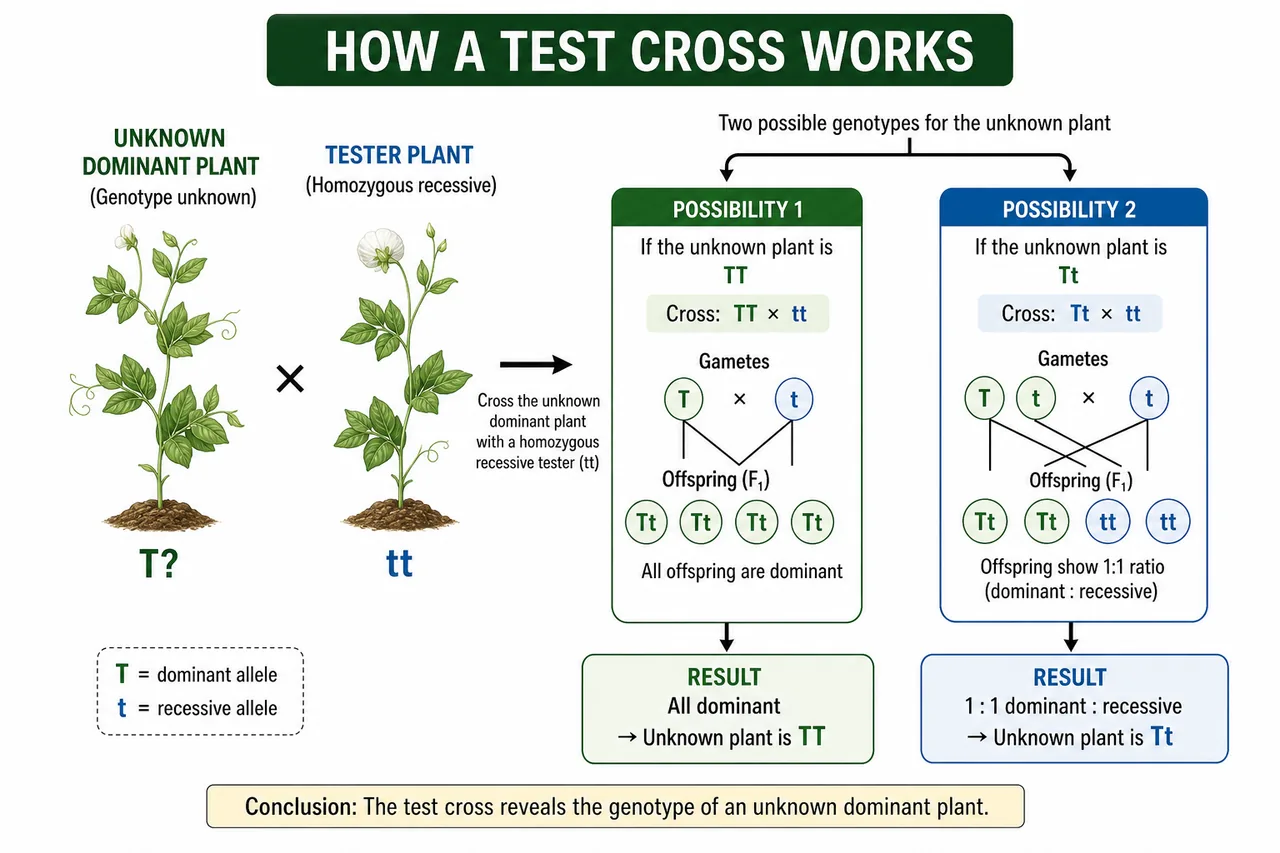

| Test Cross Result | Genotype of Tested Parent |
|---|---|
| All offspring show dominant phenotype | Homozygous dominant (TT) |
| Offspring in 1:1 ratio (dominant : recessive) | Heterozygous (Tt) |
- In a dihybrid test cross, the classical phenotypic ratio is 1:1:1:1, because the heterozygous parent contributes four gamete types that are each directly revealed by the homozygous recessive tester.

Agricultural use: The test cross is standard practice in seed production to verify the genetic purity of parental lines before using them in hybrid seed programmes.
Deviations from Mendel's Laws
| Deviation | What Happens | Example |
|---|---|---|
| Incomplete dominance | F2 ratio = 1:2:1 (instead of 3:1); heterozygote is intermediate | Mirabilis jalapa: Red x White → Pink (F1); 1 Red : 2 Pink : 1 White (F2) |
| Polygenic inheritance | Multiple genes control one trait | Yield, height, grain weight in crops |
| Multiple alleles | More than 2 alleles for a gene in a population | Eye colour alleles in Drosophila; ABO blood groups in humans |
Extra Revision Facts
| Fact | Answer |
|---|---|
| Rediscovery year of Mendelism | 1900 |
| Rediscovered by | Hugo de Vries, Carl Correns, Erich von Tschermak |
| Gamete formula | 2^n |
| F2 zygotic combination formula | 4^n |
| F2 genotypic class formula | 3^n |
| Every test cross is a | Back cross |
Why Mendel's Work Was Not Recognised Until 1900
- Darwin's theory of continuous/blending variation dominated scientific thought.
- Mendel used mathematical calculations — unfamiliar to biologists of the time.
- Chromosomal behaviour and meiosis were not yet understood.
- Published in an obscure local journal (Proceedings of the Natural History Society of Brunn).
- Failed to replicate results with Hieracium (hawkweed) — which reproduces apomictically.
Summary Cheat Sheet
| Concept / Topic | Key Details |
|---|---|
| Father of Genetics | Gregor Mendel — Theory of Inheritance |
| Experimental plant | Pisum sativum (garden pea); 7 contrasting character pairs |
| Why pea? | Self-pollinating, short lifecycle, distinct contrasting traits |
| Key to success | Studied one character at a time; large sample sizes |
| Law of Segregation | Alleles separate during gamete formation; "purity of gametes" |
| Law of Dominance | Only dominant trait appears in F1; recessive reappears in F2 |
| Law of Independent Assortment | Genes on different chromosomes assort independently |
| Monohybrid F2 ratio | Phenotypic 3:1; Genotypic 1:2:1 |
| Dihybrid F2 ratio | Phenotypic 9:3:3:1 |
| Number of gamete types | 2^n (n = heterozygous gene pairs) |
| Homozygous | Identical alleles (TT, tt); true-breeding |
| Heterozygous | Different alleles (Tt); shows dominant phenotype |
| Hemizygous | Only one allele present (X-linked genes in males) |
| Test cross | F1 x homozygous recessive → determines genotype |
| Back cross | F1 x either parent |
| Mendel rediscovered in 1900 | de Vries, Correns, Tschermak (three independent rediscoveries) |
| Incomplete dominance F2 | 1:2:1 (e.g., Mirabilis jalapa — four o'clock plant) |
| Mendel not recognised because | Blending inheritance dominant; no chromosome knowledge; small audience |