Understand gene linkage, coupling and repulsion phases, linkage groups, detection methods, and significance in plant breeding — with agricultural examples and exam tips.
Mind Map: Linkage
Why Linkage Matters in Agriculture
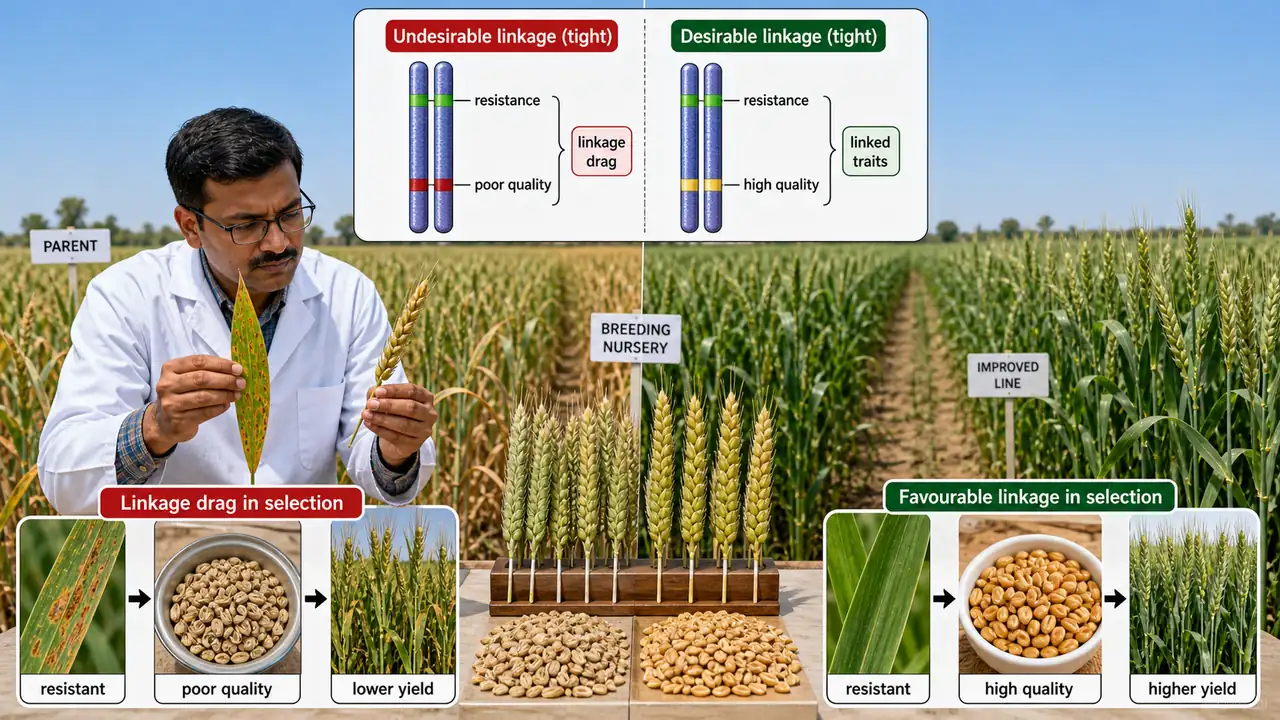
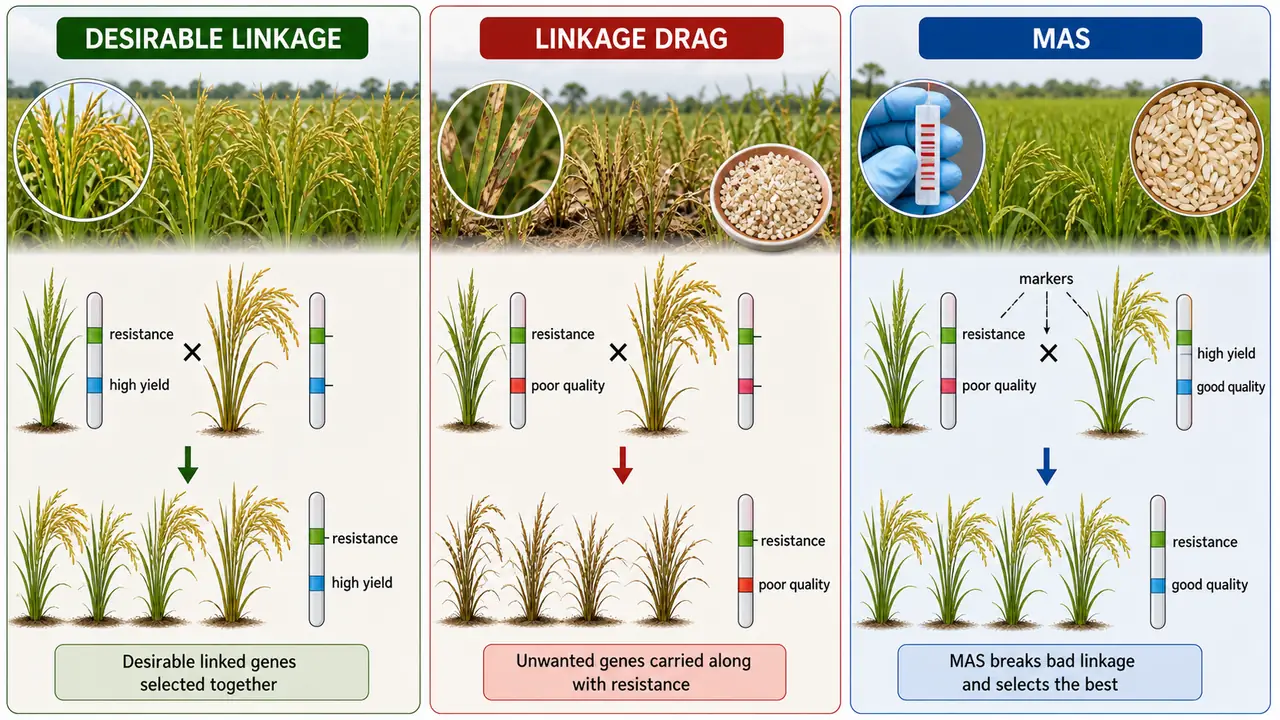
Imagine a wheat breeder who finds that a gene for rust resistance is tightly linked to a gene for poor grain quality. Every time they select for disease resistance, poor quality comes along — this is called linkage drag, one of the biggest practical challenges in crop improvement. On the other hand, when desirable genes are linked, the breeder benefits because both traits can be selected simultaneously. Understanding linkage is essential for designing efficient breeding strategies and for interpreting molecular marker data.
A breeder may struggle when a useful resistance gene is tightly linked to poor quality, but favorable linkage lets resistance and strong grain performance move together during selection.
What Is Linkage?
IMPORTANT
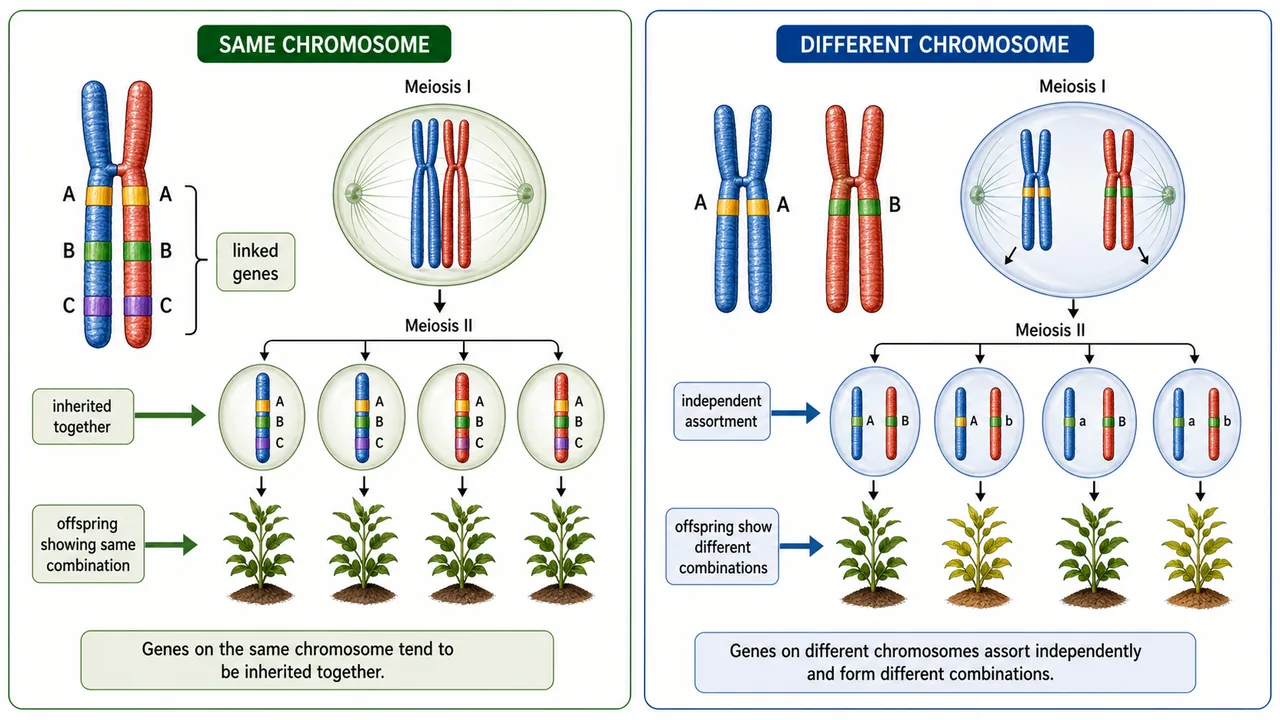
Linkage is the exception to Mendel's Law of Independent Assortment. Linked genes (on the same chromosome) tend to be inherited together.
Genes on the same chromosome usually travel together into gametes, while genes on different chromosomes assort independently and generate more combinations.
Sutton and Boveri proposed the Chromosome Theory of Inheritance — genes are located on chromosomes in a linear fashion.
Since many genes sit on the same chromosome, they tend to move together during cell division and are inherited as a unit.
This tendency of genes on the same chromosome to remain together during inheritance is called linkage.
Mendel's Law of Independent Assortment applies only to genes on different chromosomes; linkage applies to genes on the same chromosome.
Discovery of Linkage
Organism
Discoverer
Details
Plants (sweet pea)
Bateson & Punnett (1906)
Noticed certain trait combinations appeared together more often than expected
Animals (Drosophila)
T.H. Morgan
Provided thorough analysis; formulated the Theory of Linkage; Nobel Prize 1933
Bateson & Punnett initially called this phenomenon coupling and repulsion but could not explain the mechanism.
Morgan unified their observations: coupling and repulsion are two phases of a single phenomenon — linkage.
In direct classical-genetics recall, T.H. Morgan is also commonly associated with coining the term linkage and establishing the formal linkage theory through his Drosophila work.
Morgan is known as the Father of Drosophila genetics.
Key Principles
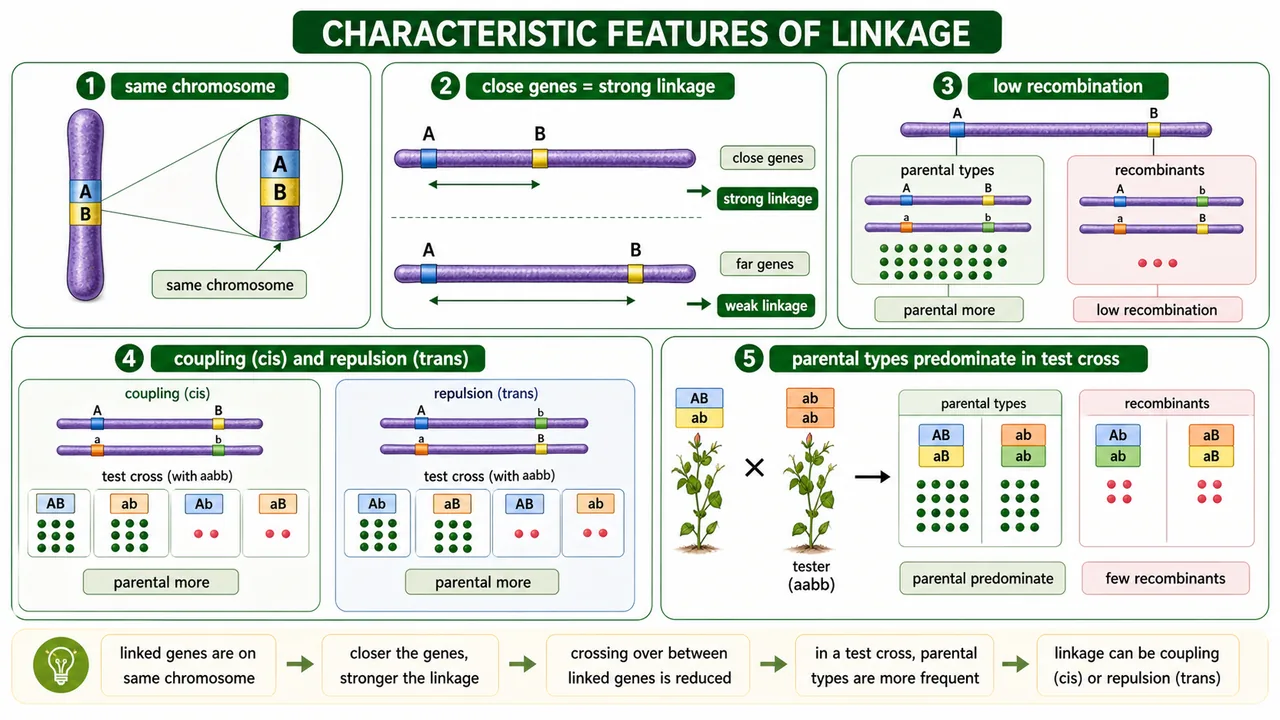
The strength of linkage depends on the distance between genes — closer genes = stronger linkage.
Linked genes can be separated by crossing over (recombination).
Crossing over frequency ranges from 0–50% (never exceeds 50% — at 50% it is indistinguishable from independent assortment).
Linkage is weakened when crossing over exchanges segments between homologous chromosomes and produces recombinant chromatids.
Gynandromorph: An organism with some body parts female and others male (e.g., Drosophila) — caused by abnormal sex chromosome distribution during early development.
Types of Linkage
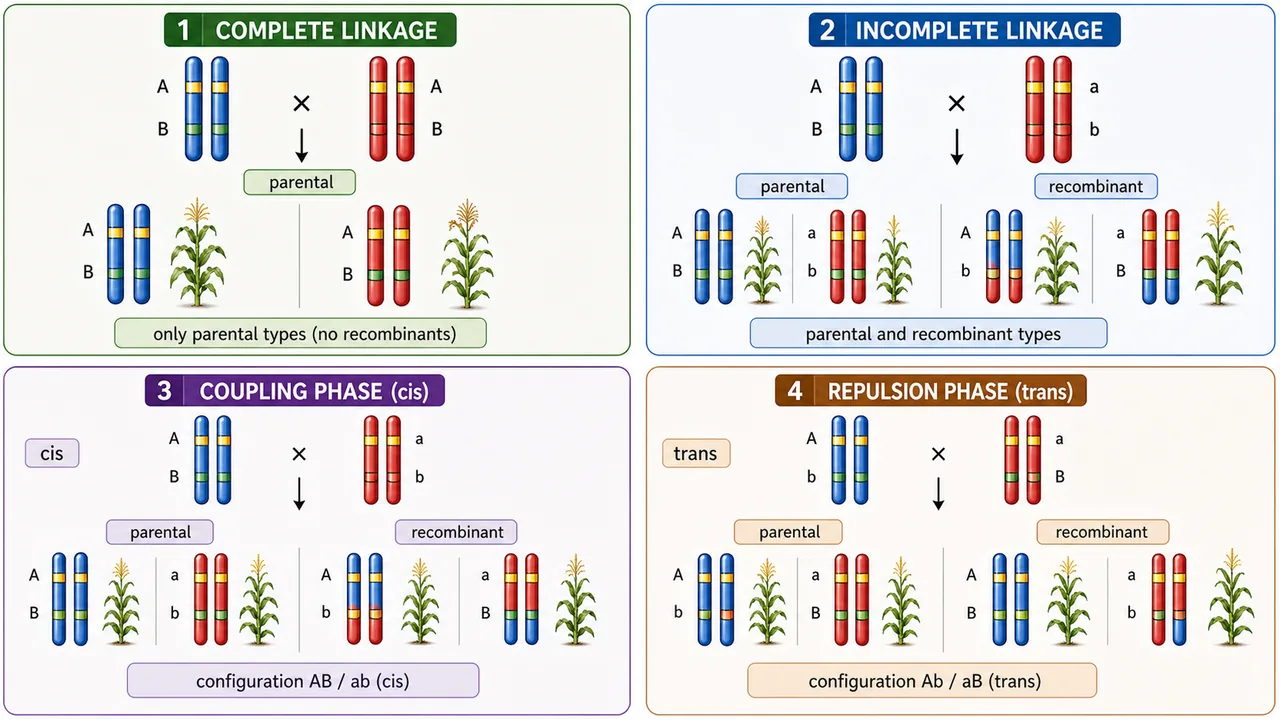
Linkage can be complete or incomplete depending on recombination, and the linked alleles may be arranged in coupling (cis) or repulsion (trans) phase.
(i) Based on Crossing Over
Type
Crossing Over
Offspring Types
Examples
Complete linkage
Absent (0%)
Only parental types
Males of Drosophila; females of silkworm
Incomplete (partial) linkage
Present (>0%)
Parental + recombinant types
Maize, pea, Drosophila females — most common type
(ii) Based on Genes Involved (Phase)
Phase
Arrangement
Also Called
Example
Coupling
All dominant alleles on one chromosome; all recessive on the other
Cis configuration
TR/tr
Repulsion
Dominant of one gene linked with recessive of another
Trans configuration
Tr/tR
Agricultural example: In rice, if a gene for blast resistance (R) is in coupling phase with a gene for high yield (Y) — both on the same chromosome as RY/ry — the breeder benefits. But if they are in repulsion (Ry/rY), breaking the linkage becomes necessary.
(iii) Based on Chromosomes Involved
Type
Location
Feature
Autosomal linkage
Genes on autosomes
Most commonly studied in crop plants
Sex linkage (X-chromosomal/allosomal)
Genes on sex chromosomes (X or Y)
Males are hemizygous for X-linked genes
Characteristic Features of Linkage
Strong linkage is most obvious when genes are close together on the same chromosome, recombination is low, and parental combinations outnumber recombinant ones.
Feature
Detail
Location
Two or more genes on the same chromosome in linear order
Effect on variability
Reduces variability — fewer recombinant types than expected
Phase
May involve all dominant (coupling) or mixed (repulsion) alleles
Trait types
Affects both oligogenic and polygenic traits
Proximity
Usually involves genes located close together
Strength
Inversely proportional to distance — closer = stronger linkage
Test cross evidence
Higher frequency of parental types than recombinants
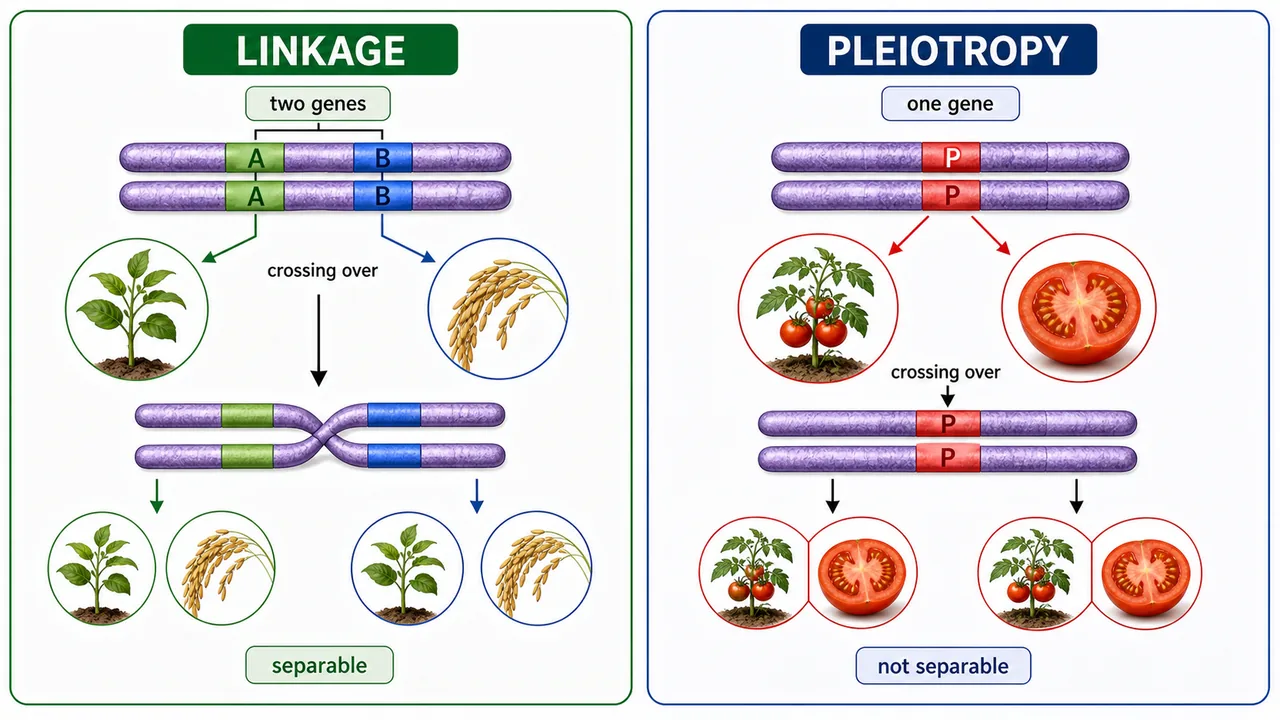
Linkage vs. Pleiotropy
Both linkage and pleiotropy can cause traits to appear associated in inheritance, but the mechanisms differ:
Linked traits come from separate loci that may be split by crossing over, whereas pleiotropic traits arise from one gene whose effects cannot be separated that way.
Feature
Linkage
Pleiotropy
Number of genes
Two or more genes (at different loci)
One gene
Can traits be separated?
Yes — by crossing over (recombination)
No — one gene controls both
How to distinguish
Find crossover products through intermating in large populations
If traits cannot be separated despite repeated intermating, likely pleiotropy
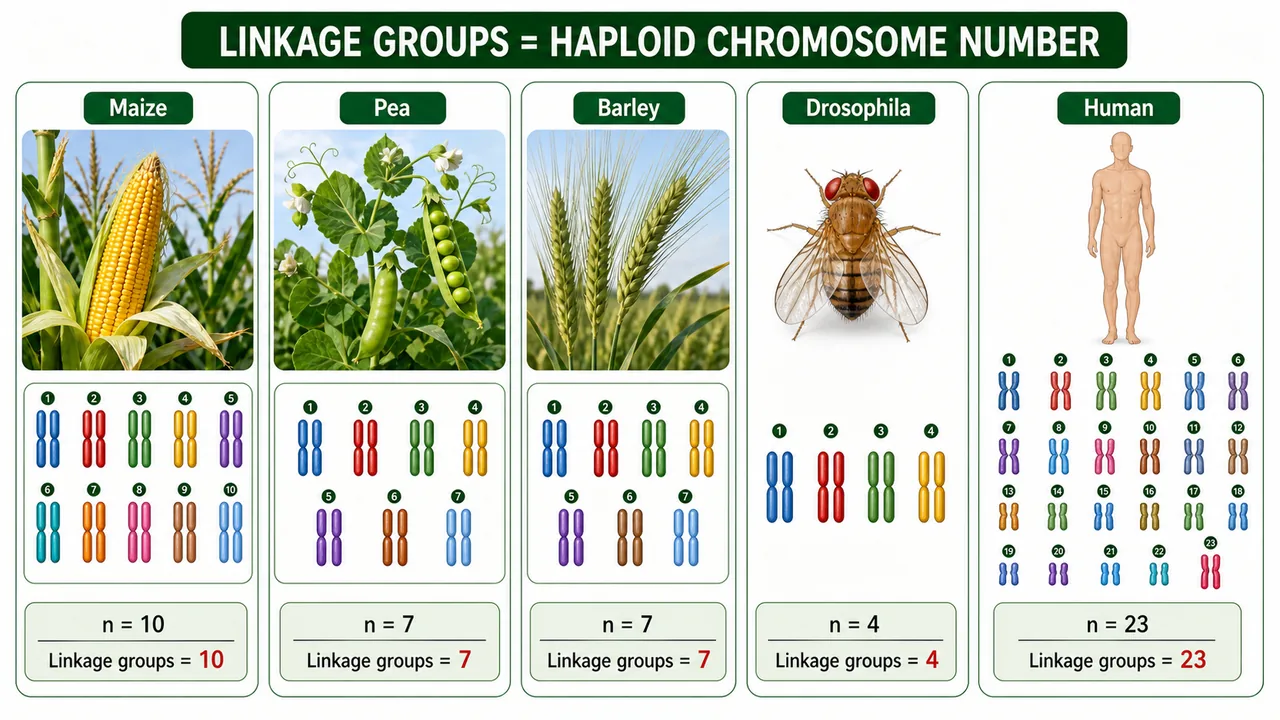
Linkage Groups
A linkage group = all genes on one chromosome.
Number of linkage groups = haploid chromosome number (n).
Each chromosome forms one linkage group, so the total number of linkage groups in a species matches its haploid chromosome number.
Organism
2n
Linkage Groups (= n)
Maize
20
10
Garden pea
14
7
Barley
14
7
Drosophila
8
4
Human
46
23
Detection of Linkage
Method 1: Test Cross (Most Common)
Cross F1 heterozygous (AB/ab) with double recessive (ab/ab), then examine phenotypic ratios:
Linkage studies often extend from simple recombination counts to interference and coincidence, which quantify how one crossover affects another nearby crossover.
Outcome
Interpretation
Ratio = 1:1:1:1 (parental ≈ recombinant)
No linkage (independent assortment)
Parental types >> Recombinant types
Linkage present
Method 2: F2 Ratio from Selfing
Self-pollinate the dihybrid heterozygote.
With complete dominance and no epistasis, expect 9:3:3:1.
Significant deviation (tested by Chi-square test) indicates linkage.
Exam tip: The test cross is preferred because the recessive parent contributes only recessive alleles, making it easy to identify gamete types from the heterozygous parent.
Significance of Linkage in Plant Breeding
Plant breeders welcome linkage when good traits stay together, but use recombination and markers to break harmful associations such as resistance linked with poor quality.
Situation
Impact
Example
Desirable genes linked
Advantageous — both traits improve simultaneously
Disease resistance + high yield linked
Desirable + undesirable genes linked
Linkage drag — selecting for one carries the other
Resistance gene linked to poor grain quality
Breaking undesirable linkage
Requires large populations + multiple generations of recombination
Wide crosses in wheat to break linkage drag from wild relatives
Effect on variance
Linkage inflates or deflates genetic variance estimates
Affects heritability calculations and selection efficiency
Agricultural takeaway: Molecular markers (SSR, SNP) allow breeders to detect and break undesirable linkages through marker-assisted selection (MAS), dramatically speeding up the process compared to phenotypic selection alone.
Summary Table
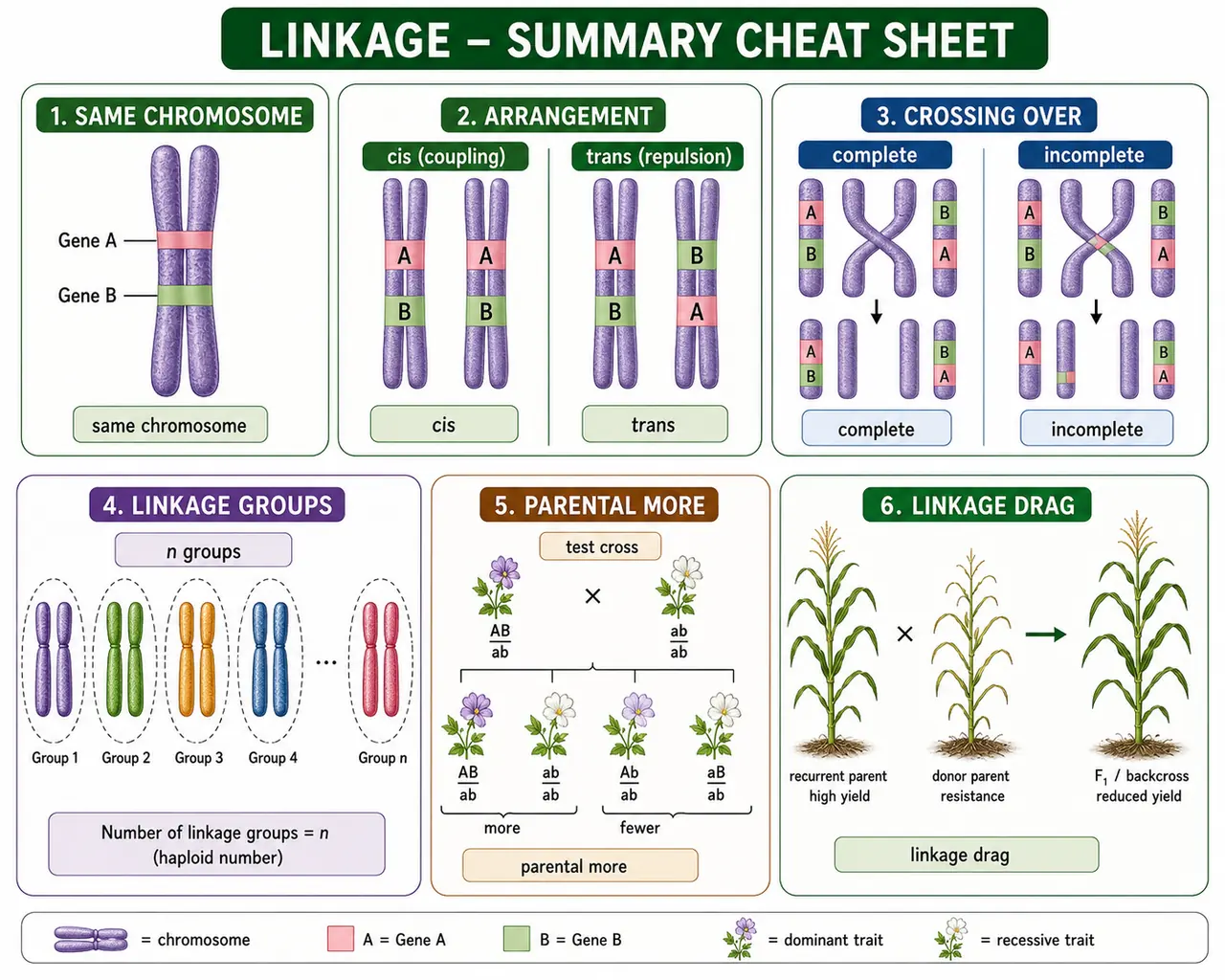
This cheat sheet condenses the exam-ready linkage ideas: same chromosome inheritance, allele arrangement, recombination pattern, linkage groups, and linkage drag.
Topic
Key Fact
Exam Pointer
Linkage definition
Genes on same chromosome inherited together
Exception to Mendel's Law of Independent Assortment
Discovered in plants
Bateson & Punnett (1906) on sweet pea
Coupling and repulsion hypothesis
Discovered in animals
T.H. Morgan on Drosophila
Father of Drosophila genetics; Nobel Prize 1933
Crossing over range
0–50% (never exceeds 50%)
50% = indistinguishable from independent assortment
Coupling phase
All dominants on same chromosome (cis)
TR/tr
Repulsion phase
Dominant + recessive mixed (trans)
Tr/tR
Linkage groups =
Haploid chromosome number (n)
Maize = 10; Pea = 7; Human = 23
Detection
Test cross (most common); Chi-square for F2
Parental types >> Recombinant types
Linkage drag
Undesirable gene linked to desirable one
Major challenge in crop breeding
Linkage vs. Pleiotropy
Linkage = separable by crossing over; Pleiotropy = not separable
Intermating in large populations to distinguish
Summary Cheat Sheet
Concept / Topic
Key Details
Linkage
Genes on same chromosome inherited together
Exception to
Mendel's Law of Independent Assortment
Discovered in plants by
Bateson & Punnett (1906) on sweet pea
Discovered in animals by
T.H. Morgan on Drosophila (Nobel Prize 1933)
Complete linkage
No crossing over; only parental types (e.g., Drosophila males)
Incomplete linkage
Some crossing over; parental + recombinant types
Coupling phase (cis)
All dominants on same chromosome (AB/ab)
Repulsion phase (trans)
Dominant + recessive mixed (Ab/aB)
Autosomal linkage
Genes linked on autosomes
Sex linkage
Genes linked on sex chromosomes
Linkage groups =
Haploid chromosome number (n) of species
Linkage groups: Maize
10; Pea = 7; Human = 23; Drosophila = 4
Detection of linkage
Test cross (most common); Chi-square test for F2
Linkage detected when
Parental types >> Recombinant types
Crossing over range
0–50% (50% = indistinguishable from independent assortment)
Linkage drag
Undesirable gene linked to desirable one; major breeding challenge
Linkage vs Pleiotropy
Linkage = separable by CO; Pleiotropy = not separable