⤭Crossing Over: Mechanism, Types, and Factors
Understand the mechanism, types, and factors affecting crossing over, plus coincidence, interference, and significance in plant breeding — with agricultural examples and exam tips.
Why Crossing Over Matters in Agriculture
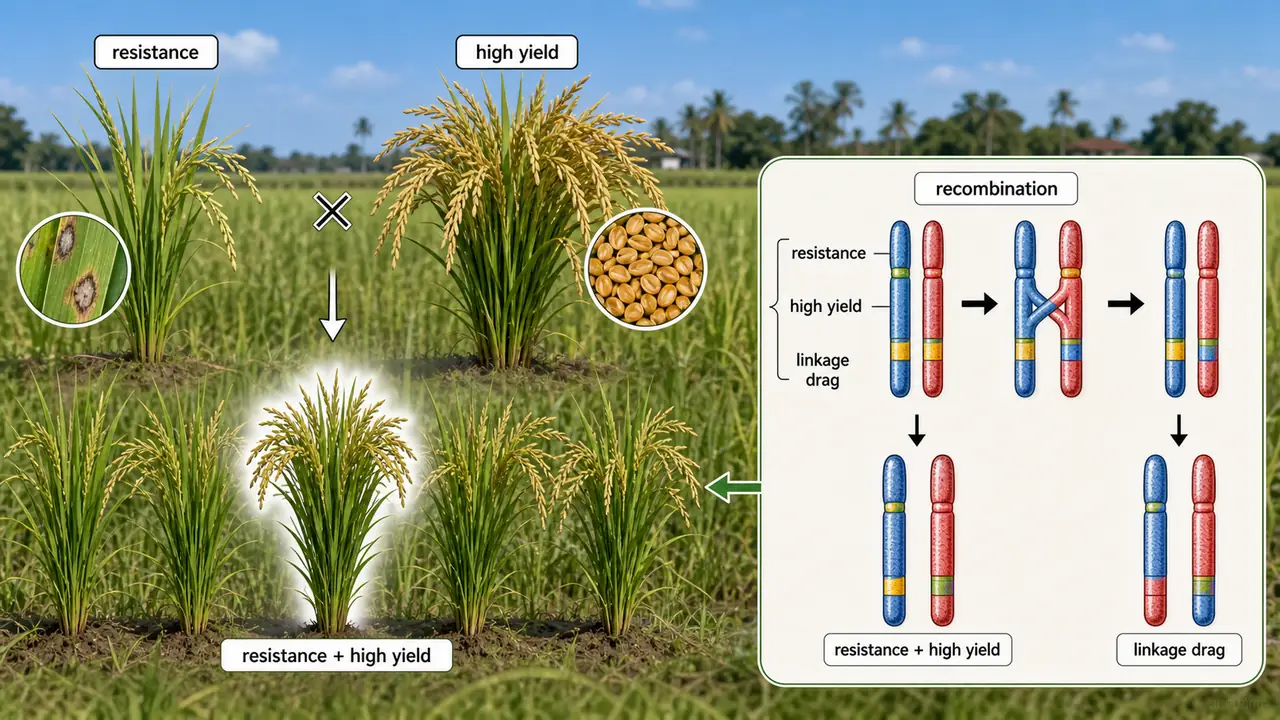
When a plant breeder crosses a blast-resistant rice variety with a high-yielding one, the desired outcome is offspring that carry both resistance and high yield. This is only possible because crossing over during meiosis breaks old gene combinations and creates new ones. Crossing over is also how breeders break linkage drag — separating a useful gene from an undesirable one that sits nearby on the same chromosome. Additionally, recombination frequencies from crossing over are used to construct genetic maps, which guide modern marker-assisted selection programmes.
What Is Crossing Over?
- The term was first used by Morgan and Cattell (1912).
- Crossing over is the physical exchange of precisely homologous segments between non-sister chromatids of homologous chromosomes during meiosis.
- It produces recombinant (new) allele combinations that differ from the parental arrangements.

Mechanism of Crossing Over
TIP
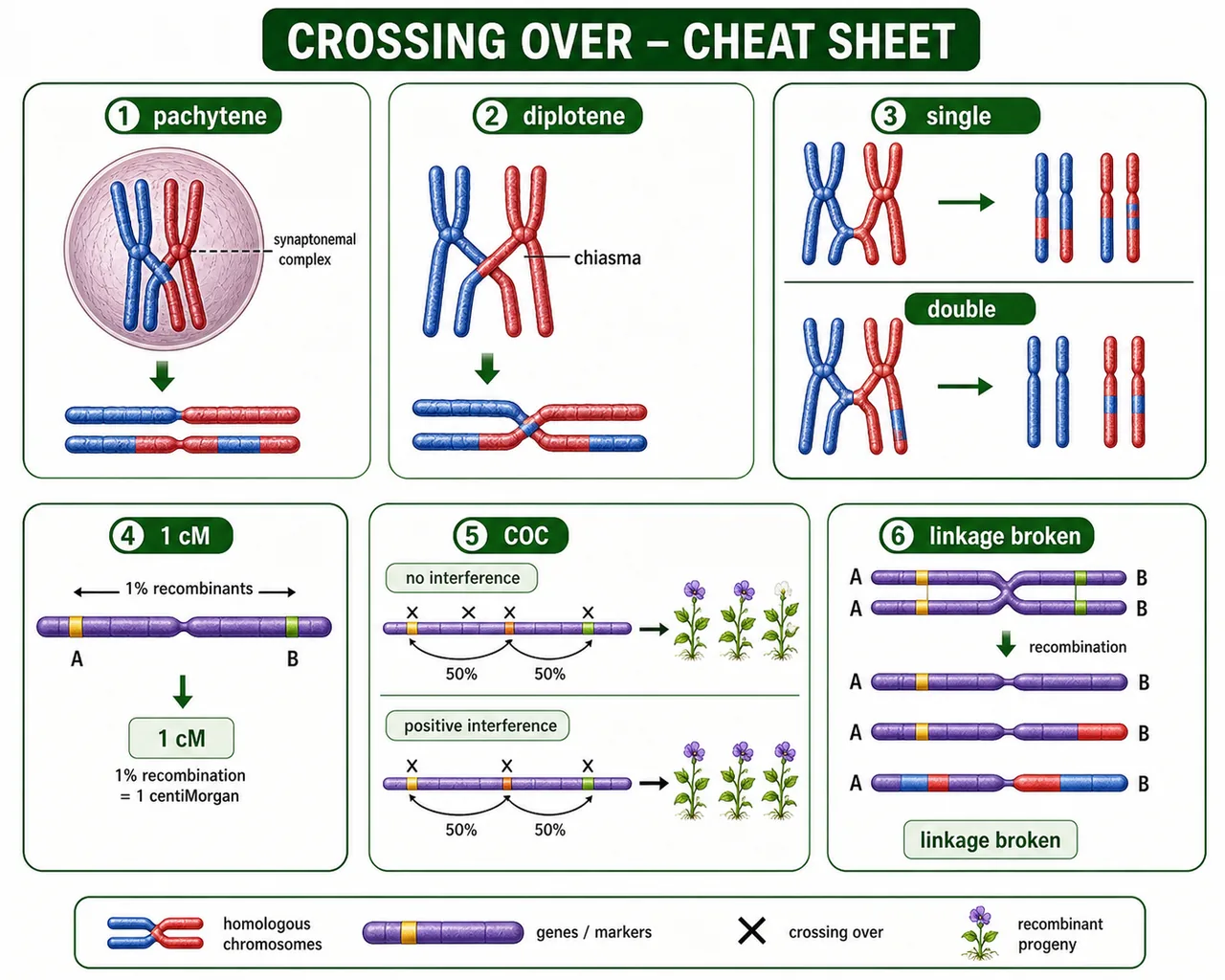
Crossing over occurs at pachytene, but chiasmata are visible at diplotene. This distinction is a common exam question.
- Crossing over takes place during the
pachytenestage of meiosis I — after homologous chromosomes have paired (synapsed) and before they begin to separate. - At pachytene, each bivalent has four chromatids (two per homologue) — called a tetrad or four-strand stage.
- Breakage occurs at precisely homologous points in two non-sister chromatids, mediated by enzymes such as recombinase (endonuclease cuts, ligase seals).
- The broken segments are exchanged and reunited — each crossing-over event involves two of the four chromatids.
- This produces an X-shaped figure at the exchange point called a
chiasma(plural: chiasmata), visible at diplotene.

Products of Crossing Over
| Product | Description | Result |
|---|---|---|
| Crossover chromatids (2) | Participated in the exchange | Recombinant — new allele combinations |
| Non-crossover chromatids (2) | Did not participate | Parental — original allele combinations |
Calculating Crossing Over Frequency

Crossing over % = (Recombinant progeny / Total progeny) x 100
The recombination frequency is a direct measure of genetic distance between two genes: 1% recombination = 1 map unit (centiMorgan).
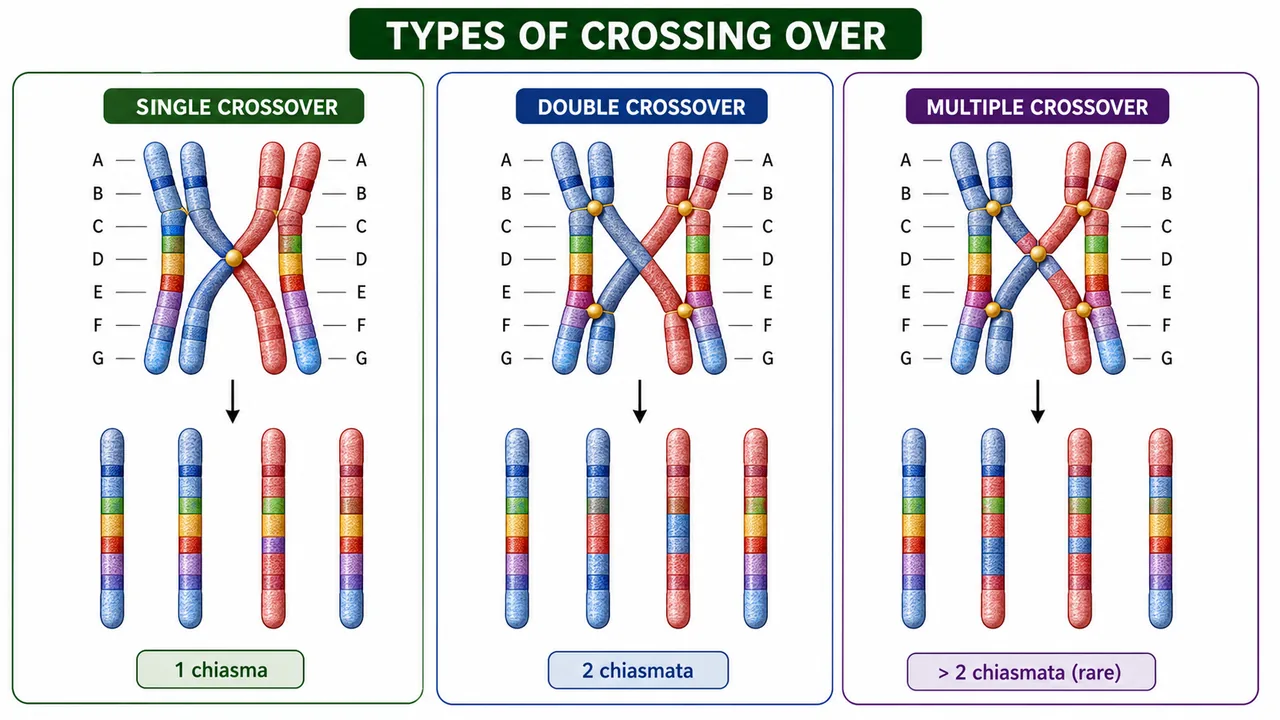
Types of Crossing Over
| Type | Chiasmata | Genes Involved | Test Cross Type | Frequency |
|---|---|---|---|---|
| Single | 1 chiasma | 2 linked genes | Two-point test cross | Most common |
| Double | 2 chiasmata | 3 linked genes | Three-point test cross | Less common; used to determine gene order |
| Multiple | >2 chiasmata | >3 linked genes | — | Extremely rare (due to interference) |
Agricultural application: Three-point test crosses are used in genetic mapping to determine gene order and calculate map distances between three genes simultaneously — essential for constructing linkage maps in crop species.
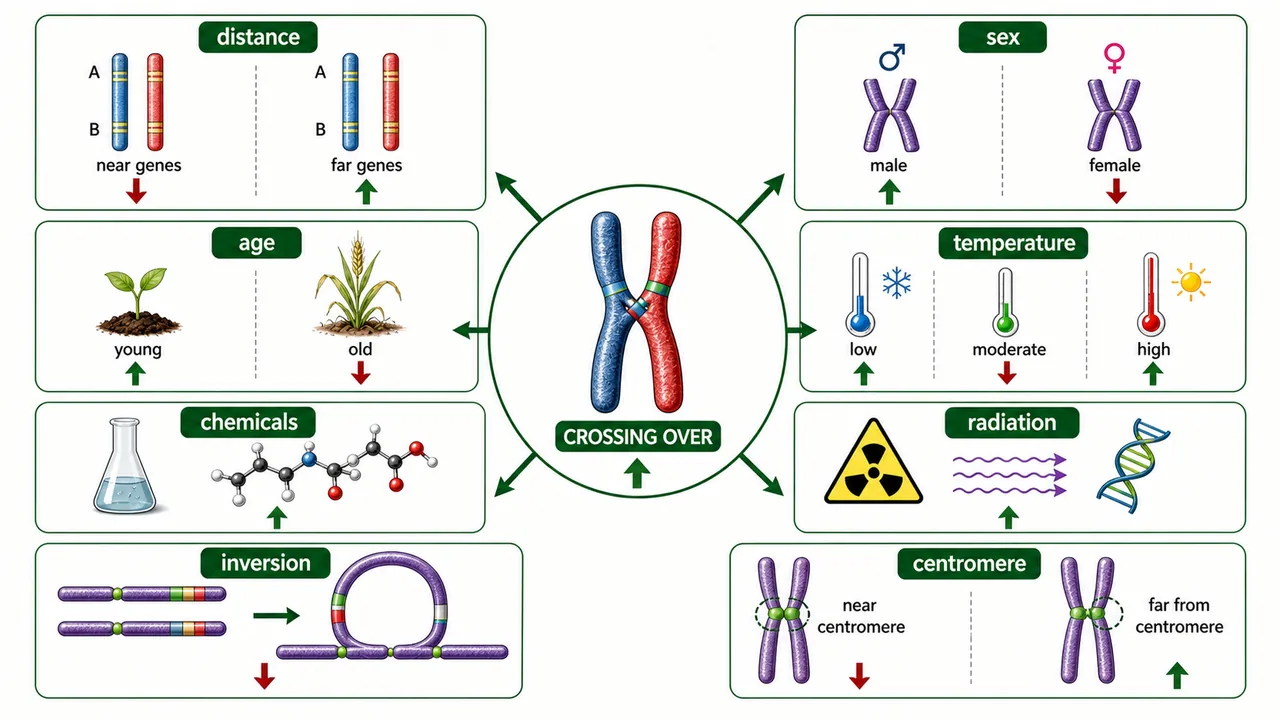
Factors Affecting Crossing Over
| Factor | Effect on Crossing Over | Mechanism |
|---|---|---|
| Distance between genes | Increases with distance (positively correlated) | Basis of genetic mapping: 1% CO = 1 cM |
| Sex | Heterogametic sex shows lower CO | No CO in Drosophila males or silkworm females |
| Age of female | Declines with advancing age | Recombination machinery becomes less efficient |
| Temperature | Lowest at 22°C in Drosophila; increases at extremes | Temperature stress disrupts normal CO control |
| Nutrition (Ca²⁺, Mg²⁺) | Higher metallic ions → lower CO | Divalent cations affect chromosome structure |
| Chemicals | Mitomycin D, actinomycin D, EMS → increase CO | Interfere with DNA replication and repair |
| Radiation | X-rays, gamma rays → increase CO | Radiation-induced DNA breaks trigger recombination |
| Plasmagenes | Some cytoplasmic genes reduce CO | E.g., Tifton male-sterile cytoplasm reduces CO in bajra |
| Genotype | Some genes promote or inhibit CO | C3G gene in Drosophila: homozygous = prevents CO; heterozygous = promotes CO |
| Chromosomal aberrations | Inversions reduce CO within inverted segment | Recombinant products from inversions are often inviable |
| Distance from centromere | Near centromere → lower CO | Centromeric heterochromatin restricts chiasma formation |
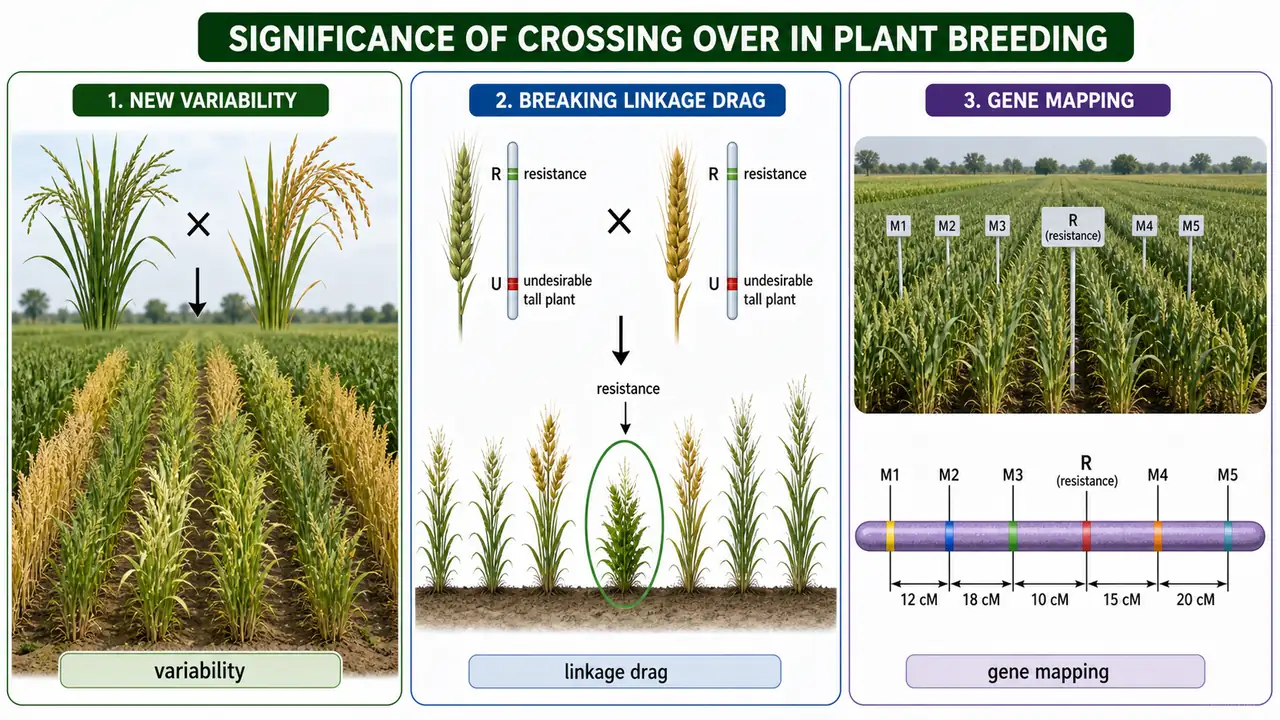
Significance in Plant Breeding
| Significance | Detail |
|---|---|
| Increases variability | Creates new allele combinations — the genetic diversity breeders select from |
| Breaks linkage | Separates desirable genes from undesirable ones (linkage drag) |
| Chromosome mapping | Recombination frequencies reveal relative gene positions → linkage maps |
Agricultural example: In wheat, crossing over has been used to break the linkage between a disease-resistance gene from a wild relative (Aegilops) and genes for poor grain quality — a classic case of overcoming linkage drag through recombination.
Coincidence and Interference
Coincidence
- Refers to the occurrence of two or more crossovers simultaneously in the same chromosomal region → double crossover product.
- Coefficient of coincidence (C.O.C.) = Observed double crossovers / Expected double crossovers.

| C.O.C. Value | Meaning |
|---|---|
| = 1.0 | No interference (double COs at expected frequency) |
| < 1.0 | Positive interference (fewer double COs than expected) |
| > 1.0 | Negative interference (more double COs than expected) |
Interference
- The tendency of one crossover to prevent another from occurring nearby — coined by Muller.
| Type | Effect | Found In |
|---|---|---|
| Positive interference | One CO reduces the chance of another nearby | Most higher organisms (most common) |
| Negative interference | One CO enhances the chance of another nearby | Aspergillus, bacteriophages (rare) |
- Interference effect decreases with distance — crossovers far apart are essentially independent.
-
Coefficient of interference = 1 − Coefficient of coincidence
- Value of 1 = complete interference (no double COs); Value of 0 = no interference.
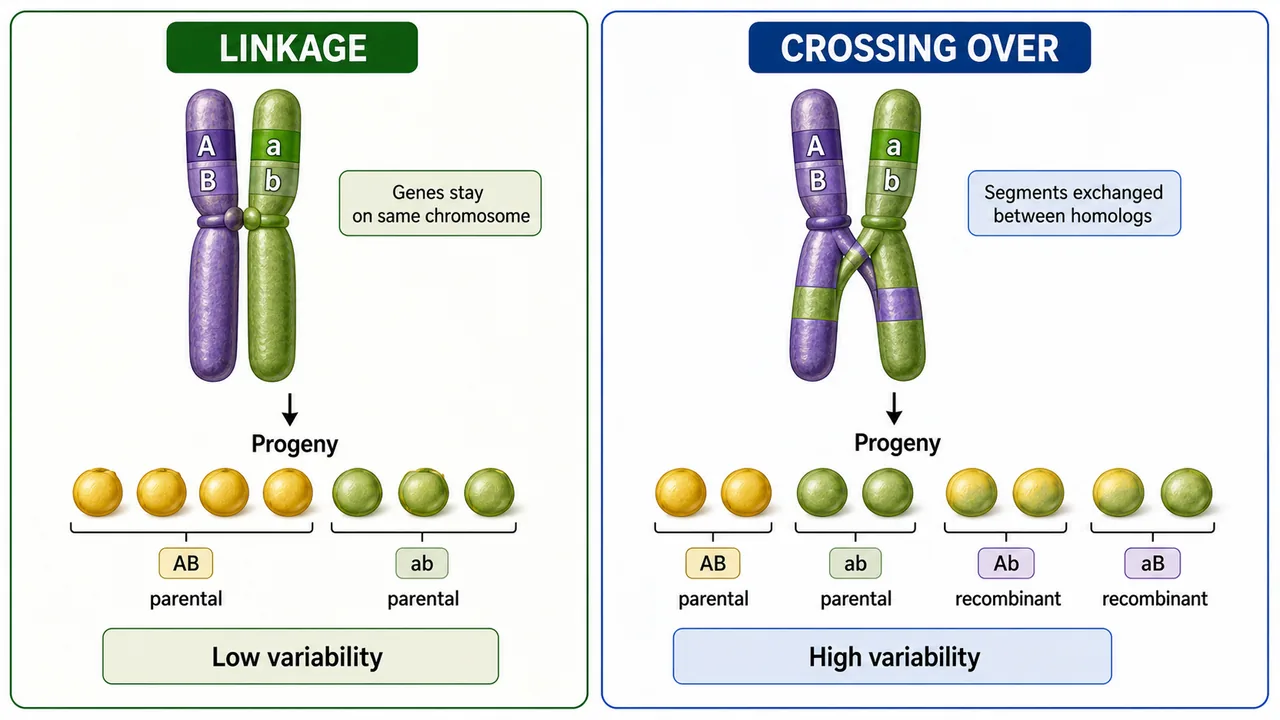
Crossing Over vs. Linkage
| Feature | Crossing Over | Linkage |
|---|---|---|
| It leads to separation of linked genes | It keeps the genes together | |
| It involves exchange of segments between non-sister chromatids of homologous chromosomes | It involves individual chromosomes | |
| The frequency of crossing over can never exceed 50%. | The number of linkage groups can never be more than haploid chromosome number | |
| It increases variability by forming new gene combinations | It reduces variability | |
| It provides equal frequency of parental and recombinant types in test cross progeny. (1:1) | It produces higher frequency of parental types than recombinant types in test cross progeny (Deviation from 1:1) |
| Feature | Linkage | Crossing Over |
|---|---|---|
| Effect | Keeps genes together | Separates linked genes |
| Variability | Reduces variability | Increases variability |
| Products | Parental types predominate | Recombinant types produced |
| Relationship | Closer genes = stronger linkage | Closer genes = less crossing over |
Summary Cheat Sheet
| Concept / Topic | Key Details |
|---|---|
| Crossing over term coined by | Morgan & Cattell (1912) |
| Definition | Exchange of segments between non-sister chromatids of a tetrad |
| Stage | Pachytene of meiosis I |
| Chiasma | X-shaped figure; physical evidence of crossing over; visible at diplotene |
| CO frequency range | 0–50% (never exceeds 50%) |
| 1% CO = | 1 centiMorgan (1 map unit) |
| Single crossover | 1 chiasma; detected by two-point test cross |
| Double crossover | 2 chiasmata; determines gene order; detected by three-point test cross |
| Key factor affecting CO | Distance between genes (positively correlated) |
| No CO occurs in | Drosophila males; silkworm females (complete linkage) |
| CO increases with | Temperature, X-rays, age; distance between genes |
| CO decreases near | Centromere and chromosome ends |
| Coefficient of Coincidence (COC) | Observed double CO / Expected double CO |
| COC < 1 | Positive interference (fewer double COs than expected) |
| COC > 1 | Negative interference (more double COs; rare) |
| Interference coined by | Muller |
| Coefficient of interference | 1 − COC |
| CO vs Linkage | CO breaks linkage; they are inversely related |
| Breeding significance | Breaks linkage drag; increases genetic variability |
| First genetic map by | Sturtevant (using Drosophila) |
Pro Content Locked
Upgrade to Pro to access this lesson and all other premium content.
₹2388 billed yearly
- All Agriculture & Banking Courses
- AI Lesson Questions (100/day)
- AI Doubt Solver (50/day)
- Glows & Grows Feedback (30/day)
- AI Section Quiz (20/day)
- 22-Language Translation (30/day)
- Recall Questions (20/day)
- AI Quiz (15/day)
- AI Quiz Paper Analysis
- AI Step-by-Step Explanations
- Spaced Repetition Recall (FSRS)
- AI Tutor
- Immersive Text Questions
- Audio Lessons — Hindi & English
- Mock Tests & Previous Year Papers
- Summary & Mind Maps
- XP, Levels, Leaderboard & Badges
- Generate New Classrooms
- Voice AI Teacher (AgriDots Live)
- AI Revision Assistant
- Knowledge Gap Analysis
- Interactive Revision (LangGraph)
🔒 Secure via Razorpay · Cancel anytime · No hidden fees
Why Crossing Over Matters in Agriculture
When a plant breeder crosses a blast-resistant rice variety with a high-yielding one, the desired outcome is offspring that carry both resistance and high yield. This is only possible because crossing over during meiosis breaks old gene combinations and creates new ones. Crossing over is also how breeders break linkage drag — separating a useful gene from an undesirable one that sits nearby on the same chromosome. Additionally, recombination frequencies from crossing over are used to construct genetic maps, which guide modern marker-assisted selection programmes.
What Is Crossing Over?
- The term was first used by Morgan and Cattell (1912).
- Crossing over is the physical exchange of precisely homologous segments between non-sister chromatids of homologous chromosomes during meiosis.
- It produces recombinant (new) allele combinations that differ from the parental arrangements.

Mechanism of Crossing Over
TIP
Crossing over occurs at pachytene, but chiasmata are visible at diplotene. This distinction is a common exam question.
- Crossing over takes place during the
pachytenestage of meiosis I — after homologous chromosomes have paired (synapsed) and before they begin to separate. - At pachytene, each bivalent has four chromatids (two per homologue) — called a tetrad or four-strand stage.
- Breakage occurs at precisely homologous points in two non-sister chromatids, mediated by enzymes such as recombinase (endonuclease cuts, ligase seals).
- The broken segments are exchanged and reunited — each crossing-over event involves two of the four chromatids.
- This produces an X-shaped figure at the exchange point called a
chiasma(plural: chiasmata), visible at diplotene.

Products of Crossing Over
| Product | Description | Result |
|---|---|---|
| Crossover chromatids (2) | Participated in the exchange | Recombinant — new allele combinations |
| Non-crossover chromatids (2) | Did not participate | Parental — original allele combinations |
Calculating Crossing Over Frequency

Crossing over % = (Recombinant progeny / Total progeny) x 100
The recombination frequency is a direct measure of genetic distance between two genes: 1% recombination = 1 map unit (centiMorgan).
Types of Crossing Over
| Type | Chiasmata | Genes Involved | Test Cross Type | Frequency |
|---|---|---|---|---|
| Single | 1 chiasma | 2 linked genes | Two-point test cross | Most common |
| Double | 2 chiasmata | 3 linked genes | Three-point test cross | Less common; used to determine gene order |
| Multiple | >2 chiasmata | >3 linked genes | — | Extremely rare (due to interference) |
Agricultural application: Three-point test crosses are used in genetic mapping to determine gene order and calculate map distances between three genes simultaneously — essential for constructing linkage maps in crop species.
Factors Affecting Crossing Over
| Factor | Effect on Crossing Over | Mechanism |
|---|---|---|
| Distance between genes | Increases with distance (positively correlated) | Basis of genetic mapping: 1% CO = 1 cM |
| Sex | Heterogametic sex shows lower CO | No CO in Drosophila males or silkworm females |
| Age of female | Declines with advancing age | Recombination machinery becomes less efficient |
| Temperature | Lowest at 22°C in Drosophila; increases at extremes | Temperature stress disrupts normal CO control |
| Nutrition (Ca²⁺, Mg²⁺) | Higher metallic ions → lower CO | Divalent cations affect chromosome structure |
| Chemicals | Mitomycin D, actinomycin D, EMS → increase CO | Interfere with DNA replication and repair |
| Radiation | X-rays, gamma rays → increase CO | Radiation-induced DNA breaks trigger recombination |
| Plasmagenes | Some cytoplasmic genes reduce CO | E.g., Tifton male-sterile cytoplasm reduces CO in bajra |
| Genotype | Some genes promote or inhibit CO | C3G gene in Drosophila: homozygous = prevents CO; heterozygous = promotes CO |
| Chromosomal aberrations | Inversions reduce CO within inverted segment | Recombinant products from inversions are often inviable |
| Distance from centromere | Near centromere → lower CO | Centromeric heterochromatin restricts chiasma formation |
Significance in Plant Breeding
| Significance | Detail |
|---|---|
| Increases variability | Creates new allele combinations — the genetic diversity breeders select from |
| Breaks linkage | Separates desirable genes from undesirable ones (linkage drag) |
| Chromosome mapping | Recombination frequencies reveal relative gene positions → linkage maps |
Agricultural example: In wheat, crossing over has been used to break the linkage between a disease-resistance gene from a wild relative (Aegilops) and genes for poor grain quality — a classic case of overcoming linkage drag through recombination.
Coincidence and Interference
Coincidence
- Refers to the occurrence of two or more crossovers simultaneously in the same chromosomal region → double crossover product.
- Coefficient of coincidence (C.O.C.) = Observed double crossovers / Expected double crossovers.

| C.O.C. Value | Meaning |
|---|---|
| = 1.0 | No interference (double COs at expected frequency) |
| < 1.0 | Positive interference (fewer double COs than expected) |
| > 1.0 | Negative interference (more double COs than expected) |
Interference
- The tendency of one crossover to prevent another from occurring nearby — coined by Muller.
| Type | Effect | Found In |
|---|---|---|
| Positive interference | One CO reduces the chance of another nearby | Most higher organisms (most common) |
| Negative interference | One CO enhances the chance of another nearby | Aspergillus, bacteriophages (rare) |
- Interference effect decreases with distance — crossovers far apart are essentially independent.
-
Coefficient of interference = 1 − Coefficient of coincidence
- Value of 1 = complete interference (no double COs); Value of 0 = no interference.
Crossing Over vs. Linkage
| Feature | Crossing Over | Linkage |
|---|---|---|
| It leads to separation of linked genes | It keeps the genes together | |
| It involves exchange of segments between non-sister chromatids of homologous chromosomes | It involves individual chromosomes | |
| The frequency of crossing over can never exceed 50%. | The number of linkage groups can never be more than haploid chromosome number | |
| It increases variability by forming new gene combinations | It reduces variability | |
| It provides equal frequency of parental and recombinant types in test cross progeny. (1:1) | It produces higher frequency of parental types than recombinant types in test cross progeny (Deviation from 1:1) |
| Feature | Linkage | Crossing Over |
|---|---|---|
| Effect | Keeps genes together | Separates linked genes |
| Variability | Reduces variability | Increases variability |
| Products | Parental types predominate | Recombinant types produced |
| Relationship | Closer genes = stronger linkage | Closer genes = less crossing over |
Summary Cheat Sheet
| Concept / Topic | Key Details |
|---|---|
| Crossing over term coined by | Morgan & Cattell (1912) |
| Definition | Exchange of segments between non-sister chromatids of a tetrad |
| Stage | Pachytene of meiosis I |
| Chiasma | X-shaped figure; physical evidence of crossing over; visible at diplotene |
| CO frequency range | 0–50% (never exceeds 50%) |
| 1% CO = | 1 centiMorgan (1 map unit) |
| Single crossover | 1 chiasma; detected by two-point test cross |
| Double crossover | 2 chiasmata; determines gene order; detected by three-point test cross |
| Key factor affecting CO | Distance between genes (positively correlated) |
| No CO occurs in | Drosophila males; silkworm females (complete linkage) |
| CO increases with | Temperature, X-rays, age; distance between genes |
| CO decreases near | Centromere and chromosome ends |
| Coefficient of Coincidence (COC) | Observed double CO / Expected double CO |
| COC < 1 | Positive interference (fewer double COs than expected) |
| COC > 1 | Negative interference (more double COs; rare) |
| Interference coined by | Muller |
| Coefficient of interference | 1 − COC |
| CO vs Linkage | CO breaks linkage; they are inversely related |
| Breeding significance | Breaks linkage drag; increases genetic variability |
| First genetic map by | Sturtevant (using Drosophila) |
Knowledge Check
Take a dynamically generated quiz based on the material you just read to test your understanding and get personalized feedback.
Lesson Doubts
Ask questions, get expert answers