⚤ Sex Genetics: Sex-Linked, Sex-Influenced, and Sex-Limited Traits
Understand sex-linked inheritance (colour blindness, haemophilia), sex-influenced traits (horns in sheep), and sex-limited traits (milk production) — with agricultural examples and exam tips.
Why Sex Genetics Matters in Agriculture
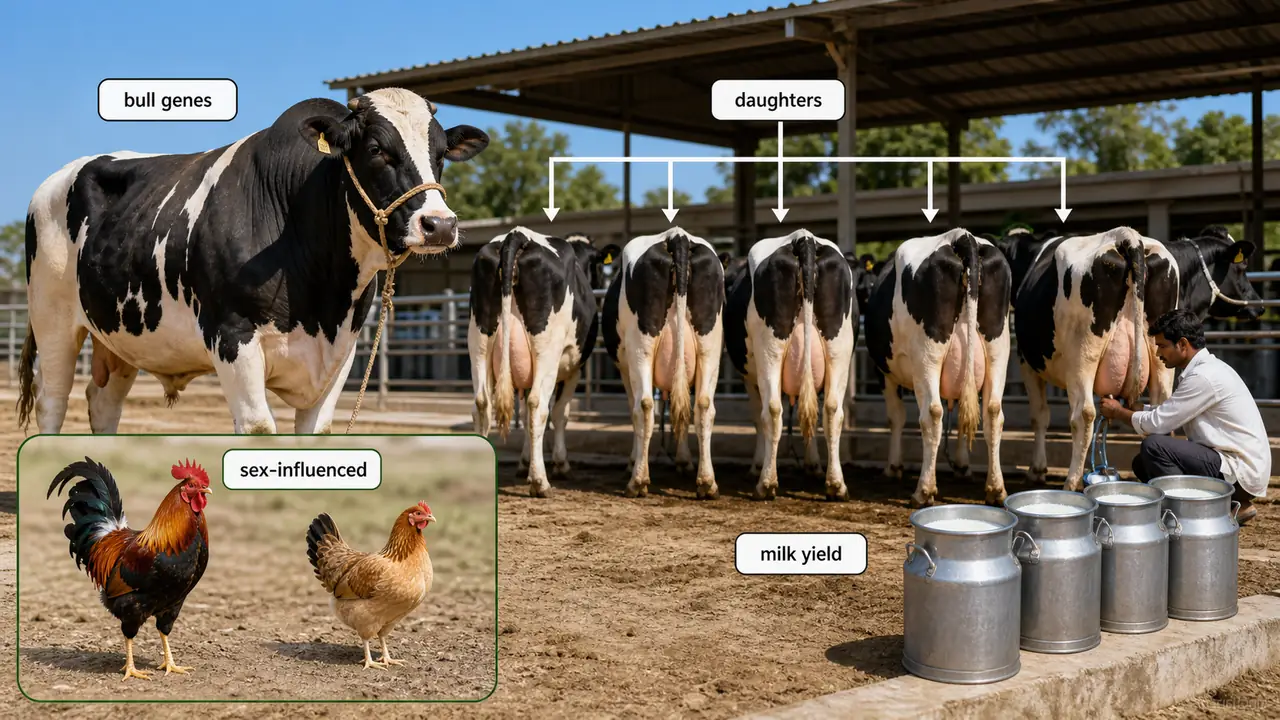
When a dairy farmer selects a bull for breeding, the bull himself never produces milk — yet his daughters' milk yield depends heavily on his genes. This is because milk production is a sex-limited trait — the gene is carried by both sexes but expressed only in females. Similarly, in poultry, feather pattern differences between roosters and hens are sex-influenced traits. Understanding how sex interacts with gene expression helps breeders design more effective selection strategies in both crops and livestock.
Sex-Linked, Sex-Influenced, and Sex-Limited Traits
IMPORTANT
Sex-linked = gene on sex chromosome. Sex-influenced = autosomal gene, dominance changes with sex. Sex-limited = autosomal gene, expressed in only one sex.
-
In classical genetics-history recall, C.E. Allen is associated with the discovery of sex determination in plants, making plant systems part of the early experimental foundation of sex genetics.
-
Older botanical-history recall also links plant sex discovery with Camerarius (1694), while Allen is commonly cited for later experimental demonstration.
-
In monoecious/hermaphrodite/bisexual (male & female on the same individual) individuals, the character or trait of the F1 generation is always irrespective of their gender. But in dioecious (male & female on the other individual) individuals there may be two types of traits:
- Some traits do not show any differences in the reciprocal crosses i.e. A♀ x B ♂, B♀ x A ♂
- Some traits show the differences in reciprocal crosses.
-
Such traits which do not show any differences in the reciprocal crosses; are located on the autosomes and the traits which show the differences are either located on sex chromosomes or if located on the autosomes, are influenced by or depend on the sex of the individual which carries it. This distinction is critical for understanding sex-related inheritance patterns -- whether a trait is truly carried on the sex chromosome or simply influenced by the hormonal environment of the organism.
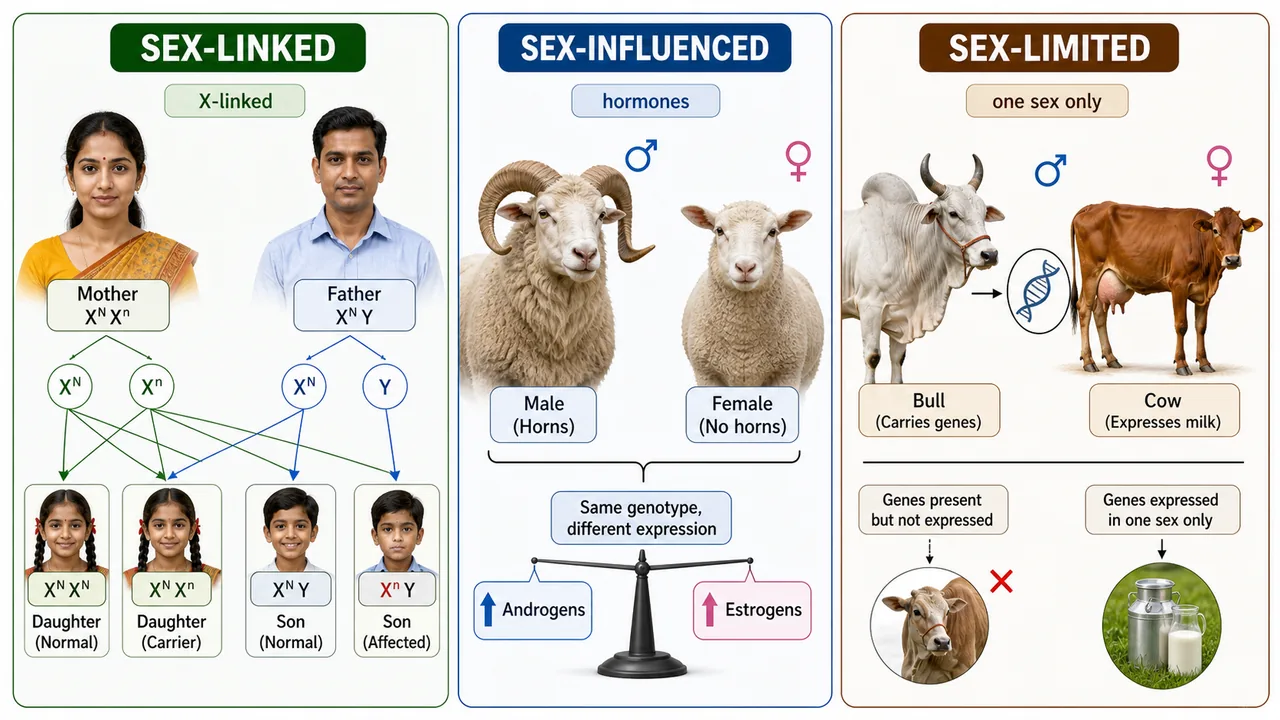
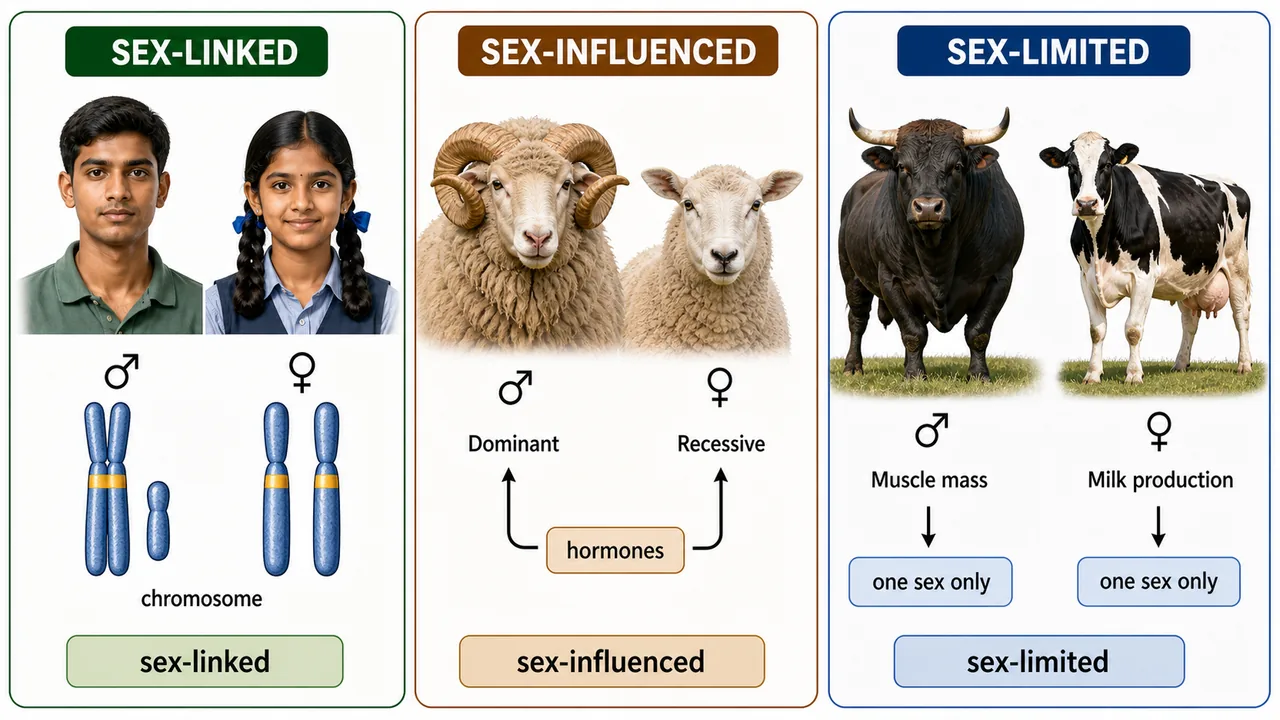
- The traitses which are located on sex chromosomes are called sex linked traits. These genes physically reside on the X or Y chromosome and therefore follow a distinctive criss-cross pattern of inheritance (from mother to son via the X-chromosome). In classical genetics recall, this criss-cross inheritance pattern is associated with T. H. Morgan.
- The traits whose expression is governed or influenced by the sex (maleness or femaleness) of the individual are called sex influenced traits. In these cases, the genes are located on autosomes (not sex chromosomes), but their dominance relationship changes depending on the sex hormones present in the individual.
- The traits whose expression is dependent on the sex (♂ or ♀) of the individual who carries it, are called sex limited traits. Such trait is expressed in one sex only and not in the other. Like sex-influenced traits, sex-limited genes are also typically on autosomes, but they are completely restricted in expression to one sex due to hormonal differences.
- In older exam-oriented genetics, C.B. Bridges is also remembered for the genic balance theory of sex determination, proposed from work in Drosophila.
Sex linked traits
- Example: Colour blindness and haemophilia in human beings. These are among the most well-known examples of X-linked recessive inheritance.
- Colour blind man is unable to differentiate between red colour and green colour. The gene for red-green colour blindness is located on X-chromosome. Since males have only one X-chromosome (from their mother), a single recessive allele on that X-chromosome is sufficient to cause the condition. Females, having two X-chromosomes, would need to be homozygous recessive (carry the allele on both X-chromosomes) to be colour blind.
- This is the classical situation described as hemizygous: the male has only one copy of an X-linked gene, so there is no second allele on a homologous X-chromosome to mask a recessive effect.

| ♂ \ ♀ | X^c | Y |
|---|---|---|
| X | XX^c (Carrier for Colour Blind Female) | XY (Normal) |
| X^c | X^c X^c (Colour Blind) | X^c Y (Colour Blind) |
- In hemophilia, the man lacks the factor responsible for blood clotting. Therefore even a minor cut may cause prolonged bleeding leading to death. Hemophilia is also X-linked recessive, which is why it is far more common in males than in females. The most famous example in history is the spread of hemophilia through the royal families of Europe, traced back to Queen Victoria.
- Such traits are transferred from mother to the son and never from the father to the son because they are X-linked and recessive in character. This is because fathers pass their Y-chromosome (not X) to their sons. A father can only pass his X-chromosome to his daughters, making them carriers if the X carries a recessive allele.
- The contrasting pattern is Y-linked or holandric inheritance, where the gene is located on the Y-chromosome itself. Such traits move strictly from father to son and never appear in daughters because daughters do not inherit the paternal Y-chromosome.
- A carrier woman transmits these diseases to the 50% of her sons, even if the father is normal. A carrier female (heterozygous, XcX) appears phenotypically normal but has a 50% chance of passing the affected X-chromosome to each son.
- In older exam-oriented terminology, these transmission routes are sometimes named more explicitly: diagenic inheritance highlights the father → daughter → grandson route, diandric inheritance highlights the mother → son → granddaughter route, and hologenic inheritance is used for the mother → daughter → granddaughter continuity pattern in sex-associated pedigree discussion.
| ♂ \ ♀ | X | Y |
|---|---|---|
| X^h | XX^h (Carrier Female) | X^h Y (Hemophilic Male) |
| X | XX (Normal) | XY (Normal) |
Non-disjunction of sex chromosomes
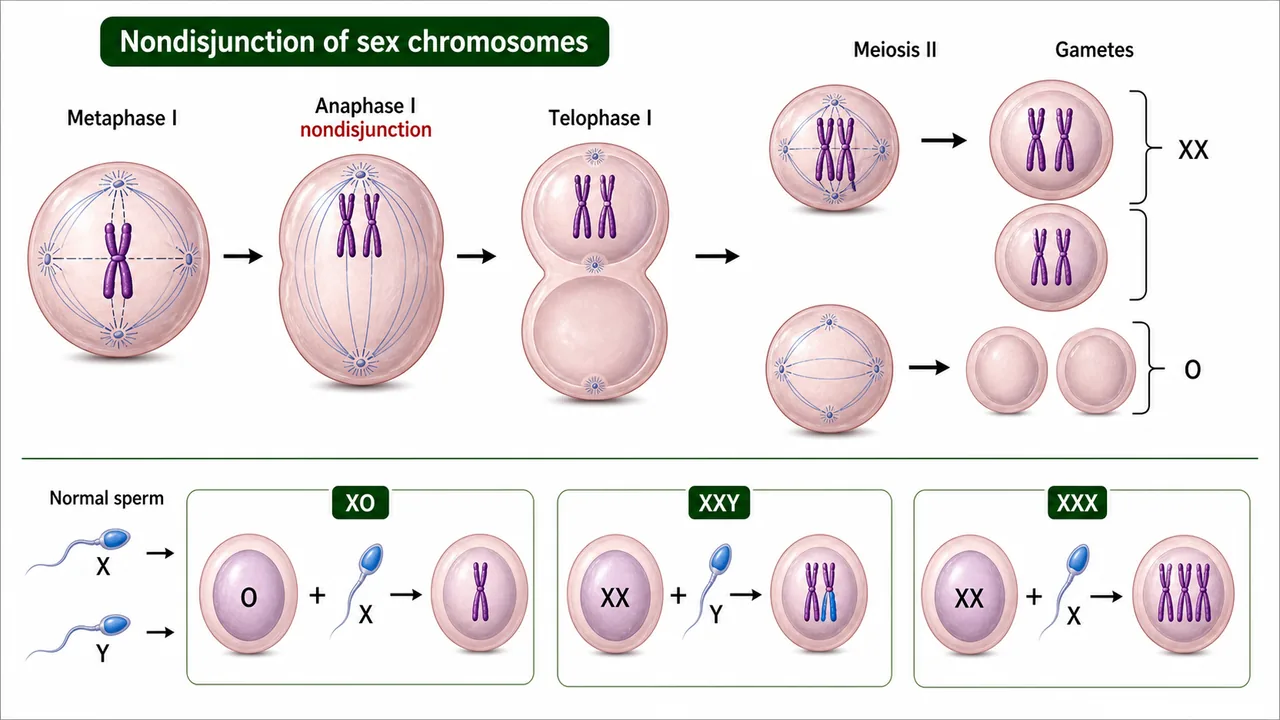
- Nondisjunction means the absence of separation of two homologous X-chromosomes (in Drosophila) during anaphase I of meiosis. In such case, both X-chromosomes go together to the same pole and other pole will get no X-chromosome. This results in abnormal gametes -- some with two X-chromosomes and some with no X-chromosome at all.
- In 1916, C.B. Bridges reported it in Drosophila. Bridges' work on non-disjunction provided one of the strongest pieces of evidence for the Chromosomal Theory of Inheritance, as the unusual phenotypes of offspring could only be explained if genes were physically located on chromosomes.
- It is a rare phenomenon. In humans, non-disjunction of sex chromosomes can lead to conditions such as Turner syndrome (XO -- one X-chromosome only), Klinefelter syndrome (XXY), and Triple X syndrome (XXX).
- A related classical term is gynandromorph, an individual showing both male and female characteristics in different body regions; Drosophila is the standard textbook example.
Sex-influenced traits
- In some organisms, some characters are influenced by the sex of the organism. Unlike sex-linked traits, sex-influenced traits are controlled by genes on autosomes, but the expression of dominance differs between males and females due to the influence of sex hormones.
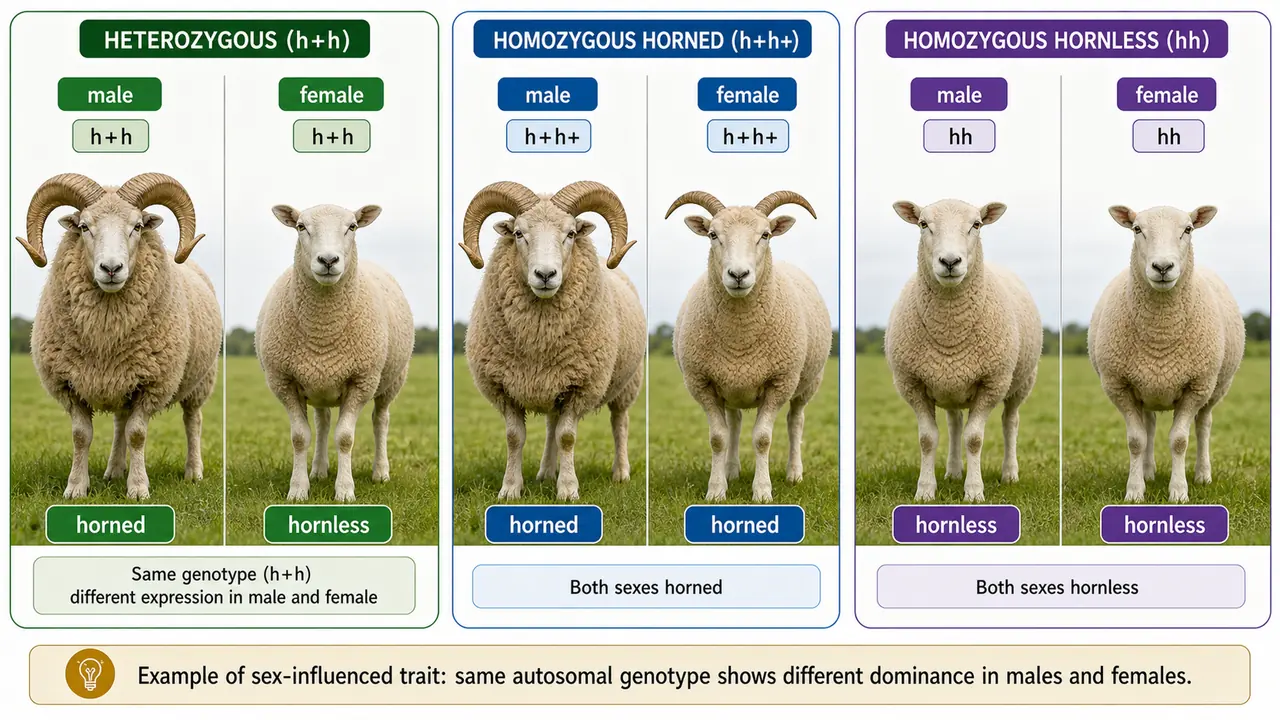
- For example horns in sheep. Horned character is dominant in male but recessive in female. This means that a heterozygous male will develop horns (because the allele acts as dominant in the male hormonal environment), but a heterozygous female will not develop horns (because the same allele acts as recessive in the female hormonal environment).
- This influence is believed to be mainly due to male & female hormones. The hormonal milieu of the individual modifies the threshold of expression of the gene, effectively changing its dominance relationship depending on sex.
| Genotype | Male | Female |
|---|---|---|
| h⁺h⁺ | horned | horned |
| h⁺h | horned | hornless |
| hh | hornless | hornless |
Sex limited traits
- E.g.
- Premature baldness is expressed only in the presence of a certain level of male hormone (androgenic). Although both males and females carry the gene for baldness, the trait is expressed only in males because females typically lack the required level of androgens (male sex hormones) needed to trigger the condition.
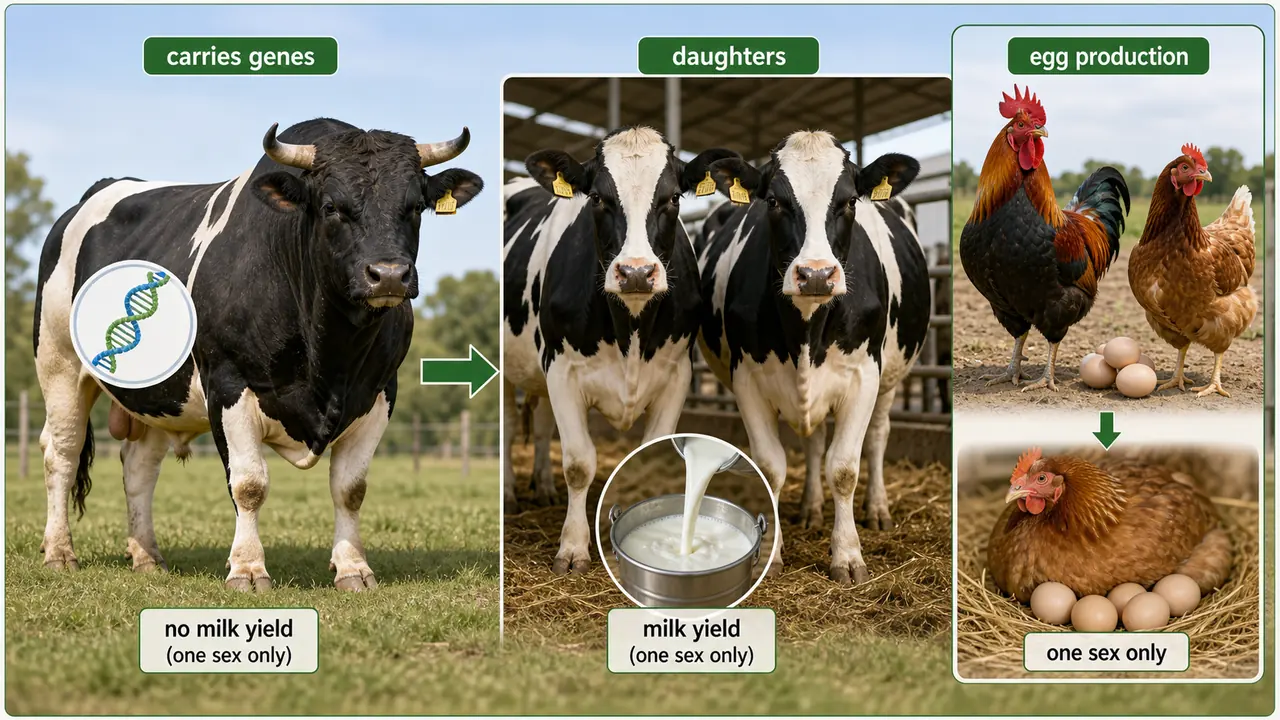
- Milk production is also sex limited trait. In such cases genes for the particular traits are carried by both male & female. A bull carries genes for milk yield and can pass them to his daughters, but the bull never produces milk himself. Similarly, hens lay eggs while roosters do not, even though both carry genes related to egg production. This concept is particularly important in animal breeding -- a bull's genetic merit for milk production is evaluated through the performance of his daughters.
Comparison Table
| Feature | Sex-Linked | Sex-Influenced | Sex-Limited |
|---|---|---|---|
| Gene location | Sex chromosome (X or Y) | Autosome | Autosome |
| Expression | Depends on number of X chromosomes | Both sexes, but dominance changes | One sex only |
| Reciprocal crosses | Different results | Same results | Same results |
| Example | Colour blindness, haemophilia | Horns in sheep | Milk production, baldness |
| Mechanism | Hemizygosity in males | Sex hormones modify dominance | Sex hormones restrict expression |

Summary Cheat Sheet
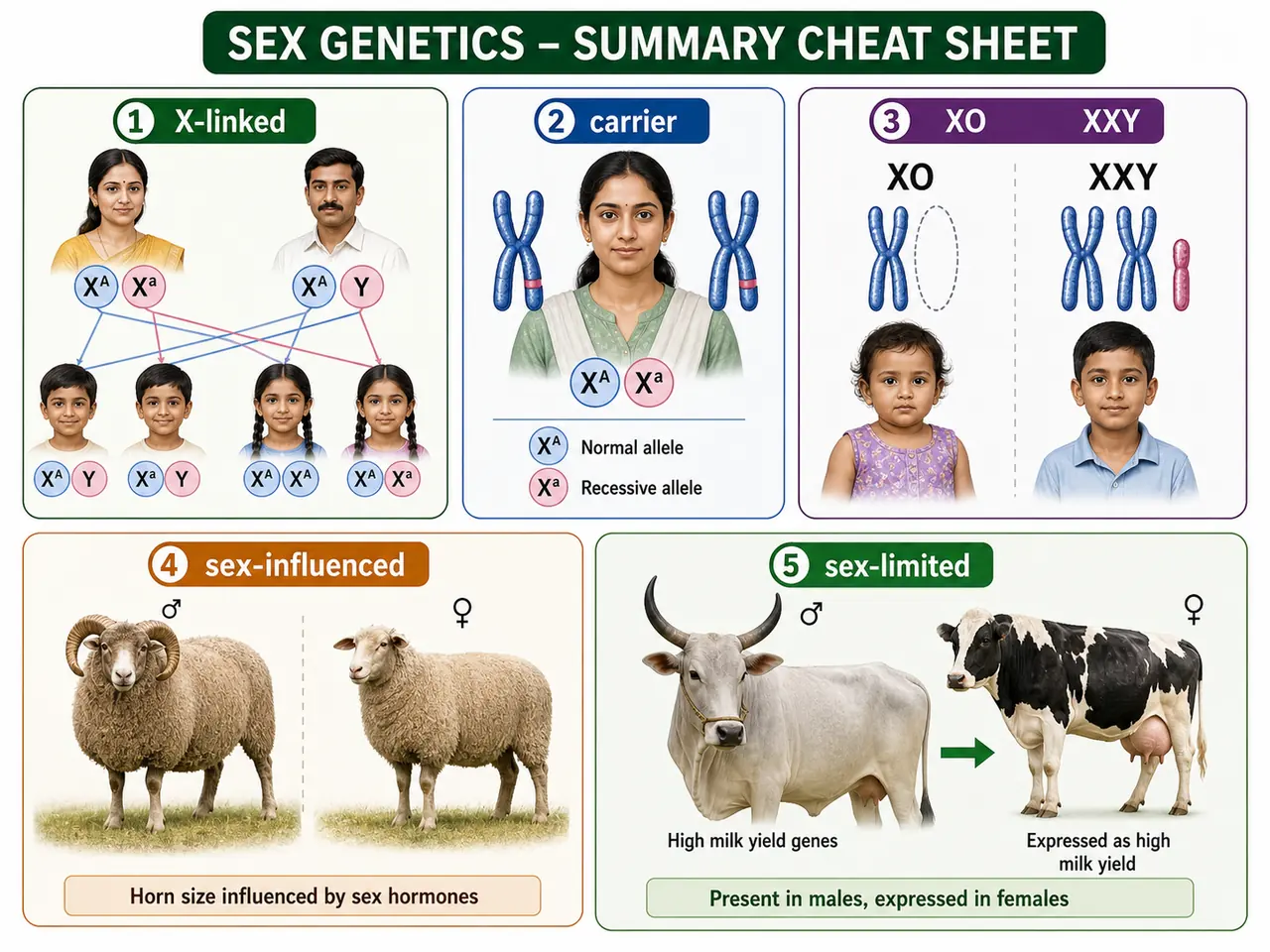
| Concept / Topic | Key Details |
|---|---|
| Sex-linked traits | Genes on sex chromosomes (X or Y) |
| Inheritance pattern | Criss-cross (mother → son via X-chromosome) |
| X-linked examples | Colour blindness, haemophilia (both recessive) |
| X-linked: carrier female x normal male | 50% sons affected, 50% daughters carriers |
| Barr body | Inactivated X-chromosome; seen in female cells |
| Lyon hypothesis | Random X-inactivation in females |
| Non-disjunction of sex chromosomes | Produces XXY (Klinefelter), XO (Turner) |
| Klinefelter syndrome | XXY; male; sterile; extra Barr body |
| Turner syndrome | XO; female; sterile; no Barr body |
| Sex-influenced traits | Autosomal genes; dominance changes with sex |
| Sex-influenced example | Horns in sheep: dominant in males, recessive in females |
| Sex-limited traits | Autosomal genes; expressed in one sex only |
| Sex-limited examples | Milk production (females only), baldness pattern (males only) |
| Distinction | Sex-linked = on sex chromosome; Sex-influenced = dominance differs; Sex-limited = one sex only |
| Holandric genes | On Y-chromosome; father → son only |
| Agricultural significance | Bull selection for milk yield via daughters' performance |