🔬Cytoplasmic Inheritance: Features, CMS, and Applications
Understand cytoplasmic (maternal/extranuclear) inheritance, CMS in hybrid seed production, and the difference between nuclear and cytoplasmic inheritance — with agricultural examples and exam tips.
Why Cytoplasmic Inheritance Matters in Agriculture
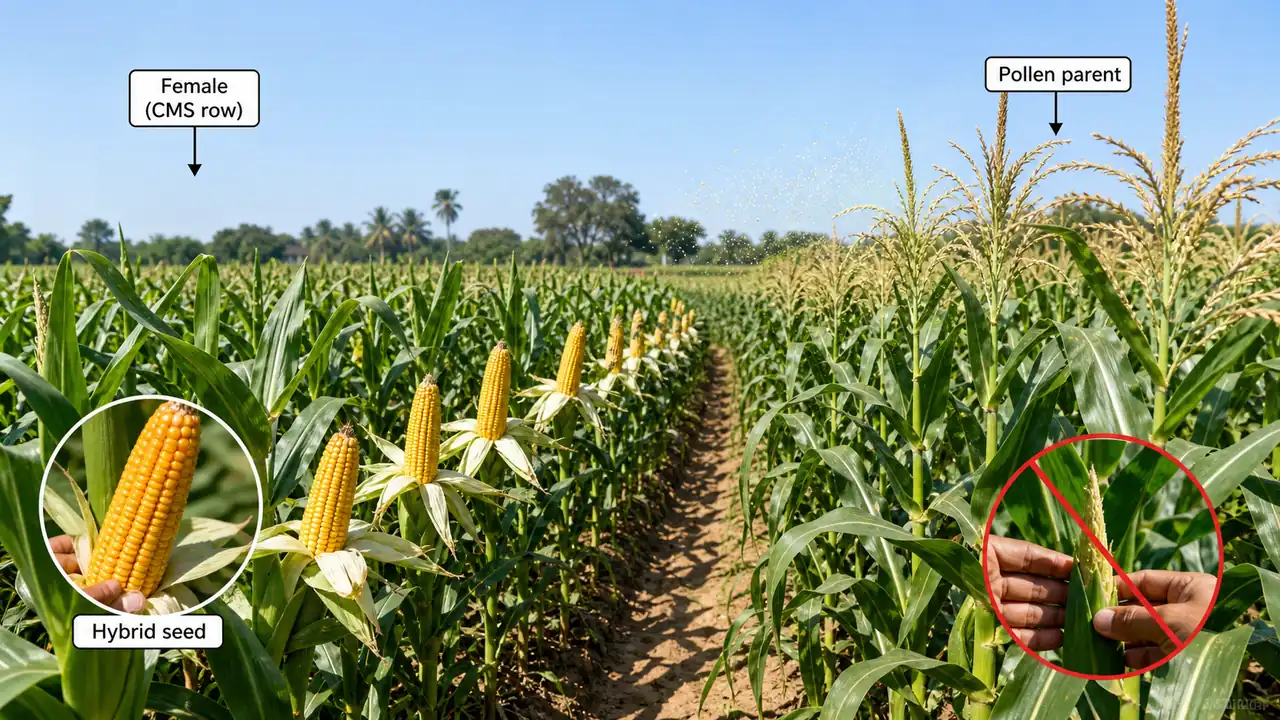
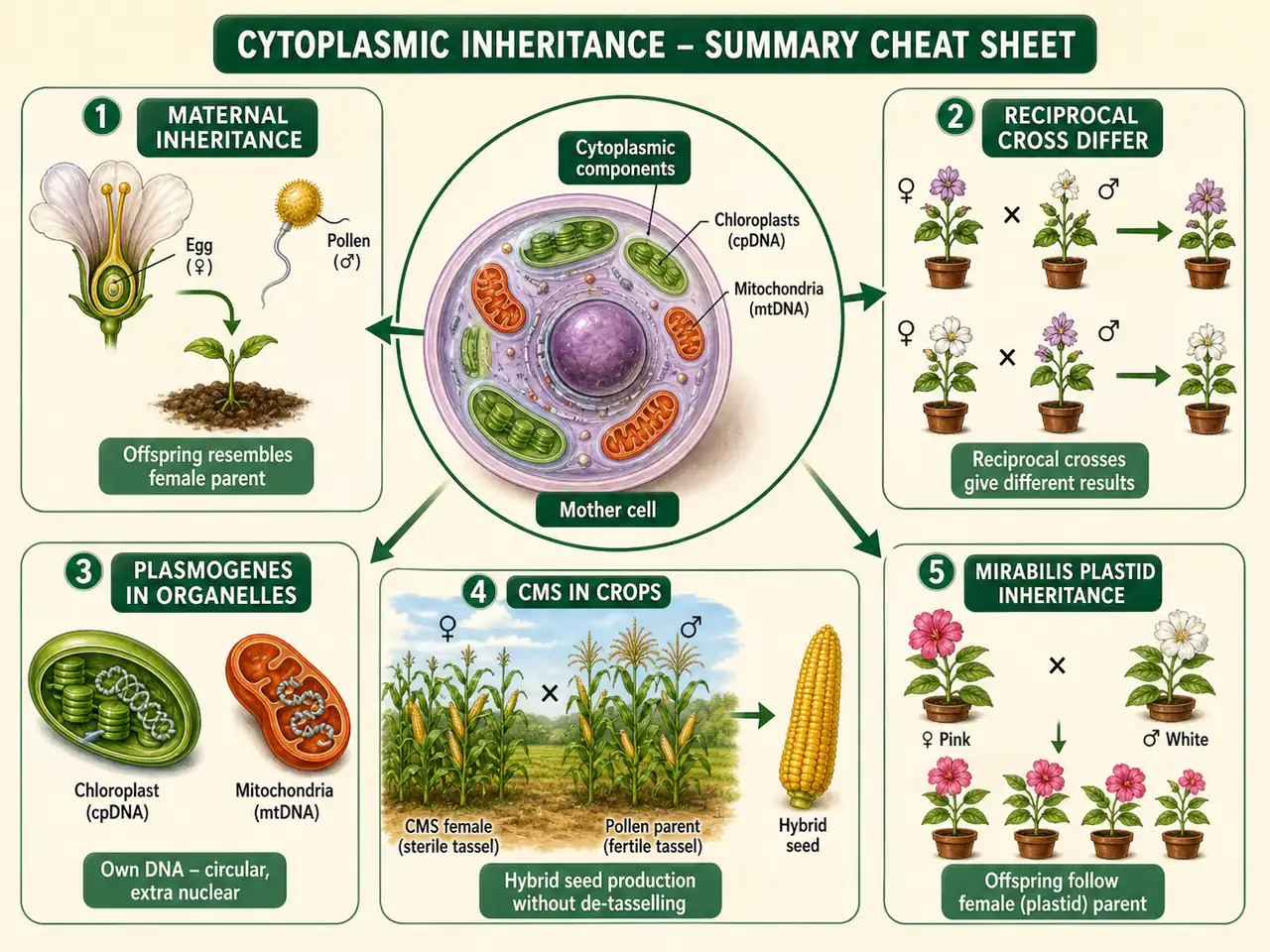
When hybrid maize seed is produced on a commercial scale without the labour-intensive process of de-tasselling, it is because the mother plant carries cytoplasmic male sterility (CMS) — a trait inherited entirely through the maternal cytoplasm, not through nuclear genes. CMS lines have revolutionised hybrid seed production in maize, pearl millet, sorghum, and cotton. Understanding cytoplasmic inheritance explains why reciprocal crosses sometimes give different results and why certain traits pass exclusively from mother to offspring.
Cytoplasmic or Extra nuclear Inheritance
NOTE
Cytoplasmic inheritance is always maternal because the egg contributes virtually all the cytoplasm (and organelles like mitochondria and chloroplasts) to the offspring, while the sperm contributes almost none.

- The inheritance of almost all traits or characters from generation to generation is governed by the genes of nuclear chromosomes. But the inheritance of some traits is also governed by the cytoplasm. While the nucleus contains the majority of the genome, certain organelles in the cytoplasm — particularly mitochondria and chloroplasts — possess their own DNA and contribute to inheritance independently of nuclear genes.
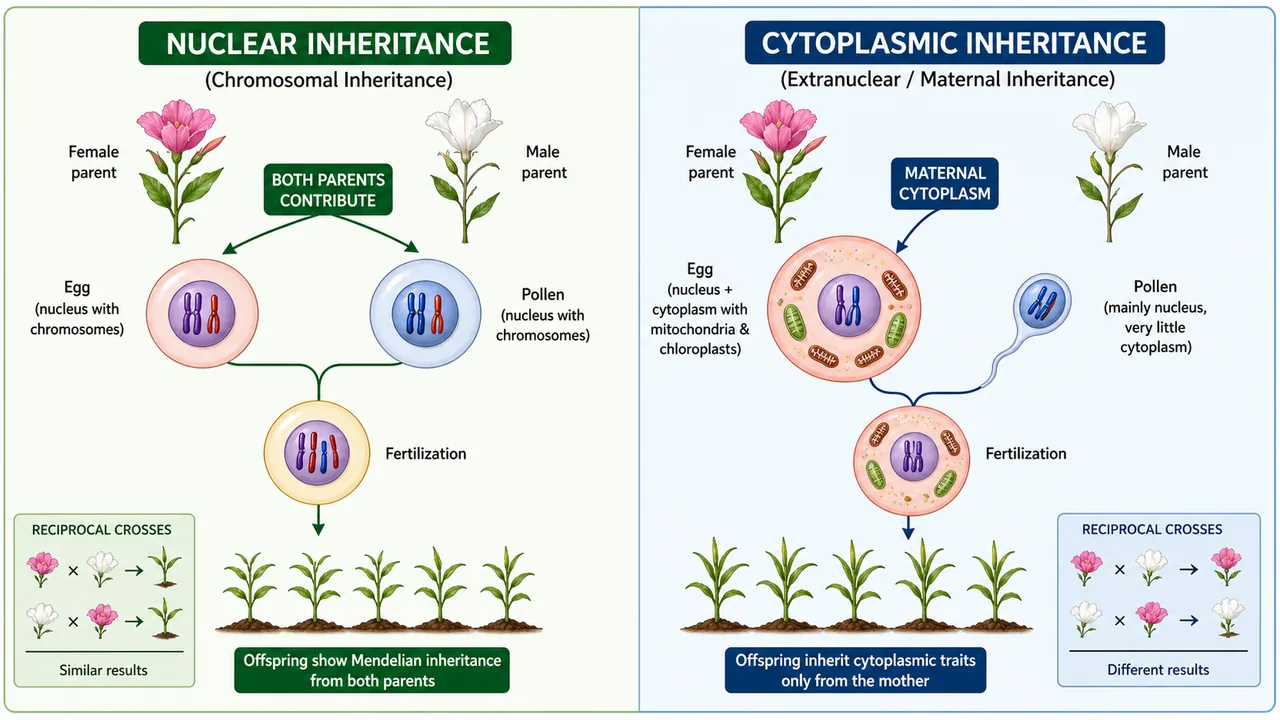
- Since major part of the cytoplasm of the zygote is derived from the female gamete and male gametes carry little or no cytoplasm means this inheritance is governed by female parent. The egg cell is much larger than the sperm and contributes virtually all of the cytoplasm (and the organelles within it) to the offspring. The inheritance of the traits governed by the cytoplasm or female parent or extra nuclear chromosomes is called Cytoplasmic/Maternal/Extranuclear inheritance. This is why the pattern of inheritance is strictly maternal — offspring inherit cytoplasmic traits exclusively from their mother.
- Genes/DNA/Chromosomes are also present in the Cytoplasmic organelles, like chloroplasts & mitochondria are solely responsible for the cytoplasmic inheritance. Genes present in the cytoplasm are called plasmogenes or plasmones. Unlike nuclear DNA, mitochondrial DNA (mtDNA) and chloroplast DNA (cpDNA) are typically circular molecules and are not associated with histone proteins.
Features of Cytoplasmic Inheritance
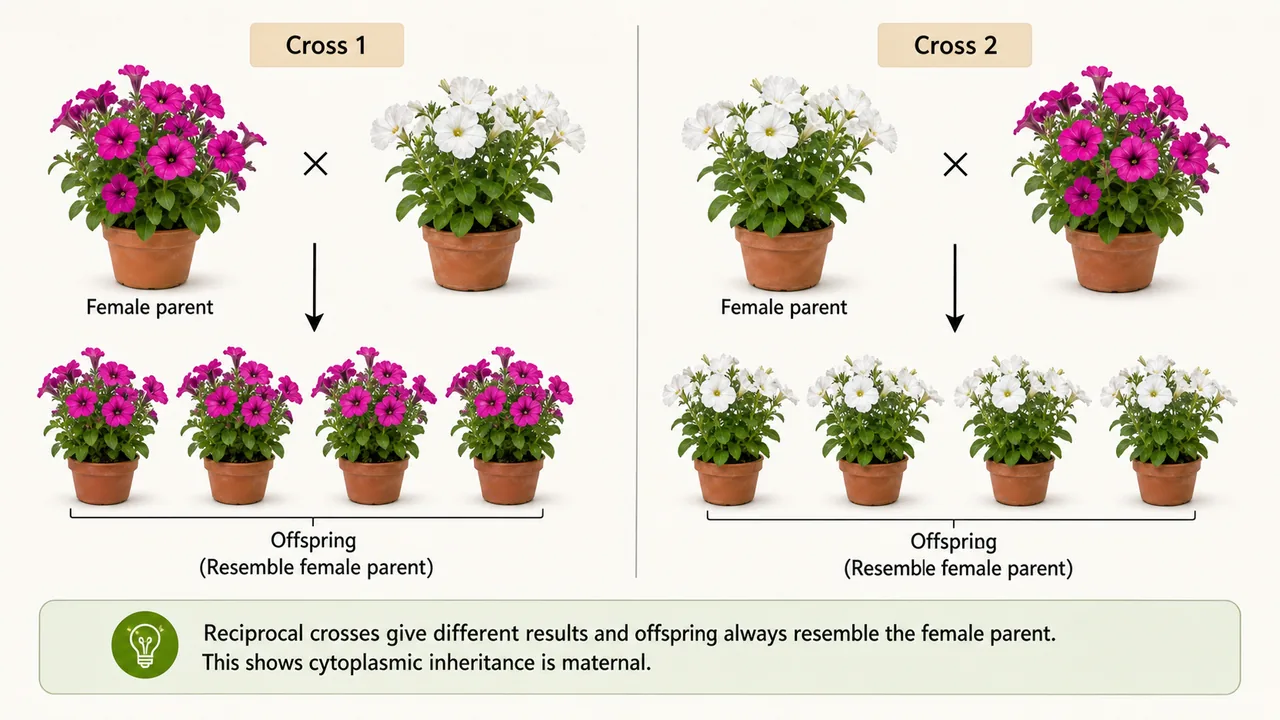
- In the inheritance of the nuclear genes, male & female parent contribute equally to the progeny and its reciprocal crosses between the parents, yield progenies of the identical phenotype except for sex-linked genes. But in the cytoplasmic inheritance only maternal effect appear in the progeny because eggs or ova (female gametes) contribute large amount of cytoplasm and many extra nuclear genes in the form of inactive mRNA, rRNA & tRNA and also in the form of DNA of mitochondria, chloroplasts & endosymbionts. Therefore reciprocal crosses yield different results (non Mendelian). This is a hallmark feature of cytoplasmic inheritance — if reciprocal crosses give different results and the offspring always resemble the female parent, cytoplasmic inheritance is strongly suspected.
- Certain traits of F1, F2 or F3 progeny are not the expression of their own genes, but rather those of the maternal parents. The substance which produce the maternal effects are transcriptional products i.e. mRNA, rRNA, tRNA.
- Inheritance of some characters like male sterility in maize is governed by mitochondrial DNA. This maternal inheritance of male sterility was discovered by Rhoades (1933) in Maize. Male sterility occurs because the mitochondrial genome carries genes that interfere with pollen development, and since mitochondria are maternally inherited, this sterility passes exclusively through the female line.
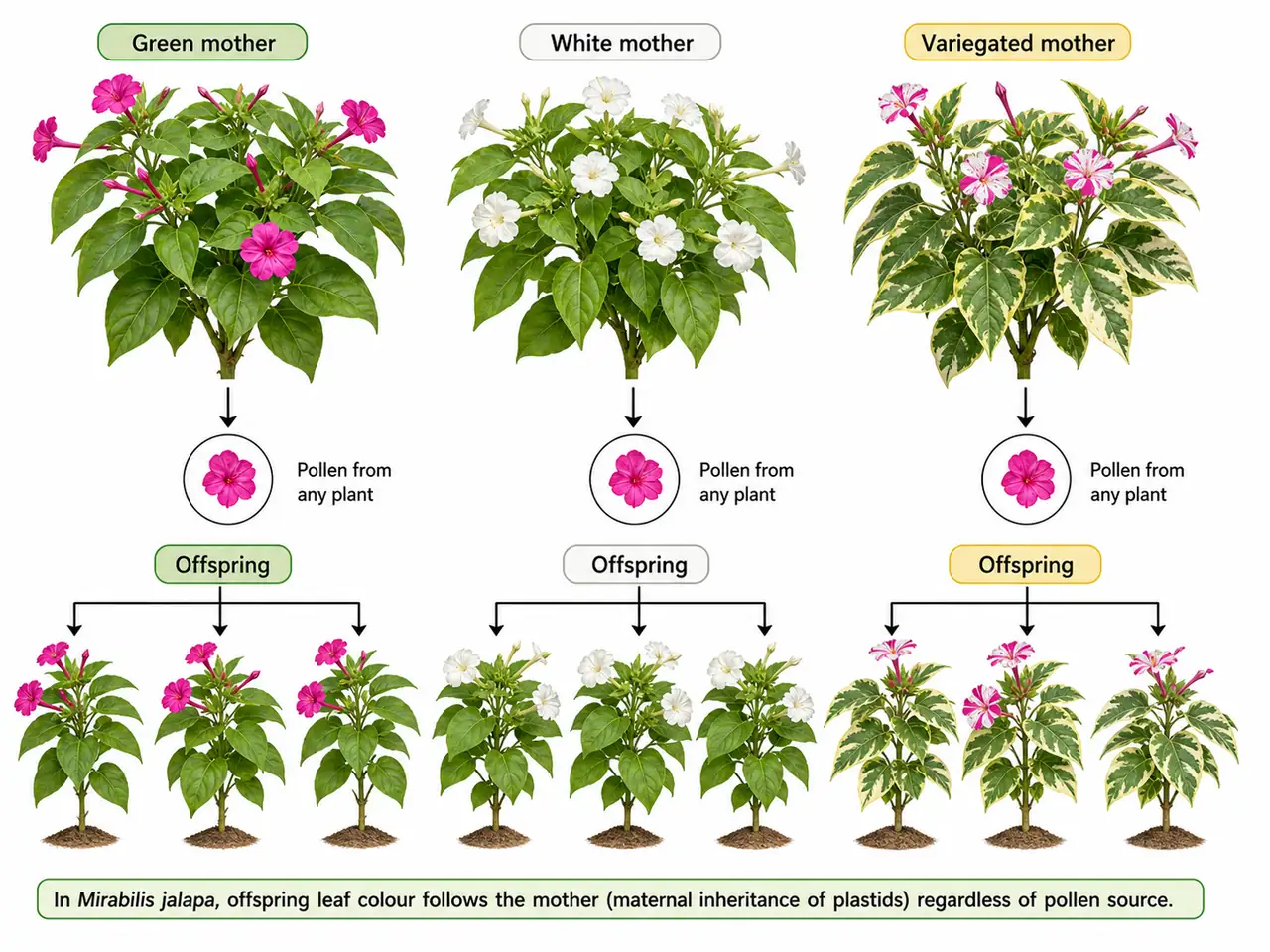
- Plastid inheritance in Four O’clock plant, Mirabilis jalapa was discovered by C. Correns (1908). He found the colour of leaf was totally governed by the colour of the female parent. Branches with green, white, or variegated leaves produce seeds that develop into plants matching the maternal branch colour, regardless of the pollen source. This was one of the earliest demonstrations of non-Mendelian inheritance.
- Jenkens (1924) discovered iojap colour (not full developed colour) in leaves of Maize (corn). The iojap gene in the nucleus can cause permanent changes to chloroplasts, which are then inherited maternally even when the nuclear gene is no longer present.
- Inheritance of Kappa particles in Paramecium was discovered by Soneberg (1943). Kappa particles are endosymbiotic bacteria living in the cytoplasm of certain Paramecium strains. They produce a toxin called paramecin that kills sensitive Paramecium strains. Since Kappa particles are in the cytoplasm, they are inherited through the maternal cytoplasm during conjugation.
- Ruthsanger (1960) discovered the uniparental (♀ parent) inheritance of streptomycin resistance in chlamydomonas (unicellular green algae). This finding showed that chloroplast DNA carries genes for antibiotic resistance, and these genes follow maternal inheritance patterns.
Ethydium bromidehas a capacity to mutate only cytoplasmic genes. Mutation caused by such chemical is heritable which showed the evidence for cytoplasmic inheritance. Ethidium bromide specifically intercalates into mitochondrial and chloroplast DNA, causing mutations in these organelle genomes without affecting nuclear DNA. This selectivity makes it a useful tool for studying cytoplasmic inheritance.
Practical application of cytoplasmic inheritance
- It plays an important role in the biology of several organism.
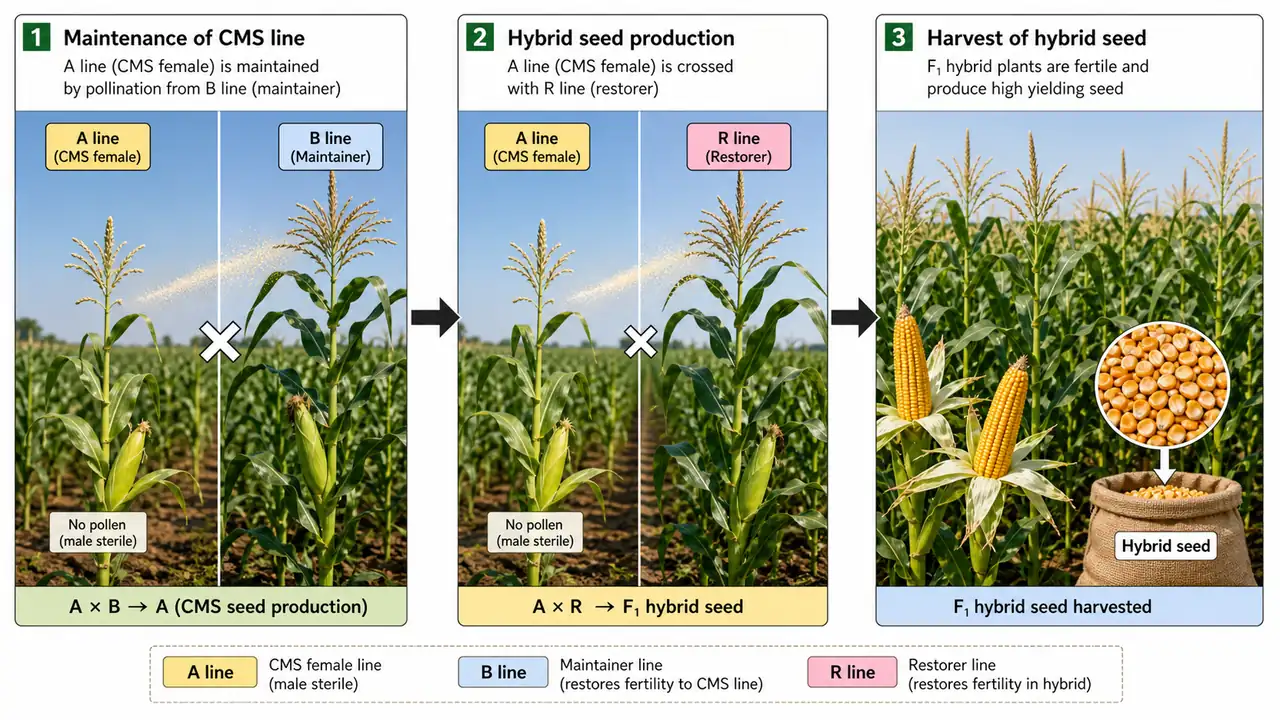
- Cytoplasmic male sterility (CMS) lines have been developed in several crops viz. maize, pearl millet, sorghum, cotton etc. Hybrid maize seed may be produced without de-tasselling (removal of tassel) by utilizing cytoplasmic/cytoplasmic genetic male sterility. CMS is one of the most important practical applications of cytoplasmic inheritance in agriculture. It enables commercial hybrid seed production on a large scale because the male-sterile mother plants cannot self-pollinate, ensuring that all seeds produced are true hybrids. This eliminates the labour-intensive process of manual emasculation or de-tasselling.
- It plays key role in mapping of chloroplast and mitochondrial genome in several species viz. yeasts, chlamydomonas, maize etc. Understanding the organization and function of organellar genomes has contributed to our knowledge of organelle evolution and the endosymbiotic theory of organelle origin.
- Role of mitochondria in the manifestation of heterosis is gaining importance. Research suggests that interactions between nuclear genes and mitochondrial genes may contribute to the superior vigour observed in hybrid organisms (heterosis or hybrid vigour).
- Mutation of chloroplast DNA & mitochondrial DNA leads to generation of new variants. These organellar mutations can create novel phenotypes that may be useful in breeding programs, particularly for traits like herbicide resistance and male sterility.
Difference
👉🏻 Between Chromosomal (Nuclear) and Extra-Chromosomal (Cytoplasmic or Extra-Nuclear or Maternal) Inheritance
The key differences include: Nuclear inheritance follows Mendelian ratios, both parents contribute equally, and reciprocal crosses give identical results. In contrast, Cytoplasmic inheritance is non-Mendelian, follows maternal inheritance only, reciprocal crosses yield different results, and traits are governed by organellar DNA (mitochondria and chloroplasts) rather than nuclear chromosomes.
| Character | Chromosomal Inheritance | Extra-Chromosomal Inheritance |
|---|---|---|
| Association with | Chromosomes | Chloroplasts and Mitochondria |
| Location of hereditary factor | Nucleus | Cytoplasm |
| Individual Hereditary factors are collectively known as | Genes | Plasmagenes |
| Hereditary factors are | Genome | Plasmon |
| Pattern of Inheritance | Can be explained by Mendelism | Cannot be explained by Mendelism |
| Characters of F₁ progeny | May show dominance or may be intermediate between the parents | Exhibits only the characteristics of the female parent |
| Reciprocal differences | Not observed | Observed |
| Segregation of factors and recombination | Present | Absent |
| Attributes of progeny | Under the control of their own genes | Under the control of cytoplasm of female parent |
| Action of mutagen | Non-specific | Very specific |
| Frequency of occurrence | Most common | Rare |
| Gene mapping | Easy | Difficult |
Summary Cheat Sheet
| Concept / Topic | Key Details |
|---|---|
| Cytoplasmic inheritance | Always maternal — egg provides all cytoplasm |
| Also called | Maternal / Extranuclear inheritance |
| Non-Mendelian | Reciprocal crosses give different results |
| Plasmogenes | Genes in cytoplasmic organelles (mitochondria, chloroplasts) |
| Organellar DNA | Circular, no histones (like prokaryotes) |
| CMS (Cytoplasmic Male Sterility) | Governed by mitochondrial DNA |
| CMS in maize discovered by | Rhoades (1933) |
| CMS application | Hybrid seed production without emasculation |
| CMS used in crops | Maize, pearl millet, sorghum, cotton |
| Plastid inheritance | Discovered by Correns (1908) in Mirabilis jalapa |
| Plastid inheritance pattern | Leaf colour follows female parent only |
| Iojap in maize | Discovered by Jenkens (1924); nuclear gene causes permanent chloroplast changes |
| Kappa particles in Paramecium | Discovered by Soneberg (1943); endosymbiotic bacteria; produce paramecin toxin |
| Streptomycin resistance | Discovered by Ruthsanger (1960) in Chlamydomonas; chloroplast DNA |
| Ethidium bromide | Mutates only cytoplasmic genes; intercalates into organellar DNA |
| Nuclear vs Cytoplasmic | Nuclear = Mendelian, both parents; Cytoplasmic = maternal only |
Pro Content Locked
Upgrade to Pro to access this lesson and all other premium content.
₹2388 billed yearly
- All Agriculture & Banking Courses
- AI Lesson Questions (100/day)
- AI Doubt Solver (50/day)
- Glows & Grows Feedback (30/day)
- AI Section Quiz (20/day)
- 22-Language Translation (30/day)
- Recall Questions (20/day)
- AI Quiz (15/day)
- AI Quiz Paper Analysis
- AI Step-by-Step Explanations
- Spaced Repetition Recall (FSRS)
- AI Tutor
- Immersive Text Questions
- Audio Lessons — Hindi & English
- Mock Tests & Previous Year Papers
- Summary & Mind Maps
- XP, Levels, Leaderboard & Badges
- Generate New Classrooms
- Voice AI Teacher (AgriDots Live)
- AI Revision Assistant
- Knowledge Gap Analysis
- Interactive Revision (LangGraph)
🔒 Secure via Razorpay · Cancel anytime · No hidden fees
Why Cytoplasmic Inheritance Matters in Agriculture
When hybrid maize seed is produced on a commercial scale without the labour-intensive process of de-tasselling, it is because the mother plant carries cytoplasmic male sterility (CMS) — a trait inherited entirely through the maternal cytoplasm, not through nuclear genes. CMS lines have revolutionised hybrid seed production in maize, pearl millet, sorghum, and cotton. Understanding cytoplasmic inheritance explains why reciprocal crosses sometimes give different results and why certain traits pass exclusively from mother to offspring.
Cytoplasmic or Extra nuclear Inheritance
NOTE
Cytoplasmic inheritance is always maternal because the egg contributes virtually all the cytoplasm (and organelles like mitochondria and chloroplasts) to the offspring, while the sperm contributes almost none.

- The inheritance of almost all traits or characters from generation to generation is governed by the genes of nuclear chromosomes. But the inheritance of some traits is also governed by the cytoplasm. While the nucleus contains the majority of the genome, certain organelles in the cytoplasm — particularly mitochondria and chloroplasts — possess their own DNA and contribute to inheritance independently of nuclear genes.
- Since major part of the cytoplasm of the zygote is derived from the female gamete and male gametes carry little or no cytoplasm means this inheritance is governed by female parent. The egg cell is much larger than the sperm and contributes virtually all of the cytoplasm (and the organelles within it) to the offspring. The inheritance of the traits governed by the cytoplasm or female parent or extra nuclear chromosomes is called Cytoplasmic/Maternal/Extranuclear inheritance. This is why the pattern of inheritance is strictly maternal — offspring inherit cytoplasmic traits exclusively from their mother.
- Genes/DNA/Chromosomes are also present in the Cytoplasmic organelles, like chloroplasts & mitochondria are solely responsible for the cytoplasmic inheritance. Genes present in the cytoplasm are called plasmogenes or plasmones. Unlike nuclear DNA, mitochondrial DNA (mtDNA) and chloroplast DNA (cpDNA) are typically circular molecules and are not associated with histone proteins.
Features of Cytoplasmic Inheritance
- In the inheritance of the nuclear genes, male & female parent contribute equally to the progeny and its reciprocal crosses between the parents, yield progenies of the identical phenotype except for sex-linked genes. But in the cytoplasmic inheritance only maternal effect appear in the progeny because eggs or ova (female gametes) contribute large amount of cytoplasm and many extra nuclear genes in the form of inactive mRNA, rRNA & tRNA and also in the form of DNA of mitochondria, chloroplasts & endosymbionts. Therefore reciprocal crosses yield different results (non Mendelian). This is a hallmark feature of cytoplasmic inheritance — if reciprocal crosses give different results and the offspring always resemble the female parent, cytoplasmic inheritance is strongly suspected.
- Certain traits of F1, F2 or F3 progeny are not the expression of their own genes, but rather those of the maternal parents. The substance which produce the maternal effects are transcriptional products i.e. mRNA, rRNA, tRNA.
- Inheritance of some characters like male sterility in maize is governed by mitochondrial DNA. This maternal inheritance of male sterility was discovered by Rhoades (1933) in Maize. Male sterility occurs because the mitochondrial genome carries genes that interfere with pollen development, and since mitochondria are maternally inherited, this sterility passes exclusively through the female line.
- Plastid inheritance in Four O’clock plant, Mirabilis jalapa was discovered by C. Correns (1908). He found the colour of leaf was totally governed by the colour of the female parent. Branches with green, white, or variegated leaves produce seeds that develop into plants matching the maternal branch colour, regardless of the pollen source. This was one of the earliest demonstrations of non-Mendelian inheritance.
- Jenkens (1924) discovered iojap colour (not full developed colour) in leaves of Maize (corn). The iojap gene in the nucleus can cause permanent changes to chloroplasts, which are then inherited maternally even when the nuclear gene is no longer present.
- Inheritance of Kappa particles in Paramecium was discovered by Soneberg (1943). Kappa particles are endosymbiotic bacteria living in the cytoplasm of certain Paramecium strains. They produce a toxin called paramecin that kills sensitive Paramecium strains. Since Kappa particles are in the cytoplasm, they are inherited through the maternal cytoplasm during conjugation.
- Ruthsanger (1960) discovered the uniparental (♀ parent) inheritance of streptomycin resistance in chlamydomonas (unicellular green algae). This finding showed that chloroplast DNA carries genes for antibiotic resistance, and these genes follow maternal inheritance patterns.
Ethydium bromidehas a capacity to mutate only cytoplasmic genes. Mutation caused by such chemical is heritable which showed the evidence for cytoplasmic inheritance. Ethidium bromide specifically intercalates into mitochondrial and chloroplast DNA, causing mutations in these organelle genomes without affecting nuclear DNA. This selectivity makes it a useful tool for studying cytoplasmic inheritance.
Practical application of cytoplasmic inheritance
- It plays an important role in the biology of several organism.
- Cytoplasmic male sterility (CMS) lines have been developed in several crops viz. maize, pearl millet, sorghum, cotton etc. Hybrid maize seed may be produced without de-tasselling (removal of tassel) by utilizing cytoplasmic/cytoplasmic genetic male sterility. CMS is one of the most important practical applications of cytoplasmic inheritance in agriculture. It enables commercial hybrid seed production on a large scale because the male-sterile mother plants cannot self-pollinate, ensuring that all seeds produced are true hybrids. This eliminates the labour-intensive process of manual emasculation or de-tasselling.
- It plays key role in mapping of chloroplast and mitochondrial genome in several species viz. yeasts, chlamydomonas, maize etc. Understanding the organization and function of organellar genomes has contributed to our knowledge of organelle evolution and the endosymbiotic theory of organelle origin.
- Role of mitochondria in the manifestation of heterosis is gaining importance. Research suggests that interactions between nuclear genes and mitochondrial genes may contribute to the superior vigour observed in hybrid organisms (heterosis or hybrid vigour).
- Mutation of chloroplast DNA & mitochondrial DNA leads to generation of new variants. These organellar mutations can create novel phenotypes that may be useful in breeding programs, particularly for traits like herbicide resistance and male sterility.
Difference
👉🏻 Between Chromosomal (Nuclear) and Extra-Chromosomal (Cytoplasmic or Extra-Nuclear or Maternal) Inheritance
The key differences include: Nuclear inheritance follows Mendelian ratios, both parents contribute equally, and reciprocal crosses give identical results. In contrast, Cytoplasmic inheritance is non-Mendelian, follows maternal inheritance only, reciprocal crosses yield different results, and traits are governed by organellar DNA (mitochondria and chloroplasts) rather than nuclear chromosomes.
| Character | Chromosomal Inheritance | Extra-Chromosomal Inheritance |
|---|---|---|
| Association with | Chromosomes | Chloroplasts and Mitochondria |
| Location of hereditary factor | Nucleus | Cytoplasm |
| Individual Hereditary factors are collectively known as | Genes | Plasmagenes |
| Hereditary factors are | Genome | Plasmon |
| Pattern of Inheritance | Can be explained by Mendelism | Cannot be explained by Mendelism |
| Characters of F₁ progeny | May show dominance or may be intermediate between the parents | Exhibits only the characteristics of the female parent |
| Reciprocal differences | Not observed | Observed |
| Segregation of factors and recombination | Present | Absent |
| Attributes of progeny | Under the control of their own genes | Under the control of cytoplasm of female parent |
| Action of mutagen | Non-specific | Very specific |
| Frequency of occurrence | Most common | Rare |
| Gene mapping | Easy | Difficult |
Summary Cheat Sheet
| Concept / Topic | Key Details |
|---|---|
| Cytoplasmic inheritance | Always maternal — egg provides all cytoplasm |
| Also called | Maternal / Extranuclear inheritance |
| Non-Mendelian | Reciprocal crosses give different results |
| Plasmogenes | Genes in cytoplasmic organelles (mitochondria, chloroplasts) |
| Organellar DNA | Circular, no histones (like prokaryotes) |
| CMS (Cytoplasmic Male Sterility) | Governed by mitochondrial DNA |
| CMS in maize discovered by | Rhoades (1933) |
| CMS application | Hybrid seed production without emasculation |
| CMS used in crops | Maize, pearl millet, sorghum, cotton |
| Plastid inheritance | Discovered by Correns (1908) in Mirabilis jalapa |
| Plastid inheritance pattern | Leaf colour follows female parent only |
| Iojap in maize | Discovered by Jenkens (1924); nuclear gene causes permanent chloroplast changes |
| Kappa particles in Paramecium | Discovered by Soneberg (1943); endosymbiotic bacteria; produce paramecin toxin |
| Streptomycin resistance | Discovered by Ruthsanger (1960) in Chlamydomonas; chloroplast DNA |
| Ethidium bromide | Mutates only cytoplasmic genes; intercalates into organellar DNA |
| Nuclear vs Cytoplasmic | Nuclear = Mendelian, both parents; Cytoplasmic = maternal only |
Knowledge Check
Take a dynamically generated quiz based on the material you just read to test your understanding and get personalized feedback.
Lesson Doubts
Ask questions, get expert answers