🔢 Polyploidy and Aneuploidy: Chromosome Number Variations
Understand euploidy, autopolyploidy, allopolyploidy, aneuploidy, colchicine treatment, and their role in crop improvement — with agricultural examples and exam tips.
Why Ploidy Matters in Agriculture
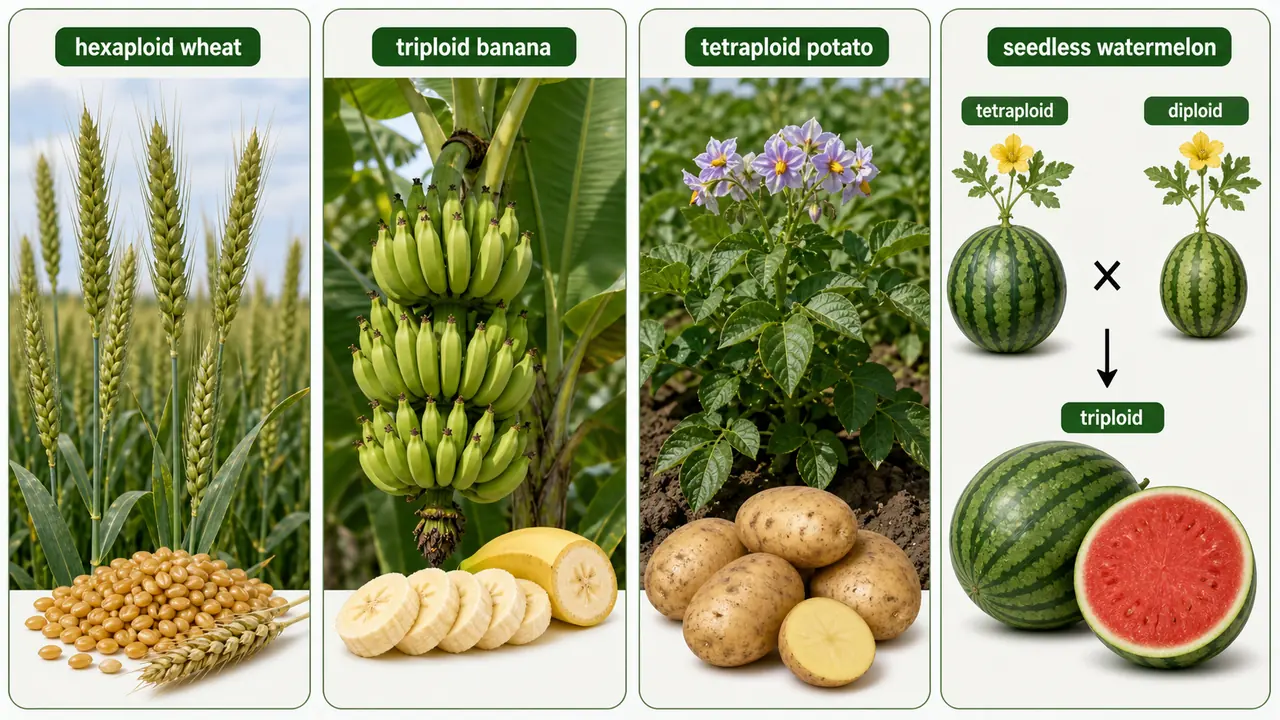
About 50% of all crop plants are polyploids — including bread wheat (hexaploid, AABBDD), cotton (tetraploid), potato (tetraploid), and banana (triploid). The seedless watermelon you enjoy in summer is a triploid created by crossing a tetraploid mother with a diploid father. Triticale, the first man-made cereal, was created by combining wheat and rye genomes through allopolyploidy. Understanding chromosome number variation is fundamental to crop evolution, breeding strategy, and the development of new crop varieties.
Genome & Ploidy — Basic Terminology
A genome is the basic (monoploid) set of chromosomes that contains all the genetic information of an organism.
| Symbol | Meaning |
|---|---|
| 2n | Somatic (body) chromosome number |
| n | Gametic chromosome number |
| x | Basic / genomic number (monoploid number) |
| x₁, x₂, x₃, x₄ | Distinct genomes from different species |
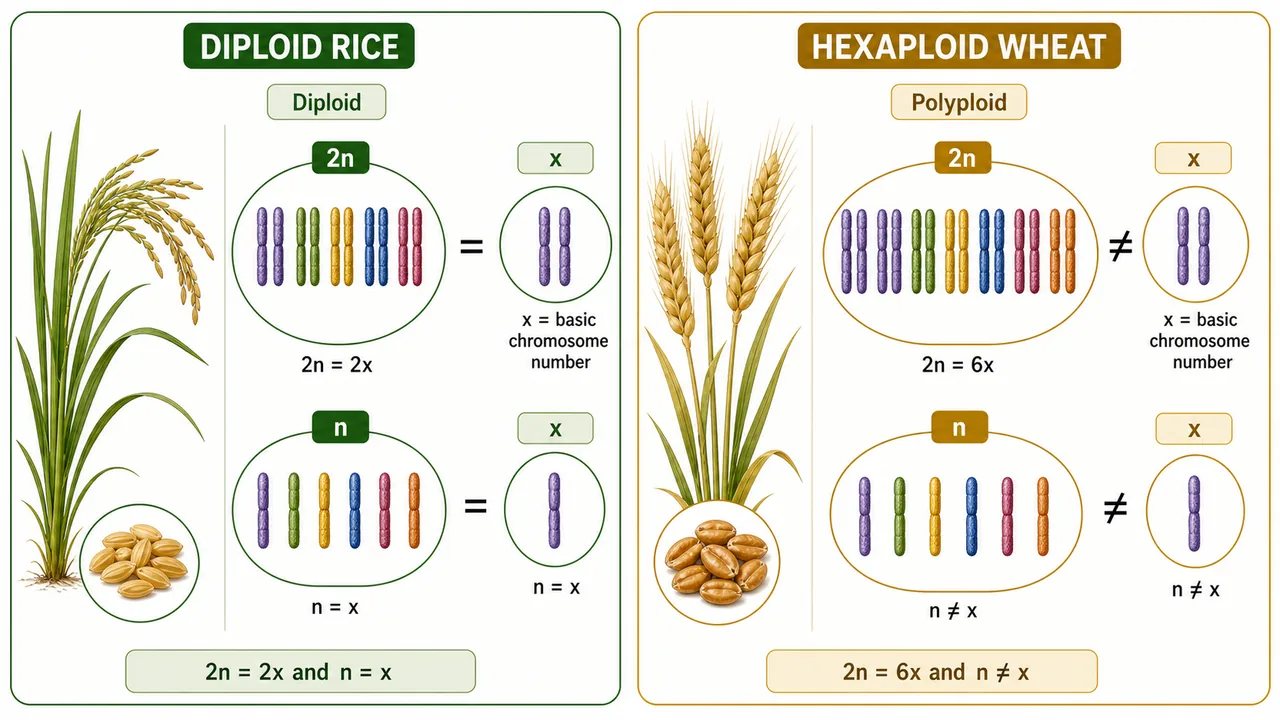
- In diploids, 2n = 2x and n = x (e.g., Rice: 2n = 2x = 24, so x = 12)
- In polyploids, 2n ≠ 2x (e.g., Wheat: 2n = 6x = 42, so x = 7)
IMPORTANT
Pro Content Locked
Upgrade to Pro to access this lesson and all other premium content.
Charged once for one year · ₹1188 total
Save ₹100/month vs ₹2388/year launch price
- All Agriculture & Banking Courses
- AI Lesson Questions (100/day)
- AI Doubt Solver (50/day)
- Glows & Grows Feedback (30/day)
- AI Section Quiz (20/day)
- 22-Language Translation (100/day)
- Recall Questions (20/day)
- AI Quiz (15/day)
- AI Quiz Paper Analysis (100/day)
- AI Step-by-Step Explanations (100/day)
- Spaced Repetition Recall (FSRS)
- AI Tutor
- Immersive Text Questions
- Audio Lessons — Hindi & English
- Mock Tests & Previous Year Papers
- Summary & Mind Maps
- XP, Levels, Leaderboard & Badges
- Generate New Classrooms
- Voice AI Teacher (AgriDots Live)
- AI Revision Assistant
- Knowledge Gap Analysis
- Interactive Revision (LangGraph)
🔒 Secure one-time yearly payment via Razorpay · No hidden fees
Why Ploidy Matters in Agriculture
About 50% of all crop plants are polyploids — including bread wheat (hexaploid, AABBDD), cotton (tetraploid), potato (tetraploid), and banana (triploid). The seedless watermelon you enjoy in summer is a triploid created by crossing a tetraploid mother with a diploid father. Triticale, the first man-made cereal, was created by combining wheat and rye genomes through allopolyploidy. Understanding chromosome number variation is fundamental to crop evolution, breeding strategy, and the development of new crop varieties.
Genome & Ploidy — Basic Terminology
A genome is the basic (monoploid) set of chromosomes that contains all the genetic information of an organism.
| Symbol | Meaning |
|---|---|
| 2n | Somatic (body) chromosome number |
| n | Gametic chromosome number |
| x | Basic / genomic number (monoploid number) |
| x₁, x₂, x₃, x₄ | Distinct genomes from different species |
- In diploids, 2n = 2x and n = x (e.g., Rice: 2n = 2x = 24, so x = 12)
- In polyploids, 2n ≠ 2x (e.g., Wheat: 2n = 6x = 42, so x = 7)
IMPORTANT
For exam purposes, always distinguish between n (gametic number) and x (basic number). They are equal only in diploids.
Monoploid
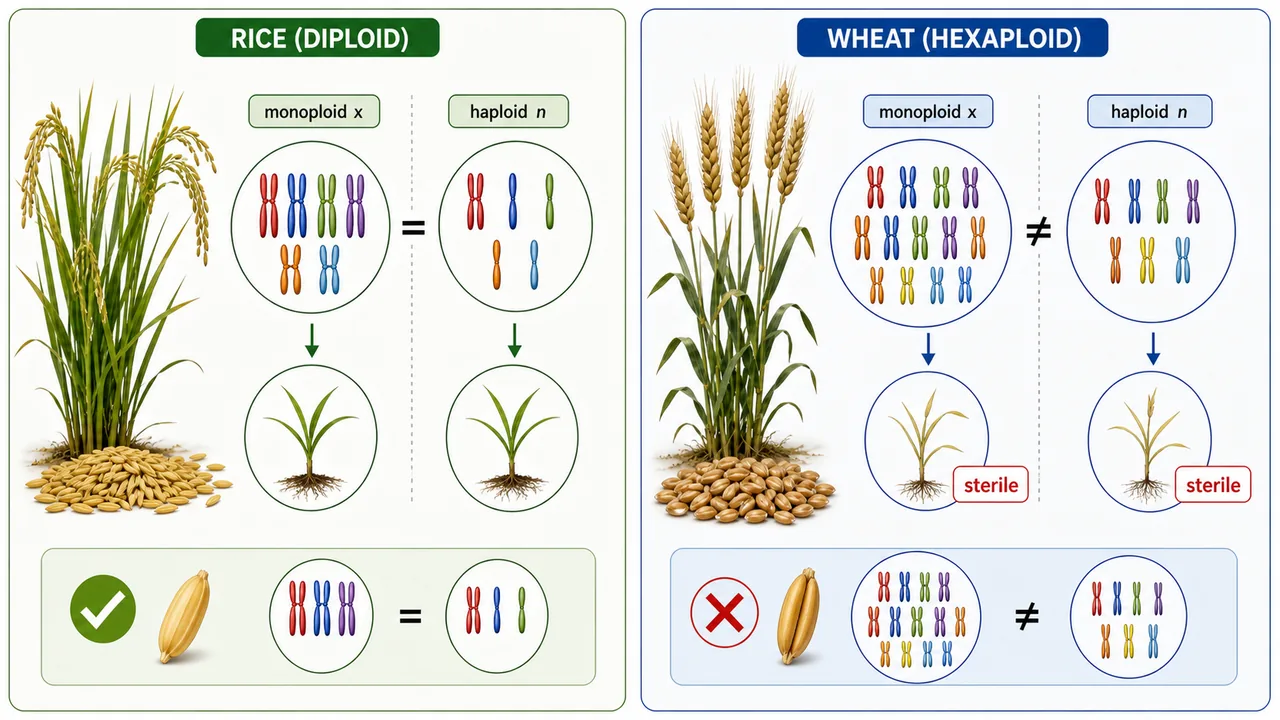
- Contains a single copy of the basic genome (x)
- Characteristically sterile because chromosomes cannot pair during meiosis
- A monoploid can be a haploid, but all haploids cannot be monoploids
- Monoploids are useful for mutation studies and detecting recessive mutations
TIP
Monoploid vs Haploid: In a diploid species (2n = 2x), the haploid (n) equals the monoploid (x). But in a hexaploid like wheat (2n = 6x = 42), the haploid is n = 21 while the monoploid is x = 7. So the haploid is NOT a monoploid here.
Haploid
- Has the gametic chromosome complement (n)
- Haploids are important in plant breeding for:
- Inbred line development
- Production of aneuploids
- Pure line development
- Increasing disease resistance
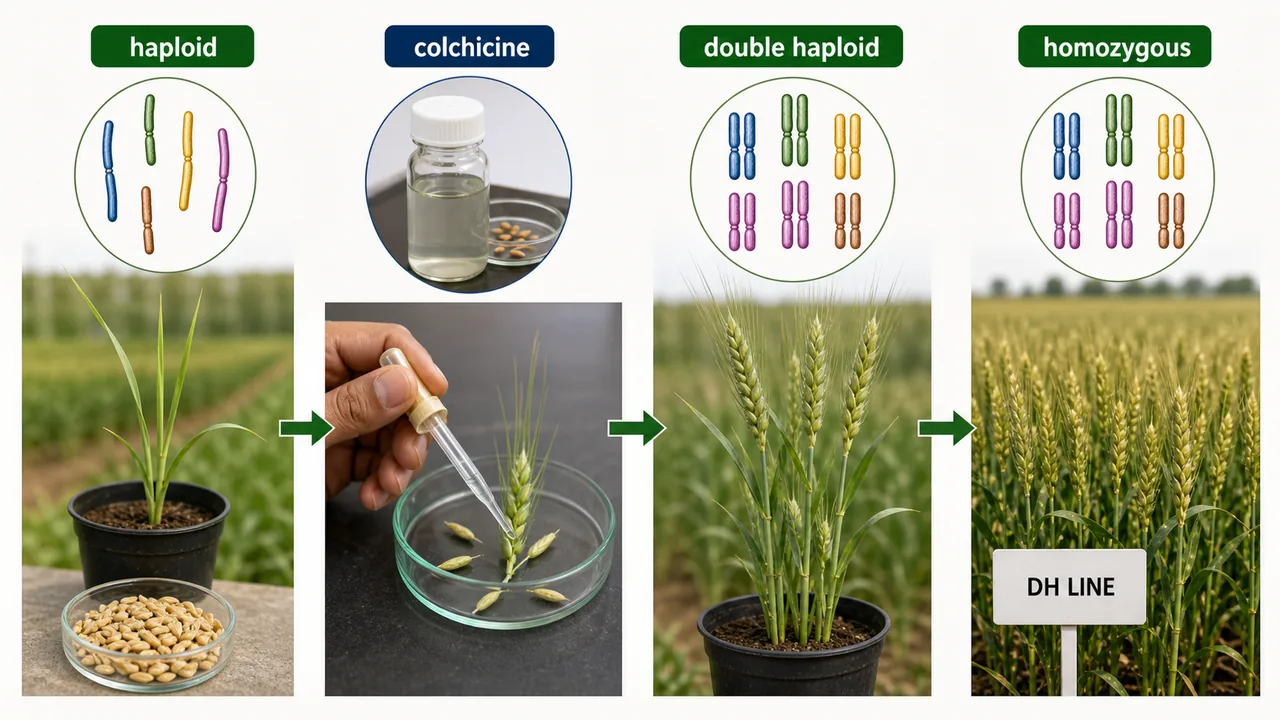
Double Haploid (DH)
- Developed from haploids by doubling chromosomes using Colchicine treatment
- Results in a completely homozygous diploid plant in a single generation
- Widely used in barley, wheat, rice, and rapeseed breeding
NOTE
Double haploid technology drastically reduces the time needed to develop homozygous lines compared to conventional selfing (6–7 generations → 1 generation).
Polyploidy
Polyploids have more than two complete sets of genomes. About 50% of crop plants are polyploid in nature.
Two major types:
| Type | Definition | Genome Formula |
|---|---|---|
| Autopolyploidy | All genomes are identical | AAA (3x), AAAA (4x) |
| Allopolyploidy | Two or more distinct genomes from different species | AABB (4x), AABBDD (6x) |
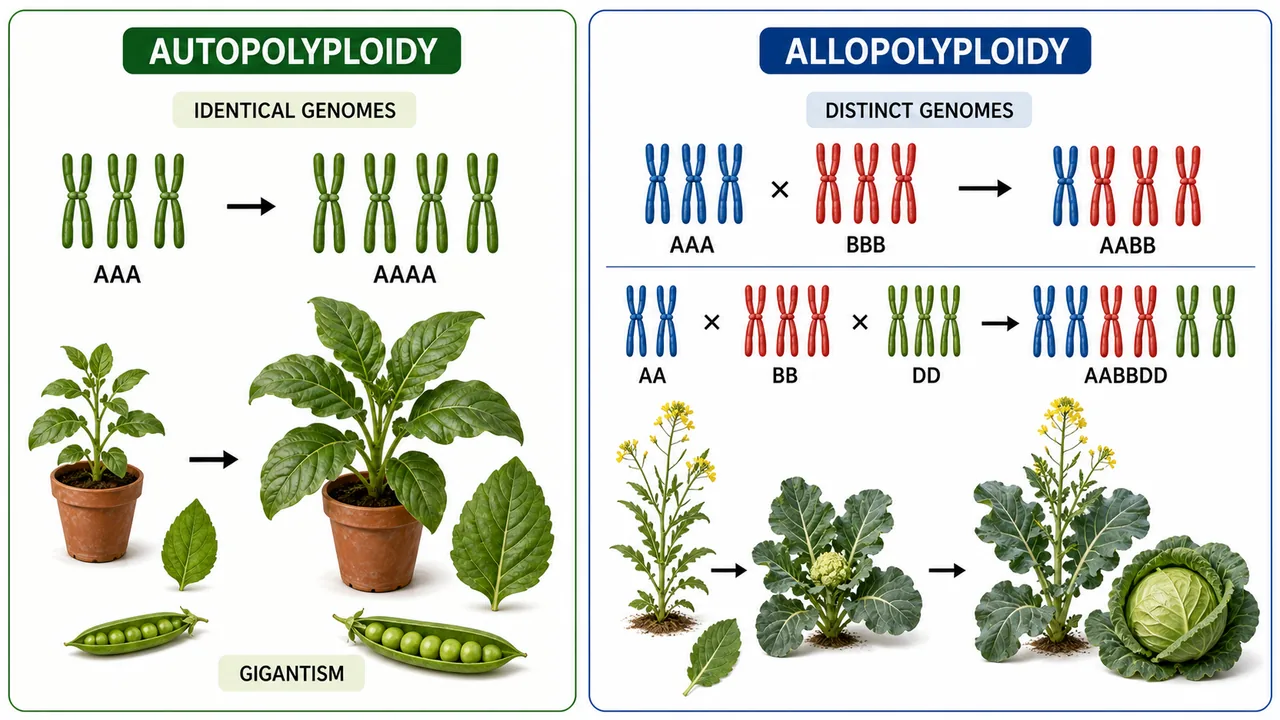
Autopolyploidy
All genomes are identical — derived from the same species. Shows gigantism (increased vigour, larger cell size, larger organs).

Autotriploids (3x)
- Generally sterile due to unequal chromosome segregation during meiosis
- Useful in asexually propagated species
| Crop | Significance |
|---|---|
| Banana | Most cultivated bananas are triploid (3n) — seedless |
| Sugarcane | Triploid varieties exist |
| Watermelon | Triploid = seedless watermelon |
| Sugarbeet | Triploid sugarbeets have larger roots and more sugar content |
| Apple | Some cultivated varieties are triploid |
TIP
Exam favourite: Seedless watermelons are autotriploid (3x). They are produced by crossing autotetraploid (4x) ♀ × diploid (2x) ♂.
Autotetraploids (4x)
- Four copies of the same genome — more stable and fertile than triploids
- Show larger size, thicker leaves, and bigger flowers/fruits
| Crop | Notes |
|---|---|
| Rye | Autotetraploid |
| Grasses | Several forage grasses |
| Alfalfa | Cultivated alfalfa is autotetraploid |
| Berseem (Pusa Giant) | Autotetraploid variety |
| Groundnut | Autotetraploid (4x = 40) |
| Potato | Autotetraploid (4x = 48) |
Allopolyploidy
Contains two or more distinct genomes from different species. Developed through:
- Interspecific hybridization (cross between two species)
- Chromosome doubling of the sterile F₁ hybrid using Colchicine
Colchicine — The Chromosome Doubling Agent
- Obtained from Colchicum autumnale (autumn crocus)
- Inhibits spindle fibre formation during cell division
- Concentration for seed treatment: 0.2%
- Concentration for shoot bud treatment: 0.1%
IMPORTANT
exams asked: Colchicine concentration for shoot bud treatment is 0.1% and for seed treatment is 0.2%. This is a high-frequency exam question.
Important Allopolyploid Crops
| Crop | Ploidy Level | Genome |
|---|---|---|
| Wheat (T. aestivum) | Allohexaploid (6x = 42) | AABBDD |
| Tobacco | Allotetraploid (4x = 48) | TTSS |
| Cotton (G. hirsutum) | Allotetraploid (4x = 52) | AADD |
| Brassica | Allotetraploid | Various (U's Triangle) |
| Oat | Allohexaploid (6x = 42) | AACCDD |
Triticale — The Man-Made Cereal
- Triticale = inter-generic polyploid of Wheat (Triticum aestivum) × Rye (Secale cereale)
- First man-made cereal crop
- Combines the grain quality of wheat with the hardiness of rye
- Used as feed grain and in some regions as food

NOTE
Triticale is the classic example of a successful man-made allopolyploid. It was the first cereal created by humans through deliberate hybridization and chromosome doubling.
Aneuploidy
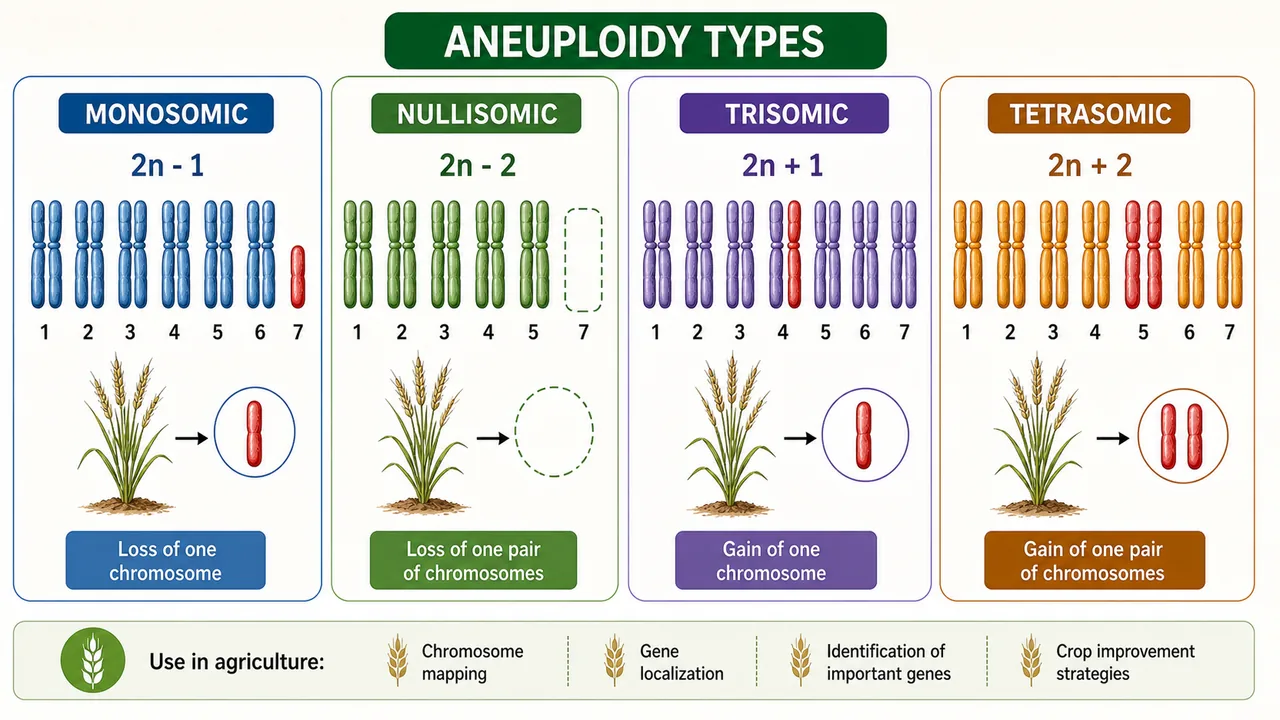
Aneuploids involve the loss or gain of one or a few chromosomes from the normal diploid (2n) number. Unlike euploidy, the change is NOT in complete sets.
Types of Aneuploids
| Term | Type of Change | Symbol |
|---|---|---|
| Monosomic | One chromosome missing from a pair | 2n − 1 |
| Double monosomic | One chromosome missing from each of two different pairs | 2n − 1 − 1 |
| Nullisomic | One entire chromosome pair missing | 2n − 2 |
| Trisomic | One extra chromosome added to a pair | 2n + 1 |
| Double trisomic | One extra chromosome in each of two different pairs | 2n + 1 + 1 |
| Tetrasomic | One extra chromosome pair added | 2n + 2 |
TIP
Memory trick for aneuploids:
- Mono = one less (2n−1), Nulli = pair gone (2n−2)
- Tri = one more (2n+1), Tetra = pair extra (2n+2)
- "Double" versions affect two different pairs simultaneously
Applications of Aneuploids
- Monosomics are used for locating genes on specific chromosomes
- Nullisomics are used to study the effect of loss of a chromosome pair
- Trisomics are used for gene mapping and chromosome identification
- In wheat, Sears (1954) developed the complete set of monosomic and nullisomic lines
Comprehensive Summary: Heteroploidy
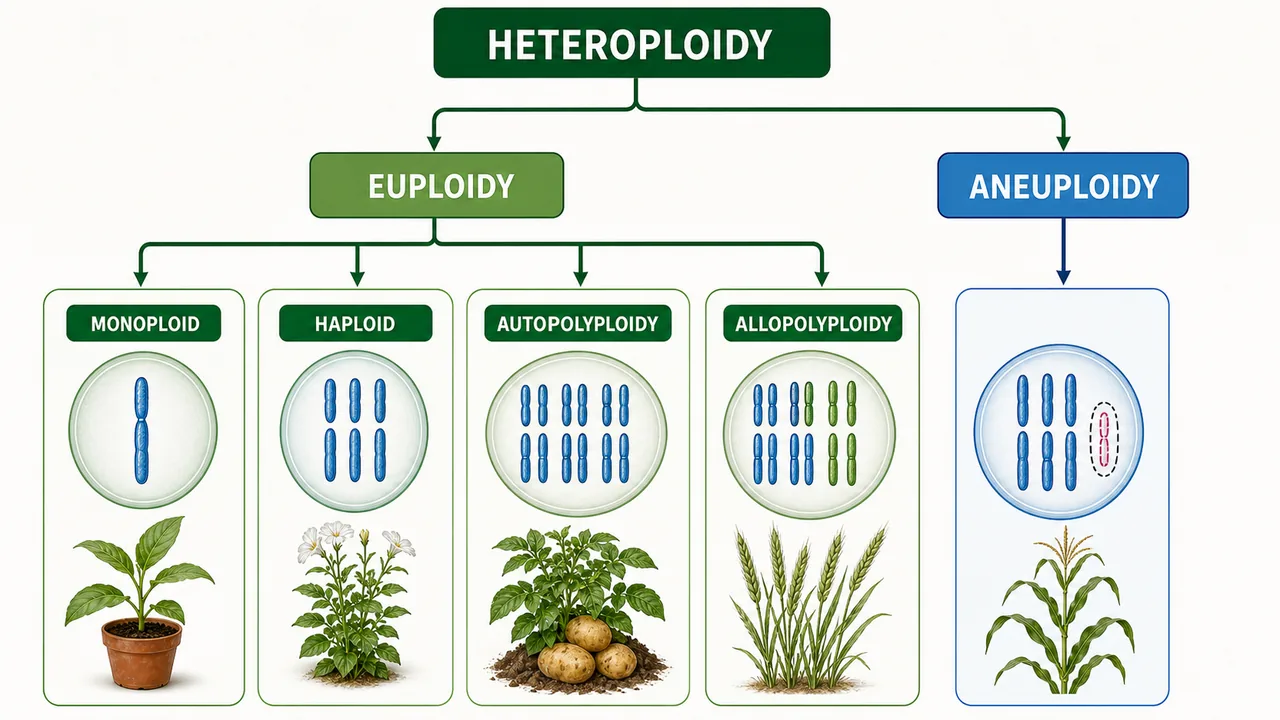
| Term | Type of Change | Symbol |
|---|---|---|
| Heteroploid | A change from 2x | — |
| Aneuploid | One or few chromosomes extra or missing from 2n | 2n ± few |
| Euploid | Number of genomes more or less than two | — |
| Monoploid | One copy of single genome | x |
| Haploid | Gametic chromosome complement | n |
| Autopolyploid | Genomes identical | — |
| Autotriploidy | Three copies of one genome | 3x |
| Autotetraploid | Four copies | 4x |
| Autopentaploid | Five copies | 5x |
| Autohexaploid | Six copies | 6x |
| Auto-octaploid | Eight copies | 8x |
| Allopolyploid | Two or more distinct genomes | (2x₁ + 2x₂) |
| Allotetraploid | Two distinct genomes | — |
| Allohexaploid | Three distinct genomes | 2x₁ + 2x₂ + 2x₃ |
| Allo-octaploid | Four distinct genomes | — |
Key Exam Points — Quick Revision
IMPORTANT
High-frequency questions for exams, NABARD, ICAR:
- Colchicine is obtained from Colchicum autumnale and inhibits spindle fibre formation
- Bread wheat (T. aestivum) is an allohexaploid with genome AABBDD
- Triticale = Wheat × Rye — first man-made cereal
- Seedless watermelon = autotriploid (3x)
- Cultivated banana = triploid
- Potato and groundnut = autotetraploid
- About 50% of crop plants are polyploid
- Monosomics (2n−1) used for gene location on chromosomes
- Berseem Pusa Giant = autotetraploid variety
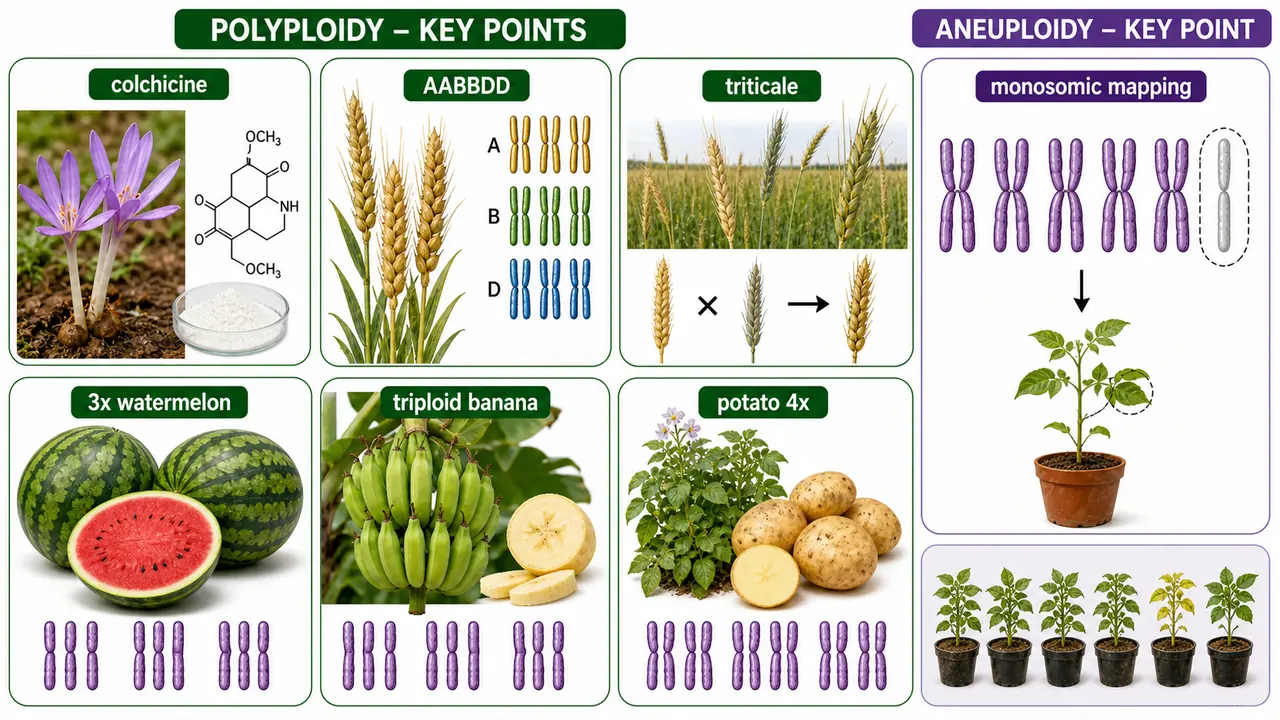
Summary Cheat Sheet
| Concept / Topic | Key Details / Explanation |
|---|---|
| Genome (x) | Basic / monoploid chromosome set containing all genetic information of an organism |
| 2n vs n vs x | 2n = somatic number; n = gametic number; x = basic number; in diploids: 2n=2x, n=x |
| Polyploidy prevalence | ~50% of all crop plants are polyploid |
| Monoploid | Contains single copy of basic genome (x); sterile due to lack of chromosome pairing |
| Monoploid vs Haploid | In diploids they are equal; in hexaploid wheat (2n=6x=42): haploid n=21 ≠ monoploid x=7 |
| Haploid uses | Inbred line development, aneuploid production, pure line development, disease resistance studies |
| Double Haploid (DH) | Haploid chromosomes doubled with colchicine → completely homozygous diploid in one generation |
| Autopolyploidy | All genomes identical (same species); shows gigantism (larger cells, organs, vigour) |
| Allopolyploidy | Two or more distinct genomes from different species; produced by interspecific hybridization + colchicine doubling |
| Autotriploid (3x) | Generally sterile; useful in asexually propagated crops; e.g., Banana, Seedless Watermelon, Sugarbeet, Apple |
| Seedless watermelon production | Autotetraploid (4x) ♀ × Diploid (2x) ♂ → triploid (3x) |
| Autotetraploid (4x) crops | Rye, Alfalfa, Berseem (Pusa Giant), Groundnut (4x=40), Potato (4x=48) |
| Colchicine source | Colchicum autumnale (autumn crocus) |
| Colchicine mechanism | Inhibits spindle fibre formation during cell division → chromosome doubling |
| Colchicine — seed treatment | 0.2% concentration |
| Colchicine — shoot bud treatment | 0.1% concentration |
| Wheat (T. aestivum) | Allohexaploid; 2n = 6x = 42; genome AABBDD |
| Tobacco | Allotetraploid; 2n = 4x = 48; genome TTSS |
| Cotton (G. hirsutum) | Allotetraploid; 2n = 4x = 52; genome AADD |
| Oat | Allohexaploid; 2n = 6x = 42; genome AACCDD |
| Triticale | Wheat (T. aestivum) × Rye (Secale cereale); first man-made cereal; combines grain quality of wheat with hardiness of rye |
| Monosomic (2n−1) | One chromosome missing from a pair; used for locating genes on specific chromosomes |
| Double Monosomic (2n−1−1) | One chromosome missing from each of two different pairs |
| Nullisomic (2n−2) | One entire chromosome pair missing; used to study effect of chromosome pair loss |
| Trisomic (2n+1) | One extra chromosome added to a pair; used for gene mapping |
| Double Trisomic (2n+1+1) | One extra chromosome in each of two different pairs |
| Tetrasomic (2n+2) | One extra chromosome pair added |
| Sears (1954) | Developed complete set of monosomic and nullisomic lines in wheat |
| Cultivated Banana | Triploid (3n) — seedless |
| Potato | Autotetraploid (4x = 48) |
| Groundnut | Autotetraploid (4x = 40) |
| Berseem Pusa Giant | Autotetraploid variety |