🧩 Chromosomal Aberrations: Deletion, Duplication, Translocation, Inversion
Understand structural chromosomal aberrations — deletion, duplication, translocation, and inversion — with agricultural examples, comparison tables, and exam tips.
Why Chromosomal Aberrations Matter in Agriculture
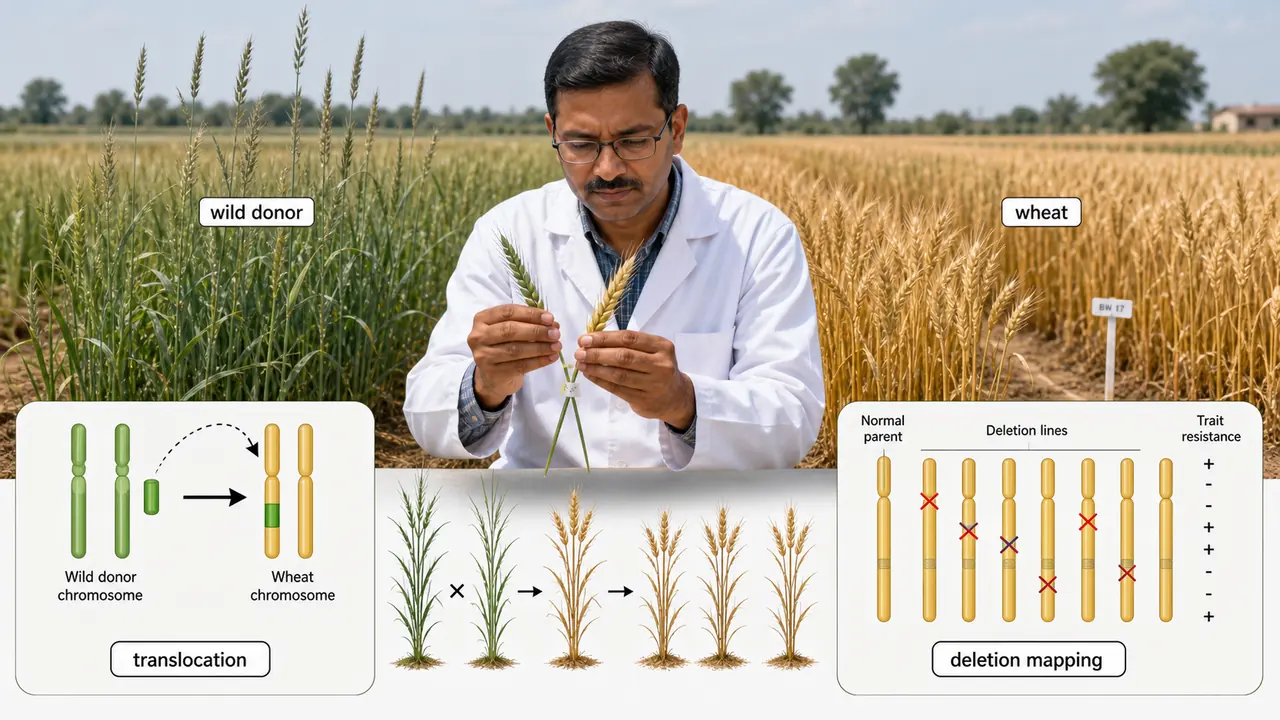
When wheat breeders transfer a disease-resistance gene from a wild grass species into cultivated wheat, they use translocations — moving a chromosome segment from one species into another. When researchers use deletion stocks of wheat to locate genes on specific chromosomes, they are exploiting chromosomal aberrations as mapping tools. And when inversions suppress crossing over in a chromosome region, breeders must account for this when trying to break undesirable linkages. Understanding these structural changes is essential for advanced crop improvement.
IMPORTANT
Any change that alters the normal structure of a chromosome is called a structural chromosomal aberration. These changes involve rearrangement, loss, or gain of chromosome segments — not changes in individual genes.
- Chromosomal aberrations are broadly classified into two categories:
- Structural aberrations — changes in chromosome structure (this lesson)
- Numerical aberrations — changes in chromosome number (euploidy, aneuploidy)
- Structural aberrations arise due to breakage and reunion of chromosome segments during cell division, radiation exposure, or chemical mutagen treatment.
- Four types of structural aberrations: Deletion, Duplication, Translocation, Inversion
TIP
Pro Content Locked
Upgrade to Pro to access this lesson and all other premium content.
Charged once for one year · ₹1188 total
Save ₹100/month vs ₹2388/year launch price
- All Agriculture & Banking Courses
- AI Lesson Questions (100/day)
- AI Doubt Solver (50/day)
- Glows & Grows Feedback (30/day)
- AI Section Quiz (20/day)
- 22-Language Translation (100/day)
- Recall Questions (20/day)
- AI Quiz (15/day)
- AI Quiz Paper Analysis (100/day)
- AI Step-by-Step Explanations (100/day)
- Spaced Repetition Recall (FSRS)
- AI Tutor
- Immersive Text Questions
- Audio Lessons — Hindi & English
- Mock Tests & Previous Year Papers
- Summary & Mind Maps
- XP, Levels, Leaderboard & Badges
- Generate New Classrooms
- Voice AI Teacher (AgriDots Live)
- AI Revision Assistant
- Knowledge Gap Analysis
- Interactive Revision (LangGraph)
🔒 Secure one-time yearly payment via Razorpay · No hidden fees
Why Chromosomal Aberrations Matter in Agriculture
When wheat breeders transfer a disease-resistance gene from a wild grass species into cultivated wheat, they use translocations — moving a chromosome segment from one species into another. When researchers use deletion stocks of wheat to locate genes on specific chromosomes, they are exploiting chromosomal aberrations as mapping tools. And when inversions suppress crossing over in a chromosome region, breeders must account for this when trying to break undesirable linkages. Understanding these structural changes is essential for advanced crop improvement.
IMPORTANT
Any change that alters the normal structure of a chromosome is called a structural chromosomal aberration. These changes involve rearrangement, loss, or gain of chromosome segments — not changes in individual genes.
- Chromosomal aberrations are broadly classified into two categories:
- Structural aberrations — changes in chromosome structure (this lesson)
- Numerical aberrations — changes in chromosome number (euploidy, aneuploidy)
- Structural aberrations arise due to breakage and reunion of chromosome segments during cell division, radiation exposure, or chemical mutagen treatment.
- Four types of structural aberrations: Deletion, Duplication, Translocation, Inversion
TIP
Memory aid — "DDTI": Think Delete, Duplicate, Translocate, Invert — or remember "DDT + I" (DDT is the famous pesticide + Inversion).
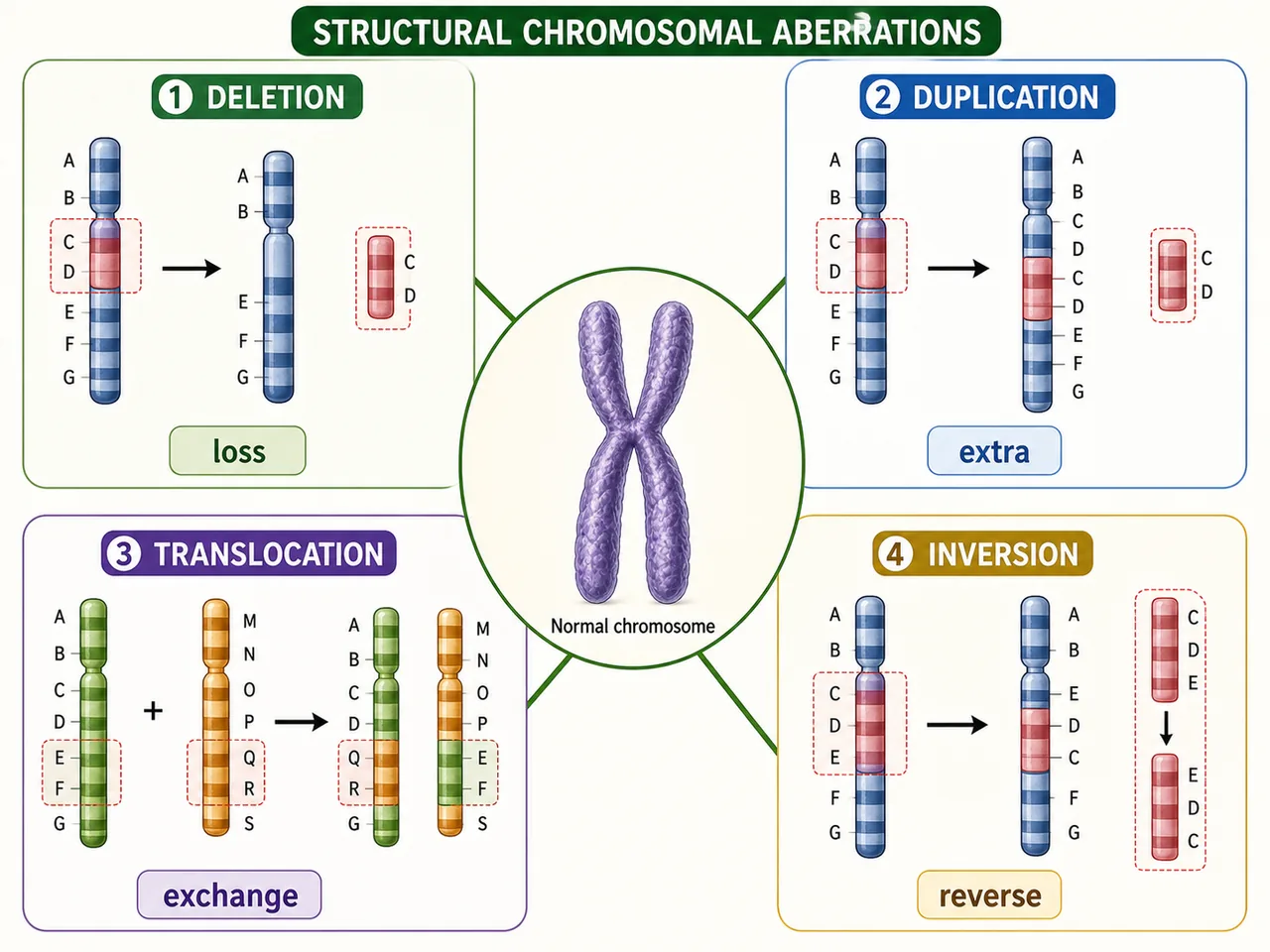
A. Deletion (Deficiency)
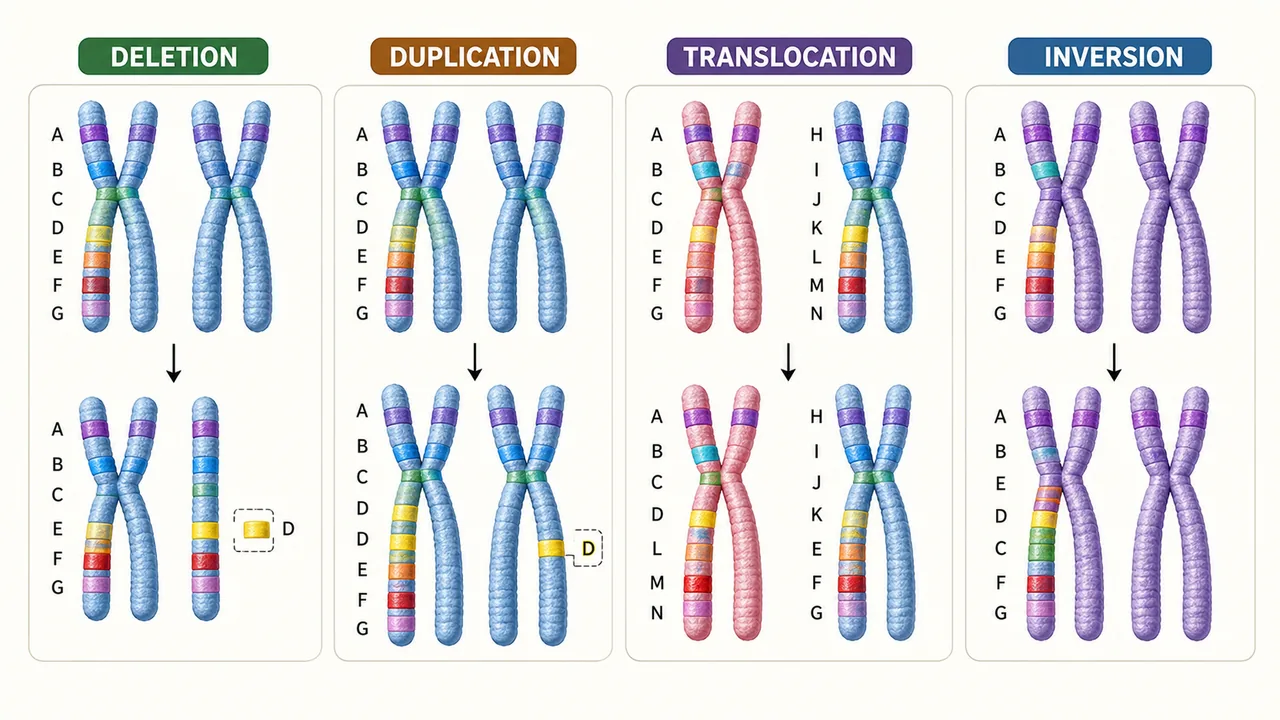
- Definition: Loss of a segment of a chromosome. The missing segment may be terminal (at the end) or intercalary (from the middle).
- Deletions play an important role in species formation and releasing variability through mutations.
- Deletions are important cytological tools for mapping genes — by observing the phenotypic effects of losing specific chromosome segments, researchers can locate genes on chromosomes.
- Generally harmful to the organism because essential genetic information is lost.
- Homozygous deletions are usually lethal — loss of the same segment from both homologous chromosomes eliminates critical genes entirely.
- In heterozygous condition, deletion may cause pseudo-dominance — a recessive allele on the normal homologue is expressed because there is no corresponding dominant allele on the deleted chromosome.
NOTE
Pseudo-dominance is a classic exam concept: when a deletion unmasks a recessive allele on the other chromosome, the recessive phenotype appears even though the organism is not homozygous recessive.

B. Duplication (Repeat)
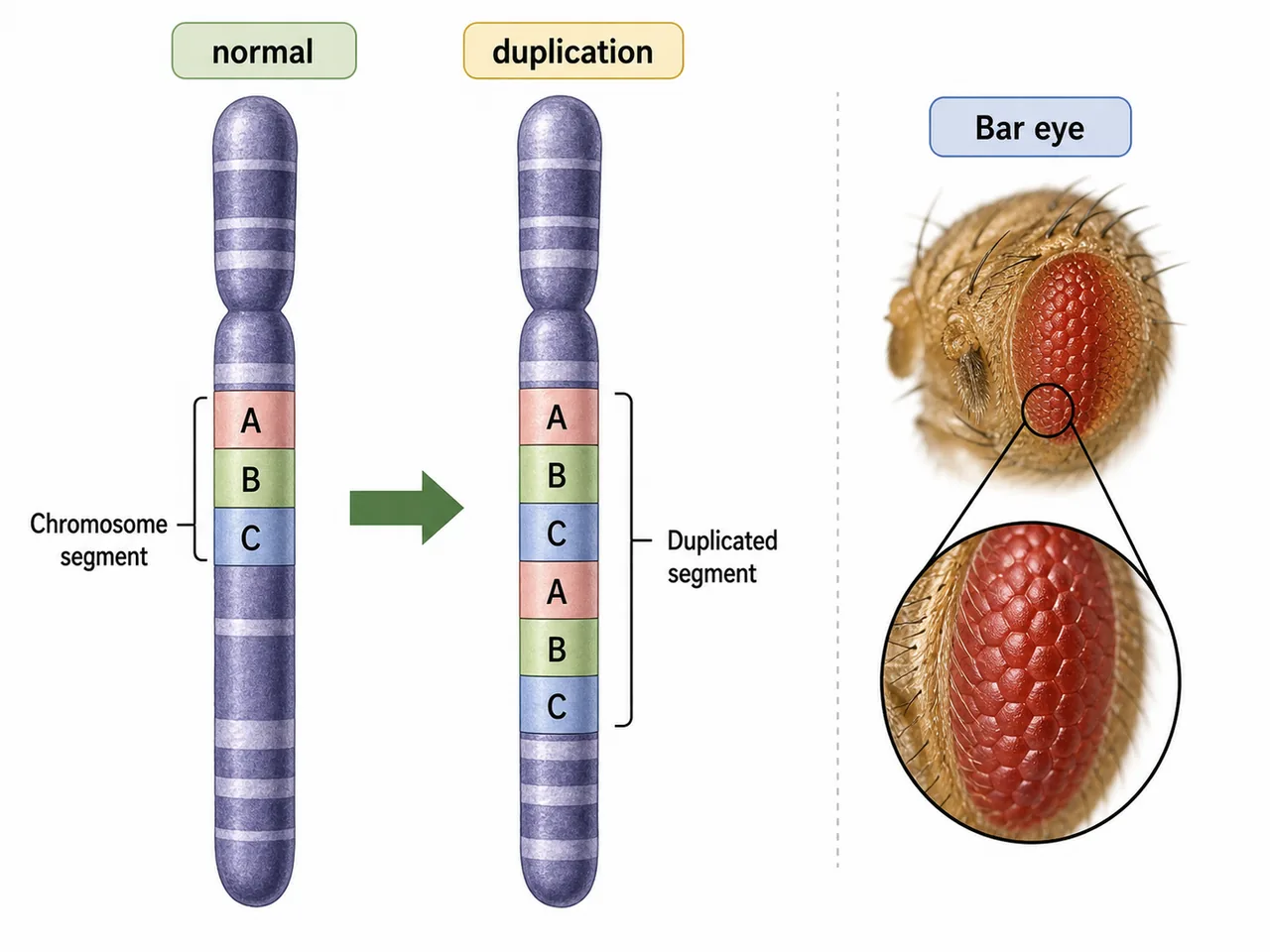
- Definition: A chromosome segment is present in more than two copies in the same nucleus, resulting in the addition of one or more genes to a chromosome.
- Duplications are less harmful than deletions — extra genetic material is generally better tolerated than missing material.
- Do not significantly reduce viability of the individual.
- Lead to addition of some genes in the population, which can serve as raw material for evolution — duplicated genes are free to accumulate mutations and potentially evolve new functions.
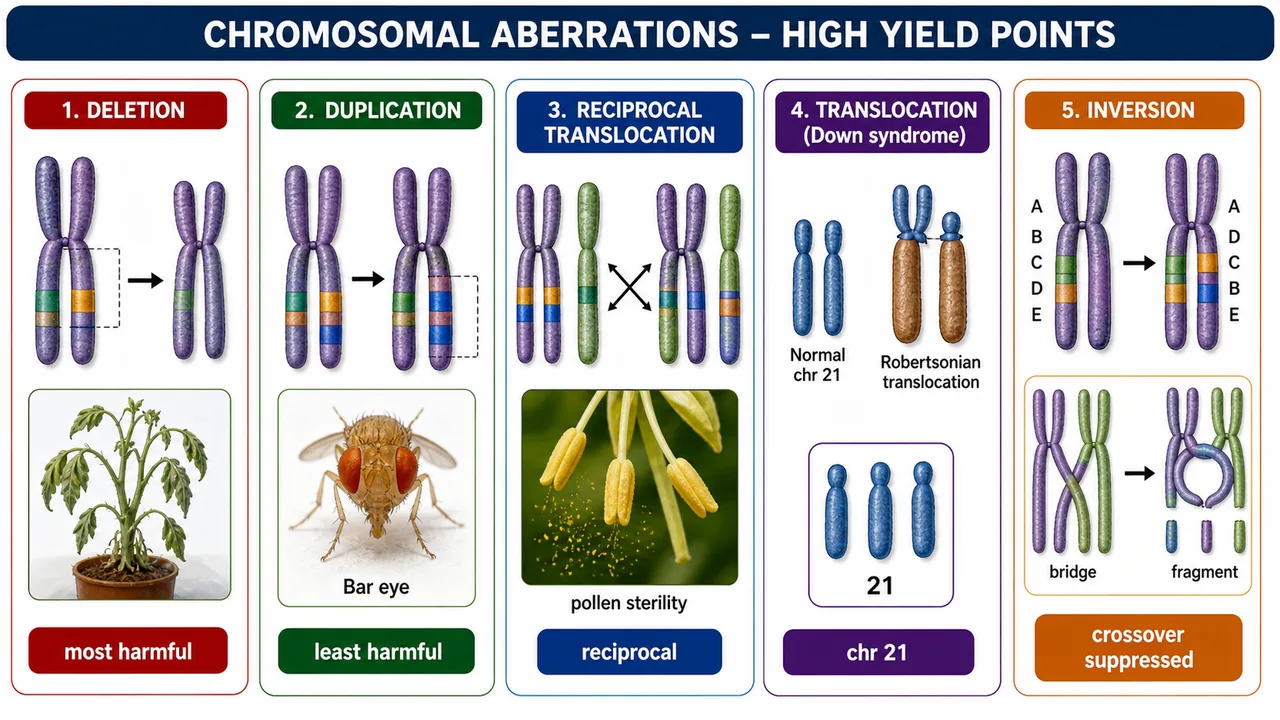
- Bar eye in Drosophila is a classic example of duplication — the 16A region of the X chromosome is duplicated, reducing the number of facets in the compound eye.
TIP
Exam favourite: Bar eye in Drosophila = Duplication. Double Bar = further duplication of the same segment. Remember: "Bar = Extra copy = Duplication."
- Types of duplication based on position:
- Tandem duplication — duplicated segment lies adjacent to the original segment in the same order
- Reverse tandem — duplicated segment is adjacent but in reverse order
- Displaced duplication — duplicated segment is located elsewhere on the same chromosome
- Transposed duplication — duplicated segment is located on a different chromosome
C. Translocation
- Definition: Transfer of a chromosome segment from one chromosome to a non-homologous chromosome. This can be one-way (simple) or reciprocal (mutual exchange between two non-homologous chromosomes).
- Reciprocal translocation is the most common type — segments are exchanged between two non-homologous chromosomes.
- Translocations can alter both chromosome size and effectively chromosome number (through Robertsonian translocations / centric fusions).
- Play an important role in species formation and evolution.
- Useful tools in breeding programmes for transfer of desirable characters from one species to another — e.g., transfer of disease resistance genes from wild species to cultivated crops.

IMPORTANT
Translocation in humans — Down Syndrome (Mongolism): Progeny of a heterozygous individual for a translocation involving chromosome 21 can result in Down syndrome. This is called translocation Down syndrome (as opposed to the more common trisomy 21) and accounts for about 3-4% of Down syndrome cases.
- Semi-sterility is a characteristic feature of translocation heterozygotes — during meiosis, the translocated chromosomes form a ring or chain of four (quadrivalent), and alternate vs. adjacent segregation determines fertility.
- Translocation heterozygotes show ~50% pollen sterility — this is a diagnostic feature used to detect translocations in plant breeding.
D. Inversion
- Definition: A structural change in which a chromosome segment is rotated 180° (oriented in reverse order). The gene order is changed within the inverted segment, but no genetic material is lost or gained.
- Two types based on centromere position:
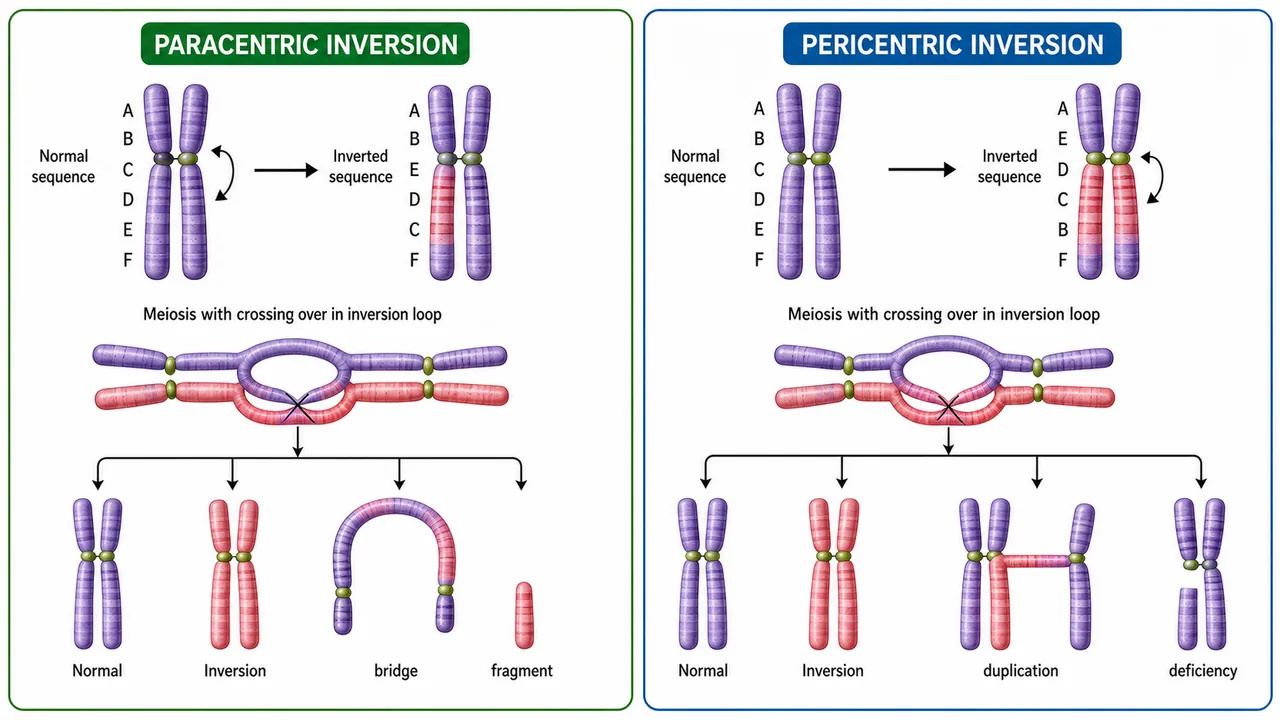
- Paracentric inversion — inverted segment does NOT include the centromere (both breaks on the same arm)
- Pericentric inversion — inverted segment includes the centromere (breaks on both arms)
TIP
Memory aid: Para = beside (centromere is beside, not inside the inversion). Peri = around (the inversion wraps around the centromere, including it).
- Inversions suppress crossing over in heterozygotes — in inversion heterozygotes, recombinant chromosomes produced by crossing over within the inverted region are unbalanced (deficient or duplicated), so recombinant gametes are inviable.
- In paracentric inversion heterozygotes, crossing over within the inverted segment produces a dicentric bridge and an acentric fragment during anaphase I — both are lost, so only non-crossover chromatids produce viable gametes.
- In pericentric inversion heterozygotes, crossing over within the inverted segment produces chromatids with duplications and deficiencies — these are also inviable.
- Because inversions suppress recombination, they act as "crossover suppressors" — this property is exploited in genetics research (e.g., balancer chromosomes in Drosophila).
- Inversions do not usually affect the phenotype of the organism unless the breakpoints disrupt a gene or cause a position effect.
Comparison Table
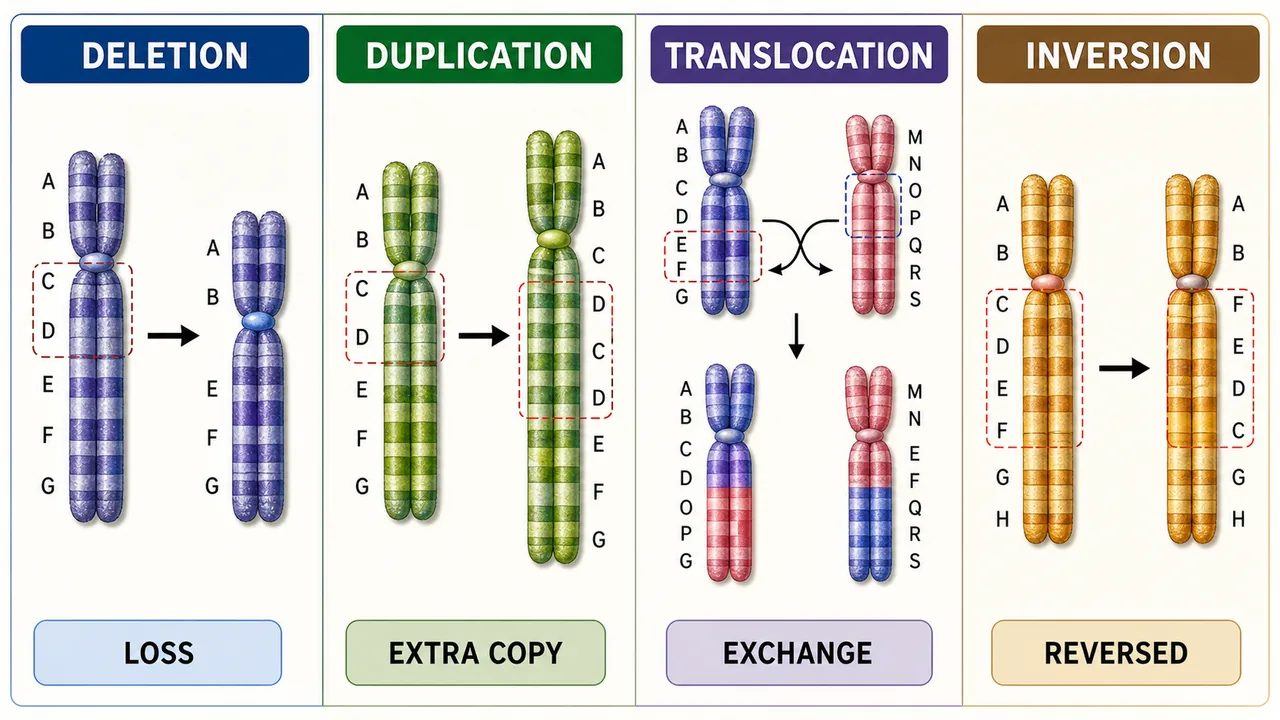
| Feature | Deletion | Duplication | Translocation | Inversion |
|---|---|---|---|---|
| Change | Loss of segment | Extra copy of segment | Transfer between non-homologous chromosomes | Segment reversed 180° |
| Gene number | Decreased | Increased | Usually unchanged | Unchanged |
| Gene order | Unchanged (remaining) | May change | Changed across chromosomes | Reversed in segment |
| Harmful? | Most harmful | Least harmful | Moderate | Usually neutral |
| Homozygous effect | Usually lethal | Viable | Viable | Viable |
| Classic example | Pseudo-dominance | Bar eye (Drosophila) | Down syndrome (chr. 21) | Crossover suppression |
| Breeding use | Gene mapping | Gene evolution | Alien gene transfer | Crossover suppression |
Key Points for Competitive Exams
IMPORTANT
Most frequently asked facts:
- Deletion is the most harmful structural aberration; duplication is the least harmful
- Bar eye in Drosophila = Duplication
- Translocation Down syndrome involves chromosome 21
- Reciprocal translocation is the most common type of translocation
- Inversions act as crossover suppressors
- Paracentric inversion → dicentric bridge + acentric fragment
- Pericentric inversion → duplications and deficiencies in crossover products
- Homozygous deletion = usually lethal
- Deletion causes pseudo-dominance
- Translocation heterozygotes show ~50% pollen sterility
- Deletions are used as cytological tools for gene mapping
- Translocations are used in breeding for alien gene transfer
Summary Table
| Topic | Key Fact | Exam Pointer |
|---|---|---|
| Four types | Deletion, Duplication, Translocation, Inversion | Mnemonic: "DDT + I" |
| Most harmful | Deletion (loss of genetic material) | Homozygous deletion = usually lethal |
| Least harmful | Duplication (extra copy) | Bar eye in Drosophila |
| Pseudo-dominance | Caused by deletion | Recessive allele expressed when dominant is deleted |
| Reciprocal translocation | Most common translocation type | ~50% pollen sterility in heterozygotes |
| Down syndrome | Translocation involving chromosome 21 | 3–4% of Down syndrome cases |
| Paracentric inversion | Does NOT include centromere | Dicentric bridge + acentric fragment |
| Pericentric inversion | Includes centromere | Duplications and deficiencies in CO products |
| Crossover suppression | Inversions suppress CO in inverted region | Used in balancer chromosomes (Drosophila) |
| Agricultural use | Translocations for alien gene transfer; deletions for gene mapping | Wheat breeding widely uses both |
Summary Cheat Sheet
| Concept / Topic | Key Details |
|---|---|
| Chromosomal aberrations | Structural changes in chromosomes; 4 types: DDT + I |
| Deletion (Deficiency) | Loss of chromosome segment; most harmful |
| Homozygous deletion | Usually lethal |
| Pseudo-dominance | Caused by deletion; recessive allele expressed when dominant is deleted |
| Duplication (Repeat) | Extra copy of chromosome segment; least harmful |
| Duplication example | Bar eye in Drosophila (16A region duplicated) |
| Translocation | Transfer of segment to a non-homologous chromosome |
| Reciprocal translocation | Most common type; causes ~50% pollen sterility in heterozygotes |
| Translocation & Down syndrome | 3–4% of Down syndrome cases involve translocation of chromosome 21 |
| Inversion | 180° rotation of a chromosome segment |
| Paracentric inversion | Does NOT include centromere → dicentric bridge + acentric fragment |
| Pericentric inversion | Includes centromere → duplications & deficiencies in crossover products |
| Inversions suppress | Crossing over in the inverted region |
| Agricultural use of translocations | Alien gene transfer (e.g., wheat breeding) |
| Agricultural use of deletions | Gene mapping |