🦚 Types of Reproduction in Crop Plants
Understand asexual and sexual reproduction in crops, their genetic consequences, and how they determine breeding strategy — with agricultural examples and exam tips.
Why Reproduction Type Matters in Agriculture
When a sugarcane breeder propagates a promising variety through stem cuttings (asexual reproduction), every plant is genetically identical to the parent — maintaining varietal purity. But when a wheat breeder wants to create new combinations, they rely on sexual reproduction through hybridisation. The mode of reproduction determines the genetic structure of a crop population and directly dictates which breeding methods are appropriate.
- Mode of reproduction determines the genetic constitution of crop plants, that is, whether the plants are normally homozygous or heterozygous. This, in turn, determines the goal of a breeding programme. Understanding reproduction is therefore the starting point for designing any crop improvement strategy.
- The modes of reproduction in crop plants may be broadly grouped into two categories, asexual and sexual.
Asexual Reproduction
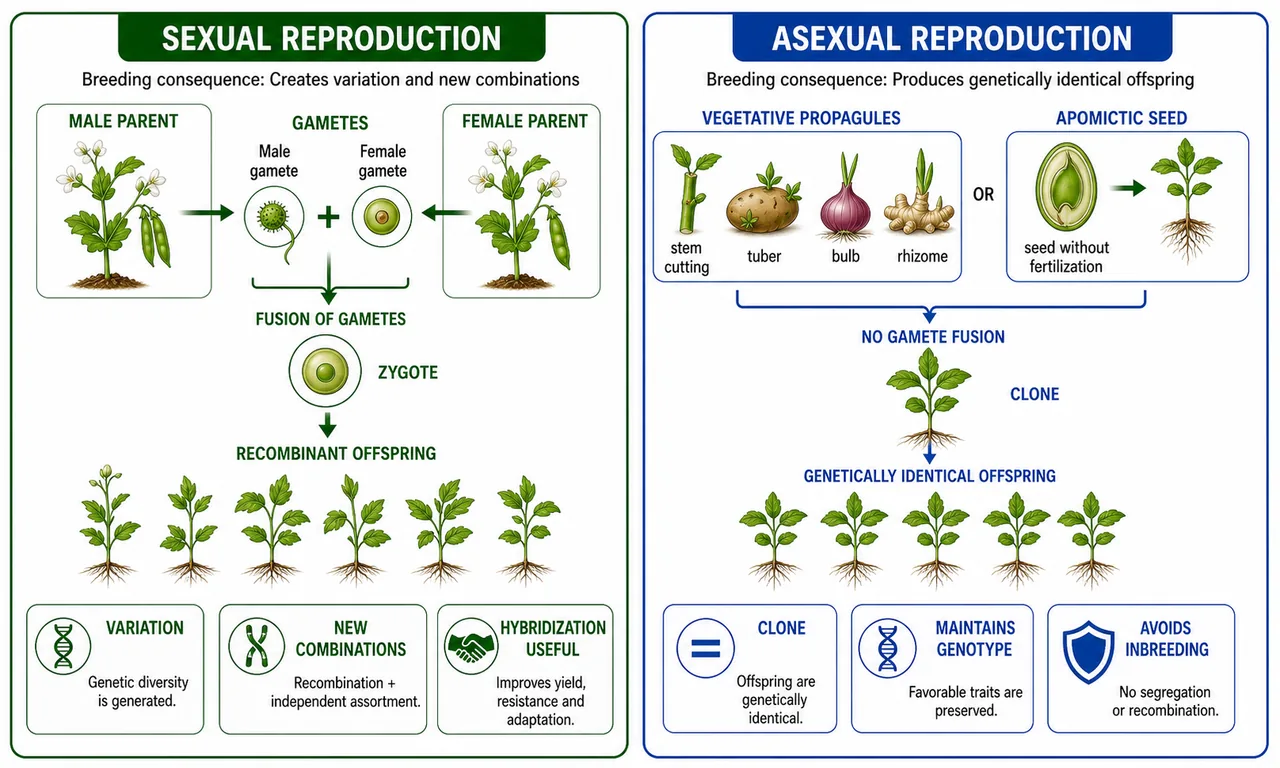
- A sexual reproduction does not involve fusion of male and female gametes. Instead, new individuals are produced from the vegetative parts of the parent plant or from seeds formed without fertilization. The offspring are genetically identical to the parent, making asexual reproduction a powerful tool for maintaining desirable genotypes.
- New plants may develop from vegetative parts of the plant (vegetative reproduction) or may arise from embryos that develop without fertilization (apomixis).
NOTE
Pro Content Locked
Upgrade to Pro to access this lesson and all other premium content.
Charged once for one year · ₹1188 total
Save ₹100/month vs ₹2388/year launch price
- All Agriculture & Banking Courses
- AI Lesson Questions (100/day)
- AI Doubt Solver (50/day)
- Glows & Grows Feedback (30/day)
- AI Section Quiz (20/day)
- 22-Language Translation (100/day)
- Recall Questions (20/day)
- AI Quiz (15/day)
- AI Quiz Paper Analysis (100/day)
- AI Step-by-Step Explanations (100/day)
- Spaced Repetition Recall (FSRS)
- AI Tutor
- Immersive Text Questions
- Audio Lessons — Hindi & English
- Mock Tests & Previous Year Papers
- Summary & Mind Maps
- XP, Levels, Leaderboard & Badges
- Generate New Classrooms
- Voice AI Teacher (AgriDots Live)
- AI Revision Assistant
- Knowledge Gap Analysis
- Interactive Revision (LangGraph)
🔒 Secure one-time yearly payment via Razorpay · No hidden fees
Why Reproduction Type Matters in Agriculture
When a sugarcane breeder propagates a promising variety through stem cuttings (asexual reproduction), every plant is genetically identical to the parent — maintaining varietal purity. But when a wheat breeder wants to create new combinations, they rely on sexual reproduction through hybridisation. The mode of reproduction determines the genetic structure of a crop population and directly dictates which breeding methods are appropriate.
- Mode of reproduction determines the genetic constitution of crop plants, that is, whether the plants are normally homozygous or heterozygous. This, in turn, determines the goal of a breeding programme. Understanding reproduction is therefore the starting point for designing any crop improvement strategy.
- The modes of reproduction in crop plants may be broadly grouped into two categories, asexual and sexual.
Asexual Reproduction
- A sexual reproduction does not involve fusion of male and female gametes. Instead, new individuals are produced from the vegetative parts of the parent plant or from seeds formed without fertilization. The offspring are genetically identical to the parent, making asexual reproduction a powerful tool for maintaining desirable genotypes.
- New plants may develop from vegetative parts of the plant (vegetative reproduction) or may arise from embryos that develop without fertilization (apomixis).
NOTE
Asexual reproduction has two distinct pathways: vegetative reproduction (from plant body parts) and apomixis (seeds formed without fertilization). Both produce offspring genetically identical to the parent.
Vegetative Reproduction
- In nature, a new plant develops from a portion of the plant body. This is the simplest form of asexual reproduction and is exploited commercially in many crop species.
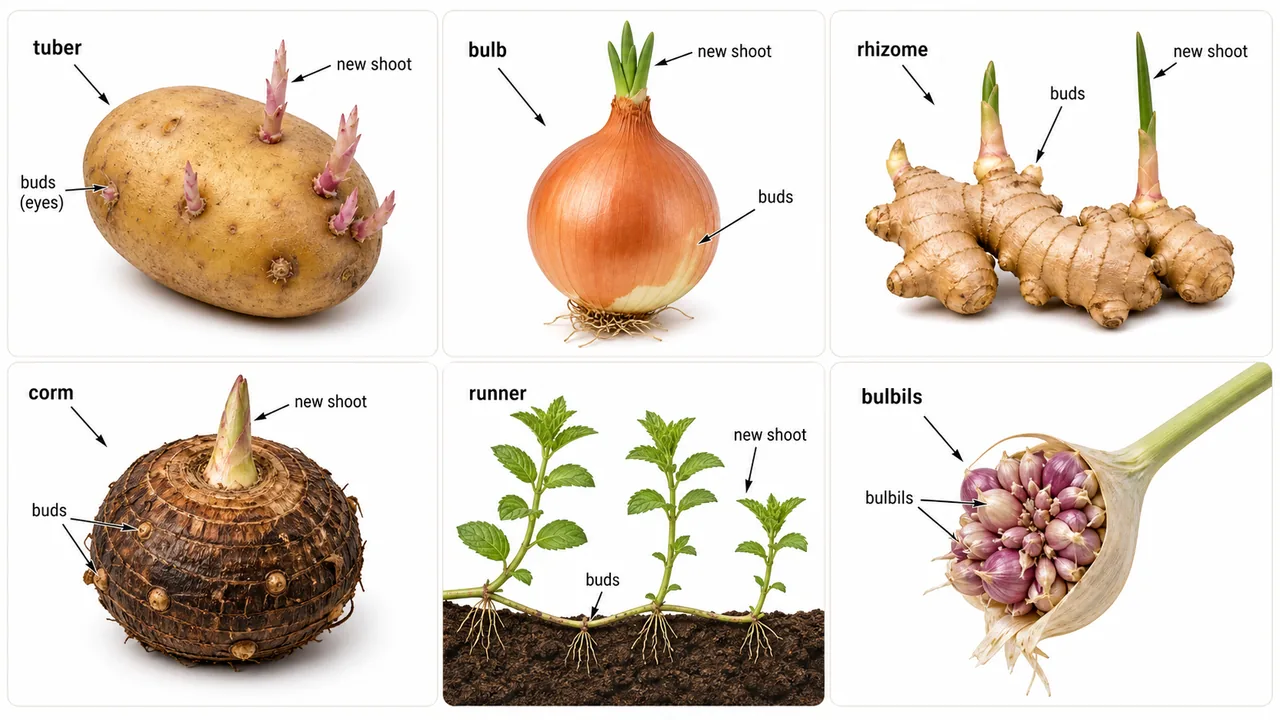
- This may occur through modified underground and sub-aerial stems, and through bulbills.
Underground Stems
- The underground modifications of stem generally serve as storage organs and contain many buds. These buds store energy and nutrients, enabling them to sprout into new plants under favourable conditions.
- These buds develop into shoots and produce plants after rooting.
- Examples:
- Tuber: Potato
- Bulb: Onion, Garlic
- Rhizome: Ginger, Turmeric
- Corm: Bunda, Arwi
Sub-aerial Stems
- These modifications include runner, stolon, sucker etc.
- Sub-aerial stems are used for the propagation of mint, date palm etc.
Bulbils
- Bulbils are modified flowers that develop into plants directly without formation of seeds. This is a fascinating example of how plants can bypass the sexual cycle entirely.
- These are vegetative bodies; their development does not involve fertilization and seed formation.
- The lower flowers in the inflorescence of garlic naturally develop into bulbils.
- Scientists are trying to induce bulbil development in plantation crops by culturing young inflorescence on tissue culture media; it has been successfully done in the case of cardamom.
Artificial Vegetative Reproduction
- It is commonly used for the propagation of many crop species, although it may not occur naturally in those species. Artificial vegetative reproduction allows breeders to multiply any desired genotype regardless of its reproductive biology.
- Stem cuttings are commercially used for the propagation of sugarcane, grapes, roses, etc. Layering, budding, grafting and gootee are in common use for the propagation of fruit trees and ornamental shrubs. Techniques are available for vegetative multiplication through tissue culture in case of many plant species, and attempts are being made to develop the techniques for many others. In many of these species sexual reproduction occurs naturally but for certain reasons vegetative reproduction is more desirable.
Significance of Vegetative Reproduction
- Vegetative reproducing species offer unique possibilities in breeding. A desirable plant may be used as a variety directly regardless of whether it is homozygous or heterozygous. This is a major advantage because it means the breeder does not need to achieve homozygosity before releasing a variety.
- Further, mutant buds, branches or seedlings, if desirable, can be multiplied and directly used as varieties. This makes vegetative propagation an excellent complement to mutation breeding.
Apomixis
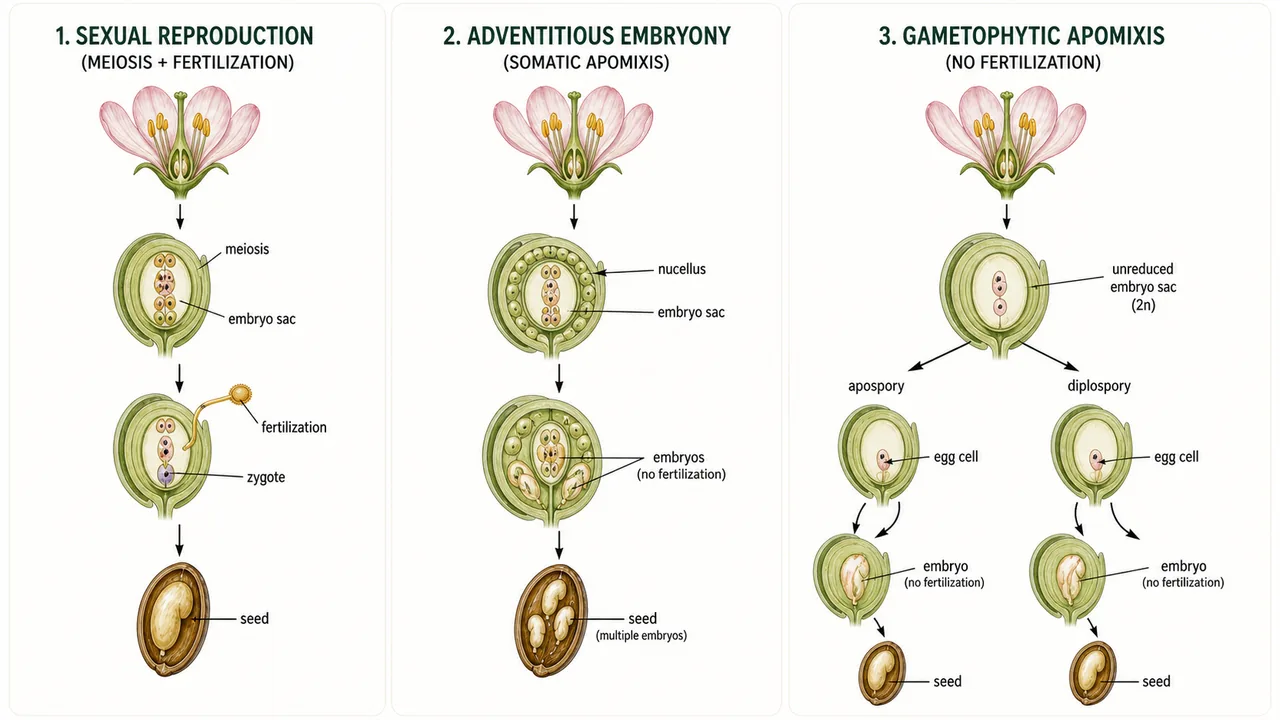
- In apomixis, seeds are formed but the embryos develop without fertilization. Consequently, the plants resulting from them are identical in genotype to the parent plant. Apomixis is sometimes described as "cloning through seeds."
- In older history-oriented recall, the early discovery of apomixis is classically linked with Leeuwenhoek (1719) in citrus seeds.
- In apomictic species, sexual reproduction is either suppressed or absent.
- When sexual reproduction does occur, the apomixis is termed as facultative.
- But when sexual reproduction is absent, it is referred to as obligate.
- Facultative apomixis is more common. In facultative apomicts, both sexual and apomictic seeds may be produced on the same plant, giving the breeder access to both systems.
- When embryo arises from haploid cells, apomixis is non-recurrent because its progeny can't be maintained further and when embryo arises from diploid cells, apomixis is called recurrent. Recurrent apomixis is of greater practical importance as the offspring maintain the same ploidy level as the parent.
- Apomixis is synonym of agamospermy.
- Apomixis is of two types:
- Adventitious embryony: Embryo is developed directly from vegetative cells of ovule such as nucellus, integument & chalaza. No production of embryo sac. e.g. Nucellar seedlings in mango, citrus, orchids etc. This is a common phenomenon in many fruit crops and is exploited for producing genetically uniform rootstocks.
- Gametophytic apomixis: Embryo developed from egg cells or other cells of embryo sacs but without fertilization.
Apomeiosis
- In recurrent apomixis, unreduced embryo sacs are developed by a process of apomeiosis. This means meiosis is bypassed, and the embryo sac retains the full diploid chromosome number.
Apospory
- Unreduced embryo sacs are developed from some vegetative cells of ovule through a series of mitotic divisions and without meiosis.
- E.g. some species of Hieraceum Malus, Crepes, Ranuculus, Orchids etc.
Apogamy
- In apogamy, synergids or antipodal cells develop into an embryo. These are cells other than the egg cell within the embryo sac.
- Like parthenogenesis, apogamy may be haploid or diploid depending upon the haploid or diploid state of the embryo sac.
- Diploid apogamy occurs in Antennaria, Alchemilla, Allium and many other plant species.
Diplospory
- Embryo sac is produced from the mega spore which may be haploid or more generally, diploid. In diplospory, the megaspore mother cell itself undergoes modified meiosis to produce a diploid megaspore.
- In apomictic species, diploid megaspores are produced by modified meiosis. The embryos in such embryo sacs may be arised by either parthenogenesis or pseudogamy.
Parthenogenesis
- Embryo is developed from the embryo sac without pollination. Pollination is the landing of pollen onto the stigma of a flower. In parthenogenesis, the egg cell develops into an embryo on its own, without any stimulus from pollen.
- [Parthenocarpy means development of fruit without fertilization] -- note the distinction: parthenocarpy relates to fruit development, while parthenogenesis relates to embryo development.
- Parthenogenesis is of two types:
- Gonial parthenogenesis: Embryo is developed from egg cell.
- Somatic parthenogenesis: Embryo is developed from some cells of the embryo sac other than the egg cell.
- Generally, 'Parthenogenesis' is used as a synonym of somatic parthenogenesis.
Pseudogamy
- Pseudo means false & gamous means marriage. Pollination occurs but fertilization of egg cell does not take place however fertilization of secondary nucleus occurs. The endosperm develops normally (providing nutrition) while the embryo develops without true fertilization.
- Pseudogamy is of two types:
- Gonal pseudogamy: Embryo is developed from egg cell.
- Somatic pseudogamy: Embryo is developed from some other cells of embryo sac.
Vybrid
- It is a progeny obtained from a cross between two facultative apomicts.
- The vybrid itself reproduces through facultative apomixis and is maintained by harvesting the seeds of only F1 like apomictic plants in every generation. This concept has potential applications in fixing hybrid vigour.
Significance of Apomixis
- Apomixis is a nuisance when the breeder desires to obtain sexual progeny, i.e., selfs or hybrids. It complicates crossing programmes because some offspring may be apomictic rather than true hybrids.
- But it is of great help when the breeder desires to maintain varieties. Once a superior genotype is identified, apomixis ensures it is perpetuated faithfully through seed.
- Thus in breeding of apomictic species, the breeder has to avoid apomictic progeny when he is making crosses or producing inbred lines. But once a desirable genotype has been selected, it can be multiplied and maintained through apomictic progeny.
- This would keep the genotype of a variety intact.
- Asexually reproducing crop species are highly heterozygous and show severe inbreeding depression.
- Therefore, breeding methods in such species must avoid inbreeding.
Sexual Reproduction
- Sexual reproduction involves fusion of male and female gametes to form a zygote, which develops into an embryo. Sexual reproduction is the basis of genetic variation and is therefore central to virtually all plant breeding programmes.
- In crop plants, male and female gametes are produced in specialised structures known as flowers.
Flower
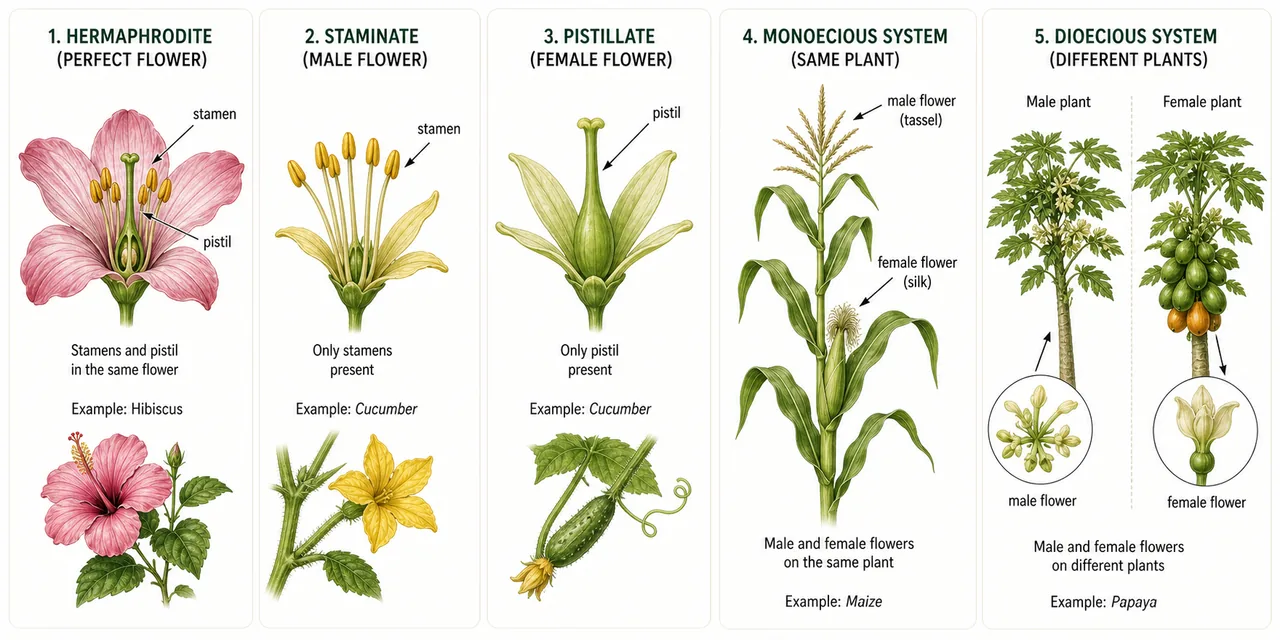
- Hermaphrodite/Perfect Flower: Such flower contains both stamens (male) and Pistil (female). Most crop plants have perfect flowers, which simplifies controlled hybridization.
- Staminate Flower: Such flower contains only stamens not pistil.
- Pistillate Flower: Such flower contains only pistil & not stamen.
- Monoecious Plant: Here staminate & Pistillate flowers occur on the same plant. E.g. Maize, Coconut, Castor, Colocasia etc. Monoecious plants allow for easy cross-pollination while keeping both sexes on one individual.
- Gynomonoecious Plant: A plant bearing pistillate and hermaphrodite flowers on the same individual.
- Andromonoecious Plant: A plant bearing staminate and hermaphrodite flowers on the same individual.
- Dioecious Plant: Here staminate & pistillate flowers occur on different plants E.g. Papaya, Date palm, Pistachio etc. In dioecious species, cross-pollination is obligatory.
- Anthesis: In the process of Flowering, the first opening of a flower is called anthesis. It facilitates the pollination by opening of flower. Knowledge of anthesis timing is critical for planning emasculation and pollination in hybridization programmes.
Sporogenesis
- In crop plants, meiotic division of specific cells in stamen and pistil yields microspores and megaspores, respectively. This is the process by which the diploid sporophyte produces haploid spores.
- This is followed by mitotic division of the spore nuclei to produce gametes; the male and female gametes are produced in microspores and megaspores, respectively.
- Productions of microspores and megaspores is known as sporogenesis.
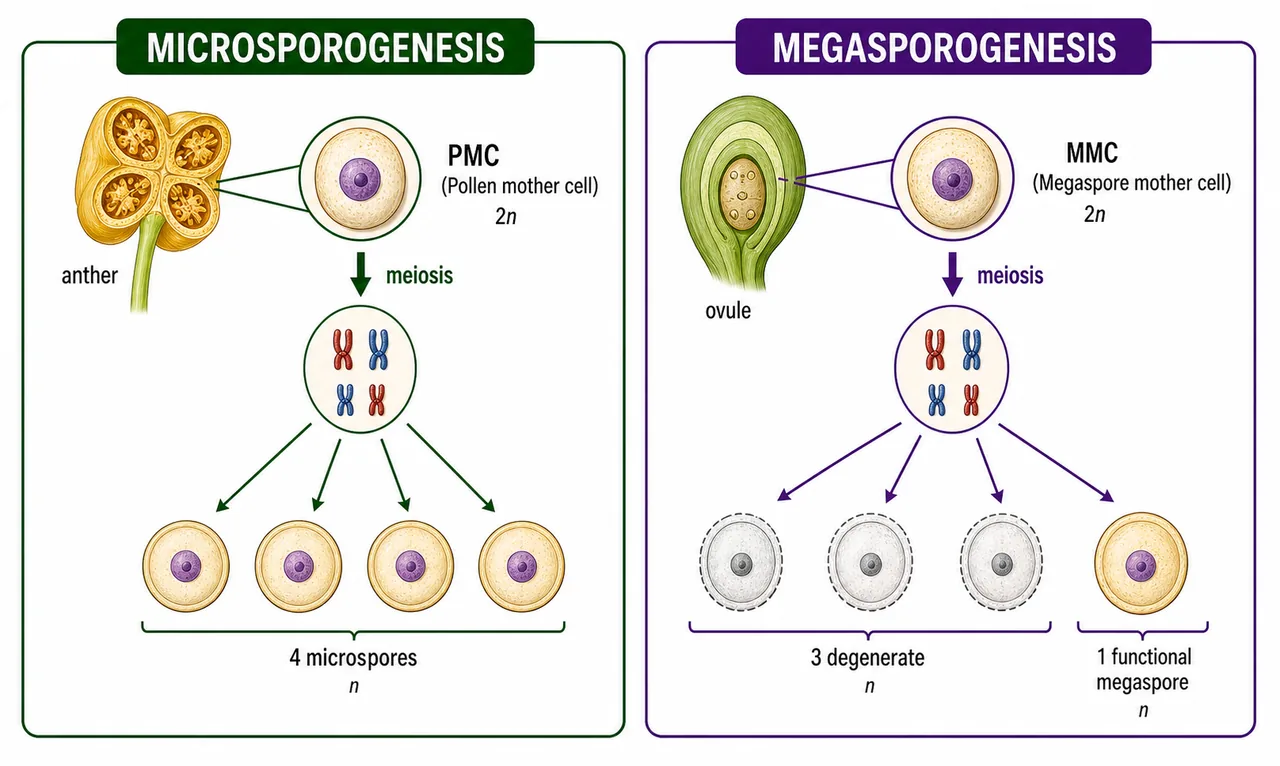
- Microspores are produced in anthers (microsporogenesis), while megs-spores are produced in ovules (megasporogenesis).
Microsporogenesis
- Each anther has four pollen sacs, which contain numerous pollen mother cells (PMCs).
- Each PMC undergoes meiosis to produce four haploid cells or microspores.
- This process is known as microsporogenesis.
- The microspores mature into pollen grains mainly by a thickening of their walls. Each pollen grain is therefore a haploid structure carrying the male genetic material.
Megasporogenesis
- Megasporogenesis occurs in ovules, which are present inside the ovary.
- A single cell in each ovule differentiates into a megaspore mother cell.
- The megaspore mother cell undergoes meiosis to produce four haploid megaspores.
- Three of the megaspores degenerate leaving one functional megaspore per ovule. This completes megasporogenesis. The single surviving megaspore will go on to develop into the embryo sac.
Gametogenesis
- The production of male and female gametes in the microspores and the megaspores, respectively, is known as gametogenesis. This is the stage where haploid spores develop into functional gametes ready for fertilization.
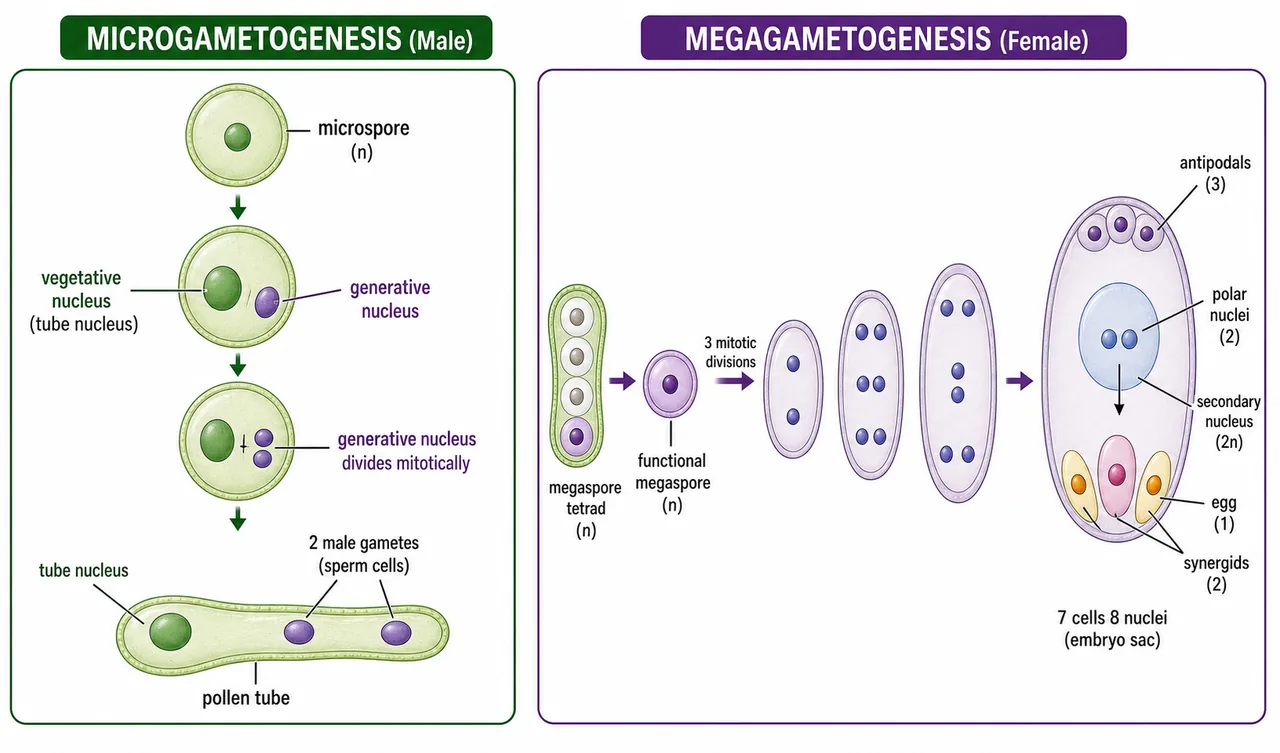
Microgametogenesis

- This refers to the production of male gamete or sperm.
- During the maturation of pollen, the microspore nucleus divides mitotically to produce a generative and a vegetative or tube nucleus.
- The pollen is generally released in this binucleate stage.
- When the pollen lands onto the stigma of a flower, it is known as pollination.
- Shortly after pollination, the pollen germinates. The pollen tube enters the stigma and grows through the style. The generative nucleus now undergoes a mitotic division to produce two male gametes or sperms.
- The pollen, along with the pollen tube, is known as microgametophyte.
- The pollen tube finally enters the ovule through a small pore, micropyle, and discharges the two sperms into the embryo sac. One sperm fuses with the egg cell (forming the zygote) and the other fuses with the secondary nucleus (forming the endosperm) -- this is double fertilization, a hallmark of flowering plants.
- In classical botanical history, the term and phenomenon of double fertilization are associated with Nawaschin (1898).
- In more explicit angiosperm terminology, the second fusion is also called triple fusion because one male gamete unites with the already diploid secondary nucleus (formed from the two polar nuclei), producing the primary endosperm nucleus, which is typically triploid (3n).
Megagametogenesis

- The nucleus of a functional megaspore divides mitotically to produce four or more nuclei. The exact number of nuclei and their arrangement vary considerably from one species to another.
- In most of the crop plants, megaspore nucleus undergoes three mitotic divisions to produce eight nuclei. Three of these nuclei move to one pole and produce a central egg cell and two synergid cells; one synergid is situated on either side of the egg cell. Another three nuclei migrate to the opposite pole to give rise to antipodal cells. The two nuclei remaining in the centre, the polar nuclei, fuse to form a secondary nucleus.
- The megaspore thus develops into a mature megagametophyte or embryo sac.
- The development of embryo sac from a megaspore is known as megagametogenesis.
- The embryo sac generally contains one egg cell, two synergids, three antipodal cells (all haploid), and one diploid secondary nucleus. This is the standard 8-nucleate, 7-celled embryo sac found in most angiosperms.
TIP
Embryo sac composition: 1 egg + 2 synergids + 3 antipodals + 1 secondary nucleus (from 2 polar nuclei) = 7 cells, 8 nuclei. This is a frequently tested fact.
Significance of Sexual Reproduction
- Sexual reproduction makes it possible to combine genes from two parents into a single hybrid plant. This is the fundamental basis of hybridization, the most powerful tool in the plant breeder's arsenal.
- Recombination of these genes produces a large number of genotypes. Through crossing over and independent assortment during meiosis, an enormous array of new gene combinations is generated.
- This is an essential step in creating variation through hybridization.
- Almost the entire plant breeding is based on sexual reproduction. Whether the final variety is maintained sexually or asexually, the initial creation of variation almost always involves sexual reproduction.
- Even in asexually reproducing species, sexual reproduction, if it occurs, is used to advantage, E.g., in sugarcane, potato, sweet potato etc. In these crops, sexual crosses are made to generate new genotypes, and the best ones are then maintained through vegetative propagation.
Summary Cheat Sheet
| Concept / Topic | Key Details |
|---|---|
| Sexual reproduction | Involves fusion of gametes (fertilization); creates variation |
| Asexual reproduction | Without gamete fusion; offspring = genetic clones |
| Vegetative propagation | From plant parts: cuttings, tubers, runners, bulbs |
| Vegetative examples | Sugarcane (stem), potato (tuber), strawberry (runner) |
| Apomixis | Seed formation without fertilization; produces maternal clones |
| Types of apomixis | Adventitious embryony, diplospory, apospory |
| Adventitious embryony | Embryo from nucellar tissue (e.g., citrus, mango) |
| Polyembryony | Multiple embryos in one seed (common in citrus) |
| Amphimixis | Normal sexual reproduction (fusion of male + female gametes) |
| Autogamy | Self-fertilization within same flower |
| Allogamy | Cross-fertilization between different plants |
| Geitonogamy | Pollination between flowers of same plant |
| Xenogamy | Pollination between flowers of different plants (true cross) |
| Parthenocarpy | Fruit development without fertilization (seedless fruits) |
| Parthenogenesis | Embryo from unfertilized egg |
| Breeding implication | Sexual = variation for selection; Asexual = fix heterosis |