💏 Plant Breeding: Definition, Domestication, and Methods
Understand what plant breeding is, the history of crop domestication, breeding objectives, and major breeding methods — with agricultural examples and exam tips.
Why Plant Breeding Matters
The Green Revolution that saved millions from famine was driven by plant breeding — semi-dwarf wheat varieties developed by Norman Borlaug and dwarf rice varieties like IR-8 dramatically increased yields across Asia. Today, plant breeding continues to address food security through higher yields, disease resistance, nutritional quality, and climate adaptation. Every improved crop variety on a farmer's field is the product of systematic breeding.
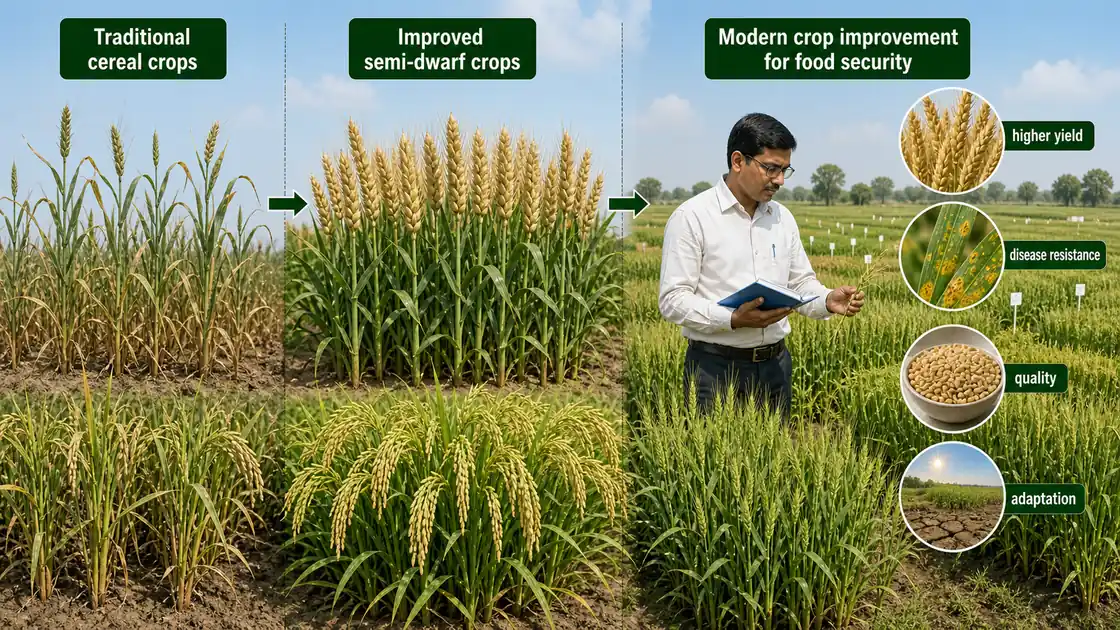
Plant Breeding
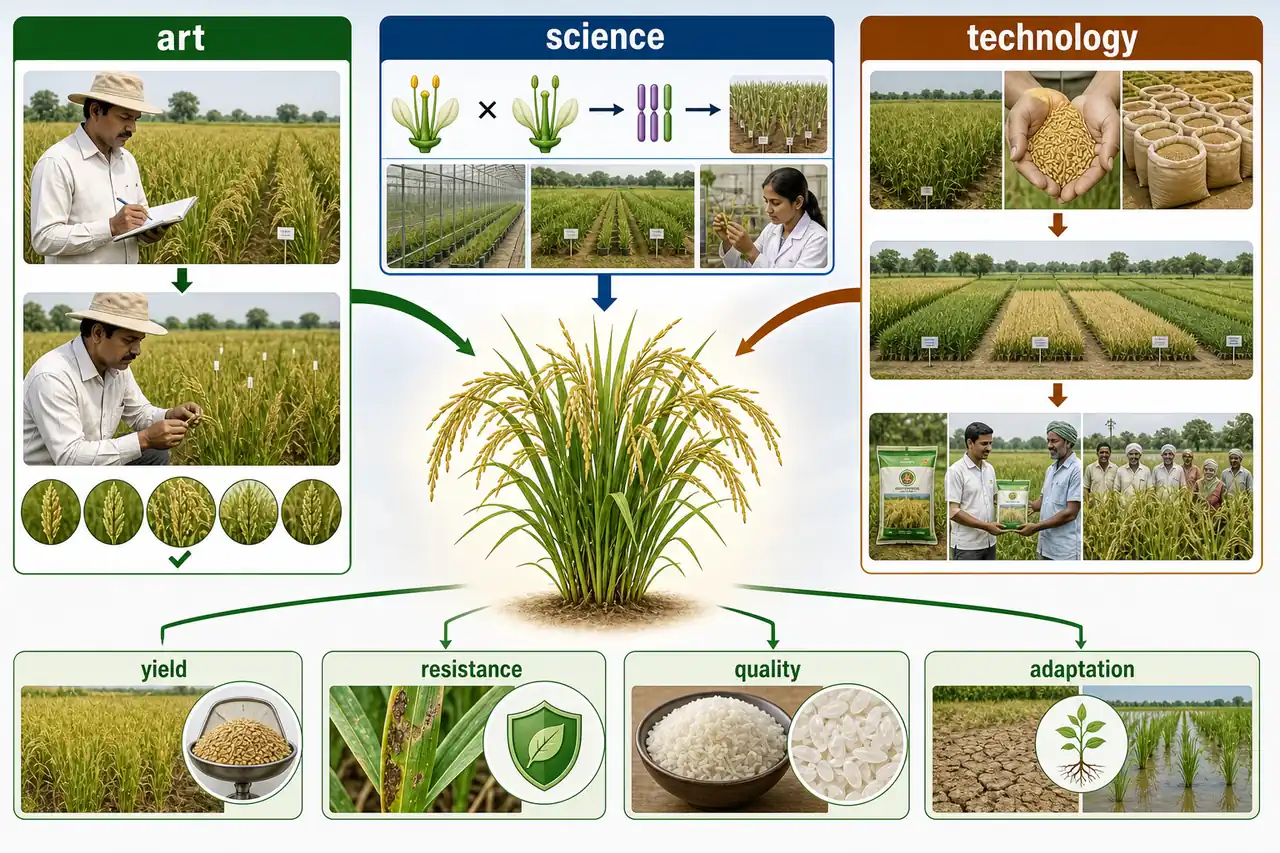
- Plant breeding can be defined as an art, a science, and technology of improving the genetic makeup of plants in relation to their economic use for the man kind. In other words, it is the systematic approach to developing new and improved crop varieties that are better suited to human needs -- whether for food, fibre, fuel, or other purposes.
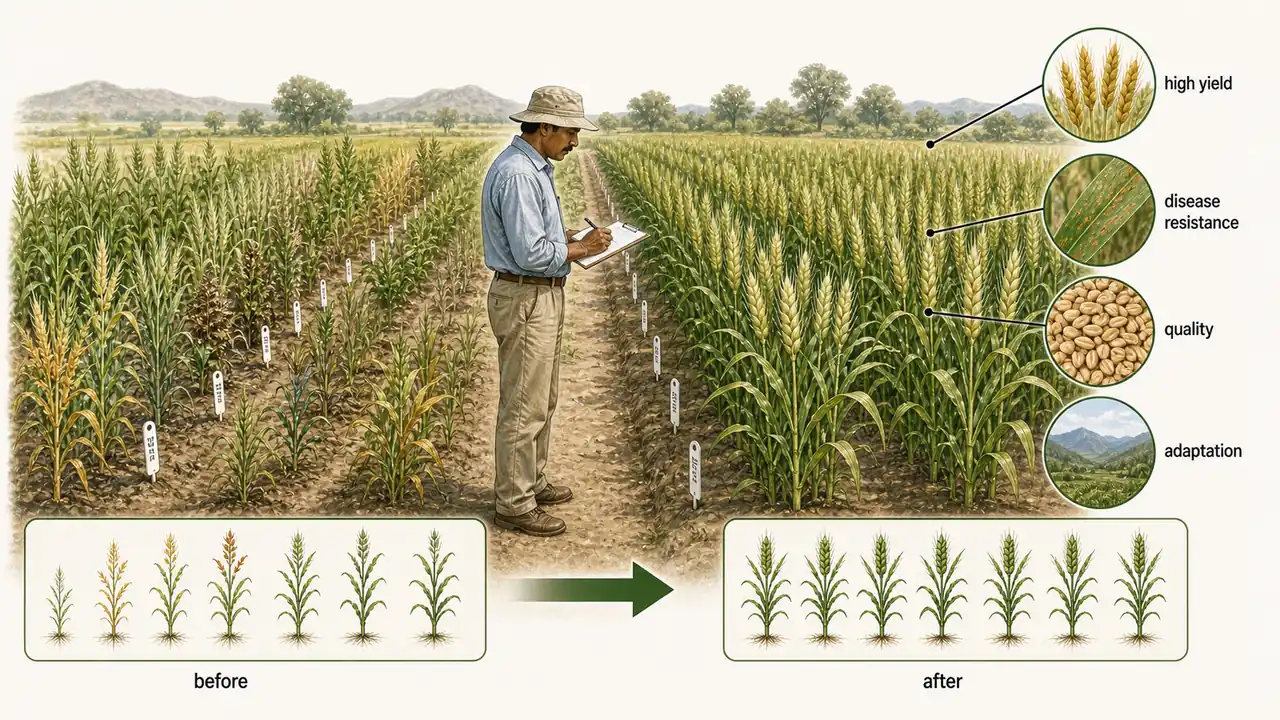
- Aim of Plant Breeding: Plant breeding aims to improve the characteristics of plants so that they become more desirable agronomically and economically. The specific objectives may vary greatly depending on the crop under consideration. For example, the goals for a cereal crop like wheat may focus on yield and disease resistance, while those for a fruit crop may emphasize quality and shelf life.
Some breeding objectives are repeatedly asked because they connect trait improvement with direct farm problems:
Pro Content Locked
Upgrade to Pro to access this lesson and all other premium content.
Charged once for one year · ₹1188 total
Save ₹100/month vs ₹2388/year launch price
- All Agriculture & Banking Courses
- AI Lesson Questions (100/day)
- AI Doubt Solver (50/day)
- Glows & Grows Feedback (30/day)
- AI Section Quiz (20/day)
- 22-Language Translation (100/day)
- Recall Questions (20/day)
- AI Quiz (15/day)
- AI Quiz Paper Analysis (100/day)
- AI Step-by-Step Explanations (100/day)
- Spaced Repetition Recall (FSRS)
- AI Tutor
- Immersive Text Questions
- Audio Lessons — Hindi & English
- Mock Tests & Previous Year Papers
- Summary & Mind Maps
- XP, Levels, Leaderboard & Badges
- Generate New Classrooms
- Voice AI Teacher (AgriDots Live)
- AI Revision Assistant
- Knowledge Gap Analysis
- Interactive Revision (LangGraph)
🔒 Secure one-time yearly payment via Razorpay · No hidden fees
Why Plant Breeding Matters
The Green Revolution that saved millions from famine was driven by plant breeding — semi-dwarf wheat varieties developed by Norman Borlaug and dwarf rice varieties like IR-8 dramatically increased yields across Asia. Today, plant breeding continues to address food security through higher yields, disease resistance, nutritional quality, and climate adaptation. Every improved crop variety on a farmer's field is the product of systematic breeding.
Plant Breeding
- Plant breeding can be defined as an art, a science, and technology of improving the genetic makeup of plants in relation to their economic use for the man kind. In other words, it is the systematic approach to developing new and improved crop varieties that are better suited to human needs -- whether for food, fibre, fuel, or other purposes.
- Aim of Plant Breeding: Plant breeding aims to improve the characteristics of plants so that they become more desirable agronomically and economically. The specific objectives may vary greatly depending on the crop under consideration. For example, the goals for a cereal crop like wheat may focus on yield and disease resistance, while those for a fruit crop may emphasize quality and shelf life.
Some breeding objectives are repeatedly asked because they connect trait improvement with direct farm problems:
- Dwarfness in cereals is valued because it improves lodging resistance and usually permits a stronger response to fertilizers.
- Seed dormancy can be either beneficial or harmful depending on the crop situation. It may delay desired germination after sowing, but it can also protect the seed from sprouting under unsuitable conditions and help prevent pre-harvest sprouting.
- Elimination of toxic substances is a major breeding objective in some crops, such as reducing BOAA / ODAP in Lathyrus and lowering harmful seed toxins or anti-nutritional factors in economically important species.
- Non-shattering habit is desirable where pod or seed breakage causes field loss before harvest.
- Synchronous maturity is preferred in crops such as pulses and cotton because it reduces repeated pickings and simplifies harvesting.
At the same time, breeders also have to remain aware of the common downside of over-reliance on highly uniform modern cultivars:
- Replacement of diverse landraces by uniform improved varieties can lead to reduction in diversity and a narrow genetic base.
- A narrow genetic base often reduces buffering capacity against new pathogen races or changing environments, which is why breeders repeatedly return to landraces, primitive cultivars, and wild relatives when new resistance or adaptability genes are needed.
Domestication
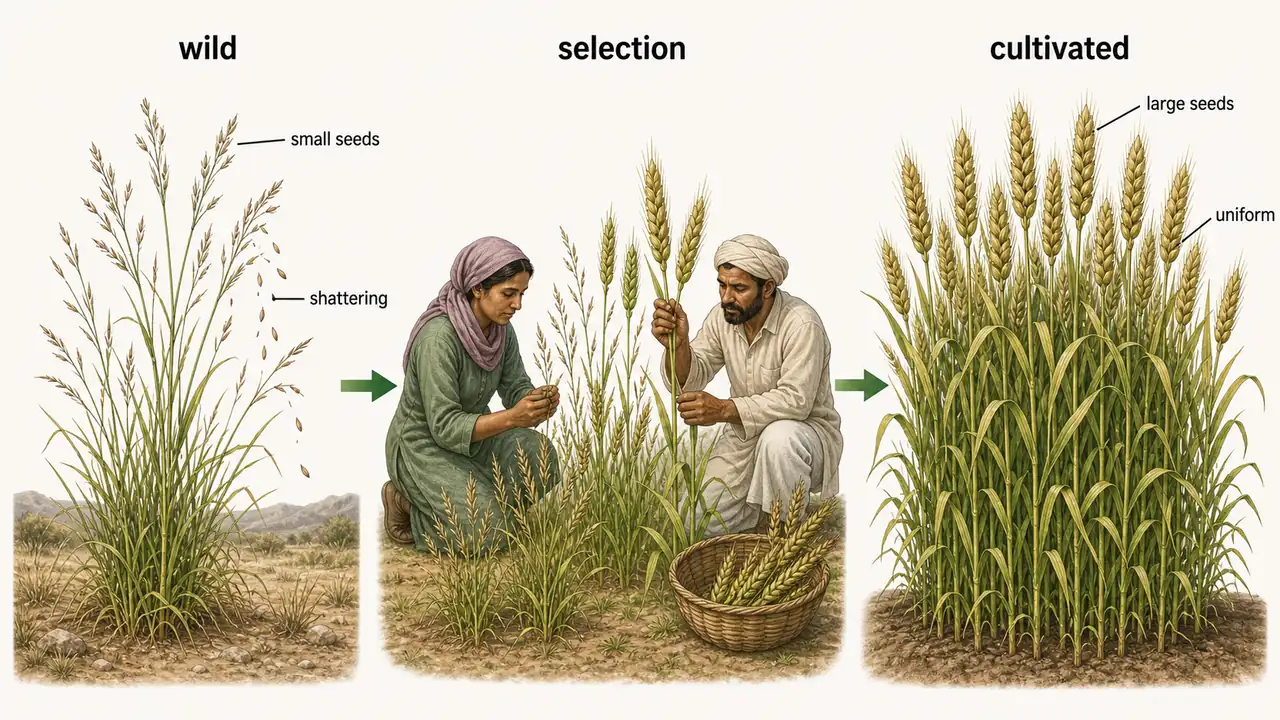
- The process of bringing a wild species under human management is referred to as domestication. This is the foundational step in agriculture -- transforming wild plants into cultivated crops through sustained human effort over generations.
- Domestication may be the most basic method of plant breeding. It represents the earliest form of selection carried out by humans, long before scientific breeding methods were developed.
- Domestication continuous today and is likely to continue for some time in future. There are still many wild species with untapped potential waiting to be brought under cultivation.
- Ex: In case of timber trees medicinal plants, microbes. These organisms are still being domesticated as we discover new uses for them.
- During the long period of historic cultivation natural selection has definitely acted on the domesticated species. Over thousands of years, the combined forces of natural selection and human preference have shaped crops into their present forms.
- Movement of man from one place to another brought about the movement of his cultivated plant species. This migration of people and their crops played a major role in spreading cultivated plants across continents.
Methods of Plant Breeding
Activities of plant breeding: Creation of Variation → Selection → Evaluation → Multiplication → Distribution UPPSC 2021
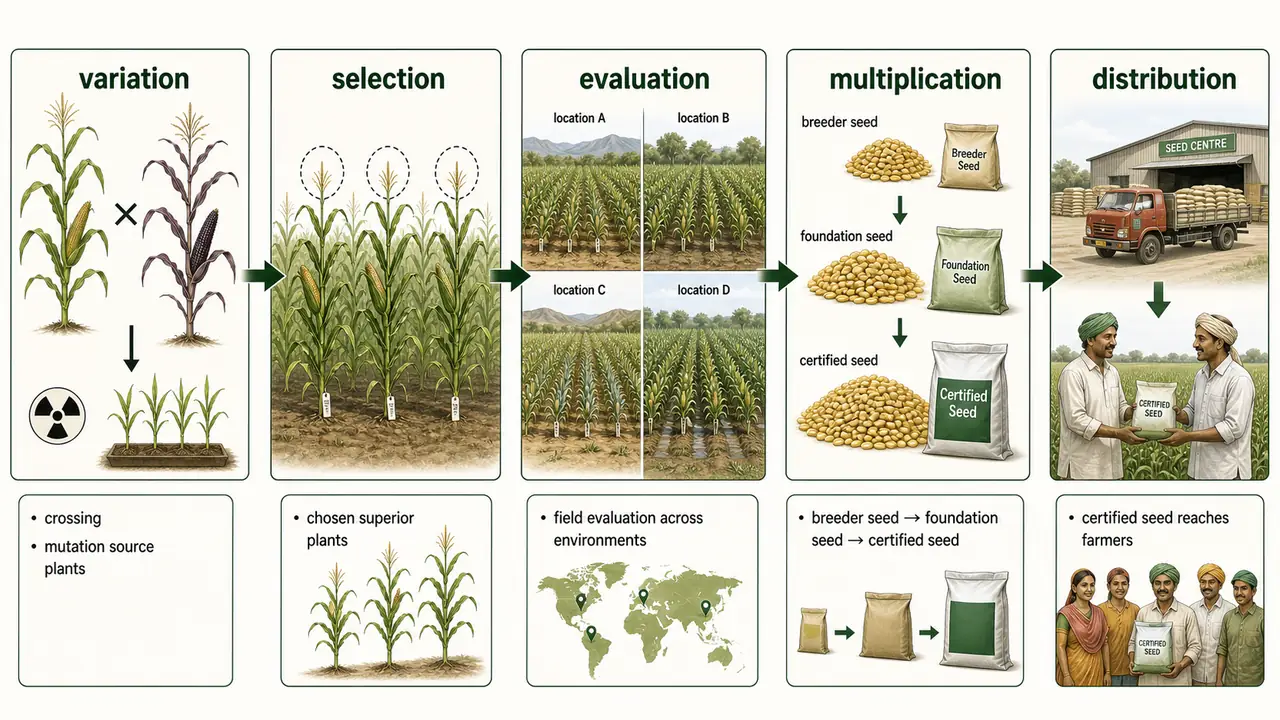
These five steps form the backbone of every breeding programme. First, genetic variation is created (through hybridization, mutation, or other means), then superior individuals are selected, their performance is evaluated across environments, and finally the best varieties are multiplied and distributed to farmers.
Methods of Breeding Autogamous species
Plant breeding methods that are used for genetic improvement of self-pollinated or autogamous species include:
- Plant Introduction
- Pureline Selection
- Mass Selection
- Pedigree Method
- Bulk Method
- Single Seed Descent Method
- Backcross Method
- Heterosis Breeding
- Mutation Breeding
- Polyploidy Breeding
- Distant Hybridization
- Transgenic Breeding
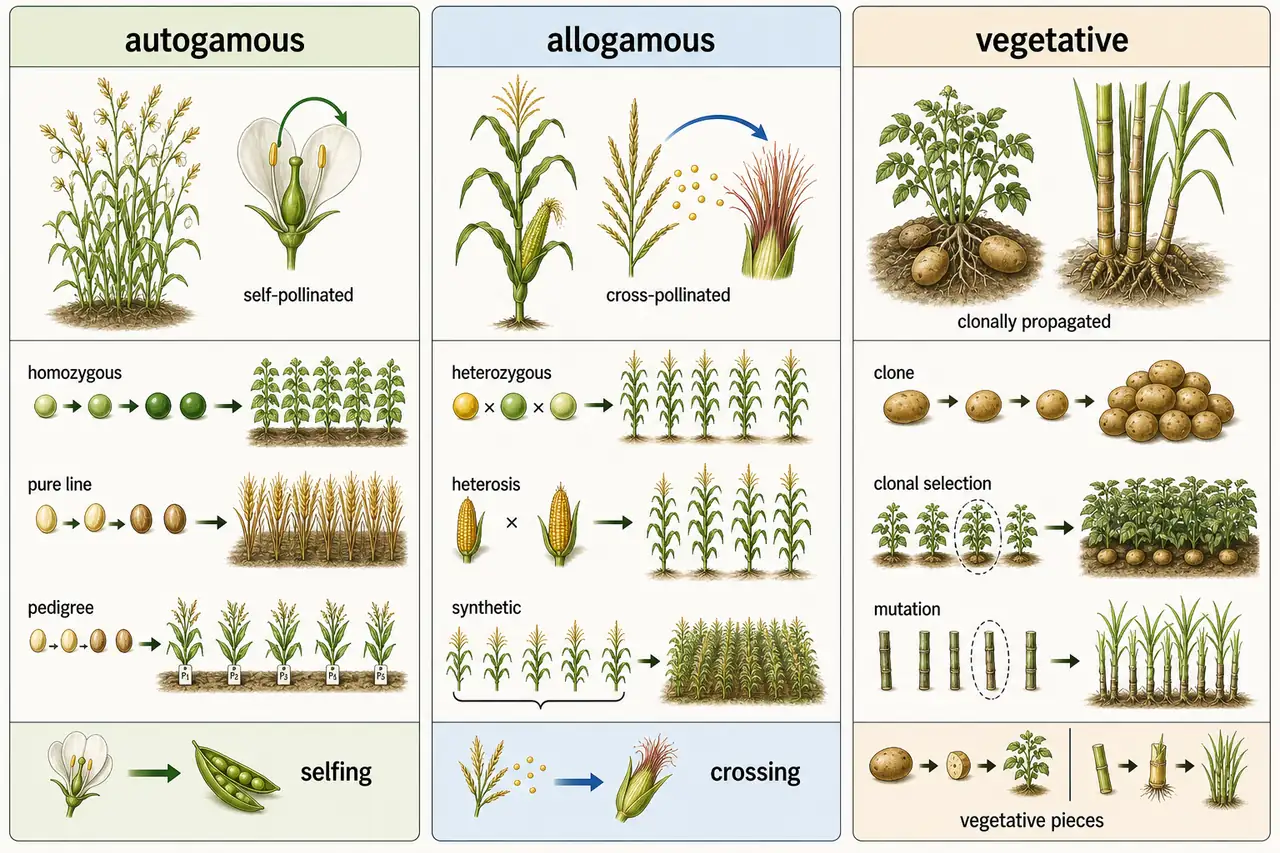
Self-pollinated crops (like wheat, rice, peas, and tomato) are naturally homozygous, which means the breeding methods for these crops focus on isolating the best homozygous lines from existing or newly created variation.
Four breeding approaches, viz., recurrent selection, disruptive selection, diallele selective mating, and biparental mating are used for population improvement.
NOTE
Self-pollinated crops are naturally homozygous, so breeding focuses on isolating the best pure lines. Cross-pollinated crops are naturally heterozygous, so breeding aims to exploit hybrid vigour.
Methods or Breeding Allogamous species
Breeding methods that are used for genetic improvement of cross pollinated or allogamous species include:
- Plant introduction
- Mass and Progeny selection
- Backcross method
- Heterosis breeding
- Synthetic breeding
- Composite breeding
- Polyploidy breeding
- Distant hybridization
- Transgenic breeding
Cross-pollinated crops (like maize, bajra, and sunflower) are naturally heterozygous, and breeding methods for these crops aim to maintain or exploit this heterozygosity for vigour and yield.
Mutation breeding is rarely used in allogamous species. This is because cross-pollinated species already possess abundant genetic variability, making it unnecessary to induce additional mutations in most cases.
TIP
A quick way to remember: Autogamous = self (auto) = homozygous = pureline methods. Allogamous = cross (allo) = heterozygous = heterosis breeding methods.
Three breeding approaches viz., recurrent selection, disruptive mating and biparental mating are used for population improvement.
Methods of Breeding Asexually Propagated Species
Important breeding methods applicable to asexually propagated species are:
- Plant Introduction
- Clonal selection
- Mass selection
- Heterosis breeding
- Mutation breeding
- Polyploidy breeding
- Distant hybridization
- Transgenic breeding
Asexually propagated crops (like sugarcane, potato, and banana) maintain the exact genotype of the parent plant through vegetative propagation. This means that once a desirable genotype is identified, it can be multiplied indefinitely without any change in its genetic constitution.
Mass selection is rarely used in asexually propagated species. Since individual clones can be evaluated and maintained directly, there is little need for bulking seeds as done in mass selection.
Four breeding approaches, viz., recurrent selection, disruptive selection, diallele selective mating, and biparental mating are used for population improvement.
Explore More
Summary Cheat Sheet
| Concept / Topic | Key Details |
|---|---|
| Plant breeding | Science of improving genetic makeup of crop plants |
| Definition | Art and science of changing plant heredity for human benefit |
| Father of plant breeding | N.I. Vavilov |
| Objectives | Higher yield, quality, disease/pest resistance, adaptation |
| Green Revolution | Dramatic yield increase in wheat and rice (1960s–70s) |
| Green Revolution in India | M.S. Swaminathan — Father of Indian Green Revolution |
| Norman Borlaug | Father of Green Revolution worldwide; Nobel Peace Prize 1970 |
| Dwarfing genes in wheat | Norin-10 (Rht1, Rht2) from Japan |
| Dwarfing gene in rice | Dee-geo-woo-gen (sd1) — semi-dwarf |
| Key achievements | Semi-dwarf varieties, hybrid vigour exploitation, disease resistance |
| Breeding methods overview | Selection, hybridization, mutation, polyploidy, biotechnology |
| Variety | Group of plants with DUS (Distinct, Uniform, Stable) |
| Cultivar | Cultivated variety; term for commercially released variety |
| Plant breeding steps | Collection of variability → selection → evaluation → release |
| Modern tools | MAS, genomics, transgenics, speed breeding |