🦹🏼♀️ Germplasm Activities: Collection, Conservation, and Genetic Erosion
Understand the six key germplasm activities — exploration, collection, conservation, evaluation, documentation, exchange — plus genetic erosion and key organisations.
Why Germplasm Activities Matter
India's National Bureau of Plant Genetic Resources (NBPGR) in New Delhi holds over 4.5 lakh accessions of crop germplasm — one of the largest collections in the world. But germplasm is valuable only when it is properly collected, conserved, evaluated, documented, and exchanged. Meanwhile, genetic erosion — the loss of crop diversity due to replacement of traditional varieties by modern ones — threatens the very raw material breeders depend on.
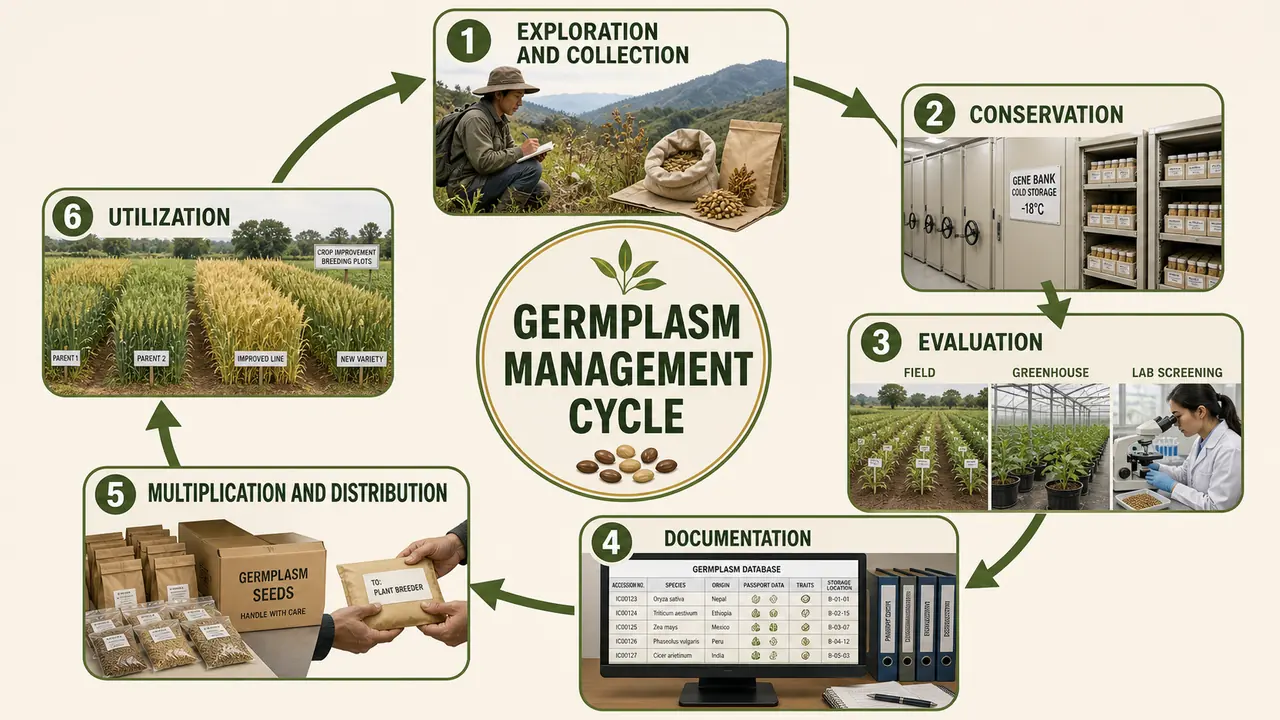
👉🏻 There are six important activities related to plant genetic resources.
These activities form the backbone of any germplasm management programme. Each step is interconnected -- effective collection enables meaningful evaluation, and good documentation ensures that valuable material can be readily distributed and utilized.
IMPORTANT
Remember the six germplasm activities in order: E-C-E-D-D-U -- Exploration, Conservation, Evaluation, Documentation, Distribution, Utilization. These are frequently tested in competitive exams.
- Exploration and Collection
- Conservation
- Evaluation
- Documentation
- Multiplication and Distribution
- Utilization
1. Exploration
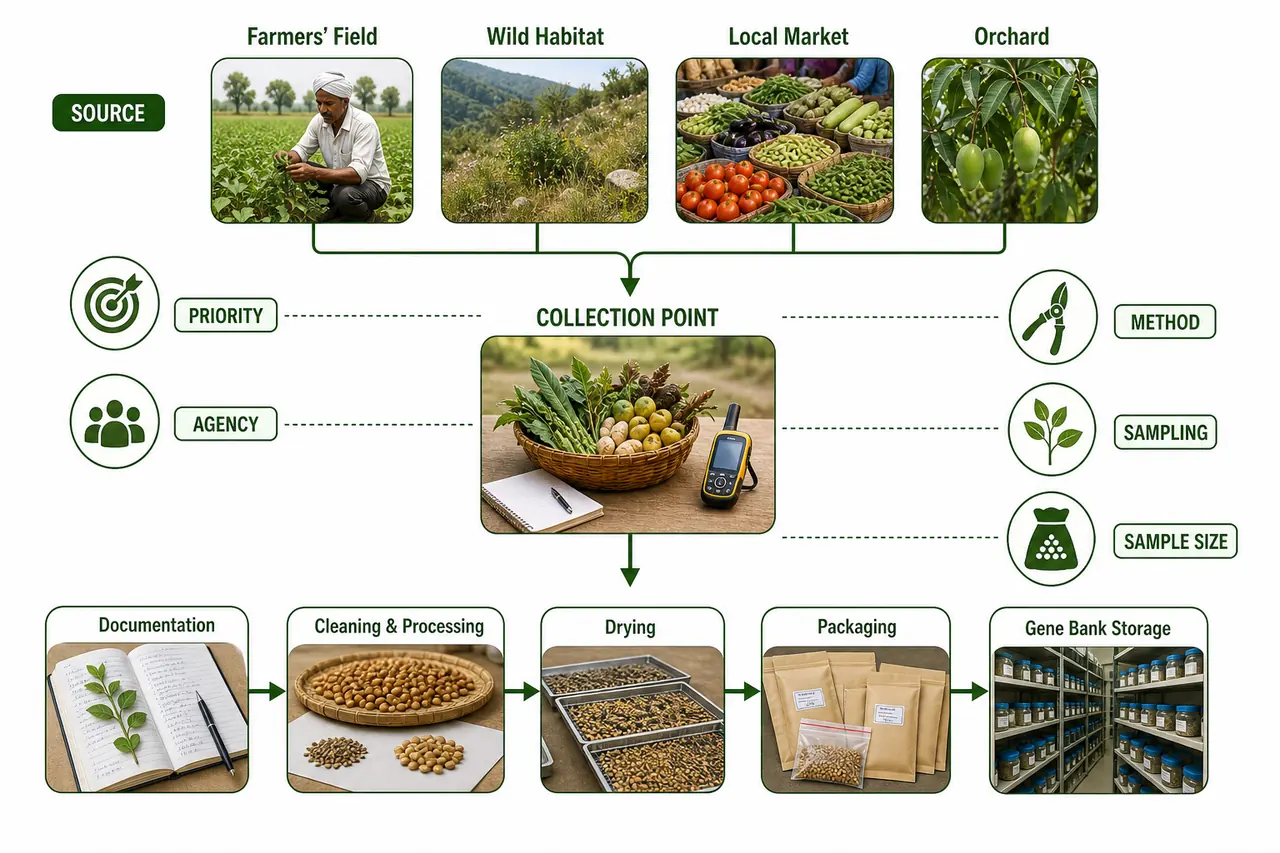
- Exploration refers to collection trips and collection refers to tapping of genetic diversity from various sources and assembling the same at one place. The exploration and collection is a highly scientific process. This process takes into account six important items, viz,
- sources of collection -- where the genetic diversity exists (farmers' fields, wild habitats, markets, etc.)
- priority of collection -- which crops or regions need urgent attention, especially those threatened by genetic erosion
- agencies of collection -- organizations responsible for conducting collection missions
- methods of collection -- techniques used to gather plant material (seeds, cuttings, tubers, etc.)
- methods of sampling -- strategies to capture maximum diversity within a population
- sample size -- the number of samples needed to adequately represent the genetic variation in a population.
✅ Merits
Pro Content Locked
Upgrade to Pro to access this lesson and all other premium content.
Charged once for one year · ₹1188 total
Save ₹100/month vs ₹2388/year launch price
- All Agriculture & Banking Courses
- AI Lesson Questions (100/day)
- AI Doubt Solver (50/day)
- Glows & Grows Feedback (30/day)
- AI Section Quiz (20/day)
- 22-Language Translation (100/day)
- Recall Questions (20/day)
- AI Quiz (15/day)
- AI Quiz Paper Analysis (100/day)
- AI Step-by-Step Explanations (100/day)
- Spaced Repetition Recall (FSRS)
- AI Tutor
- Immersive Text Questions
- Audio Lessons — Hindi & English
- Mock Tests & Previous Year Papers
- Summary & Mind Maps
- XP, Levels, Leaderboard & Badges
- Generate New Classrooms
- Voice AI Teacher (AgriDots Live)
- AI Revision Assistant
- Knowledge Gap Analysis
- Interactive Revision (LangGraph)
🔒 Secure one-time yearly payment via Razorpay · No hidden fees
Why Germplasm Activities Matter
India's National Bureau of Plant Genetic Resources (NBPGR) in New Delhi holds over 4.5 lakh accessions of crop germplasm — one of the largest collections in the world. But germplasm is valuable only when it is properly collected, conserved, evaluated, documented, and exchanged. Meanwhile, genetic erosion — the loss of crop diversity due to replacement of traditional varieties by modern ones — threatens the very raw material breeders depend on.
👉🏻 There are six important activities related to plant genetic resources.
These activities form the backbone of any germplasm management programme. Each step is interconnected -- effective collection enables meaningful evaluation, and good documentation ensures that valuable material can be readily distributed and utilized.
IMPORTANT
Remember the six germplasm activities in order: E-C-E-D-D-U -- Exploration, Conservation, Evaluation, Documentation, Distribution, Utilization. These are frequently tested in competitive exams.
- Exploration and Collection
- Conservation
- Evaluation
- Documentation
- Multiplication and Distribution
- Utilization
1. Exploration
- Exploration refers to collection trips and collection refers to tapping of genetic diversity from various sources and assembling the same at one place. The exploration and collection is a highly scientific process. This process takes into account six important items, viz,
- sources of collection -- where the genetic diversity exists (farmers' fields, wild habitats, markets, etc.)
- priority of collection -- which crops or regions need urgent attention, especially those threatened by genetic erosion
- agencies of collection -- organizations responsible for conducting collection missions
- methods of collection -- techniques used to gather plant material (seeds, cuttings, tubers, etc.)
- methods of sampling -- strategies to capture maximum diversity within a population
- sample size -- the number of samples needed to adequately represent the genetic variation in a population.
✅ Merits
- Collection helps in tapping crop genetic diversity and assembling the same at one place, making it accessible for breeding and research.
- It reduces the loss of genetic diversity due to genetic erosion.
- Sometimes, we get material of special interest during exploration trips, such as rare alleles for disease resistance or quality traits.
- Collection also helps in saving certain genotypes from extinction.
❌ Demerits
- Collection of germplasm especially from other countries, sometimes leads to entry of new diseases, new insects and new weeds. This makes plant quarantine measures essential during germplasm exchange.
- Collection is a tedious job.
- Collector, sometimes has encounter with wild animals like elephants, tigers etc.
- Transportation of huge collections also poses difficulties in the exploration and collection.
Germplasm Conservation
- Conservation refers to protection of genetic diversity of crop plants from genetic erosion. or
- Germplasm conservation refers to maintain the collected germplasm in such a state that there is minimum risk for its loss and that either it can be planted directly in the field or it can be prepared for planting with relative ease whenever necessary. The goal is to keep the material alive and genetically intact for future use.
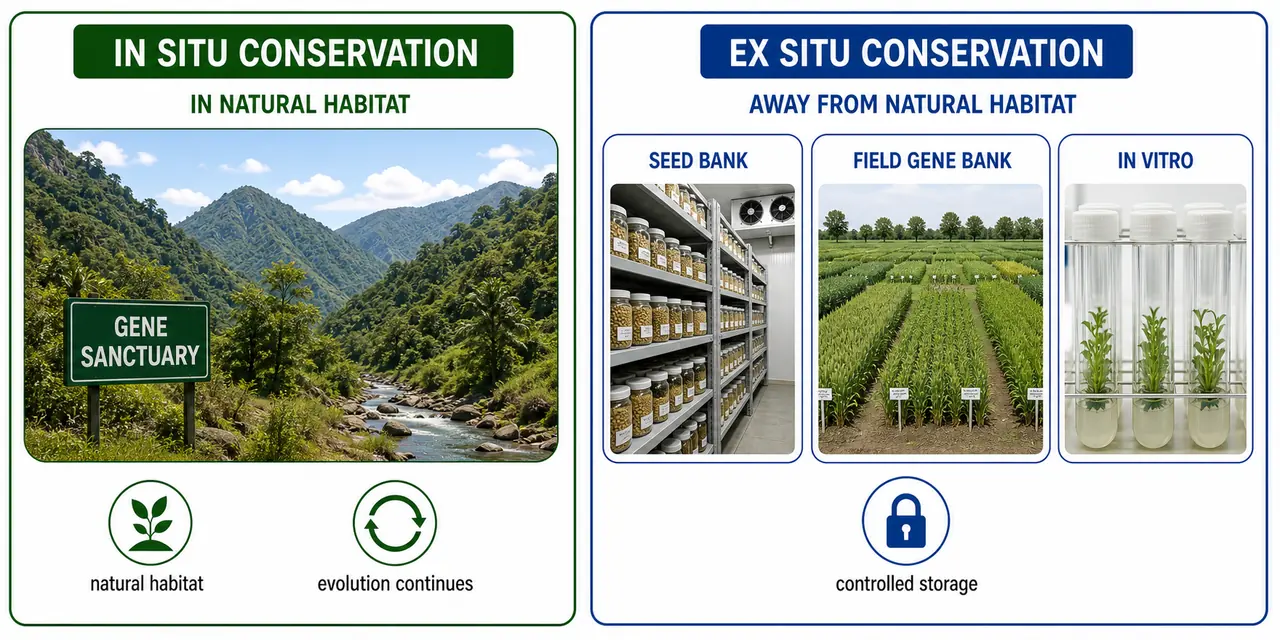
- There are two important methods of germplasm conservation or preservation viz.,
- In situ conservation
- Ex situ conservation
1. In situ conservation
- Conservation of germplasm under natural habitat is referred to as in situ conservation. This method preserves not just the genes but also the evolutionary processes that generate new genetic variation over time, such as natural selection, mutation, and gene flow.
- This is achieved by protecting this area from human interference. Such an area is often called as natural park, biosphere reserve or gene sanctuary.
Gene Sanctuaries
- The genetic diversity is sometimes conserved under natural habitat. The areas of great genetic diversity are protected from human interference. These protected areas in natural habitat are referred to as gene sanctuaries.
- Gene sanctuary is also Known As Natural Park or Biosphere Reserve.
- A gene sanctuary is best located within the centre of origin of crop species concerned, preferably covering the microcenter within the centre of origin. The centre of origin typically harbors the greatest diversity for a species, so protecting these areas captures maximum genetic variation.
- India has setup its first gene sanctuary in the Garo Hills of Assam for wild relatives of citrus. Efforts are also being made to setup gene sanctuaries for Banana, Sugarcane, Rice and Mango.

- In Ethiopia gene sanctuary for conservation of wild relatives of Coffee was setup in 1984.
- NBPGR, New Delhi is making attempts to establish gene sanctuaries in Meghalaya for Citrus and in the North-Eastern region for Musa, Citrus, Oryza, Saccharum and Mengifera genus.
✅ Merits
- A gene sanctuary not only conserves the existing genetic diversity present in the population, it also allows evolution to continue. As a result, new alleles and new gene combinations would appear with time, enriching the gene pool naturally.
- The risks associated with ex situ conservation are not operative.
❌ Disadvantages
- Each protected area will cover only very small portion of total diversity of a crop species, hence several areas will have to be conserved for a single species.
- The management of such areas also poses several problems, including protection from encroachment, natural disasters, and invasive species.
- This is a costly method of germplasm conservation
Ex situ conservation
- Conservation of germplasm away from its natural habitat is called ex situ germplasm conservation. This is the most commonly used approach worldwide, where germplasm is maintained in gene banks, seed vaults, field repositories, or in vitro collections.
✅ Merits
- It is possible to preserve entire genetic diversity of a crop species at one place.
- Handling of germplasm is also easy.
- This is a cheap method of germplasm conservation
👉🏻 Seed Collection
- Preservation in the form of seed is the most common and easy method, relatively safe, requires minimum space and easy to maintain.
- Glass, tin or plastic containers are used for preservation and storage of seeds. The seed can be conserved under long term, medium term and short-term storage conditions.

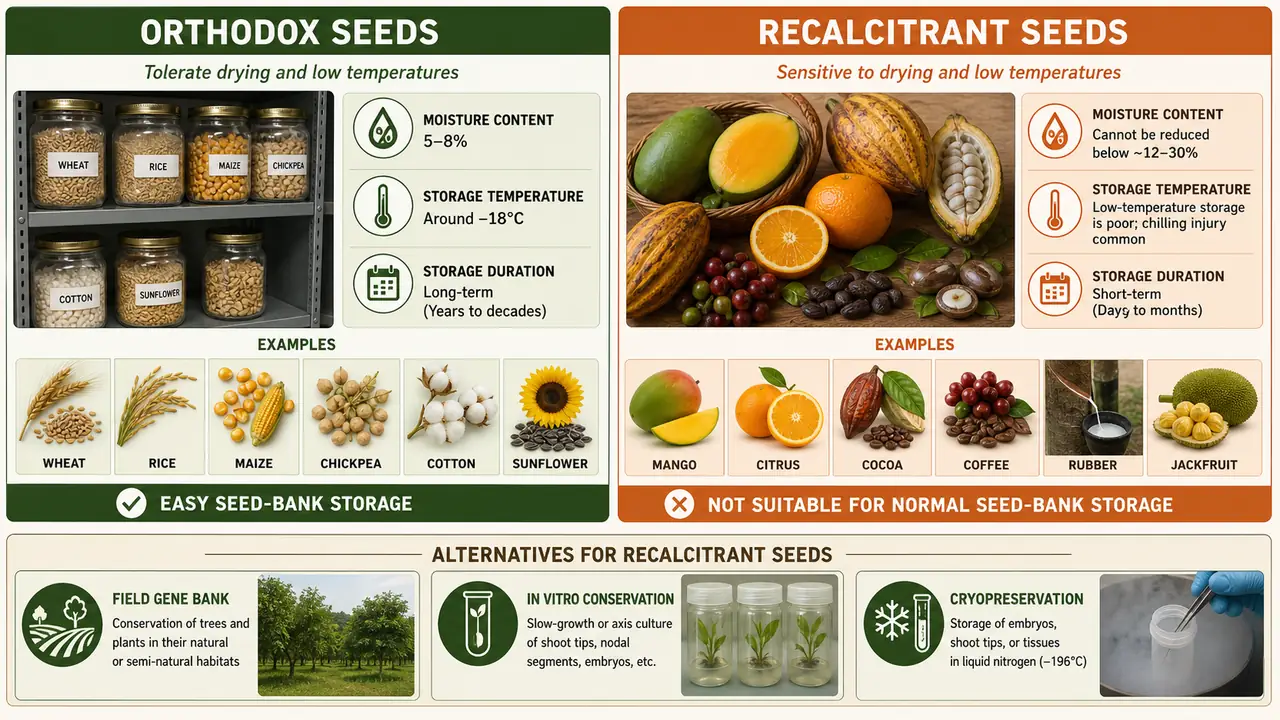
- Roberts in 1973 classified seeds on the basis of their storability, into two major groups. viz.,
-
Orthodox Seeds: Seeds of this type can be dried to low moisture content of 5% and stored at a low temperature without losing their viability are known as orthodox seeds. Most crop seeds belong to this category. Such seeds can be easily stored for long periods; their longevity increases in response to lower humidity and storage temperature. Eg. Wheat, Rice, Corn, Chickpea, Cotton, Sunflower etc.
-
Recalcitrant Seeds: The viability of this group of seeds drops drastically if their moisture content is reduced below 12-30%. Seeds of many forest and fruit trees, and of several tropically crops like Citrus, mango, coffee, cocoa, rubber, oil palm, jackfruit, etc. belong to this group. Such seeds present considerable difficulties in storage. They require in situ conservation or alternative preservation methods like cryopreservation (storage in liquid nitrogen at -196 degrees C).
3. Evaluation
- Evaluation refers to screening of germplasm in respect of morphological, genetical, economic, biochemical, physiological, pathological and entomological attributes. This comprehensive screening identifies accessions with desirable traits that can be directly used in breeding.
- Evaluation requires a team of specialists from the disciplines of plant breeding, physiology, biochemistry, pathology and entomology.
- First of all a list of descriptors (characters) for which evaluation has to be done is prepared. This task is completed by a team of experts from IPGRI, Rome, Italy. Descriptors are standardized traits that allow consistent evaluation across different locations and years.
- The descriptors are ready for various crops.
- The evaluation of germplasm is done in three different places, viz., (1) in the field, (2) in green house, and (3) in the laboratory.
4. Documentation
- It refers to compilation, analysis, classification, storage and dissemination of information.
- In plant genetic resources, documentation means dissemination of information about various activities such as collection, evaluation, conservation, storage and retrieval of data. Good documentation ensures that breeders worldwide can quickly identify and request germplasm with specific traits.
- Now the term documentation is more appropriately known as information system. Documentation is one of the important activities of genetic resources.
- Large number of accessions are available in maize, rice, wheat, sorghum, potato and other major crops.
- About 7.3 million germplasm accessions are available in 200 crops species. Handling of such huge germplasm information is only possible through electronic computers and modern database management systems.
5. Distribution
- The specific germplasm lines are supplied to the users on demand for utilization in the crop improvement programmes.
- Distribution of germplasm is the responsibility of the gene bank centres.
- The germplasm is usually supplied to the workers who are engaged in research work of a particular crop species.
- Supplied free of cost to avoid cumbersome work of book keeping. This ensures that genetic resources remain accessible to all breeders regardless of their funding situation.
- The quantity of seed samples depends on the availability of seed material and demands
- Proper records are maintained about the distribution of material.
- It helps in acclimatization and purification of the material.
6. Utilization
- It refers to use of germplasm in crop improvement programmes. The germplasm can be utilized in various ways. Utilization is the ultimate purpose of all other germplasm activities -- collection, conservation, evaluation, documentation, and distribution all serve to enable effective use of genetic resources.
- The uses of cultivated and wild species of germplasm are briefly discussed below:
- Cultivated Germplasm
- It can be used in three main ways: (1) as a variety (directly released for cultivation), (2) as a parent in the hybridization (to combine desirable traits), and (3) as a variant in the gene pool (stored for future use).
- Wild Germplasm
- It is used to transfer resistance to biotic and abiotic stresses, wider adaptability and sometimes quality such as fibre strength in cotton.
Organizations associated with germplasm
- International Plant Genetic Resources Institute (IPGRI), Rome, Italy -- This is the premier international organization responsible for coordinating the conservation and use of plant genetic resources across the globe. IPGRI works with national programmes in over 100 countries.
NOTE
IPGRI has since been renamed Bioversity International and later merged to form the Alliance of Bioversity International and CIAT. However, exams often still refer to it as IPGRI.

- National Bureau of Plant Genetic Resources (NBPGR), New Delhi -- NBPGR is the nodal organization in India for the management of plant genetic resources. It is responsible for exploration, collection, exchange, quarantine, evaluation, conservation, and documentation of the country's plant genetic wealth.
- The National Gene Bank was established at NBPGR, New Delhi in 1996 to preserve plant genetic resources under controlled long-term conservation conditions.

Genetic Erosion
-
Genetic erosion refers to loss of genetic diversity between and within populations of the same species over a period of time. or
-
Gradual reduction in genetic diversity in the populations of a species, due to elimination of various genotypes, is called genetic erosion.
-
Thus, genetic erosion leads to reduction of the genetic base of a species due to human intervention and environmental changes. Once genetic diversity is lost, it cannot be recovered, making conservation efforts critically important.
-
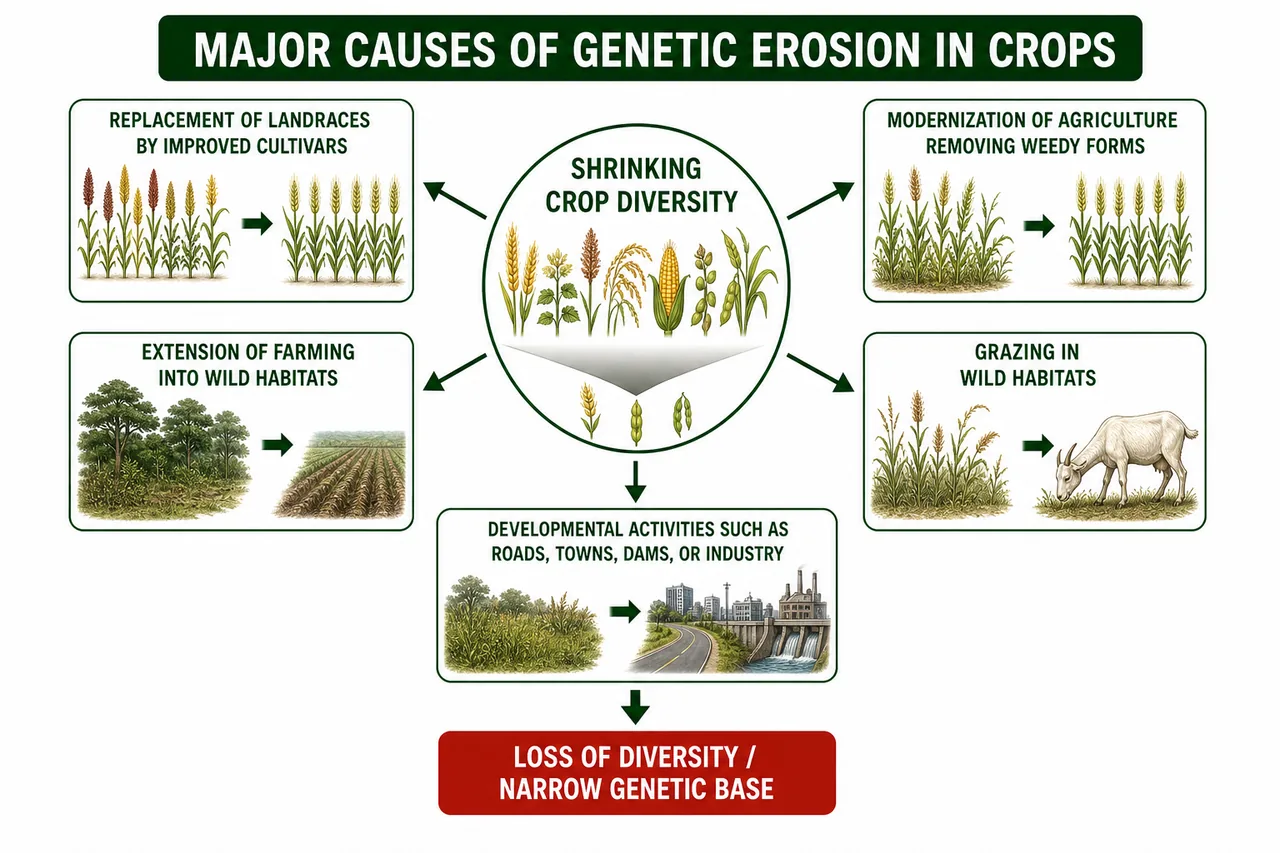
There are five main reasons of genetic erosion:
- Replacement of land races with improved cultivars: The main features of modern cultivars are high yield, uniformity, narrow genetic base and narrow adaptability. On the other hand land races and primitive cultivars have more genetic diversity, broad genetic base, wider adaptability and low yield potential. Thus replacement of land races with modern cultivars has resulted in reduction in genetic diversity because land races are disappearing. This is the single most important cause of genetic erosion worldwide.
- Modernization of agriculture: Clean and modern agriculture, Improved crop management practices has resulted in the elimination of wild and weedy forms of many crops. These weedy forms enhance the genetic diversity through introgression of genes from crop to weedy forms and weedy forms to crop plants.
- Extension of farming into wild habitats: It has resulted in destruction of wild relatives of various crops resulting in reduction of their genetic diversity.
- Grazing into wild habitats: Grazing of animals in the wild habitat also reduces genetic diversity by destroying the wild and weedy forms of crop plants.
- Developmental activities like Hydroelectric projects, growth of towns, cities, roads, air ports and industrial areas also lead to genetic erosion of crop plants, because vast areas are cleaned for such activities.
Extinction
- Extinction refers to permanent loss of a crop species due to various reasons. Unlike genetic erosion, which is a gradual reduction, extinction is total and irreversible -- once a species is extinct, all its unique genes are lost forever.
Introgression
- Introgression is the transfer of few genes from one species into the full diploid chromosome complement of another species. It typically occurs through repeated backcrossing of an interspecific hybrid with one of the parent species, so that only a small segment of the donor genome is retained in the resulting progeny.
Gene banks
- Gene bank refers to a place or organization where germplasm can be conserved in living state. Gene banks serve as repositories of genetic diversity that can be tapped into by breeders whenever needed.
- Gene banks are also known as germplasm banks.
- The germplasm is stored in the form of seeds, pollen or in vitro cultures, or in the case of a field gene banks, as plants growing in the field.
- Types:
- Seed gene banks -- the most common and cost-effective type for orthodox seed species
- Plant or field gene banks -- used for vegetatively propagated crops and species with recalcitrant seeds
- Meristem gene banks -- storing shoot tips or meristems through tissue culture techniques
- Cell and organ gene banks -- preserving plant cells or organs in vitro for species that cannot be stored otherwise
- DNA gene banks -- storing extracted DNA for molecular characterization and future biotechnological use
Summary Cheat Sheet
| Concept / Topic | Key Details |
|---|---|
| 6 germplasm activities | Exploration, collection, conservation, evaluation, documentation, exchange |
| Exploration | Survey and locate genetic diversity in natural habitats |
| Collection | Gather seeds/plant material from diverse sources |
| Conservation methods | Ex situ (seed banks, field gene banks) + In situ (nature reserves) |
| Ex situ conservation | Seeds stored at low temperature and humidity; most common |
| In situ conservation | Maintain populations in natural habitats; preserves evolutionary processes |
| Seed bank conditions | -18°C, 5–8% moisture content for long-term storage |
| Cryopreservation | Storage in liquid nitrogen (-196°C) |
| Evaluation | Characterize for morphological, agronomic, quality traits |
| Documentation | Record passport, characterization, evaluation data in databases |
| Exchange | Share germplasm among institutions/countries |
| Genetic erosion | Loss of genetic diversity due to modern varieties, deforestation |
| NBPGR | National Bureau of Plant Genetic Resources, New Delhi |
| ICAR | Indian Council of Agricultural Research |
| CGIAR / IBPGR | International Board for Plant Genetic Resources |
| Svalbard Global Seed Vault | "Doomsday vault" in Norway; backup of world's seed collections |