🕊 Pollination: Types and Mechanisms in Crop Plants
Understand self-pollination vs cross-pollination, mechanisms promoting each type, and their significance in plant breeding — with agricultural examples and exam tips.
Why Pollination Matters in Agriculture
The breeding method a scientist chooses for a crop depends fundamentally on its pollination behaviour. Self-pollinated crops like wheat and rice are bred using pure line selection and pedigree methods, while cross-pollinated crops like maize and sunflower are bred using population improvement and hybrid development. Understanding pollination mechanisms is therefore the starting point for designing any breeding programme.

- Study of pollen grain is termed as Palynology. Palynology is an important field that helps in understanding plant taxonomy, evolution, and breeding systems.
- Pollen grain is a double walled structure, with hard outer cover (exine) and thin inner layer (intine). The exine provides protection and contains species-specific surface patterns useful for identification, while the intine is involved in pollen tube growth during germination.
Self-pollination (Autogamy)
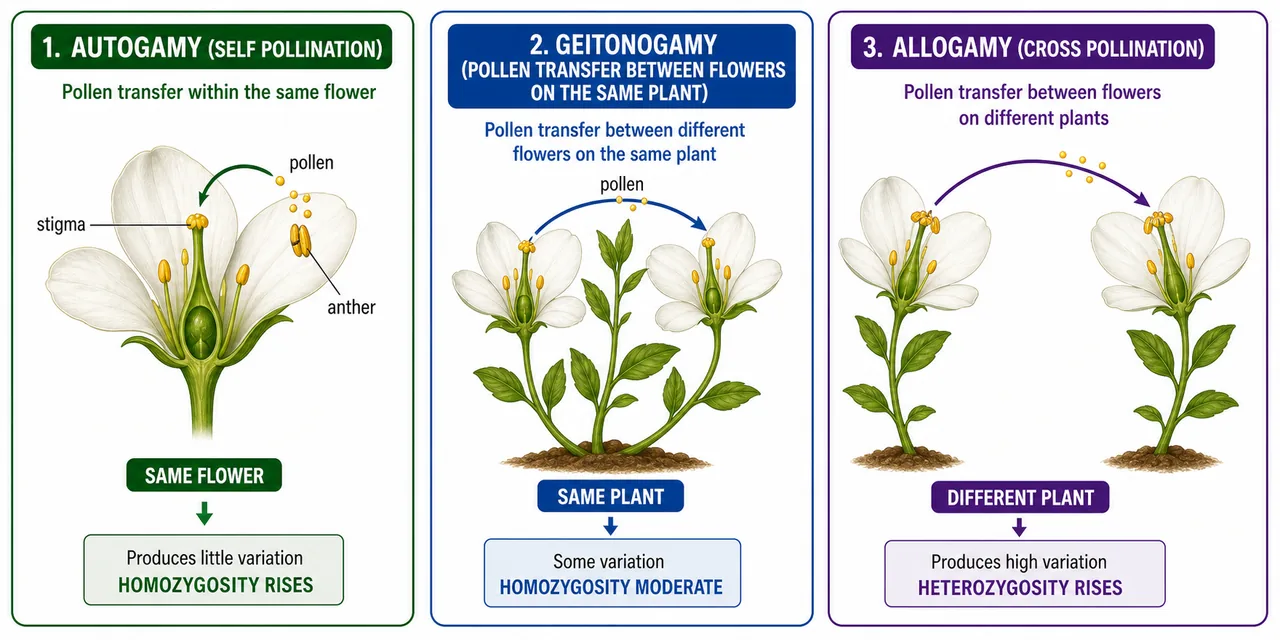
- In such pollination, pollen from an anther falls on the stigma of the same flower. This is the most restrictive form of pollination, ensuring that the genetic material comes from a single individual.
- Cross pollination is less than 5%. This small percentage of outcrossing still provides some genetic variability over generations.
- Self-pollination leads to rise in homozygosity. Over successive generations, self-pollination progressively increases the proportion of homozygous individuals in the population, leading to genetically uniform lines.
- Because deleterious recessive alleles are progressively exposed and purged under continued selfing, classical inbreeders usually show little or no inbreeding depression once stabilized, though they often have narrower adaptation and less buffering capacity than highly variable populations.
Cross-Pollination
Geitonogamy
- When pollens from a flower of one plant fall on the stigmas of other flowers of the same plant, this situation is called geitonogamy. Although pollen moves between flowers, both flowers belong to the same individual.
- The genetic consequence of geitonogamy is the same as those of autogamy. Since the pollen and the egg come from the same plant (same genotype), the result is genetically equivalent to self-pollination.
Allogamy
- Here pollens from flowers of the one plant are transmitted to the stigma of flowers of another plant by wind (anemophily), water (hydrophily) or insects (entomophily). Allogamy is true cross-pollination where genetic material from two different individuals combines.
- Allogamy leads to rise in heterozygosity. This increased heterozygosity is the basis of hybrid vigour (heterosis) observed in cross-pollinated species.
- In many naturally cross-pollinated species, a small amount of selfing may still occur, but the outcrossing level is commonly treated in exam-style notes as extending up to about 0-20% selfing in mixed situations and much higher true outcrossing in strongly allogamous crops.

Mechanisms promoting self-pollination
- Cleistogamy: Here Flowers do not open at all i.e. complete closed flowers. e.g. some varieties of wheat, oat, barley and in some grasses. Cleistogamy is the most effective mechanism ensuring self-pollination, as there is absolutely no opportunity for foreign pollen to reach the stigma.
- Chasmogamy: Here Flowers open only after pollination. Due to opening of flower, some cross pollination may occur. This allows a small degree of outcrossing while still primarily favouring self-pollination.
TIP
Pro Content Locked
Upgrade to Pro to access this lesson and all other premium content.
Charged once for one year · ₹1188 total
Save ₹100/month vs ₹2388/year launch price
- All Agriculture & Banking Courses
- AI Lesson Questions (100/day)
- AI Doubt Solver (50/day)
- Glows & Grows Feedback (30/day)
- AI Section Quiz (20/day)
- 22-Language Translation (100/day)
- Recall Questions (20/day)
- AI Quiz (15/day)
- AI Quiz Paper Analysis (100/day)
- AI Step-by-Step Explanations (100/day)
- Spaced Repetition Recall (FSRS)
- AI Tutor
- Immersive Text Questions
- Audio Lessons — Hindi & English
- Mock Tests & Previous Year Papers
- Summary & Mind Maps
- XP, Levels, Leaderboard & Badges
- Generate New Classrooms
- Voice AI Teacher (AgriDots Live)
- AI Revision Assistant
- Knowledge Gap Analysis
- Interactive Revision (LangGraph)
🔒 Secure one-time yearly payment via Razorpay · No hidden fees
Why Pollination Matters in Agriculture
The breeding method a scientist chooses for a crop depends fundamentally on its pollination behaviour. Self-pollinated crops like wheat and rice are bred using pure line selection and pedigree methods, while cross-pollinated crops like maize and sunflower are bred using population improvement and hybrid development. Understanding pollination mechanisms is therefore the starting point for designing any breeding programme.
- Study of pollen grain is termed as Palynology. Palynology is an important field that helps in understanding plant taxonomy, evolution, and breeding systems.
- Pollen grain is a double walled structure, with hard outer cover (exine) and thin inner layer (intine). The exine provides protection and contains species-specific surface patterns useful for identification, while the intine is involved in pollen tube growth during germination.
Self-pollination (Autogamy)
- In such pollination, pollen from an anther falls on the stigma of the same flower. This is the most restrictive form of pollination, ensuring that the genetic material comes from a single individual.
- Cross pollination is less than 5%. This small percentage of outcrossing still provides some genetic variability over generations.
- Self-pollination leads to rise in homozygosity. Over successive generations, self-pollination progressively increases the proportion of homozygous individuals in the population, leading to genetically uniform lines.
- Because deleterious recessive alleles are progressively exposed and purged under continued selfing, classical inbreeders usually show little or no inbreeding depression once stabilized, though they often have narrower adaptation and less buffering capacity than highly variable populations.
Cross-Pollination
Geitonogamy
- When pollens from a flower of one plant fall on the stigmas of other flowers of the same plant, this situation is called geitonogamy. Although pollen moves between flowers, both flowers belong to the same individual.
- The genetic consequence of geitonogamy is the same as those of autogamy. Since the pollen and the egg come from the same plant (same genotype), the result is genetically equivalent to self-pollination.
Allogamy
- Here pollens from flowers of the one plant are transmitted to the stigma of flowers of another plant by wind (anemophily), water (hydrophily) or insects (entomophily). Allogamy is true cross-pollination where genetic material from two different individuals combines.
- Allogamy leads to rise in heterozygosity. This increased heterozygosity is the basis of hybrid vigour (heterosis) observed in cross-pollinated species.
- In many naturally cross-pollinated species, a small amount of selfing may still occur, but the outcrossing level is commonly treated in exam-style notes as extending up to about 0-20% selfing in mixed situations and much higher true outcrossing in strongly allogamous crops.
Mechanisms promoting self-pollination
- Cleistogamy: Here Flowers do not open at all i.e. complete closed flowers. e.g. some varieties of wheat, oat, barley and in some grasses. Cleistogamy is the most effective mechanism ensuring self-pollination, as there is absolutely no opportunity for foreign pollen to reach the stigma.
- Chasmogamy: Here Flowers open only after pollination. Due to opening of flower, some cross pollination may occur. This allows a small degree of outcrossing while still primarily favouring self-pollination.
TIP
Remember: Cleistogamy = Closed flowers (both start with "Cl"). Chasmogamy = flowers open after pollination (think of "chasm" = opening).
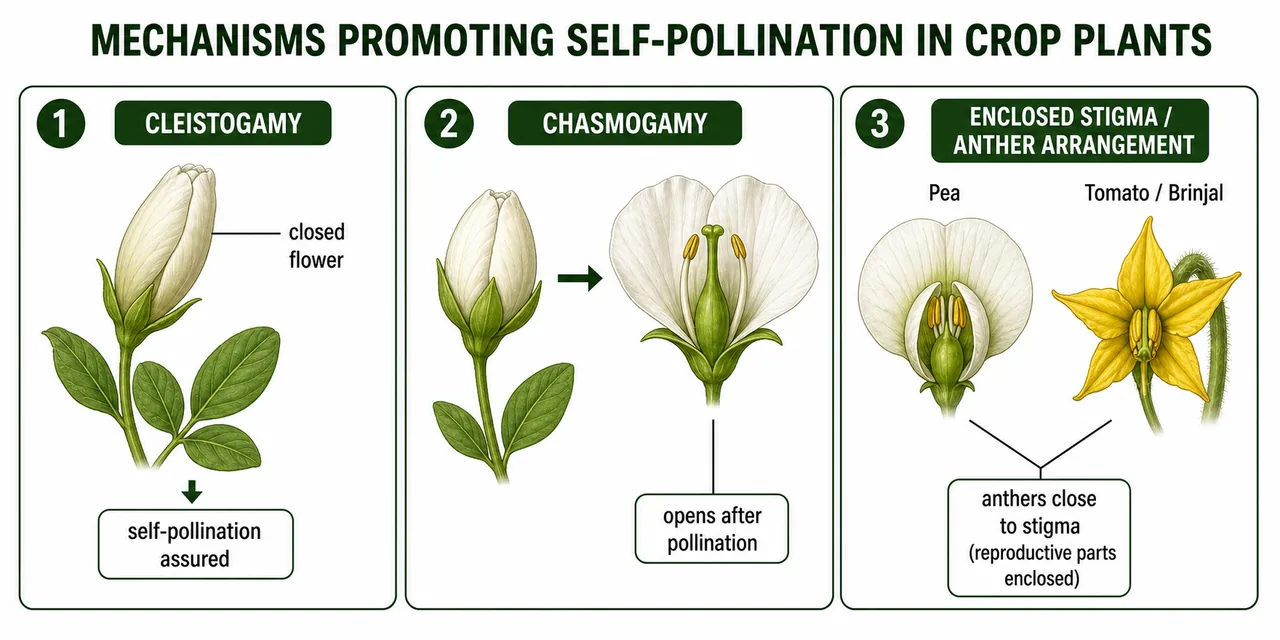

- In some crops stigma is closely surrounded by anthers and pollination generally occurs when the flowers open E.g. Tomato, Brinjal. The proximity of anthers to the stigma ensures self-pollination even in open flowers.
- In some species, the flowers open but the stamens and stigma are hidden by the floral organs. E.g. pea, mung, urd, soybean, gram. The keel petals enclose the reproductive parts, protecting them from foreign pollen.
- In few species, the stigma becomes receptive and elongates through the staminal columns.

Classification of crop species on the basis of their natural mode of pollination
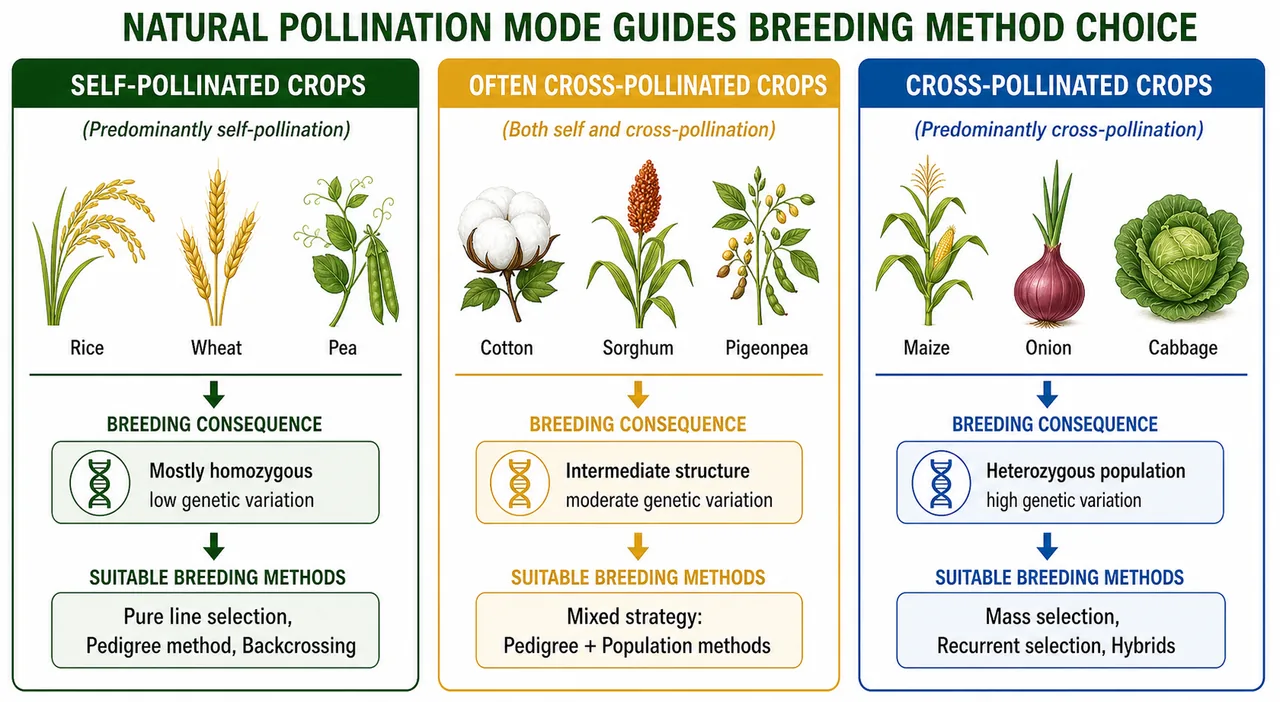
Understanding the natural pollination mode of a crop is fundamental to choosing the correct breeding method. Self-pollinated crops are bred using different approaches than cross-pollinated crops.
Self-Pollinated Crop Species

Cross-Pollinated Crop Species

Often Cross-Pollinated Crops

Genetic makeup of often cross pollinated plants is intermediate between self-pollinated and cross-pollinated plants. These crops (e.g., cotton, sorghum) exhibit a mix of homozygosity and heterozygosity, and breeding methods for them may borrow strategies from both self- and cross-pollinated crop improvement.
Mechanism promoting cross-pollination
Dicliny or unisexuality
- Dicliny or unisexuality is a condition in which the flowers are either staminate (male) or pistillate (female). Since both sexes are not present in the same flower, self-pollination within a single flower is impossible, thereby promoting cross-pollination.
- It is of two types
Monoecy
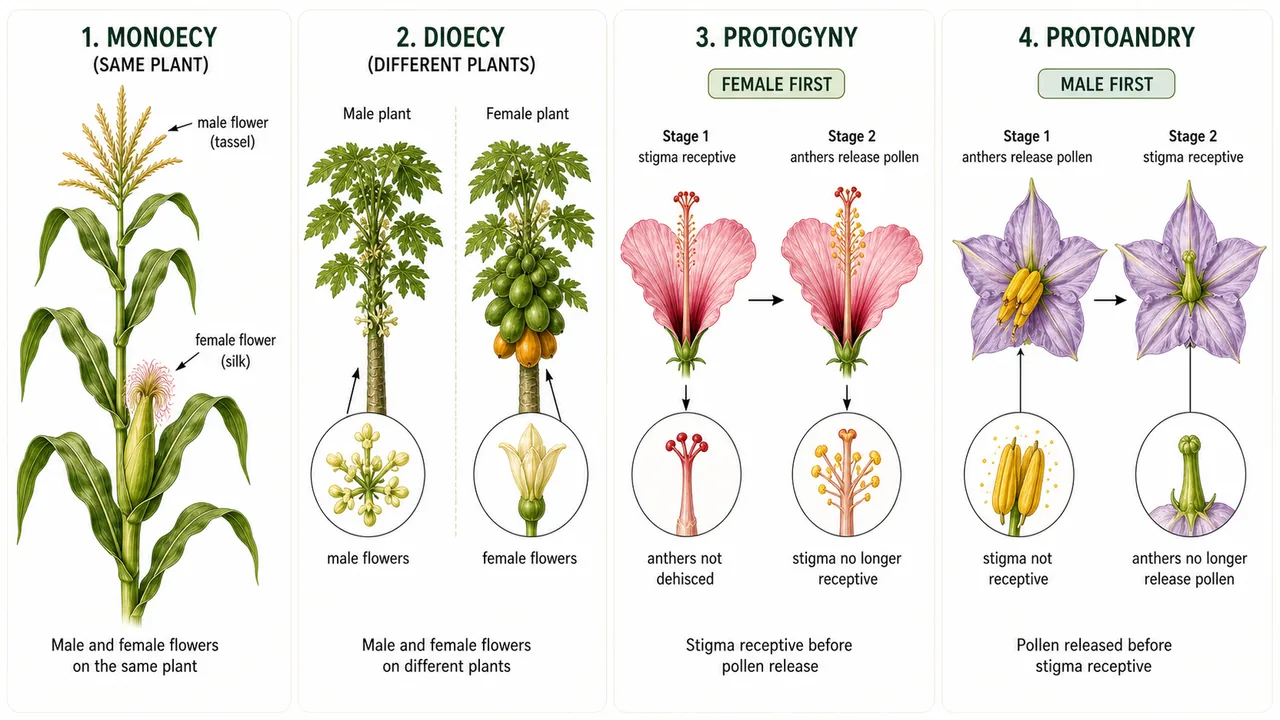
- Staminate & Pistillate flowers are found in the same plant either in the same inflorescence or in separate inflorescences. Monoecious plants can still undergo some self-pollination (geitonogamy), but cross-pollination is greatly favoured.
- Examples of same inflorescence: Castor, Mango, Banana & Coconut
- Examples of different inflorescences: Maize -- in maize, the tassel (male) and ear (female) are on separate parts of the same plant, making it an excellent example of monoecy with spatial separation.
Dioecy
- Staminate (male) & pistillate (female) flowers are found on different plants. Dioecy guarantees 100% cross-pollination since a single plant cannot pollinate itself.
- E.g. Papaya, Dates, Hemp, Asparagus, Spinach.
Dichogamy
- Maturity times of stamens and pistils of hermaphrodite flowers are different. This temporal separation of male and female functions within the same flower promotes cross-pollination even in perfect flowers.
- Protogyny: Here pistils mature earlier than stamens. E.g. Bajra (Pearl millet). The stigma emerges and is receptive before the anthers of the same flower shed pollen, forcing cross-pollination.
- Protoandry: Here stamens mature earlier than pistils E.g. Maize, Sugarbeet, Sunflower, Onion. The anthers shed pollen before the stigma of the same flower is receptive.
TIP
Proto-gyny = "gyno" (female) first. Proto-andry = "andro" (male) first. The suffix tells you which sex matures earlier.
Duodichogamy
🔖 exams 2020
- A temporal mating system in which each plant produces two batches of male flowers that are temporally separated by a batch of female flowers, with within-individual synchrony and among-individual asynchrony to ensure mating partners. This is a rare and complex reproductive strategy.
- Most trees flower in the order male → female → male.
- Duodichogamy is a rarest form of dichogamy, it is known only in a few species in four genera in unrelated families.
Other
- In some plants, stigma is covered with a waxy film which is broken by the visit of honey bees facilitating cross pollination. E.g. Lucerne or alfalfa. This is a fascinating example of plant-insect co-evolution promoting outcrossing.
- More than one mechanism may occur in some species. e.g. maize has both monoecy and protoandry. The combination of multiple mechanisms makes maize a highly cross-pollinated crop.
- Self Incompatibility: means the failure of pollen from a flower to fertilize the same flower or other flowers on the same plant. Here male gamete is fully functional. E.g. Brassica sp., Nicotiana, radish etc. Self-incompatibility is a genetically controlled mechanism that actively prevents self-fertilization.
- Male Sterility: means the non-functional pollen grains. Here female gamete is fully functional. Male sterility is not common in natural populations but is extremely valuable in hybrid seed production programmes.
IMPORTANT
Self-incompatibility = pollen is functional but cannot fertilize the same plant (a recognition barrier). Male sterility = pollen itself is non-functional (a production barrier). Both promote cross-pollination but through completely different mechanisms.
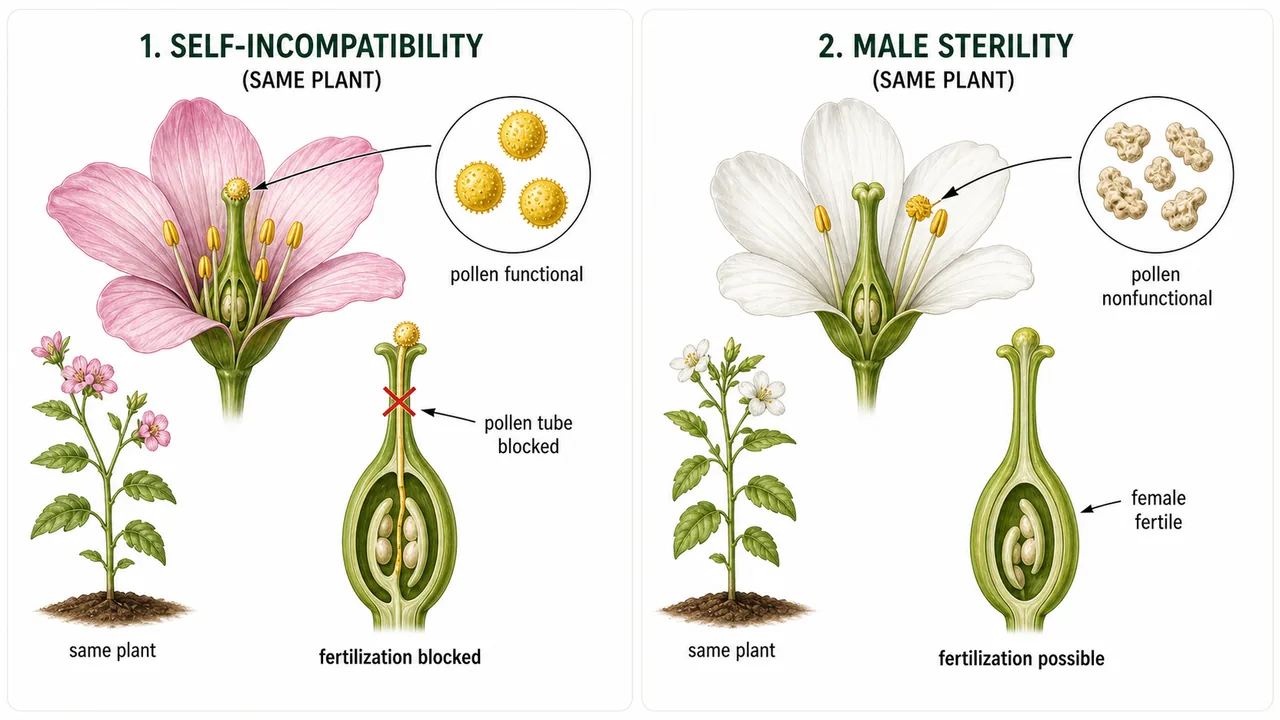
Self-Incompatibility
- Self-incompatible pollen grain does not germinate and if pollen grain germinates, its pollen tube fails to enter into stigma. If pollen tube enters into stigma and fertilization takes place but ultimately embryo aborts. It means any how embryo does not develop and occurrence of self-incompatibility is due to biochemical reaction but its precise nature is not clearly understood.
- On the basis of the interaction between pollen grains and pistil, it is of two types:
- Complementary i.e. stimulatory type where pistil & pollen stimulate each other or either. e.g. Dendrobium.
- Oppositional i.e. inhibitory type where pistil & pollen inhibit each other or either. Almost all the cases of self-incompatibility are inhibitory type.
- Lewis (1954) suggested various types of classifications of self-incompatibility (SI). A simpler classification is:
Heteromorphic System
- Flowers of different incompatibility groups are different in morphology.
- The compatibility reaction of pollen is determined by the genotype of the plant producing them. The incompatibility system is heteromorphic-sporophytic.
Homomorphic System
- Here morphological differences between flowers is not associated with incompatibility. The incompatibility reaction of pollen is either controlled by the genotype of the plant on which it is produced (sporophytic control) or by its own genotype (gametophytic control).
- Gametophytic system: East and Mangelsdorf (1925) firstly described Gametophytic incompatibility in Nicotiana sanderae. The incompatibility reaction of pollen is determined by its own genotype and not by the genotype of the plant on which it is produced. e.g. pineapple, ryegrass, diploid coffee, diploid clovers (Trifolium sp.) etc.
- Sporophytic system: First time this system was reported, by Hughes & Babcock (1950) in Crepis foetida and by Gerstel (1950) in Parthenium argentatum. The incompatibility reaction of pollen is determined by the genotype of the plant on which the pollen is produced and not by the genotype of the pollen.
Elimination of self-incompatibility
- By doubling the chromosome number in single locus gametophytic system.
- Isolation of self-fertile mutations (very useful tool)
- The transfer of self-compatibility alleles from a related species through a back cross programme.
Temporary suppression of self-incompatibility
- For the production of inbred (for hybrid seed production) it is essential to achieve self-fertility, where self-incompatibility is fully functional in the selfed progeny. This self-fertility is called as pseudo fertility. This pseudo fertility is achieved through temporary suppression of incompatibility by one of the following techniques:
- Bud pollination: Means application of mature pollen to immature non-receptive stigma generally 1-2 days before anthesis. Bud pollination is the most practicable & successful method in both gametophytic and sporophytic systems.
- Surgical techniques: Removal of stigma is very useful in sporophytic system. Pollen is directly dropped on to the ovules.
- End-of-season pollination controversial technique.
- High temperature: May induce pseudo fertility E.g. in Trifolium, Lycopersicon, Brassica, Oenothera exposure of pistils upto 60 degrees C induces pseudo fertility.
- Increased CO2 conc. in sporophytic system
- High humidity
- Salt, (NaCl) sprays are used by the Chinese
- Irradiation: In a single locus gametophytic system. e.g. in solanaceae, acute irradiation with x-rays or gamma-rays induces pseudo-fertility
- Grafting
- Double pollination
- Other techniques like use of phytohormones, treatment of flowers with carbon-monoxide etc.
Male Sterility
- Male sterility means non-functional pollen grains. Here female gametes are normally functional. It is classified into four groups:
- Genetic Male Sterility (GMS) or Nuclear Male Sterility
- Temperature-sensitive GMS
- Photoperiod-sensitive GMS
- Transgenic GMS
- Cytoplasmic Male Sterility (CMS)
- Cytoplasmic-Genetic Male Sterility (CGMS)
- Chemically-Induced Male Sterility
- Male Sterility is used for hybrid seed production in many crops because it is a means of genetic emasculation. UPPSC 2021 Using male sterility eliminates the need for hand emasculation, making large-scale hybrid seed production economically feasible.
Genetic (Nuclear) Male Sterility
- GMS/NMS is ordinarily governed by a single recessive gene ms but also by dominant genes. Male sterility alleles are occurred spontaneously or are induced artificially.
- Genetic male sterility is simple and ecofriendly technique of hybrid seed production. UPPSC 2021
- When a male sterile plant (ms ms) is crossed with the male fertile (Ms Ms) plant, the product F1 (Ms ms) is male fertile.
- In F2, 3 Fertile : 1 Sterile is obtained. A male sterile line is maintained by crossing with heterozygous male fertile (Ms ms). This mating produces 1 : 1 male sterile & male fertile plants.
Maintenance of a male sterile line
- During the maintenance of male sterile lines, sibmating (i.e. brother-sister mating) is achieved through natural pollination. The male sterile plants are pollinated by adjacent male fertile sibs, maintaining the line generation after generation.
- In some cases ms gene expression is affected by the specified range of temperature and or photoperiod regime. Such GMS is environment sensitive and found in Rice, tomato, wheat etc.
- Temperature-sensitive Genetic Male sterility:
- Complete male sterility is produced by the ms gene at higher temperatures
- E.g. 23.3 degrees C or higher for rice TGMS line Pei-Ai 645. This type of genetic male sterility is being used in the China to develop hybrid rice.
- Photoperiod-sensitive Genetic male sterility (PGMS):
- In some cases, ms gene expression is drastically affected by the prevailing photoperiod, provided the temp. is within the critical range.
- E.g. the critical temp. is 23-29 degrees C for rice for PGMS. Within this critical temp. range, complete sterility is found in rice plants grown under long day conditions (i.e. day length more than 13 hours 45 minutes). But under short day conditions almost normal fertility is found. This type PGMS is being utilized in the China to develop hybrid rice.
Transgenic Genetic male sterility
- Transgene is such a gene which is introduced into the genome of an organisms by recombinant DNA technology or genetic engineering. Many transgenes cause male sterility. These are found in maize, cauliflower, tomato, wheat & chicory but this system is not yet used commercially.
- The genetic male sterility is being used for hybrid rice development in China. GMS is being successfully used in castor in U.S.A. In India GSM is being used for hybrid seed production of Arhar by private companies like Maharashtra Hybrid seed Co. Ltd.
Cytoplasmic Male Sterility (CMS)
- Here male sterility is governed by the cytoplasm. The male sterility is the result of mutation in the mitochondrial genome (mt DNA) which leads to mitochondrial dysfunction e.g. CMS-Maize, Ogura cms of brassica. This is a maternally inherited trait.
- Since the cytoplasm of a zygote comes primarily from egg cells, the progeny of such male sterile plants would always be male sterile. This makes CMS a reliable system for maintaining male sterility across generations.
- Cytoplasmic male sterility may be transferred easily to a given strain by using that strain as a pollinator (recurrent parent) in the, successive generations of a backcross programme.
- CMS is used only for the vegetative growth purposes because all the progenies are male steriles & there are no seed setting.
- It is used in chillies by some private companies.
- In 1996, Kaul concluded that restorer genes have been detected for all cases of CMS. The idea of CMS has been disfavored by Kaul and according to Kaul, male sterility is either genetic or cytoplasmic-genetic.
Cytoplasmic-genetic male sterility (CGMS)
- The case of cytoplasmic male sterility where the nuclear gene for restoring fertility in the male sterile line is known; is called cytoplasmic genetic male sterility. CGMS involves an interaction between cytoplasmic factors and nuclear genes.
- The fertility restorer gene, R, is dominant which restores male fertility in the male sterile line. If the nuclear genotype is rr, and the cytoplasm is male sterile, then plant would be male sterile.
- The effect of sterile cytoplasm is negated by the presence of restorer gene R even in heterozygous condition (Rr) because R is dominant over r.
- CGMS is also known as nucleoplasmatic male sterility.
- CGMS is commercially utilized in rice, wheat, maize, Sorghum, Pearl Millet, Cotton etc. It is the most widely used system for commercial hybrid seed production.
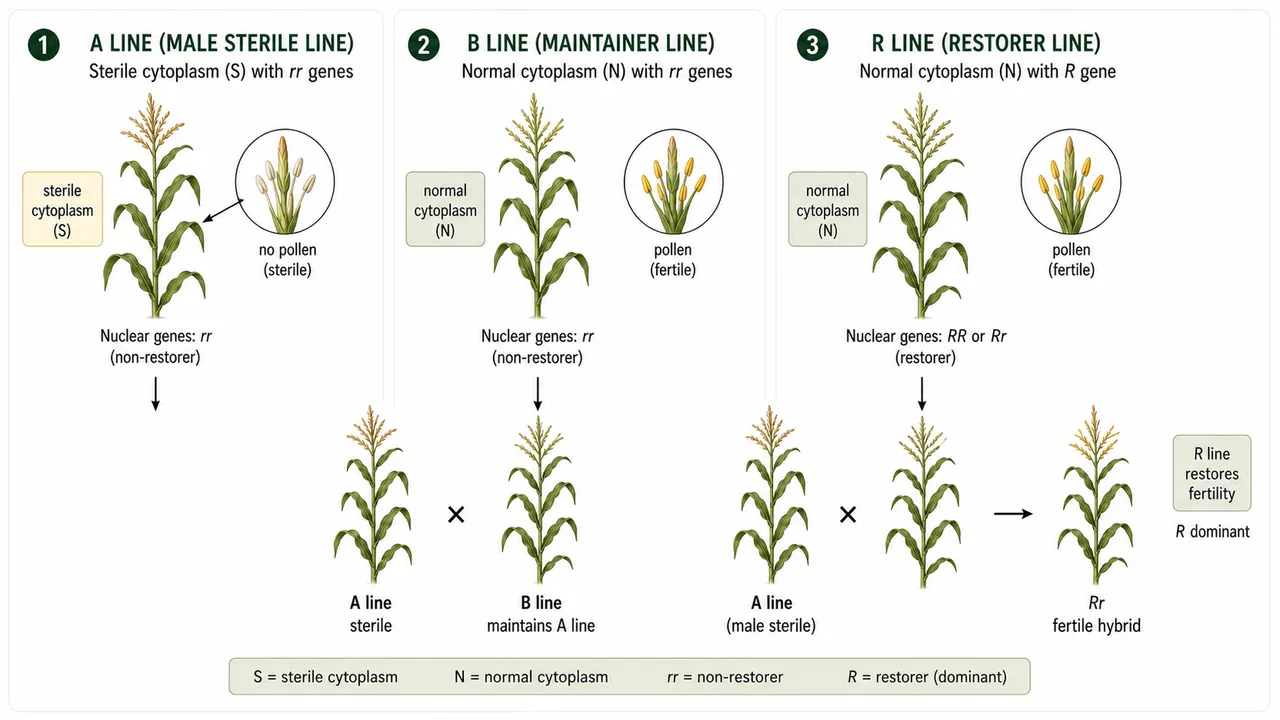
- After selfing of the male fertile progeny, individual plant progeny is grown in the next generation and non-segregating progenies are selected and segregating progenies are rejected.
- Determination of genotype or genotypic value of a plant by studying its progeny is known as progeny test.
Chemical hybridising Agent (CHA)
- Such chemicals which affect the function of male reproductive organs in plants; are called chemical hybridising agents (CHAs). CHAs offer an alternative to genetic male sterility systems for hybrid seed production.
- E.g. Maleic hydrazide (MH), α - NAA, β - NAA, FW 450 (Mendok), Ethrel (Ethephon), Arsenicals, GA3, Hybrex (RH0007), Shell (WL 84811). Firstly in 1950, Moore & Naylor induced male sterility in maize using MN.
- Hybrex has been used for the commercial production of hybrid wheat in USA since 1982.
- Arsenic inhibits respiration in anthers via enzymes like succinate dehydrogenase and cytochrome oxidase.
- Ethephon (Ethrel) produces ethylene which interacts with the plant hormone system.
- GA produces male sterility in rice, wheat etc. by interfering with tile nutrient flow to developing anthers.
- Hybrex disrupts pollen development during microsporogenesis which leads to irregular and thinner deposition of exine and ultimately to pollen
Summary Cheat Sheet
| Concept / Topic | Key Details |
|---|---|
| Pollination | Transfer of pollen from anther to stigma |
| Self-pollination | Pollen from same flower/plant; produces homozygosity |
| Cross-pollination | Pollen from different plant; produces heterozygosity |
| Self-pollinated crops | Wheat, rice, barley, pea, tomato, soybean, groundnut |
| Cross-pollinated crops | Maize, bajra, sunflower, sugarbeet, rye, alfalfa |
| Often cross-pollinated | Cotton, sorghum, pigeonpea, safflower, tobacco, triticale, Corchorus olitorius |
| Cleistogamy | Pollination in closed flower (ensures self-pollination) |
| Cleistogamy examples | Wheat, rice, barley, oat |
| Chasmogamy | Pollination in open flower |
| Emasculation | Removal of anthers before pollen shed |
| Bagging | Covering emasculated flower to prevent unwanted pollen |
| Protandry | Anthers mature before stigma (promotes cross-pollination) |
| Protogyny | Stigma matures before anthers |
| Dichogamy | Maturation of anthers and stigma at different times |
| Herkogamy | Structural barrier between anther and stigma |
| Dioecy | Male and female flowers on separate plants (e.g., papaya, date palm) |
| Monoecy | Male and female flowers on same plant (e.g., maize, coconut) |
| Genetic male sterility (GMS) | Usually governed by recessive ms gene; used for hybrid seed production |
| GMS inheritance recall | F2 = 3 fertile : 1 sterile |
| Male-sterile line maintenance | Crossing with heterozygous fertile (Ms ms) gives 1:1 sterile:fertile plants |
| CMS | Cytoplasm-governed, maternally inherited male sterility |
| CGMS | CMS + nuclear restorer system; dominant R restores fertility |