🌍 Plant Introduction: Acclimatisation and Quarantine
Understand plant introduction as a breeding method — primary vs secondary introduction, acclimatisation, plant quarantine, merits, and demerits — with agricultural examples and exam tips.
Why Plant Introduction Matters in Agriculture
Many of India's most important crops are not native — maize came from Mexico, potato from South America, soybean from China, and rubber from Brazil. All were brought to India through plant introduction, the oldest and simplest method of crop improvement. Even today, breeders introduce exotic germplasm to access genes for disease resistance, quality traits, and stress tolerance that may not exist in locally available material.
Plant Introduction
NOTE
Plant introduction is one of the oldest and simplest methods of crop improvement. Many of India's most important crops -- maize, potato, tobacco -- were originally introduced from other countries.
- Plant introduction consists of taking a genotype or a group of genotypes of plants into new environments where they were not being grown before. It is one of the simplest and most widely used methods of crop improvement, enabling the rapid acquisition of new genetic material.
- Introduction may involve new varieties of a crop already grown in the area, wild relatives of the crop species or a totally new crop species. Each of these types of introduction serves a different purpose in the overall crop improvement strategy.
- Mostly materials are introduced from other countries or continents. But movement of crop varieties from one environment into another within a country is also introduction. Some examples of within the country introduction are popularization of grape cultivation in Haryana, Introduction of wheat in West Bengal, Rice in Punjab etc. These within-country introductions highlight that the concept of plant introduction is not limited to international exchanges.

Primary Introduction
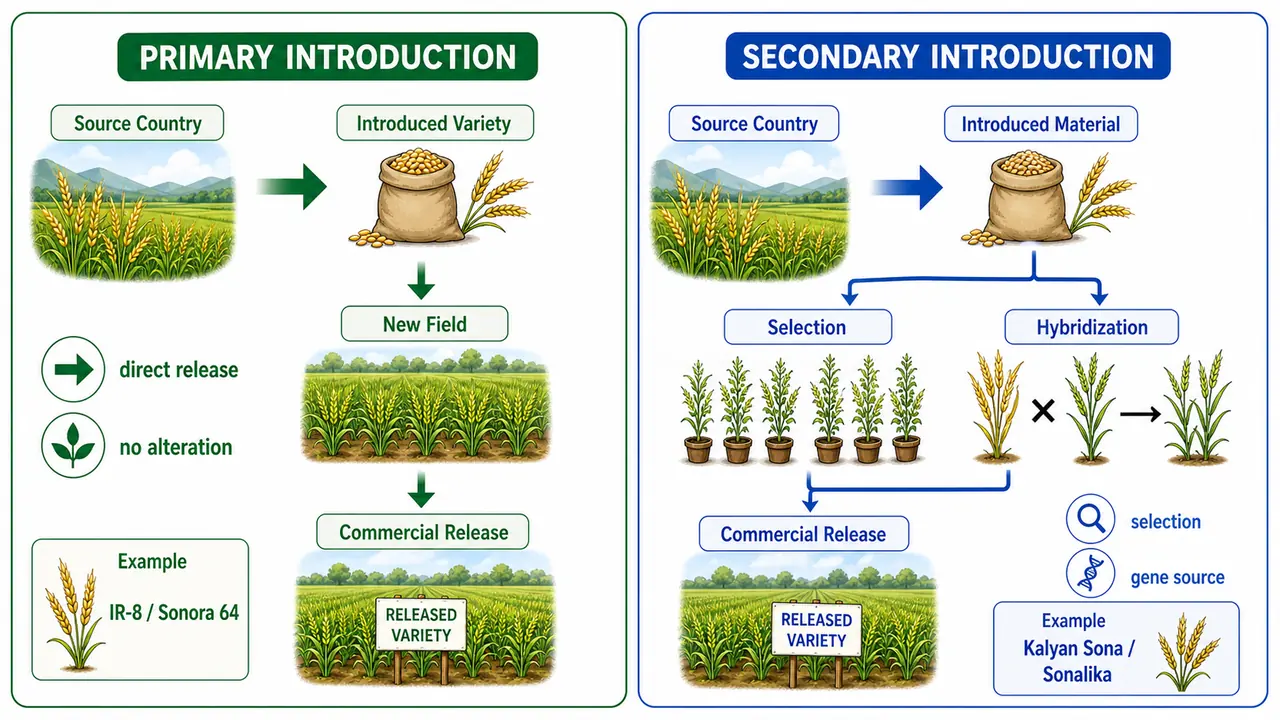
- When the introduced variety is well suited to the new environment, it is released from commercial cultivation without any alteration in the original genotype, this constitutes primary introduction. In other words, the variety performs so well in the new location that no selection or hybridization is needed before it can be grown commercially.
- Primary introduction is less common, particularly in countries having well organized crop improvement programmes. This is because most introduced materials require some degree of modification to perform optimally in a new environment.
- Introduction of semi dwarf wheat varieties Sonora 64, Lerma Roja and of semi dwarf rice varieties Taichung Native 1 (TN-1), IR-8 and IR-36 are some examples of primary introductions. These varieties played a pivotal role in the Green Revolution in India.
Secondary Introduction
- The introduced variety may be subjected to selection to isolate a superior variety. Alternatively, it may be hybridized with local varieties to transfer one or few characters from this variety to the local ones these processes are known as secondary introduction. In secondary introduction, the introduced material serves as a source of genes rather than a ready-made variety.
- Secondary introduction is much more common than primary introduction. Most introduced materials need some modification to adapt to local conditions, making secondary introduction the norm in plant breeding.
- Examples of secondary introduction are Kalyan Sona and Sonalika wheat varieties selected from material introduced from CIMMYT, Mexico. These varieties were not direct introductions but were selected from segregating populations introduced from abroad.
History of Plant Introduction
- Crop plants have traveled into many new areas from their centres of origin. This movement of plants occurred with the movement of man. Most of these introductions occurred very early in the history. The history of plant introduction is essentially the history of agriculture itself.

- For example, mung, mustard, pear, apple and walnut were introduced from the Central Asian Center of origin into various parts of India. Similarly sesame, Jowar, arhar, Asian Cotton and finger millet originated in Africa and traveled to India in the prehistoric period. From this it is clear that plant wealth of various nations is to a large extent the result of plant introductions.
- For several centuries A.D. The agencies of plant Introduction were invaders, settlers, traders, travelers, explorers and naturalists. The plant introduction were made either knowingly or unknowingly. Muslim invaders introduced in India cherries and grapes from Afghanistan by 1300 A.D.
- In the 16th century A.D. Portuguese introduced Maize, groundnut, chilies, potato, sweet potato, guava, pineapple, papaya, cashew and Tobacco. This was one of the most significant periods of plant introduction, as it brought New World crops to India that are now integral to Indian agriculture and cuisine.
TIP
Pro Content Locked
Upgrade to Pro to access this lesson and all other premium content.
Charged once for one year · ₹1188 total
Save ₹100/month vs ₹2388/year launch price
- All Agriculture & Banking Courses
- AI Lesson Questions (100/day)
- AI Doubt Solver (50/day)
- Glows & Grows Feedback (30/day)
- AI Section Quiz (20/day)
- 22-Language Translation (100/day)
- Recall Questions (20/day)
- AI Quiz (15/day)
- AI Quiz Paper Analysis (100/day)
- AI Step-by-Step Explanations (100/day)
- Spaced Repetition Recall (FSRS)
- AI Tutor
- Immersive Text Questions
- Audio Lessons — Hindi & English
- Mock Tests & Previous Year Papers
- Summary & Mind Maps
- XP, Levels, Leaderboard & Badges
- Generate New Classrooms
- Voice AI Teacher (AgriDots Live)
- AI Revision Assistant
- Knowledge Gap Analysis
- Interactive Revision (LangGraph)
🔒 Secure one-time yearly payment via Razorpay · No hidden fees
Why Plant Introduction Matters in Agriculture
Many of India's most important crops are not native — maize came from Mexico, potato from South America, soybean from China, and rubber from Brazil. All were brought to India through plant introduction, the oldest and simplest method of crop improvement. Even today, breeders introduce exotic germplasm to access genes for disease resistance, quality traits, and stress tolerance that may not exist in locally available material.
Plant Introduction
NOTE
Plant introduction is one of the oldest and simplest methods of crop improvement. Many of India's most important crops -- maize, potato, tobacco -- were originally introduced from other countries.
- Plant introduction consists of taking a genotype or a group of genotypes of plants into new environments where they were not being grown before. It is one of the simplest and most widely used methods of crop improvement, enabling the rapid acquisition of new genetic material.
- Introduction may involve new varieties of a crop already grown in the area, wild relatives of the crop species or a totally new crop species. Each of these types of introduction serves a different purpose in the overall crop improvement strategy.
- Mostly materials are introduced from other countries or continents. But movement of crop varieties from one environment into another within a country is also introduction. Some examples of within the country introduction are popularization of grape cultivation in Haryana, Introduction of wheat in West Bengal, Rice in Punjab etc. These within-country introductions highlight that the concept of plant introduction is not limited to international exchanges.
Primary Introduction
- When the introduced variety is well suited to the new environment, it is released from commercial cultivation without any alteration in the original genotype, this constitutes primary introduction. In other words, the variety performs so well in the new location that no selection or hybridization is needed before it can be grown commercially.
- Primary introduction is less common, particularly in countries having well organized crop improvement programmes. This is because most introduced materials require some degree of modification to perform optimally in a new environment.
- Introduction of semi dwarf wheat varieties Sonora 64, Lerma Roja and of semi dwarf rice varieties Taichung Native 1 (TN-1), IR-8 and IR-36 are some examples of primary introductions. These varieties played a pivotal role in the Green Revolution in India.
Secondary Introduction
- The introduced variety may be subjected to selection to isolate a superior variety. Alternatively, it may be hybridized with local varieties to transfer one or few characters from this variety to the local ones these processes are known as secondary introduction. In secondary introduction, the introduced material serves as a source of genes rather than a ready-made variety.
- Secondary introduction is much more common than primary introduction. Most introduced materials need some modification to adapt to local conditions, making secondary introduction the norm in plant breeding.
- Examples of secondary introduction are Kalyan Sona and Sonalika wheat varieties selected from material introduced from CIMMYT, Mexico. These varieties were not direct introductions but were selected from segregating populations introduced from abroad.
History of Plant Introduction
- Crop plants have traveled into many new areas from their centres of origin. This movement of plants occurred with the movement of man. Most of these introductions occurred very early in the history. The history of plant introduction is essentially the history of agriculture itself.
- For example, mung, mustard, pear, apple and walnut were introduced from the Central Asian Center of origin into various parts of India. Similarly sesame, Jowar, arhar, Asian Cotton and finger millet originated in Africa and traveled to India in the prehistoric period. From this it is clear that plant wealth of various nations is to a large extent the result of plant introductions.
- For several centuries A.D. The agencies of plant Introduction were invaders, settlers, traders, travelers, explorers and naturalists. The plant introduction were made either knowingly or unknowingly. Muslim invaders introduced in India cherries and grapes from Afghanistan by 1300 A.D.
- In the 16th century A.D. Portuguese introduced Maize, groundnut, chilies, potato, sweet potato, guava, pineapple, papaya, cashew and Tobacco. This was one of the most significant periods of plant introduction, as it brought New World crops to India that are now integral to Indian agriculture and cuisine.
TIP
Remember the Portuguese introductions with this mnemonic: "My Great Country Produces Sweet Grapes, Pineapples, Papayas, Cashews, and Tobacco" -- Maize, Groundnut, Chilies, Potato, Sweet Potato, Guava, Pineapple, Papaya, Cashew, Tobacco.
- East India Company brought tea, litchi, and loquat from China.
- Cabbage, cauliflower and other vegetables from the Mediterranean; annatto and mahogany from West Indies in the last quarter of 18th century.
- During 19th century, a number of botanic gardens played an important role in plant introduction. The Calcutta botanic gardens was established in 1781. The Kew botanic gardens, England arranged introduction of quinine and rubber trees from South America into India. During and after the last part of 19th century various agricultural and horticulture research stations were established in the country. These stations introduced horticulture and agriculture plants independent of each other. There was no co-ordination among these agencies regarding their introduction activities.
Plant Introduction Agencies in India
- A centralized plant introduction agency was initiated in 1946 at the Indian Agricultural Research Institute (IARI), New Delhi. This was a landmark step in organizing and streamlining the introduction of plant material into India.
- The agency began as a plant introduction scheme in the Division of Botany and was funded by ICAR.
- In 1956, during the second five year plan, the scheme was expanded as the Plant Introduction and Exploration Organization. Subsequently in 1961, it was made an independent division in IARI, the Division of Plant Introduction.
- The division was reorganized as National Bureau of Plant Genetic Resources (NBPGR) in 1976. This reorganization marked a shift towards a more comprehensive approach to germplasm management, including not just introduction but also collection, conservation, and evaluation.
IMPORTANT
The evolution of India's plant introduction agency: 1946 (scheme at IARI) → 1956 (Plant Introduction & Exploration Org.) → 1961 (Division of Plant Introduction) → 1976 (NBPGR). All introductions in India must be routed through NBPGR, New Delhi.
- The nature of activities and the functions of the bureau have remained the same, but the scope and scale of its activities have increased considerably. The bureau is responsible for the introduction and maintenance of germplasm of agricultural and horticultural plants.
- In addition to the National Bureau of Plant Genetic Resources, there are some other agencies concerned with plant introduction. Forest Research Institute, Dehradun, has a plant introduction organization which looks after the introduction, maintenance and testing of germplasm of forest trees. The Botanical Survey of India was established in 1890; it was responsible for the introduction, testing and maintenance of plant materials of botanical and medicinal interest. But at present, introduction and improvement of medicinal plants is being looked after by NBPGR.
- The Central Research Institute for various crops, e.g., tea, coffee, sugarcane, potato, Tobacco, rice etc., introduce, test and maintain plant materials of their interest.
- But their activities are coordinated by the NBPGR, which has the ultimate responsibility for introduction activities. Plant material may also be introduced by individual scientists, universities and other research organizations. But all the introductions in India must be routed through the NBPGR, New Delhi. This ensures proper quarantine, documentation, and coordinated evaluation.
- The National Bureau of Plant Genetic Resources. The bureau has its headquarters at IARI, New Delhi. It has four substations for the testing of introduced plant materials. These substations represent the various climatic zones of India, they are listed below.
- Simla (Himachal Pradesh) -- represents the temperate zone; approximately 2,300 m above sea level.
- Jodhpur (Rajasthan) -- represents the arid zone
- Kanya Kumari (Tamil Nadu) -- represents the tropical zone
- Akola (Maharashtra) -- represents the mixed climatic zone. It was recently shifted from Amravati.
- In addition, a new substation has recently been established at Shillong for collection of germplasm from North-east India. This part of the country has a large genetic variability for several crop species, e.g., rice, citrus, Maize etc.
- The bureau functions as the central agency for the export and introduction of germplasm of economic importance. The bureau is assisted in its activities by the various Central Research Institutes of ICAR. The activities of the bureau are summarized below.
- It introduces the required germplasm from its counterparts or other agencies in other countries.
- It arranges explorations inside and outside the country to collect valuable germplasm.
- It is responsible for the inspection and quarantine of all the introduced plant materials.
- Testing, multiplication and maintenance of germplasm obtained through various sources. This may be done by the bureau itself at one of its substations or by one of the concerned Central Institutes of ICAR.
- To supply, on request, germplasm to various scientists or institutions. The germplasm may be supplied ex-stock or may by procured from outside in case it is not available in the country.
- Maintenance of records of plant name, variety name, propagating material, special characteristics, source, date and other relevant information about the materials received.
- To supply germplasm to its counterparts or other agencies in other countries.
- To publish its exchange and collection lists. An Introduction News Letter containing such lists is being published by the Food and Agriculture Organisation (FAO) since 1957 at irregular intervals. NBPGR has also published some lists, and is in the process of publishing some other catalogues.
- To set up natural gene sanctuaries of plants where genetic resources are endangered.
- Improvement of certain plants like medicinal and aromatic plants.
Procedure of Plant Introduction
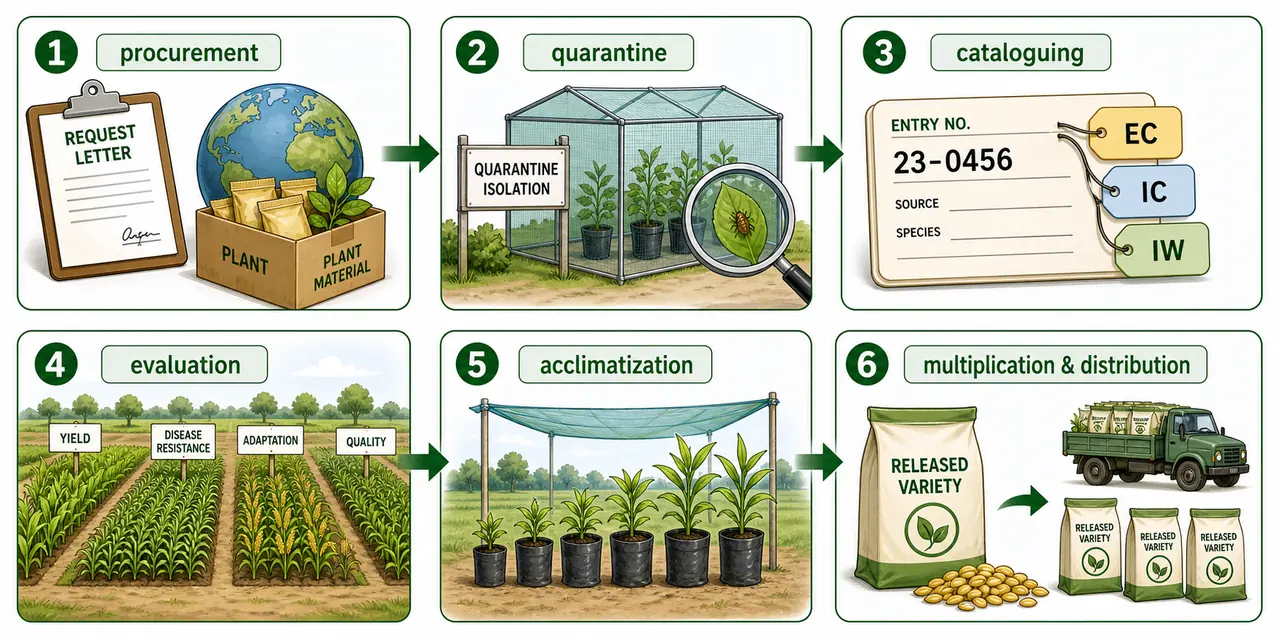
- Procurement: Any individual or institution can introduce germplasm in India. But all the introductions must be routed through the NBPGR, New Delhi. There are two routes for plant introduction. In first route the individual or the institution makes a direct request to an individual or institution abroad, who has the desired germplasm, to send it through the NBPGR, New Delhi. In second procedure the individual or institute submits his germplasm requirements to the NBPGR with a request for their import. Both routes ensure that all introduced material passes through proper quarantine channels.
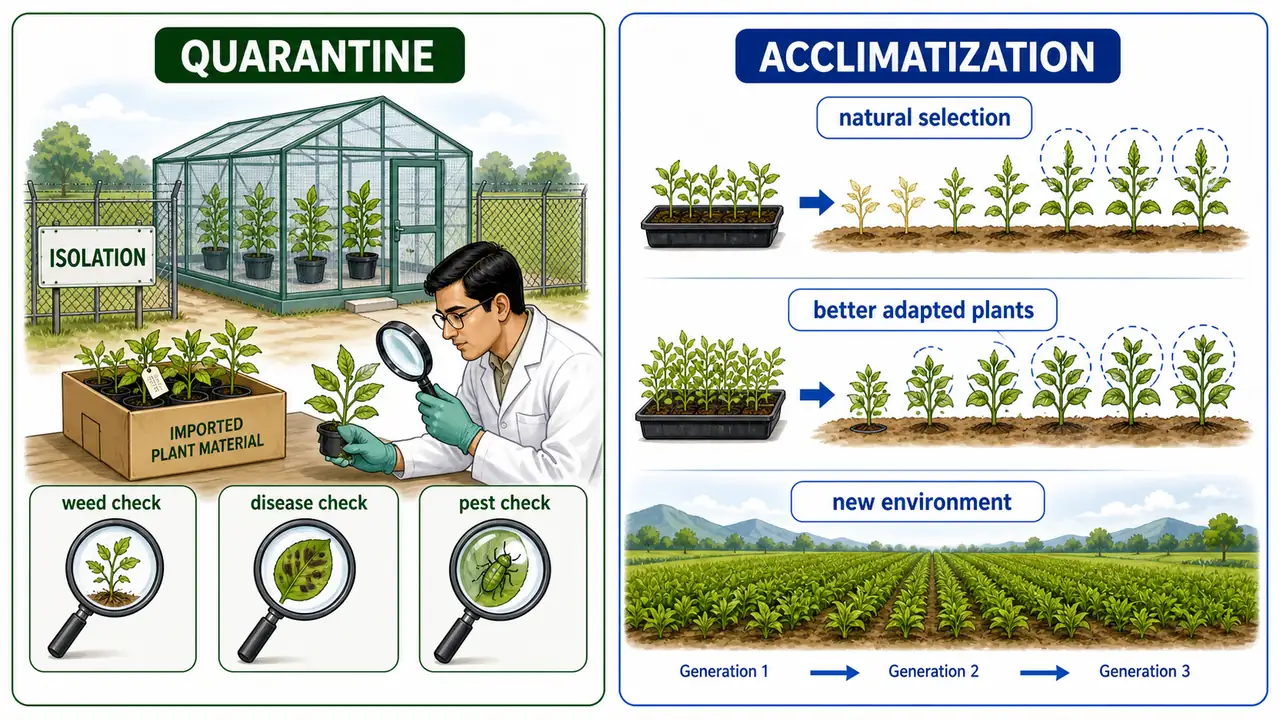
- Quarantine: Quarantine means to keep materials in isolation to prevent the spread of diseases etc. All the introduced plant propagules are thoroughly inspected for contamination with weeds, diseases and insect pests. Materials that are suspected to be contaminated are fumigated or are given other treatments to get rid of the contamination. If necessary, the materials are grown in isolation for observation of diseases, insect pests and weeds. The entire process is known as quarantine and the rules prescribing them are known as quarantine rules. Quarantine is essential to protect the country's agriculture from the entry of exotic pests and diseases.
- Cataloguing: When an introduction is received, it is given an entry number. Further, information regarding name of the species, variety, place of origin, adaptation and its various characteristics are recorded. The plant materials are classified into three groups.
- Exotic collections are given the prefix 'EC'
- Indigenous collections are designated as 'IC' and
- Indigenous wild collections are marked as 'IW'
- Evaluation: To assess the potential of new introductions, their performance is evaluated at different substations of the Bureau. In case of those crops for which Central Research Institutes are functioning, e.g., rice, sugarcane, potato, Tobacco etc., the introduced materials are evaluated and maintained by these institutes. The resistance to diseases and pests is evaluated under environments favouring heavy attacks by them. Thorough evaluation ensures that only truly superior introductions advance further.
- Acclimatization:
- Generally, the introduced varieties perform poorly because they are often not adapted to the new environment. Sometimes, the performance of a variety in the new environment improves with the number of generations grown there.
- The process that leads to the adaptation of a variety to a new environment is known as acclimatization. It is essentially a gradual adjustment of the introduced material to local growing conditions.
- Acclimatization is brought about by a faster multiplication of those genotypes (present in the original population) that are better adapted to the new environment. Thus acclimatization is essentially natural selection. Variability must be present in the original population for acclimatization to occur.
- Therefore, land varieties are likely to get acclimatized, while pure lines are not likely to. This is because land varieties contain genetic variability upon which natural selection can act, whereas pure lines are genetically uniform.
- The extent of acclimatization is determined by
- the mode of pollination,
- the range of genetic variability present in the original population, and
- the duration of lifecycle of the crop.
- Cross-pollination leads to a far greater gene recombination than self-pollination. As a result, cross-pollination is much more helpful in acclimatization than self-pollination.
- Multiplication and Distribution: Promising introductions or selections from the introductions may be increased and released as varieties after the necessary trials. Most of the introductions, however, are characterized for desirable traits and are maintained for future use. Such materials are used in crossing programmes and are readily supplied by the bureau on request.
Purpose of Plant Introduction
- To Obtain An Entirely New Crop Plant. Plant introductions may provide an entirely new crop species. Many of our important crops, e.g., Maize, potato, tomato, Tobacco, etc., are introductions. Some recently introduced crops are Soybean, gobhi, sarson, oil palm etc. These introductions have transformed Indian agriculture and dietary patterns.
- To Serve as New Varieties. Sometimes introductions are directly released as superior commercial varieties. The Maxican semi dwarf wheat varieties Sonora 64 and Lerma Rojo, semidrawf rice varieties TN 1, IR-8 and IR-36 are more recent examples of this type. These direct introductions have had enormous impact on food production.
- To Be Used in Crop Improvement. Often the introduced material is used for hybridization with local varieties to develop improved varieties. Pusa Ruby tomato was derived from a cross between Meeruty and Sioux, an introduction from U.S.A.
- To Save the Crop from Diseases And Pests. Sometimes a crop is introduced into a new area to protect it from diseases and pests. Coffee was introduced in South America from Africa to prevent losses from leaf rust. Hevea rubber, on the other hand, was brought to Malaya from South America to protect it from a leaf disease. This strategy of moving crops to disease-free zones has saved entire industries.
- For Scientific Studies. Collections of plants have been used for studies on biosystematics, evolution and origin of plant species. N.I. Vavilov developed the concept of centres of origin and that of homologous series in variation from the study of a vast collection of plant types.
- For Aesthetic Value. Ornamentals, shrubs and lawn grasses are introduced to satisfy the finer sensibilities of man. These plants are used for decoration and are of great value in social life.
- Varieties Selected from Introductions. Many varieties have been developed through selection from introductions. Two varieties of wheat, Kalyan Sona and Sonalika, were selected from introductions from CIMMYT, Mexico.
- Varieties Developed through Hybridization. Introductions have contributed immensely to the development of crop varieties through hybridization. All the semi dwarf wheat varieties are derived from crosses with Mexican semi-dwarf wheat. All but few semi-dwarf rice varieties possess the dwarfing gene from Dee-geo-woo-gen through either TN1 or IR 8. Thus almost all these semi-dwarf wheat and rice varieties have been developed from crosses involving introductions. All the sugarcane varieties have been derived from the introduced noble canes. Other examples of varieties developed through hybridization with introductions are Pusa Ruby tomato obtained from a cross between Meeruti and Sioux; Pusa Early Dwarf Tomato derived from the cross Meeruti x Red Cloud; Pusa Kesar carrot, Pusa Kanchan turnip etc.
✅ Merits of Plant Introduction
- It provides entirely new crop plants.
- It provides superior varieties either directly or after selection & hybridization.
- Introduction and exploration are the only feasible means of collecting germplasm and to protect variability from genetic erosion.
- It is very quick & economical method of crop improvement, particularly when the introductions are released as varieties either directly or after a simple selection. Compared to hybridization programmes that may take 10-15 years, a successful primary introduction can reach farmers within 2-3 years.
- Plants may be introduced in new disease-free areas to protect them from damage, e.g., coffee and rubber.
❌ Demerits of Plant Introduction
- The disadvantages of plant introduction are associated with the introduction of weeds, diseases and pests. Despite strict quarantine measures, there is always a risk that exotic organisms may inadvertently enter along with the introduced plant material, potentially causing serious damage to local agriculture and ecosystems.
Summary Cheat Sheet
| Concept / Topic | Key Details |
|---|---|
| Plant introduction | Transfer of plant material from one region to another |
| Primary introduction | Material used directly as a variety without selection |
| Secondary introduction | Material used as base for selection or hybridization |
| Acclimatization | Adaptation of introduced plant to new environment |
| Quarantine | Inspection to prevent introduction of pests and diseases |
| Plant Quarantine Act | Regulates import/export of plant material |
| Successful introductions in India | Wheat (Mexico), soybean (China), potato (S. America) |
| Green Revolution varieties | Norin-10 dwarfing genes in wheat; IR-8 in rice |
| Norman Borlaug | Father of Green Revolution; Nobel Peace Prize 1970 |
| Exotic collection | Germplasm obtained from other countries |
| Risk of introduction | Spread of new diseases, pests, weeds |
| NBPGR role | National nodal agency for plant introduction in India |
| Introduction advantages | Quick, simple, new genetic variability |
| Introduction disadvantages | May carry pests/diseases; may need adaptation |
| Historical introductions | Maize, tobacco, rubber, potato — all from Americas to Old World |