🤭 Breeding Methods for Self-Pollinated Crops
Understand selection and hybridisation methods for self-pollinated crops — pedigree, bulk, backcross, and SSD methods — with agricultural examples and exam tips.
Why Breeding in Self-Pollinated Crops Matters
Wheat, rice, soybean, and most pulses are self-pollinated crops — naturally homozygous. The breeding methods for these crops (pedigree, bulk, backcross, single seed descent) are designed to manage segregating populations after hybridisation and arrive at stable, uniform, homozygous lines. Understanding these methods is fundamental because self-pollinated crops form the bulk of India's food production.
Selection in Self-pollinated Crops
NOTE
Self-pollinated crops like wheat, rice, and pulses are naturally homozygous. Understanding how selection works in these crops is fundamental to most breeding methods covered in this course.
- Selection is essentially based on phenotype of the plants. The phenotype is the observable appearance of a plant, which is determined by both its genetic makeup (genotype) and the environment in which it grows.
- The effectiveness of selection primarily depends upon the degree to which the phenotype reflects the genotype. When environmental variation is low, phenotypic differences more closely mirror genetic differences, making selection more reliable.

👉🏻 Basic characteristics of selection:
Pro Content Locked
Upgrade to Pro to access this lesson and all other premium content.
Charged once for one year · ₹1188 total
Save ₹100/month vs ₹2388/year launch price
- All Agriculture & Banking Courses
- AI Lesson Questions (100/day)
- AI Doubt Solver (50/day)
- Glows & Grows Feedback (30/day)
- AI Section Quiz (20/day)
- 22-Language Translation (100/day)
- Recall Questions (20/day)
- AI Quiz (15/day)
- AI Quiz Paper Analysis (100/day)
- AI Step-by-Step Explanations (100/day)
- Spaced Repetition Recall (FSRS)
- AI Tutor
- Immersive Text Questions
- Audio Lessons — Hindi & English
- Mock Tests & Previous Year Papers
- Summary & Mind Maps
- XP, Levels, Leaderboard & Badges
- Generate New Classrooms
- Voice AI Teacher (AgriDots Live)
- AI Revision Assistant
- Knowledge Gap Analysis
- Interactive Revision (LangGraph)
🔒 Secure one-time yearly payment via Razorpay · No hidden fees
Why Breeding in Self-Pollinated Crops Matters
Wheat, rice, soybean, and most pulses are self-pollinated crops — naturally homozygous. The breeding methods for these crops (pedigree, bulk, backcross, single seed descent) are designed to manage segregating populations after hybridisation and arrive at stable, uniform, homozygous lines. Understanding these methods is fundamental because self-pollinated crops form the bulk of India's food production.
Selection in Self-pollinated Crops
NOTE
Self-pollinated crops like wheat, rice, and pulses are naturally homozygous. Understanding how selection works in these crops is fundamental to most breeding methods covered in this course.
- Selection is essentially based on phenotype of the plants. The phenotype is the observable appearance of a plant, which is determined by both its genetic makeup (genotype) and the environment in which it grows.
- The effectiveness of selection primarily depends upon the degree to which the phenotype reflects the genotype. When environmental variation is low, phenotypic differences more closely mirror genetic differences, making selection more reliable.
👉🏻 Basic characteristics of selection:
- Selection is effective only for heritable differences. This means that only those variations that are genetically controlled can be improved through selection.
- Selection does not create new variation. It merely identifies and isolates the best genotypes that already exist in a population.
👉🏻 It means there are two requirements of selection:
- Variation must be present in the population.
- Variation must be heritable.
👉🏻 Purpose of selection:
- To isolate desirable plant types from the population.
👉🏻 Two basic steps of any breeding programme:
- Creation of variation -- through hybridization, mutation, or introduction
- Selection -- to identify and retain the best individuals from the variable population
Progeny test
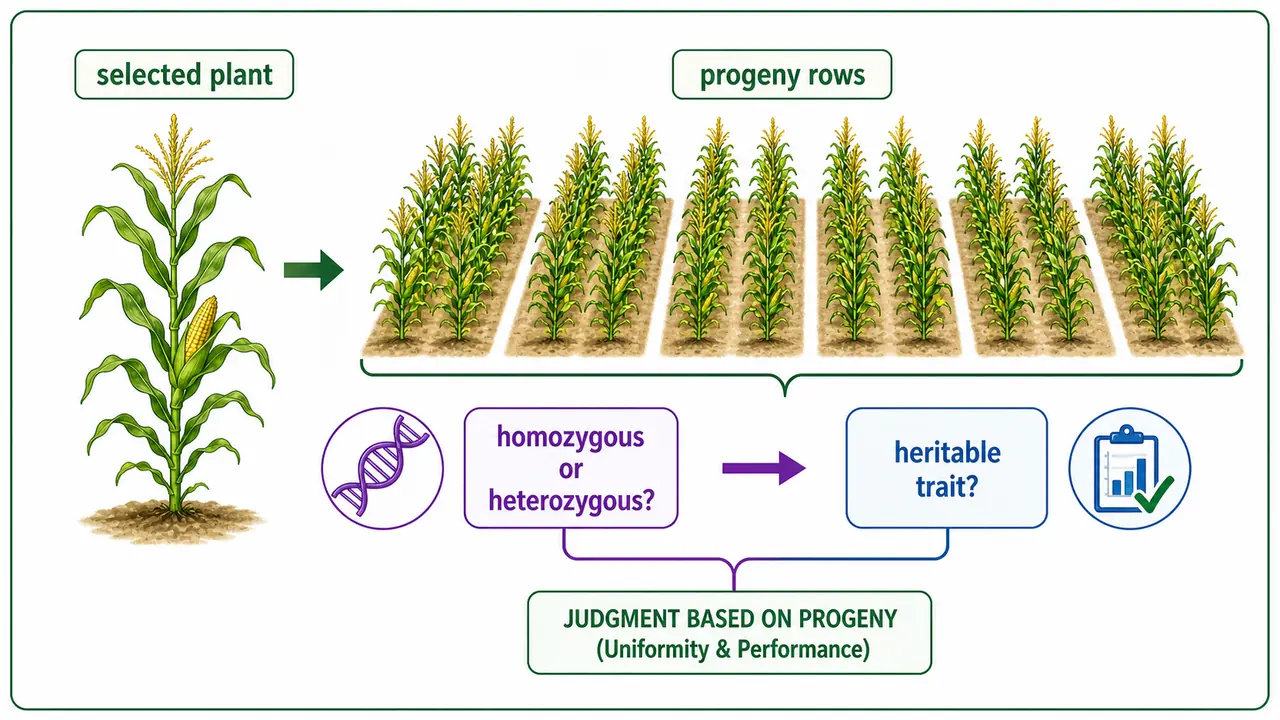
- The value of the plant is judged by the performance of its progeny. Evaluation of the plant on the basis of performance of its progeny is known as progeny test. This is essential because a plant's phenotype alone can be misleading -- only by examining its offspring can we confirm whether its desirable traits are genetically controlled and heritable.
- This test was developed by Louis de Vilmorin. Therefore it is also known as Vilmorin principle or Vilmorin Isolation Principle.
- According to Vilmorin: The real value of a plant can be known only by studying the progeny produced by it.
- Two valuable functions of progeny test:
- To determine the breeding behaviour of a plant i.e. whether the Plant is homozygous or heterozygous.
- To find out whether the character for which the plant was selected is heritable. This is the most important function.
Pureline Theory
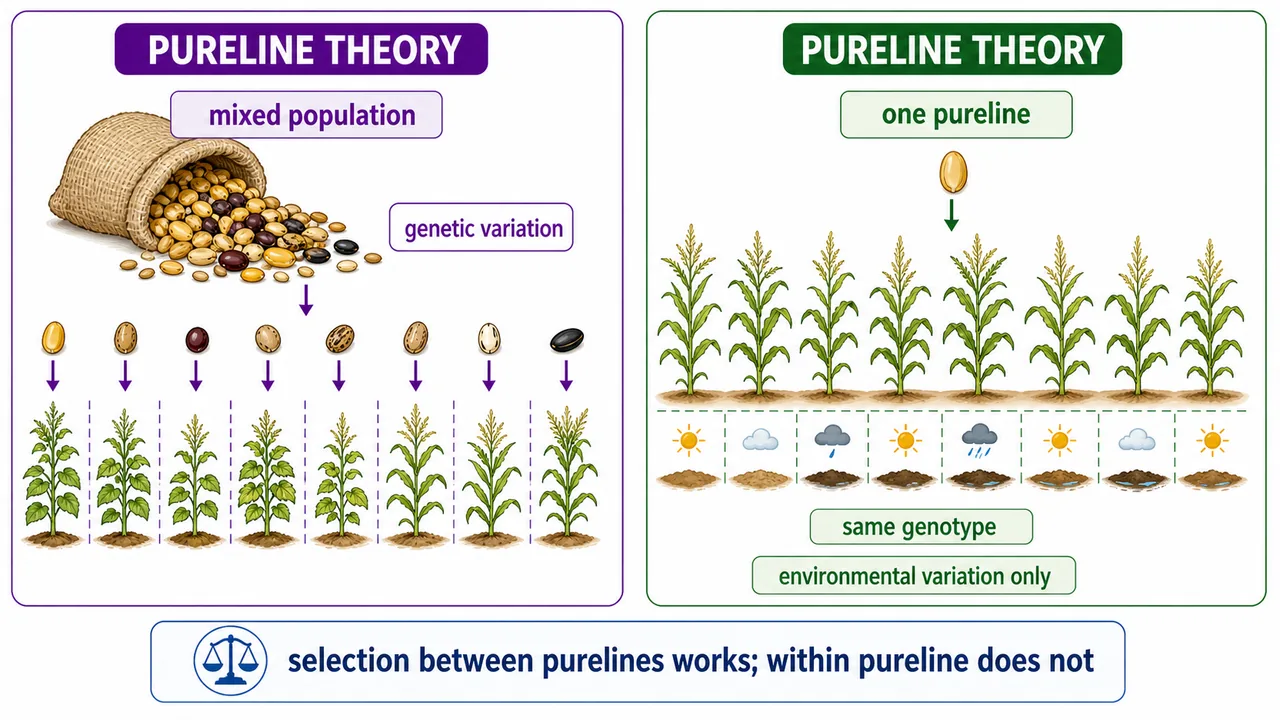
- A pureline is the progeny of a single homozygous plant of a self-pollinated species.
- All the plants in a pureline have the same genotype.
- It means the phenotypic differences within a pureline are due to environment and the variation within a pureline is not heritable.
- The concept of the pureline was given by Johannsen in 1903 on the basis of his studies with the Princess variety of beans (Phaseolus vulgaris). Johannsen brought commercial seed lot of the Princess variety of beans and found that the seed lot had variation in seed size. He selected the seed of different sizes and grew them separately. The obtained progenies differed in seed size i.e. large seeds were obtained from larger seeds and smaller seeds from smaller seed.
- It means that the variation in seed size in commercial seed lot had genetic base and selection for seed size was effective. Johannsen further studied 19 lines i.e. each line was a progeny of a single seed from the original seed lot. He found that variation in seed weight in each 19 line was much smaller than that in original seed lot.
- Ultimately he postulated that the original seed lot was a mixture of purelines means each of 19 lines was a pureline and variation in seed size within each of the purelines had no genetic basis and was purely due to environment.
- Conclusions of Johannsen's experiment
- A self-fertilized population consists of a mixture of several homozygous genotypes. Here selection is effective because variation in such population has a genetic basis.
- Selection within a pure line is ineffective because variation within pure lines is purely environmental.
IMPORTANT
Johannsen's two key conclusions are frequently tested: (1) Selection between purelines is effective (genetic variation exists), (2) Selection within a pureline is ineffective (variation is only environmental).
- Effects of self-pollination:
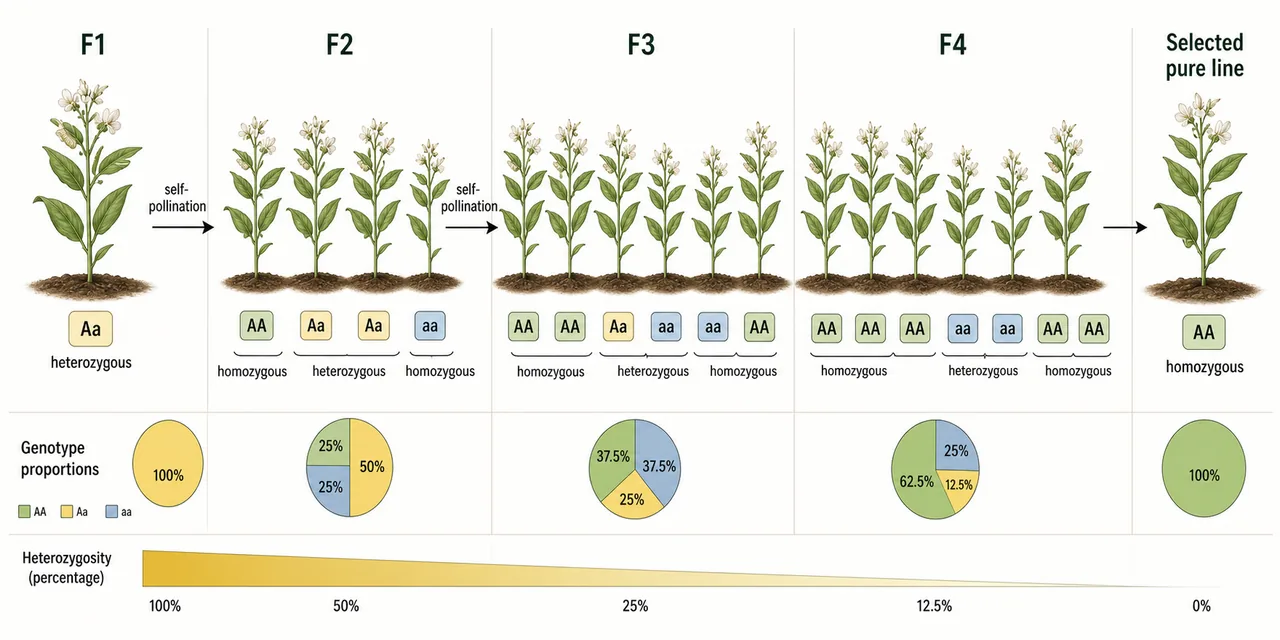
- Self-pollination increases homozygosity. With each generation of selfing, the proportion of heterozygous loci is halved, so homozygosity increases rapidly.
- Self-pollination decreases heterozygosity.
- Inbreeding: Mating between individuals related by descent i.e. having a common parent or parents is called inbreeding. Self-pollination is the most extreme form of inbreeding.
- Sibmating means brother-sister mating.
- Half sibmating means brother-stepsister mating.
- Self-pollination is the most intense form of inbreeding.
- Main effects of Selfing:
- All the plants in the population become completely homozygous.
- Population is a mixture of several homozygous genotypes.
Pureline Selection
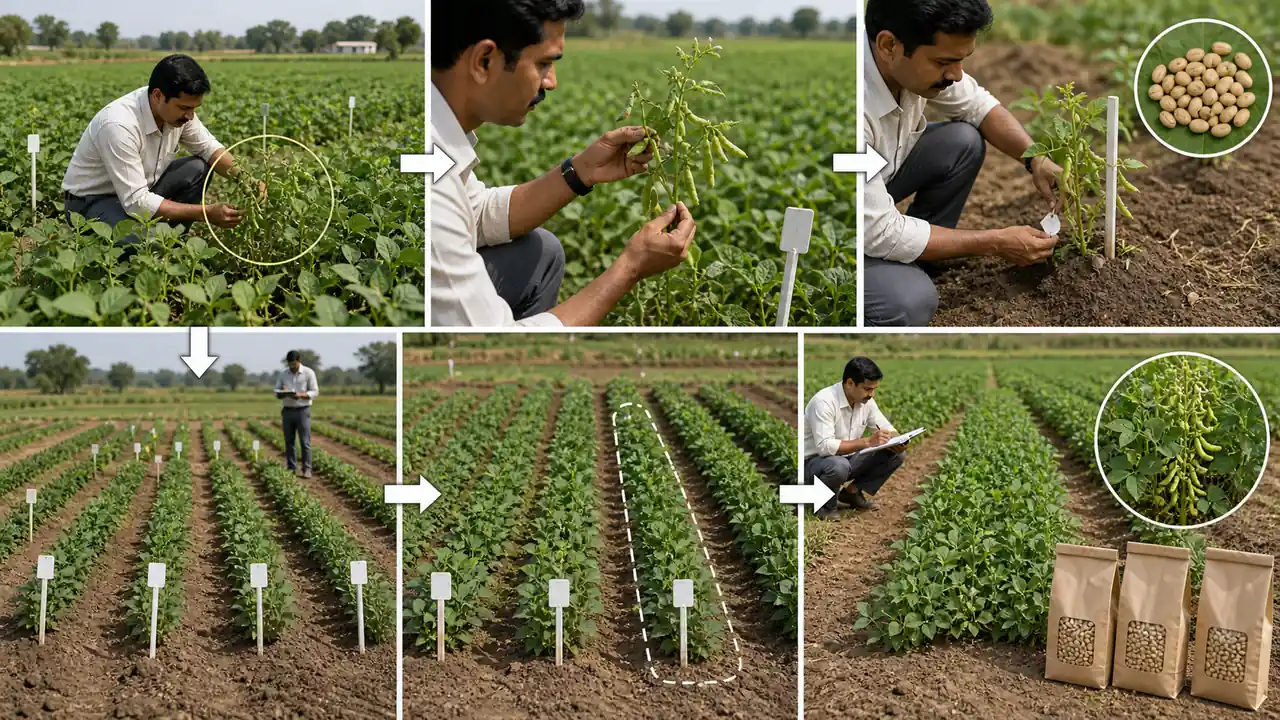
- Here a large no. (i.e. 200-3000 Plants) of plants are selected on the basis of their phenotype from a self-pollinated plant and are harvested individually. Their Individual progenies are evaluated and are grown. Undesirable progenies are rejected. Upto seventh year this process may be maintained if necessary. Ultimately the best progeny is selected and released as a pureline variety.
- Here individual plant is selected, therefore, pureline selection is also known as individual plant selection.
- Pureline selection is the most commonly used method of improvement of self-pollinated crops. Almost all the present varieties of self-pollinated crops are purelines.
Characteristics of a pureline
- All the plants within a pureline have the same genotype.
- The variation within a pureline is environmental and non-heritable.
- Purelines become genetically variable with time due to mechanical mixture, natural hybridization, chromosomal aberrations & mutation. Over time, these sources of variation accumulate, and the pureline may need to be purified again through maintenance breeding.
Mass-Selection
- Here a large no. of plants (i.e. 200-2000 plants) of similar phenotype (i.e. phenotypically superior) are selected and their seeds are mixed together to constitute a new variety. The variety developed through mass selection would have considerable genetic variation because it is a mixture of several genotypes rather than a single genotype.
- Generally plants selected in mass selection are not subjected to progeny test but according to Allard (1960) progeny test should be done.
- In self-pollinated crops, mass selection has two major applications:
- Improvement of Desi or local varieties.
- Purification of existing pureline varieties.
- In cross pollinated crops through mass selection, inbreeding is avoided or kept to minimum because in mass selection several plants are selected and their seeds are mixed to raise the next generation.
- Due to popularity of pureline varieties, mass selection is not commonly used in improvement of self-pollinated crops.
- At present use of mass selection is limited to purification of pureline varieties of self-pollinated crops.
- Pureline selection and Mass selection are used in selecting new varieties from mixed populations that have homozygous plants. These selections cannot be applied to segregating populations e.g. F2, F3 etc. obtained from crosses.
- The methods generally used in handling the segregating generations are:
- Pedigree Method
- Bulk Method
- Backcross Method
- The objective of the above three methods is to develop pureline varieties.
Pedigree Method
- Here individual plants are selected from F2 and subsequent generations. Their progenies are tested during the entire operation and a record of all the parent-offspring (progeny) relationships is kept. Individual plant selection is continued till the progenies show no segregation. This detailed record-keeping is the defining feature of the pedigree method and helps the breeder trace the ancestry of each selected line.
- Pedigree means a description of the ancestors of an individual.
- Pedigree method is the most commonly used method for selection from the segregating generations from crosses in self-pollinated crops.
- This method is often used to correct some specific weakness of an established variety (i.e. combination breeding). Pedigree method provides the best opportunity for the breeder to exercise his skill in selection.
- Because plants are selected from the early segregating generations themselves, pedigree breeding gives the breeder strong control, but it also carries some risk of discarding potentially valuable genotypes too early if phenotypic judgment is misleading under a given environment.
Bulk Method
- This method was first used by Nilsson-Ehle in 1908 at Svalof. This method is also known as mass method or the population method of breeding.
- When a group of phenotypically similar appearing plant is selected and harvested and their seeds are bulked, the process is known as bulk method of breeding.
- It is the best method of breeding to carry forwards maximum number of genes to the advanced generations against the force of natural selection.
- Here F2 and subsequent generations are harvested in mass or as bulks to raise the next generation. At the end of the bulking period, individual plants are selected and evaluated in a similar manner as in pedigree method.
- In pedigree method individual plant progenies are grown and evaluated in F3 and subsequent generations but in bulk method these generations are grown as bulks. This saves considerable time, labour, and resources during the early segregating generations.
- Since equal or broad representation of genotypes is maintained through the early bulked generations, the danger of losing useful segregants too early is reduced compared with intense early-generation pedigree selection.
Purpose of bulk method
- Isolation of homozygous lines with a minimum effort & expense.
- Waiting for opportunity of selection. Selection for resistance, lodging etc. depends upon the presence of suitable environmental conditions favouring disease epidemic, severe lodging etc. Such environment do not occur every year. The segregating generations may be carried in bulk until such environments occur.
- Opportunity for natural selection: Some bulk population may be carried upto F20 to F30 to provide opportunity for natural selection to act. It was called evolutionary method of breeding by Suneson. In this approach, natural selection eliminates poorly adapted genotypes over many generations, so the surviving genotypes are more fit for the target environment.
Modified pedigree approach
- A classical modification is the mass pedigree method, associated with Harrington (1937), which combines elements of pedigree and bulk handling so that many crosses can be advanced together while still preserving enough family structure for later breeder selection.
Backcross method
- Backcross is a cross between hybrid (F1 or a segregating generation) and one of its parent. This method, the hybrid and the progenies in the subsequent generations are repeatedly back crossed to one of the parent. At the end of 6-8 backcrosses, the progeny would be almost identical with the parent used in backcross, except for the gene(s) being transferred.
TIP
Remember the three main methods for handling segregating generations: Pedigree (individual plant records kept), Bulk (generations grown in bulk, selection delayed), Backcross (gene transfer to a good variety). All three aim to develop pureline varieties.
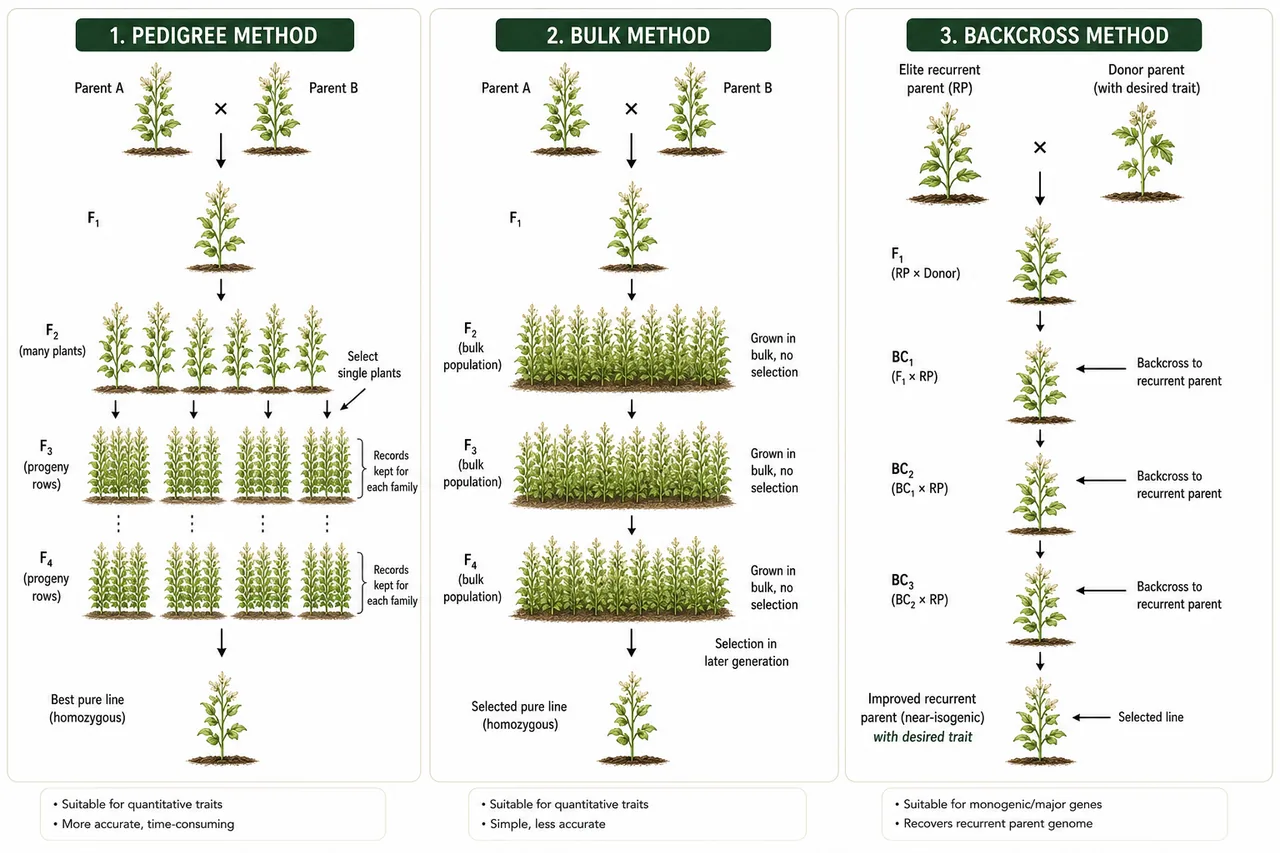
- Objective of backcross: To improve one or two specific defects of a high yielding variety.
- The characters lacking in the variety are transferred to it from a donor parent without changing its genotype except for the gene (genes) being transferred.
- Since recipient parent is repeatedly used in backcross, recipient parent is also known as recurrent parent and the donor parent is known as non-recurrent parent because it is used only once for producing the F1 hybrid.
- Backcross method changes the genotype of the recurrent parent only for the gene under transfer. It is the only useful method for gene transfers from related species and for producing addition and substitution lines. It is suitable for transfer of both qualitative and quantitative characters provided they have moderate to high heritability.
- The objective of pure line selection, pedigree method, bulk method and backcross method is to develop pure line varieties. These methods either use the variability present in the population (mass selection & pure line selection) or the variability created through hybridization.
- The F1 hybrid from a cross is either allowed to self-pollinate (pedigree and bulk method) or is backcrossed to the desirable parent (backcross method).
- The effect of either of the above approaches is increase in homozygosity. Ultimately, the goal is to arrive at a stable, uniform, homozygous variety that breeds true and can be released for commercial cultivation.
Which Breeding Method for Which Situation? (Self-Pollinated Crops)
The most tested decision in plant breeding exams:
| Situation | Best Method | Why | Duration | Example |
|---|---|---|---|---|
| Improve one trait (e.g., disease resistance) in an already good variety | Backcross | Transfers specific gene without disturbing rest of genotype | 6-7 generations | Adding rust resistance to HD-2967 wheat |
| Combine multiple traits from two parents; breeder wants to track pedigree | Pedigree | Individual plant selection with records; early identification of best families | 10-12 years | Developing new wheat variety combining yield + quality |
| Combine traits but resources/labour limited | Bulk | No individual plant records until later; natural selection operates | 10-12 years | Breeding barley, oats (large populations, less labour) |
| Speed up generation advancement; limited land | Single Seed Descent (SSD) | One seed/plant/generation → rapid cycling (off-season nursery possible) | 5-6 years | Soybean, pulse breeding with short generation turnover |
| Select from existing natural variability (no hybridisation) | Pure Line Selection | Isolate best genotypes from heterogeneous landrace | 5-7 years | Improving local wheat or rice landraces |
Decision flowchart for exams:
- Is the objective to transfer one gene to an existing variety? → Backcross
- Is the objective to combine multiple traits from two parents? → Pedigree (if labour available) or Bulk (if not)
- Is the objective to exploit existing variability without crossing? → Pure Line Selection
- Need to speed up generation advancement? → SSD
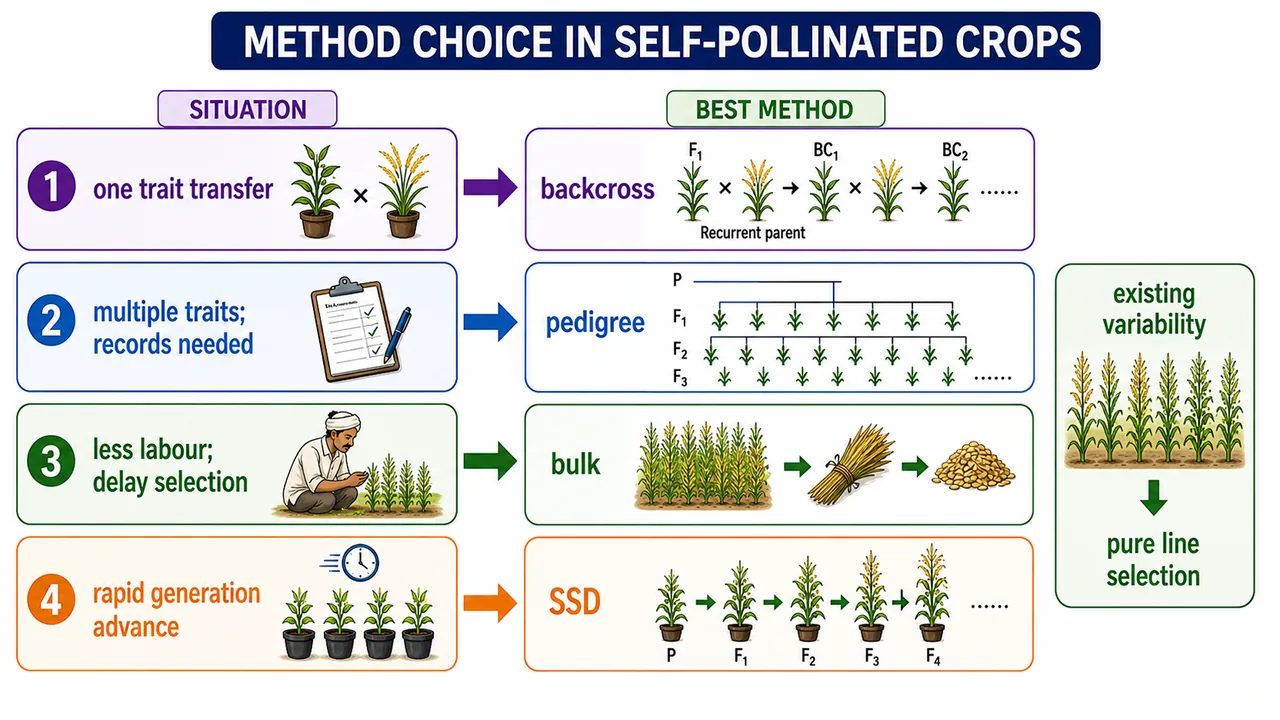
Common exam trap: All these methods produce pureline varieties (homozygous, true-breeding). They differ in HOW they handle segregating generations, not in the end product.
Summary Cheat Sheet
| Concept / Topic | Key Details |
|---|---|
| Self-pollinated crops | >50% self-pollination; homozygous, homogeneous |
| Examples | Wheat, rice, barley, pea, gram, soybean, tomato |
| Pure line selection | Select from existing variability; proposed by Johannsen |
| Mass selection | Select phenotypically superior plants; bulk seed |
| Pedigree method | Individual plant selection; record of ancestry maintained |
| Pedigree advantage | Complete record; select for multiple traits |
| Pedigree disadvantage | Labour-intensive; requires large space |
| Bulk method | F2–F5 grown in bulk; natural selection operates |
| Bulk advantage | Simple, inexpensive; good for survival traits |
| SSD (Single Seed Descent) | One seed per plant each generation; rapid generation advance |
| SSD advantage | Fastest to reach homozygosity; off-season nurseries |
| Backcross method | Transfer one or few genes from donor to recurrent parent |
| Backcross: 6 backcrosses | Recovers ~99% recurrent parent genome |
| Backcross advantage | Retains all good traits of adapted variety |
| Transgressive segregation | F2 individuals exceed both parents |
| Goal of all methods | Increase homozygosity for pure-breeding varieties |