🥶 Male Sterility: GMS, CMS, CGMS, and Chemical Methods
Understand genetic male sterility (GMS), cytoplasmic male sterility (CMS), CGMS systems, and chemical hybridising agents — with applications in hybrid seed production and exam tips.
Why Male Sterility Matters in Agriculture
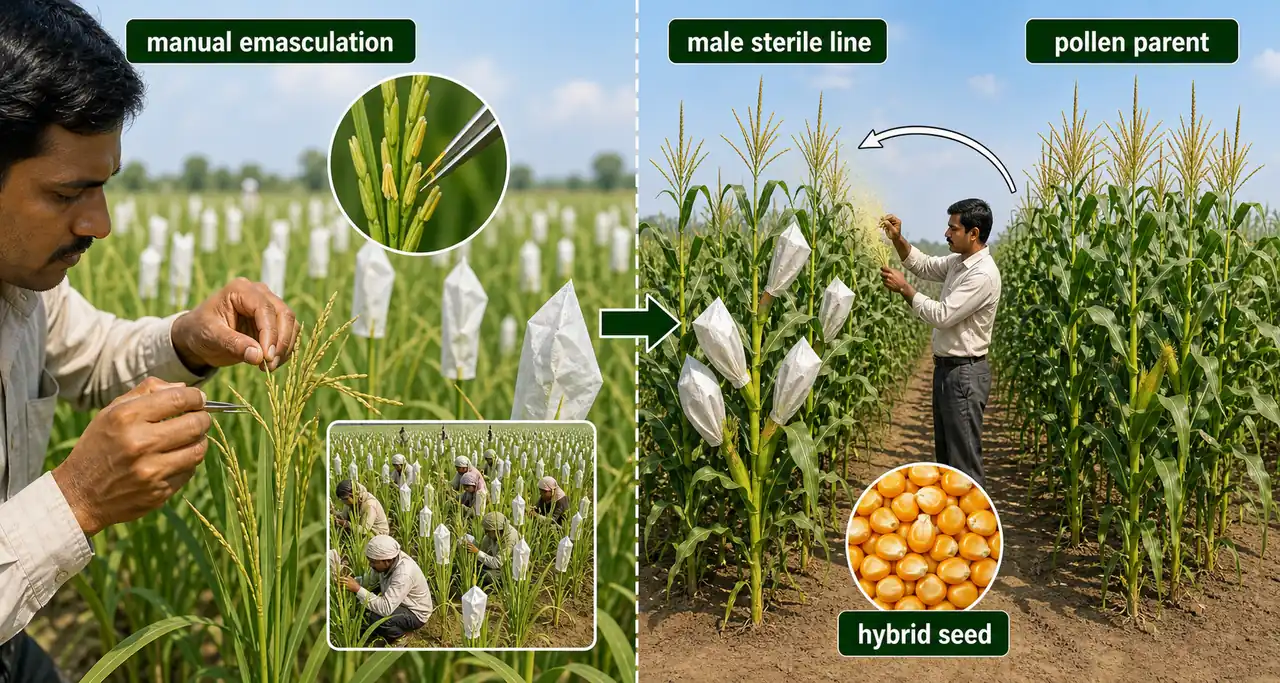
Hybrid maize, hybrid rice, hybrid bajra, hybrid sunflower — all of India's commercial hybrid crops rely on male sterility systems for cost-effective seed production. Without male sterility, producing hybrid seed would require manual emasculation of every flower on the mother plant — impractical on a commercial scale. The CMS-based three-line system (A-line, B-line, R-line) is the backbone of the hybrid seed industry.
IMPORTANT
Male sterility is one of the most frequently tested topics in plant breeding. Focus on the differences between GMS, CMS, and CGMS, and know which crops use each system.
- Male sterility means non-functional pollen grains. Here female gametes are normally functional. Male sterility is a crucial phenomenon in plant breeding, primarily used for hybrid seed production without the labour-intensive process of hand emasculation. It is classified into four groups:
- Genetic Male Sterility (GMS) or Nuclear Male Sterility
- Temperature-sensitive GMS
- Photoperiod-sensitive GMS
- Transgenic GMS
- Cytoplasmic Male Sterility (CMS)
- Cytoplasmic-Genetic Male Sterility (CGMS)
- Chemically-Induced Male Sterility
- Male Sterility is used for hybrid seed production in many crops because it is a means of genetic emasculation. UPPSC 2021 By eliminating functional pollen, male sterility removes the need for manual removal of anthers, making large-scale hybrid seed production economically viable.
Genetic (Nuclear) Male Sterility
- GMS/NMS is ordinarily governed by a single recessive gene ms but also by dominant genes. Male sterility alleles are occurred spontaneously or are induced artificially. Since the gene is nuclear in origin, it follows standard Mendelian inheritance patterns.
- Genetic male sterility is simple and ecofriendly technique of hybrid seed production. UPPSC 2021
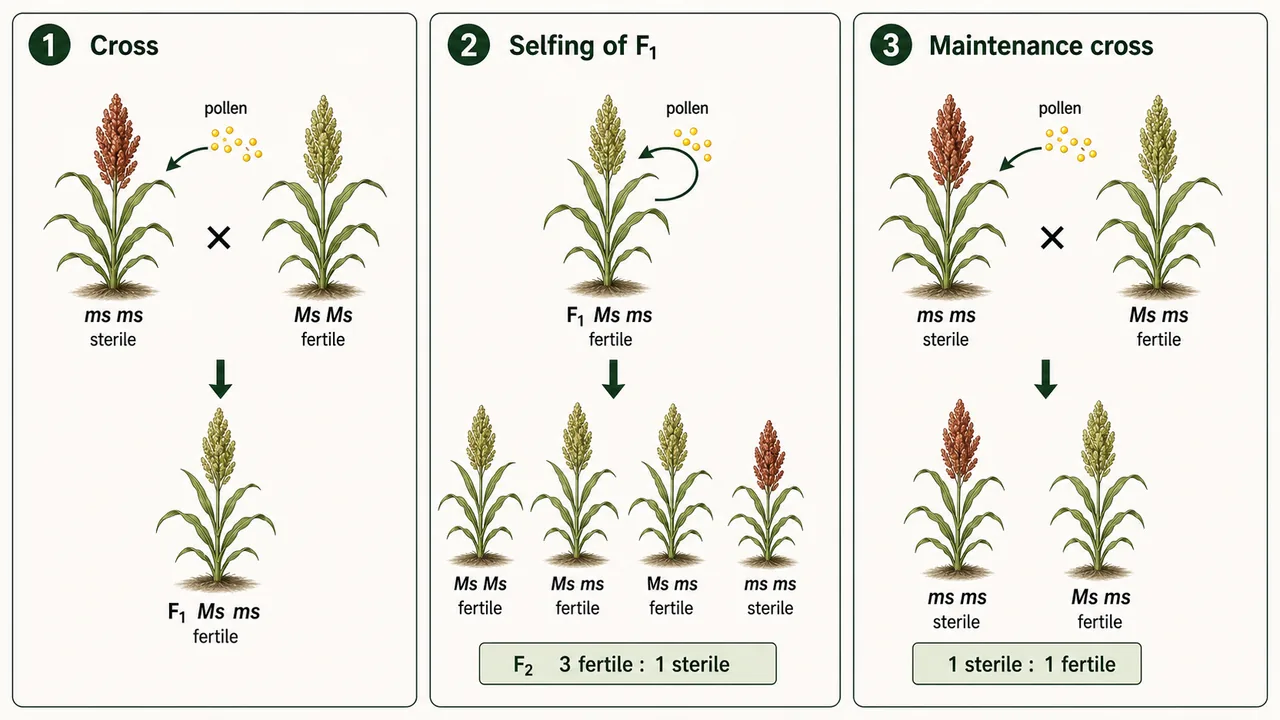
- When a male sterile plant (ms ms) is crossed with the male fertile (Ms Ms) plant, the product F1 (Ms ms) is male fertile. All F1 plants are fertile because the dominant Ms allele masks the recessive ms allele.
- In F2, 3 Fertile : 1 Sterile is obtained. A male sterile line is maintained by crossing with heterozygous male fertile (Ms ms). This mating produces 1 : 1 male sterile & male fertile plants. This 1:1 ratio is the basis for maintaining the male sterile line in a breeding programme.
Maintenance of a male sterile line
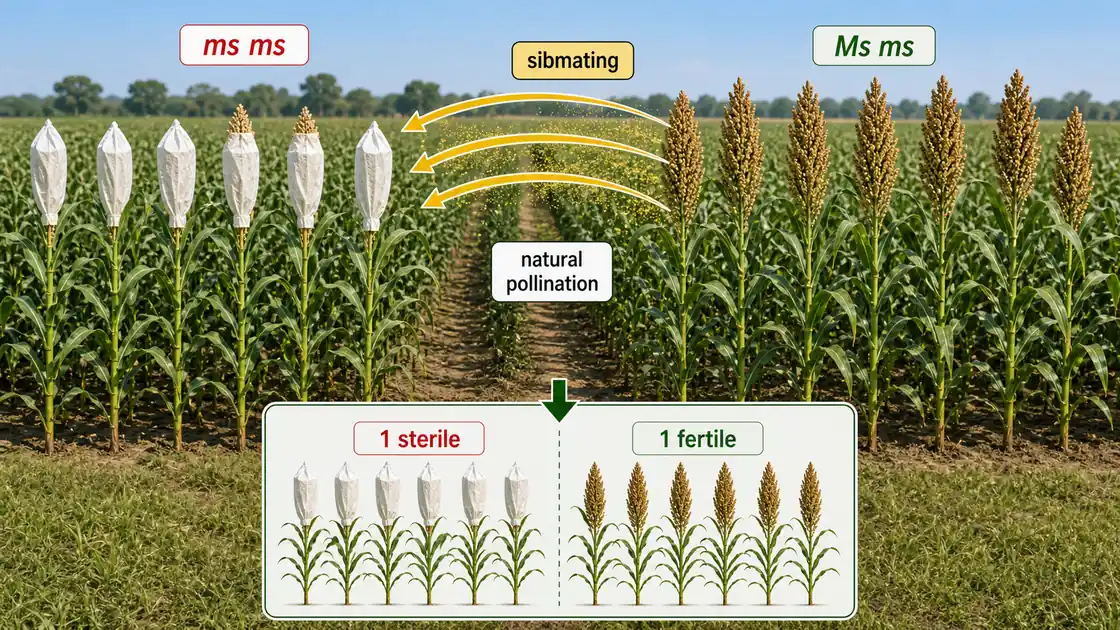
- During the maintenance of male sterile lines, sibmating (i.e. brother-sister mating) is achieved through natural pollination. The male sterile plants receive pollen from their male fertile sibling plants growing alongside them.
- In some cases ms gene expression is affected by the specified range of temperature and or photoperiod regime. Such GMS is environment sensitive and found in Rice, tomato, wheat etc. This environmental sensitivity can be exploited -- the line is maintained under one set of conditions and hybrid seed is produced under another.
- Temperature-sensitive Genetic Male sterility:
- Complete male sterility is produced by the ms gene at higher temperatures
- E.g. 23.3 degrees C or higher for rice TGMS line Pei-Ai 645. This type of genetic male sterility is being used in the China to develop hybrid rice. At lower temperatures, fertility is restored, allowing the line to be self-maintained.
- Photoperiod-sensitive Genetic male sterility (PGMS):
- In some cases, ms gene expression is drastically affected by the prevailing photoperiod, provided the temp. is within the critical range.
- E.g. the critical temp. is 23-29 degrees C for rice for PGMS. Within this critical temp. range, complete sterility is found in rice plants grown under long day conditions (i.e. day length more than 13 hours 45 minutes). But under short day conditions almost normal fertility is found. This type PGMS is being utilized in the China to develop hybrid rice. The two-line hybrid system in rice is based on TGMS and PGMS.
Transgenic Genetic male sterility
- Transgene is such a gene which is introduced into the genome of an organisms by recombinant DNA technology or genetic engineering. Many transgenes cause male sterility. These are found in maize, cauliflower, tomato, wheat & chicory but this system is not yet used commercially. Transgenic approaches offer precise control over male sterility but face regulatory and public acceptance challenges.
- The genetic male sterility is being used for hybrid rice development in China. GMS is being successfully used in castor in U.S.A. In India GSM is being used for hybrid seed production of Arhar by private companies like Maharashtra Hybrid seed Co. Ltd.
Cytoplasmic Male Sterility (CMS)
WARNING
Pro Content Locked
Upgrade to Pro to access this lesson and all other premium content.
Charged once for one year · ₹1188 total
Save ₹100/month vs ₹2388/year launch price
- All Agriculture & Banking Courses
- AI Lesson Questions (100/day)
- AI Doubt Solver (50/day)
- Glows & Grows Feedback (30/day)
- AI Section Quiz (20/day)
- 22-Language Translation (100/day)
- Recall Questions (20/day)
- AI Quiz (15/day)
- AI Quiz Paper Analysis (100/day)
- AI Step-by-Step Explanations (100/day)
- Spaced Repetition Recall (FSRS)
- AI Tutor
- Immersive Text Questions
- Audio Lessons — Hindi & English
- Mock Tests & Previous Year Papers
- Summary & Mind Maps
- XP, Levels, Leaderboard & Badges
- Generate New Classrooms
- Voice AI Teacher (AgriDots Live)
- AI Revision Assistant
- Knowledge Gap Analysis
- Interactive Revision (LangGraph)
🔒 Secure one-time yearly payment via Razorpay · No hidden fees
Why Male Sterility Matters in Agriculture
Hybrid maize, hybrid rice, hybrid bajra, hybrid sunflower — all of India's commercial hybrid crops rely on male sterility systems for cost-effective seed production. Without male sterility, producing hybrid seed would require manual emasculation of every flower on the mother plant — impractical on a commercial scale. The CMS-based three-line system (A-line, B-line, R-line) is the backbone of the hybrid seed industry.
IMPORTANT
Male sterility is one of the most frequently tested topics in plant breeding. Focus on the differences between GMS, CMS, and CGMS, and know which crops use each system.
- Male sterility means non-functional pollen grains. Here female gametes are normally functional. Male sterility is a crucial phenomenon in plant breeding, primarily used for hybrid seed production without the labour-intensive process of hand emasculation. It is classified into four groups:
- Genetic Male Sterility (GMS) or Nuclear Male Sterility
- Temperature-sensitive GMS
- Photoperiod-sensitive GMS
- Transgenic GMS
- Cytoplasmic Male Sterility (CMS)
- Cytoplasmic-Genetic Male Sterility (CGMS)
- Chemically-Induced Male Sterility
- Male Sterility is used for hybrid seed production in many crops because it is a means of genetic emasculation. UPPSC 2021 By eliminating functional pollen, male sterility removes the need for manual removal of anthers, making large-scale hybrid seed production economically viable.
Genetic (Nuclear) Male Sterility
- GMS/NMS is ordinarily governed by a single recessive gene ms but also by dominant genes. Male sterility alleles are occurred spontaneously or are induced artificially. Since the gene is nuclear in origin, it follows standard Mendelian inheritance patterns.
- Genetic male sterility is simple and ecofriendly technique of hybrid seed production. UPPSC 2021
- When a male sterile plant (ms ms) is crossed with the male fertile (Ms Ms) plant, the product F1 (Ms ms) is male fertile. All F1 plants are fertile because the dominant Ms allele masks the recessive ms allele.
- In F2, 3 Fertile : 1 Sterile is obtained. A male sterile line is maintained by crossing with heterozygous male fertile (Ms ms). This mating produces 1 : 1 male sterile & male fertile plants. This 1:1 ratio is the basis for maintaining the male sterile line in a breeding programme.
Maintenance of a male sterile line
- During the maintenance of male sterile lines, sibmating (i.e. brother-sister mating) is achieved through natural pollination. The male sterile plants receive pollen from their male fertile sibling plants growing alongside them.
- In some cases ms gene expression is affected by the specified range of temperature and or photoperiod regime. Such GMS is environment sensitive and found in Rice, tomato, wheat etc. This environmental sensitivity can be exploited -- the line is maintained under one set of conditions and hybrid seed is produced under another.
- Temperature-sensitive Genetic Male sterility:
- Complete male sterility is produced by the ms gene at higher temperatures
- E.g. 23.3 degrees C or higher for rice TGMS line Pei-Ai 645. This type of genetic male sterility is being used in the China to develop hybrid rice. At lower temperatures, fertility is restored, allowing the line to be self-maintained.
- Photoperiod-sensitive Genetic male sterility (PGMS):
- In some cases, ms gene expression is drastically affected by the prevailing photoperiod, provided the temp. is within the critical range.
- E.g. the critical temp. is 23-29 degrees C for rice for PGMS. Within this critical temp. range, complete sterility is found in rice plants grown under long day conditions (i.e. day length more than 13 hours 45 minutes). But under short day conditions almost normal fertility is found. This type PGMS is being utilized in the China to develop hybrid rice. The two-line hybrid system in rice is based on TGMS and PGMS.
Transgenic Genetic male sterility
- Transgene is such a gene which is introduced into the genome of an organisms by recombinant DNA technology or genetic engineering. Many transgenes cause male sterility. These are found in maize, cauliflower, tomato, wheat & chicory but this system is not yet used commercially. Transgenic approaches offer precise control over male sterility but face regulatory and public acceptance challenges.
- The genetic male sterility is being used for hybrid rice development in China. GMS is being successfully used in castor in U.S.A. In India GSM is being used for hybrid seed production of Arhar by private companies like Maharashtra Hybrid seed Co. Ltd.
Cytoplasmic Male Sterility (CMS)
WARNING
Do not confuse CMS with CGMS. In CMS, no restorer gene is known -- all progeny remain male sterile. In CGMS, a known restorer gene (R) can restore fertility, enabling commercial hybrid seed production.
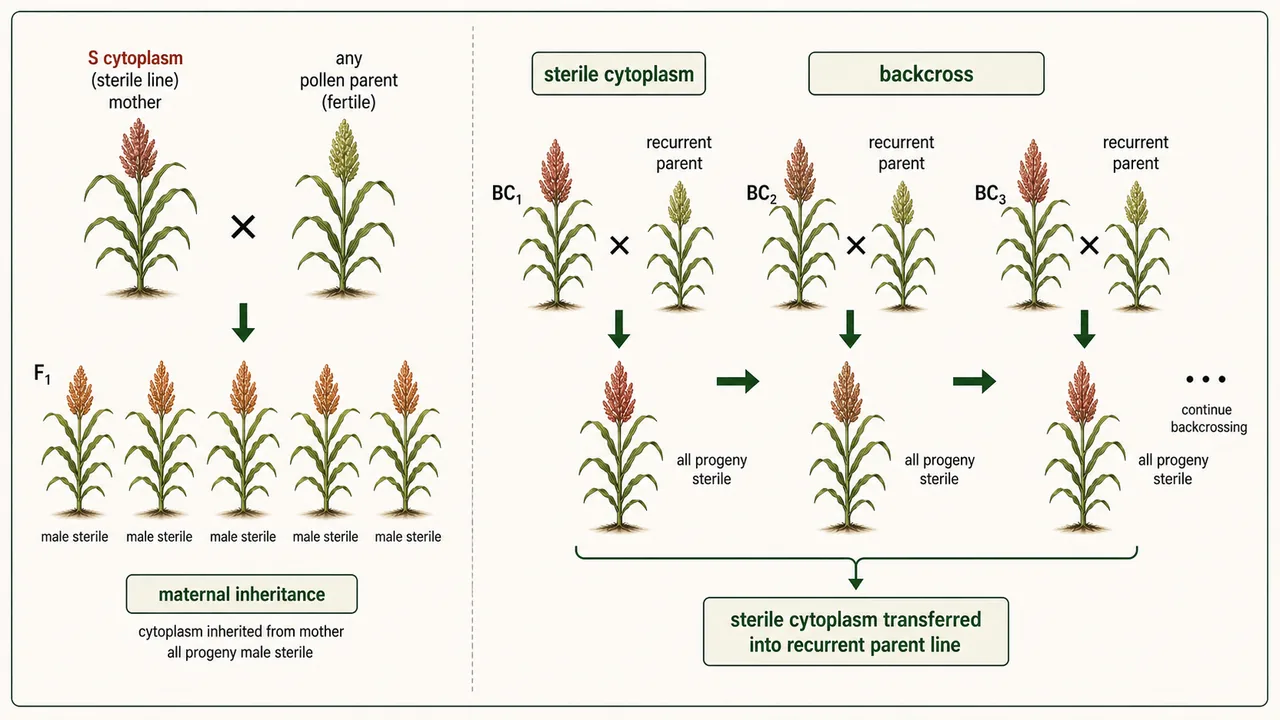
- Here male sterility is governed by the cytoplasm. The male sterility is the result of mutation in the mitochondrial genome (mt DNA) which leads to mitochondrial dysfunction e.g. CMS-Maize, Ogura cms of brassica. Since cytoplasm is inherited maternally (through the egg cell), CMS follows a non-Mendelian pattern of inheritance.
- Since the cytoplasm of a zygote comes primarily from egg cells, the progeny of such male sterile plants would always be male sterile. Regardless of which pollen parent is used, all offspring will carry the sterile cytoplasm.
- Cytoplasmic male sterility may be transferred easily to a given strain by using that strain as a pollinator (recurrent parent) in the, successive generations of a backcross programme. After 6-8 backcrosses, the nuclear genome of the recurrent parent is recovered while retaining the sterile cytoplasm.
- CMS is used only for the vegetative growth purposes because all the progenies are male steriles & there are no seed setting. This is a significant limitation -- without a restorer gene, fertile seed cannot be produced.
- It is used in chillies by some private companies.
- In 1996, Kaul concluded that restorer genes have been detected for all cases of CMS. The idea of CMS has been disfavored by Kaul and according to Kaul, male sterility is either genetic or cytoplasmic-genetic.
| Crop | Common sterile-cytoplasm / CMS source recall |
|---|---|
| Sorghum | Combine Kafir 60 |
| Pearl millet | Tift 23 A |
| Rice | Wild Abortive (WA) |
| Wheat | Aegilops caudata |
Cytoplasmic-genetic male sterility (CGMS)
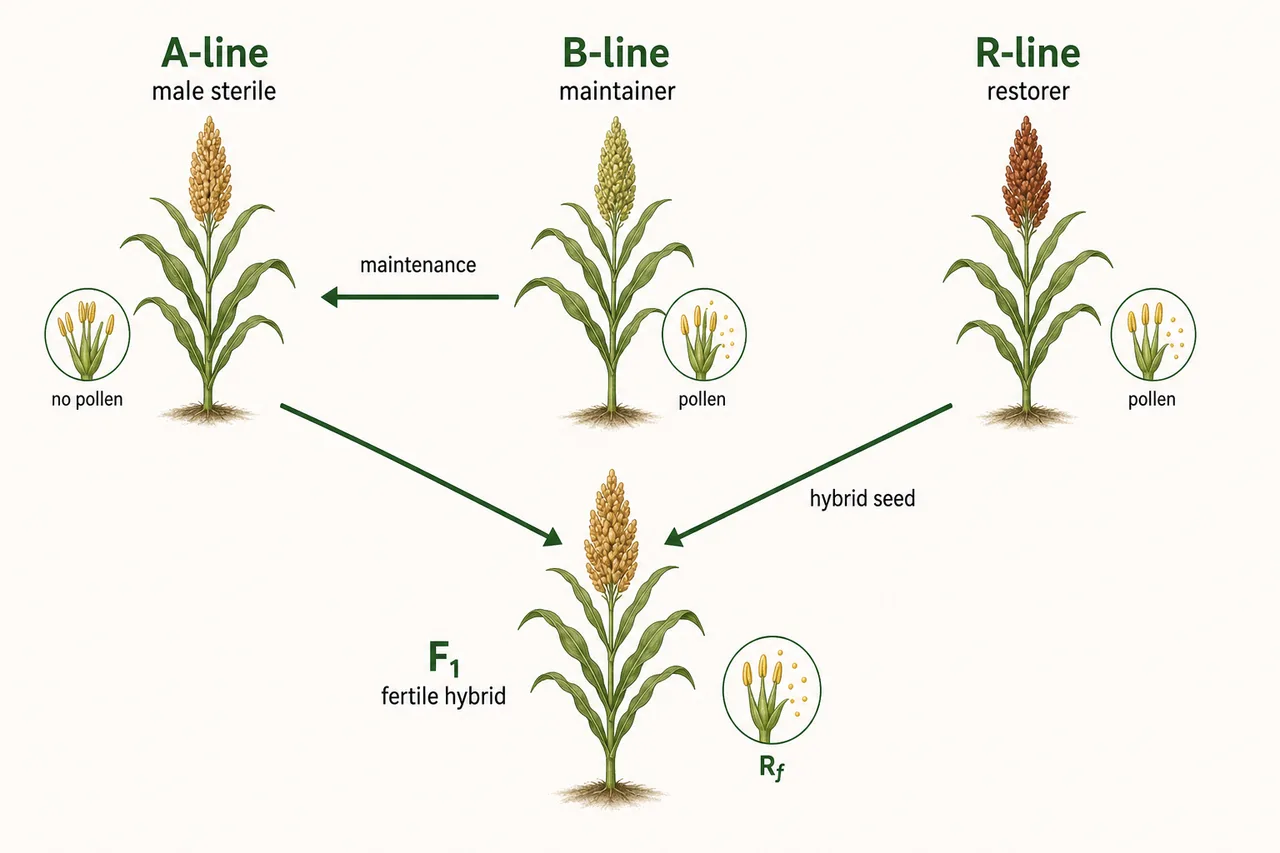
- The case of cytoplasmic male sterility where the nuclear gene for restoring fertility in the male sterile line is known; is called cytoplasmic genetic male sterility. CGMS is the most commercially important type of male sterility because it enables a complete three-line system (A-line, B-line, R-line) for hybrid seed production.
- A useful history anchor is that Jones and Davis (1944) are credited with the first clear report of CGMS in onion, which is often asked as a one-liner in exam-oriented notes.
- The fertility restorer gene, R, is dominant which restores male fertility in the male sterile line. If the nuclear genotype is rr, and the cytoplasm is male sterile, then plant would be male sterile.
- The effect of sterile cytoplasm is negated by the presence of restorer gene R even in heterozygous condition (Rr) because R is dominant over r. This means the F1 hybrid produced from a male sterile mother and a restorer father will be fully fertile and can set seed normally for commercial grain production.
- CGMS is also known as nucleoplasmatic male sterility.
- CGMS is commercially utilized in rice, wheat, maize, Sorghum, Pearl Millet, Cotton etc. It is the backbone of hybrid seed production in these major crops worldwide.
- After selfing of the male fertile progeny, individual plant progeny is grown in the next generation and non-segregating progenies are selected and segregating progenies are rejected.
- Determination of genotype or genotypic value of a plant by studying its progeny is known as progeny test. This is crucial for identifying plants that are homozygous for the restorer gene (RR).
Chemical hybridising Agent (CHA)
- Such chemicals which affect the function of male reproductive organs in plants; are called chemical hybridising agents (CHAs). CHAs provide a flexible alternative to genetic male sterility systems -- any variety can be made temporarily male sterile by chemical treatment.
- E.g. Maleic hydrazide (MH), α - NAA, β - NAA, FW 450 (Mendok), Ethrel (Ethephon), Arsenicals, GA3, Hybrex (RH0007), Shell (WL 84811). Firstly in 1950, Moore & Naylor induced male sterility in maize using MH.
- Hybrex has been used for the commercial production of hybrid wheat in USA since 1982. This is one of the most successful commercial applications of CHAs.
- Arsenic inhibits respiration in anthers via enzymes like succinate dehydrogenase and cytochrome oxidase. By disrupting energy production in the anther, pollen development is blocked.
- Ethephon (Ethrel) produces ethylene which interacts with the plant hormone system. Ethylene disrupts normal pollen development by altering hormonal balance.
- GA produces male sterility in rice, wheat etc. by interfering with tile nutrient flow to developing anthers.
- Hybrex disrupts pollen development during microsporogenesis which leads to irregular and thinner deposition of exine and ultimately to pollen
Summary Cheat Sheet
| Concept / Topic | Key Details |
|---|---|
| Male sterility | Inability to produce functional pollen |
| Importance | Eliminates need for hand emasculation in hybrid seed production |
| GMS (Genetic Male Sterility) | Governed by nuclear genes; usually single recessive gene (ms ms) |
| GMS disadvantage | Cannot maintain 100% male-sterile population (segregates 1:1) |
| CMS (Cytoplasmic Male Sterility) | Governed by mitochondrial DNA (cytoplasmic genes) |
| CMS inheritance | Maternal; all progeny of CMS mother are male-sterile |
| CGMS (Cytoplasmic-Genetic MS) | Interaction of cytoplasmic + nuclear genes |
| 3-line system | A-line (CMS), B-line (maintainer), R-line (restorer) |
| A-line | Male-sterile; used as female parent in hybrid production |
| B-line | Maintains A-line; same genotype but fertile cytoplasm |
| R-line | Has restorer genes (Rf); restores fertility in hybrid |
| 2-line system | Uses TGMS/PGMS (thermo/photo-sensitive GMS) |
| CMS discovered by | Rhoades (1933) in maize |
| CMS used in | Maize, bajra, sorghum, rice, cotton, sunflower |
| Chemical hybridizing agents | Chemicals inducing temporary male sterility (e.g., maleic hydrazide) |
| Restorer gene symbol | Rf (Restorer of fertility) |