📖 Breeding Terminology: Essential Glossary for Exams
A comprehensive glossary of exam-critical breeding and genetics terms — heterosis, inbreeding depression, ideotype, chimera, amphidiploid, and more — with precise definitions.
Why Terminology Matters
In competitive exams (IBPS AFO, NABARD Grade A, ICAR, and FCI), one-liner questions on breeding terminology are among the highest-frequency question types. Knowing the precise definitions — and distinguishing between similar-sounding terms like heterosis vs. luxuriance, or synthetic vs. composite — can make the difference between a correct and incorrect answer.
A comprehensive glossary of exam-critical breeding and genetics terms frequently asked in exams, NABARD, IBPS AFO/NABARD exams. Each term includes its precise definition and exam context.
Pollination & Reproduction Terms
-
Duodichogamy — individual plants produce two batches of male flowers temporally separated by female flowers. Rarest temporal sexual system in flowering plants. (asked in exams)
-
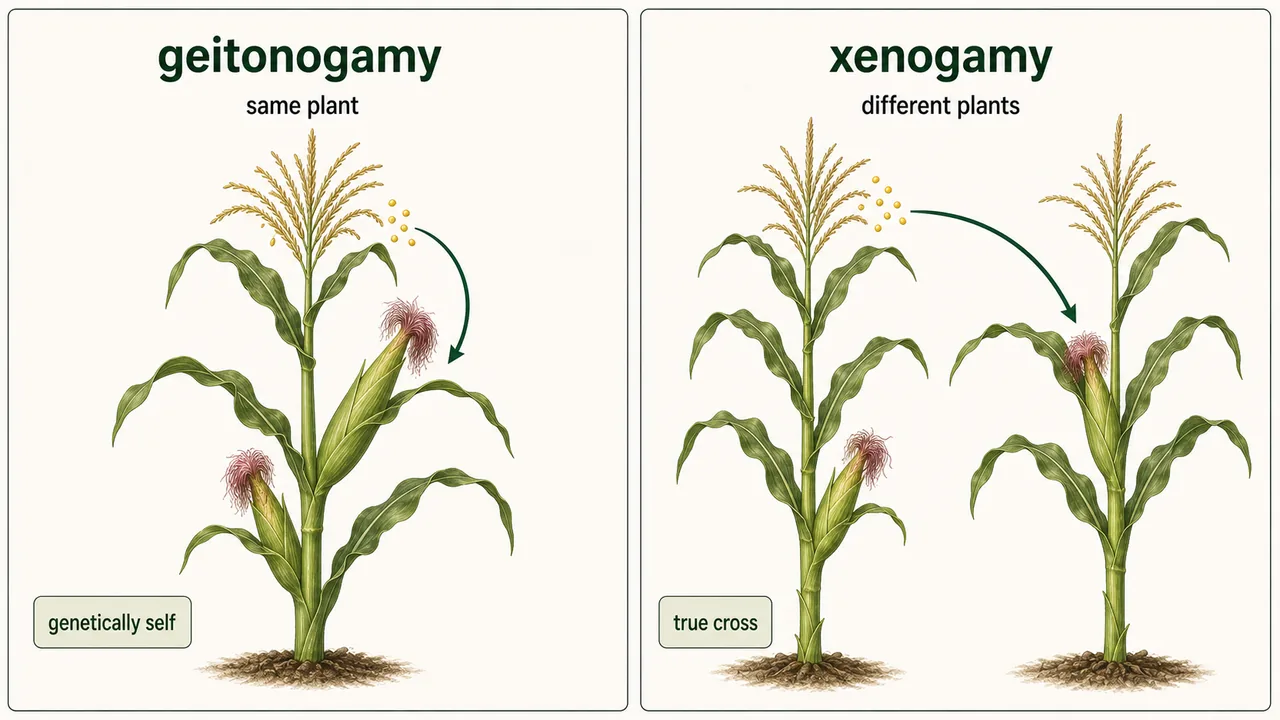
Geitonogamy — pollen from one flower of a plant falls on the stigma of another flower of the same plant. Functionally cross-pollination but genetically self-pollination. E.g. Maize.
-
Xenogamy — transfer of pollen from a flower of one plant to the stigma of a flower of a different plant. This is true cross-pollination and leads to maximum genetic recombination.
Pro Content Locked
Upgrade to Pro to access this lesson and all other premium content.
Charged once for one year · ₹1188 total
Save ₹100/month vs ₹2388/year launch price
- All Agriculture & Banking Courses
- AI Lesson Questions (100/day)
- AI Doubt Solver (50/day)
- Glows & Grows Feedback (30/day)
- AI Section Quiz (20/day)
- 22-Language Translation (100/day)
- Recall Questions (20/day)
- AI Quiz (15/day)
- AI Quiz Paper Analysis (100/day)
- AI Step-by-Step Explanations (100/day)
- Spaced Repetition Recall (FSRS)
- AI Tutor
- Immersive Text Questions
- Audio Lessons — Hindi & English
- Mock Tests & Previous Year Papers
- Summary & Mind Maps
- XP, Levels, Leaderboard & Badges
- Generate New Classrooms
- Voice AI Teacher (AgriDots Live)
- AI Revision Assistant
- Knowledge Gap Analysis
- Interactive Revision (LangGraph)
🔒 Secure one-time yearly payment via Razorpay · No hidden fees
Why Terminology Matters
In competitive exams (IBPS AFO, NABARD Grade A, ICAR, and FCI), one-liner questions on breeding terminology are among the highest-frequency question types. Knowing the precise definitions — and distinguishing between similar-sounding terms like heterosis vs. luxuriance, or synthetic vs. composite — can make the difference between a correct and incorrect answer.
A comprehensive glossary of exam-critical breeding and genetics terms frequently asked in exams, NABARD, IBPS AFO/NABARD exams. Each term includes its precise definition and exam context.
Pollination & Reproduction Terms
-
Duodichogamy — individual plants produce two batches of male flowers temporally separated by female flowers. Rarest temporal sexual system in flowering plants. (asked in exams)
-
Geitonogamy — pollen from one flower of a plant falls on the stigma of another flower of the same plant. Functionally cross-pollination but genetically self-pollination. E.g. Maize.
-
Xenogamy — transfer of pollen from a flower of one plant to the stigma of a flower of a different plant. This is true cross-pollination and leads to maximum genetic recombination.
-
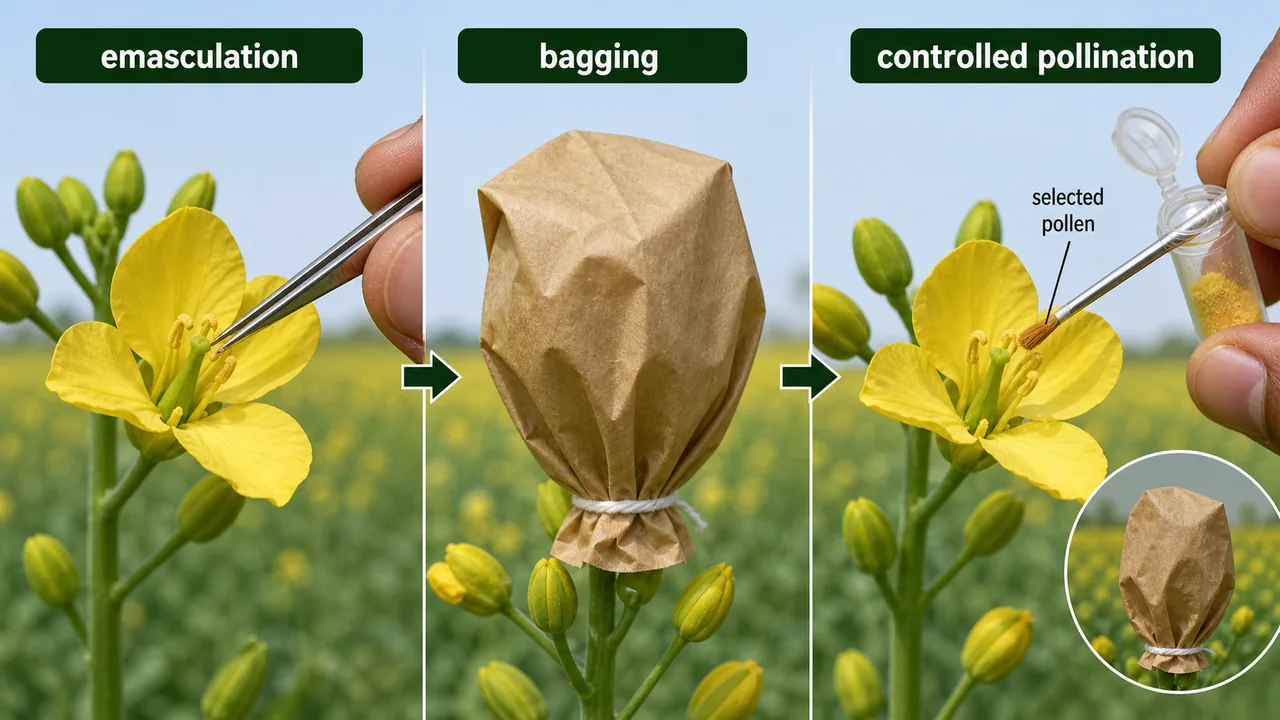
Emasculation — removal of stamens or anthers, or killing of pollen grains, to prevent self-pollination. Essential step in hybridization of bisexual flowers. Methods include hand emasculation, hot water treatment, alcohol treatment, and use of gametocides. (exams)
-
Complete flower — a flower that possesses all four basic floral whorls: calyx, corolla, androecium, and gynoecium.
-
Incomplete flower — a flower lacking one or more of the four basic floral whorls.
-
Diadelphous — a condition in which the stamens are united into two bundles, a classic example being many legumes such as chickpea, pea, and groundnut.
-
Actinomorphic flower — a flower with radial symmetry, so it can be divided into similar halves through more than one vertical plane. A standard example is Solanaceae flowers.
-
Zygomorphic flower — a flower with bilateral symmetry, so it can be divided into similar halves through only one vertical plane.
-
Parthenocarpy — development of fruit without fertilization. The resulting fruits are seedless. E.g. Banana, Seedless watermelon.
-
Agamospermy — development of embryo and seed without meiosis and fertilization. A form of apomixis where seeds are produced asexually. E.g. Citrus, Mango.
-
Apomixis — reproduction through seeds formed without fusion of gametes (without sexual union). It includes agamospermy, adventitious embryony, and apospory.
NOTE
Geitonogamy vs Xenogamy: Geitonogamy involves pollen transfer between flowers of the same plant (genetically = selfing), while Xenogamy involves pollen transfer between different plants (true outcrossing). This distinction is frequently tested.
Genetic Variation Terms
-
Allosyndesis — pairing of non-homologous chromosomes from diverse sets of an allopolyploid at meiosis. Results in recombination between genomes of different species. (exams-2019)
-
Autosyndesis — pairing of homologous chromosomes from similar sets of an allopolyploid at meiosis. Results in recombination within genomes of the same species.
-
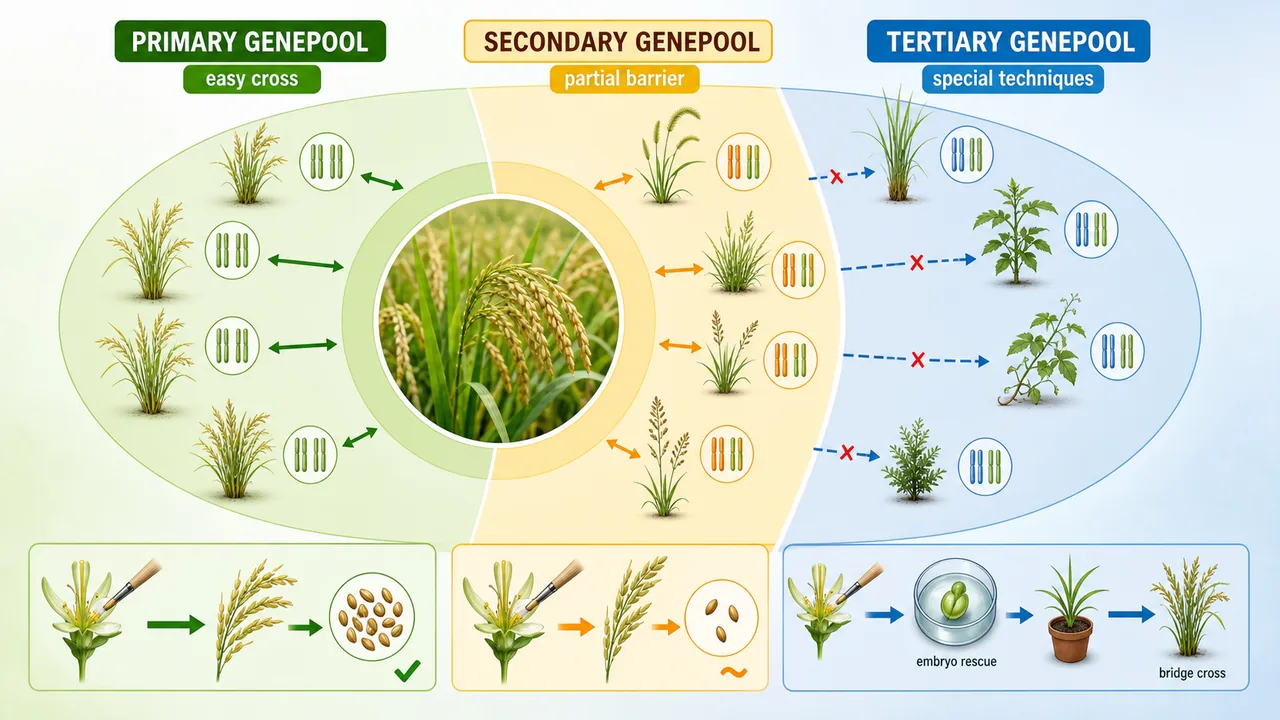
Genepool — sum total of all alleles present in the breeding/reproductive members of a random mating population. Classified into:
- Primary genepool — same species, cross easily
- Secondary genepool — related species, cross with some difficulty
- Tertiary genepool — distantly related, cross with extreme difficulty (embryo rescue needed)
-
Gene frequency — proportion of one allele relative to all alleles of a gene in a Mendelian population. Also called allele frequency.
-
Biodiversity — total variability present within and among species of all living organisms. Includes genetic, species, and ecosystem diversity.
-
Epistasis — when one gene affects the expression of another non-allelic gene. Types include dominant epistasis (12:3:1), recessive epistasis (9:3:4), duplicate epistasis (15:1), complementary epistasis (9:7), and inhibitory epistasis (13:3).
-
Pleiotropism — one gene affects more than one character (pleiotropic genes). E.g. the gene for seed coat colour in peas also affects flower colour and leaf axil pigmentation.
-
Silent Mutation — a mutation that changes the nucleotide sequence but does not alter the amino acid or protein activity due to the degeneracy of the genetic code.
-
Spontaneous Mutations — mutations occurring under natural conditions without any deliberate treatment with mutagens. Frequency is very low (10-5 to 10-8 per gene per generation).
-
Tautomerism — ability of a molecule (especially bases of DNA) to exist in more than one chemical form. Tautomeric shifts in bases lead to transition mutations during DNA replication.
-
Pseudo alleles — genes that govern different expressions of the same character, are closely linked, and exhibit cis-trans position effect. They can be separated by crossing over. E.g. Star and asteroid loci in Drosophila.
IMPORTANT
Allosyndesis vs Autosyndesis is a classic one-liner in IBPS AFO, NABARD, and FCI exams. Remember: Allo = different (non-homologous pairing), Auto = same (homologous pairing). Both occur in allopolyploids during meiosis.
Breeding & Selection Terms
-
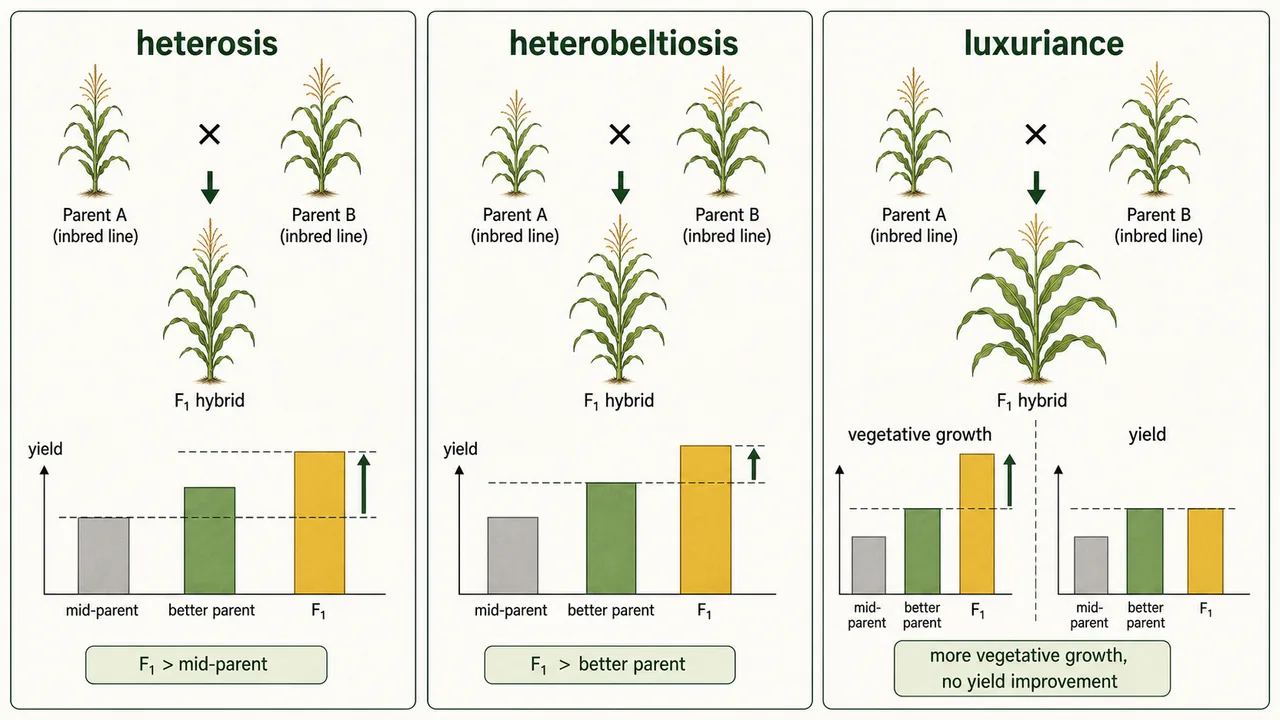
Heterosis (Hybrid Vigour) — superiority of F1 hybrid in one or more characters over its parents. Term coined by G.H. Shull (1914). Three types:
- Relative heterosis — F1 superiority over mid-parent value
- Heterobeltiosis — F1 superiority over the better parent
- Standard/Economic heterosis — F1 superiority over the best commercial check variety
-
Heterobeltiosis — heterosis estimated over the superior/better parent. More useful than mid-parent heterosis for practical breeding purposes.
-
Luxuriance — superiority of F1 over parents in vegetative growth but NOT in yield and adaptation. Also known as pseudo heterosis. The hybrid may look vigorous but performs poorly in reproductive traits.
-
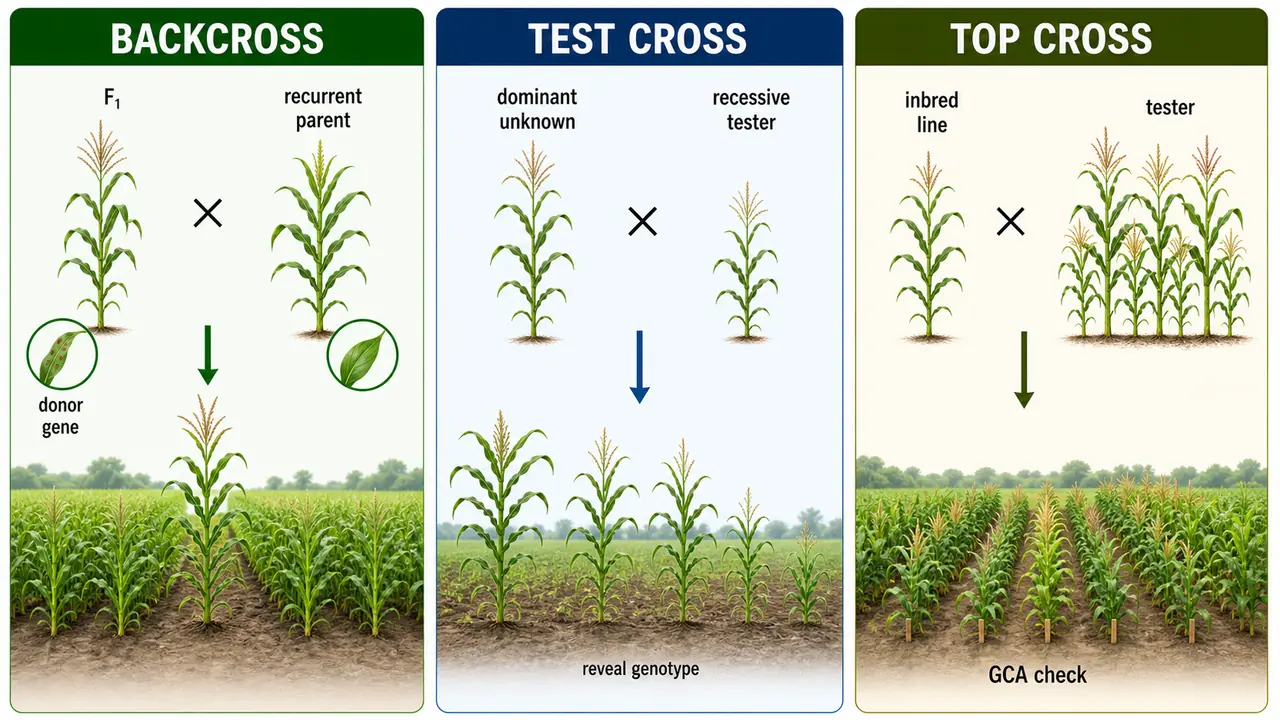
Top cross — cross between an inbred line and an open-pollinated variety. Also known as inbred-variety cross. Used to evaluate general combining ability (GCA) of inbred lines. Proposed by Davis (1927).
-
Inbreeding — mating between individuals related by descent or common ancestry (brother-sister/sib mating). Highest degree of inbreeding is achieved by selfing. Increases homozygosity by 50% per generation in self-pollinated crops.
-
Inbreeding Depression — severe reduction in vigour and fertility in cross-pollinated species when subjected to continued selfing. Very low in self-pollinated crops. Highest in cross-pollinated crops like Carrot, Alfalfa, Lucerne. Opposite of heterosis.
WARNING
Do not confuse Heterosis with Luxuriance. Heterosis shows superiority in yield and economically important traits, while Luxuriance (pseudo heterosis) shows superiority only in vegetative growth without any yield advantage.
-
Acclimatization — adaptation or adjustment of an introduced variety to a new environment. Different from adaptation, which is a natural evolutionary process.
-
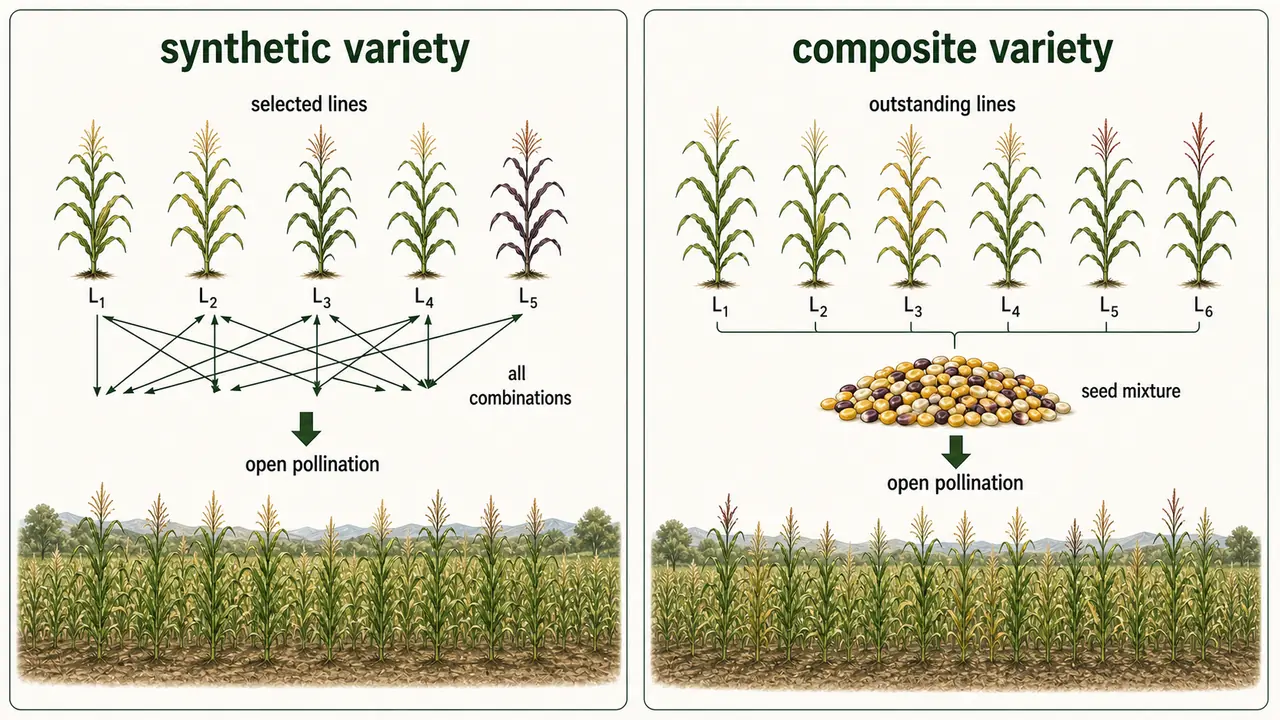
Synthetic Variety — produced by crossing in all combinations a number of lines that combine well, followed by open pollination. Can be grown for 4-5 years without significant yield reduction. Reconstituted from parental lines when yield drops. Proposed by Sewall Wright.
-
Composite Variety — produced by mixing seeds of several phenotypically outstanding lines and encouraging open pollination. Broader genetic base than synthetic varieties but may show faster yield decline over generations.
-
Land races — crop cultivars developed through traditional farming over centuries of natural and human selection. Good source of genetic variability and adaptation genes. Also called desi varieties or primitive cultivars.
-
Obsolete varieties — varieties developed by systematic modern agricultural science that have been replaced by newer, improved varieties. Valuable as sources of specific genes.
-
Chimera — an individual with one genotype in some parts and another genotype in other parts. Arises from mutation in a single cell during development. Jaganath rice = gamma-ray induced semi-dwarf mutant from T-141. Types include sectorial, mericlinal, and periclinal chimeras.
-
Amphidiploid — an allopolyploid with two complete copies of each parental genome, behaves as a diploid during meiosis (showing bivalent pairing). Used as a bridge species for character transfer between incompatible species. E.g. Raphanobrassica (2n = 36) — first artificial amphidiploid produced by Karpechenko (1927).
-
Ideotype — according to Donald (1968), a biological model that is expected to perform or behave in a predictable manner within a defined environment. Ideotype breeding aims to combine specific morphological and physiological traits for maximum yield.
TIP
Synthetic vs Composite Variety: Both are used in cross-pollinated crops. Synthetic varieties involve controlled crosses among selected lines (all possible combinations), while Composite varieties are simply mixtures of seeds from outstanding lines. Synthetic varieties maintain yield longer (4-5 years).
Cytogenetics & Molecular Terms
-
Cytogenetics — study of various aspects of chromosomes and their effects on the development of characters. Bridges the gap between cytology and genetics.
-
Genomics — study of the structure and function of the entire genome of an organism. Includes structural genomics, functional genomics, and comparative genomics.
-
Genome — complete set of chromosomes of a diploid species (one haploid set). Represented by letters (e.g. Wheat: AABBDD = 3 genomes).
-
Euphenics — deals with the control of hereditary diseases, especially inborn errors of metabolism, through environmental manipulation or medical intervention. Term coined by Lederberg.
-
Allele — alternate form of a gene occupying the same locus on homologous chromosomes. Shorter term for allelomorph.
-
Multiple alleles — the presence of many alleles of a single gene in a population (but only two per diploid individual). E.g. ABO blood group system has three alleles: IA, IB, i.
-
Antibody — a protein (immunoglobulin) found in serum or plasma, demonstrated by specific reaction with its corresponding antigen. Produced by B-lymphocytes.
-
Antigen — a substance that induces production of a specific antibody when introduced into a vertebrate body. Located on the surface of RBC (in blood group systems).
-
Cytoplasmic inheritance — characters controlled by plasmagenes (genes in cytoplasm — mitochondria, chloroplasts). Also called extranuclear or maternal inheritance. Always shows maternal effect. E.g. Male sterility in maize, Kappa particles in Paramecium.
NOTE
Cytoplasmic inheritance is identified by the fact that reciprocal crosses give different results, and the trait always follows the maternal parent. This is because cytoplasm (and organelles) are inherited almost exclusively from the egg cell.
Important Historical Facts
-
First artificial hybrid in plants: Thomas Fairchild (1717) — crossed Sweet William (Dianthus barbatus) with Carnation (Dianthus caryophyllus). The resulting hybrid is known as Fairchild's Mule.
-
Back cross — crossing F1 with one of its parents. Important in development of disease resistance through backcross breeding. Two types:
- Recurrent parent — the parent to which repeated backcrosses are made
- Donor parent — the parent that donates the gene of interest
-
Test cross — crossing F1 (or any dominant phenotype individual) with its homozygous recessive parent. Used to determine the genotype of a dominant phenotype individual. Proposed by Mendel.
-
Xenia — the direct effect of foreign pollen on the endosperm or embryo in the same generation. It is classically illustrated in maize, where pollen source can immediately influence grain expression.
-
Pure line theory — given by Johannsen (1903). A pure line is the progeny of a single homozygous self-pollinated plant. Selection within a pure line is ineffective.
-
Law of Homologous Series — given by N.I. Vavilov (1920). Species that are genetically related exhibit parallel variation in their characteristics.
-
Mutation theory — given by Hugo de Vries (1901) based on his work on Oenothera lamarckiana (Evening Primrose). However, what he observed were actually chromosomal aberrations, not gene mutations.
Quick Revision Table
| Term | Key Point | Exam Relevance |
|---|---|---|
| Duodichogamy | Rarest temporal sexual system | exams 2019 |
| Allosyndesis | Non-homologous pairing in allopolyploid | exams 2019 |
| Emasculation | Prevents self-pollination in bisexual flowers | exams 2023 |
| Heterobeltiosis | Heterosis over better parent | exams, NABARD |
| Luxuriance | Pseudo heterosis (vegetative only) | exams |
| Synthetic variety | Lasts 4-5 years without yield drop | exams |
| Amphidiploid | Bridge species, diploid behaviour | exams |
| Ideotype | Donald (1968), biological model | NABARD |
| Top cross | Tests GCA, Davis (1927) | exams |
| Fairchild (1717) | First artificial plant hybrid | All exams |
TIP
Exam Strategy: Terms like Heterobeltiosis, Luxuriance, Allosyndesis, and Duodichogamy are frequently asked in one-liner format. Memorize the precise definitions and the scientists/years associated with them. Focus on distinguishing between similar-sounding terms (e.g., Allosyndesis vs Autosyndesis, Heterosis vs Luxuriance, Synthetic vs Composite).
Summary Cheat Sheet
| Concept / Topic | Key Details / Explanation |
|---|---|
| Duodichogamy | Two batches of male flowers separated by female flowers; rarest temporal sexual system; asked in exams |
| Geitonogamy | Pollen from one flower to another flower of the same plant; genetically = selfing (e.g., Maize) |
| Xenogamy | Pollen from one plant to a different plant; true cross-pollination; maximum genetic recombination |
| Emasculation | Removal of anthers/stamens to prevent self-pollination; methods: hand, hot water, alcohol, gametocides; exams |
| Parthenocarpy | Fruit development without fertilization; results in seedless fruit (e.g., Banana, Seedless watermelon) |
| Agamospermy | Seed and embryo formed without meiosis and fertilization (e.g., Citrus, Mango) |
| Apomixis | Reproduction via seeds without gamete fusion; includes agamospermy, adventitious embryony, apospory |
| Allosyndesis | Pairing of non-homologous chromosomes in allopolyploids at meiosis; Allo = different; exams 2019 |
| Autosyndesis | Pairing of homologous chromosomes in allopolyploids at meiosis; Auto = same |
| Genepool | Total alleles in a random mating population; Primary (same sp.) / Secondary (related sp.) / Tertiary (distant sp., embryo rescue needed) |
| Epistasis | One gene affects expression of another non-allelic gene; ratios: 12:3:1 (dominant), 9:3:4 (recessive), 15:1 (duplicate), 9:7 (complementary), 13:3 (inhibitory) |
| Pleiotropism | One gene affects more than one character (e.g., seed coat colour gene in peas) |
| Silent Mutation | Nucleotide change with no change in amino acid due to degeneracy of genetic code |
| Tautomerism | Molecule exists in more than one chemical form; tautomeric shifts in DNA bases → transition mutations |
| Pseudo alleles | Govern different expressions of same character; show cis-trans position effect; can be separated by crossing over |
| Heterosis (Hybrid Vigour) | F1 superiority over parents; coined by G.H. Shull (1914); types: relative heterosis, heterobeltiosis, standard/economic heterosis |
| Heterobeltiosis | Heterosis measured over the better/superior parent; most useful for practical breeding |
| Luxuriance (Pseudo Heterosis) | F1 superiority in vegetative growth only — NOT in yield or adaptation |
| Top Cross | Inbred line × open-pollinated variety; tests GCA; proposed by Davis (1927) |
| Inbreeding | Mating between related individuals; selfing = highest degree; increases homozygosity 50% per generation |
| Inbreeding Depression | Reduction in vigour/fertility in cross-pollinated species upon selfing; highest in Carrot, Alfalfa, Lucerne |
| Acclimatization | Adaptation of an introduced variety to a new environment |
| Synthetic Variety | All combinations of selected lines + open pollination; lasts 4-5 years without yield drop; proposed by Sewall Wright |
| Composite Variety | Seeds of several outstanding lines mixed + open pollination; broader genetic base than synthetic |
| Land races | Traditional cultivars developed by natural/human selection over centuries; good source of variability |
| Chimera | Individual with two different genotypes in different body parts; arises from somatic mutation; e.g., Jaganath rice (gamma-ray mutant from T-141) |
| Amphidiploid | Allopolyploid with two complete parental genomes; behaves as diploid (bivalent pairing); used as bridge species; e.g., Raphanobrassica (2n=36) by Karpechenko (1927) |
| Ideotype | Biological model expected to perform predictably in a defined environment; concept by Donald (1968) |
| Cytogenetics | Study of chromosomes and their effects on character development |
| Genome | Complete set of chromosomes of a diploid species (one haploid set) |
| Euphenics | Control of hereditary diseases via environmental/medical intervention; term by Lederberg |
| Multiple Alleles | Many alleles of a single gene in a population; e.g., ABO blood group (I^A, I^B, i) |
| Cytoplasmic Inheritance | Characters controlled by plasmagenes (mitochondria, chloroplasts); maternal inheritance; e.g., male sterility in maize |
| First artificial plant hybrid | Thomas Fairchild (1717) — Sweet William × Carnation = Fairchild's Mule |
| Back Cross | F1 × one of its parents; Recurrent parent (repeated backcross) vs Donor parent (gene donor) |
| Test Cross | F1 × homozygous recessive parent; determines genotype of dominant phenotype; by Mendel |
| Xenia | Direct effect of foreign pollen on endosperm or embryo in the same generation; classical example maize |
| Pure Line Theory | By Johannsen (1903); selection within a pure line is ineffective |
| Law of Homologous Series | By N.I. Vavilov (1920); genetically related species show parallel variation |
| Mutation Theory | By Hugo de Vries (1901); based on Oenothera lamarckiana; what he saw were chromosomal aberrations |