🎃 Quantitative and Qualitative Characters in Crops
Understand the difference between quantitative (polygenic) and qualitative (oligogenic) traits, heritability, genetic variance, and their breeding implications.
Why This Distinction Matters in Agriculture
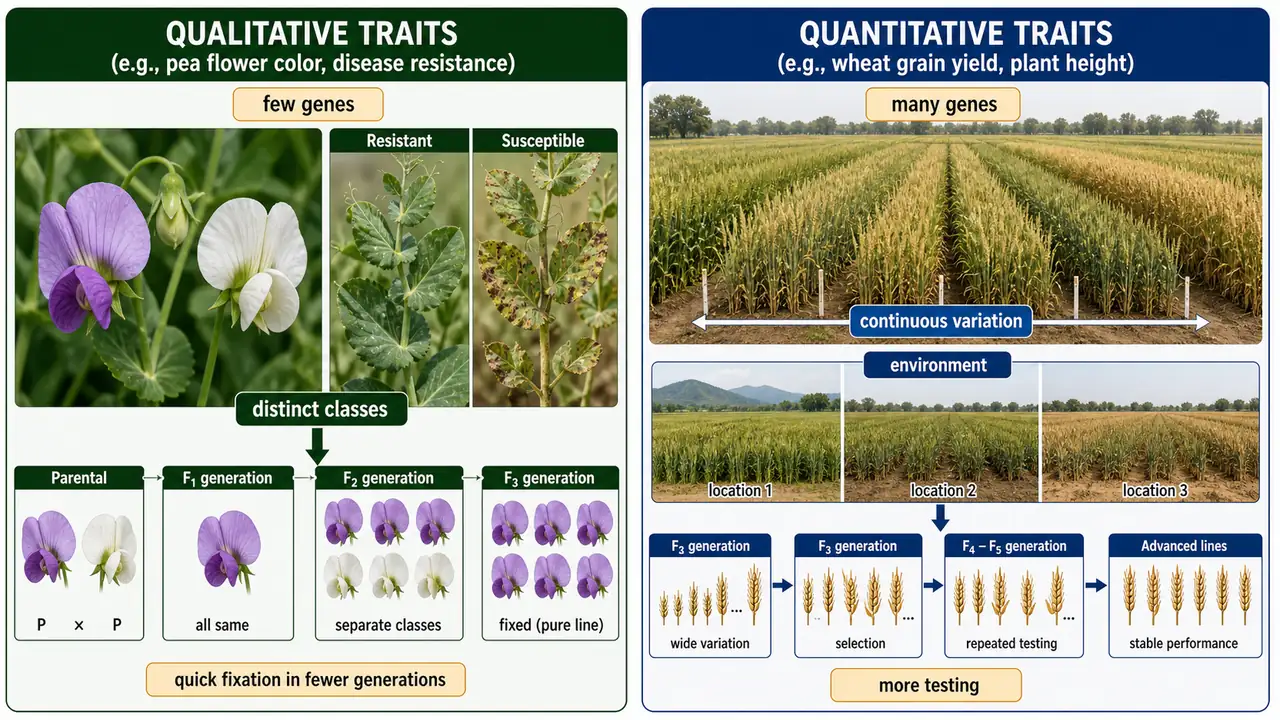
Grain yield in wheat is a quantitative trait — controlled by many genes, heavily influenced by environment, and showing continuous variation. Flower colour in pea is a qualitative trait — controlled by one or two genes with clear-cut categories. The breeding approach for these two types of traits is fundamentally different: qualitative traits can be fixed in a few generations, while quantitative traits require extensive testing across environments and statistical analysis.
👉🏻 Basic requirements of Plant breeding
- Variation in a character = It is must for the improvement in the character. Variation may be created by hybridization, mutation or polyploidy. Without variation, there is nothing to select from and no genetic progress can be made.
- Selection means identification and isolation of desirable plants. Selection from a population depends on the appearance i.e. phenotype. Phenotype may be heritable or may not be. Heritable character of phenotype is due to genotype i.e. genes present in the plants. Only heritable variation is useful for permanent genetic improvement.
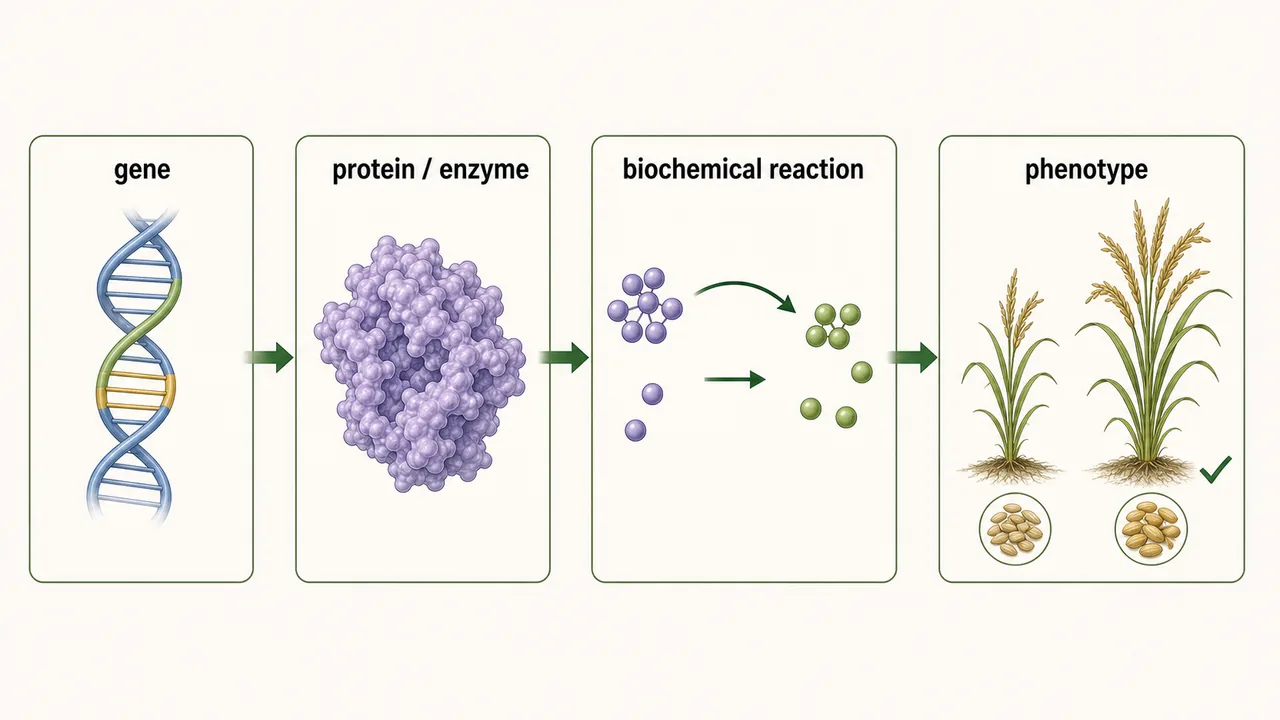
- Genes do not produce characters directly. Genes produce different proteins which often acts as enzymes. Enzymes catalyze a specific biochemical reaction which finally leads to development of various characters i.e. phenotype. This is the fundamental pathway: Gene → Protein/Enzyme → Biochemical Reaction → Character (Phenotype).
- Some characters are little affected by other genes i.e. the genetic background, or the environment. Such characters are generally governed by one or few genes with large easily detectable effects. These genes are called oligogenes. Because oligogenes have large, distinct effects, the traits they control are relatively easy to study and manipulate in breeding programmes.
- Oligogenes produce the characters having distinct classes. These characters are called qualitative characters.
NOTE
Pro Content Locked
Upgrade to Pro to access this lesson and all other premium content.
Charged once for one year · ₹1188 total
Save ₹100/month vs ₹2388/year launch price
- All Agriculture & Banking Courses
- AI Lesson Questions (100/day)
- AI Doubt Solver (50/day)
- Glows & Grows Feedback (30/day)
- AI Section Quiz (20/day)
- 22-Language Translation (100/day)
- Recall Questions (20/day)
- AI Quiz (15/day)
- AI Quiz Paper Analysis (100/day)
- AI Step-by-Step Explanations (100/day)
- Spaced Repetition Recall (FSRS)
- AI Tutor
- Immersive Text Questions
- Audio Lessons — Hindi & English
- Mock Tests & Previous Year Papers
- Summary & Mind Maps
- XP, Levels, Leaderboard & Badges
- Generate New Classrooms
- Voice AI Teacher (AgriDots Live)
- AI Revision Assistant
- Knowledge Gap Analysis
- Interactive Revision (LangGraph)
🔒 Secure one-time yearly payment via Razorpay · No hidden fees
Why This Distinction Matters in Agriculture
Grain yield in wheat is a quantitative trait — controlled by many genes, heavily influenced by environment, and showing continuous variation. Flower colour in pea is a qualitative trait — controlled by one or two genes with clear-cut categories. The breeding approach for these two types of traits is fundamentally different: qualitative traits can be fixed in a few generations, while quantitative traits require extensive testing across environments and statistical analysis.
👉🏻 Basic requirements of Plant breeding
- Variation in a character = It is must for the improvement in the character. Variation may be created by hybridization, mutation or polyploidy. Without variation, there is nothing to select from and no genetic progress can be made.
- Selection means identification and isolation of desirable plants. Selection from a population depends on the appearance i.e. phenotype. Phenotype may be heritable or may not be. Heritable character of phenotype is due to genotype i.e. genes present in the plants. Only heritable variation is useful for permanent genetic improvement.
- Genes do not produce characters directly. Genes produce different proteins which often acts as enzymes. Enzymes catalyze a specific biochemical reaction which finally leads to development of various characters i.e. phenotype. This is the fundamental pathway: Gene → Protein/Enzyme → Biochemical Reaction → Character (Phenotype).
- Some characters are little affected by other genes i.e. the genetic background, or the environment. Such characters are generally governed by one or few genes with large easily detectable effects. These genes are called oligogenes. Because oligogenes have large, distinct effects, the traits they control are relatively easy to study and manipulate in breeding programmes.
- Oligogenes produce the characters having distinct classes. These characters are called qualitative characters.
NOTE
Oligogenes = few genes, large effects, distinct classes = qualitative traits. Polygenes = many genes, small effects, continuous variation = quantitative traits.
- In other words Qualitative characters are such characters which show distinct classes, are little affected by the environment (both external and internal), and are governed by one or few genes with large distinct effects i.e. oligogenes. Examples include flower colour, seed shape, and presence or absence of awns.
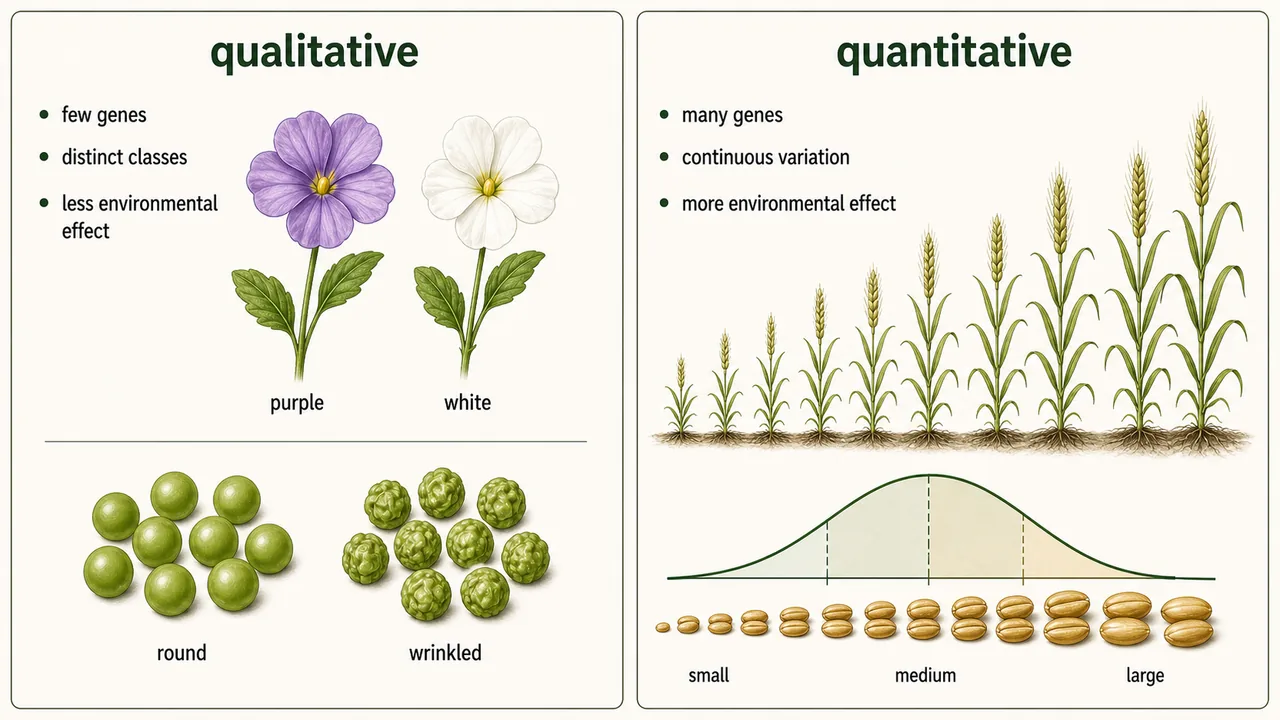
- Whereas most of the characters are governed by several genes with individual effects and very much affected by the genetic background and more particularly by the environment. These genes are called polygenes. The characters produced by polygenes do not show clear-cut classes and have to be studied by measurement, are called Quantitative Characters.
- In other words, the quantitative characters show continuous distribution, are generally influenced by the environment and are controlled by several genes with small and cumulative effects i.e. polygenes.
- The small effect of each gene is usually cumulative. Example: yield, plant height, days to flower, days to maturity, protein content, seed size etc. These are the most economically important traits in agriculture.
- Inheritance of both characters i.e. qualitative and quantitative follows the laws of Mendel but the effects of individual genes are totally different. This is an important concept -- the same Mendelian principles apply, but the observable patterns differ greatly due to the number of genes involved.
- Mendel proposed his laws of inheritance based on his studies with qualitative characters. His famous experiments with peas involved traits like tall vs. dwarf, round vs. wrinkled -- all governed by oligogenes with distinct classes.
Pleiotropy
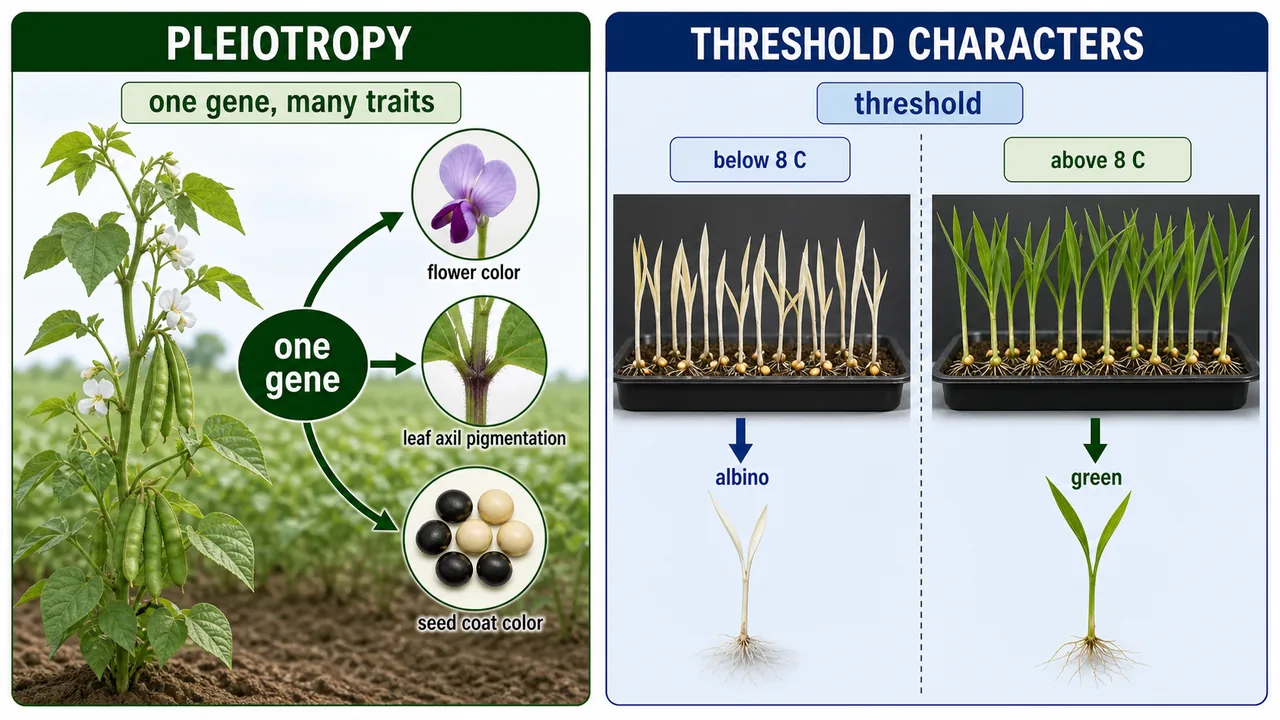
- A single major gene i.e. oligogene generally governs a single character but there are many instances where an oligogene affects, more than one character. Such phenomenon of a single major gene affecting more than one character is known as pleiotropy and such a gene action is called pleiotropic gene action. Understanding pleiotropy is important in breeding because selecting for one trait may inadvertently affect another trait controlled by the same gene.
- Clear-cut examples of pleiotropy are limited mainly because of difficulty in demonstrating pleiotropic effect of a gene. To investigate pleiotropic effect of a gene, two lines must be developed which are identical with respect to all other genes except for the gene under investigation. Such lines are called isogenic lines. Developing isogenic lines is a laborious process but essential for confirming pleiotropic effects.
Threshold characters
- Certain genes require a specific environment for their expression, such characters are called threshold characters. E.g. a mutant gene in barley (Hordeum vulgare) produces albino seedlings at temperatures below 8 degrees C. This demonstrates the critical role of genotype-environment interaction -- the gene is present but only expressed under particular environmental conditions.
Modifying genes
- The genes modify the effects of other genes are called modifying genes. Such genes have no any effect of their own but they increase or decrease the expression of other oligogenes. The effects of such genes are quantitative in nature. Modifying genes play an important role in fine-tuning the expression of major genes and contribute to the continuous variation observed in many traits.
- E.g. spotting in mice is affected by modifying genes.
Quantitative Characters
- The application of statistical procedures to biological problems is known as biometry or biometrics. In plant breeding this is essential because quantitative traits must be understood through measured variation, not only by visual categories.
- In 1906, Yule suggested that many genes with small, similar effects could produce continuous variation. He proposed that these genes (responsible for quantitative characters) were transmitted according to the laws of Mendel. This was a groundbreaking idea that bridged the gap between Mendelian genetics and the continuous variation observed in most economically important traits.
- In 1908, Nilsson-Ehle presented experimental evidence to support the hypothesis of Yule i.e. seed colour in wheat and oat. The F2 generations from various crosses had red & white grains in the ratios of 3:1, 15:1 or 63:1. It means that the seed colour in these crosses were governed by one, two and three genes respectively. The closer study of seed colour in 15:1 ratio revealed that the seed classified as red differed in the intensity of colour. Thus it was assumed that the seed colour was governed by two genes with similar, small and additive effects and Nilsson-Ehle showed certain characters were governed by genes which have small & cumulative effects.
- This is known as multiple factor hypothesis or polygenic inheritance. This hypothesis forms the foundation of quantitative genetics, which is central to modern plant breeding.
- East (1916) presented conclusive evidence by studying inheritance of corolla length in Nicotiana longiflora that quantitative characters are governed by many genes with small & cumulative effects.
- To analyse his data, East used statistical parameters such as frequency distribution, mean & coefficient of variability. Quantitative characters are considerably affected by the environment i.e. 10-50%. The chief effect of environment is to mask the differences between different genotypes and to produce a continuous variation even if the no. of governing genes is very small or even one. This is why statistical methods are indispensable in breeding for quantitative traits.
- Assuming the effect of environment is zero, the increase in no. of governing genes produces a similar continuous variation. It means polygenic inheritance produces continuous variation.
- Due to the environmental effect or polygenic inheritance, phenotype does not reveal the genotype. The phenotype may be described in a mathematical model:
X̄ = μ + g + e + ge
- Where
- X̄ = phenotypic mean
- μ = general population mean (i.e. phenotype of all possible genotypes grown under all possible environments)
- g = effect of genotype
- e = effect of environment
- ge = interaction between genotype & environment
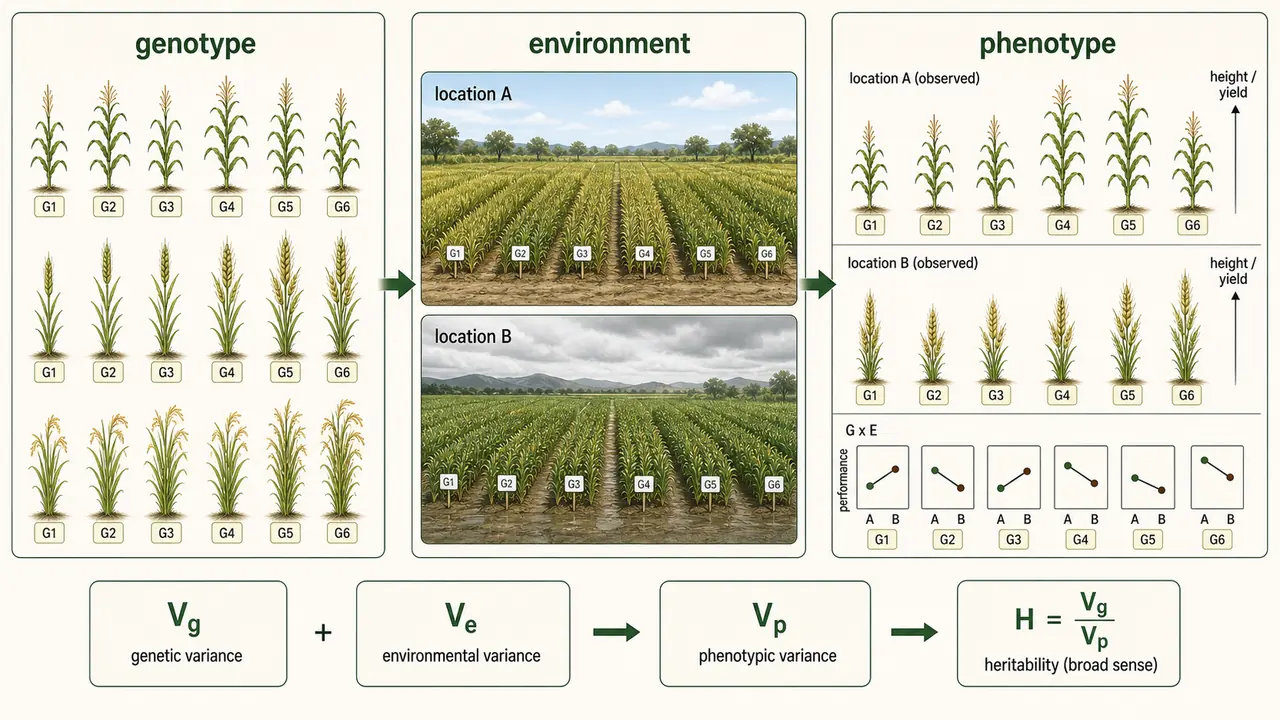
- genotype X environment: signifies the various genotypes affected by environment. This interaction is a key challenge in plant breeding -- a variety that performs well in one location may not perform equally well in another.
- Variance due to environment may be estimated from a replicated trial consisting of several genotypes. But the interaction component may be estimated only when the trial is conducted more than one environment, preferably at different locations and during different years. From such a trial the genetic variance and phenotypic variance can be competed which may be used to estimate heritability.
- Phenotypic variance (σ²p) = genotypic variance (σ² g) + environmental variance (σ² e)
- In crop improvement, only the genetic component of variation is important. The ratio of genetic variance to the total variance i.e. phenotypic variance is called heritability. Heritability tells the breeder how much of the observed variation is due to genetics and therefore how much progress can be expected from selection.
Heritability (H) = Vg/Vp = (Genetic Variance) /(Phenotypic Variance)
Vg/(Vg + Ve)
- Where, Ve environmental variance
- Fisher (1918) further partitioned the genotypic variance into three major components:
- Additive variance — the fixable component and the main basis of permanent response to selection.
- Dominance variance — arises from allelic interaction at the same locus and is closely associated with heterosis.
- Epistatic variance — arises from interaction between genes at different loci.
Summary Cheat Sheet
| Concept / Topic | Key Details |
|---|---|
| Qualitative characters | Controlled by few major genes; discontinuous variation |
| Qualitative examples | Flower colour, seed shape, disease resistance (R/S) |
| Qualitative inheritance | Mendelian ratios (3:1, 9:3:3:1) |
| Quantitative characters | Controlled by many genes (polygenes); continuous variation |
| Quantitative examples | Yield, height, maturity, oil content |
| Polygenic inheritance | Multiple genes with small, additive effects |
| Term polygene coined by | Mather (1941) |
| Nilsson-Ehle | Demonstrated multiple factor hypothesis (wheat kernel colour) |
| Heritability | Proportion of phenotypic variance due to genetic variance |
| Broad-sense heritability (H²) | V_G / V_P (includes all genetic variance) |
| Narrow-sense heritability (h²) | V_A / V_P (only additive variance) |
| High heritability | Selection is more effective |
| Genetic advance | Expected improvement from one cycle of selection |
| Genetic advance depends on | Heritability x selection intensity x phenotypic SD |
| GCV (Genetic Coefficient of Variation) | Measures genetic variability relative to mean |
| Qualitative vs Quantitative | Few genes/Mendelian vs Many genes/continuous/polygenic |