🌱 Seed: Definition, Characteristics, and Germination Testing
Understand seed definitions (agronomic vs botanical), seed characteristics, germination testing procedures, and seed quality parameters — with agricultural examples and exam tips.
Why Seed Quality Matters in Agriculture
A farmer's entire season depends on the quality of seed sown. Poor germination means replanting costs; genetic impurity means reduced yield; seed-borne diseases mean crop losses. Seed testing is the scientific process that ensures farmers receive seeds that are pure, viable, healthy, and true to type. Every seed lot sold in India must meet minimum standards set by the Indian Minimum Seed Certification Standards (IMSCS).
Seed
-
Seed is defined either Agronomically or Botanically. Understanding both definitions is important because they serve different contexts in agriculture and plant science.
-
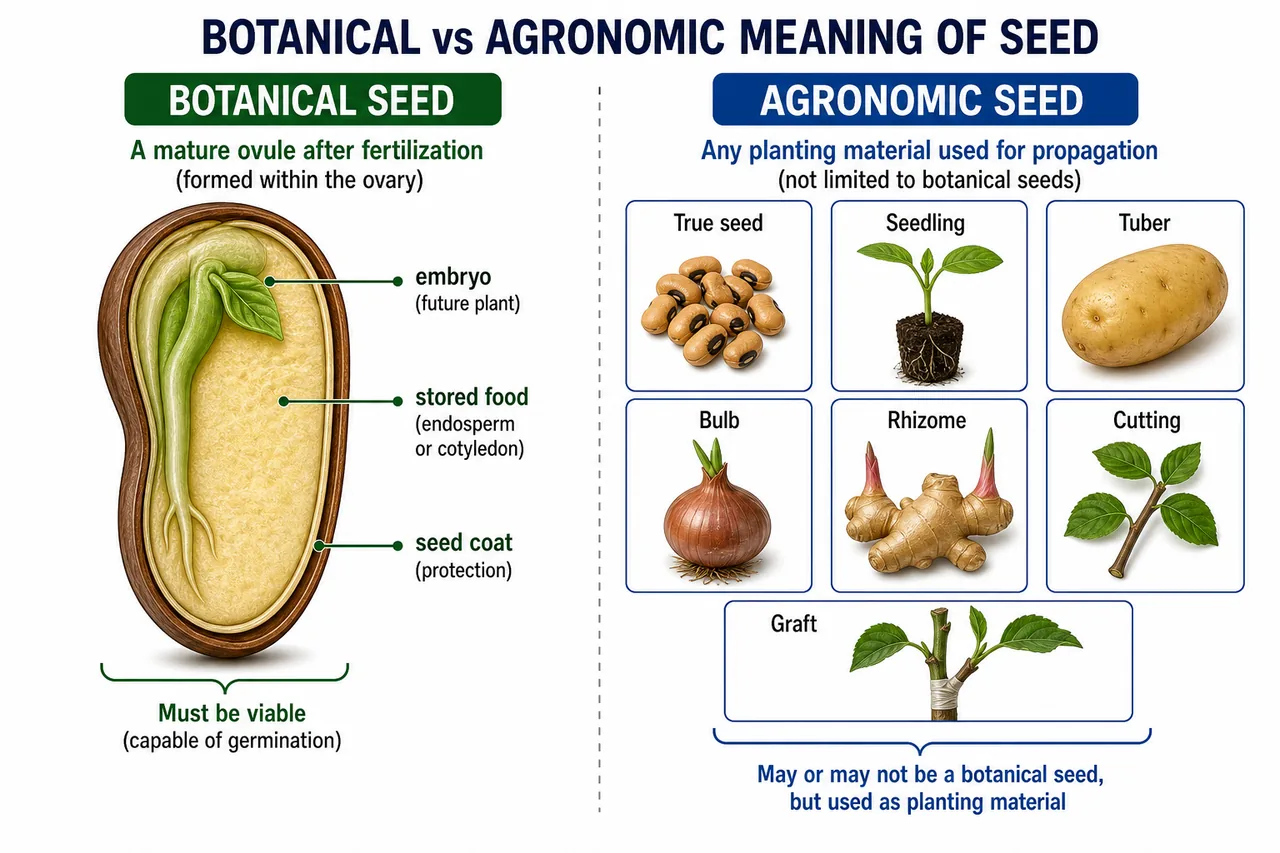
Botanically: "Seed is a fertilized ovule consisting of intact embryo, stored food and seed coat which is viable and has got the capacity to germinate." This definition focuses on the biological origin of the seed -- it must arise from the process of fertilization and contain a living embryo capable of developing into a new plant.
Pro Content Locked
Upgrade to Pro to access this lesson and all other premium content.
₹99 charged monthly · Cancel anytime
- All Agriculture & Banking Courses
- AI Lesson Questions (100/day)
- AI Doubt Solver (50/day)
- Glows & Grows Feedback (30/day)
- AI Section Quiz (20/day)
- 22-Language Translation (100/day)
- Recall Questions (20/day)
- AI Quiz (15/day)
- AI Quiz Paper Analysis (100/day)
- AI Step-by-Step Explanations (100/day)
- Spaced Repetition Recall (FSRS)
- AI Tutor
- Immersive Text Questions
- Audio Lessons — Hindi & English
- Mock Tests & Previous Year Papers
- Summary & Mind Maps
- XP, Levels, Leaderboard & Badges
- Generate New Classrooms
- Voice AI Teacher (AgriDots Live)
- AI Revision Assistant
- Knowledge Gap Analysis
- Interactive Revision (LangGraph)
🔒 Secure via Razorpay · Cancel anytime · No hidden fees
Why Seed Quality Matters in Agriculture
A farmer's entire season depends on the quality of seed sown. Poor germination means replanting costs; genetic impurity means reduced yield; seed-borne diseases mean crop losses. Seed testing is the scientific process that ensures farmers receive seeds that are pure, viable, healthy, and true to type. Every seed lot sold in India must meet minimum standards set by the Indian Minimum Seed Certification Standards (IMSCS).
Seed
-
Seed is defined either Agronomically or Botanically. Understanding both definitions is important because they serve different contexts in agriculture and plant science.
-
Botanically: "Seed is a fertilized ovule consisting of intact embryo, stored food and seed coat which is viable and has got the capacity to germinate." This definition focuses on the biological origin of the seed -- it must arise from the process of fertilization and contain a living embryo capable of developing into a new plant.
-
Agronomically: "Seed is any material used for planting & propagation whether it is in the form of seed (grain) of food, fodder, fiber or vegetable crop or seedlings, tubers, bulbs, rhizomes, roots, cuttings, grafts or other vegetative propagated material." This broader definition recognizes that farmers use many types of planting material beyond true botanical seeds. From an agronomic standpoint, anything that can reproduce a crop counts as "seed."
NOTE
The botanical definition is narrow (fertilized ovule only), while the agronomic definition is broad (any planting material). Exam questions often test this distinction.
- Some quick recall facts usually travel with the basic definition. Seed is treated as the most basic input in agriculture, and the Indian Institute of Seed Science is associated with Mau, Uttar Pradesh. In fruit morphology, fruit is the mature ovary, while apple and strawberry are classic examples of false fruits / pseudocarps because much of the edible portion develops from the receptacle or thalamus.
Characteristics of the Seed
A good quality seed must meet several important criteria before it is considered suitable for planting:
- It must be true to its type, meaning it should accurately represent the variety it claims to be.
- The seeds must be healthy, pure and free from all inert materials and weed seeds. Any contamination reduces the quality of the seed lot.
- The seeds must be viable, meaning they must possess the ability to germinate and produce a healthy plant.
- The germination capacity is up to the standard and it has been tested recently. Only recently tested seed gives a reliable measure of its planting potential.
- The seeds must be uniform in its texture, structure and look. Uniformity ensures consistent crop performance in the field.
- The seeds should be truthfully labelled and produced under all due cares. Correct labelling protects the farmer from unknowingly purchasing substandard seed.
- The seed must not be affected by any seed-borne disease. Diseased seed can spread pathogens across the field and even to new regions.
- It should be dry & not mouldy and should contain 12-14 per cent moisture. Excess moisture promotes fungal growth and reduces seed longevity.
- Seed health refers that the seed is free from any kind of disease propagule (spore, mycelium, etc.), either active or latent. Even dormant pathogens can become active under favorable conditions, so seed health testing is essential.
- In practical seed-health diagnostics, older objective-style seed-technology references also mention immunological detection methods such as ELISA (Enzyme-Linked Immunosorbent Assay) and DIBA (Dot Immunobinding Assay), especially when discussing rapid detection of seed-borne viral pathogens.
- Older exam-oriented seed-health recalls also include crop-specific screening methods such as 20% NaCl brine for detecting ergot in pearl millet and NaOH test for visually separating certain bunt- or smut-affected grains in practical lab demonstrations.
Difference between Seed and Grain

| S.No. | Seed | Grain |
|---|---|---|
| 1 | Viability is important | Viability never considered |
| 2 | Should have maximum genetic & physical purity | Not so |
| 3 | Should satisfy minimum seed certification standards | No such requirements |
| 4 | Can be treated with fungicide, pesticide | Should never be treated with any chemicals, since used for consumption |
| 5 | Respiration rate and other physiological & biological processes should be kept at low level during storage | No such specifications |
| 6 | Should be compulsorily certified / truthfully labelled | No such condition in grain production |
| 7 | Should never be converted into grain unless warranted | Can be converted as seed provided the situation warrants |
| 8 | It should satisfy all the quality norms | Not considered |
| 9 | Harvested at physiological maturity | Harvestable maturity |
| 10 | Comes under preview of seed acts | Comes under preview of food acts |
| S.No. | Seed Production | Grain Production |
|---|---|---|
| 1 | Planned programme -- start with demand forecasting, ends with marketing | Well planning not required |
| 2 | Authenticated source is required to raise a seed crop | Need not be |
| 3 | Specific land and field requirements | Not so |
| 4 | Should be monitored for certification standards and certified by the Agency | Not so |
| 5 | To be harvested at physiological maturity | Harvestable maturity |
| 6 | Proper post-harvest technology should be followed | Not so |
Key Seed Organizations & Acts
- National Seed Corporation (NSC) was established in 1963. It is the primary agency responsible for foundation seed production in India.
- National Seed Act was passed in 1966.
- Maharashtra was the first State to establish an official seed certification Agency during 1970 as a part of the Department of Agriculture, whereas Karnataka was the first State to establish the seed certification Agency as an autonomous body during 1974.
- At present 22 states in the country have their own Seed Certification Agencies established under the Seed Act 1966.
Types of Seeds by Number of Cotyledons
- Monocotyledonous seeds: These seeds contain embryo, endosperm and only one cotyledon. Endosperm provides food to embryo. Examples: Wheat, Bajra, Maize, Rice & Grasses.
- Dicotyledonous seeds: These seeds contain embryo and two cotyledons. Here cotyledons provide food to embryo. Examples: Mango, Gram, Pea, Pulses.
Types of Seeds by Food Storage Tissue
- Albuminous / endospermic seeds: Seeds with a well-developed endosperm at maturity. Examples: wheat, barley, rice, bajra, castor, cotton, coffee, fenugreek and opium poppy.
- Exalbuminous / non-endospermic seeds: Seeds with very little or no endosperm at maturity, so food is mainly stored in the cotyledons. Examples: most legumes such as pea, gram and groundnut, and also mustard.
- A standard exam recall point is that some dicot seeds can still be albuminous, especially castor, cotton, soybean, and poppy.
- Older agriculture exam books also use a seed-composition recall that wrinkling in field pea is associated with reduced amylopectin content. Keep this as a memory cue tied to reserve-food composition in legume seeds.
Parts of a Seed
- A seed is commonly described as having three major components: embryo, stored food (usually endosperm or cotyledons), and seed coat.
- Within the embryo, the plumule gives rise to the shoot, while the radicle gives rise to the root of the new seedling.
- In the seed coat, the outer layer is called testa and the inner layer is called tegmen.
- The aleurone layer is a living, protein-rich layer associated especially with cereal endosperm and plays an important role during germination.
- A standard seed-composition one-liner is that much of the phosphorus reserve in seeds is stored in the form of phytic acid / phytin.
- During germination, this stored phytic acid / phytin reserve is mobilized by the enzyme phytase.
- A classic exam-book recall split is:
- Living parts of a seed = cotyledon, embryo, and aleurone layer
- Non-living parts of a seed = endosperm, testa, and tegmen
- In monocot seed structure, the base of the hypocotyl sheath surrounding the radicle is called the coleorhiza.
- The endosperm generally has a triploid (3n) chromosome complement. Standard exam examples include:
- Wheat endosperm = 63 chromosomes
- Rice endosperm = 36 chromosomes
- Maize endosperm = 30 chromosomes
- A classic one-liner from seed-technology MCQs is that coconut is the crop associated with liquid endosperm.
Types of Seeds Based on Light Requirement (Photoblastic Seeds)
Seeds respond differently to light during germination. This classification is important for understanding germination ecology and is frequently asked in exams.
- Positive Photoblastic Seeds: Require light at the time of germination. E.g. Tobacco, Lettuce.
- Negative Photoblastic Seeds: Germinate in absence of light (darkness). E.g. Onion, Amaranthus.
- Non-photoblastic Seeds: Can germinate in light and dark or both. Most crop seeds are non-photoblastic.
TIP
Red light is the most effective wavelength for seed germination. This is mediated by the phytochrome system in the seed.
Seed testing
- In standard exam one-liners, the father of seed testing is remembered as Friedrich Nobbe of Germany.
- A classic historical recall point is that Nobbe's early seed-testing work is associated with Saxony, Germany, and objective questions may frame it as the first organized seed-testing setup in that region.
- First Seed Testing Laboratory was established at IARI in 1961. This marked the beginning of systematic seed quality evaluation in India and laid the foundation for ensuring that only quality seeds reach the farmer.
- A related Indian institutional recall point is that the Central Seed Testing Laboratory (CSTL) is associated with Varanasi, Uttar Pradesh.
- The International Seed Testing Association (ISTA) was founded in 1924 at Zurich, Switzerland, and India is commonly recalled as becoming an ISTA member in 1961.
Seed Germination
-
Germination is the emergence and development of seedling from the seed-embryo which is able to produce a normal plant under favourable condition. In simple terms, it is the process by which a dormant seed "wakes up" and begins to grow.
-
Agronomically germination means the capacity of seeds to give rise to normal sprouts within a definite period fixed for each crop under optimum field conditions. This practical definition focuses on field outcomes rather than just laboratory performance.
-
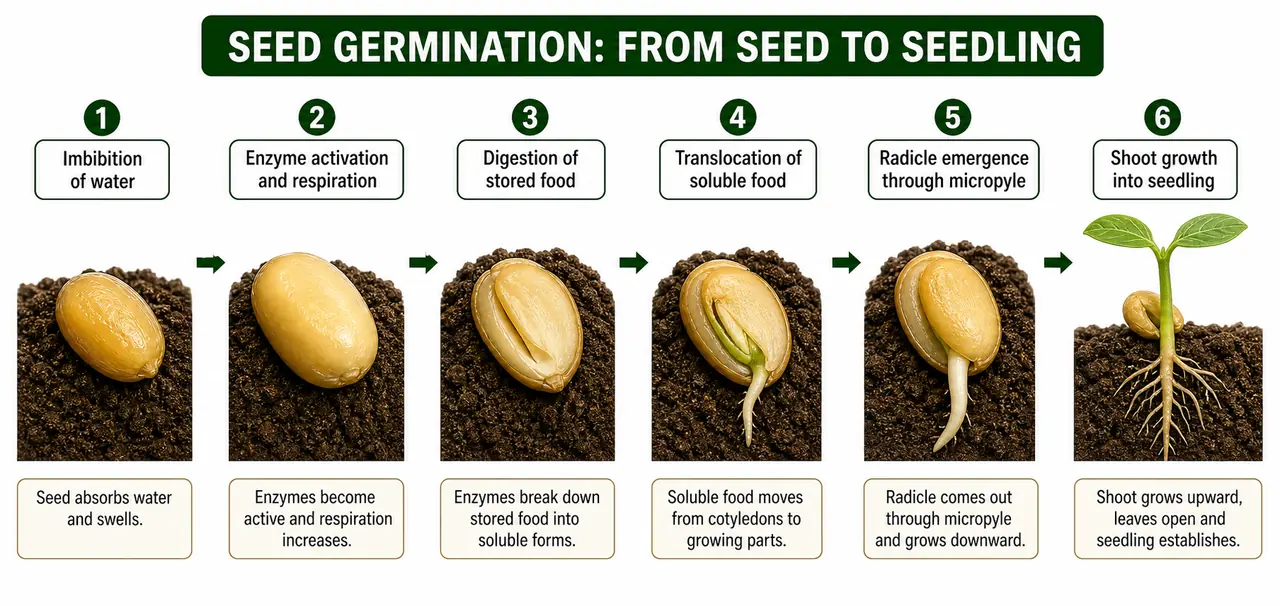
Changes during Germination -- The germination process involves a well-defined sequence of physiological events:
- Swelling of seed due to imbibition of water by osmosis. Water uptake is the very first step, softening the seed coat and activating internal biochemistry.
- Initiation of physiological activities such as respiration & secretion of enzyme. Water uptake also stimulates gibberellin activity, which in turn promotes hydrolytic enzymes.
- Digestion of stored food by enzymes. Reserve starches, proteins, and fats are broken down into simpler forms the embryo can use.
- Translocation & assimilation of soluble food. These digested nutrients are transported to the growing points of the embryo (radicle and plumule).
-
In cereal-type seeds, the aleurone layer is a major source of hydrolytic enzymes during germination. A standard recall point is that alpha-amylase helps convert stored starch into simpler sugars such as maltose for the developing embryo.
-
When seed is placed in soil gets favorable conditions, radical grows vigorously & comes out through micropyle & fixes seed in the soil. Then either hypocotyl or epicotyl begins to grow, depending on the type of germination.
-
The radicle is normally the first visible part to emerge during germination.
IMPORTANT
The sequence of germination is: Imbibition → Enzyme activation → Food digestion → Translocation → Radicle emergence → Shoot growth. This order is frequently tested in exams.
Types of Germination
Hypogeal germination
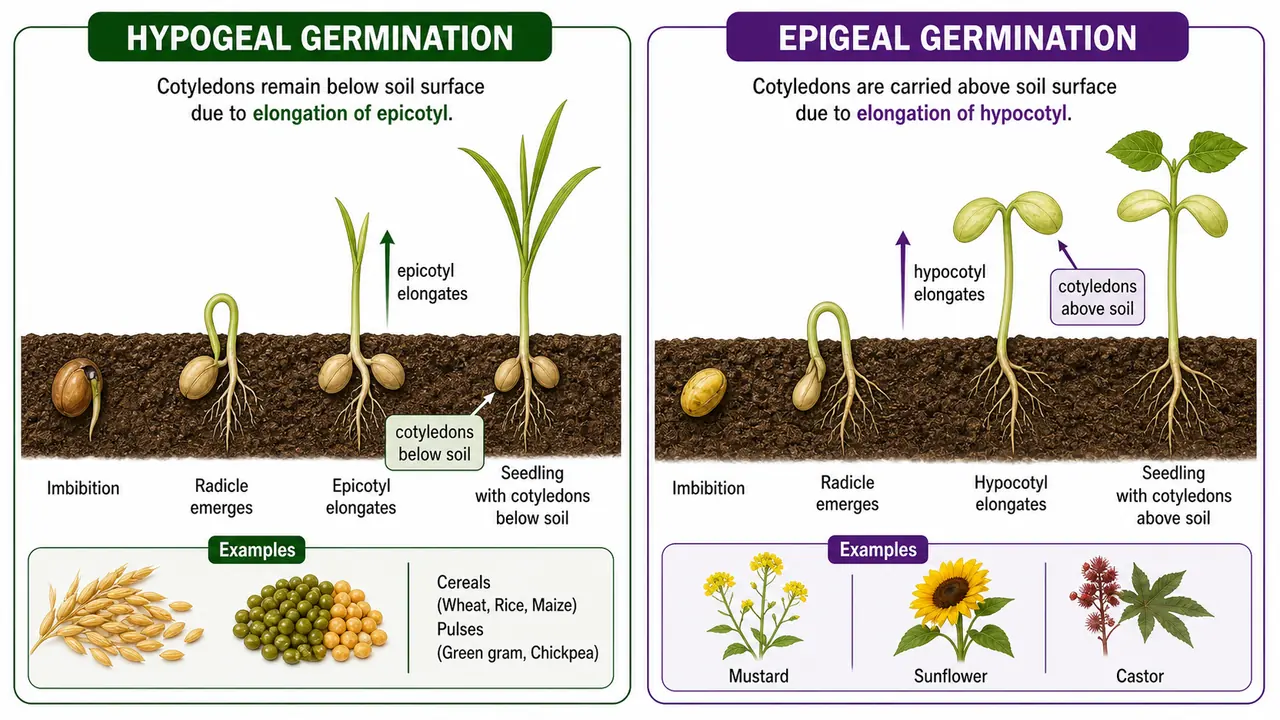
- The cotyledons remain under the soil. The epicotyl elongates and pushes the plumule upward while the cotyledons stay below ground, continuing to nourish the seedling. Standard agricultural examples include cereals and several pulses, especially gram, arhar / pigeon pea, lentil, groundnut, and mango.

Epigeal germination
- The cotyledons are pushed above the soil surface. Here the hypocotyl elongates rapidly, lifting the cotyledons above ground where they may even photosynthesize briefly before the true leaves take over. Common examples include mustard, sunflower, castor, onion, cotton, French bean, sunhemp, papaya, and tamarind.

TIP
Memory aid: Hypogeal = Hypo (below) = cotyledons stay below soil. Epigeal = Epi (above) = cotyledons pushed above soil. Hypogeal examples are common among cereals and several pulses, while epigeal examples are frequent among oilseeds and broad-leaved dicots.
👉🏻 Four essential factors for germination of seeds:
- Capacity of seed to germinate -- the seed must be alive and vigorous.
- Moisture -- water triggers imbibition and activates enzymes, and in standard seed-technology recall it is often treated as the most important immediate factor controlling germination.
- Temperature -- each species has an optimum range for germination.
- Oxygen-supply (Air) -- aerobic respiration is necessary for the energy demands of the growing embryo.
- A related exam-style one-liner is that nitrogen gas (N2) has no direct promoting role in seed germination, unlike oxygen which supports respiration.
- A notable exception is that rice seeds can germinate even under very low-oxygen / near-anaerobic conditions, which helps explain their adaptation to flooded environments.
Seed Longevity Classes
- Seed longevity means the length of time for which the embryo remains viable.
- A compact objective classification is:
- Microbiotic seeds: viable for less than 3 years
- Mesobiotic seeds: viable for about 3 to 15 years
- Macrobiotic seeds: viable for more than 15 years
👉🏻 Factors affecting the emergence of seedlings are:
These are field-level constraints that often cause germination under laboratory conditions to differ from germination in the field:
- Deep sowing or depth of soil cover over the seed -- excessively deep planting makes it harder for the seedling to reach the surface.
- Inadequate or excess soil moisture -- too little water prevents imbibition; too much can cause waterlogging and oxygen deprivation.
- Poor aeration -- compacted or waterlogged soils restrict oxygen supply to the germinating seed.
- Higher soil compaction or impermeable layer of soil or outer material -- physical barriers reduce seedling emergence.
- Low temperature -- slows metabolic processes and delays germination.
- Rapid desiccation of soil -- if the topsoil dries out quickly, the germinating seed may lose moisture and die.
- Longer time period -- seeds left too long before favorable conditions arrive may lose viability.
- Injurious level of salt content -- high salinity creates osmotic stress, making it difficult for seeds to absorb water.
- Poor seed capacity -- inherently weak or aged seeds have lower vigor.
- Detrimental physical, chemical and biological soil conditions -- these include soil pathogens, toxins, and unfavorable pH.
WARNING
Field germination is always lower than the germination of seeds tested in Laboratory. The mortality of seedlings after germination in the field frequently depends upon entomological (insect), phytopathological (disease), edaphological (soil) and meteorological (weather) factors as well as toxic effects of organic secretions and applied chemicals and storage period of the seed i.e. ageing. Laboratory results represent the best-case scenario, while field performance accounts for real-world stresses.
-
In general, the mortality of seedlings is more in kharif than rabi. So, germination of Rabi crops is more. This is because kharif season brings higher temperatures, excess moisture, and greater pest and disease pressure, all of which reduce seedling survival.
-
Germination tests are always carried out with the seeds counted at random from the pure fraction of seeds. In accordance with the I.S.T.A. rules, a minimum number of 400 seeds are required for germination test. Using 400 seeds (typically in four replicates of 100) provides statistical reliability.

| Crop | Germination Percentage |
|---|---|
| Maize | 90% |
| Wheat | 85% |
| Rice | 80% |
| Sorghum | 80% |
| Cotton (Hybrid) | 65% |
IMPORTANT
Exam-important germination percentages:
- Germination percentage in Maize: 90% (highest in field crops)
- Germination percentage in Cotton: 65% (lowest in field crops)
Xenia and Metaxenia
These are special effects of pollen on seed/fruit characteristics that appear in the same generation (not in the next generation as in normal inheritance):
-
Xenia: The direct/visible effect of pollen on the endosperm and related tissues in the formation of a seed color. Since endosperm is a product of triple fusion (involving one sperm nucleus), the pollen parent can directly influence endosperm traits like colour and composition.
-
Metaxenia: The effect of pollen on the maternal tissues of the fruit (pericarp). This is a rarer phenomenon where the pollen influences tissues that are entirely maternal in origin.
NOTE
Xenia affects the endosperm (inside the seed), while Metaxenia affects the pericarp (fruit wall). Both are direct pollen effects visible in the current generation.
Methods for Testing Germination
Several standardized methods are used to evaluate the germination potential of seeds. The choice of method depends on the size of the seed and the facilities available.
1. Petridish Method
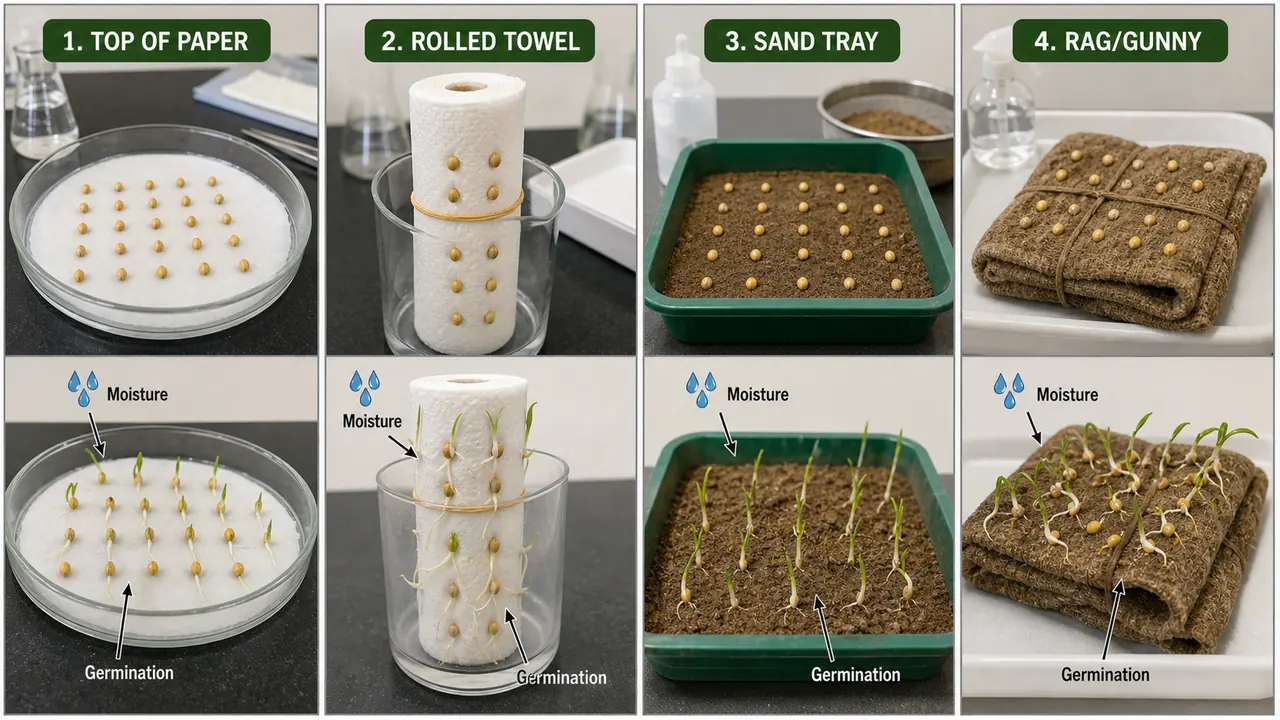
- Two blotters or filter papers are placed on the bottom of the petridish and they are soaked with water. A convenient number of seeds, ranging from 10-20, are placed on the surface of water-soaked blotters in the petridish. The kind of seed, date and time of seed soaking are written on the glass-cover of petridish with the help of a glass marking pencil.
- Usually, the germination percentage is calculated in two counts and reported on the basis of the results of germination of about 100 to 200 seeds. This method is suitable for small seeds viz. tobacco, tomato, radish, knol-khol, cabbage, cauliflower, mustard, lettuce, brinjal, chillies, etc.
2. Rolled Towel Method
- Two wet towels are placed on a smooth table top. The appropriate number of seeds are placed on the upper surface of the towels and are covered by two wet towels. A fold is made of the bottom of the towel to prevent the seeds from falling out. The towels are then rolled from right to left.
- The full informations regarding the test i.e. the kind of seed, lot number, date and time of seed soaking are noted on the roll with the help of an indelible pencil. This method is suitable for comparatively large sized seeds viz. maize, wheat, pea and gram.
3. Folder Paper Towel Method
- Two wet paper towels (big bamboo sheets), specially made for germination test, are placed on the working table-top. The surface of paper-towel is marked into two halves. The right half of the towel surface is planted with seeds and the left side half is folded to cover the right half and informations regarding the seed sample, date and time of seed soaking are written on the fold with an indelible pencil.
- Water is frequently sprinkled on these towels and observations on germinating seedlings and their numbers are taken periodically. This method of germination test is convenient for relatively large sized seeds.
4. Sand Method
- Seeds are planted in uniform layer of moist sand and then covered to depth of 1-2 cm with sand. Substrates for germination are moistened with 0.2 per cent KNO3 solution. The use of potassium nitrate helps break any residual dormancy and promotes uniform germination.
5. Rags or Gunny Sacs Method
- The seeds are simply wrapped in a moistened rag or gunny sac, which is then rolled and tied loosely in the form of bundle. This is now kept at a proper temperature on a rack or convenient place for germination.
- The rolls are opened after a fixed period of time and the number of germinated seeds is counted. This is a simple, low-cost method especially useful in rural settings where laboratory equipment may not be available.
6. Mechanical Method
- In this method, apparatus like Germinators are used. Cabinets of the incubator type with thermostatically controlled temperature may be used for the purpose. These provide the most controlled and reproducible conditions.
- In these cabinets the seeds may be placed evenly on moist filter paper in petri dishes or between filter papers kept moist by folds of moistened flannel or large seeds be sown in dishes containing sand or fine soil. Adequate water is applied needed by the help of a wash-bottle or sprayer.
| Method | Best For | Key Feature |
|---|---|---|
| Petridish | Small seeds (tobacco, tomato, mustard) | Filter paper + water in petridish |
| Rolled Towel | Large seeds (maize, wheat, pea) | Seeds between wet towels, rolled |
| Folder Paper Towel | Large seeds | Paper towel folded in halves |
| Sand | General use | Moist sand + KNO3 solution |
| Rags/Gunny Sacs | Rural settings | Low-cost, no lab equipment needed |
| Mechanical (Germinator) | Lab/commercial | Thermostatically controlled cabinets |
Seed Purity
- The purity of seed denotes the real percentage of desirable seed from a lot of with several impurities i.e. seeds of other varieties, other crop seed, defective seeds, weeds seeds, inert matter, sand straw, stones, soil and iron particles, pebbles etc. A high purity percentage means the seed lot is clean and predominantly composed of the intended crop seed.
- A standard seed-testing recall point is that a working sample should contain at least about 2500 seeds for proper examination in many practical testing contexts.
- In routine seed-sampling terminology, the sampling ladder is remembered as primary sample → composite sample → submitted sample → working sample. The primary samples are drawn from different parts of the lot, pooled into a composite sample, reduced to a submitted sample for the laboratory, and then further reduced to the working sample used for individual tests.
- In practical seed cleaning and purity work, a fanning mill is also referred to as an air screen cleaner.
- In physical-purity work, damaged or undersized seeds of the same crop may still be counted with the pure-seed fraction if they remain identifiable as that crop. A common lab recall is that a broken seed piece larger than about half of the original seed size can still be treated as pure seed, whereas detached coverings such as empty seed coats in legumes and crucifers are treated as inert matter.

- Dockage is the impurity percentage of seed. It represents everything in the seed lot that is not the desired pure seed.
- Some practical laboratory recalls also concern seed-coat injury tests: ferric chloride test is classically linked with legumes, indoxyl acetate test with large-seeded legumes, and fast green test with seeds such as sorghum, maize, and other grasses to make damaged tissues more visible.

- Genetic purity is tested by Field Plot test (also called grow-out test). In this test, seeds are grown out in the field and the resulting plants are inspected for trueness-to-type.
Real Value of Seed
- The real value of seed represents its seed quality in terms of purity and germination. It combines both parameters into a single, meaningful figure that indicates how much of the seed lot will actually produce plants.
- It can be evaluated by multiplying the purity percentage and germination percentage of a seed sample and dividing the product by 100.

- Real Value (RV) is expressed in percentage known as Utility percentage of seed. This is one of the most practical indicators of seed quality used in the seed trade.
IMPORTANT
Seeds having a real value lower than 70% are usually not preferred for sowing purposes because of poor germination and purity values. Always aim to procure seed with the highest possible real value to ensure good crop establishment.
- Conditions affecting the real value of seeds are the method of production, the method of handling and the method of storage.
Summary Cheat Sheet
| Concept / Topic | Key Details |
|---|---|
| Seed testing | Laboratory analysis of seed quality parameters |
| Purpose | Determine purity, germination, moisture, health |
| ISTA rules | International Seed Testing Association; standardized procedures |
| Important institute | Indian Institute of Seed Science — Mau, Uttar Pradesh |
| False fruits / pseudocarps | Apple and strawberry |
| Purity analysis | Separate pure seed, other crop seed, weed seed, inert matter |
| Physical purity minimum | 98% for most crops |
| Germination test | Standard test in germinator; count normal seedlings |
| Germination counted on | First count (4th day) + Final count (7–14 days depending on crop) |
| Germination substrate | Between paper (BP), top of paper (TP), sand, soil |
| Moisture testing | Oven method (standard); electrical moisture meters |
| Oven temperature | 130°C for 1 hour (high constant temperature method) |
| Seed health testing | Detect seedborne pathogens (fungi, bacteria, viruses) |
| Seed health methods | Blotter method, agar plate method, embryo count |
| Blotter method | Most common; seeds on moist blotter; incubate and examine fungi |
| Vigour testing | Measures seedling growth rate, stress tolerance |
| Accelerated aging test | Seeds exposed to high temp + humidity; then germination tested |
| Electrical conductivity test | Measures seed leachate; higher conductivity = lower vigour |
| Albuminous / endospermic seeds | Well-developed endosperm at maturity |
| Exalbuminous / non-endospermic seeds | Very little or no endosperm; food stored mainly in cotyledons |
| Dicot seeds that are still albuminous | Castor, cotton, soybean, poppy |
| Seed coat layers | Testa = outer; Tegmen = inner |
| Aleurone layer | Living protein-rich layer linked with cereal endosperm |
| Living seed parts | Cotyledon, embryo, aleurone layer |
| Non-living seed parts | Endosperm, testa, tegmen |