👮🏼 Seed Legislation: Seeds Act, Seed Control Order, and National Seed Programme
Understand India's seed laws — Seeds Act 1966, Seed Rules 1968, Seed Control Order 1983, New Seed Bill, and the National Seed Programme — with exam tips.
Why Seed Legislation Matters in Agriculture
Without seed laws, farmers would have no protection against substandard or adulterated seed. The Seeds Act, 1966 and subsequent regulations ensure that every seed bag sold in India meets minimum standards of genetic purity, physical purity, germination, and moisture content. These laws form the backbone of India's seed quality assurance system and are among the most frequently tested topics in exams and agricultural officer exams.
- The seed is an important agricultural input and it plays vital role in increasing production and productivity. There is a need to safeguard the farmers with the supply of genetically pure and quality seeds. Any new variety produced by the Scientist has to be multiplied many times to meet the needs of the farmers. Without a legal framework, there would be no mechanism to ensure that the seed reaching the farmer is genuine and of acceptable quality. In order to ensure the availability of quality seeds, Government of India have enacted Seeds Act, 1966 and Seed Rules, 1968.
- The Seed (Control) Order, 1983 was promulgated under Essential Commodities Act, 1955 in order to ensure the production, marketing and equal distribution of the seeds. Together, these laws form the backbone of India's seed quality regulation system.
Seeds Act, 1966
- The object of Seed Act is to regulate the quality of certain notified kind / varieties of seeds for sale and for matters connected therewith. The seed act passed by the Indian Parliament in 1966 was designed to create a 'Climate' in which the seeds man could operate effectively and to make good quality seed available to cultivators. It established the legal basis for seed certification, testing, and trade in India.
- Seeds rule under the act were notified in September 1968 and the act was implemented throughout the India in 2nd October, 1969. This act extends to the whole of India and it has 25 sections.

👉🏻 Seed legislation could broadly be divided into two groups:
Pro Content Locked
Upgrade to Pro to access this lesson and all other premium content.
₹99 charged monthly · Cancel anytime
- All Agriculture & Banking Courses
- AI Lesson Questions (100/day)
- AI Doubt Solver (50/day)
- Glows & Grows Feedback (30/day)
- AI Section Quiz (20/day)
- 22-Language Translation (100/day)
- Recall Questions (20/day)
- AI Quiz (15/day)
- AI Quiz Paper Analysis (100/day)
- AI Step-by-Step Explanations (100/day)
- Spaced Repetition Recall (FSRS)
- AI Tutor
- Immersive Text Questions
- Audio Lessons — Hindi & English
- Mock Tests & Previous Year Papers
- Summary & Mind Maps
- XP, Levels, Leaderboard & Badges
- Generate New Classrooms
- Voice AI Teacher (AgriDots Live)
- AI Revision Assistant
- Knowledge Gap Analysis
- Interactive Revision (LangGraph)
🔒 Secure via Razorpay · Cancel anytime · No hidden fees
Why Seed Legislation Matters in Agriculture
Without seed laws, farmers would have no protection against substandard or adulterated seed. The Seeds Act, 1966 and subsequent regulations ensure that every seed bag sold in India meets minimum standards of genetic purity, physical purity, germination, and moisture content. These laws form the backbone of India's seed quality assurance system and are among the most frequently tested topics in exams and agricultural officer exams.
- The seed is an important agricultural input and it plays vital role in increasing production and productivity. There is a need to safeguard the farmers with the supply of genetically pure and quality seeds. Any new variety produced by the Scientist has to be multiplied many times to meet the needs of the farmers. Without a legal framework, there would be no mechanism to ensure that the seed reaching the farmer is genuine and of acceptable quality. In order to ensure the availability of quality seeds, Government of India have enacted Seeds Act, 1966 and Seed Rules, 1968.
- The Seed (Control) Order, 1983 was promulgated under Essential Commodities Act, 1955 in order to ensure the production, marketing and equal distribution of the seeds. Together, these laws form the backbone of India's seed quality regulation system.
Seeds Act, 1966
- The object of Seed Act is to regulate the quality of certain notified kind / varieties of seeds for sale and for matters connected therewith. The seed act passed by the Indian Parliament in 1966 was designed to create a 'Climate' in which the seeds man could operate effectively and to make good quality seed available to cultivators. It established the legal basis for seed certification, testing, and trade in India.
- Seeds rule under the act were notified in September 1968 and the act was implemented throughout the India in 2nd October, 1969. This act extends to the whole of India and it has 25 sections.
👉🏻 Seed legislation could broadly be divided into two groups:
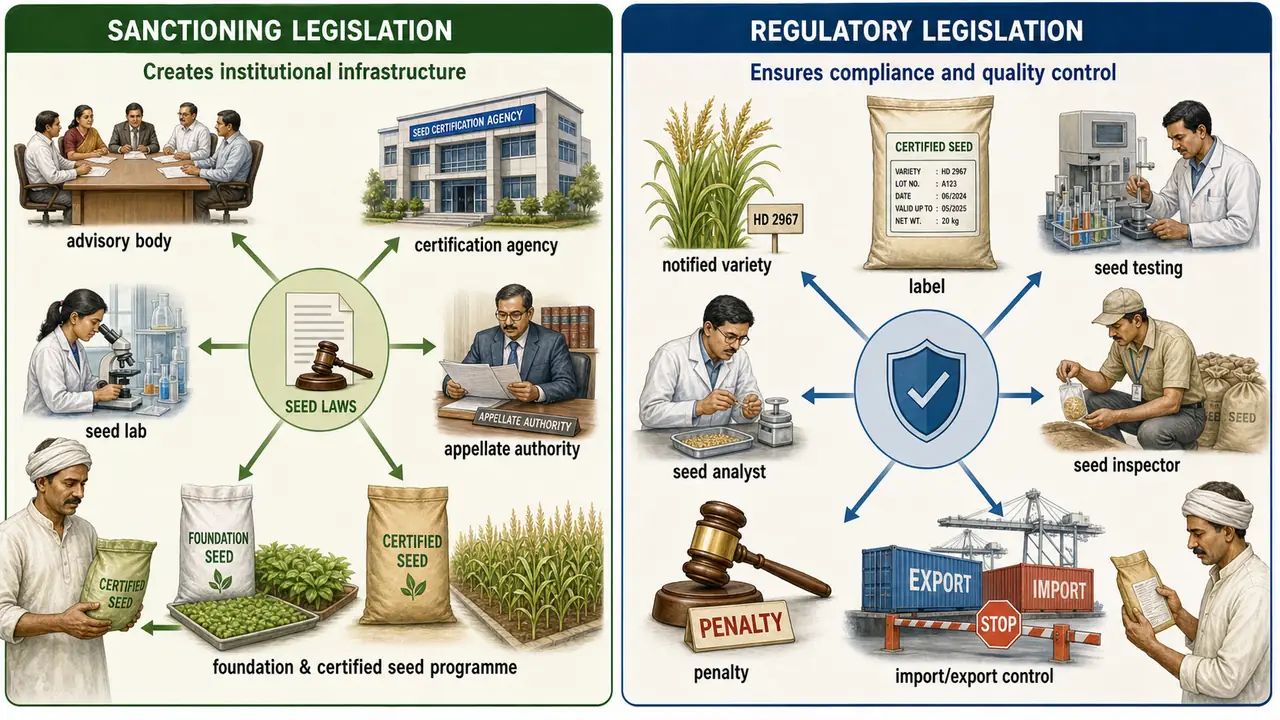
1. Sanctioning legislation
- Sanctioning legislation authorizes formation of Advisory bodies, Seed Certification Agencies, Seed Testing laboratories, Foundation and Certified Seed Programmes, Recognition of Seed certification Agencies of Foreign countries, Appellate authorities etc. In other words, this group of legislation creates the institutional infrastructure needed for the seed sector to function.
2. Regulatory legislation
- Regulatory Legislation controls the quality of seeds sold in the market including suitable agencies for regulating the seed quality. This is the enforcement arm that sets standards, penalizes violations, and ensures compliance. On quality control basis, the Seeds Act could conveniently be divided into the following:
I. Minimum limit and labeling of the notified kind / varieties of seed
- Power to notify the kind / variety -- the government decides which crops and varieties come under the Act's purview.
- Labeling provisions -- every seed container must carry a label with specified information about the seed.
- Seed testing -- laboratory analysis of seed quality parameters.
- Seed analyst -- qualified persons authorized to analyze seed samples.
- Seed inspectors -- officers empowered to draw samples, inspect premises, and enforce the Act.
- Penalty -- punishments for selling substandard or misbranded seed.
- General provisions -- procedural rules governing the implementation of the Act.
II. Seed Certification -- the formal process of verifying that seed meets prescribed standards.
III. Restriction of Import and Export of Seeds -- regulations governing the movement of seed across national borders to protect domestic agriculture and biosecurity.
NOTE
Sanctioning legislation = Creates institutions (certification agencies, labs, advisory bodies). Regulatory legislation = Enforces quality standards (labeling, testing, penalties). Both work together to ensure seed quality.
Seed (Control) Order 1983
- Seed was declared as an essential commodity under the Essential Commodities Act (1955). This classification gives the government power to regulate seed production, distribution, and pricing to prevent hoarding and ensure availability.
- All GM crops will be tested for environment and bio safety before commercial release as per EPA (1986). The Environmental Protection Act adds an additional layer of regulation for genetically modified seed.
Issue of License to Dealers
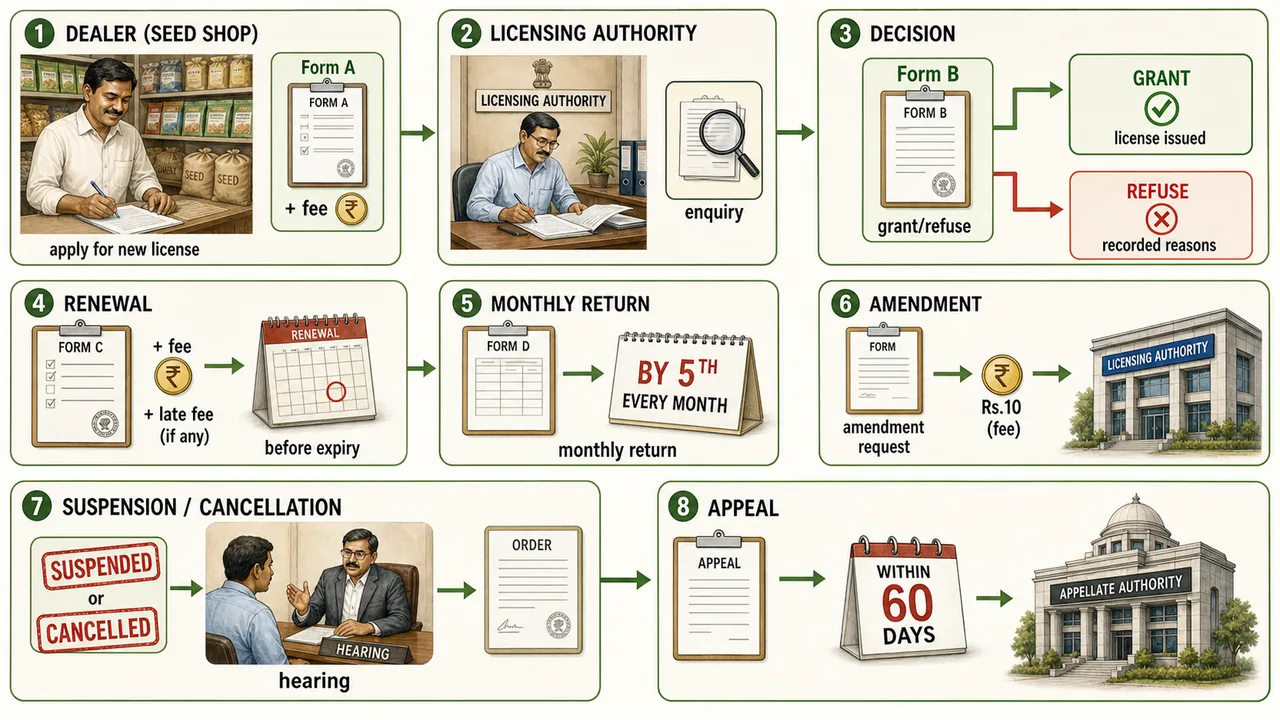
- All persons carrying on the business of selling, exporting and importing seeds will be required to carry on the business in accordance with terms and conditions of license granted to him for which dealer has to make an application in duplicate in Form 'A' together with a fee of Rs.50/- for license to licensing authority unless the State Government by notification exempts such class of dealers in such areas and subject to such conditions as may be specified in the notification. This licensing requirement ensures that only authorized persons trade in seed, providing a layer of accountability.
- Based on such enquiry as it thinks fit for licensing authority may grant in form 'B' or refuse in provisions of the Order. The refusal to grant license shall be accompanied by clear recording of reasons for such refusal. This transparency protects dealers from arbitrary denial.
Renewal of License
- A holder of license shall be eligible for renewal upon an application being made in the prescribed form 'C' (in duplicate) together with a fee of rupees twenty before the expiry of license or at the most within a month of date of expiry of license for which additional fee of Rs. 25/- is required to be paid. Timely renewal is important to avoid interruption in business operations.
| Form | Purpose |
|---|---|
| Form A | Application for new license (fee Rs. 50/-) |
| Form B | Grant of license by licensing authority |
| Form C | Renewal of license (fee Rs. 20/-; late fee Rs. 25/-) |
| Form D | Monthly return of business (due by 5th of every month) |
Appointing of Licensing Authority
- The state government may appoint such number of persons as it thinks necessary to be inspector and define the area of such Inspector's jurisdiction through notification in the official gazette. These inspectors are the frontline enforcement officers ensuring compliance with seed quality norms.
Time limit for analysis of samples by Seed testing lab
- Time limit for analysis of samples by seed testing lab and suspension / cancellation of license may be done by Licensing authority after giving an opportunity of being heard to the holder of license, suspend or cancel the license on grounds of mis-representation of a material in particular or contravention in provision of the order. Timely analysis is crucial because seed is a perishable biological product whose quality changes over time.
Suspension / Cancellation of license
- The Licensing authority may after giving an opportunity of being heard to the holder of license, suspend or cancel the license on grounds of mis-representation of material in particular or contravention in provision of the Order. This provision ensures that errant dealers are held accountable while also protecting their right to a fair hearing through the principles of natural justice.
Appeal
- The state government may specify authority for hearing the appeals against suspension / cancellation under this order and the decision of such authority shall be final. Any person aggrieved by an order of refusal to grant or amend or renew the license for sale, export / import of seed may within 60 days from the date of Order appeal to the designated authority in the manner prescribed in the Order. This appellate mechanism provides a safeguard against potentially unfair decisions.
Miscellaneous
- The licensing authority may on receipt of request in writing together with Rs.10/- can amend the license of such dealer. Every seed dealer are expected to maintain such books, accounts and records to this business in order and submit monthly return of his business for the preceding months in Form 'D' to the licensing authority by 5th day of every month. This record-keeping requirement enables traceability and monitoring of seed distribution patterns.
National Seed Programme - 1975
This programme laid the foundation for organized seed production in India by establishing seed processing plants, seed testing laboratories, and seed certification agencies across the country.
National Seed Project - 1988
Building on the National Seed Programme, this project aimed to strengthen the seed infrastructure further and expand the capacity for production and distribution of quality seeds of improved varieties.
National Seed Policy - 2002
- Was launched to -- provide intellectual property protection to new varieties; usher this sector into planned development; protect the interest of farmers and encourage conservation of agro-biodiversity. Import of seeds and planting material. Export of seeds. Promotion of Domestic Seed.
- India aimed to raise seed export from present level of less than 1% to 10% by 2020. This ambitious target reflected India's potential as a major global seed producer given its diverse agro-climatic zones and strong breeding programs.
IMPORTANT
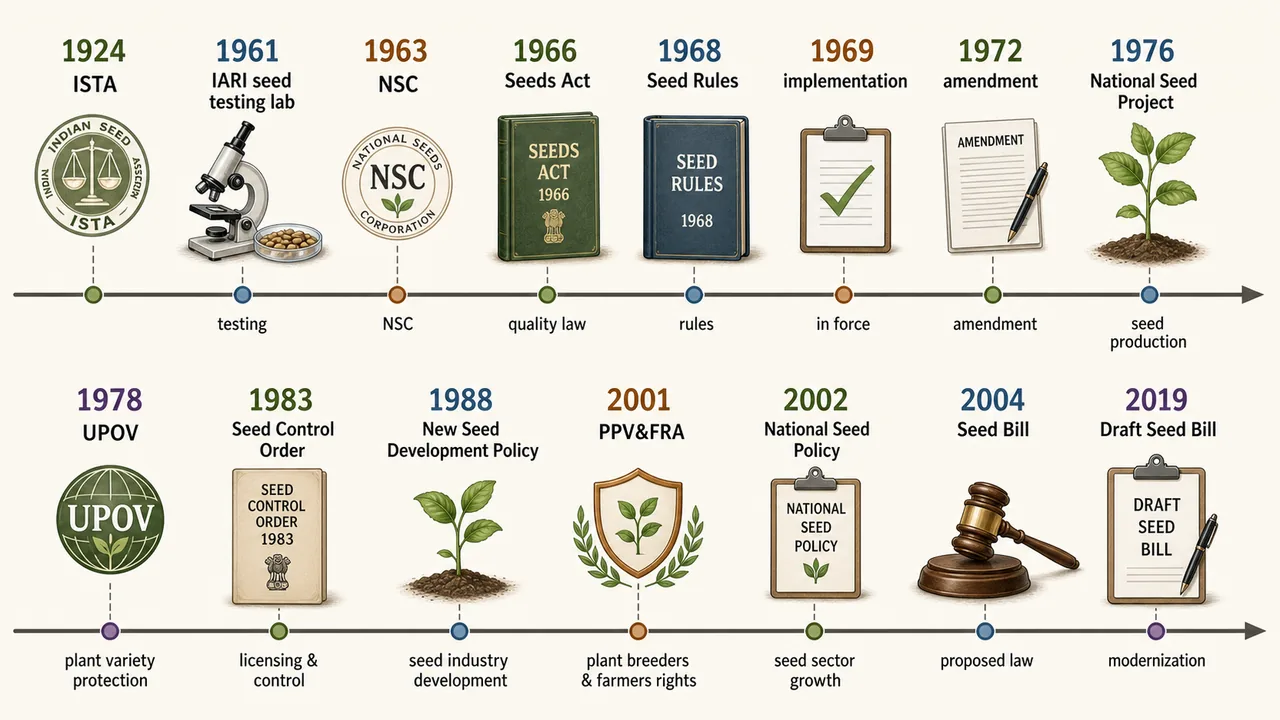
Timeline of seed legislation: ISTA (1924) → First Seed Testing Lab at IARI (1961) → NSC (1963) → Seeds Act (1966) → Seed Rules (1968) → Implementation (1969) → Seeds Act Amended (1972) → National Seed Programme (1975) → UPOV (1978) → Seed (Control) Order (1983) → New Seed Development Policy (1988) → PPV&FRA (2001) → National Seed Policy (2002) → Seed Bill (2004) → Draft Seed Bill (2019).
Seed Bill - 2004
- The Seed Bill was proposed to replace the Seed Act (1966), however, owing to several shortcomings it was not passed. The 2019 draft version tries to overcome the drawbacks of the 2004 Bill. The proposed Bill aimed to modernize India's seed regulatory framework to address contemporary challenges such as transgenic seeds, farmer's rights, and seed pricing, but achieving consensus among all stakeholders has proved difficult.
Significant Landmarks in Indian Seed Industry & Legislation
The development of India's seed sector has been shaped by a series of institutional, legislative, and policy milestones spanning nearly a century. The following timeline captures the most important events from the establishment of international seed testing standards to modern draft legislation.
| Year | Important Event |
|---|---|
| 1924 | International Seed Testing Association (ISTA) established in Norway (present HQ -- Switzerland) |
| 1961 | First seed testing laboratory established at IARI, New Delhi |
| 1963 | National Seed Corporation (NSC) established in New Delhi |
| 1966 | The first Indian Seeds Act was formulated |
| 1968 | Seed Rules framed to implement various legislation under Seeds Act, 1966 |
| 1969 | Seeds Act came into force throughout India (2nd October, 1969) |
| 1972 | The Seeds Act, 1966 was amended |
| 1974 | The Seeds (Amendment) Rules, 1974 were introduced |
| 1976 | The National Seed Project was launched by ICAR, New Delhi |
| 1978 | The UPOV Seed Act was introduced |
| 1983 | Enactment of Seed (Control) Order -- seeds declared an essential commodity |
| 1988 | The New Policy on Seed Development was introduced |
| 1989 | Plants, Fruits and Seed Order, 1989 was introduced |
| 2001 | Protection of Plant Varieties and Farmers' Rights Act (PPV&FRA) was formulated |
| 2002 | The National Seed Policy was formulated |
| 2003 | Plant Quarantine (Regulation of Import into India) Order was introduced |
| 2003 | Protection of Plant Varieties Rules, 2003 were introduced |
| 2004 | The New Seed Act (Seed Bill) was formulated to replace Seeds Act, 1966 |
| 2005 | The Seed Act, 2004 came into force in January 2005 |
| 2019 | Draft Seed Bill introduced |
TIP
Key years to remember: ISTA (1924) → First Seed Testing Lab at IARI (1961) → NSC (1963) → Seeds Act (1966) → UPOV (1978) → PPV&FRA (2001) → National Seed Policy (2002) → Seed Bill (2004) → Draft Seed Bill (2019).
ISTA Seed Analysis Certificates
The International Seed Testing Association (ISTA), established in 1924 in Norway (present headquarters in Switzerland), issues internationally recognized seed analysis certificates. These certificates facilitate international seed trade by ensuring uniform quality standards. There are three types of ISTA certificates:

1. Orange Certificate
- Sampling and testing of samples are both carried out in the same country by an ISTA accredited lab.
2. Green Certificate
- Sampling is done by an ISTA accredited station in one country.
- Testing is done in another country by an ISTA accredited lab.
3. Blue Certificate
- Sampling is done by non-accredited laboratories/agencies.
- Testing is done by an ISTA accredited laboratory.
- Quality assurance is only for the submitted sample tested in the laboratory.
NOTE
The certificate is always issued by the station which performed the testing, not the sampling station. This is an important distinction for exam questions.
| Certificate | Sampling By | Testing By | Scope |
|---|---|---|---|
| Orange | ISTA accredited lab (same country) | ISTA accredited lab (same country) | Full assurance |
| Green | ISTA accredited station (Country A) | ISTA accredited lab (Country B) | Cross-country trade |
| Blue | Non-accredited agency | ISTA accredited lab | Lab-tested sample only |
WARNING
Previously asked in exams-2020. ISTA certificate types and their differences are a frequently tested topic in banking and agriculture officer exams.
Summary Cheat Sheet
| Concept / Topic | Key Details |
|---|---|
| Seeds Act | 1966 — first comprehensive seed law in India |
| Seeds Act objective | Regulate quality of seeds sold in market |
| Seed Rules | 1968 — implementing rules under Seeds Act |
| Seed Control Order | 1983 — controls seed prices and licensing |
| Central Seed Committee | Advises government on seed matters under Seeds Act |
| Central Seed Certification Board | Advises on seed certification standards |
| Seed Inspector | Authorized to inspect seed shops; collect samples |
| Seed analyst | Tests seed quality at Seed Testing Laboratories |
| Penalties under Seeds Act | Fine and imprisonment for selling substandard seed |
| Compulsory labelling | All notified crop seeds must meet minimum standards |
| National Seed Policy | 2002 — liberalized seed sector; encouraged private participation |
| National Seed Programme | Established NSC (1963) and 15 SSFs for seed multiplication |
| New Seed Bill | Proposed to replace Seeds Act 1966; includes transgenic seed regulation |
| ISTA | International Seed Testing Association — standardizes testing globally |
| Seeds Act 1966 key feature | Made labelling compulsory; set minimum germination/purity standards |