😡 Seed Viability, Vigour, and Isolation Distance
Understand seed viability tests (TZ test), seed vigour, factors affecting viability, isolation distances for seed production, and genetic purity maintenance — with exam tips.
Why Seed Viability Matters in Agriculture
A seed lot with 95% germination will establish a good crop stand, but one with 60% means a farmer needs to sow 50% more seed — increasing costs and still risking poor plant population. The Tetrazolium (TZ) test can assess viability within hours (versus 7-14 days for germination tests), making it invaluable for quick quality decisions during the busy sowing season. Understanding viability, vigour, and isolation distances is essential for seed production professionals.
Seed Viability
- Viability of seeds represents the capacity of the seed to germinate. It is one of the most fundamental measures of seed quality because a seed that cannot germinate is of no use to a farmer.
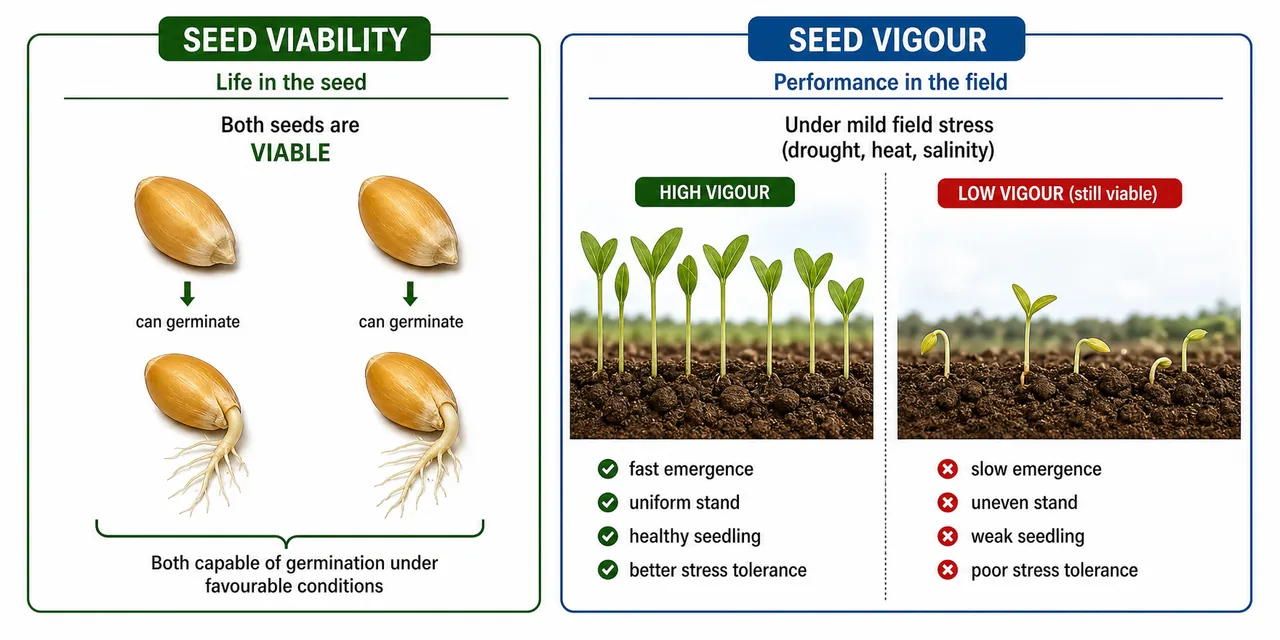
- Viability is defined as the capacity of the seed to remain capable of germination for some specific period of the time. Seeds do not live forever; their viability declines over time depending on storage conditions, species, and seed quality. A Seed vigour is the ability of seed to emerge in varying environments of fields. While viability tells us whether a seed can germinate, vigour tells us how well it can perform under stressful or suboptimal conditions.
NOTE
Pro Content Locked
Upgrade to Pro to access this lesson and all other premium content.
₹99 charged monthly · Cancel anytime
- All Agriculture & Banking Courses
- AI Lesson Questions (100/day)
- AI Doubt Solver (50/day)
- Glows & Grows Feedback (30/day)
- AI Section Quiz (20/day)
- 22-Language Translation (100/day)
- Recall Questions (20/day)
- AI Quiz (15/day)
- AI Quiz Paper Analysis (100/day)
- AI Step-by-Step Explanations (100/day)
- Spaced Repetition Recall (FSRS)
- AI Tutor
- Immersive Text Questions
- Audio Lessons — Hindi & English
- Mock Tests & Previous Year Papers
- Summary & Mind Maps
- XP, Levels, Leaderboard & Badges
- Generate New Classrooms
- Voice AI Teacher (AgriDots Live)
- AI Revision Assistant
- Knowledge Gap Analysis
- Interactive Revision (LangGraph)
🔒 Secure via Razorpay · Cancel anytime · No hidden fees
Why Seed Viability Matters in Agriculture
A seed lot with 95% germination will establish a good crop stand, but one with 60% means a farmer needs to sow 50% more seed — increasing costs and still risking poor plant population. The Tetrazolium (TZ) test can assess viability within hours (versus 7-14 days for germination tests), making it invaluable for quick quality decisions during the busy sowing season. Understanding viability, vigour, and isolation distances is essential for seed production professionals.
Seed Viability
- Viability of seeds represents the capacity of the seed to germinate. It is one of the most fundamental measures of seed quality because a seed that cannot germinate is of no use to a farmer.
- Viability is defined as the capacity of the seed to remain capable of germination for some specific period of the time. Seeds do not live forever; their viability declines over time depending on storage conditions, species, and seed quality. A Seed vigour is the ability of seed to emerge in varying environments of fields. While viability tells us whether a seed can germinate, vigour tells us how well it can perform under stressful or suboptimal conditions.
NOTE
Viability = Can the seed germinate? (Yes/No). Vigour = How strongly and quickly can it germinate under stress? Vigour declines before viability is lost, so a seed lot may still be "viable" but have poor field performance due to low vigour.
Methods for Viability Test of Seeds
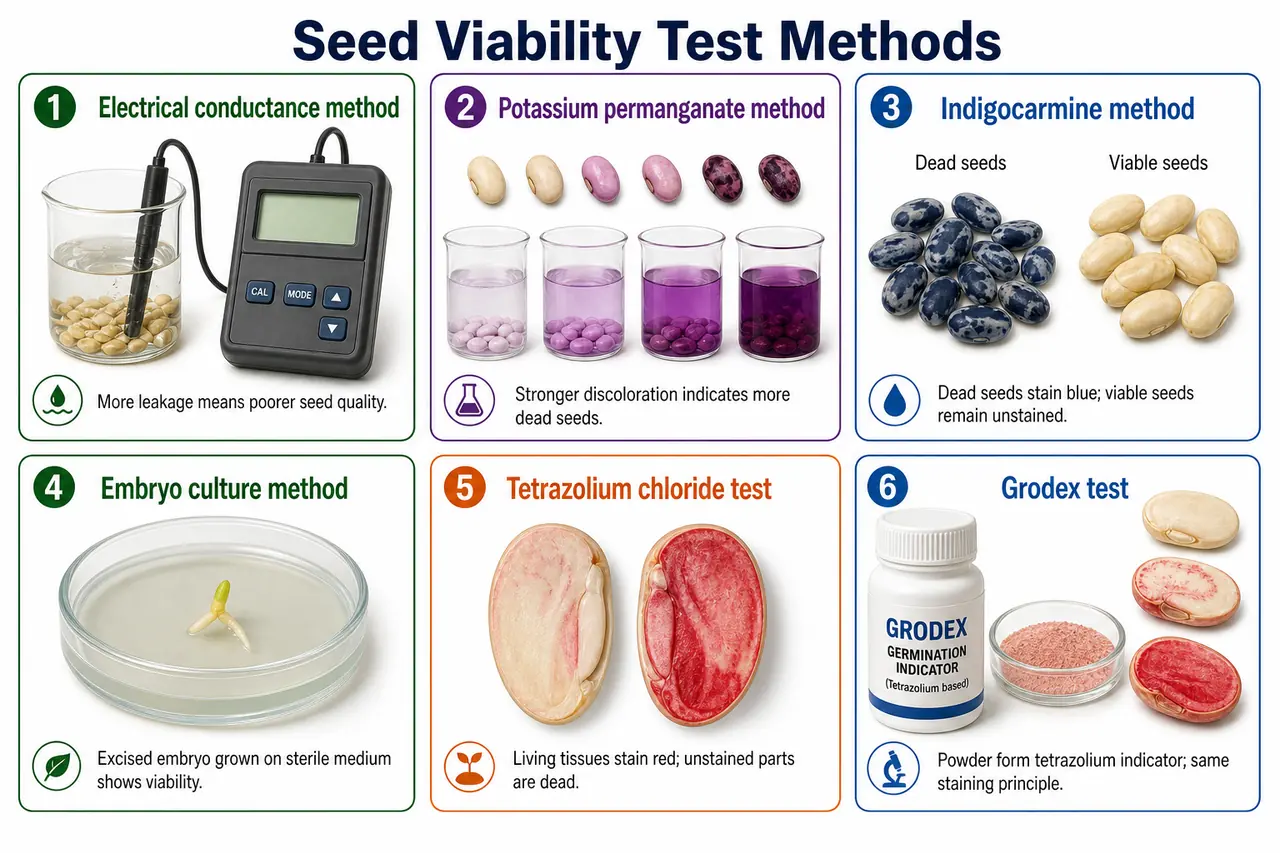
Several laboratory methods have been developed to quickly determine what proportion of seeds in a lot are alive (viable) versus dead. Understanding these methods is essential for seed quality evaluation.
1. Electrical Conductance Method
- The seeds are soaked in distilled water and the electrical conductance of the bathing solution is tested, the increase in conductance (Less resistance) is roughly proportional to the percentage of dead tissues.
- The increase in the conductivity is due to leaching of metabolites from dead seeds which become pervious owing to increasing permeability. In other words, dead cells lose membrane integrity and release sugars, amino acids, and electrolytes into the water, making it more conductive. The higher the conductance reading, the poorer the seed lot quality.
TIP
Principle: Dead cells = leaky membranes = more solutes in water = higher electrical conductance. So high conductance = poor seed quality.
2. Potassium Permanganate Method
- The seeds are soaked in a weak solution of potassium permanganate and as the proportion of dead seed increases the discoloration of the solution also increases.
- The dead cells become freely permeable to their contained solutes which leach out easily into bathing solution, whereas leaching from living cells is very less. (More dead part more will be staining)
- Thus, the extent of discoloration indicates the proportion of dead seeds in a seed-lot. A deeply discolored solution signals a high percentage of non-viable seeds.
3. Indigocarmine Method
- The seeds are soaked in the solution of any aniline dyes such as indigocarmine for few hours, it is observed that the dead seeds or their cells are stained. (More dead part more will be staining) Living cells with intact membranes do not absorb the dye, so they remain unstained.
- Thus, the portion of dead and viable seeds can be determined by counting the number of stained (dead) and unstained (viable) seeds respectively. This provides a quick visual assessment of seed lot quality.
4. Embryo Culture Method
- In this method, the embryo is removed carefully from its cotyledons or endosperm and then it is placed naked on granulated peat mass or on sterilized nutrient agar medium (White's nutrient medium). This eliminates any influence of the seed coat or stored food on the test result.
- The method takes about 7 to 10 days to give the viability percentage of the seeds.
- The viability is judged by counting the number of germinated embryos because the viable seeds will germinate and non-viable will fail to do so. Though slower than chemical tests, this method gives a very direct measure of true embryo viability.
5. Tetrazolium Chloride Test

- Given by Lakon. This is one of the most widely used quick viability tests in seed technology.
- The tetrazolium chloride test is also known as "Biochemical test".
- In this method the seeds are soaked in 0.5 to 2 per cent solution of tetrazolium chloride (2, 3, 5-triphenyl tetrazolium chloride).
- The viable or living seeds take bright red colorations which becomes more intense in the embryo while the dead seeds remain in their original colour. The red color is due to the formation of formazan, a compound produced when living cells reduce the colorless tetrazolium salt through the activity of dehydrogenase enzymes in actively respiring tissues.
- The method can be used as a guide in blending seeds and their lots under an urgent and immediate demand for seed. This makes it extremely useful in commercial seed operations.
- It can be made quicker by cutting kernels, using vacuum and maintaining a temperature of 40-45 degrees C, it takes only 4-5 minutes to complete a test of 100 kernels. This speed is a major advantage over traditional germination tests that may take days.
IMPORTANT
The Tetrazolium Chloride Test is the most frequently asked viability test in exams. Remember: Living tissue → red (formazan); Dead tissue → no colour change. The enzyme responsible is dehydrogenase.
6. Grodex Test
- Grodex is a seed germination indicator and is a brand name of triphenyl tetrazolium bromide in powder form. It works on the same principle as the tetrazolium chloride test, staining living tissues while leaving dead tissues unstained.
| Method | Principle | Speed | Key Indicator |
|---|---|---|---|
| Electrical Conductance | Leaching from dead cells | Fast | High conductance = poor quality |
| Potassium Permanganate | Discoloration by leachates | Fast | More discoloration = more dead seeds |
| Indigocarmine | Dye uptake by dead cells | Few hours | Stained = dead, Unstained = viable |
| Embryo Culture | Direct embryo germination | 7-10 days | Germinated embryo = viable |
| Tetrazolium Chloride | Dehydrogenase enzyme activity | Minutes | Red = viable, No colour = dead |
| Grodex | Same as Tetrazolium | Fast | Same as Tetrazolium |
Seed Vigour Tests
- While viability tells whether a seed is alive, vigour tests are used to predict how strongly that seed lot will establish under field stress.
- The cold test is a classic vigour test, especially associated with maize and soybean, because it checks whether seedlings can still emerge well under low-temperature stress.
- Older practical lists may also include GADA test, paper piercing test, and brick gravel test as named vigour assessments that challenge the emerging seedling mechanically or physiologically.
- In exam memory terms, these named vigour tests are best grouped with other fast laboratory indicators such as electrical conductance and tetrazolium-based methods, even though they measure seed performance from a different angle.
TIP
Quick recall: viability asks "is the seed alive?" while vigour asks "how forcefully will it establish?" So cold test, paper piercing, brick gravel, and GADA belong with the vigour side.
Seed Index
- Weight of 100 seeds of a crop. This is a simple but important measure used to assess seed size and quality. Larger, heavier seeds within a variety often indicate better fill and potentially higher vigor.
Test Weight
- Weight of 1000 seeds of a crop. Also known as thousand seed weight, this parameter is commonly used in seed testing laboratories to characterize seed lots and calculate seeding rates.

TIP
Seed Index = weight of 100 seeds. Test Weight = weight of 1000 seeds. Don't confuse the two -- this is a common exam trap.
Pure Live Seed
- Pure Live Seed (PLS) is a measure used by the seed industry to describe the percentage of a quantity of seed that will germinate. (PLS related to germination percentage). It provides the most realistic picture of how much "usable seed" is actually present in a given lot.
- PLS is obtained by multiplying the purity percentage by the percentage of total viable seed, then dividing by 100.

Genetic Purity
- Genetic purity is required 100% as far as impurities by seeds of other varieties of the same crop is concerned but in case of Impurity by seeds of other crop species; it is permitted up to 0.1% only. This strict standard ensures that the harvested crop is true-to-type and performs as expected by the farmer.
- Genetic purity is determined by grow out test. In this test, seed samples are sown in the field and the resulting plants are observed for off-types or deviations from the standard variety description.
Isolation Distance
- Isolation means to keep apart. Isolation distance is the specified distance from potential contaminants, where an acceptable level of contamination is expected. Isolation of seed crop is essential to avoid genetic & physical impurities. This is one of the most critical aspects of seed production planning.
- Genetic purity i.e. varietal purity may be deteriorated by cross-pollination from the plants of nearby plots.
- Physical impurities may occur due to physical or mechanical admixture with other crop species or other varieties of the same species from the nearby plots.
- In hybrid seed production, breakdown of male sterility can also reduce genetic purity because fertile plants may begin shedding pollen in the female line. Such an unintended pollen-producing plant is commonly recalled as a pollen shedder, and exam-oriented questions often link this term with maize.
- Therefore the protection from these sources of contamination is necessary for maintaining genetic and physical purity i.e. good quality of the seed.
- Isolation distance is affected by mode of pollination (i.e. self-pollination or cross pollination), pollination activity as well as direction and velocity of wind. Cross-pollinated crops need much greater isolation distances than self-pollinated crops.
- Essentially self-pollinated crops like rice, wheat & soybean have only 3 meter as isolation distance. The increase in natural cross pollination percentage requires increasing isolation distance. E.g.


IMPORTANT
Self-pollinated crops (rice, wheat, soybean) need only 3 m isolation. Cross-pollinated crops need much greater distances (200-400 m or more). This is because wind and insects can carry pollen over long distances in cross-pollinated species.
Self-Pollinated Crops (Cereals & Millets)
| Crop | Foundation Seed (m) | Certified Seed (m) |
|---|---|---|
| Paddy | 3 | 3 |
| Wheat | 3 | 3 |
| Soybean | 3 | 3 |
| Groundnut | 3 | 3 |
Pulses
| Crop | Foundation Seed (m) | Certified Seed (m) |
|---|---|---|
| Green gram | 10 | 5 |
| Black gram | 10 | 5 |
| Peas | 10 | 5 |
Self-Pollinated Vegetables
| Crop | Foundation Seed (m) | Certified Seed (m) |
|---|---|---|
| Tomato | 50 | 25 |
| Lettuce | 50 | 25 |
| Potato | 5 | 5 |
Often Cross-Pollinated Crops (Millets)
| Crop | Foundation Seed (m) | Certified Seed (m) |
|---|---|---|
| Sorghum Variety | 200 | 100 |
| Sorghum Hybrid | 300 | 200 |
| Red gram | 200 | 100 |
Often Cross-Pollinated (Oilseeds)
| Crop | Foundation Seed (m) | Certified Seed (m) |
|---|---|---|
| Mustard (Self compatible) | 200 | 50 |
| Mustard (Self incompatible) | 100 | 50 |
| Sesame | 100 | 50 |
| Cotton (Variety) | 50 | 30 |
Often Cross-Pollinated (Vegetables)
| Crop | Foundation Seed (m) | Certified Seed (m) |
|---|---|---|
| Okra | 400 | 200 |
| Brinjal | 200 | 100 |
| Chilli | 400 | 200 |
Cross-Pollinated Crops
| Crop | Foundation Seed (m) | Certified Seed (m) |
|---|---|---|
| Maize | 400 | 200 |
| Bajra Variety | 400 | 200 |
| Bajra Hybrid | 1000 | 200 |
| Sun hemp | 200 | 100 |
| Sunflower Variety | 400 | 200 |
| Sunflower Hybrid | 600 | 400 |
| Cotton | 50 | 30 |
| Beetroot | 1600 | 800 |
| Radish | 1600 | 1000 |
| Cauliflower | 1600 | 1000 |
| Cabbage | 1600 | 1000 |
| Onion | 1000 | 500 |
| Carrot | 1000 | 800 |
| Amaranthus | 400 | 200 |
| Cucurbits (All crops) | 1000 | 500 |
| Spinach | 1600 | 1000 |
WARNING
Highest isolation distances: Bajra Hybrid = 1000 m (foundation), Beetroot, Radish, Cauliflower, Cabbage, Spinach = 1600 m (foundation). These are frequently tested in AFO/AO exams.
Objectionable Weeds of Seed Crop Plants
👉🏻 The size and shape of their seeds are so similar to that of the crop seed that it is difficult to remove. (Other damages of weeds are same). These weeds are specifically listed in seed certification standards because their seeds contaminate the seed lot and are nearly impossible to separate during processing.

- Off types are removed by negative selection. This means identifying and removing the undesirable plants rather than selecting the desirable ones.
- Rouging is the removal of plants which are off-type that is phenotypically different from the plants of the variety under production. It is an important aspect of seed production and is necessary to prevent out-crossing and mechanical mixtures. Timely and thorough rouging at multiple crop stages (vegetative, flowering, and maturity) is essential for maintaining seed purity. UPPSC 2021
Characteristics of good quality seed
High genetic purity
Genetic purity ensures that the seed produces plants that are true-to-type and exhibit all the characteristics of the registered variety. The following standards apply:

| Seed Class | Minimum Genetic Purity |
|---|---|
| Breeder / Nucleus Seed | 100% |
| Foundation Seed | 99.5% |
| Certified Seed | 99.0% |
TIP
Genetic purity is required 100% as far as impurity by seeds of other varieties of the same crop is concerned. In case of impurity by seeds of other crop species, it is permitted up to 0.1% only in foundation seed and 0-0.5% in other seeds.
Higher physical purity for certification
Physical purity refers to the proportion of pure seed in a seed lot after removing inert matter, weed seeds, and other crop seeds. Higher physical purity means a cleaner, higher quality seed lot.

| Crop(s) | Minimum Physical Purity |
|---|---|
| Maize, Bhendi (Okra) | 99% |
| All crops (general) | 98% |
| Sesame, Soybean & Jute | 97% |
| Groundnut | 96% |
| Carrot | 95% |
Optimum moisture content for storage
Maintaining the correct moisture content is critical for preserving seed viability during storage. Excess moisture leads to fungal growth, heating, and rapid deterioration.
- Long term storage: 6-8% -- For storage periods exceeding one year, seeds must be dried to very low moisture levels to slow metabolic activity and prevent deterioration.
- Short term storage: 10-13% -- For storage periods of a few months (one season), slightly higher moisture levels are acceptable.
- Dried to the safe storage moisture level of 10-12% for cereals and 7-9% for oil seeds (on wet basis) for a safe storage period of 6-12 months. Oil seeds require lower moisture because their higher oil content makes them more susceptible to rancidity and fungal attack at higher moisture levels.
| S.No. | Crop | Moisture (%) | S.No. | Crop | Moisture (%) |
|---|---|---|---|---|---|
| 1 | Paddy | 12 | 20 | Barley | 12 |
| 2 | Maize | 12 | 21 | Berseem | 10 |
| 3 | Sorghum, Cumbu & Ragi | 12 | 22 | Lucerne | 10 |
| 4 | Black Gram | 9 | 23 | Oats | 12 |
| 5 | Groundnut | 9 | 24 | Pearl millet | 12 |
| 6 | Sesame | 9 | 25 | Rapeseed mustard | 8 |
| 7 | Soyabean | 12 | 26 | Wheat | 12 |
| 8 | Sunflower | 9 | 27 | Clusterbean | 9 |
| 9 | Castor | 8 | 28 | Cowpea | 9 |
| 10 | Cotton | 10 | 29 | French Bean | 9 |
| 11 | Cucurbits | 7 | 30 | Kol-Khol | 7 |
| 12 | Brinjal & Chillies | 8 | 31 | Amaranthus | 8 |
| 13 | Bhendi (Okra) | 10 | 32 | Lettuce | 8 |
| 14 | Tomato | 8 | 33 | Brinjal | 8 |
| 15 | Cabbage & Cauliflower | 7 | 34 | Chilli | 8 |
| 16 | Onion | 8 | 35 | Jute | 9 |
| 17 | Carrot | 8 | 36 | Mesta | 8 |
| 18 | Beet root | 9 | 37 | Sunhemp | 10 |
| 19 | Radish | 6 | 38 | - | - |
NOTE
General pattern: Cereals (Paddy, Wheat, Maize, Barley, Oats, Pearl millet) = 12%. Oilseeds (Groundnut, Sesame, Sunflower) = 9%. Castor = 8%. Vegetables (Cabbage, Cauliflower, Cucurbits, Kol-Khol) = 7%. Radish has the lowest at 6%.
Seed Germination and Purity Standards
These are the minimum standards prescribed for Foundation, Certified, and Labelled (Truthfully Labelled) seed classes. Meeting these standards is mandatory for seed certification.
| Crop | Min. Pure Seed % (F / C / L) | Min. Germination % (F / C / L) |
|---|---|---|
| Barley | 98 / 98 / 97 | 85 / 85 / 75 |
| Berseem | 98 / 98 / - | 80 / 80 / - |
| Castor | 98 / 98 / - | 70 / 70 / - |
| Cotton | 98 / 98 / 95 | 60 / 60 / 65 |
| Groundnut | 96 / 96 / 97 | 70 / 70 / 70 |
| Maize Inbred | 98 / - / - | 80 / - / - |
| Maize (Composite & OPV) | 98 / 98 / 97 | 90 / 90 / 80 |
| Oats | 98 / 98 / - | 85 / 85 / - |
| Paddy | 98 / 98 / 97 | 80 / 80 / 70 |
| Pearl millet (Bajra) | 98 / 98 / 96 | 75 / 75 / 70 |
| Rapeseed & Mustard | 97 / 97 / - | 85 / 85 / - |
| Sorghum Hybrid | 98 / 98 / 97 | 80 / 80 / 70 |
| Soyabean | 97 / 97 / 96 | 70 / 70 / 70 |
| Wheat | 98 / 98 / 97 | 85 / 85 (exams) / 80 |
| Clusterbean | 98 / 98 / - | 75 / 75 / 70 |
| Frenchbean | 98 / 98 / - | 75 / 75 / - |
| Cabbage | 98 / 98 / 97 | 70 / 70 / 65 |
| Cauliflower | 98 / 98 / 97 | 65 / 65 / 60 |
| Carrot | 95 / 95 / 94 | 60 / 60 / 55 |
| Onion | 98 / 98 / 97 | 70 / 70 / 65 |
| Radish | 98 / 98 / 97 | 70 / 70 / 65 |
| Turnip | 98 / 98 / 97 | 70 / 70 / 65 |
| Brinjal | 98 / 98 / 97 | 70 / 70 / 65 |
| Chilli | 98 / 98 / 97 | 60 / 60 / 55 |
| Okra | 99 / 99 / 98 | 70 / 70 / 65 |
| Tomato | 98 / 98 / 97 | 70 / 70 / 65 |
| Cucurbits | 99 / 99 / - | 60 / 60 / - |
| Jute | 97 / 97 / - | 80 / 80 / - |
| Mesta | 98 / 98 / - | 80 / 80 / - |
| Sunhemp | 97 / 97 / - | 80 / 80 / - |
F = Foundation, C = Certified, L = Labelled
IMPORTANT
Highest germination %: Maize (Composite/OPV) = 90%. Lowest germination %: Cotton = 60%, Chilli & Carrot = 60%, Cucurbits = 60%. These extremes are commonly tested in exams.
Xenia and Metaxenia
These are two important phenomena related to the direct effect of pollen on seed and fruit development, beyond normal fertilization. They are frequently asked in competitive exams.
Xenia
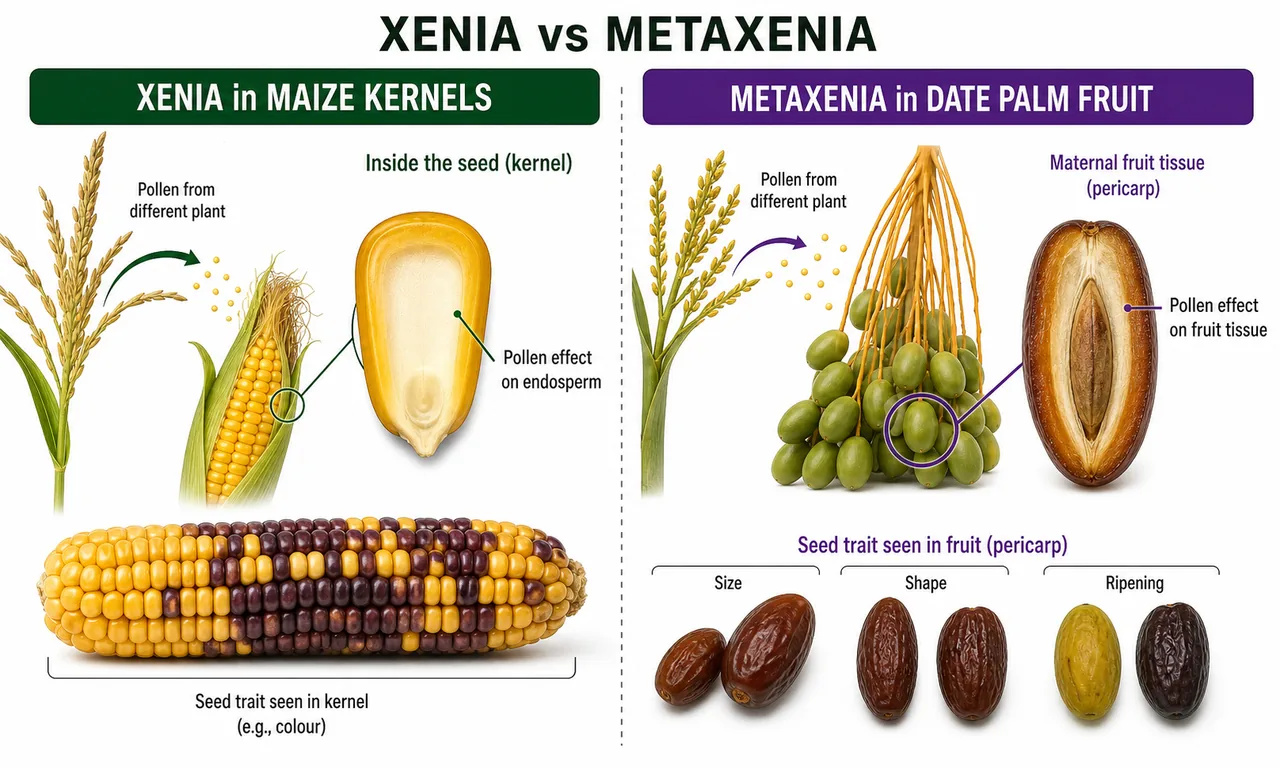
- Xenia refers to the direct/visible effect of pollen on the endosperm and related tissues (seed coat) in the formation of a seed. Since the endosperm is triploid (2 maternal + 1 paternal genome), the pollen parent can influence endosperm characteristics like colour and composition.
- Example: In maize, when a yellow-endosperm variety is pollinated by a purple-endosperm variety, the resulting kernels may show the purple colour -- this is xenia.
Metaxenia
- Metaxenia is the effect of pollen on the maternal tissues of the fruit (pericarp), which are entirely of maternal origin and should theoretically not be affected by the pollen parent.
- This phenomenon is observed in crops like date palm, where pollen source influences the size, shape, and ripening time of the fruit.
TIP
Memory aid: Xenia = effect on endosperm/seed (inside). Metaxenia = effect on maternal fruit tissues/pericarp (outside). "Meta" = beyond, so the pollen effect goes beyond the seed to the fruit.
Summary Cheat Sheet
| Concept / Topic | Key Details |
|---|---|
| Seed viability | Capacity of seed to germinate and produce normal seedling |
| Viability period | Duration seed remains viable under given conditions |
| Tetrazolium (TZ) test | Quick viability test; living tissue stains red (formazan) |
| TZ test duration | 2–24 hours (much faster than germination test) |
| TZ chemical | 2,3,5-triphenyl tetrazolium chloride |
| Seed vigour | Ability to germinate and establish under stress conditions |
| Vigour vs viability | High viability does not guarantee high vigour |
| Seed longevity | Total period seed remains viable |
| Factors affecting viability | Moisture, temperature, species, seed coat, storage conditions |
| Harrington's Rule | 5°C ↑ = life halved; 1% moisture ↑ = life halved |
| Isolation distance | Minimum distance between seed fields to prevent cross-contamination |
| Isolation for foundation seed | Greater than for certified seed |
| Isolation: wheat (foundation) | 3 metres (self-pollinated; less needed) |
| Isolation: maize (foundation) | 400 metres (cross-pollinated; more needed) |
| Genetic purity maintenance | Roguing, isolation, certified seed source |
| Grow-out test (GOT) | Field test to verify genetic purity; gold standard |
| Electrophoresis | Lab test for varietal identification (isozyme/protein patterns) |