📝 Seed Certification: Agencies, Procedure, and Seed Village Concept
Understand seed certification process, agencies (NSC, SSC, SSCA), certification standards, field inspection, and the Seed Village concept — with exam tips.
Why Seed Certification Matters in Agriculture
When a farmer buys a bag of certified seed with a blue tag, they are assured that the seed has passed through multiple stages of quality control — field inspections during the growing season, seed testing in accredited laboratories, and processing under monitored conditions. The seed certification system is what stands between the farmer and the risk of sowing impure, low-germinating, or disease-infected seed.
Seed Certification
- "Seed certification is a legally sanctioned system for quality control of seed multiplication and Production" and which consists the control measures are:

-
Field inspection: At the time of growing a crop for seed production purpose. The data should be obtained on trueness to varietals purity, isolation of seed crop to prevent cross-pollination, mechanical admixtures and diseases dissemination, objectionable weeds and admixtures. Field inspection is conducted at critical crop growth stages to catch any quality issues early.
Pro Content Locked
Upgrade to Pro to access this lesson and all other premium content.
₹99 charged monthly · Cancel anytime
- All Agriculture & Banking Courses
- AI Lesson Questions (100/day)
- AI Doubt Solver (50/day)
- Glows & Grows Feedback (30/day)
- AI Section Quiz (20/day)
- 22-Language Translation (100/day)
- Recall Questions (20/day)
- AI Quiz (15/day)
- AI Quiz Paper Analysis (100/day)
- AI Step-by-Step Explanations (100/day)
- Spaced Repetition Recall (FSRS)
- AI Tutor
- Immersive Text Questions
- Audio Lessons — Hindi & English
- Mock Tests & Previous Year Papers
- Summary & Mind Maps
- XP, Levels, Leaderboard & Badges
- Generate New Classrooms
- Voice AI Teacher (AgriDots Live)
- AI Revision Assistant
- Knowledge Gap Analysis
- Interactive Revision (LangGraph)
🔒 Secure via Razorpay · Cancel anytime · No hidden fees
Why Seed Certification Matters in Agriculture
When a farmer buys a bag of certified seed with a blue tag, they are assured that the seed has passed through multiple stages of quality control — field inspections during the growing season, seed testing in accredited laboratories, and processing under monitored conditions. The seed certification system is what stands between the farmer and the risk of sowing impure, low-germinating, or disease-infected seed.
Seed Certification
- "Seed certification is a legally sanctioned system for quality control of seed multiplication and Production" and which consists the control measures are:
-
Field inspection: At the time of growing a crop for seed production purpose. The data should be obtained on trueness to varietals purity, isolation of seed crop to prevent cross-pollination, mechanical admixtures and diseases dissemination, objectionable weeds and admixtures. Field inspection is conducted at critical crop growth stages to catch any quality issues early.
-
Supervision on agricultural operations i.e. intercultural operations, harvesting, storage, transport and processing etc. for identity and quality of lots. Every step from planting to packaging is monitored to ensure that the genetic identity is preserved and no contamination occurs.
-
Sample inspection: For quality and to maintain genetic purity, a lab test of representative samples drawn by the S.C.A. for determining, percentage of germination, moisture content, weed seed content, admixture and purity. These laboratory tests provide objective, quantifiable evidence of seed quality.
-
Bulk inspection: For checking homogeneity of the bulk as compared with the sample inspected. Even if a sample meets standards, the entire lot must be uniform -- bulk inspection verifies that no part of the seed lot has been contaminated or mixed.
-
Control Plot Testing: Samples drawn from the source seed and the final seed produced can be grown in the field along with standard samples of the variety. This grow-out test is the ultimate verification of genetic purity, as it reveals any off-types or varietal mixtures that laboratory tests may miss.
-
The purpose of seed certification is to maintain and make available high quality seed and propagating materials of notified plant varieties. It provides farmers with the assurance that the seed they purchase meets prescribed standards.
-
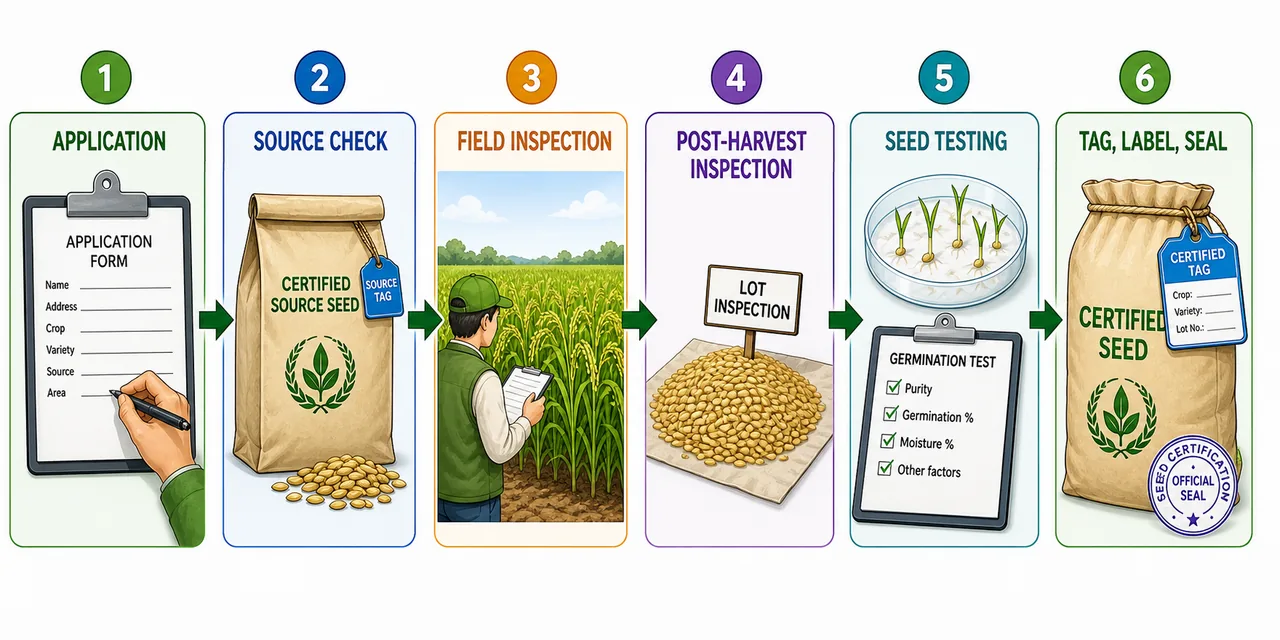
Seed certification involves 6 phases -- a systematic, step-by-step process:
- Receipt and scrutiny of application -- the seed producer submits details about the seed crop for evaluation.
- Verification of seed source -- the certification agency confirms that the source seed (breeder or foundation seed) is genuine and traceable.
- Field inspection to verify field standards -- trained inspectors visit the crop at critical stages to check isolation distance, varietal purity, disease incidence, and weed presence.
- Post-harvest seed inspection -- after harvest and processing, the physical condition of the seed lot is examined.
- Seed testing to verify seed standards -- laboratory tests confirm that germination percentage, moisture content, and purity meet the minimum certification standards.
- Issue of certificate, tagging, labeling and sealing -- once all standards are met, the seed lot receives an official certification tag and is sealed to prevent tampering.
-
Within post-harvest processing, seed cleaning is an important practical step. It usually involves pre-conditioning (preparing the seed lot for cleaning), basic seed cleaning (commonly with an air-screen cleaner), and then further refinement as needed to improve the marketable quality and purity of the lot.

IMPORTANT
The 6 phases of seed certification in order: Application → Source verification → Field inspection → Post-harvest inspection → Seed testing → Certificate, tag, label & seal. This sequence is frequently asked in exams.
National Seed Corporation (NSC)
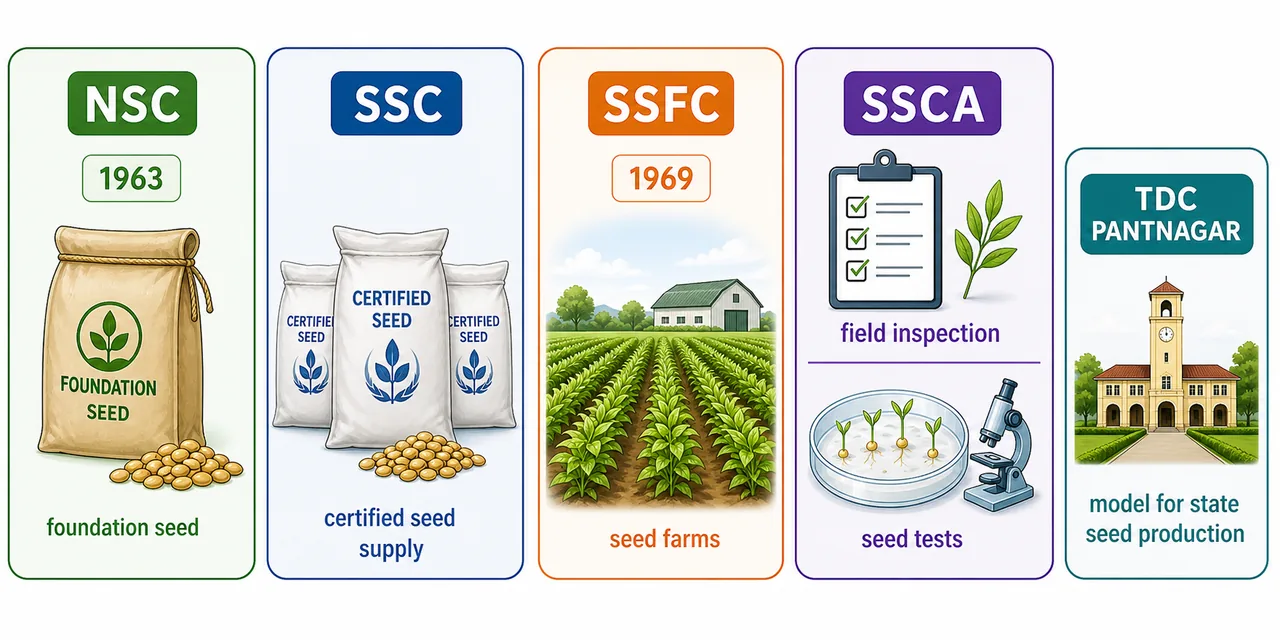
👉🏻 NSC was registered in 1963 having two main objectives:
- To promote development of a seed industry in India. NSC played a pioneering role in establishing organized seed production, processing, and marketing infrastructure across the country.
- To produce and supply foundation seeds of various crops. Foundation seed is the critical link between breeder seed and the certified seed that reaches farmers.
State Seed Corporation (SSC)
- SSC's are chiefly concerned with production and supply of certified seed. Each state has its own SSC that works within its boundaries to multiply and distribute quality seed to farmers.
- To reduce the work load of NSC and to stimulate a faster growth of industry, SSCs were established in view of great success of and the impact made by the Tarai Development Corporation (TDC), Pantnagar. TDC demonstrated that state-level seed corporations could effectively produce and distribute certified seed, inspiring the creation of SSCs nationwide.
State Seed Farm Corporation (SSFC)
- Set up during 1969, which mainly concerned with production and supply of certified seed. SSFCs operate dedicated seed farms where crops are grown specifically for seed production under controlled conditions, ensuring high quality output.
State Seed Certification Agency (SSCA)
- Responsible for seed certification. SSCA is the regulatory body that ensures all seed produced for sale meets the prescribed quality standards.
- SSCA makes field inspections and conducts seed tests required for seed certification. Their inspectors are the gatekeepers of seed quality, verifying every stage of production from sowing to sealing.
| Organization | Year | Primary Role |
|---|---|---|
| NSC (National Seed Corporation) | 1963 | Foundation seed production; seed industry development |
| SSC (State Seed Corporation) | Various | Certified seed production & supply |
| SSFC (State Seed Farm Corporation) | 1969 | Certified seed on dedicated farms |
| SSCA (State Seed Certification Agency) | Various | Certification & quality regulation |
| TDC (Tarai Development Corporation) | - | Pioneered state-level seed production (Pantnagar) |
Seed Village
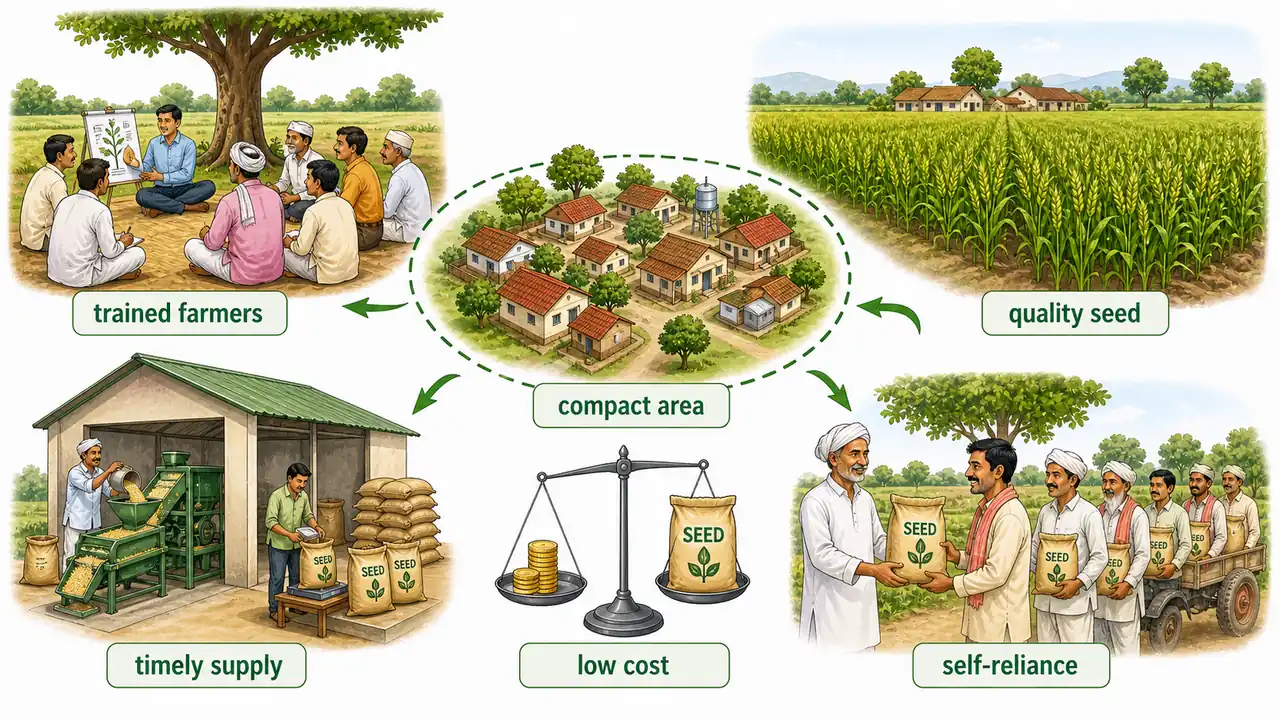
- A village, wherein trained group of farmers are involved in production of seeds of various crops and cater to the needs of themselves, fellow farmers of the village and farmers of neighboring villages in appropriate time and at affordable cost is called "a seed village". This decentralized approach to seed production empowers rural communities and reduces dependence on distant seed supply chains.
Concept
The Seed Village concept is built on the idea of local self-sufficiency in seed supply:
- Organizing seed production in cluster (or) compact area -- concentrating production in a specific area makes supervision, inspection, and quality control more efficient.
- Replacing existing local varieties with new high yielding varieties -- gradually introducing improved germplasm at the village level.
- Increasing the seed production -- by training farmers and providing technical support, overall seed output rises.
- To meet the local demand, timely supply and reasonable cost -- eliminating delays and middlemen that often plague the formal seed supply chain.
- Self-sufficiency and self-reliance of the village -- the village becomes independent in meeting its own seed needs.
- Increasing the seed replacement rate -- more farmers adopt quality seed each season, driving productivity improvements.
Features
The Seed Village model offers several practical benefits that make it attractive to farming communities:
- Seed is available at the door steps of farms at an appropriate time -- no need to travel to distant markets or wait for government supply.
- Seed availability at affordable cost even lesser than market price -- local production cuts transportation and marketing costs.
- Increased confidence among the farmers about the quality because of known source of production -- farmers trust seed produced by their neighbors whom they know personally.
- Producer and consumer are mutually benefited -- producers earn additional income while consumers get quality seed conveniently.
- Facilitates fast spread of new cultivars of different kinds -- new varieties are adopted more quickly when demonstrated and produced locally by trusted farmers.
TIP
The Seed Village concept is India's answer to the "last mile problem" in seed delivery. It improves seed replacement rate, reduces costs, and builds farmer self-reliance -- all commonly asked benefits in exams.
Seed Certification Standards for Objectionable Weeds and Other Crop Seeds
These field standards prescribe the maximum permissible number of objectionable weed seed plants and other crop seed plants per unit area during field inspection. Exceeding these limits leads to rejection of the seed crop.
Maximum Objectionable Weed Seeds in Field Crops
| Crop | Objectionable Weed | Foundation | Certified |
|---|---|---|---|
| Paddy | Wild rice (O. sativa var. fatua) | 2 | 5 |
| Wheat Triticale | Wild morning glory (Hiran khuri; Convolvulus arvensis) and Gulli danda (Phalaris minor) | 2 | 5 |
| Rape seed & Mustard Taramira | Mexican prickly poppy (Satyanashi; Argemone mexicana) | 5 | 10 |
| Berseem | Cichorium intybus | 5 | 10 |
| Lucerne | Cuscuta spp. | 5 | 10 |
IMPORTANT
Key objectionable weeds to remember: Paddy = Wild rice (O. sativa var. fatua), Wheat = Convolvulus arvensis (Hirankuri) & Phalaris minor, Rape & Mustard = Argemone mexicana (Satyanashi), Berseem = Cichorium intybus, Lucerne = Cuscuta spp.
Maximum Other Crop Seeds in Field (per hectare)
| Crop Group | Foundation | Certified |
|---|---|---|
| Rice, Wheat, Pearl millet, Barley, Minor millets, Triticale, Oat, Rape seed & Mustard, Berseem, Jute, Lucerne | 10 | 20 |
| Maize (Composite, Synthetic & OPV), Sorghum, Lentil, Pigeonpea, Urad, Moong, Lathyrus, Cotton, Forage sorghum, Sunflower, Safflower | 5 | 10 |
| Chickpea, Field pea, Rice bean | Nil | 5 |
| Castor, Groundnut | Nil | Nil |
NOTE
Castor and Groundnut have the strictest standard -- zero tolerance for other crop seeds in both foundation and certified seed fields. Chickpea, Field pea, and Rice bean allow nil in foundation but up to 5 in certified.
Summary Cheat Sheet
| Concept / Topic | Key Details |
|---|---|
| Seed certification | Process to maintain genetic purity and quality of seed |
| Purpose | Ensure seed is true-to-type and meets quality standards |
| Certification agencies | State Seed Certification Agencies (SSCA) |
| NSC | National Seed Corporation (central agency) |
| NSAI | National Seeds Association of India |
| Certification phases | 6 phases: verification, field inspection, post-harvest, processing, labelling, sealing |
| Field inspection | Minimum 3 inspections during crop growth |
| Key field standards | Isolation distance, off-types, designated diseases |
| Off-type plants | Plants not conforming to variety description; must be rogued |
| Roguing | Removal of off-type, diseased, and weed plants |
| Seed Village concept | Entire village produces certified seed of one variety |
| Seed Village launched by | Government of India under seed sector programs |
| Grow-out test | Growing seed sample to verify genetic purity in field |
| Certification tag | Attached to every certified seed bag |
| Tag colours | Breeder=golden yellow, Foundation=white, Certified=blue, TL=opal green |
| Seed cleaning steps | Pre-conditioning → basic cleaning → further refinement |