📔 Seed Classes: Breeder, Foundation, Certified, and Truthfully Labelled
Understand the four classes of seed (breeder, foundation, certified, truthfully labelled), their tag colours, multiplication chain, and seed moisture standards — with exam tips.
Why Seed Classes Matter in Agriculture
From the handful of breeder seed produced by a scientist to the tonnes of certified seed that reach farmers, each stage of the seed multiplication chain has strict quality standards. Knowing the difference between the golden-yellow tag of breeder seed and the blue tag of certified seed is not just exam knowledge — it is essential for anyone working in seed production, certification, or agricultural extension.
Seed Classes
👉🏻 There are four generally recognized classes of seeds. They are
- Breeder seed
- Foundation seed
- Registered seed
- Certified seed
These classes form a chain of seed multiplication that begins with the purest genetic stock and progressively multiplies it to reach millions of farmers. Each successive class allows a slightly lower standard of purity than the one before it, but all must meet strict certification norms.
- The basis of seed multiplication of all notified varieties/hybrids is the Nucleus seed. Nucleus seed is the starting point -- the most genetically pure stock from which all other classes originate.
- In India, normally 3 generation system of seed production is followed: Breeder seed → Foundation seed → Certified seed. The Registered seed stage is often skipped.
IMPORTANT
Pro Content Locked
Upgrade to Pro to access this lesson and all other premium content.
₹99 charged monthly · Cancel anytime
- All Agriculture & Banking Courses
- AI Lesson Questions (100/day)
- AI Doubt Solver (50/day)
- Glows & Grows Feedback (30/day)
- AI Section Quiz (20/day)
- 22-Language Translation (100/day)
- Recall Questions (20/day)
- AI Quiz (15/day)
- AI Quiz Paper Analysis (100/day)
- AI Step-by-Step Explanations (100/day)
- Spaced Repetition Recall (FSRS)
- AI Tutor
- Immersive Text Questions
- Audio Lessons — Hindi & English
- Mock Tests & Previous Year Papers
- Summary & Mind Maps
- XP, Levels, Leaderboard & Badges
- Generate New Classrooms
- Voice AI Teacher (AgriDots Live)
- AI Revision Assistant
- Knowledge Gap Analysis
- Interactive Revision (LangGraph)
🔒 Secure via Razorpay · Cancel anytime · No hidden fees
Why Seed Classes Matter in Agriculture
From the handful of breeder seed produced by a scientist to the tonnes of certified seed that reach farmers, each stage of the seed multiplication chain has strict quality standards. Knowing the difference between the golden-yellow tag of breeder seed and the blue tag of certified seed is not just exam knowledge — it is essential for anyone working in seed production, certification, or agricultural extension.
Seed Classes
👉🏻 There are four generally recognized classes of seeds. They are
- Breeder seed
- Foundation seed
- Registered seed
- Certified seed
These classes form a chain of seed multiplication that begins with the purest genetic stock and progressively multiplies it to reach millions of farmers. Each successive class allows a slightly lower standard of purity than the one before it, but all must meet strict certification norms.
- The basis of seed multiplication of all notified varieties/hybrids is the Nucleus seed. Nucleus seed is the starting point -- the most genetically pure stock from which all other classes originate.
- In India, normally 3 generation system of seed production is followed: Breeder seed → Foundation seed → Certified seed. The Registered seed stage is often skipped.
IMPORTANT
The seed multiplication chain: Nucleus → Breeder → Foundation → (Registered) → Certified. In India, the 3-generation system (Breeder → Foundation → Certified) is standard practice.
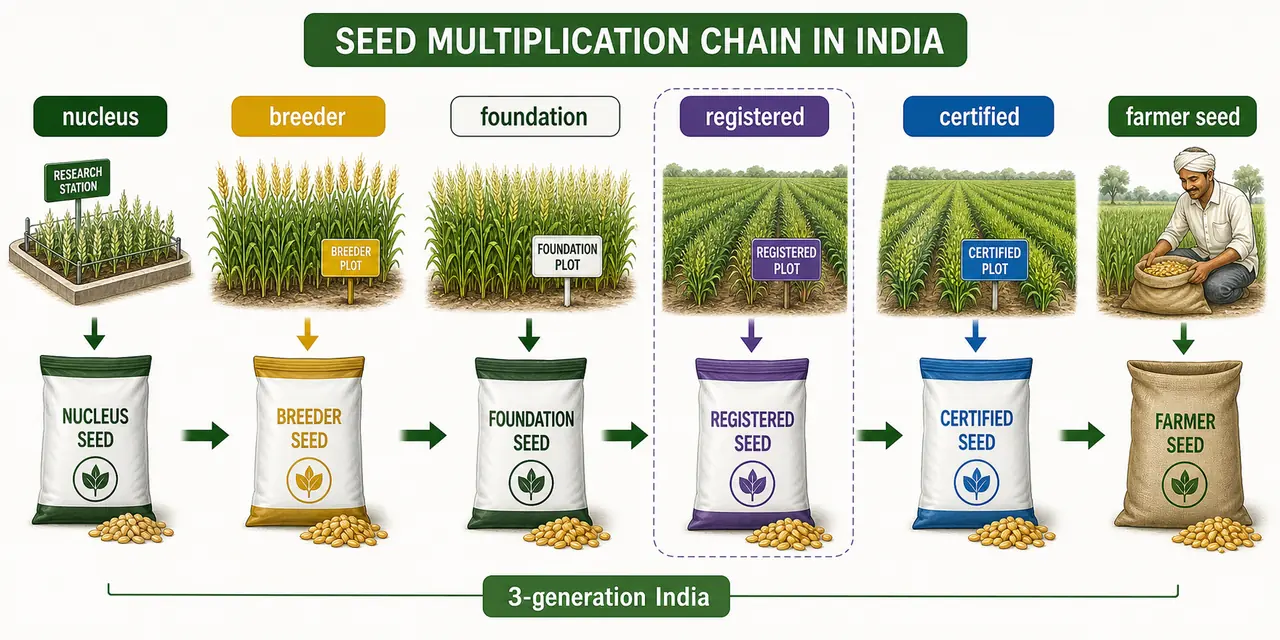
Definition of seed classes
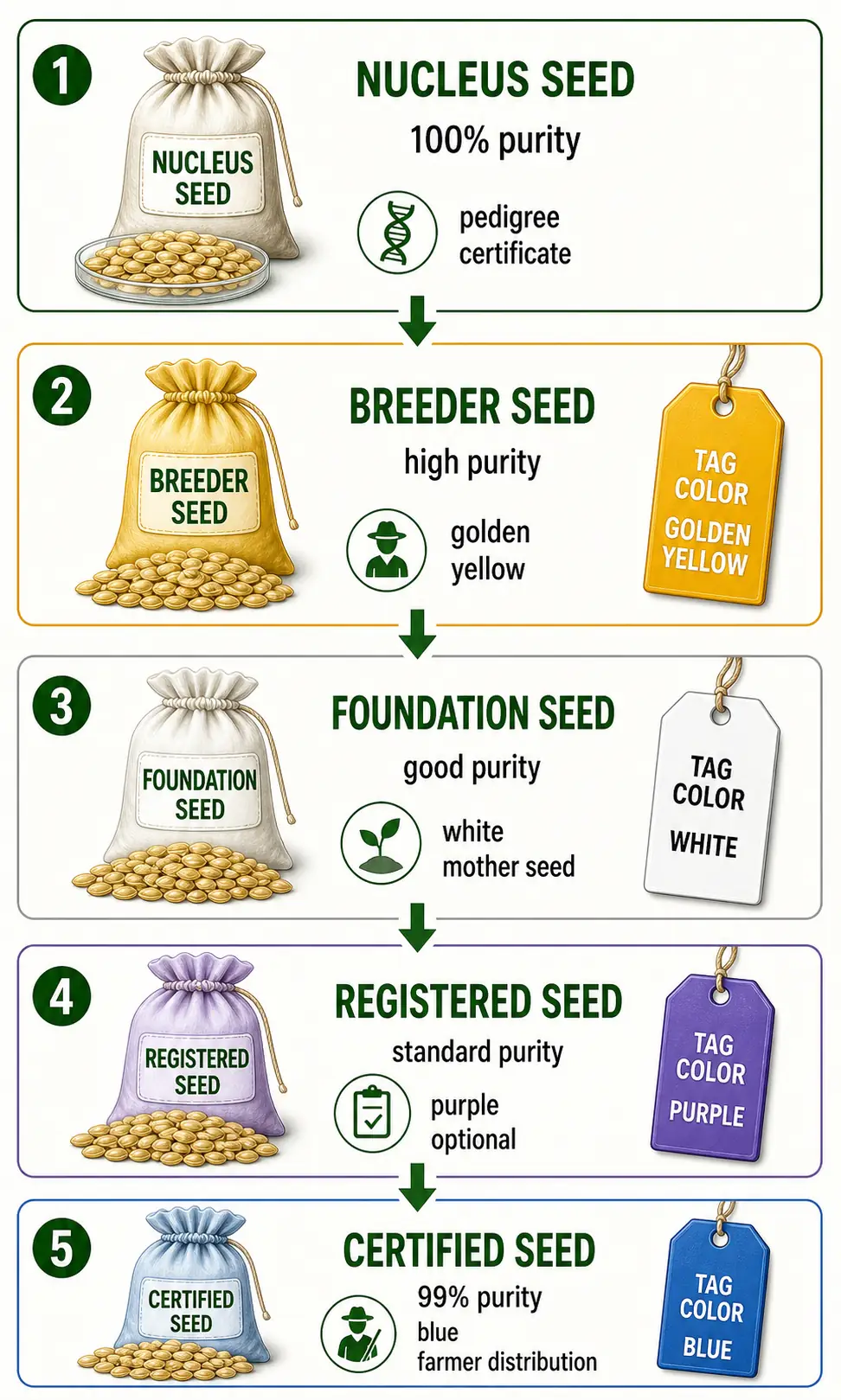
Nuclear seed
- This is the hundred percent genetically & physically pure seed and produced by the original breeder/Institute/State Agriculture University (SAU) from basic nucleus seed stock. It represents the highest level of genetic purity available.
- Obtained by process of mass selection. The breeder carefully selects typical plants, harvests them individually, and bulks the progeny after evaluation to produce nucleus seed.
- A pedigree certificate is issued by the producing breeder. This certificate documents the genetic lineage and ensures traceability.
Breeder seed
- The progeny of nucleus seed multiplied in large area as per indent of Department of Agriculture and Cooperation (DoAC), Ministry of Agriculture, Government of India, under supervision of plant breeder / institute / SAUs and monitored by a committee consisting of the representatives of state seed certification agency, national / state seed corporations, ICAR nominee and concerned breeder.
- This is also hundred percent physical and genetic pure seed for production of foundation seed. The rigorous monitoring ensures that no contamination occurs during multiplication.
- A Golden Yellow (Buff) Colour certificate/tag is issued for this category of seed by the producing breeder. UPPSC 2021
- Breeder seed is exempted from certification. exams 2021 This is because it is produced under the direct supervision of the breeder who is responsible for its genetic purity.
- Tag size: 12 cm x 6 cm

Foundation seed
- Produced from breeder seed and is the source of all other certified seed classes either directly or through registered seed. It is also known as Mother Seed because it "gives birth" to the seed that ultimately reaches the farmer.
- Older seed-technology exam books often attach a historical recall here: the production of foundation seed is associated with Robertson (1917).
- It is always produced by certain organizations viz. National Seeds Corporation (mainly), Tarai Development Corporation (TDC) and State Seed Corporation (SSC). Only authorized agencies can produce foundation seed to maintain quality control.
- lt is produced on Government Farms, at experiment stations, Agriculture Universities or on cultivator's field under strict supervision of research scientists and experts from NSC or SSC. lt has specific genetic identity and purity.
- A White Colour certificate is issued for foundation seed by seed certification agencies. UPPSC 2021
- Tag size: 15 cm x 7.5 cm

Registered seed
- Produced from Foundation Seed (FS) or Registered seed itself. lt is the parent of certified seed or RS. This class serves as an intermediate step to bridge the gap between limited foundation seed and the large quantity of certified seed needed.
- It has satisfactory genetic identity and purity and is usually produced by progressive farmers under technical guidance and supervision from SSC.
- In India, it is often omitted and certified seed is produced directly from FS. This simplifies the multiplication chain and speeds up seed availability.
- A Purple Colour certificate is issued for this category of seed.
Certified seed
- Progeny of RS, FS or CS itself. lt has satisfactory genetic identity and purity. This is the final link in the seed multiplication chain that connects the breeder's work to the farmer's field.
- lt is approved and certified by the state seed certifying agency (SSCA), annually produced by progressive farmers according to standard seed production practices.
- lt is available for general distribution to farmers for commercial crop production. This is the seed that farmers buy from seed shops and cooperatives.
- lt is generally produced by SSC but NSC also undertakes its production, if required.
- This is the commercial seed which is available to the farmers and its genetic purity should be 99 per cent.
- Tag size: 15 cm x 7.5 cm
- Two classes of CS are produced i.e. F1 and F2. The first generation (F1) of certified seed can be recertified once to produce the second generation (F2).
- Recertification is not permitted from F2 generation (Second) of seeds. This limit prevents genetic drift and quality deterioration from accumulating over too many multiplication cycles.
- Azure Blue Colour certificate is issued by seed certification agency for this category of seed. UPPSC 2021

| Seed Class | Certificate Colour | Purity Level | Produced By |
|---|---|---|---|
| Nucleus | Pedigree Certificate | 100% | Original breeder/SAU |
| Breeder | Golden Yellow | 100% | Breeder under DoAC indent |
| Foundation | White | High | NSC, TDC, SSC |
| Registered | Purple | Satisfactory | Progressive farmers |
| Certified | Azure Blue | 99% minimum | SSC/NSC, progressive farmers |
👉🏻 Other types of seeds in Agronomic use are:
Truthfully Labeled Seed (TFL)
- It is the seed offered for sale after testing germination percentage and physical purity etc. TFL seed fills the gap when certified seed is unavailable, offering the farmer a tested alternative.
- It is not a certified seed, as there is no inspection carried out by the certified person. The producer self-declares the quality parameters on the label.
- There is no colour tag for TFL seed, distinguishing it visually from all certified seed classes.

| Certified Seed | Truthfully Labelled Seed |
|---|---|
| Certification is voluntary | Truthful labeling is compulsory for notified kind of varieties |
| Applicable to notified kinds only | Applicable to both notified and released varieties |
| Should satisfy both minimum field and seed standards | Tested for physical purity and germination only |
| Seed certification officer and seed inspectors can take samples for inspection | Seed inspectors alone can take samples for checking the seed quality |
| Blue colour tag | Opal green tag |
Improved seed
- It is a better seed substitute for pure seed but is not so good with respect to genetic and physical factors. It has at least 10-15% more genetic potential than the local seed and are resistant to pest and diseases, well adapted to agro-climatic conditions of the locality, high in response to better condition of growth. Improved seeds include:
- Hybrid seed -- produced by crossing two genetically distinct parents; offers heterosis (hybrid vigor).
- Composite seeds -- developed by mixing seeds from several superior lines; useful in cross-pollinated crops.
- Mutant seeds -- derived from mutation breeding, carrying desirable traits induced through physical or chemical mutagens.
Attributes of International Seed Analysis Certification

ISTA (International Seed Testing Association) issues three types of seed analysis certificates, each serving a different purpose: Exams
-
Orange Certificate: Sampling and testing of samples are carried out in the same country by ISTA accredited lab. Used for international seed trade.
-
Green Certificate: Sampling is done by ISTA accredited station, but testing is done in another country by ISTA accredited lab. Issued for seed lots not internationally traded.
-
Blue Certificate: Sampling is done by non-accredited laboratories/agencies but testing by ISTA accredited laboratory. Provides quality assurance only for submitted sample tested in laboratory. These are sample certificates.
NOTE
The certificate is always issued by the station which had done the testing. ISTA was established during 1924.
Certification Tag Sizes
The size of certification tags varies by seed class. This is a frequently tested detail in competitive exams.
| Seed Class | Tag Colour | Tag Size |
|---|---|---|
| Breeder seed | Golden Yellow (Buff) | 12 cm x 6 cm |
| Foundation seed | White | 15 cm x 7.5 cm |
| Certified seed | Blue (Azure Blue) | 15 cm x 7.5 cm |
IMPORTANT
The seed tag of Certified seed is blue coloured in India. The size of the certification tag is 15 x 7.5 cm (for both Foundation and Certified seed). Breeder seed tag is smaller at 12 x 6 cm.
Seed Moisture
-
Germination occurs when seed moisture is above 40-60%. Seeds must absorb a substantial amount of water before the germination process can begin. Below this threshold, the biochemical reactions necessary for germination cannot proceed.
-
The moisture determination in seeds can be done by several methods, ranging from simple field techniques to sophisticated laboratory equipment:
- Traditional bite test -- a quick, rough field method where the seed is bitten to judge hardness and moisture.
- Electrical moisture meters -- measure the electrical resistance or capacitance of the seed, which changes with moisture content.
- Infra-red moisture meters -- use infrared radiation to rapidly evaporate moisture and measure the weight loss.
- Oil distillation method -- suitable for oil seeds; seed is heated in a non-miscible liquid and the water driven off is collected and measured.
- The lab. Oven method -- the standard reference method where seeds are dried at a specified temperature for a set time and the weight loss is calculated as moisture percentage.
- Karl Fisher reagent method -- a precise chemical titration method used for highly accurate moisture determination; considered the gold standard for moisture analysis.
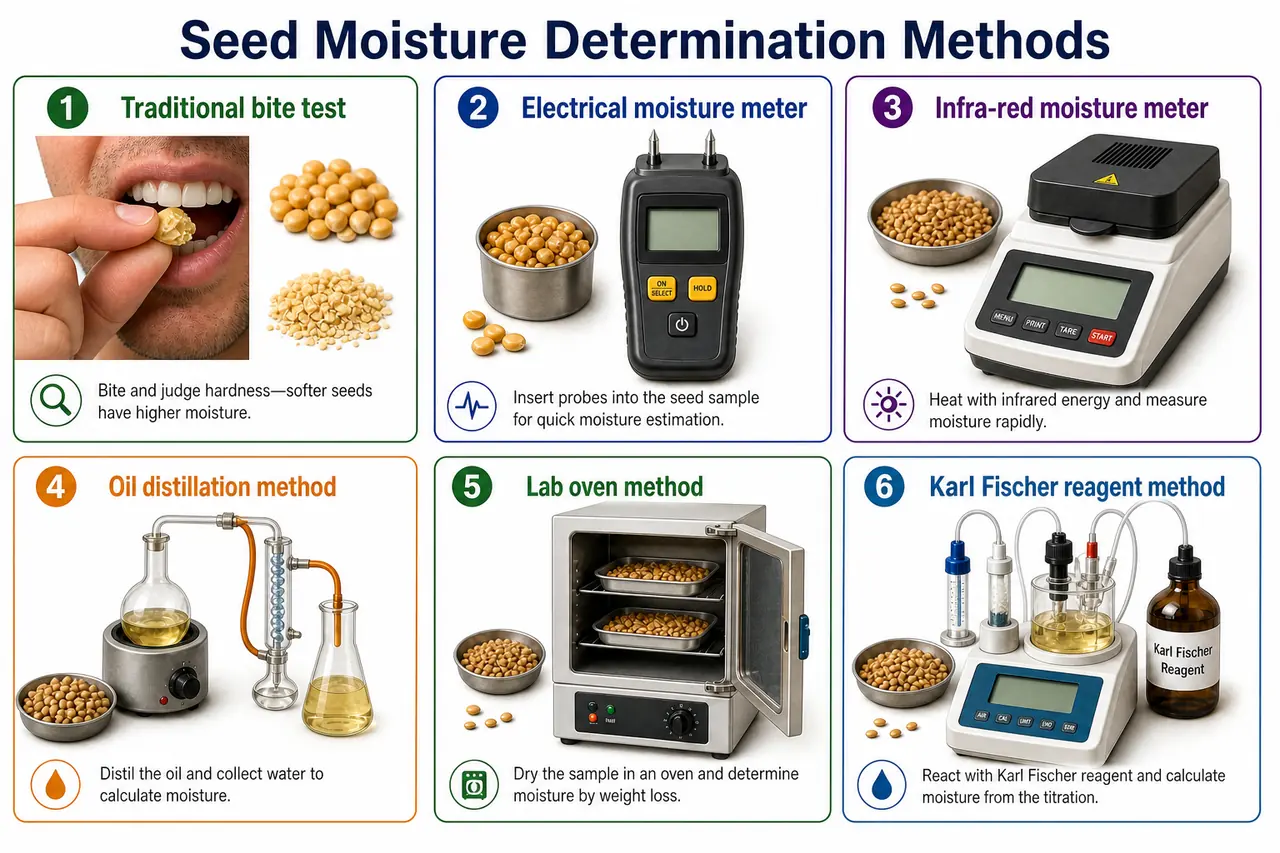
Summary Cheat Sheet
| Concept / Topic | Key Details |
|---|---|
| Seed multiplication chain | Nucleus → Breeder → Foundation → Certified |
| Nucleus seed | Produced by originating breeder; 100% genetic purity |
| Breeder seed | Produced under breeder supervision; tag = golden yellow |
| Foundation seed | Progeny of breeder seed; tag = white; produced by NSC/SSFs |
| Certified seed | Progeny of foundation seed; tag = blue (azure blue); for farmers |
| Truthfully Labelled (TL) seed | Not certified but labelled truthfully; tag = opal green |
| Multiplication ratio | Breeder → Foundation = 1:5 to 1:10 (varies by crop) |
| Genetic purity standards | Breeder > Foundation > Certified (decreasing stringency) |
| Physical purity | Minimum 98% for most crops |
| Germination standard | Minimum 75–85% depending on crop |
| Moisture content (cereals) | 12% for safe storage |
| Moisture content (oilseeds) | 8–9% for safe storage |
| IMSCS | Indian Minimum Seed Certification Standards |
| OECD scheme | International seed certification for trade |
| Source of breeder seed | ICAR institutes and SAUs |
| Seed multiplication chain | Nucleus → Breeder → Foundation → Certified |
| Nucleus Seed | Seeds from selected individual plants for maintaining genetic purity — foundation of the chain |