🕸 Seed Dormancy: Types, Causes, and Breaking Methods
Understand seed dormancy types, causes, methods to break dormancy, seed storage principles, and Harrington's Rule — with agricultural examples and exam tips.
Why Seed Dormancy Matters in Agriculture
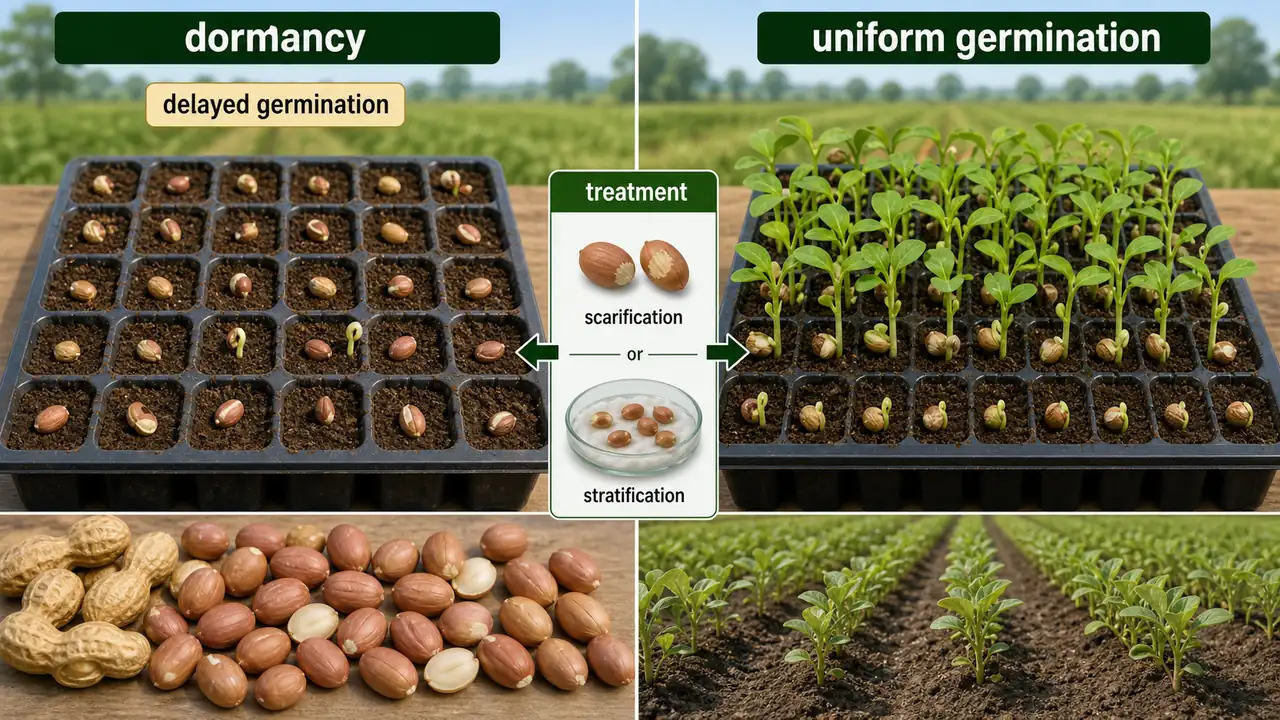
Freshly harvested groundnut seeds often refuse to germinate even under ideal conditions — this is seed dormancy, nature's mechanism to prevent premature germination. While dormancy is beneficial in the wild (preventing sprouting during unfavourable seasons), it is a problem for farmers and seed producers who need quick, uniform germination. Understanding dormancy types and how to break them (scarification, stratification, chemical treatment) is essential for seed technology.
Seed Dormancy
- Dormancy is the arrested development and reversible rest period of plant organs either of a seed or of any vegetative part. In simple terms, a dormant seed is alive but refuses to germinate even when provided with favorable conditions of moisture, temperature, and oxygen. This is an important survival mechanism that prevents seeds from germinating at the wrong time, such as immediately after harvest when conditions may not support seedling survival.
NOTE
Pro Content Locked
Upgrade to Pro to access this lesson and all other premium content.
₹99 charged monthly · Cancel anytime
- All Agriculture & Banking Courses
- AI Lesson Questions (100/day)
- AI Doubt Solver (50/day)
- Glows & Grows Feedback (30/day)
- AI Section Quiz (20/day)
- 22-Language Translation (100/day)
- Recall Questions (20/day)
- AI Quiz (15/day)
- AI Quiz Paper Analysis (100/day)
- AI Step-by-Step Explanations (100/day)
- Spaced Repetition Recall (FSRS)
- AI Tutor
- Immersive Text Questions
- Audio Lessons — Hindi & English
- Mock Tests & Previous Year Papers
- Summary & Mind Maps
- XP, Levels, Leaderboard & Badges
- Generate New Classrooms
- Voice AI Teacher (AgriDots Live)
- AI Revision Assistant
- Knowledge Gap Analysis
- Interactive Revision (LangGraph)
🔒 Secure via Razorpay · Cancel anytime · No hidden fees
Why Seed Dormancy Matters in Agriculture
Freshly harvested groundnut seeds often refuse to germinate even under ideal conditions — this is seed dormancy, nature's mechanism to prevent premature germination. While dormancy is beneficial in the wild (preventing sprouting during unfavourable seasons), it is a problem for farmers and seed producers who need quick, uniform germination. Understanding dormancy types and how to break them (scarification, stratification, chemical treatment) is essential for seed technology.
Seed Dormancy
- Dormancy is the arrested development and reversible rest period of plant organs either of a seed or of any vegetative part. In simple terms, a dormant seed is alive but refuses to germinate even when provided with favorable conditions of moisture, temperature, and oxygen. This is an important survival mechanism that prevents seeds from germinating at the wrong time, such as immediately after harvest when conditions may not support seedling survival.
NOTE
Dormancy ≠ Dead seed. A dormant seed is alive but will not germinate even under perfect conditions. A dead seed will never germinate regardless of treatment. This distinction is critical for seed testing.
Causes of Dormancy
Innate Dormancy (Primary / Endogenous Dormancy)
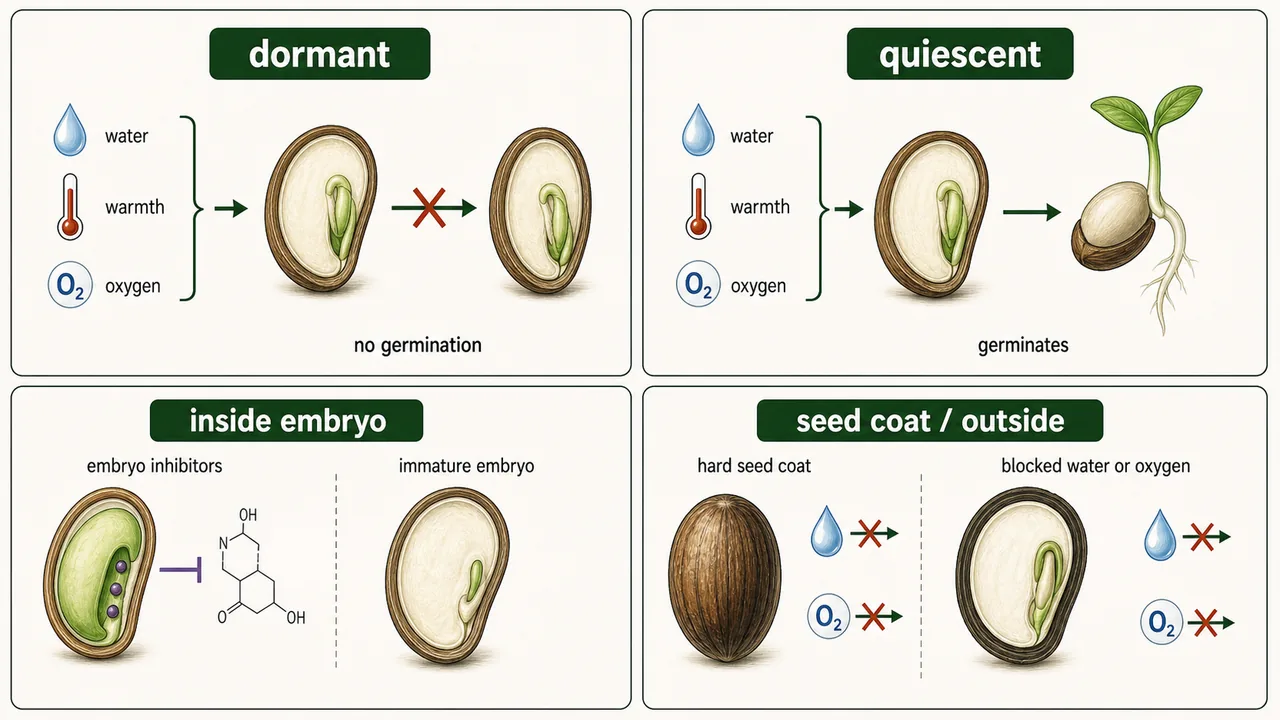
- This type of dormancy is imposed by factors inside the embryo. The embryo itself has internal mechanisms -- chemical inhibitors, immature tissues, or physiological blocks -- that prevent germination.
- It is different from quiescence stage. A seed which is just waiting for favourable environmental condition to germinate is called Quiescent seed. The key distinction is: a quiescent seed will germinate immediately once given water, warmth, and oxygen, while a dormant seed will not -- even under perfect conditions -- until the dormancy mechanism is overcome.
TIP
Dormant = internal block prevents germination even in favorable conditions. Quiescent = simply waiting for favorable conditions. This is a commonly tested distinction.
Enforced Dormancy (Secondary / Exogenous Dormancy)
- This type of dormancy is imposed by factors outside the embryo. External structures like the seed coat, endosperm, or fruit wall create physical or chemical barriers that prevent water uptake, gas exchange, or embryo expansion, thereby blocking germination.
Physiology of Dormancy
Understanding the biochemistry behind dormancy helps in developing effective methods to break it:
- The formation of dormant structures is commonly associated with the suspension of metabolic, synthetic and morphogenetic activities that are associated with the minimum physiological and a minimum moisture content.
- During this period, there is very poor or total suspension of respiration or rather anaerobic respiration with higher respiration quotient (infinite). The extremely low metabolic rate allows dormant seeds to survive for extended periods.
- Dormancy is due to lack or inactivity of hydrolytic enzymes. Without these enzymes, stored food reserves cannot be broken down to fuel the growth of the embryo.
- Gibberellins are the predominant germination agents found in the germination phase during the food reserve degradation stage. Gibberellins (especially GA3) stimulate the production of alpha-amylase and other enzymes that mobilize starch reserves.
- Cytokinins exert their influence later on the initiation of cell proliferation and expansion. Once the food reserves are mobilized, cytokinins drive cell division in the growing embryo.
- In cereal seeds, the aleurone layer is especially important because it secretes enzymes such as alpha-amylase after germination begins. Water uptake stimulates gibberellin synthesis, and gibberellin in turn activates this enzyme system to mobilize stored reserves.
- Red light (~660 nm) generally promotes germination, while far-red light (~730-735 nm) tends to inhibit or reverse that effect. In exam-style phytochrome wording, the Pr form absorbs maximally near 660 nm and converts to Pfr, whereas Pfr absorbs near 730 nm and can shift back under far-red light. This pigment system acts as a molecular switch for light-dependent germination.
IMPORTANT
Hormonal control of dormancy: Gibberellins (GA3) → promote germination (enzyme activation). Abscisic acid (ABA) → inhibits germination (dormancy maintenance). The GA3:ABA ratio determines whether a seed germinates or stays dormant.
Causes of Dormancy
The following are the specific physical and physiological reasons why seeds may remain dormant:
- Hard Seed coat -- an extremely tough coat physically restrains the embryo from expanding.
- Seed coats being impermeable to water -- prevents imbibition, the essential first step of germination.
- Seed Coat being impermeable to oxygen -- restricts aerobic respiration needed for active growth.
- Rudimentary embryo of seeds -- some species produce seeds with embryos that are not fully developed at the time of dispersal and need additional time to mature.
- Dormant embryo -- the embryo is fully formed but chemically inhibited from growing.
- Synthesis and accumulation of germination inhibitors in the seeds -- substances such as abscisic acid (ABA) actively block the germination process until they are degraded or leached away.
Detailed Classification of Dormancy
Primary dormancy is further classified into exogenous and endogenous types:
1. Primary Exogenous Dormancy (Seed Coat Factors)
Dormancy due to the seed coat, either from inhibitors or hard seed nature:
- A. Physical: Dormancy due to the hard seed coat which prevents the entry of water and sometimes gaseous exchange. e.g. Hard seeds of pulses, Acacia sp., Prosopis, sapota.
- B. Chemical: Presence of some inhibitors in the seed coat which prevents germination.
- C. Mechanical: Restriction of the growth of protruding radicle due to structure -- inadequate space in the seeds. e.g. seeds of Terminalia sp.
2. Primary Endogenous Dormancy (Embryo Factors)
Dormancy due to the embryo -- may be the presence of inhibitors, immature embryo, or combination of both. asked in exams
- A. Morphological: Due to immature embryo -- it is not able to put forth germination even under favourable conditions. e.g. Apple.
- B. Physiological: Due to arrest of metabolic activity in the seeds due to presence of inhibitors like ABA, coumarins, phenols etc.
- C. Morphophysiological: Combination of immature embryo with inhibitors -- both mechanisms operate simultaneously.
Secondary Dormancy
- Secondary dormancy can take place only in a matured and imbibed seed by certain environmental conditions which are unfavourable to germination. e.g. Spring wheat and winter barley.
- Induction of secondary dormancy was possible one and half months after physiological maturity.
- Secondary dormancy in Spring wheat could not be broken by two weeks of storage. However, it was completely broken by treatment with 0.1% GA3, 0.5 to 1.0% Ethanol, low temperature stratification, removal of pericarp and storage at 20°C.
IMPORTANT
Types of Secondary Dormancy: Thermo -- dormancy due to temperature; Skoto -- dormancy due to light; Photo -- dormancy due to quality of light; and high osmotic stress can also prevent germination.
Methods of Breaking Seed Dormancy
Several physical and chemical methods have been developed to overcome dormancy and improve germination. The choice of method depends on the type of dormancy present.
Physical Treatment
- Scarification: Any treatment -- physical, mechanical, or chemical -- that weakens or softens the seed coat is known as scarification. This method is most applicable to Malvaceae and Leguminosae group of seeds. There are three types:
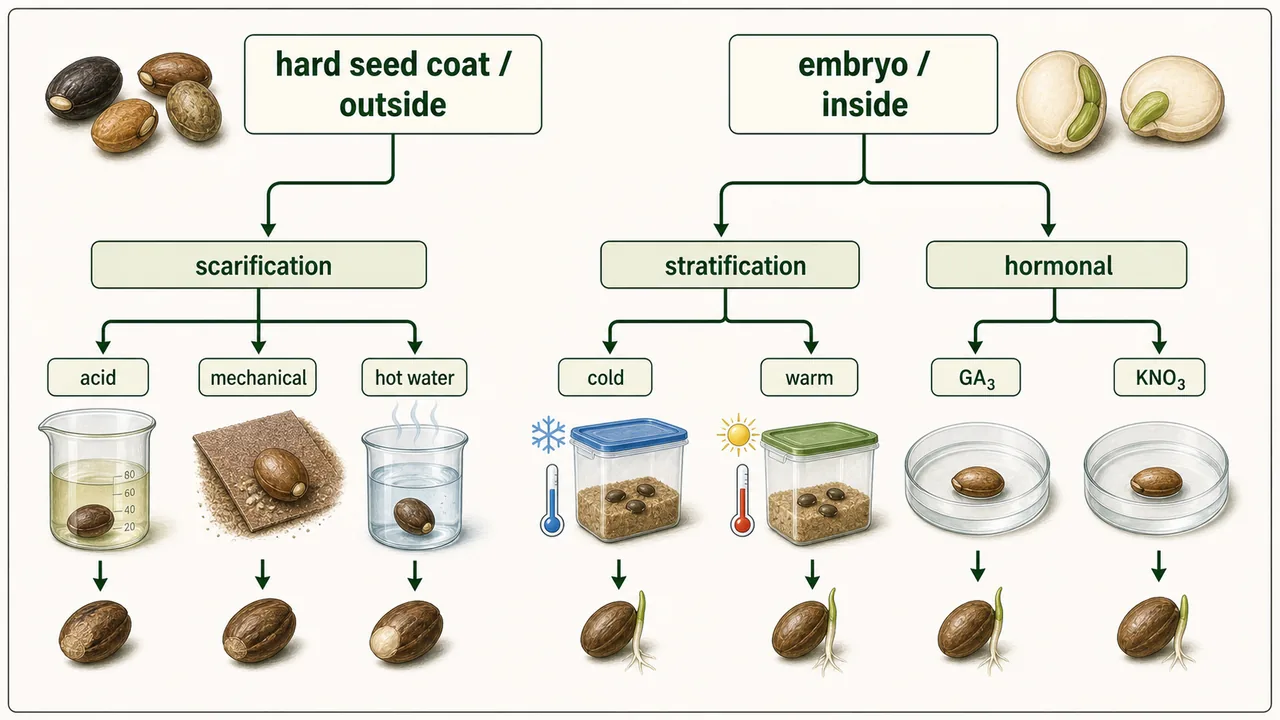
- Acid Scarification: By using concentrated H2SO4 @ 100 ml/kg of seed for 2-3 minutes. The duration of treatment varies depending on type and nature of seed coat.
- Mechanical Scarification: Seeds are rubbed on a sand paper or with a mechanical scarifier, or by puncturing the seed coat with a needle to enhance moisture absorption. e.g. Bitter gourd -- for sand scarification, sand and seed 2:1 ratio should be followed. Rub against hard surface for 5-10 minutes.
- Hot Water Treatment: Effective for leguminous tree crop seeds. Seeds should be soaked in hot water for 1-5 minutes at 82°C. Some crops like Bengal gram and Groundnut -- hot water treatment for more than 1 minute is found injurious to seed.
WARNING
For Bengal gram and Groundnut, hot water treatment for more than 1 minute is injurious to the seed. Always calibrate treatment duration based on crop type.
-
Stratification: Exams When seed dormancy is due to the embryo factor, seeds can be subjected to stratification treatments.
- Cold Stratification: Incubate the seed at low temperature of 0-5°C over a moist substratum for 2-3 days to several months. It depends on the nature of seed and kind of dormancy. e.g. Cherry and oil palm seeds.
- Warm Stratification: Some seeds require temperature of 40-50°C for a few days. e.g. Paddy. In case of oil palm, it requires 40-50°C for 2 months for breaking dormancy. Moisture content of seed should not be more than 15% during treatment.
-
Temperature Treatments:
- Low temperature: Plants which grow in temperate and cooler climate require a period of chilling for breaking dormancy. Seeds should be kept at 2-8°C for 12-24 hours but should be presoaked for 36 hours before the low temperature treatment. e.g. Apple seed dormancy can be released by storing seeds at 5°C.
- High temperature: Normally exhibited by early flowering "winter" annuals. e.g. Blue bell (Hyacinthoidesnonscripta) -- seeds are shed in early summer and do not germinate until they have been exposed to heat during high summer.
- Alternate temperature: Most plant species which grow in temperate and cool temperate regions require alternate temperature for breaking dormancy. e.g. Bull rush (Typha).
-
Alternate drying and wetting for several times. This also weakens the seed coat through repeated swelling and shrinking.
-
Exposure for 24 hours of water-soaked seeds to red light for 1-2 hrs. at 15-25 degrees C temperature. Red light activates the phytochrome system, converting it to the germination-promoting form.
| Method | Details | Target Dormancy Type |
|---|---|---|
| Acid Scarification | H2SO4 @ 100 ml/kg seed, 2-3 min | Exogenous (hard coat) |
| Mechanical Scarification | Sand paper, scarifier, sand:seed 2:1 | Exogenous (hard coat) |
| Hot Water Treatment | 82°C for 1-5 min (leguminous trees) | Exogenous (hard coat) |
| Cold Stratification | 0-5°C, moist, 2-3 days to months | Endogenous (physiological) |
| Warm Stratification | 40-50°C, few days to 2 months | Endogenous (physiological) |
| Low Temperature | 2-8°C for 12-24 hrs (pre-soak 36 hrs) | Endogenous (physiological) |
| High Temperature | Heat exposure for winter annuals | Exogenous + Endogenous |
| Alternate Temperature | For temperate species (e.g. Typha) | Exogenous (impermeable coat) |
| Alternate Dry/Wet | Swelling/shrinking weakens coat | Exogenous (impermeable coat) |
| Red Light Exposure | 15-25°C, activates phytochrome | Endogenous (light-sensitive) |
Chemicals
Chemical treatments offer precise control over dormancy breaking and are widely used in commercial seed production.
-
Inorganic Chemicals:
- By acid treatment: Dilute solutions of HNO3, HCl or H2SO4 (0.10 - 0.5%) for different durations in minutes. The acid etches and weakens the hard seed coat, making it permeable to water. Concentrated sulphuric acid is especially effective for seeds with very hard coats (e.g., legumes).
- Potassium Nitrate (KNO3) @1-3%: Strongest and used for immediate dormancy break after harvesting; NH4NO3 (1-3%), H2O2, H3BO4 etc. Ex. Rice, Tomato, Chilies etc. Potassium nitrate provides nitrate ions that stimulate germination and also supplies oxygen within the seed.
- By gases: by increasing O2 concentration. Higher oxygen levels promote aerobic respiration in the embryo, overcoming the inhibitory effect of impermeable seed coats.
-
Organic Chemicals:
- Non-hormonal: Thiourea, Ascorbic acid. Thiourea can be used for breaking dormancy in both light-requiring and chilling-requiring seeds. e.g. Lettuce -- thiourea @ 10^-2 to 10^-3 M is used.
- Hormonal: GA3 (1-1000 ppm) -- the most commonly used hormone to break dormancy. GA is a light-substituting chemical. GA and Cytokinin can be used at concentration of 100-1000 ppm to break dormancy. KNO3 2% can be used for breaking dormancy of light-requiring seeds e.g. Oats, Barley, and Tomato.
- Ethrel can be used for breaking dormancy of cotton seed -- the dormancy in cotton seed is due to the presence of ABA in pericarp of seed.
- Nitrogenous compounds like Thiourea, Hydroxylamine, Nitric acid, and Nitrate can also be used.
- Sulphidral compounds like 2-mercapto ethanol and 2,3-dimercaptoehtanol can also be used.
- Strigol (root exudation from Striga parasite host plant) can also be used for breaking seed dormancy.
TIP
Quick recall for exams: KNO3 (1-3%) = strongest dormancy breaker for immediate use after harvest. Thiourea & GA = used for potato. GA & Cytokinin = best for hormonal treatment. Ethrel = cotton dormancy (ABA in pericarp).
- A related priming-based recall point is halopriming, in which seeds are soaked in a salt solution such as NaCl before sowing. This is used to improve the physiological readiness of seed, especially under stress conditions.
Real Value of Seed
- Real value of seed is the percentage of germinability of percentage of purity of a seed lot. It is also known as utility percentage of seed.
- Impurity percentage is called dockage.
- Real value of seed should be more than 70%.
Real Value = Purity % x Germination % / 100
Seed Storage
Proper seed storage is essential for maintaining seed viability and vigor over time. The goal is to slow down metabolic activity and prevent deterioration caused by moisture, temperature, and biological agents.
Seven Types of Seed Storage
-
Storage at ambient temperature and humidity: Seeds can be stored in piles, single layers, sacks or open containers, under shelter against rain, well ventilated and protected from rodents. Storage for several months.
-
Dry storage with control of moisture but not temperature: Orthodox seeds dried to low moisture content (4-8%) and stored in a sealed container or humidity-controlled room. Cool conditions are especially favourable.
-
Dry storage with control of both moisture and temperature: Recommended for many orthodox species with periodicity of seeding (e.g. large-scale afforestation). A combination of 4-8% moisture and 0 to 5°C temperature will maintain viability for 5 years or more.
-
Dry storage for long-term gene conservation: Long-term conservation of gene resources of orthodox agricultural seeds at -18°C temperature and 5±1% moisture content. This is the standard for gene banks worldwide.
-
Moist storage without control of temperature: Suitable for storage of recalcitrant seeds for a few months over winter. Seeds may be stored in heaps on the ground, in shallow pits, in well-drained soils, or in well-ventilated sheds mixed with leaves, moist sand, peat, or other porous materials.
-
Moist cold storage with control of temperature: This method implies controlled low temperature just above freezing or less commonly just below freezing. Moisture can be controlled within approximate limits by adding moist media e.g. sand, peat.
-
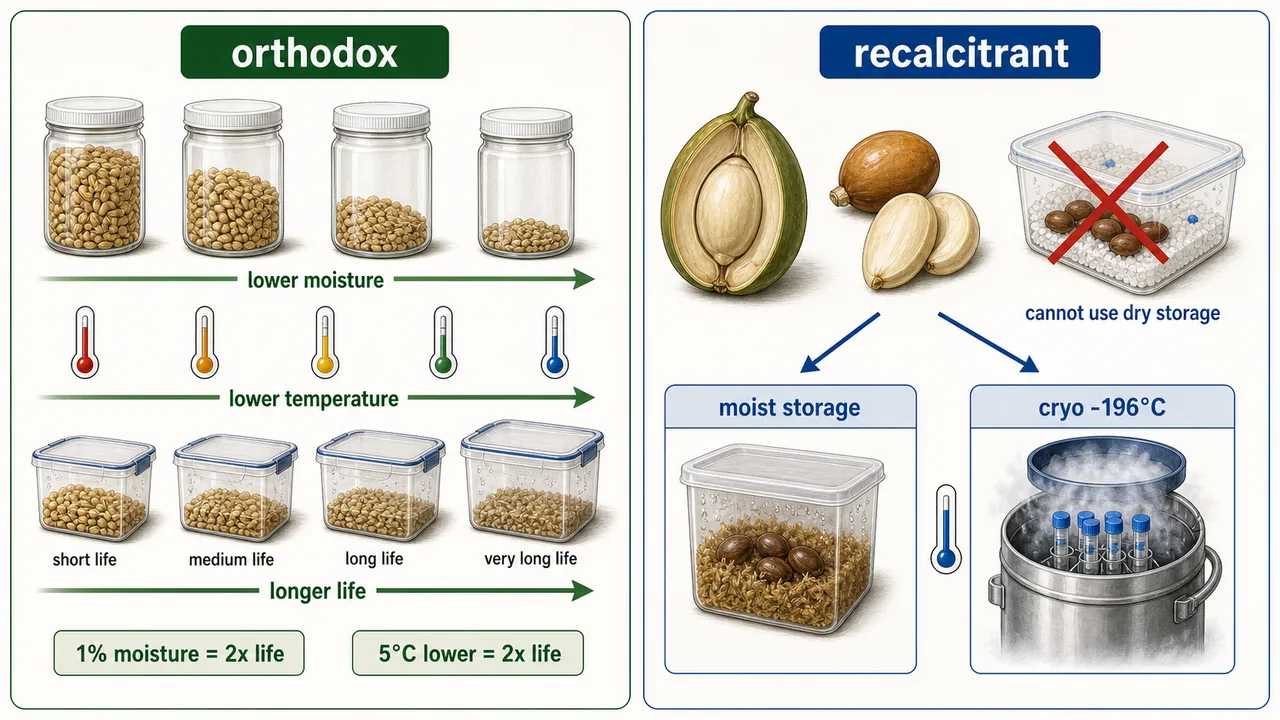
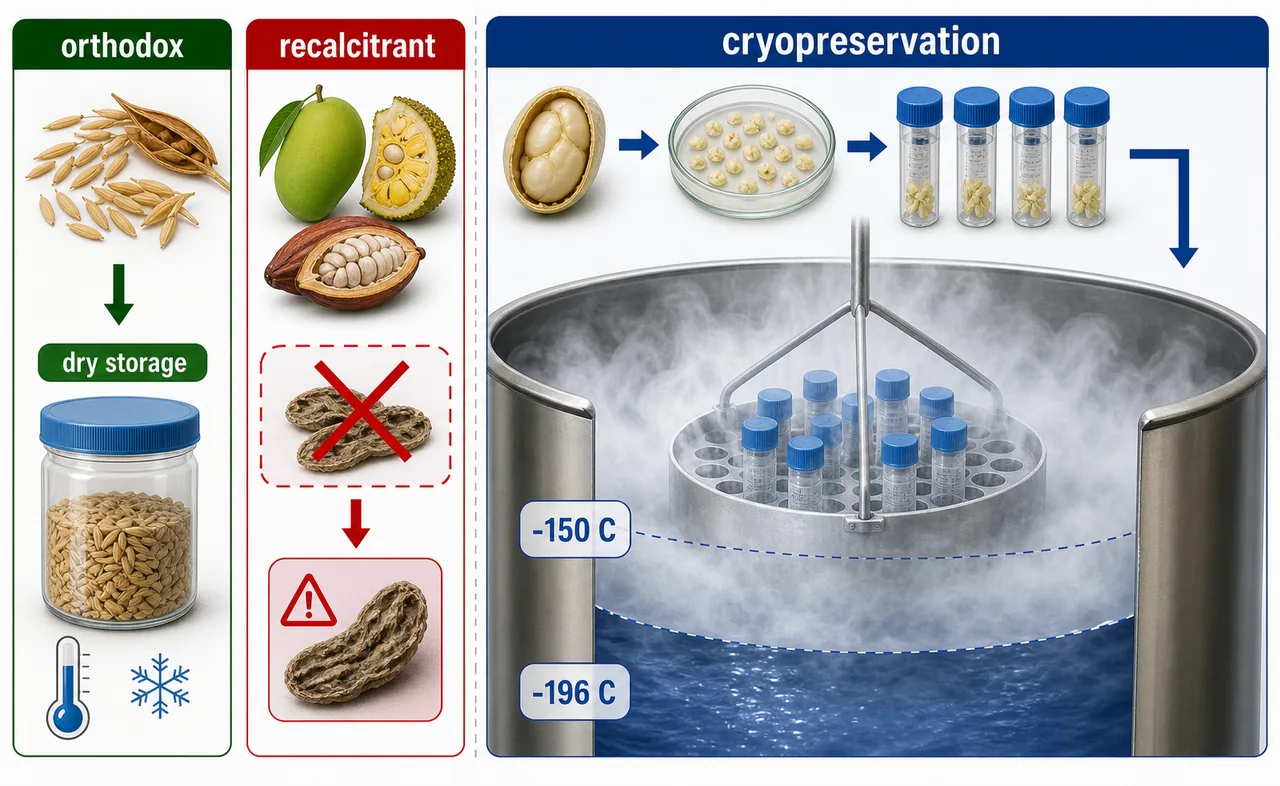
Cryopreservation: Also called cryogenic storage. Seeds are placed in liquid nitrogen at -196°C. Seeds are actually placed into the gaseous phase of liquid nitrogen at -150°C for easy handling and safety. Used for recalcitrant seeds that cannot tolerate drying.
TIP
Orthodox seeds can be dried to low moisture and stored for long periods (most crop seeds). Recalcitrant seeds cannot tolerate drying and must be stored using cryopreservation at -196°C (e.g., mango, jackfruit, cocoa).
- Older exam books also use a physiological-maturity moisture recall:
- Orthodox seeds: about 30-50% moisture at physiological maturity
- Recalcitrant seeds: about 30-70% moisture at physiological maturity
- As an exceptional longevity recall, older competitive-exam books often cite lotus seeds as remaining viable for up to 1000 years. Treat this as a special memory point rather than the normal storage life of ordinary crop seed lots.
Seed Moisture Content vs Storage Life
| Seed Moisture Content (%) | Storage Life (Years) |
|---|---|
| 11-13 | 0.5 |
| 10-12 | 1 |
| 09-11 | 2 |
| 08-10 | 4 |
Harrington's Thumb Rule on Seed Storage
This is one of the most frequently tested concepts in competitive exams:
- For every decrease of 1% seed moisture content, the life of the seed doubles. This rule is applicable when moisture content is between 5% and 14%.
- For every decrease of 5°C (10°F) in storage temperature, the life of the seed doubles. This rule applies between 0°C and 50°C.
IMPORTANT
Harrington's Rule (exam favourite): 1% moisture decrease = 2x seed life (valid 5-14% MC). 5°C temperature decrease = 2x seed life (valid 0-50°C). Both rules work independently -- combining lower moisture AND lower temperature gives multiplicative benefits.
Other Storage Concepts
-
Dehumidification: Removal of water-vapour from the air in storage. Silica gel is the most common desiccant used as chemical dehumidifier. Maintaining low humidity in the storage environment prevents seeds from re-absorbing moisture, which would increase respiration and hasten deterioration.
-
Tempering: Process of bringing grains or other products to a desired moisture or temperature for processing. This conditioning step ensures uniform moisture distribution throughout the seed lot before milling, packaging, or further storage.
-
Matrical is the heterogeneity in the quality due to location of the seeds in the inflorescence e.g. difference in flowering pattern. Seeds produced at different positions on the plant may vary in size, maturity, and vigor, leading to uneven performance within a seed lot.
-
Acclimatization: The process that leads to adaptation of a variety, line or population to a new environment is known as Acclimatization. When seeds or planting materials are moved to a different agro-climatic zone, they may need time and selection pressure to perform optimally in the new conditions.
Summary Cheat Sheet
| Concept / Topic | Key Details |
|---|---|
| Seed dormancy | Failure of viable seed to germinate under favourable conditions |
| Innate dormancy | Built-in; due to seed structure/physiology at maturity |
| Induced dormancy | Acquired after harvest; due to unfavourable storage conditions |
| Enforced dormancy | Due to lack of essential requirements (water, O₂, light) |
| Causes of dormancy | Hard seed coat, immature embryo, inhibitors (ABA), impermeability |
| Hard seed coat | Prevents water/gas entry; common in legumes |
| ABA (Abscisic acid) | Growth inhibitor promoting dormancy |
| Gibberellic acid (GA₃) | Growth promoter that breaks dormancy |
| Scarification | Scratching/weakening seed coat; mechanical or chemical (H₂SO₄) |
| Stratification | Moist chilling at 0–5°C for several weeks |
| After-ripening | Dry storage period needed for dormancy to break naturally |
| Harrington's Rule | For every 5°C rise, seed life halved; for every 1% moisture rise, seed life halved |
| Ideal seed storage | Low temperature + low moisture |
| Orthodox seeds | Can be dried and stored at low temperature (most crops) |
| Recalcitrant seeds | Cannot tolerate drying; lose viability quickly (mango, cocoa, jackfruit) |
| Light requirement | Some seeds need light (lettuce); others need dark for germination |