🗽 Intellectual Property Rights: Patents, PPVFR Act, and Plant Variety Protection
Understand IPR in agriculture — patents, plant variety protection (PPVFR Act 2026), farmers' rights, breeders' rights, and UPOV — with exam tips.
Why IPR Matters in Agriculture
When IARI develops a new wheat variety after 12 years of research, how do they ensure that the variety is not commercially exploited by others without acknowledgement? India's Protection of Plant Varieties and Farmers' Rights (PPVFR) Act, 2001 provides the legal framework — protecting breeders' intellectual property while simultaneously safeguarding farmers' traditional rights to save, use, exchange, and sell farm-saved seed. Understanding IPR is essential for anyone working in seed production, variety development, or agricultural policy.
-
Intellectual property rights (IPRs) can be broadly defined as legal rights established over creative or inventive ideas. Such legal rights generally allow right holders to exclude the unauthorized commercial use of their creations/inventions by third persons. In essence, IPRs grant a temporary monopoly to inventors and creators as a reward for their contribution to society.
-
The rationale for the establishment of a legal framework on IPRs is that it is a signal to society that creative and inventive ideas will be rewarded. By ensuring that innovators can benefit financially from their work, IPR systems incentivize continued research and development.
Pro Content Locked
Upgrade to Pro to access this lesson and all other premium content.
₹99 charged monthly · Cancel anytime
- All Agriculture & Banking Courses
- AI Lesson Questions (100/day)
- AI Doubt Solver (50/day)
- Glows & Grows Feedback (30/day)
- AI Section Quiz (20/day)
- 22-Language Translation (100/day)
- Recall Questions (20/day)
- AI Quiz (15/day)
- AI Quiz Paper Analysis (100/day)
- AI Step-by-Step Explanations (100/day)
- Spaced Repetition Recall (FSRS)
- AI Tutor
- Immersive Text Questions
- Audio Lessons — Hindi & English
- Mock Tests & Previous Year Papers
- Summary & Mind Maps
- XP, Levels, Leaderboard & Badges
- Generate New Classrooms
- Voice AI Teacher (AgriDots Live)
- AI Revision Assistant
- Knowledge Gap Analysis
- Interactive Revision (LangGraph)
🔒 Secure via Razorpay · Cancel anytime · No hidden fees
Why IPR Matters in Agriculture
When IARI develops a new wheat variety after 12 years of research, how do they ensure that the variety is not commercially exploited by others without acknowledgement? India's Protection of Plant Varieties and Farmers' Rights (PPVFR) Act, 2001 provides the legal framework — protecting breeders' intellectual property while simultaneously safeguarding farmers' traditional rights to save, use, exchange, and sell farm-saved seed. Understanding IPR is essential for anyone working in seed production, variety development, or agricultural policy.
-
Intellectual property rights (IPRs) can be broadly defined as legal rights established over creative or inventive ideas. Such legal rights generally allow right holders to exclude the unauthorized commercial use of their creations/inventions by third persons. In essence, IPRs grant a temporary monopoly to inventors and creators as a reward for their contribution to society.
-
The rationale for the establishment of a legal framework on IPRs is that it is a signal to society that creative and inventive ideas will be rewarded. By ensuring that innovators can benefit financially from their work, IPR systems incentivize continued research and development.
-
There are two broad categories of IPRs:
- Industrial property covering IPRs such as patents, trademarks, geographical indications and industrial designs. These protect functional inventions, brand identities, and product origins.
- Copyright and related rights covering artistic and literary works, performances, broadcasts and the like. These protect creative expression rather than functional innovation.
-
IPRs that do not fit into this classical division are termed sui generis, meaning one-of-its-kind. Such sui generis rights include those covering lay-out designs of semi-conductor chips and plant breeders' rights. These specialized forms of protection are designed for subject matter that doesn't fit neatly into the patent or copyright framework.
NOTE
Sui generis (Latin: "of its own kind") is a key term in agricultural IPR. Plant breeders' rights fall under this category because they are neither patents nor copyrights -- they are a unique form of protection designed specifically for new plant varieties.
- IPRs Relevant to Agriculture
- Several of the IPRs mentioned above are relevant to the agricultural sector in that they can be used to protect goods or services produced in the agricultural sector. These are mainly patents, plant breeders' rights, trademarks, geographical indications and trade secrets. Understanding these rights is essential for anyone involved in agricultural research, seed production, or agribusiness.
Patents
-
Patents are probably the most important IPR today for agricultural goods and services as they provide, wherever these are available, the strongest protection for patentable plants and animals and biotechnological processes for their production. A patent gives its holder an exclusive right for a limited period, typically 20 years.
-
Patents universally give the patentee the right to prevent third parties from making, using or selling the patented product or process. This exclusivity allows the inventor to recoup their research investment.
-
Patents, however, have to be disclosed to the public through the patent documents. This enables researchers to develop further useful products or services. The disclosure requirement is a deliberate trade-off: the inventor gets protection in exchange for sharing knowledge with the world.
-
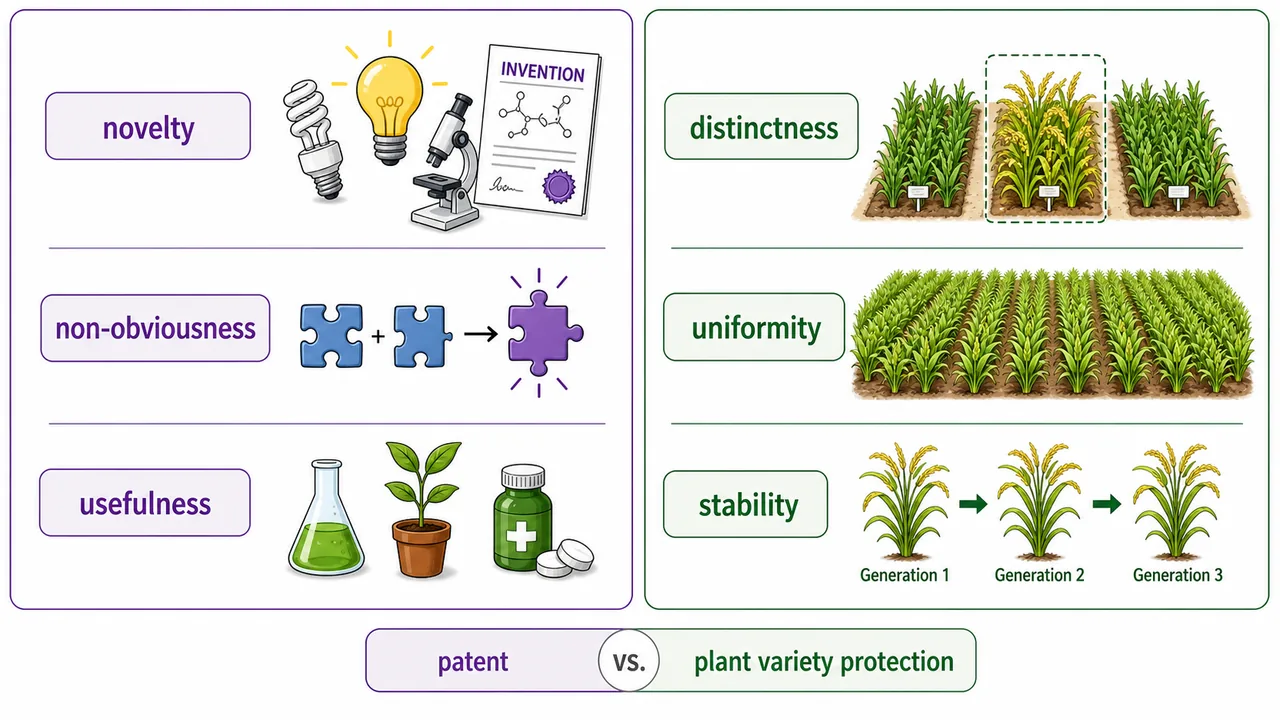
Patentable products have to meet the criteria of patentability, viz.,
- Novelty i.e. that which is not known in the prior art -- the invention must be genuinely new.
- Non-obviousness i.e. that which involves an inventive step -- the invention must not be something a skilled person in the field would easily deduce.
- Usefulness i.e. that which is industrially applicable -- the invention must have practical utility.
IMPORTANT
The three criteria of patentability: Novelty + Non-obviousness + Usefulness. For plant breeders' rights (PBR), the criteria are different: DUS Testing = Distinctness + Uniformity + Stability. Do not confuse the two.
- With some differences the patent laws of all countries follow these criteria. However, not all countries allow the patenting of plants and animals or even microorganisms or biotechnological processes. This is an area of ongoing debate, particularly in developing countries.
-
Many countries have developed plant breeders' rights to reward conventional plant breeding efforts. Such sui generis protection is weaker than patent protection in that the right holders can only prevent third parties from commercially exploiting the protected material.
-
The criteria used to grant such protection is also lower than that used to determine patentability as these are: (DUS Testing)
- Distinctness i.e. distinguishable from earlier known varieties -- the new variety must be clearly different from existing varieties.
- Uniformity i.e. display of the same essential characteristics in every plant -- all plants of the variety must look and perform alike.
- Stability i.e. the retention of the essential characteristics on reproduction -- the variety must breed true across generations.
- Such protection encourages breeding efforts in the private sector. Historically, in developing countries, such efforts have emanated from the public sector or from international research institutions. It is only in recent years that developing countries have begun to institute such protection, recognizing its role in stimulating agricultural innovation.
Protection of Plant Variety and Farmers Rights (PPVFR) Act 2001
- PPVF Act came in 2001. This landmark legislation balances the rights of breeders, farmers, and researchers.
- Established in 2005 at New Delhi.
- It maintains a National Register of Plant Varieties. The certificate of Registration shall be valid for 9 years in the case of trees and vines and 6 years in case of other crops.
- The total period a variety shall not exceed 18 years for trees and vines and 15 years for extant varieties notified. After this period, the variety enters the public domain and anyone can freely use it.
| Category | Initial Registration | Maximum Total Period |
|---|---|---|
| Trees and Vines | 9 years | 18 years |
| Other Crops | 6 years | 15 years |
-
India's plant variety protection and Farmers' Rights Act, 2001, The General Agreement on Trade and Tariffs (GATT), the predecessor to the World Trade Organization (WTO), was established to restore world trade after the end of the Second World War in 1945. Several GATT rounds starting from 1948, dealt with the quotas and duties of tradable commodities between nations. The 1986 GATT Round, popularly known as the Uruguay Round, brought in new elements into the trade discussion, especially relating to agriculture.
-
One of the most controversial agreements of the Uruguay Round is that relating to the granting of Intellectual Property Rights on biological materials embodied in the Trade Related Intellectual Property Rights (TRIPS). TRIPS fundamentally changed the global landscape of agricultural IPR.
-
TRIPS specifically require member nations to grant patents on microorganisms, non-biological and microbiological processes as well as effective IPR protection for plant varieties. This was a significant mandate for developing countries that had traditionally kept agriculture outside the patent system.
-
TRIPS provide a choice for protecting plant varieties. Members may choose from patents, a sui generis system or a combination of the two. Most developing countries including India have decided not to have patents for plant varieties and have chosen the sui generis option instead. The sui generis system (translating roughly into self-generating) means any system a country decides on, provided it grants effective Plant Breeders' Rights. TRIPS does not specify what kind of breeders' rights is meant and it does not say what else a member state can include in its law, apart from breeders' rights.
-
In short, TRIPS is a flexible system, which leaves a lot to the discretion of members. As a response to the TRIPS agreement, India has started enacting a series of domestic laws to implement the commitments it has made. The Plant Variety Protection and Farmers Rights Act, 2001, is the Indian sui generis legislation. The Indian law, which has been hailed as a progressive, pro-developing country legislation, has some notable features. Apart from a well-defined breeders' right, it has strong and proactive farmers' rights. In fact the Indian legislation succeeds in balancing the rights of Breeders and Farmers and exploits the flexibility granted in TRIPS, in an intelligent manner. There are clauses to protect the rights of researchers and provisions to protect the public interest.
-
The Indian legislation is the first in the world to grant formal rights to farmers in a way that their self-reliance is not jeopardized. In order to coordinate inter-country implementation of PBR a "Union Internationale Pour La Protection Des Obtention Vegetables" (UPOV) was established by International Convention for Protection of New Varieties of plants (the UPOV convention), which was signed in Paris in 1961. UPOV is at present the only platform for regulating plant breeders' rights. It is a platform for developed countries which is modulated to protect the interests of agriculture in industrial countries. It does not even have the notion of farmers' rights. The innovative Indian legislation has opened up interesting possibilities for developing a developing country platform for regulating breeders' and farmers' rights so that both, not just one, are acknowledged and protected. The salient features of the new law are described below.
IMPORTANT
India chose the sui generis option under TRIPS (not patents) for plant variety protection. The PPVFR Act 2001 is the first legislation in the world to formally recognize farmers' rights alongside breeders' rights.
Breeders Rights
-
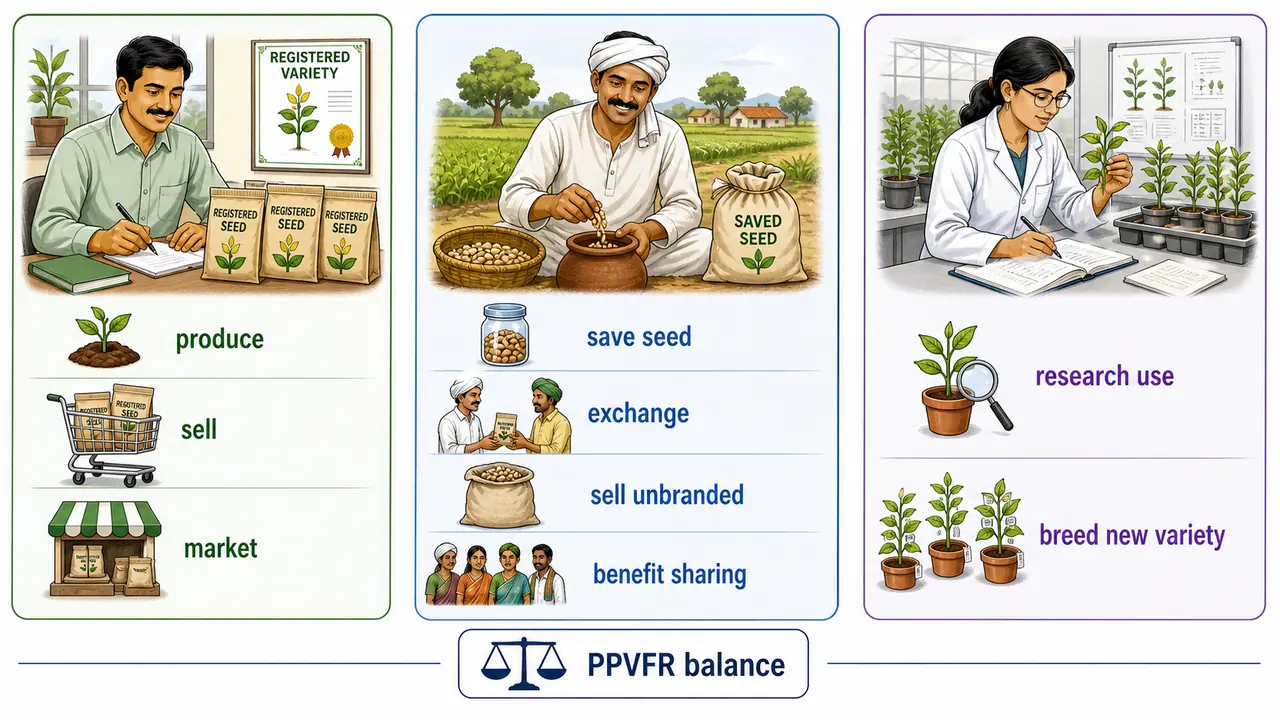
On registration of a particular variety, the plant breeder has rights of commercialization for the registered variety either in his/her own person or through a designated person. These rights include the right to produce, sell, market, distribute, import or export a variety, in short, full control over formal marketing. This comprehensive set of rights ensures that breeders can monetize their innovations.
-
Violation of the breeder's right can be construed at several levels. It applies to the variety itself as also to its packaging. Infringement will be established if the packaging is the same or even similar, such that the package could appear to be that of the Breeder. Legally, a similar looking package will be considered "Passing Off" and so actionable. Anyone other than the breeder cannot use the registered name or denomination. The use of the same or similar name in any way, by action or even suggestion, will constitute a violation and will be punishable. Penalties are prescribed for applying false denomination and for selling varieties to which false denomination is applied.
Farmers Rights
👉🏻 The Act recognizes the farmer not just as a cultivator but also as a conserver of the agricultural gene pool and a breeder who has bred several successful varieties. This three-dimensional recognition of the farmer's role is unique to the Indian legislation.
-
There are provisions for such farmers' varieties to be registered with the help of NGOs so that they are protected against being scavenged by formal sector breeders.
-
The law allows the farmer to sell seed in the way he has always done, with the restriction that this seed cannot be branded with the Breeder's registered name. This preserves the traditional right of farmers to save, use, exchange, and sell farm-saved seed.
-
In this way, both farmers and breeders' rights are protected. The breeder is rewarded for his innovation by having control of the commercial market place but without being able to threaten the farmers' ability to independently engage in his livelihood, and supporting the livelihood of other farmers.
-
Apart from the right to sell non-branded seed of protected varieties, the rights of farmers and local communities are protected in other ways too.
-
There are provisions for acknowledging the role of rural communities as contributors of landraces and farmer varieties in the breeding of new plant varieties. This recognition of traditional knowledge is a progressive feature of the Act.
-
Breeders wanting to use farmers varieties for creating Essentially Derived Varieties (EDVs) cannot do so without the express permission of the farmers involved in the conservation of such varieties. EDVs are varieties predominantly derived from an initial variety that retain most of its essential characteristics.
-
Any one is entitled to register a community's claim and have it duly recorded at a notified center. This intervention enables the registration of farmer varieties even if the farmers themselves cannot do this due to illiteracy or lack of awareness. If the claim on behalf of the community is found to be genuine, a procedure is initiated for benefit sharing so that a share of profits made from the use of a farmer variety in a new variety goes into a National Gene Fund. This fund is used for the conservation and sustainable use of genetic resources.
TIP
Under PPVFR Act, farmers have three key rights: (1) Save, use, exchange, sell farm-saved seed (but not branded). (2) Register farmer varieties through NGOs. (3) Benefit sharing through the National Gene Fund when their varieties are used by breeders.
Protection against Bad Seed
- In providing a liability clause in the section on Farmers Rights, the farmer in principle is protected against the supply of spurious and/or poor-quality seed leading to crop failures. This is a powerful consumer protection provision. But at present there is too much left to the discretion of the Plant Variety Authority which will fix the compensation. This could lead to arbitrary decisions and should be amended. (Sahai, 2001 a,b)
Rights of Researchers
-
All IPR systems must strike a balance between the monopoly granted to the IPR holder, in this case the plant breeder, and the benefits to society, in this case the farmers and consumers. Since nobody concerned with public interest would want plant breeding to shift into just a few hands, it is important to maintain competition and vitality in the plant breeding sector.
-
That is why freedom and rights for other researchers to use all genetic material, including IPR protected material, is important. The Bill has provisions for researcher's rights which allows scientists and breeders to have free access to registered varieties for research. The registered variety can also be used for the purpose of creating other, new varieties.
-
The breeder cannot stop other breeders from using his/her variety to breed new crop varieties except when the registered variety needs to be used repeatedly as a parental line. In that case authorization is required. This exception protects the breeder's commercial interest in hybrid seed production.
-
There is however some difference of opinion. Some view that the Indian law actually grants very restricted rights to researchers because of the acknowledgment of Essentially Derived Varieties (EDV). It is felt that all kinds of research will become subject to the breeder's authorization if a protected variety is used for research. In the Indian Act, the Breeder's authorization is needed for making EDVs.
Protection of Public Interest
-
The PPV legislation includes public interest clauses, like exclusion of certain varieties from protection and the grant of Compulsory Licensing. These safeguards ensure that IPR protection does not come at the expense of food security or public welfare.
-
To secure public interest, certain varieties may not be registered if it is felt that prevention of commercial exploitation of such variety is necessary to "protect order or public morality or human, animal and plant life and health or to avoid serious prejudice to the environment".
-
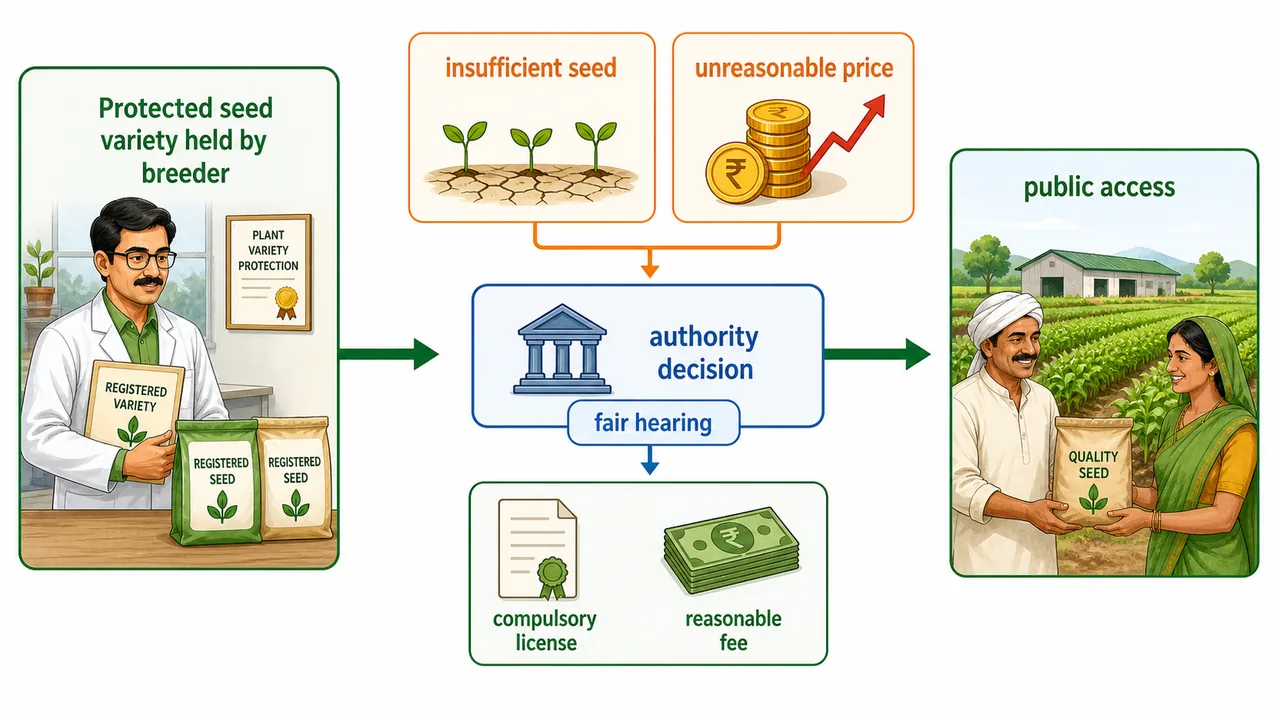
The Act also provides for the granting of compulsory license to a party other than the holder of the Breeders certificate if it is shown that the reasonable requirements for seeds have not been satisfied or that the seed of the variety is not available to the public at a reasonable price. The breeder is entitled to file an opposition but should the charge be valid, the breeder may be ordered by the Authority to grant a compulsory license under certain terms and conditions including the payment of a reasonable license fee. Compulsory License however will not be awarded if the Breeder can demonstrate reasonable grounds for his inability to produce the seed.
NOTE
Compulsory licensing under PPVFR Act can be granted when: (1) Seed is not available in sufficient quantity, or (2) Seed is not available at a reasonable price. The breeder can oppose the order and must be given a fair hearing.
DNA finger printing and seed Registration
-
Conventionally, morphological descriptors are routinely used for establishing the identity of varieties. But these morphological descriptors suffer from many drawbacks such as influence of environment on trait expression, epistatic interactions, pleiotropic effects etc. A variety may look different in different environments, making morphological identification unreliable.
-
Furthermore, the paucity of sufficient number of these descriptors for unequivocal identification of increasing number of reference collection of varieties enforces to look for alternatives.
-
Electrophoresis of seed proteins and isozyme analysis have overcome these limitations to some extent but now many powerful DNA based techniques are available. Since all genetic differences between individuals are laid down in the primary sequence of their genomic DNA, the straightforward method of identification of crop varieties and parental lines would be to determine this sequence for the genome under comparison. Sequencing requires huge monetary investment and it is practically impossible to sequence the whole genomes of all varieties. But with the automation in sequencing now possible, short stretches of amplified DNA can be sequenced. However, a more practical strategy would be to limit the comparisons to specific regions of the genome, which frequently differ between individuals like RFLP as a DNA profiling technique.
-
DNA fingerprinting, through its high precision in identifying plant genotypes, holds considerable promise as a reliable tool of intellectual property protection of crop varieties and germplasm. It provides a molecular identity card for each variety that is independent of environmental conditions.

👉🏻 Only for Rajasthan State Exams
Varietal Identification and Release System in Rajasthan
- Regulations for state releases in Rajasthan are similar to those at central level. All state releases must go through varietal testing procedure before being finally released by the Rajasthan State Seed Sub-Committee (SSSC).
- Notification of state releases, however, is made by the Central Sub-Committee following proposals sent by the sponsoring agency through the SSSC. This two-tier process ensures both state-level relevance and national-level coordination.
The State Variety Evaluation Committee (SVEC)
- The State Variety Evaluation Committee (SVEC) is constituted by the SSSC and has the job of scrutinizing release proposals submitted by breeders and sponsoring agencies and deciding on the suitability of cultivars for release in Rajasthan. The SVEC makes recommendations to the SSSC for release of any cultivar. This committee acts as the technical gatekeeper, ensuring that only genuinely superior varieties are recommended.
Trials and vetting procedures
-
Material generated by breeders is evaluated in trials at research stations representative of the crop growing areas, under low and high fertility management. Entries showing significantly superior grain yield over national and state checks are then tested in state trials at other locations. The number of locations depends upon the spatial extent of the crop. After ascertaining a genotype's performance in the state for two years, promising material is channeled into the AICCIP testing procedure.
-
Cultivars are evaluated for three years in the coordinated trials - one year in Initial Evaluation Trials (IETs) and two years in Advanced Varietal Trials (AVTs). This multi-year, multi-location testing ensures that a variety performs consistently across different seasons and environments.

- Those showing significant superiority over national/state checks with respect to grain yield, maturity and reactions to diseases and pests become eligible for identification by AICCIP at its annual workshop for submitting release proposal to the Central Sub-Committee.
Seed producers
-
There are five producers of foundation and certified seed in Rajasthan:
-
The Rajasthan State Seed Corporation (RSSC): The corporation was established in 1978 under NSP (National Seeds Project) Phase II, and the functions of the Seed Production Scheme of GOR were transferred to it. RSSC is the only public sector agency in the state engaged in seed production of foundation and certified seed of all major crops. As well as producing seed at its own farms, a major part of its production is through contract growing by individual seed growers and producers.
-
National Seeds Corporation (NSC): NSC was a significant seed producer in Rajasthan until the early 1980s, but since then its programme has been considerably reduced.
-
State Farms Corporation of India (SFCI): SFCI is a fairly large seed producer. It has three Central State Farms located in Ganganagar district, which produce foundation and certified seed of varieties of Wheat, Cotton and Chickpea.
-
Rajasthan Agricultural University (RAU): The university is mainly concerned with the production of breeder and foundation seed. As the breeding institution, RAU is the source of the purest genetic stock.
-
Private Seed Companies: The private sector is a major seed producer. Companies mainly produce foundation and certified seed of cotton, wheat, chickpea, mustard and groundnut. The private sector has grown rapidly, driven by the increasing demand for quality seed and hybrid varieties.
-
Rajasthan State Seed Certification Agency (RSSCA)
- Until 1978, NSC was responsible for seed certification in the state. The Rajasthan State Seed Certification Agency (RSSCA) was then set up and took over the task. This transition allowed for more localized and responsive certification services.
- The representatives of RSSCA inspect plots producing foundation and certified seed that are offered for certification, and supervise processing and labelling of seed at 77 registered processing plants, spread over the state. This extensive network ensures that seed quality is monitored at every stage of production across Rajasthan.
Summary Cheat Sheet
| Concept / Topic | Key Details |
|---|---|
| IPR | Intellectual Property Rights — legal protection for inventions/creations |
| Patent | Exclusive right for invention; valid 20 years |
| PPVFR Act | Protection of Plant Varieties and Farmers' Rights Act, 2001 (India) |
| PPVFR authority | PPV&FRA — Plant Variety Protection & Farmers' Rights Authority |
| DUS test | Distinctness, Uniformity, Stability — criteria for variety registration |
| Breeders' rights | Exclusive right to produce/sell seed of registered variety |
| Farmers' rights | Save, use, sow, re-sow, exchange, share seed (PPVFR Act) |
| Farmers cannot | Sell branded seed of protected variety |
| Researchers' rights | Use registered variety for research and breeding |
| UPOV | International Union for Protection of New Varieties of Plants (1961) |
| UPOV protection period | 20 years (25 for trees and vines) |
| Essentially Derived Variety | Predominantly derived from initial variety; needs permission |
| Sui generis system | India's PPVFR is sui generis (unique system balancing breeders + farmers) |
| Compulsory licensing | Government can license if variety not available at reasonable price |
| Benefit sharing | Communities compensated for contribution to genetic resources |
| TRIPS | Trade-Related Aspects of IPR (WTO agreement) |