🍯 Seed Treatment: Methods, Types, and Examples
Understand seed treatment methods (chemical, biological, physical), types of seed dressing, seed coating, and pelleting — with agricultural examples and exam tips.
Why Seed Treatment Matters in Agriculture
Treating wheat seeds with Carboxin or Thiram before sowing can prevent loose smut and other seed-borne diseases, protecting the entire crop at minimal cost. Rhizobium seed inoculation in pulses fixes atmospheric nitrogen, reducing fertiliser needs. Seed treatment is one of the most cost-effective crop protection measures — a small investment at sowing time that pays dividends throughout the season.
Seed Treatment
👉🏻 Besides breaking seed dormancy, seed treatment is also done before sowing the seeds for the following purposes:
- To protect from seed borne diseases and insect pests damage. Treating seeds with fungicides or insecticides creates a protective zone around the germinating seed, shielding it during its most vulnerable stage.
- To promote quick germination by breaking dormancy. Certain treatments accelerate the onset of germination, leading to faster and more uniform crop establishment.
- To have convenience in sowing. Ex. removing fuzz in cotton with conc. H2SO4. Delinting cotton seeds with acid removes the lint fiber that otherwise makes handling and mechanical sowing difficult.
- To hasten nitrogen fixation capacity in case of pulses. Ex. Rhizobium culture. Inoculating legume seeds with the appropriate Rhizobium strain ensures that root nodules form early, boosting biological nitrogen fixation.
- To induce earliness (Vernalization treatment). Exposing seeds to cold temperatures before sowing can satisfy the chilling requirement of certain crops, causing them to flower and mature earlier.
Treatment for Diseases and Insects control
(a) Physical treatment
-
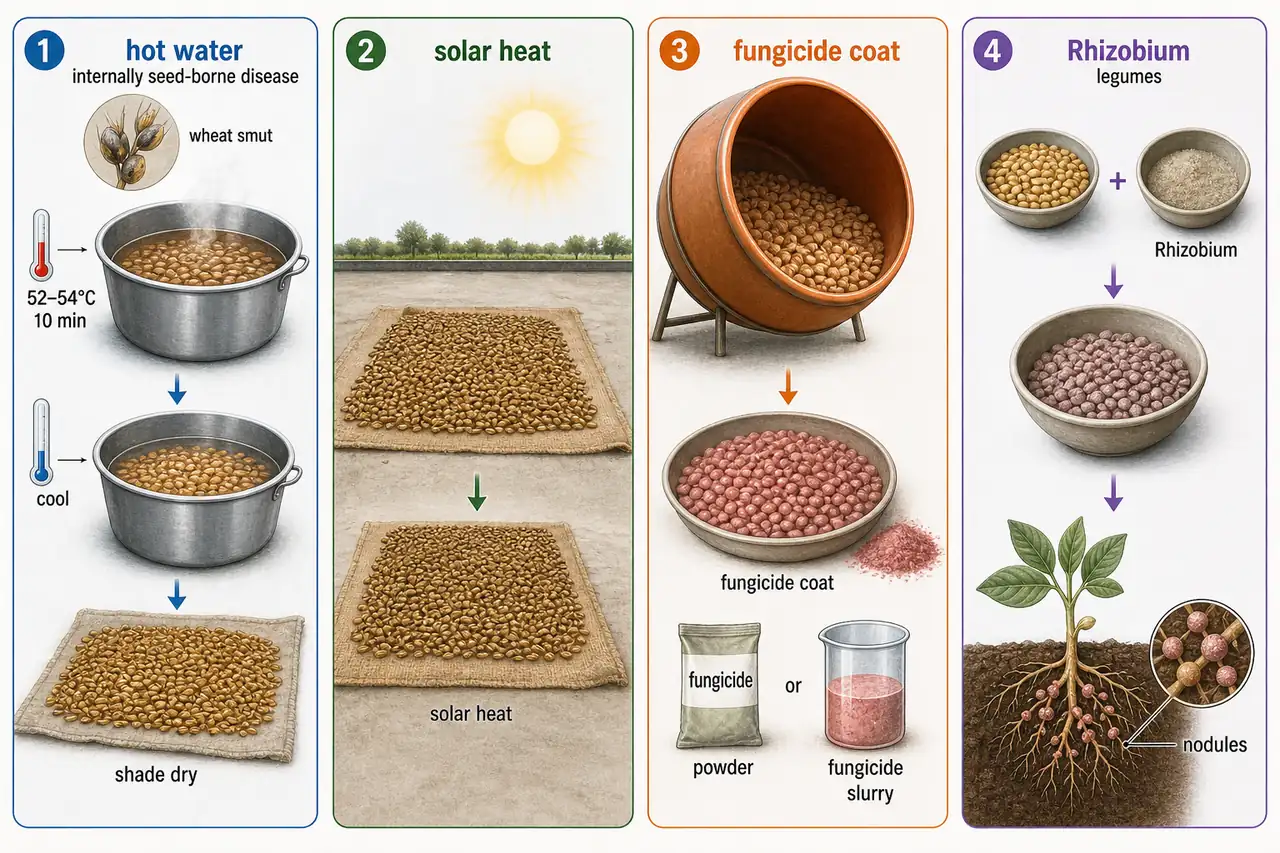
(i) Hot water treatment: Seeds are kept in hot water at a certain temperature for certain period. Later on, after cooling in cold water such seeds are dried in shade. The heat kills pathogen mycelium and spores present inside and on the seed surface without damaging the embryo. This method is successful in controlling following diseases:
Pro Content Locked
Upgrade to Pro to access this lesson and all other premium content.
₹99 charged monthly · Cancel anytime
- All Agriculture & Banking Courses
- AI Lesson Questions (100/day)
- AI Doubt Solver (50/day)
- Glows & Grows Feedback (30/day)
- AI Section Quiz (20/day)
- 22-Language Translation (100/day)
- Recall Questions (20/day)
- AI Quiz (15/day)
- AI Quiz Paper Analysis (100/day)
- AI Step-by-Step Explanations (100/day)
- Spaced Repetition Recall (FSRS)
- AI Tutor
- Immersive Text Questions
- Audio Lessons — Hindi & English
- Mock Tests & Previous Year Papers
- Summary & Mind Maps
- XP, Levels, Leaderboard & Badges
- Generate New Classrooms
- Voice AI Teacher (AgriDots Live)
- AI Revision Assistant
- Knowledge Gap Analysis
- Interactive Revision (LangGraph)
🔒 Secure via Razorpay · Cancel anytime · No hidden fees
Why Seed Treatment Matters in Agriculture
Treating wheat seeds with Carboxin or Thiram before sowing can prevent loose smut and other seed-borne diseases, protecting the entire crop at minimal cost. Rhizobium seed inoculation in pulses fixes atmospheric nitrogen, reducing fertiliser needs. Seed treatment is one of the most cost-effective crop protection measures — a small investment at sowing time that pays dividends throughout the season.
Seed Treatment
👉🏻 Besides breaking seed dormancy, seed treatment is also done before sowing the seeds for the following purposes:
- To protect from seed borne diseases and insect pests damage. Treating seeds with fungicides or insecticides creates a protective zone around the germinating seed, shielding it during its most vulnerable stage.
- To promote quick germination by breaking dormancy. Certain treatments accelerate the onset of germination, leading to faster and more uniform crop establishment.
- To have convenience in sowing. Ex. removing fuzz in cotton with conc. H2SO4. Delinting cotton seeds with acid removes the lint fiber that otherwise makes handling and mechanical sowing difficult.
- To hasten nitrogen fixation capacity in case of pulses. Ex. Rhizobium culture. Inoculating legume seeds with the appropriate Rhizobium strain ensures that root nodules form early, boosting biological nitrogen fixation.
- To induce earliness (Vernalization treatment). Exposing seeds to cold temperatures before sowing can satisfy the chilling requirement of certain crops, causing them to flower and mature earlier.
Treatment for Diseases and Insects control
(a) Physical treatment
-
(i) Hot water treatment: Seeds are kept in hot water at a certain temperature for certain period. Later on, after cooling in cold water such seeds are dried in shade. The heat kills pathogen mycelium and spores present inside and on the seed surface without damaging the embryo. This method is successful in controlling following diseases:
- Loose smut of Wheat (54 degrees C for 10 minutes)
- Loose smut of Barley (54 degrees C for 13 minutes)
- Alternaria blight of Wheat (38 degrees C for 10 minutes)
- Leaf spot of Til (54 degrees C for one hour)
-
(ii) Solar heat treatment: After soaking the seeds in water for some hours, seeds are dried in scorching sun in the month of May-June by keeping on cemented floor or metal-sheet. The intense solar heat raises the seed temperature enough to kill internal pathogens. This method is used to control loose smut of Wheat and Barley. (Loothrs and Satar). It is a cost-effective alternative to hot water treatment, especially useful in tropical and subtropical regions.
TIP
Hot water treatment is the standard method for controlling internally seed-borne diseases like loose smut. Remember: the temperature and duration are crop-specific -- even a few degrees difference matters.
(b) Chemical treatment
- Different fungicides e.g. Agrosan G.N., Ceresan, Captan, Thiram etc. are used for the same. These chemicals are applied as dry powders or slurries to coat the seed surface, providing a protective barrier against soil-borne and seed-borne fungi during the critical germination and seedling establishment phase.
(B) Seed Inoculations in Legumes
- Before sowing the legume crops in the new area, the legume seeds are to be inoculated with Rhizobium culture. This is especially important when the crop is being introduced to a field for the first time, as the specific Rhizobium strain may not be naturally present in the soil. Inoculation ensures effective root nodulation and biological nitrogen fixation, reducing the need for chemical nitrogen fertilizers.

Treatment in Important Crops
Different crops require specific seed treatment protocols depending on the diseases prevalent and the nature of the seed. Here is a crop-wise summary:
-
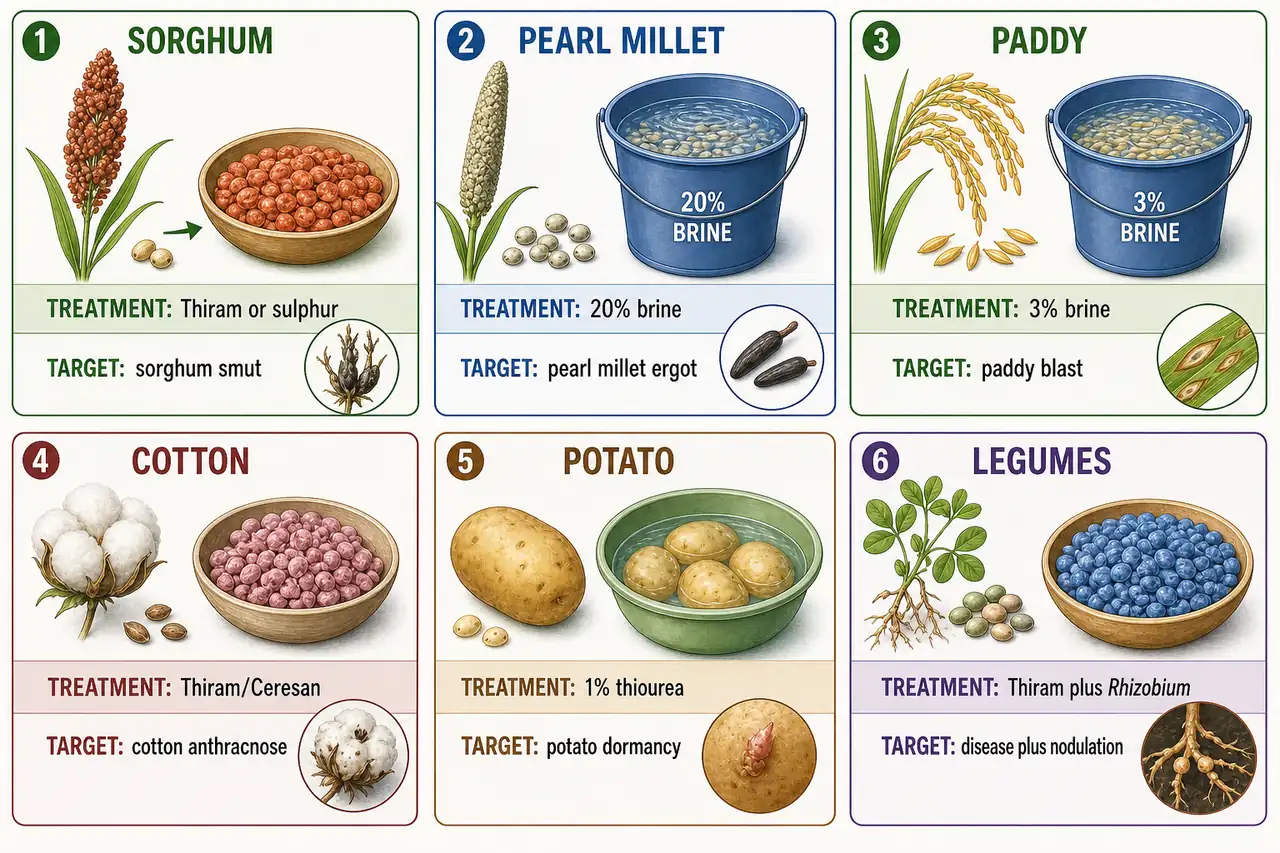
Sorghum: Thiram or 300 mesh sulphur: Seed is coated in seed dressing drum or earthen pot @ 3.4 g/kg seed against smut disease. Smut is one of the most economically damaging diseases of sorghum, and seed treatment is the most effective preventive measure.
-
Pearl Millet: Brine solution treatment is given @ 20 per cent against ergot and to discard light & diseased seed. When dipped in brine, healthy heavy seeds sink while light, diseased, or poorly filled seeds float and can be easily removed.
-
Paddy: Seed is treated with brine solution @ 3 per cent against blast of paddy and to discard unfilled seed. This dual-purpose treatment both removes empty grains and provides some disease protection.
-
Wheat & Oilseed crops: Seed is coated with Thiram or Bavistin @ 5 g/kg seed against seed borne diseases. This is a standard practice to protect against smuts, bunts, and other fungal pathogens.
-
Cotton: Seed is treated with organo mercurial compound like Ceresan, Agrosan @ 3 g or Thiram @ 5g against seed borne disease like anthracnose. Cotton seeds are particularly susceptible to several seed-borne pathogens, making treatment essential.
-
Small seeded crops like Sesamum, bajra, tobacco, etc; Seed is mixed with fine sand or soil for even sowing of seed in the field. Because these seeds are tiny, mixing with an inert carrier ensures uniform distribution in the furrow.
-
Potato:
- Seed is dipped in 1 per cent Thiourea solution for breaking the seed dormancy. Potato tubers often exhibit dormancy after harvest, and thiourea treatment hastens sprouting for timely planting.
- Seed is dipped in streptomycin solution @200 g in 100 lit. Water for 1 hour against Ring rot disease. Ring rot is a bacterial disease, so an antibiotic treatment is needed rather than a fungicide.
-
Legume crops like Mung, Urd, Soybean etc.
- Seed is treated with Thiram @3 g/kg seed against seed borne disease.
- Seed is treated with Rhizobium culture @ 250g/10kg seed for 'N' fixation & better nodulation. It is important to apply Rhizobium after the fungicide treatment to avoid killing the beneficial bacteria, or to use compatible formulations.
-
Sugarcane:
- A small terminology recall point often asked in seed-technology MCQs is that true sugarcane seeds are called fuzz or fluff.
- Hot water treatment (50 degrees C) or hot air treatment (54 degrees C) is given to sets for 2 hrs. Against grassy shoot & other diseases. These systemic diseases cannot be controlled by surface treatment, so heat must penetrate the sett tissue.
- Sets are treated with OMC 6 per cent @ 500g in 100 lit. Water by dipping for 5 min. against smut & increase germination or Bavistin @ 200g in 100 lit. for 5 min.
| Crop | Treatment | Dose | Target Disease |
|---|---|---|---|
| Sorghum | Thiram / Sulphur | 3.4 g/kg | Smut |
| Pearl Millet | Brine solution | 20% | Ergot |
| Paddy | Brine solution | 3% | Blast |
| Wheat | Thiram / Bavistin | 5 g/kg | Seed borne diseases |
| Cotton | Ceresan / Thiram | 3-5 g | Anthracnose |
| Potato | Thiourea | 1% solution | Dormancy breaking |
| Legumes | Thiram + Rhizobium | 3 g/kg + 250g/10kg | Disease + N-fixation |
| Sugarcane | Hot water / hot air | 50-54°C for 2 hrs | Grassy shoot |
Seed Plot technique of Potato
- It was given by Pushkarnath in 1967. This technique is a cornerstone of virus-free potato seed production in India.
Objective:
-
To produce seeds free from virus Y, A, X and S. These viruses are transmitted by aphids. Since aphids are the primary vector, the strategy revolves around producing seed in locations and seasons when aphid populations are minimal.
-
Aphid population is low in hills during April to August while it is low in the plains during October to early January. This seasonality is the key insight behind the technique.
-
Nucleus seed of potato is produced in the hills during April to August when aphid population is low. The cool hill environment naturally suppresses aphid activity.
-
It is brought to plains and is stored in cold-storage for planting the seed crop in October.
-
The seed production practices are:
- Start with disease free seed stock -- the foundation of quality potato seed production.
- Select suitable location i.e. aphids free during crop growth -- choose areas and seasons with minimal vector activity.
- Adopt lands isolation and other requirement of certified seed production -- prevent contamination from neighboring potato fields.
- Rouging and inspection of crops -- remove any virus-infected plants promptly to prevent spread.
- Other good crop management -- proper nutrition, irrigation, and pest control support healthy, vigorous seed tuber production.
IMPORTANT
Pushkarnath's Seed Plot Technique (1967): Produce nucleus seed in hills (April-August) when aphid population is low → Store in cold storage → Plant in plains (October) when aphid population is again low. The key principle is avoidance of aphid vectors to prevent virus transmission.
Indian Seed Industry
-
Seed is the critical determinant of agricultural production on which depends the performance and efficacy of other inputs. No amount of fertilizer, irrigation, or crop protection can compensate for poor quality seed.
-
Quality seeds appropriate to different agro-climatic conditions and in sufficient quantity at affordable prices are required to raise productivity. Matching the right variety to the right region is just as important as the seed's genetic purity.
-
Quality seed alone can increase in the productivity at least 10-15% (ICAR 1993). This statistic underscores why seed quality improvement is one of the most cost-effective interventions in agriculture.
-
The Indian seed industry is the eighth largest in the world. India has a diverse seed sector with both public and private players contributing to seed production and distribution.
-
First private seed company: Sutton and Sons (1912, Kolkata). This marks the beginning of organized commercial seed activity in India.
-
Indian seed industry annual growth rate of 12% to 13%. This rapid growth reflects increasing farmer awareness and demand for quality seed.
-
In exam-oriented agriculture notes, Jalna, Maharashtra is often recalled as the seed capital of India, reflecting the region's strong concentration of seed production and seed-industry activity.
-
The Planning Commission in its Mid-Term Appraisal of the 10th Five Year Plan (2002-07) has concluded as follows with regard to seeds:
"Despite a huge institutional framework for seed production both in the public and private sector, availability of good quality seeds continues to be a problem for the farmers. As a result, they prefer to rely on farm saved seeds; seed replacement rate continues to remain in the range of 2-10 per cent in certain states for certain crops, which is much below the desired level of 20 per cent for most crops. As is well known, seed replacement rate has a strong positive correlation with the productivity and production of crops. There is a need to rejuvenate the seeds sector through revamping the public sector seed companies, including the State Seed Corporations".
- The desirable seed replacement rates, without which it is not possible to achieve higher productivity are 25% for self-pollinated crops, 35% for cross pollinated crops and 100% for hybrids. Hybrids must be replaced every season because their vigor (heterosis) is lost in subsequent generations.
Seed Replacement Rate of Select Crops
- Seed Replacement Rate (SRR) is the rate at which farmers replace their farm-saved seeds with certified/quality seeds. A higher SRR indicates greater adoption of improved varieties.
- It is the percentage of area sown out of total area of crop planted in the season by using certified/quality seeds other than the farm saved seed.
- The seed replacement rate in India is around 15-20% which may vary with crop varieties. However, it will be 100% for hybrid seeds.
Formula:
SRR = (x / y) x 100
Where:
- x = Quantity of actual quality seed sown / used in an area / location
- y = Quantity of quality seed (certified) required for the entire production area / location

Seed Multiplication Ratio
👉🏻 It is the ratio of seed yield per seed generation i.e. how many seeds are produced from a single seed when it is sown and harvested. This ratio varies greatly among crops and is critical for planning seed production to meet demand. According to the Expert Group of Seeds (1989), the seed multiplication ratios for different crops are as follows:

| Crop | Ratio | Crop | Ratio |
|---|---|---|---|
| Wheat | 1:20 | Lucerne | 1:25 |
| Paddy (Hybrids) | 1:100 | Oats | 1:15 |
| Paddy (Varieties) | 1:80 | Okra | 1:100 |
| Maize (Varieties) | 1:80 | Tomato | 1:400 |
| Maize (Hybrids) | 1:100 | Brinjal | 1:450 |
| Sorghum | 1:100 | Chillies | 1:240 |
| Bajra | 1:200 | Watermelon | 1:100 |
| Ragi | 1:80 | Pumpkin | 1:160 |
| Gram | 1:10 | Bittergourd | 1:41 |
| Blackgram | 1:40 | Bottlegourd | 1:99 |
| Greengram | 1:40 | Ridgegourd | 1:83 |
| Cowpea | 1:40 | Cucumber | 1:200 |
| Horsegram | 1:40 | French bean | 1:9 |
| Mothbean | 1:40 | Clusterbean | 1:50 |
| Redgram | 1:100 | Peas | 1:19 |
| Colecrops | 1:433 | Onion | 1:171 |
| Potato | 1:4 | Radish | 1:100 |
| Groundnut | 1:8 | Carrot | 1:83 |
| Linseed | 1:50 | Mustard & Rape | 1:100 |
| Cotton | 1:50 | Soybean | 1:16 |
| Jute | 1:100 | Sunflower | 1:50 |
| Mesta | 1:40 | Sesame | 1:250 |
| Sunhemp | 1:30 | Safflower & Castor | 1:60 |
| Berseem | 1:10 |
TIP
Potato has the lowest SMR (1:4) among all crops listed. French bean (1:9) and Groundnut (1:8) also have very low ratios. In contrast, Brinjal (1:450), Colecrops (1:433), and Tomato (1:400) have the highest multiplication ratios.
Seed Standards for Moisture Content
Seed moisture content is critical for safe storage and maintaining seed viability. The prescribed maximum moisture content standards (%) for certification of different crops are:
| Crop | Moisture (%) | Crop | Moisture (%) |
|---|---|---|---|
| Paddy | 12 | Onion | 8.0 |
| Maize | 12 | Carrot | 8.0 |
| Sorghum, Cumbu & Ragi | 12 | Beet root | 9.0 |
| Wheat | 12 | Radish | 6.0 |
| Barley | 12 | Barley | 12 |
| Soybean | 12 | Berseem | 10 |
| Pearl millet | 12 | Lucerne | 10 |
| Oats | 12 | Oats | 12 |
| Black Gram | 9.0 | Rapeseed mustard | 8.0 |
| Groundnut | 9.0 | Clusterbean | 9.0 |
| Sesame | 9.0 | Cowpea | 9.0 |
| Sunflower | 9.0 | French Bean | 9.0 |
| Jute | 9.0 | Kol-Khol | 7.0 |
| Mesta | 8.0 | Amaranthus | 8.0 |
| Cotton | 10 | Lettuce | 8.0 |
| Castor | 8.0 | Brinjal | 8.0 |
| Cucurbits | 7.0 | Chilli | 8.0 |
| Brinjal & Chillies | 8.0 | Okra | 10.0 |
| Bhendi | 10 | Sunhemp | 10.0 |
| Tomato | 8.0 | Cabbage & Cauliflower | 7.0 |
Types of Seed Treatment
Seed treatment is a biological, chemical, mechanical or physical process designed to mitigate seed borne pests and improve the quality of seed. There are three main types of special seed treatments:
Seed Dressing
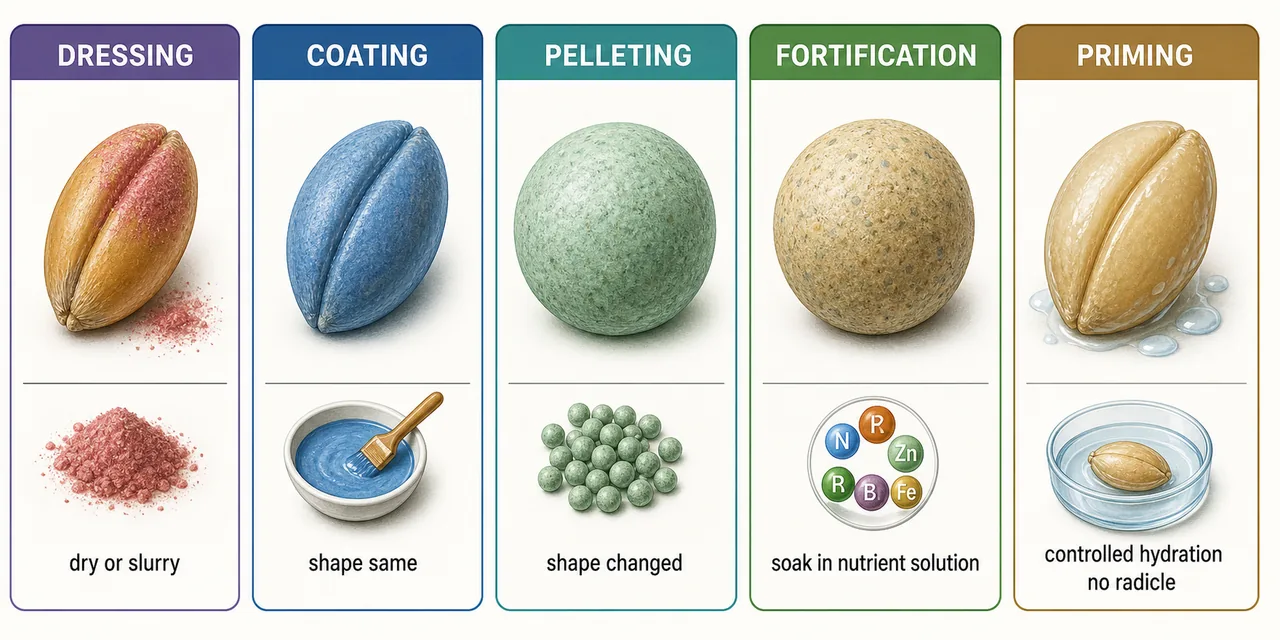
- In this method, the seed is dressed with either a dry formulation or wet treated with a slurry or liquid formulation.
- Dressings can be applied at both farm and industrial level.
- Low cost earthen pots can be used for mixing pesticides with seed, or seed can be spread on a polythene sheet and the required quantity of chemical can be sprinkled on the seed lot and mixed mechanically by the farmers.
Seed Coating
- Seed coating is defined as the substance applied to seed that does not obscure its shape.
- Seed coating examples include fungicides, microbiological treatments and micronutrients.
- The major benefit is that the seed enhancement material is placed directly on the seed.
Seed Pelleting
- The most sophisticated seed treatment technology, resulting in changing the physical shape of a seed to enhance plantability and handling.
- Pelleting requires specialized application machinery and techniques and is the most expensive of the applications.
IMPORTANT
Key difference: Seed dressing = surface application (dry/slurry); Seed coating = does NOT change shape; Seed pelleting = CHANGES the physical shape of seed. Pelleting is the most expensive method.
Seed Fortification
- Seed fortification is the impregnation of required substance for invigorating the seeds for improved production.
- Seeds are soaked either in water or dilute solution of bio active chemicals such as micro nutrients, growth regulators, vitamins and seed protectants.
- The main objective is to achieve high vigour to overcome unfavourable soil reactions.
- Example: Seed fortification with MnSO4 @ 0.5 to 1% will improve oxidation-reduction potential of seeds, which ultimately leads to higher germination.
Seed Priming
- It is the process of controlled hydration of seeds to a level that permits pre-germinative metabolic activity to proceed, but prevents actual emergence of the radicle.
- Seed priming is used to increase rate of germination and uniformity. Subsequently, the seeds are dried, distributed and planted in the usual way.
- Primed seed usually exhibits more rapid and uniform emergence of seedlings from the soil compared to non-primed seed of the same seed lot.
Types of Seed Priming
| Type | Method |
|---|---|
| Osmo priming | Soaking the seeds in osmotic solutions |
| Halo priming | Soaking the seeds in salt solutions |
| Bio priming | Soaking the seeds with biological agent's solution like Bacteria, Rhizobium etc. |
| Solid priming | Mixing seeds in an organic or inorganic carrier and water for a particular period |
| Matrix priming | Mixing with moist solid particulate materials such as exfoliated vermiculite, diatomaceous earth or lignaceous shale |
| Hydropriming | Soaking in water for short period of time |
NOTE
Mnemonic for 6 types of seed priming: Osmo, Halo, Bio, Solid, Matrix, Hydro -- remember as "Oh Honey, Bring Some More Honey"
Additional Important Facts
- Block system is adopted for hybrid seed production in: Cotton
- An example of triploid endosperm is: Seedless grapes
- An alloautogamous oil seed is: Sesame
- Central Seed Technology Laboratory was established during: 1960
- Cotyledons serve as sole food storage organ in: Non-endospermic seed
- During processing, the genetic purity assessment is taken in: Maize
- Ear to row progeny method is adopted in production of: Nucleus seed
- Endosperm present in legume: Only in Fabaceae seed
- Example for hysterogeocarpic fruit: Groundnut
- Failure of seed to grow under unfavorable condition is known as: Quiescence
- Food supply to seed by: Endosperm and cotyledons
- Genetic purity in the field is controlled through: Rouging
- Genetic purity maintained during hybrid seed production: Isolation Distance
- Grow out test is must for hybrid of: Cotton
- In self-pollinated crop, genetic purity maintained by: Mass selection
- Indian seed certification rules are based on rules proposed by: OECD
- Isolation could be modified based on number of border rows in: Maize
- ISTA was established during: 1924
- Karnal bunt of wheat can be identified by: NaOH soaking test
- Malachite green test used to identify: Mechanical damage
- KOH test is conducted to identify the: Varieties
- Male sterility is first identified in: Onion
- Most allium seed have: Morph physiological dormancy
- Most legume seed are: Non-endospermic
- Natural inhibitor present in seed: ABA
- Phenol test is conducted in: Wheat
- Pollen shadder found in which crop: Maize
- Pollination in cotton occurs by: Often cross pollination
- Pustovit model is followed in: Sunflower
- Seed control order was passed in: 1983
- Seed production using polyploids is common in: Sugarcane
- T2 test estimates: Seed viability
Summary Cheat Sheet
| Concept / Topic | Key Details / Explanation |
|---|---|
| Purposes of Seed Treatment | Protect from seed-borne diseases/pests; promote germination; sowing convenience; enhance N-fixation; induce earliness via vernalization |
| Hot Water Treatment — Loose Smut of Wheat | 54°C for 10 minutes |
| Hot Water Treatment — Loose Smut of Barley | 54°C for 13 minutes |
| Hot Water Treatment — Alternaria Blight of Wheat | 38°C for 10 minutes |
| Hot Water Treatment — Leaf Spot of Til | 54°C for one hour |
| Solar Heat Treatment | Seeds soaked → dried in scorching sun (May-June); controls loose smut of Wheat and Barley |
| Chemical Treatment | Fungicides: Agrosan G.N., Ceresan, Captan, Thiram applied as dry powder or slurry |
| Rhizobium Seed Inoculation | Done for legumes in new areas; promotes root nodulation and biological N-fixation |
| Sorghum | Thiram / 300 mesh sulphur @ 3.4 g/kg seed against smut disease |
| Pearl Millet | Brine solution @ 20% against ergot; floats away light/diseased seeds |
| Paddy | Brine solution @ 3% against blast; also removes unfilled seeds |
| Wheat & Oilseed crops | Thiram or Bavistin @ 5 g/kg seed against seed-borne diseases |
| Cotton | Ceresan/Agrosan @ 3g or Thiram @ 5g against anthracnose; acid delinting for sowing convenience |
| Potato — Dormancy breaking | 1% Thiourea solution soak |
| Potato — Ring rot | Streptomycin @ 200g/100 lit. water for 1 hour (bacterial disease → antibiotic) |
| Legumes (Mung, Urd, Soybean) | Thiram @ 3g/kg (disease) + Rhizobium culture @ 250g/10kg seed (N-fixation) |
| Sugarcane | Hot water (50°C) or hot air (54°C) for 2 hrs against grassy shoot; also Bavistin @ 200g/100 lit. |
| Seed Plot Technique | By Pushkarnath (1967); produces virus-free potato seed; nucleus seed produced in hills (April-Aug) when aphids are low → cold storage → plains planting in October |
| Indian Seed Industry Rank | 8th largest in the world |
| First private seed company in India | Sutton and Sons (1912, Kolkata) |
| Seed Industry Growth Rate | 12-13% annually |
| Seed Replacement Rate (India) | ~15-20% overall; 100% for hybrids (heterosis lost in next generation) |
| Desired SRR | Self-pollinated: 25%; Cross-pollinated: 35%; Hybrids: 100% |
| Seed Multiplication Ratio | Seeds produced per seed sown; Potato lowest (1:4); Brinjal highest (1:450) |
| Seed Moisture Standards | Cereals (Wheat, Paddy, Maize, Sorghum, Barley): 12%; Groundnut, Sesame, Blackgram: 9%; Cotton: 10%; Cucurbits: 7% |
| Seed Dressing | Dry or wet (slurry) formulation applied to seed surface; farm or industrial level |
| Seed Coating | Applied to seed surface; does NOT obscure/change seed shape; includes fungicides, micronutrients, bioagents |
| Seed Pelleting | Most sophisticated; CHANGES physical shape of seed; requires specialized machinery; most expensive |
| Seed Fortification | Impregnation with bio-active chemicals (micronutrients, growth regulators, vitamins, protectants); e.g., MnSO4 @ 0.5-1% |
| Seed Priming | Controlled hydration allowing pre-germinative metabolism without radicle emergence; improves germination rate and uniformity |
| Osmopriming | Seed soaked in osmotic solutions |
| Halopriming | Seed soaked in salt solutions |
| Biopriming | Seed soaked with biological agents (bacteria, Rhizobium) |
| Solid priming | Seeds mixed with organic/inorganic carrier + water |
| Matrix priming | Seeds mixed with moist solid particulates (vermiculite, diatomaceous earth) |
| Hydropriming | Soaking in water for a short period |
| ISTA established | 1924 |
| Central Seed Technology Laboratory | Established in 1960 |
| Seed Control Order | Passed in 1983 |
| Seed certification rules basis | Based on rules proposed by OECD |
| Phenol test | Conducted in Wheat (variety identification) |
| KOH test | Conducted to identify varieties |
| Malachite green test | Identifies mechanical damage |
| Karnal bunt identification | NaOH soaking test |
| Grow out test | Mandatory for hybrids of Cotton |
| Block system | Adopted for hybrid seed production in Cotton |
| T2 test | Estimates seed viability |