🌥 Plantation Crops — High-Value Crop Strategy in India
Complete guide to plantation crops and India’s region-specific high-value crop strategy covering coconut, cashew, cocoa, sandalwood, agarwood, and temperate nut crops.
Plantation Crops in India — High-Value Crop Lens
Plantation crops are commercially cultivated perennial crops that remain productive over many years and are usually linked with intensive management, processing, and market-oriented sale. In the present Indian policy context, plantation crops are also being viewed through the wider lens of high-value agriculture.
High-value crops are called “high value” because they usually generate higher returns per unit area than staple crops and create stronger opportunities for processing, branding, exports, and farmer income growth.
According to the current policy framing:
- horticulture contributes about 37% of the Gross Value Output within the crop sub-sector
- coastal, North Eastern, and hilly regions are being aligned to crop-specific diversification
- plantation-linked crops are being positioned as a core route for value addition and export growth
TIP
State-wise leadership in plantation crops is a high-frequency exam topic. Memorize the top producer for each crop along with its percentage share.
Pro Content Locked
Upgrade to Pro to access this lesson and all other premium content.
₹99 charged monthly · Cancel anytime
- All Agriculture & Banking Courses
- AI Lesson Questions (100/day)
- AI Doubt Solver (50/day)
- Glows & Grows Feedback (30/day)
- AI Section Quiz (20/day)
- 22-Language Translation (100/day)
- Recall Questions (20/day)
- AI Quiz (15/day)
- AI Quiz Paper Analysis (100/day)
- AI Step-by-Step Explanations (100/day)
- Spaced Repetition Recall (FSRS)
- AI Tutor
- Immersive Text Questions
- Audio Lessons — Hindi & English
- Mock Tests & Previous Year Papers
- Summary & Mind Maps
- XP, Levels, Leaderboard & Badges
- Generate New Classrooms
- Voice AI Teacher (AgriDots Live)
- AI Revision Assistant
- Knowledge Gap Analysis
- Interactive Revision (LangGraph)
🔒 Secure via Razorpay · Cancel anytime · No hidden fees
Plantation Crops in India — High-Value Crop Lens
Plantation crops are commercially cultivated perennial crops that remain productive over many years and are usually linked with intensive management, processing, and market-oriented sale. In the present Indian policy context, plantation crops are also being viewed through the wider lens of high-value agriculture.
High-value crops are called “high value” because they usually generate higher returns per unit area than staple crops and create stronger opportunities for processing, branding, exports, and farmer income growth.
According to the current policy framing:
- horticulture contributes about 37% of the Gross Value Output within the crop sub-sector
- coastal, North Eastern, and hilly regions are being aligned to crop-specific diversification
- plantation-linked crops are being positioned as a core route for value addition and export growth
TIP
State-wise leadership in plantation crops is a high-frequency exam topic. Memorize the top producer for each crop along with its percentage share.


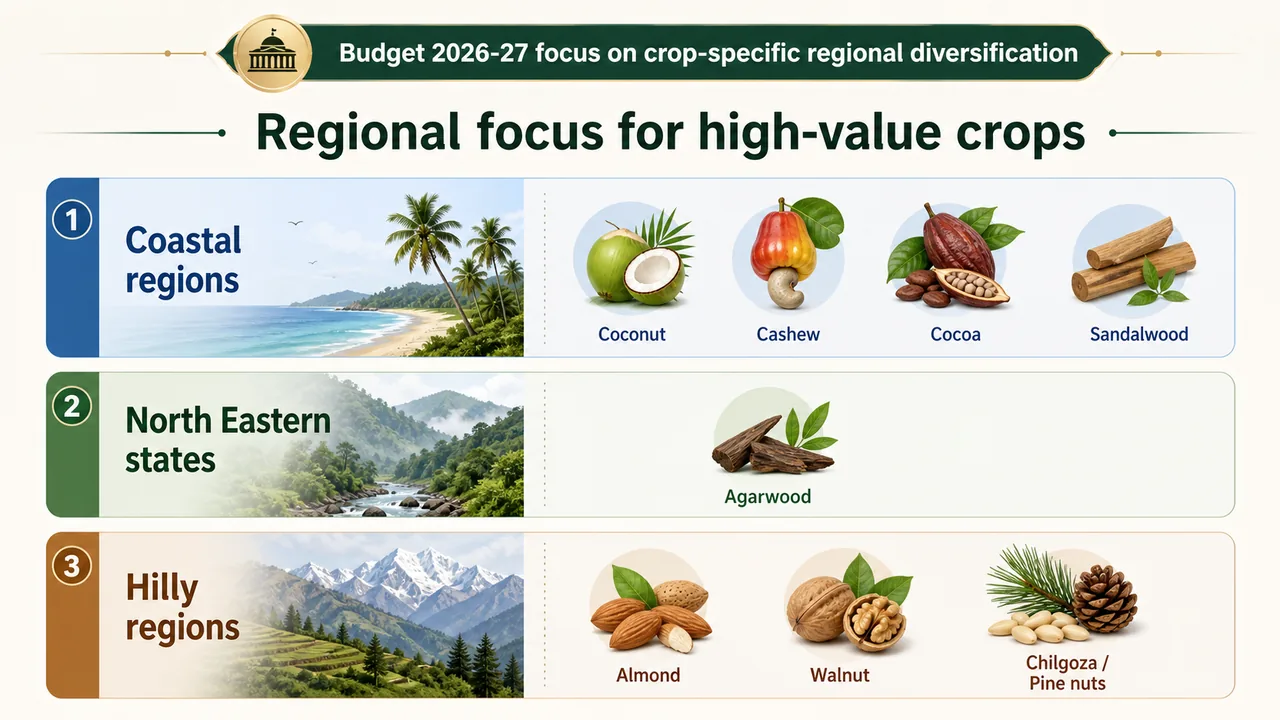
Understanding which state leads in which crop is still essential for competitive exams, but it now makes more sense when linked with this broader high-value-crop strategy.
- Largest total plantation crops producing state: Kerala (33%) > KR (27%) > TN (23%)
Kerala dominates overall plantation crop production with a 33% share, followed by Karnataka (KR) at 27% and Tamil Nadu (TN) at 23%. Together, these three southern states account for over 83% of India's total plantation crop output. This concentration is due to the tropical climate, well-distributed rainfall, and laterite soils found in these regions that are ideal for plantation agriculture.
- Largest Cashew nut producing state: Maharashtra
Maharashtra is the leading producer of cashew nuts in India. Cashew thrives in the coastal regions of the state, particularly in the Konkan belt (Sindhudurg, Ratnagiri districts). The crop prefers well-drained laterite soils and a warm, humid climate, both of which are abundantly available along Maharashtra's western coast.
- Largest Areca Nut producing state: Karnataka
Karnataka leads in areca nut (also known as betel nut or supari) production in India. The major areca nut growing districts include Shimoga, Uttara Kannada, Dakshina Kannada, and Chikmagalur. Areca nut is an important commercial crop for farmers in these areas and is widely used in the preparation of pan masala and traditional betel quid.
- Largest Coconut producing state: Kerala
Kerala is the largest producer of coconut in India. Often called the "Land of Coconuts", Kerala's economy has historically been closely linked with coconut cultivation. The crop is grown extensively across all districts of the state. Coconut requires a warm, humid tropical climate with well-distributed rainfall and sandy loam or laterite soils — conditions that Kerala provides in abundance.
- Largest Cocoa producing state: Kerala
Kerala also holds the top position in cocoa production in India. Cocoa is largely grown as an intercrop in coconut and areca nut plantations, making it a natural fit for Kerala's existing plantation landscape. The shade provided by coconut palms creates ideal growing conditions for cocoa, which is a shade-loving crop. Other significant cocoa-growing states include Karnataka, Andhra Pradesh, and Tamil Nadu.
Summary Cheat Sheet
| Concept / Topic | Key Details / Explanation |
|---|---|
| Plantation-crop concept | Plantation crops are commercial perennial crops managed intensively for long-term production, processing, and market sale, and they are now framed within high-value agriculture. |
| Why they are called high-value crops | They generate higher returns per unit area than staples and create stronger opportunities for processing, branding, export growth, and farmer income improvement. |
| Current policy lens | Horticulture contributes about 37% of crop-sector Gross Value Output, and coastal, North Eastern, and hilly belts are being aligned to region-specific high-value diversification. |
| Regional strategy | Coastal belts are linked with crops like coconut, cashew, cocoa, and sandalwood; the North East is highlighted for agarwood; and hilly regions are associated with premium nut crops. |
| Overall plantation-crop leaders | In total plantation-crop output, Kerala leads with about 33%, followed by Karnataka with 27% and Tamil Nadu with 23%. |
| Crop-wise state leaders | Maharashtra leads cashew, Karnataka leads areca nut, Kerala leads coconut, and Kerala also leads cocoa. |