📊 Status of Horticulture
India’s horticulture landscape, growth trend, production mix, and global standing with current data points.
Horticulture Landscape in India
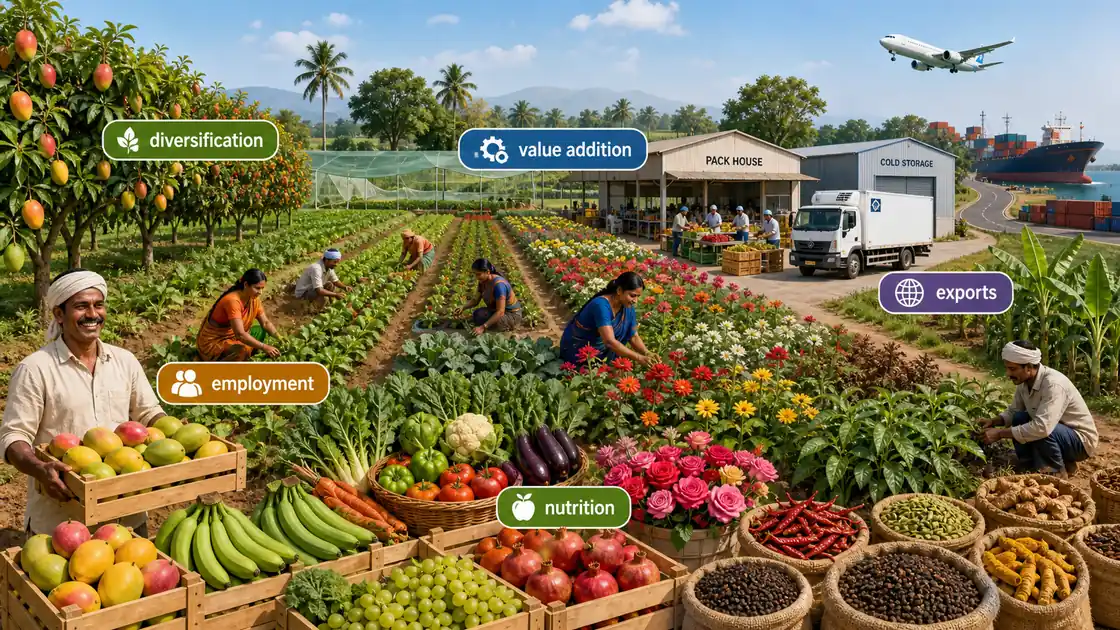
In recent years, horticulture has moved from being treated as a supporting activity to becoming a core driver of agricultural growth in India. It is now central to discussions on farm diversification, value addition, employment generation, nutrition, and export competitiveness.
As of June 5, 2026, the latest official all-India baseline available in this lesson is the NHB 2024-25 Final Estimates. So wherever this page gives a "current" figure, it is anchored to that NHB release.
The broad idea is simple:
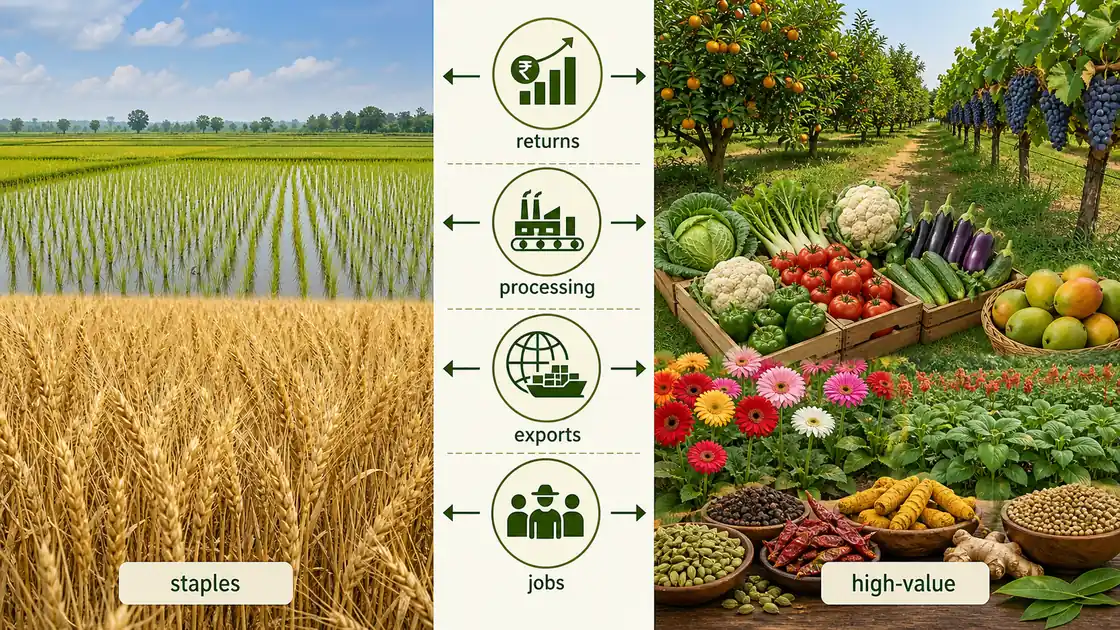
- traditional staples mainly secure calorie supply
- horticultural crops improve income quality
- high-value crops strengthen the commercial side of agriculture
This is why horticulture is often described as the nucleus of India’s high-value crop economy.
What are High-Value Crops?
High-value crops (HVCs) are crops that generate higher economic return per unit area than traditional staple crops such as cereals and pulses.
Pro Content Locked
Upgrade to Pro to access this lesson and all other premium content.
₹99 charged monthly · Cancel anytime
- All Agriculture & Banking Courses
- AI Lesson Questions (100/day)
- AI Doubt Solver (50/day)
- Glows & Grows Feedback (30/day)
- AI Section Quiz (20/day)
- 22-Language Translation (100/day)
- Recall Questions (20/day)
- AI Quiz (15/day)
- AI Quiz Paper Analysis (100/day)
- AI Step-by-Step Explanations (100/day)
- Spaced Repetition Recall (FSRS)
- AI Tutor
- Immersive Text Questions
- Audio Lessons — Hindi & English
- Mock Tests & Previous Year Papers
- Summary & Mind Maps
- XP, Levels, Leaderboard & Badges
- Generate New Classrooms
- Voice AI Teacher (AgriDots Live)
- AI Revision Assistant
- Knowledge Gap Analysis
- Interactive Revision (LangGraph)
🔒 Secure via Razorpay · Cancel anytime · No hidden fees
Horticulture Landscape in India
In recent years, horticulture has moved from being treated as a supporting activity to becoming a core driver of agricultural growth in India. It is now central to discussions on farm diversification, value addition, employment generation, nutrition, and export competitiveness.
As of June 5, 2026, the latest official all-India baseline available in this lesson is the NHB 2024-25 Final Estimates. So wherever this page gives a "current" figure, it is anchored to that NHB release.
The broad idea is simple:
- traditional staples mainly secure calorie supply
- horticultural crops improve income quality
- high-value crops strengthen the commercial side of agriculture
This is why horticulture is often described as the nucleus of India’s high-value crop economy.
What are High-Value Crops?
High-value crops (HVCs) are crops that generate higher economic return per unit area than traditional staple crops such as cereals and pulses.
In the Indian context, high-value crops mainly include:
- fruits
- vegetables
- flowers
- spices
- aromatic plants
- plantation crops with strong commercial value
They are called high-value crops because they usually offer:
- better market price realization
- stronger processing and export potential
- more value addition opportunities
- higher income per hectare
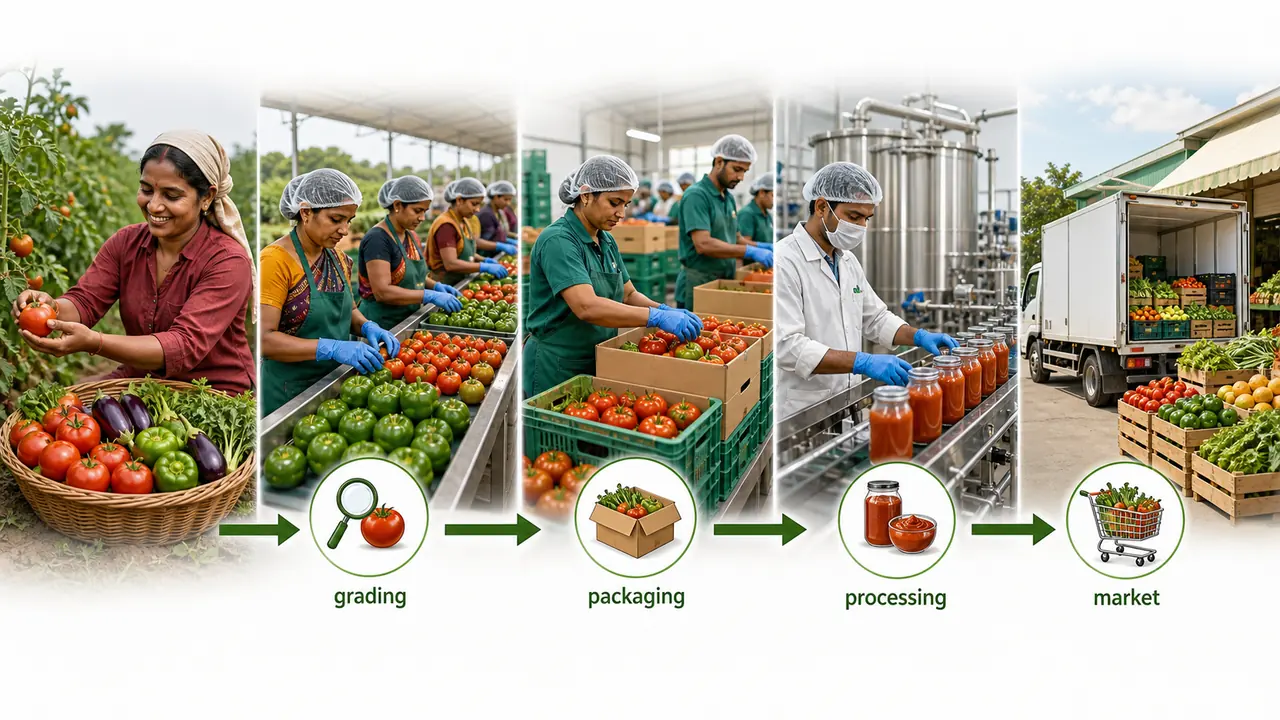
- greater employment generation in production, harvesting, grading, packaging, and marketing
So, in simple exam language:
High-value crops are market-oriented crops that give higher returns than staple crops and are closely linked with horticulture.
Why Horticulture is Called a High-Value Sector
High-value crops mainly include horticultural produce such as:
- fruits
- vegetables
- flowers
- spices
- aromatic plants
These crops are called high value because they generally provide:
- higher net returns than cereals and pulses
- stronger market linkage
- more scope for grading, processing, branding, and export
- more local employment per unit of land
Unlike many staple crops, horticulture contributes not only to production but also to:
- nutrition security
- agro-processing
- rural enterprise development
- farm income diversification
Role of Horticulture in Agricultural Growth
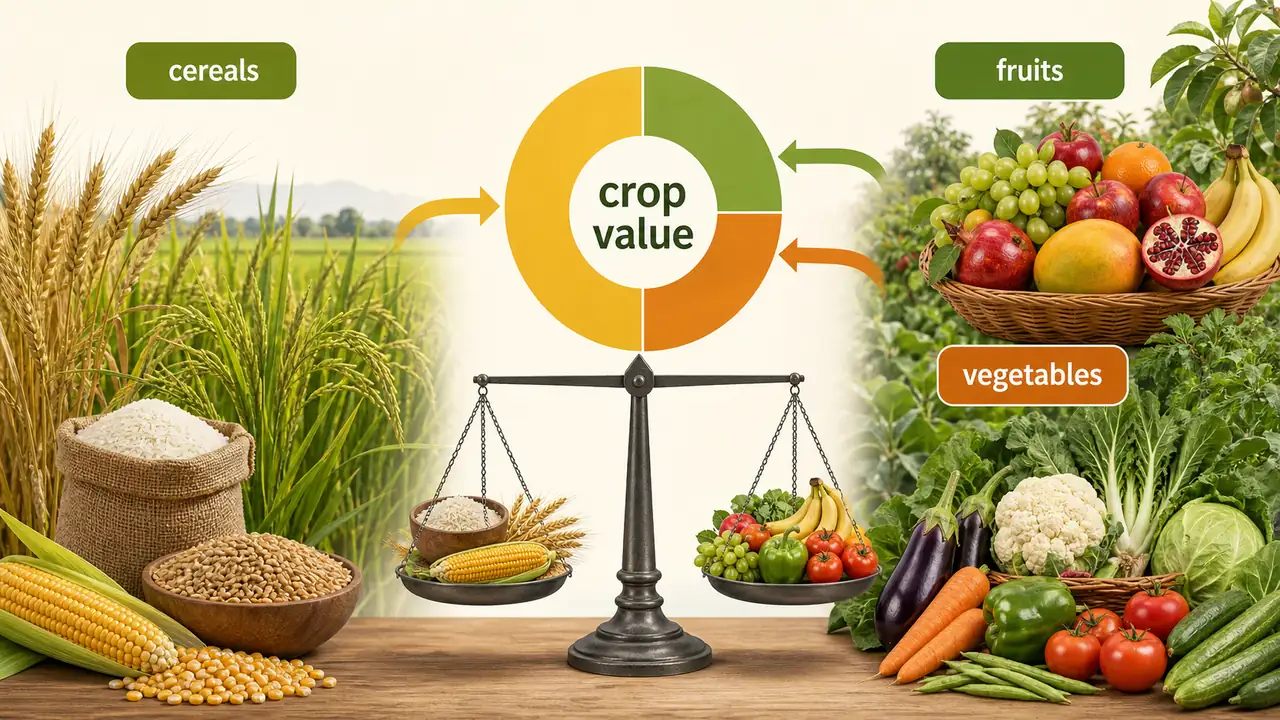
Official MOSPI material shows that fruits and vegetables alone contributed about Rs. 410.0 thousand crore to crop-sector Gross Value Output (GVO) at constant prices in 2023-24.
MOSPI also notes that cereals and fruits & vegetables together accounted for about 52.5% of total crop-sector GVO in 2023-24. This is a strong reminder that horticulture is no longer a side component of agriculture. It is now a major contributor to the value side of farm output.
So, even before adding spices, floriculture, plantation crops, and medicinal plants, horticulture already occupies a very large place in India’s value-led farm economy.
Source: MOSPI, Statistical Report on Value of Output from Agriculture and Allied Sectors 2025.
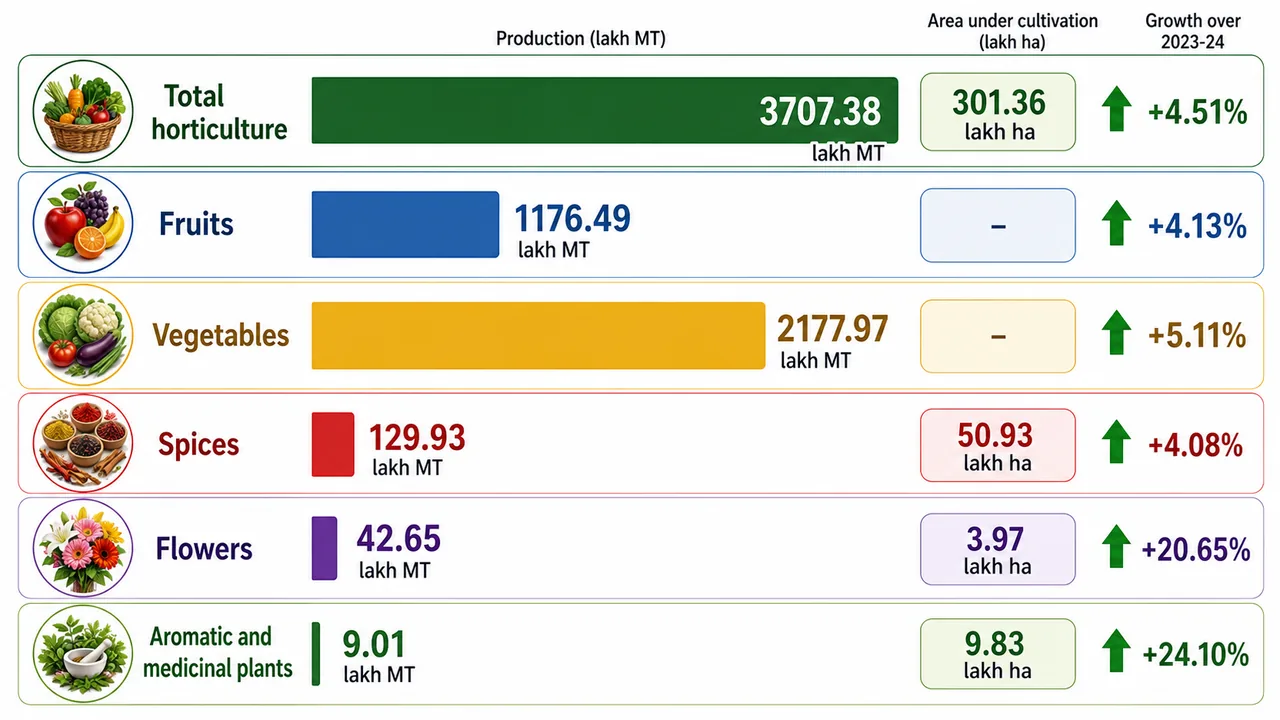
Official Current Snapshot (2024-25 Final Estimates)
The latest NHB all-India snapshot for 2024-25 Final Estimates is:
| Category | Area | Production | Change over 2023-24 |
|---|---|---|---|
| Total Horticulture | 301.36 lakh ha | 3,707.38 lakh MT | +4.51% |
| Fruits | — | 1,176.49 lakh MT | +4.13% |
| Vegetables | — | 2,177.97 lakh MT | +5.11% |
| Spices | 50.93 lakh ha | 129.93 lakh MT | +4.08% |
| Flowers | 3.97 lakh ha | 42.65 lakh MT | +20.65% |
| Aromatic & Medicinal Plants | 9.83 lakh ha | 9.01 lakh MT | +24.10% |
The same NHB release places 2023-24 Final Estimates at 290.86 lakh ha and 3,547.44 lakh MT, so the 2024-25 rise is not just a rounding effect. It reflects a real expansion in India’s horticulture base.
Source: NHB, Area & Production Estimates of Horticulture Crops, 2024-25 (Final Estimates).
Growth in Horticultural Production
India’s horticultural production increased substantially from 277.35 million tonnes in 2013-14 to 370.74 million tonnes in 2024-25.
| Year | Horticulture Production |
|---|---|
| 2013-14 | 277.35 million tonnes |
| 2024-25 | 370.74 million tonnes |
This rise shows that India’s crop economy is steadily moving toward:
- greater diversification
- higher-value produce
- better commercialization of agriculture
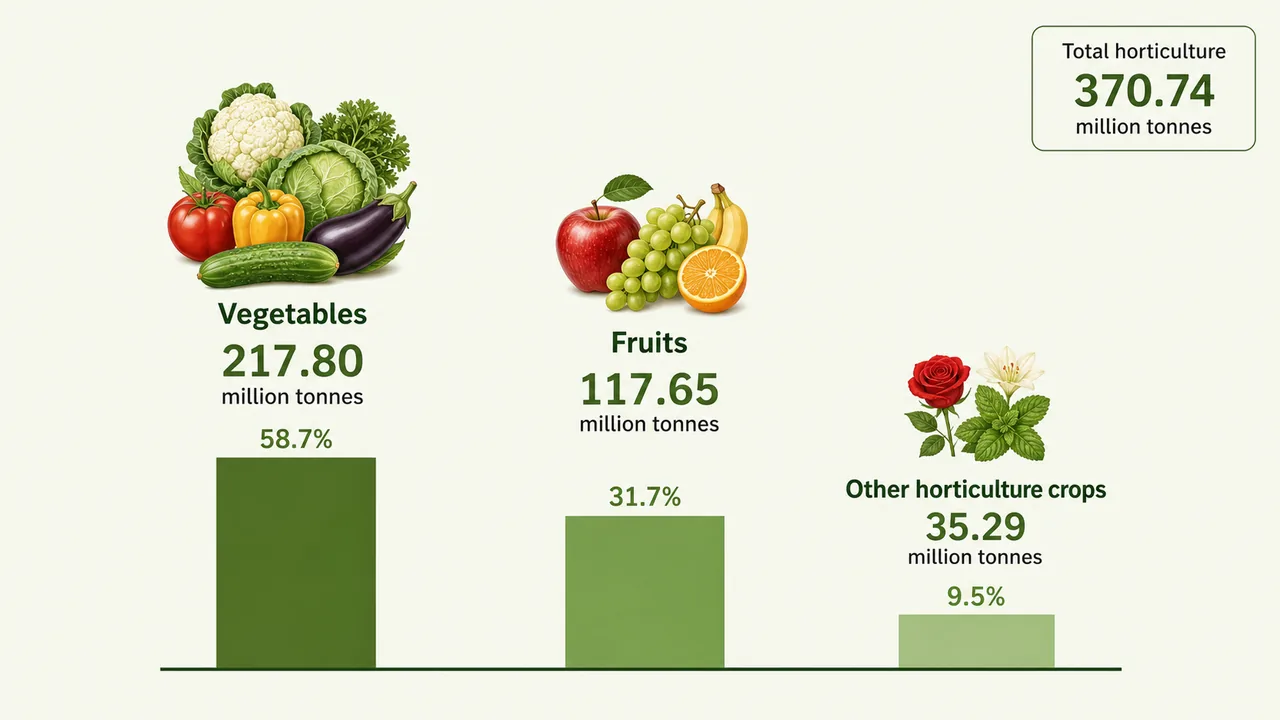
Production Composition in 2024-25
The 2024-25 horticulture output was made up of three major segments:
| Segment | Production |
|---|---|
| Fruits | 117.65 million tonnes |
| Vegetables | 217.80 million tonnes |
| Other horticulture crops | 35.29 million tonnes |
| Total | 370.74 million tonnes |
Vegetables remain the largest component of horticultural output, while fruits form the second major pillar.
The NHB final estimates also show that flowers and aromatic & medicinal plants, although much smaller in tonnage than fruits and vegetables, are now posting faster percentage growth. That is why they matter in diversification strategy and exam questions on high-value crops.
India’s Global Position in Horticulture
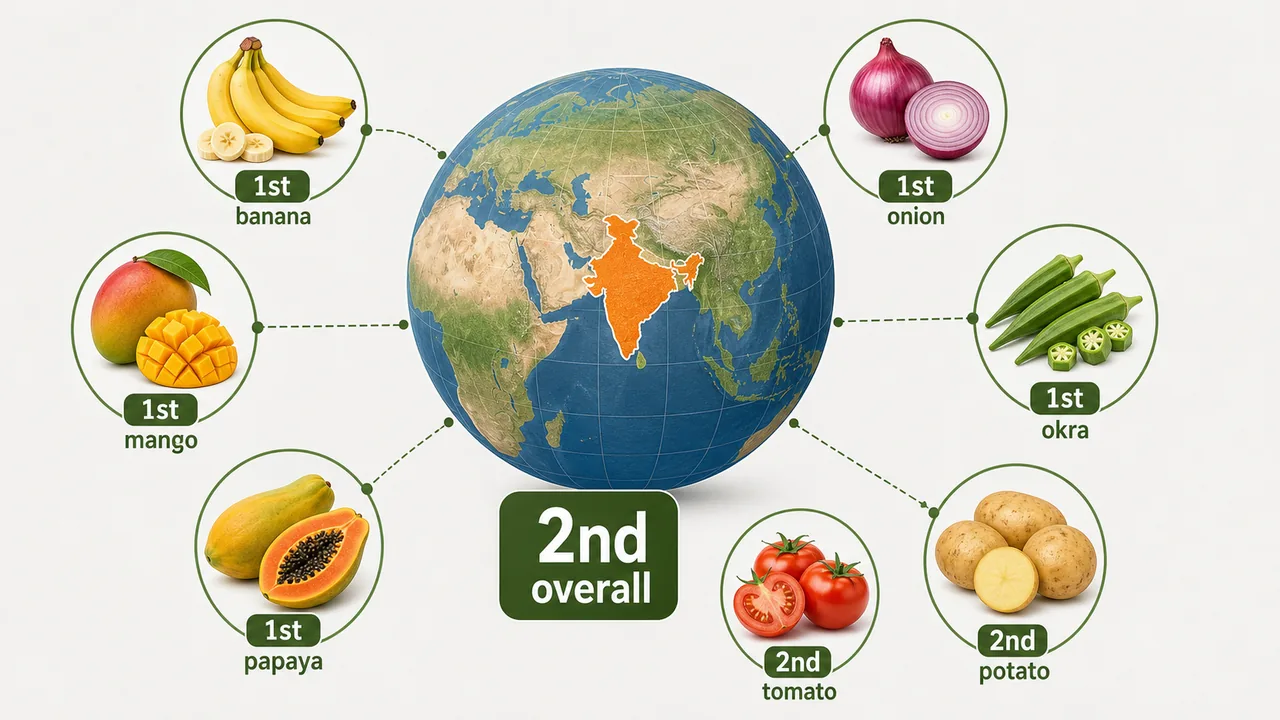
India’s position in global horticulture is strategically important.
- APEDA’s 2024-25 Annual Administrative Report describes India as the world’s second-largest producer of horticulture crops
- APEDA’s fresh fruits and vegetables page, citing FAO 2023, says India ranks second in overall fruits and vegetables production after China
- The same APEDA source says India ranks first in bananas, mangoes (including mangosteens and guavas), papayas, onions, and okra
- APEDA’s annual report also places India among the leaders in ginger
For exam revision, the latest rank-style anchors are:
| Commodity / Group | Latest ranking anchor |
|---|---|
| Horticulture crops overall | 2nd in the world |
| Fruits and vegetables overall | 2nd in the world |
| Banana | 1st in the world |
| Mango (including mangosteens and guavas) | 1st in the world |
| Papaya | 1st in the world |
| Onion | 1st in the world |
| Okra | 1st in the world |
| Potato | 2nd in the world |
| Tomato | 2nd in the world |
| Cauliflower | 2nd in the world |
| Brinjal | 2nd in the world |
| Cabbage | 2nd in the world |
These rankings show that India is not only a large domestic producer, but also a major force in the global food supply chain.
Source: APEDA Fresh Fruits & Vegetables page citing FAO 2023; APEDA Annual Administrative Report 2024-25.
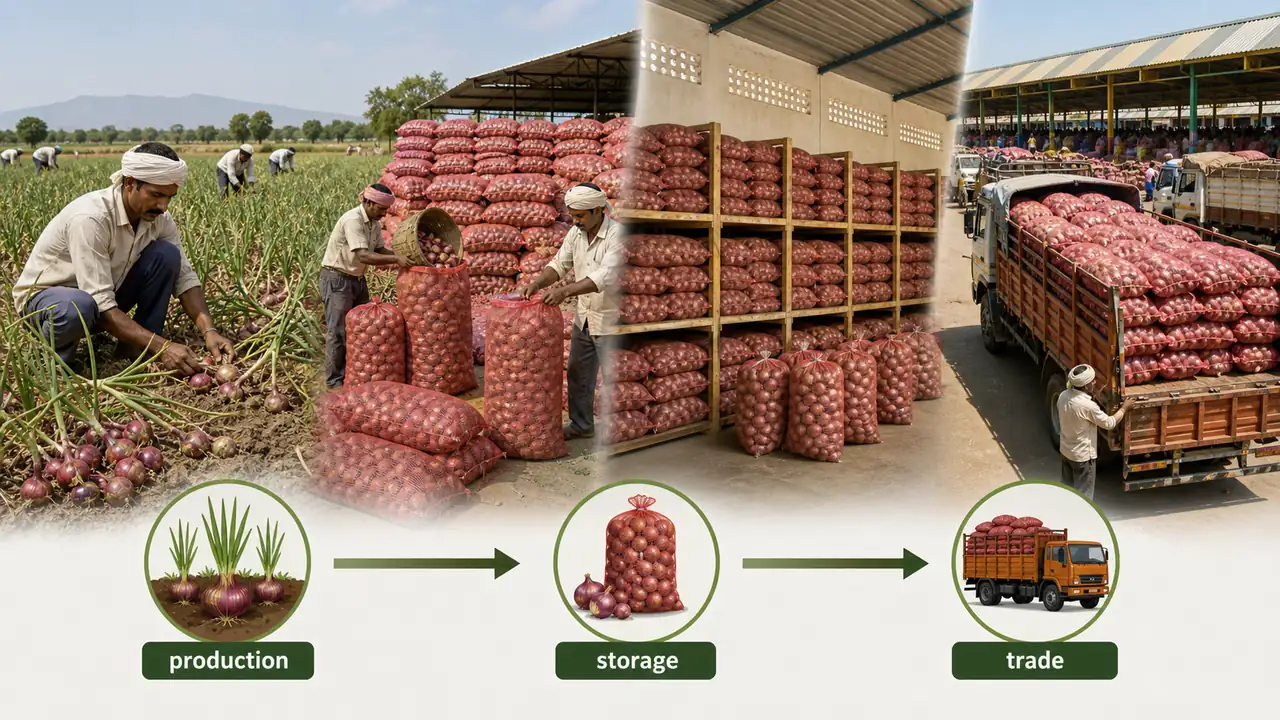
Onion Leadership
APEDA’s current commodity note, based on FAO 2023, identifies India as the world’s largest producer of onions. The March 17, 2026 PIB release also shows why this remains a major exam point: 2024-25 onion production jumped to 307.67 lakh tonnes, up 26.79% from 242.67 lakh tonnes in 2023-24.
This is an important exam point because onion is repeatedly used in questions related to:
- horticultural trade
- price stability
- storage and post-harvest management
- vegetable production leadership
Source: APEDA Fresh Fruits & Vegetables page citing FAO 2023; PIB release dated March 17, 2026.
Crop-wise State Leaders
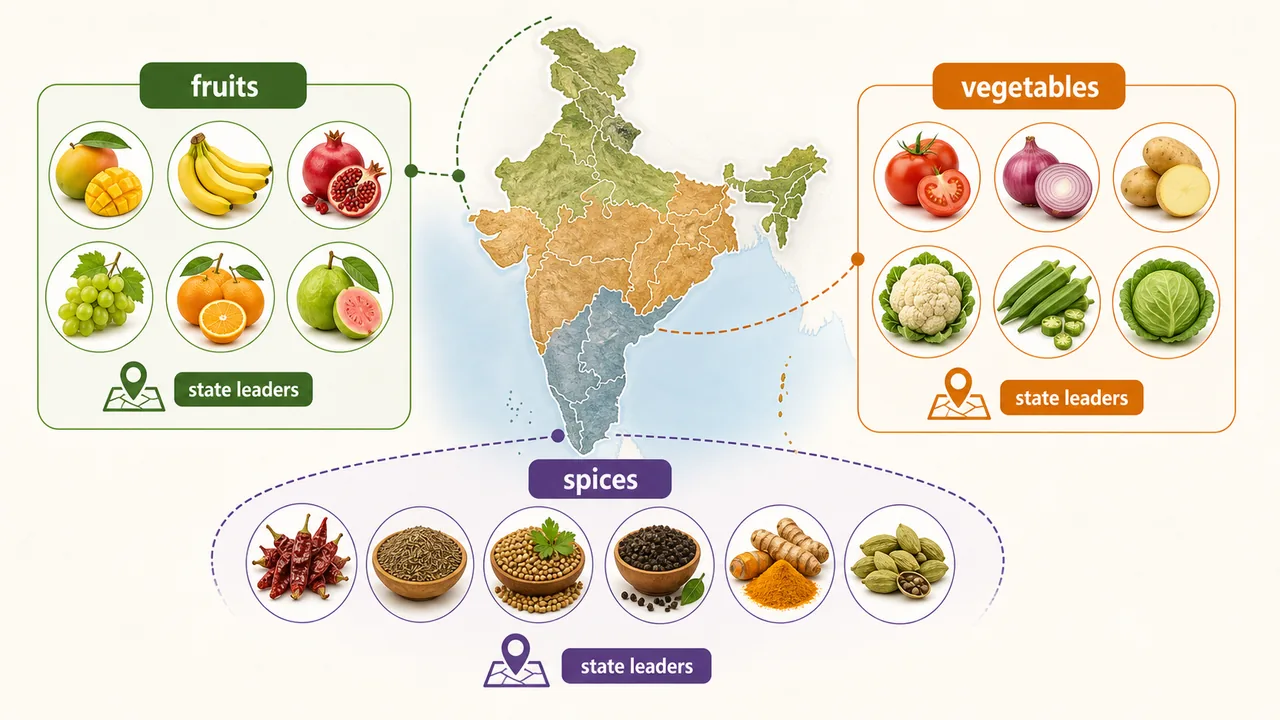
The following tables summarise the leading states for major horticulture crops.
Major Fruits
| Fruit | Top State (Area) | Top State (Production) |
|---|---|---|
| Mango | Andhra Pradesh | Uttar Pradesh |
| Banana | Tamil Nadu | Maharashtra |
| Apple | Jammu & Kashmir | Jammu & Kashmir |
| Citrus | Andhra Pradesh | Andhra Pradesh |
| Guava | Madhya Pradesh | Madhya Pradesh |
| Papaya | Andhra Pradesh | Andhra Pradesh |
| Grape | Maharashtra | Maharashtra |
| Pomegranate | Maharashtra | Maharashtra |
| Litchi | Bihar | Bihar |
| Sapota | Karnataka | Gujarat |
| Pineapple | Assam | — |
| Jackfruit | Kerala | — |
| Watermelon | Uttar Pradesh | — |
| Ber | Rajasthan | — |
TIP
AP = Area Prince for fruit rankings because Andhra Pradesh repeatedly appears as the area leader in mango, citrus, and papaya.
Major Vegetables and Spice-like Crops
| Crop | Top State (Area) | Top State (Production) |
|---|---|---|
| Potato | Uttar Pradesh | Uttar Pradesh |
| Onion | Maharashtra | Maharashtra |
| Tomato | Andhra Pradesh | Madhya Pradesh |
| Brinjal | West Bengal | Madhya Pradesh |
| Cabbage | West Bengal | Madhya Pradesh |
| Cauliflower | West Bengal | Madhya Pradesh |
| Okra | West Bengal | Andhra Pradesh |
| Chilli | Andhra Pradesh | Madhya Pradesh |
| Garlic | Rajasthan | Madhya Pradesh |
| Ginger | Meghalaya | Assam |
| Turmeric | Telangana | Maharashtra |
Major Spices
| Spice | Leading state |
|---|---|
| Black pepper | Karnataka |
| Small cardamom (India) | Kerala |
| Coriander | Rajasthan |
| Cumin (Jeera) | Rajasthan / Gujarat |
| Fenugreek | Rajasthan |
| Saffron | Jammu & Kashmir |
These tables highlight a few important distinctions, especially:
- banana production: no longer treated as Andhra Pradesh in the updated ranking table
- ginger: no longer reduced to a single old-state shortcut
- coriander and cumin: now grouped under the stronger current seed-spice pattern centered on Rajasthan
- turmeric: separated into area leader and production leader instead of a single flat label
TIP
Two exam-friendly contrasts to remember:
- Mango: Andhra Pradesh leads in area, but Uttar Pradesh leads in production
- Banana: Tamil Nadu leads in area, but Maharashtra leads in production
TIP
WB sows, MP grows:
- West Bengal often leads in vegetable area
- Madhya Pradesh often leads in vegetable production
TIP
Rajasthan = Seed Spice King because coriander, cumin, and fenugreek repeatedly point back to Rajasthan in exam-oriented spice rankings.
NOTE
India remains a major spice producer, consumer, and exporter, but for small cardamom the classic global trap is that Guatemala is treated as the world leader while Kerala remains the key Indian state anchor.
What This Status Means for Indian Agriculture
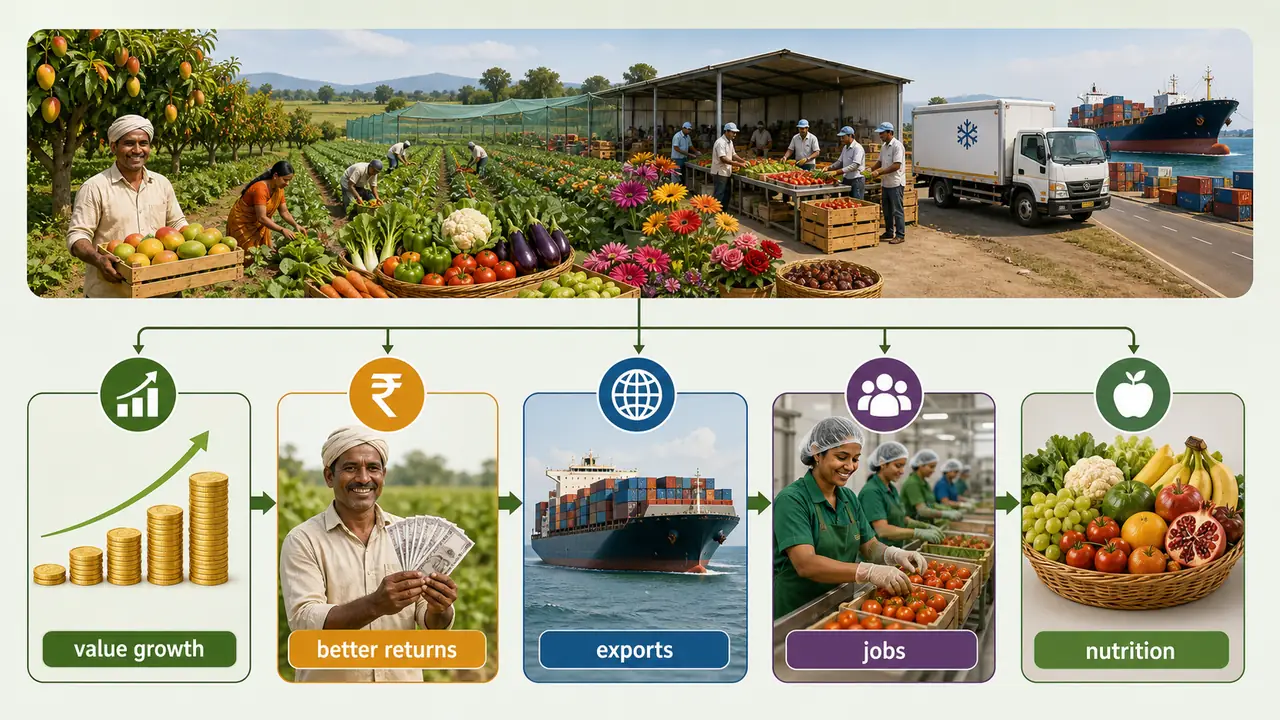
The current horticulture landscape tells us five major things:
- Indian agriculture is shifting from only staple production toward value-led growth.
- Farmers are increasingly linked to crops that offer better returns per unit area.
- Horticulture is becoming more important for exports, processing, and rural jobs.
- Fruits and vegetables are strengthening nutrition security along with income generation.
- Region-specific planning for high-value crops is becoming more important in policy.
Current Government Focus on High-Value Crops
The present policy direction of the Government is clearly moving toward high-value crop diversification. The idea is not only to increase production, but to shift agriculture toward crops that improve:
- farmer income
- export earnings
- agro-processing
- regional specialization
- value-chain development
The current focus is especially on crop-specific and region-specific promotion of high-value crops.
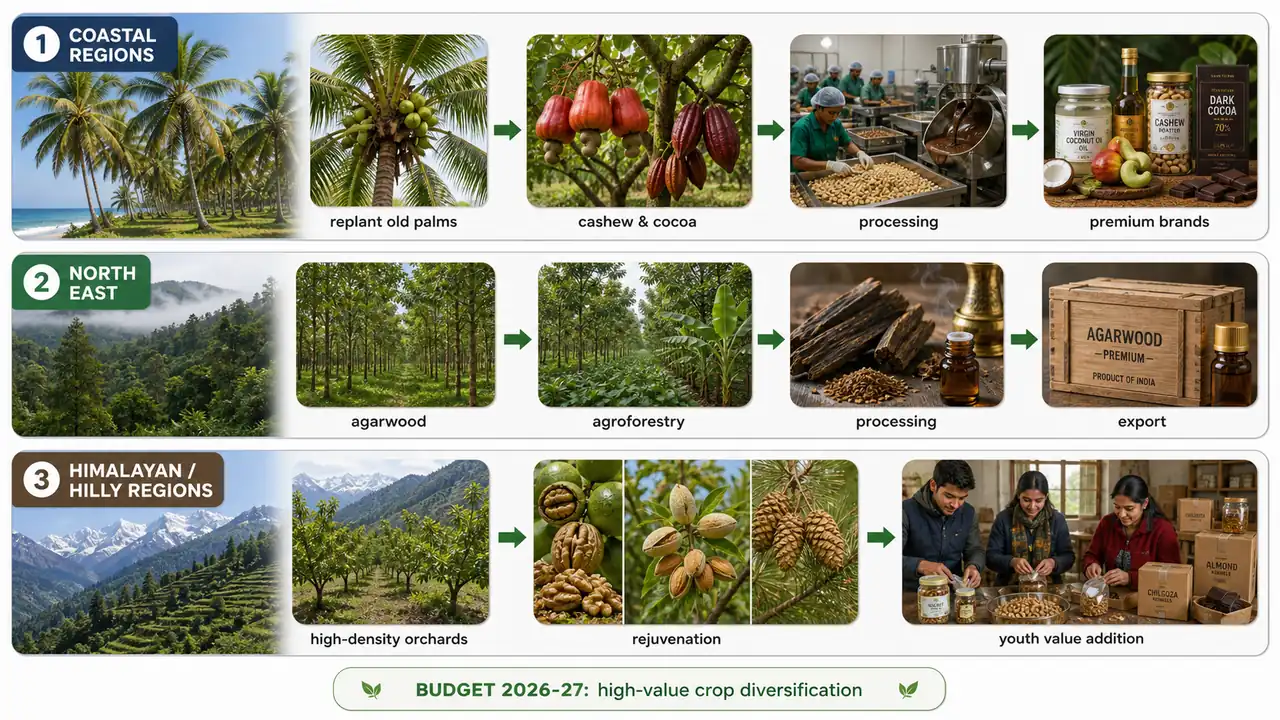
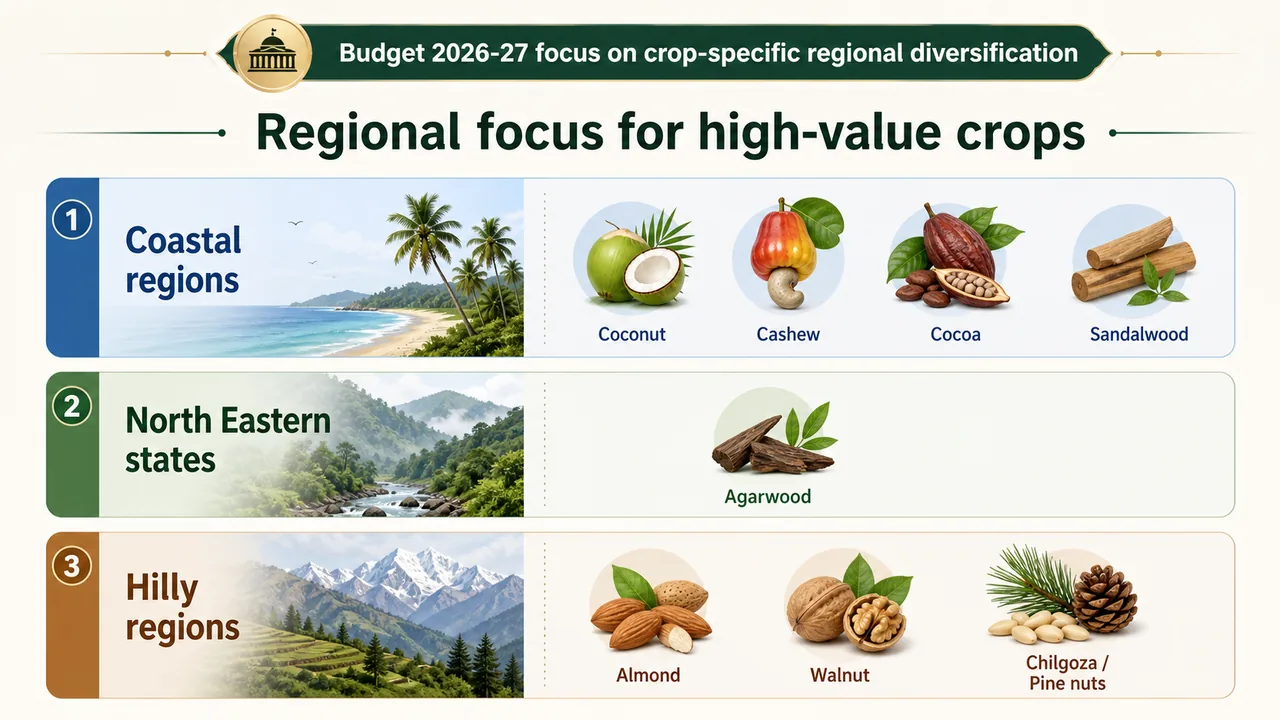
According to the policy framing discussed in the document, the Union Budget 2026-27 emphasized a regionally differentiated strategy for high-value agriculture. This includes support for:
- coconut, cashew, cocoa, and sandalwood in coastal regions
- agarwood in the North Eastern states
- almond, walnut, and pine nuts/chilgoza in hilly regions
This shows that the government’s approach is now:
- not only “grow more”
- but “grow higher-value crops in the right region”
That is why horticulture and high-value crops are receiving more attention in development planning, budget announcements, and diversification strategy.
Summary Cheat Sheet
| Concept / Topic | Key Details / Explanation |
|---|---|
| Horticulture in Indian agriculture | Horticulture has become a core driver of agricultural growth and is treated as the nucleus of India’s high-value crop economy. |
| High-value crop meaning | High-value crops give higher return per unit area than staples and mainly include fruits, vegetables, flowers, spices, aromatic plants, and plantation crops. |
| Why horticulture is high-value | Horticulture offers better price realization, more processing and export scope, stronger value addition, more employment, and better farm-income diversification. |
| Value-side importance | In 2023-24, MOSPI reported Rs. 410.0 thousand crore as the value of output of fruits & vegetables at constant prices, while cereals and fruits & vegetables together made up about 52.5% of crop-sector GVO. |
| Current official baseline | The latest exam-safe all-India baseline is the NHB 2024-25 Final Estimates released before June 5, 2026. |
| Production growth | India’s horticulture production rose from 277.35 million tonnes in 2013-14 to 370.74 million tonnes in 2024-25. |
| Current production totals | In 2024-25, total horticulture reached 301.36 lakh ha and 3,707.38 lakh MT. |
| 2024-25 production mix | In 2024-25, output included about 117.65 million tonnes fruits, 217.80 million tonnes vegetables, and 35.29 million tonnes other horticultural crops; vegetables remain the largest segment. |
| Fast-growth groups | Flowers reached 42.65 lakh MT and aromatic & medicinal plants reached 9.01 lakh MT in 2024-25, with both groups growing faster than the overall horticulture average. |
| Global position | APEDA describes India as the world’s second-largest producer of horticulture crops and second in overall fruits and vegetables production. |
| First-rank crops | Current APEDA rank anchors place India first in banana, mango (including mangosteens and guavas), papaya, onion, and okra production. |
| Second-rank crops | APEDA’s FAO-based ranking notes place India second in potato, tomato, cauliflower, brinjal, and cabbage production. |
| Onion leadership | India remains the largest producer of onions, and 2024-25 onion production reached 307.67 lakh tonnes after a strong year-on-year jump. |
| Fruit state leaders | Andhra Pradesh leads mango area while Uttar Pradesh leads mango production; Tamil Nadu leads banana area while Maharashtra leads banana production; Maharashtra leads grape and pomegranate; Bihar leads litchi; J&K leads apple; Andhra Pradesh leads citrus and papaya; and Madhya Pradesh leads guava. |
| Extra fruit state anchors | Additional quick anchors are Assam for pineapple, Kerala for jackfruit, Uttar Pradesh for watermelon, Rajasthan for ber, and Karnataka area vs Gujarat production for sapota. |
| Updated vegetable leaders | Core updated pairs include UP for potato, Maharashtra for onion, AP area but MP production for tomato, WB area but MP production for brinjal/cabbage/cauliflower, WB area but AP production for okra, Rajasthan area but MP production for garlic, and Telangana area but Maharashtra production for turmeric. |
| Fruit and vegetable memory cues | High-yield quick cues are “AP = Area Prince” for fruit-area rankings and “WB sows, MP grows” for vegetable area-vs-production contrasts. |
| Updated spice leaders | Karnataka leads black pepper, Kerala leads small cardamom in India, Rajasthan dominates coriander/cumin/fenugreek, and Jammu & Kashmir leads saffron. |
| Global spice trap | For exam revision, the key exception is small cardamom: Kerala is the Indian anchor, but Guatemala is the global trap answer. |
| Policy meaning | The status of horticulture shows Indian agriculture is shifting toward value-led growth, better returns per hectare, stronger export and processing linkages, and region-specific planning. |
| Current regional focus | The 2026-27 policy framing supports coconut, cashew, cocoa, and sandalwood in coastal belts, agarwood in the North East, and almond, walnut, and chilgoza in hilly regions. |