👨❤️💋👨 Methods of Propagation
Sexual and asexual propagation, seed behaviour, dormancy, and the basic logic behind plant multiplication.
Plants can be propagated by sexual and asexual means. Each method has its own biological basis, advantages, limitations, and practical use in horticulture.
Sexual Methods of Propagation
- Propagation or multiplication of plants by seeds is known as 'sexual propagation'. Seeds are formed as a result of successful fertilisation and combination of parental gametes. Since seeds are the product of fusion of male and female gametes, the resulting progeny carries genetic material from both parents, leading to variation.
- It is an old and easy method and is widely used for the propagation of crops like ornamental annuals, vegetables, medicinal and fruit plants, such as papaya. For crops where genetic uniformity is not critical or where varietal improvement is desired, seed propagation is the preferred method.
Merits of sexual propagation
- Plants propagated by seeds live longer, are vigorous and more resistant to biotic (insect-pests and diseases) and abiotic stresses (environmental conditions). Seedling plants develop a strong, deep tap root system which anchors them firmly and allows them to access water and nutrients from deeper soil layers.
- It is an easy, simple and convenient method of plant propagation. Minimal skill and equipment are required compared to vegetative methods like grafting and budding.
- Some plants like papaya, marigold, chilli, capsicum, tomato, etc., cannot be propagated by asexual method. For these crops, seed propagation is the only option available.
- It is the only means of creating genetic diversity of plants. Genetic recombination during sexual reproduction creates new combinations of traits that can be selected for desirable characteristics.
- New varieties and cultivars of ornamental and vegetable crops can be developed only by this method. Plant breeding programmes rely entirely on sexual reproduction through hybridization and selection.
- A large number of rootstocks for budding and grafting purpose is also raised by this method. Rootstocks for most fruit crops are raised from seeds before the desired scion variety is grafted or budded onto them.
- Seeds can be transported easily and stored for a longer time using this method. Seeds are lightweight, compact, and can be stored under proper conditions for extended periods, making them ideal for distribution over long distances.
Demerits of sexual propagation
- Sexually propagated plants show variations and are not genetically true-to-type to the mother plants. Due to genetic segregation and recombination, seedlings differ from the parent plant, which is undesirable when uniformity is needed for commercial production.
- Plants that are propagated through seeds have long gestation period, which results in delayed flowering and fruiting. Seedling trees take many years to reach the reproductive stage -- for example, a mango seedling may take 6-10 years to bear fruit, compared to only 3-4 years for a grafted plant.
- Plants grow vigorously and cause obstruction in intercultural practices like harvesting and spraying. The tall, vigorous growth of seedling trees makes them difficult to manage in modern orchards.
- Advantages offered by rootstocks and scion as in asexual propagation cannot be exploited through sexual method. The benefits of combining a disease-resistant or dwarfing rootstock with a high-quality scion variety are unique to asexual propagation.
- Crop species, which do not produce seeds like pineapple, banana, strawberry, fig, jasmine, hibiscus, bougainvillea, etc., cannot multiply by this method. These crops are either seedless or produce non-viable seeds, making vegetative propagation the only option.
Seed
- Seed quality is considered best if pure seed % is above 98%. Moisture content: 6-8% Germination %: 60-70%. These are the standard seed quality parameters that ensure good establishment in the nursery. High purity means minimal weed seeds and other crop seeds, while proper moisture content ensures seed viability during storage.
Dormancy
- Inability of viable seed to germinate. Seed dormancy is a natural mechanism that prevents seeds from germinating under unfavourable conditions, ensuring the species' survival. However, it can be a challenge for growers who need seeds to germinate promptly.
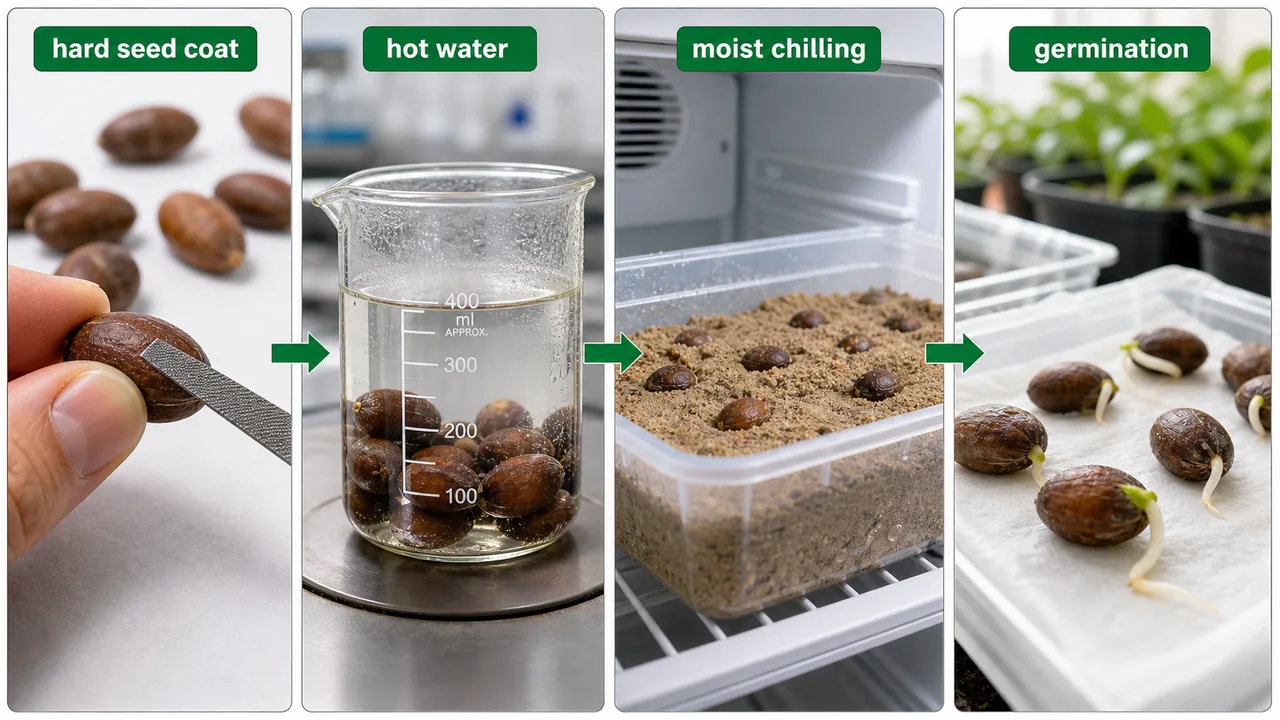
- Hard seed coat dormancy: Ber, Guava, Walnut. In these crops, the seed coat is so hard and impermeable that water and oxygen cannot enter, preventing germination.
- Dormancy due to presence of ABA -- temperate fruits. Abscisic acid (ABA) is a plant hormone that inhibits germination. Temperate fruit seeds contain high levels of ABA that must be broken down before germination can occur.
- Seeds of tropical and subtropical fruits are sown during monsoon. The warm, moist conditions of the monsoon season provide ideal conditions for germination and seedling growth.
- In Walnut, Pecanut, Jackfruit, Ber-sowing of seeds in insitu is recommended. In situ sowing (sowing seeds directly at the permanent planting site) is recommended for these crops because their seedlings have a strong tap root that does not transplant well.
- Orthodox seeds: Seeds remain viable for long time at low temperature. These seeds can be dried to low moisture content and stored at cool temperatures without losing viability, making them easy to store and transport.
- Recalcitrant seed: Seeds don't remain viable for long time at low temperature. So they should be sown immediately after extraction. Recalcitrant seeds are sensitive to desiccation and chilling injury -- they lose viability rapidly when dried or cooled, so they must be planted fresh.
- Example: 1. Mango 2. Citrus 3. Litchi 4. Loquat 5. Mangosteen 6. Avocado 7. Jack fruit 8. Rambutan 9. Barbados Cherry
Methods to break dormancy
- Scarification: Process of breaking or softening the seed covering to make it permeable to water and gases. This method addresses physical dormancy caused by a hard seed coat.
- Mechanically: Ber, Walnut, Peach -- The seed coat is physically scratched, filed, or cracked to allow water penetration.
- By Hot water: Guava, Strawberry -- Seeds are soaked in hot water which softens the seed coat and makes it permeable.
- By Acid: KNO3 -- Chemical treatment with concentrated sulphuric acid or other chemicals dissolves or weakens the seed coat.
- Stratification: Seeds are subjected to low temperature (Chilling temp) to break dormancy - Apple, Pear, Peach, Apricot. This method is also called moist chilling and involves placing seeds in moist sand or peat at temperatures of 2-7°C for several weeks. This simulates the natural winter conditions that temperate fruit seeds require before germination.
- Chemical treatment: Seeds are treated with 0.2% KNO3 (Potassium nitrate). Potassium nitrate acts as a dormancy-breaking chemical by stimulating the production of gibberellins and other germination-promoting hormones.
- Use of hormones: 1. 100-500 ppm GA; 2. Etheral (500 ppm) 3. BA (10-20 ppm) (F) Cryopreservation: Storage in liquid N, at - 196 °C temperature or liquid CO2 at 43 °C temperature. Gibberellic acid (GA) is the most commonly used hormone for breaking dormancy, as it counteracts the effect of ABA. Cryopreservation is an advanced technique for long-term conservation of plant genetic material.
- Cryoprotactants: 1. Glycerol 2. DMSO (Dimethyl-sulphoxide). These chemicals protect cells from damage during the freezing and thawing process in cryopreservation by preventing ice crystal formation inside cells.
Asexual Methods of Propagation
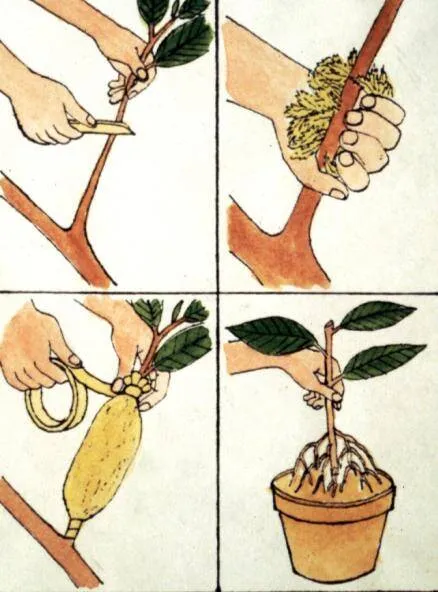
- It is also called 'vegetative propagation'. The vegetative parts of a plant like leaf, stem, root or their modified forms are used for propagation. Since no sexual fusion is involved, the offspring are genetically identical to the parent plant (clones).
- Most of the horticultural crops are commercially propagated by vegetative or asexual method of propagation. This is because commercial growers need plants that are true-to-type, uniform, and come into bearing early.
- Most of the fruit crops are propagated by vegetative means.
- Types
- Cutting
- Layering
- Grafting
- Propagation by specialized organs
✅ Merits of asexual propagation
Pro Content Locked
Upgrade to Pro to access this lesson and all other premium content.
₹99 charged monthly · Cancel anytime
- All Agriculture & Banking Courses
- AI Lesson Questions (100/day)
- AI Doubt Solver (50/day)
- Glows & Grows Feedback (30/day)
- AI Section Quiz (20/day)
- 22-Language Translation (100/day)
- Recall Questions (20/day)
- AI Quiz (15/day)
- AI Quiz Paper Analysis (100/day)
- AI Step-by-Step Explanations (100/day)
- Spaced Repetition Recall (FSRS)
- AI Tutor
- Immersive Text Questions
- Audio Lessons — Hindi & English
- Mock Tests & Previous Year Papers
- Summary & Mind Maps
- XP, Levels, Leaderboard & Badges
- Generate New Classrooms
- Voice AI Teacher (AgriDots Live)
- AI Revision Assistant
- Knowledge Gap Analysis
- Interactive Revision (LangGraph)
🔒 Secure via Razorpay · Cancel anytime · No hidden fees
Plants can be propagated by sexual and asexual means. Each method has its own biological basis, advantages, limitations, and practical use in horticulture.
Sexual Methods of Propagation
- Propagation or multiplication of plants by seeds is known as 'sexual propagation'. Seeds are formed as a result of successful fertilisation and combination of parental gametes. Since seeds are the product of fusion of male and female gametes, the resulting progeny carries genetic material from both parents, leading to variation.
- It is an old and easy method and is widely used for the propagation of crops like ornamental annuals, vegetables, medicinal and fruit plants, such as papaya. For crops where genetic uniformity is not critical or where varietal improvement is desired, seed propagation is the preferred method.
Merits of sexual propagation
- Plants propagated by seeds live longer, are vigorous and more resistant to biotic (insect-pests and diseases) and abiotic stresses (environmental conditions). Seedling plants develop a strong, deep tap root system which anchors them firmly and allows them to access water and nutrients from deeper soil layers.
- It is an easy, simple and convenient method of plant propagation. Minimal skill and equipment are required compared to vegetative methods like grafting and budding.
- Some plants like papaya, marigold, chilli, capsicum, tomato, etc., cannot be propagated by asexual method. For these crops, seed propagation is the only option available.
- It is the only means of creating genetic diversity of plants. Genetic recombination during sexual reproduction creates new combinations of traits that can be selected for desirable characteristics.
- New varieties and cultivars of ornamental and vegetable crops can be developed only by this method. Plant breeding programmes rely entirely on sexual reproduction through hybridization and selection.
- A large number of rootstocks for budding and grafting purpose is also raised by this method. Rootstocks for most fruit crops are raised from seeds before the desired scion variety is grafted or budded onto them.
- Seeds can be transported easily and stored for a longer time using this method. Seeds are lightweight, compact, and can be stored under proper conditions for extended periods, making them ideal for distribution over long distances.
Demerits of sexual propagation
- Sexually propagated plants show variations and are not genetically true-to-type to the mother plants. Due to genetic segregation and recombination, seedlings differ from the parent plant, which is undesirable when uniformity is needed for commercial production.
- Plants that are propagated through seeds have long gestation period, which results in delayed flowering and fruiting. Seedling trees take many years to reach the reproductive stage -- for example, a mango seedling may take 6-10 years to bear fruit, compared to only 3-4 years for a grafted plant.
- Plants grow vigorously and cause obstruction in intercultural practices like harvesting and spraying. The tall, vigorous growth of seedling trees makes them difficult to manage in modern orchards.
- Advantages offered by rootstocks and scion as in asexual propagation cannot be exploited through sexual method. The benefits of combining a disease-resistant or dwarfing rootstock with a high-quality scion variety are unique to asexual propagation.
- Crop species, which do not produce seeds like pineapple, banana, strawberry, fig, jasmine, hibiscus, bougainvillea, etc., cannot multiply by this method. These crops are either seedless or produce non-viable seeds, making vegetative propagation the only option.
Seed
- Seed quality is considered best if pure seed % is above 98%. Moisture content: 6-8% Germination %: 60-70%. These are the standard seed quality parameters that ensure good establishment in the nursery. High purity means minimal weed seeds and other crop seeds, while proper moisture content ensures seed viability during storage.
Dormancy
- Inability of viable seed to germinate. Seed dormancy is a natural mechanism that prevents seeds from germinating under unfavourable conditions, ensuring the species' survival. However, it can be a challenge for growers who need seeds to germinate promptly.
- Hard seed coat dormancy: Ber, Guava, Walnut. In these crops, the seed coat is so hard and impermeable that water and oxygen cannot enter, preventing germination.
- Dormancy due to presence of ABA -- temperate fruits. Abscisic acid (ABA) is a plant hormone that inhibits germination. Temperate fruit seeds contain high levels of ABA that must be broken down before germination can occur.
- Seeds of tropical and subtropical fruits are sown during monsoon. The warm, moist conditions of the monsoon season provide ideal conditions for germination and seedling growth.
- In Walnut, Pecanut, Jackfruit, Ber-sowing of seeds in insitu is recommended. In situ sowing (sowing seeds directly at the permanent planting site) is recommended for these crops because their seedlings have a strong tap root that does not transplant well.
- Orthodox seeds: Seeds remain viable for long time at low temperature. These seeds can be dried to low moisture content and stored at cool temperatures without losing viability, making them easy to store and transport.
- Recalcitrant seed: Seeds don't remain viable for long time at low temperature. So they should be sown immediately after extraction. Recalcitrant seeds are sensitive to desiccation and chilling injury -- they lose viability rapidly when dried or cooled, so they must be planted fresh.
- Example: 1. Mango 2. Citrus 3. Litchi 4. Loquat 5. Mangosteen 6. Avocado 7. Jack fruit 8. Rambutan 9. Barbados Cherry
Methods to break dormancy
- Scarification: Process of breaking or softening the seed covering to make it permeable to water and gases. This method addresses physical dormancy caused by a hard seed coat.
- Mechanically: Ber, Walnut, Peach -- The seed coat is physically scratched, filed, or cracked to allow water penetration.
- By Hot water: Guava, Strawberry -- Seeds are soaked in hot water which softens the seed coat and makes it permeable.
- By Acid: KNO3 -- Chemical treatment with concentrated sulphuric acid or other chemicals dissolves or weakens the seed coat.
- Stratification: Seeds are subjected to low temperature (Chilling temp) to break dormancy - Apple, Pear, Peach, Apricot. This method is also called moist chilling and involves placing seeds in moist sand or peat at temperatures of 2-7°C for several weeks. This simulates the natural winter conditions that temperate fruit seeds require before germination.
- Chemical treatment: Seeds are treated with 0.2% KNO3 (Potassium nitrate). Potassium nitrate acts as a dormancy-breaking chemical by stimulating the production of gibberellins and other germination-promoting hormones.
- Use of hormones: 1. 100-500 ppm GA; 2. Etheral (500 ppm) 3. BA (10-20 ppm) (F) Cryopreservation: Storage in liquid N, at - 196 °C temperature or liquid CO2 at 43 °C temperature. Gibberellic acid (GA) is the most commonly used hormone for breaking dormancy, as it counteracts the effect of ABA. Cryopreservation is an advanced technique for long-term conservation of plant genetic material.
- Cryoprotactants: 1. Glycerol 2. DMSO (Dimethyl-sulphoxide). These chemicals protect cells from damage during the freezing and thawing process in cryopreservation by preventing ice crystal formation inside cells.
Asexual Methods of Propagation
- It is also called 'vegetative propagation'. The vegetative parts of a plant like leaf, stem, root or their modified forms are used for propagation. Since no sexual fusion is involved, the offspring are genetically identical to the parent plant (clones).
- Most of the horticultural crops are commercially propagated by vegetative or asexual method of propagation. This is because commercial growers need plants that are true-to-type, uniform, and come into bearing early.
- Most of the fruit crops are propagated by vegetative means.
- Types
- Cutting
- Layering
- Grafting
- Propagation by specialized organs
✅ Merits of asexual propagation
- Many fruit and ornamental plants that do not produce seeds are multiplied by this method. Crops like banana, pineapple, strawberry, and fig that are seedless or produce non-viable seeds can only be multiplied vegetatively.
- Plants propagated by asexual propagation are true-to-type genetically. Since no genetic recombination occurs, every plant is a clone of the mother plant, ensuring uniformity in fruit quality, yield, and other characteristics.
- By top working (using budding and grafting), old and economically low productive fruit plants can be converted into superior ones. This is a cost-effective way to upgrade orchards without replanting.
- Advantages offered by rootstocks and scion can be exploited through asexual method. By grafting a desired variety onto the right rootstock, growers can achieve benefits like disease resistance, dwarfing, salt tolerance, and drought hardiness.
- Maturity is uniform and the plant gives quality yield. Vegetatively propagated plants flower and fruit at the same time, allowing for synchronized harvesting.
- Plants propagated by asexual method are small in size, so spraying of chemicals and harvesting are easy. The reduced tree size (especially when using dwarfing rootstocks) lowers management costs significantly.
- This method enables noble plant production, e.g., different colours of flowers in a single rose plant and different types of mangoes in one mango plant can be produced through asexual method only. This is achieved through multi-grafting, which is popular for exhibition and home garden purposes.
❌ Demerits of asexual propagation
- By vegetative propagation, new varieties cannot be developed. Since there is no genetic recombination, asexual propagation only multiplies existing genotypes -- it does not create new ones.
- It requires specialised skills, so it is an expensive method of propagation. Techniques like grafting and budding require trained personnel, and the success rate can vary with skill level and environmental conditions.
- The life span of asexually propagated plants is short as compared to sexually propagated ones. Seedling trees typically have a lifespan of 50-100+ years, while grafted trees may live for 30-50 years or less.
- These plants are more prone to biotic and abiotic stresses. The shallower root system of vegetatively propagated plants makes them more susceptible to drought, waterlogging, and wind damage compared to deep-rooted seedling trees.
The detailed vegetative propagation techniques themselves are taken up in the next lesson, where cutting, budding, grafting, layering, tissue culture, specialised organs, and crop-wise methods are studied one by one.
Summary Cheat Sheet
| Concept / Topic | Key Details / Explanation |
|---|---|
| Propagation types | Plants are propagated by two broad methods: sexual propagation through seeds and asexual or vegetative propagation through plant parts. |
| Sexual propagation basics | Sexual propagation uses seeds formed after fertilization, produces variation because both parents contribute genes, and is commonly used where uniformity is less critical or breeding value is important. |
| Merits of sexual propagation | Seed-propagated plants are long-lived, vigorous, often more stress tolerant, easy to raise, useful for breeding and genetic variability, and also provide rootstocks for budding and grafting. |
| Demerits of sexual propagation | Seedlings are not true-to-type, have a long juvenile period, grow vigorously and become harder to manage, cannot exploit rootstock-scion advantages, and cannot be used in seedless or non-viable-seed crops like banana, pineapple, and strawberry. |
| Seed quality and dormancy | Good seed quality here means purity above 98%, moisture about 6-8%, and germination around 60-70%; dormancy means failure of a viable seed to germinate and may be due to hard seed coat or ABA as in temperate fruits. |
| Important seed facts | In situ sowing is recommended for walnut, pecan, jackfruit, and ber; orthodox seeds store well at low temperature, while recalcitrant seeds such as mango, citrus, litchi, avocado, jackfruit, and rambutan should be sown soon after extraction. |
| Breaking dormancy | Main dormancy-breaking methods listed are scarification, stratification, chemical treatment with 0.2% KNO3, hormones such as GA, and cryopreservation with cryoprotectants like glycerol and DMSO. |
| Asexual propagation basics | Asexual or vegetative propagation uses leaf, stem, root, or their modified organs and produces clones that are genetically true-to-type. |
Summary Continued
| Concept / Topic | Key Details / Explanation |
|---|---|
| Merits of asexual propagation | Asexual propagation is essential for seedless crops, preserves true-to-type plants, allows rootstock-scion benefits, gives uniform maturity, and helps maintain desired plant characters. |
| Demerits of asexual propagation | It does not create new varieties, needs specialized skill and cost, gives shorter-lived plants than seedlings, and may produce plants that are more stress-prone than seedling trees. |
| Pedagogic bridge | After understanding these concepts, the next lesson moves into the practical vegetative methods used in commercial horticulture. |