🧑🏫 Things to Know
Branches, Nutritive value, Daily requirement, Important Horticultural Institutes
- The term Horticulture is derived from the Latin words: hortus meaning garden and cultura meaning cultivation. Together, these words literally translate to "garden cultivation," which captures the essence of this discipline.
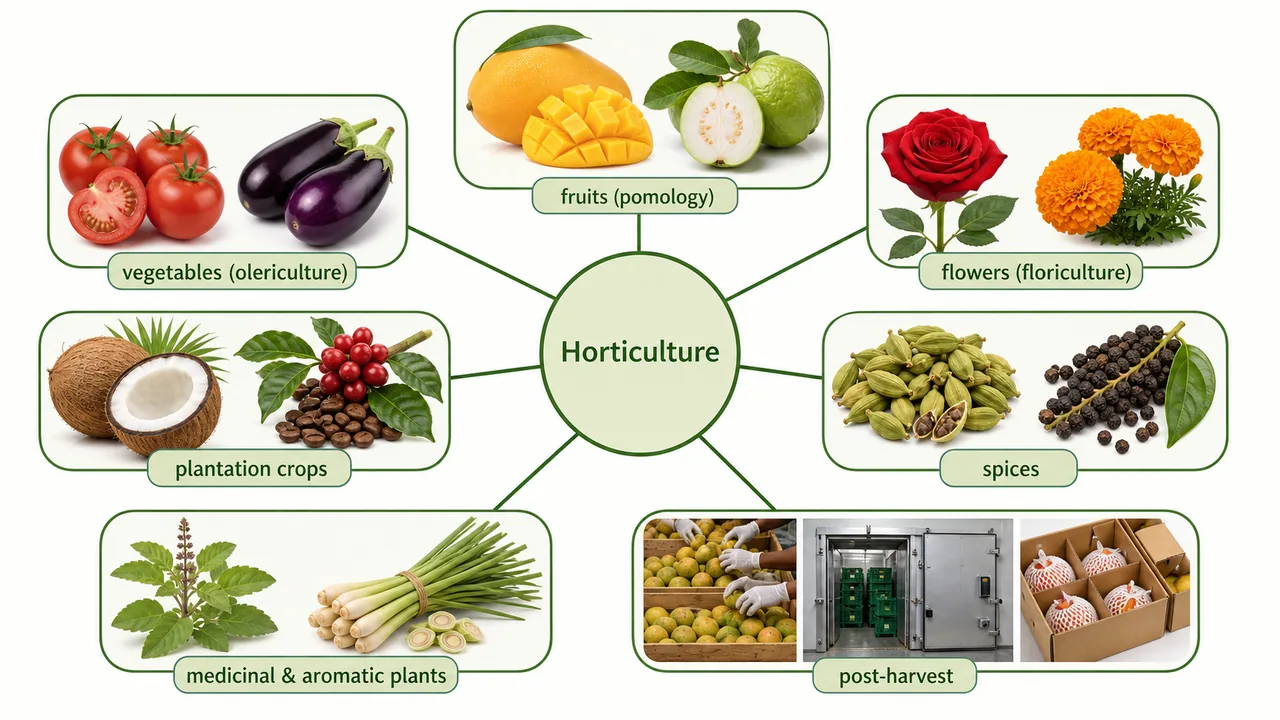
- Horticulture may be defined as the science and technique of production, processing and merchandizing of fruits, vegetables, flowers, spices, plantations, medicinal and aromatic plants. It is a broad branch of agriculture that deals with the intensive cultivation of high-value crops, distinguishing itself from agronomy which focuses on field crops like cereals and pulses.
Branches of Horticulture
| Branch | Description |
|---|---|
| Pomology | Cultivation of fruit crops |
| Olericulture Exams | Cultivation of vegetables |
| Floriculture | Cultivation of flower crops |
| Plantation crops | Cultivation of crops like coconut, arecanut, rubber, coffee, tea etc. |
| Spices crop | Cultivation of crops like cardamom, pepper, nutmeg etc. |
| Medicinal and aromatic plants | Cultivation of medicinal and aromatic crops |
| Post-Harvest | Post-harvest handling, grading, packaging, storage, processing, value addition, marketing etc. of horticulture crops |
The major branches of horticulture include Pomology (study of fruit crops), Olericulture (study of vegetable crops), Floriculture (study of flower crops), Plantation crops, Spices, Medicinal and Aromatic plants, and Post-harvest technology. Each branch specializes in the cultivation, management, and marketing of its respective crop group.
Pro Content Locked
Upgrade to Pro to access this lesson and all other premium content.
₹99 charged monthly · Cancel anytime
- All Agriculture & Banking Courses
- AI Lesson Questions (100/day)
- AI Doubt Solver (50/day)
- Glows & Grows Feedback (30/day)
- AI Section Quiz (20/day)
- 22-Language Translation (100/day)
- Recall Questions (20/day)
- AI Quiz (15/day)
- AI Quiz Paper Analysis (100/day)
- AI Step-by-Step Explanations (100/day)
- Spaced Repetition Recall (FSRS)
- AI Tutor
- Immersive Text Questions
- Audio Lessons — Hindi & English
- Mock Tests & Previous Year Papers
- Summary & Mind Maps
- XP, Levels, Leaderboard & Badges
- Generate New Classrooms
- Voice AI Teacher (AgriDots Live)
- AI Revision Assistant
- Knowledge Gap Analysis
- Interactive Revision (LangGraph)
🔒 Secure via Razorpay · Cancel anytime · No hidden fees
- The term Horticulture is derived from the Latin words: hortus meaning garden and cultura meaning cultivation. Together, these words literally translate to "garden cultivation," which captures the essence of this discipline.
- Horticulture may be defined as the science and technique of production, processing and merchandizing of fruits, vegetables, flowers, spices, plantations, medicinal and aromatic plants. It is a broad branch of agriculture that deals with the intensive cultivation of high-value crops, distinguishing itself from agronomy which focuses on field crops like cereals and pulses.
Branches of Horticulture
| Branch | Description |
|---|---|
| Pomology | Cultivation of fruit crops |
| Olericulture Exams | Cultivation of vegetables |
| Floriculture | Cultivation of flower crops |
| Plantation crops | Cultivation of crops like coconut, arecanut, rubber, coffee, tea etc. |
| Spices crop | Cultivation of crops like cardamom, pepper, nutmeg etc. |
| Medicinal and aromatic plants | Cultivation of medicinal and aromatic crops |
| Post-Harvest | Post-harvest handling, grading, packaging, storage, processing, value addition, marketing etc. of horticulture crops |
The major branches of horticulture include Pomology (study of fruit crops), Olericulture (study of vegetable crops), Floriculture (study of flower crops), Plantation crops, Spices, Medicinal and Aromatic plants, and Post-harvest technology. Each branch specializes in the cultivation, management, and marketing of its respective crop group.
Important Horticultural Institutes
| Abbreviation | Name of Institute | Place | State |
|---|---|---|---|
| CISH | Central Institute of Subtropical Horticulture | Lucknow | UP |
| CITH | Central Institute of Temperate Horticulture | Srinagar | J&K |
| CPCT | Central Plantation Crops Research Institute | Kasaragod | Kerala |
| NRCC | National Research Centre for Cashew | Puttur | Karnataka |
| CTCRI | Central Tuber Crops Research Institute | Thiruvananthapuram | Kerala |
| CISH | Central Institute for Subtropical Horticulture | Lucknow | UP |
| NBSS | National Bureau of Soil Survey | Nagpur | Maharashtra |
| NRCS | National Research Centre for Seed Spices | Ajmer | Rajasthan |
| CPRI | Central Potato Research Institute | Shimla | HP |
| NRCM | National Research Centre for Mushroom | Solan | HP |
| CIAH | Central Institute for Arid Horticulture | Bikaner | Rajasthan |
| NRFB | National Research Centre for Banana | Trichy | TN |
| NRCG | National Research Centre for Citrus | Nagpur | Maharashtra |
| NRCOG | National Research Centre for Onion & Garlic | Rajgurunagar | MH |
| CRDC | Central Research Institute for Dryland Agriculture | Hyderabad | Telangana |
| NRCMAP | National Research Centre for Medicinal & Aromatic Plants | Anand | Gujarat |
| NRCO | National Research Centre for Orchids | Gangtok | Sikkim |
| IIHR | Indian Institute of Horticultural Research | Bengaluru | Karnataka |
| IIVR | Indian Institute of Vegetable Research | Varanasi | UP |
| NIB | National Institute of Biotic Stress | Raipur | Haryana |
| Board / Institute | Location |
|---|---|
| Coffee Board | Bangalore, Karnataka |
| Coconut Board | Kochi, Kerala |
| Coir Board | Kochi, Kerala |
| Tea Board | Kolkata, West Bengal |
| Spices Board | Cochin, Kerala |
| National Medicinal Plants Board | New Delhi |
| National Horticulture Board (NHB) | Gurgaon, Haryana |
| Institute of Himalayan Bioresource Technology (IHBT) | Palampur, HP |
| Central Sericultural Research & Training Institute (CSRTI) | Mysore |
| Central Silk Board | Bangalore, Karnataka |
| Central Muga Eri Research & Training Institute | Jorhat, Assam |
These institutes and boards play a crucial role in research, development, and policy-making for the horticulture sector in India. They coordinate efforts across states, provide technical guidance to farmers, and work towards improving productivity and quality of horticultural crops.
Nutritive value of fruits and vegetables
| Nutrients | Fruit | Vegetable |
|---|---|---|
| Vitamin A/ Carotene | Mango 4800 IU/100 g, Papaya 2020 IU/100 g | Bathua leaves 11,300 IU/100g |
| Vitamin B₁/ Thiamine | Cashew nut | Chilies 0.55 mg/100 g |
| Vitamin B₂ | Bael > Papaya | Fenugreek |
| Vitamin C/ Ascorbic acid | Barbados cherry 2000 mg/100g, Aonla (600 mg/100g) | Coriander leaves 135 mg/100 g |
| Carbohydrates | Raisin (Dehydrated Grape) | Tapioca (38.1%) |
| Protein | Cashew nut 21.2% | Peas (7.2%) |
| Fat | Walnut 64.5% | Potato 11.8 g/100g |
| Fibre | Fig | Fig |
| Calcium | Litchi 0.21% | Agathi 1130 mg/100g |
| Phosphorus | Almond > Cashew nut | Amaranthus 800 mg/100g |
| Iron | Dry Karonda 39.1%, Date Palm 10.6% | Amaranthus 22.9% |
| Calorific value | Walnut 687 calorie/100g | Tapioca 338 calorie/100g |
Fruits and vegetables are essential components of a balanced diet. They are rich sources of vitamins, minerals, dietary fibre, and antioxidants. Understanding their nutritive value helps in planning diets and also in selecting crops for cultivation based on nutritional demand.
Daily requirement: Per day per capita
| Food Group | Daily Requirement |
|---|---|
| Cereals | 475 g |
| Pulses | 80 g |
| Fruits | 120 g |
| Vegetables | 285 g |
| Milk | 240 g |
| Sugar | 40 g |
The per capita daily requirement indicates the recommended amount of fruits and vegetables that an individual should consume for maintaining good health. India has been steadily increasing its per capita availability of fruits and vegetables through focused horticulture development programmes.
Difference between fruits and vegetables
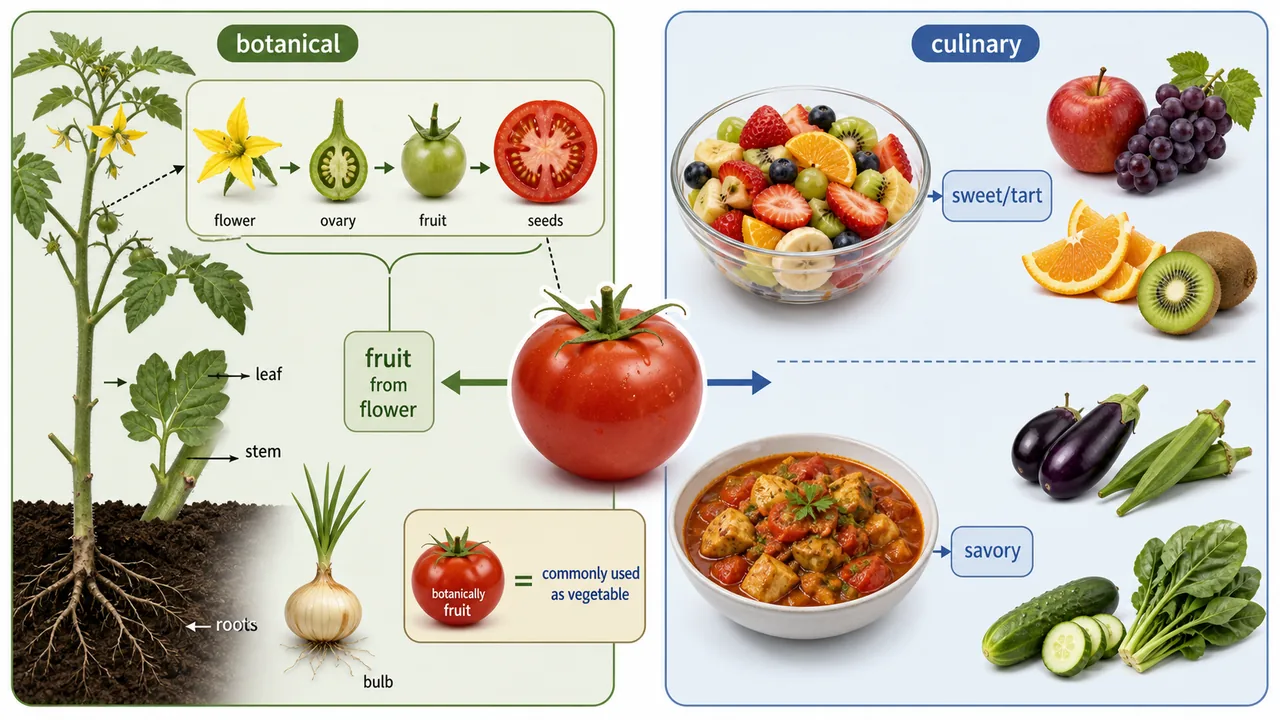
- Fruits and vegetables are classified from both a botanical and culinary standpoint. Understanding this distinction is important for examinations, as questions often test whether a particular crop is botanically a fruit or a vegetable.
- Botanically, fruits and vegetables are classified depending on which part of the plant they come from. This classification is based on plant morphology and reproductive biology.
- A fruit develops from the flower of a plant, while the other parts of the plant are categorized as vegetables. For instance, a tomato is botanically a fruit (it develops from the ovary of a flower), but is culinarily treated as a vegetable.
- Fruits contain seeds, while vegetables can consist of roots, stems and leaves. This is a key botanical distinction to remember.
- From a culinary perspective, fruits and vegetables are classified based on taste. This is the classification most commonly used in everyday life and in the food industry.
- Fruits generally have a sweet or tart flavor and can be used in desserts, snacks or juices. Their high sugar content is what gives them this characteristic taste.
- Vegetables have a more mild or savory taste and are usually eaten as part of a side dish or main course. They are typically cooked before consumption, though many can also be eaten raw.
Classification of fruits
👉🏻 The following are the various types of classification:
- Climatic adaptability
- According to Fruit ripening
- Rate of respiration
- Photoperiodic responses
- Relative salt tolerance
- Acid present in fruit crop
These classification systems help us understand the growth requirements, post-harvest behaviour, and management practices needed for different fruit crops. Each system offers a unique lens through which to study and manage fruits.
Climatic Adaptability
| Tropical | Subtropical | Temperate |
|---|---|---|
| Mango | Citrus | Apple |
| Banana | Guava | Pear |
| Papaya | Ber | Peach |
| Sapota | Phalsa | Plum |
| Pineapple | Date palm | Quince |
| Coconut | Pomegranate | Apricot |
| Cashew | Grape | Walnut |
| Arecanut | Aonla | Almond |
| Jackfruit | Litchi | Strawberry |
| Avocado | Loquat | Cherry |
Based on climatic adaptability, fruits are broadly classified into tropical, subtropical, and temperate fruits. Tropical fruits like mango, banana, and papaya thrive in warm climates with no frost. Subtropical fruits like citrus and guava can tolerate mild winters. Temperate fruits like apple, pear, and peach require a distinct cold period (chilling hours) for proper growth and fruiting.
- *However, this choice is not very rigid as some tropical crops which can be grown in Subtropics and vice versa.
Arid zone fruits
- Ber
- Aonla
- Pomegranate
- Fig
- Phalsa
These fruits are well-adapted to hot and dry climatic conditions with limited water availability. They are particularly important for farmers in arid and semi-arid regions of India such as Rajasthan, Gujarat, and parts of Maharashtra, where other fruit crops may not survive.
Shade Tolerant
| Highly Tolerant | Moderately Tolerant | Highly Sensitive |
|---|---|---|
| Carambola | Banana | Coconut, Mango, Guava, Citrus |
Shade-tolerant fruit crops are those that can grow and produce fruit even under partial shade conditions. This characteristic is important when planning multi-storey cropping systems or agroforestry models where some crops grow under the canopy of taller trees.
According to fruit ripening condition
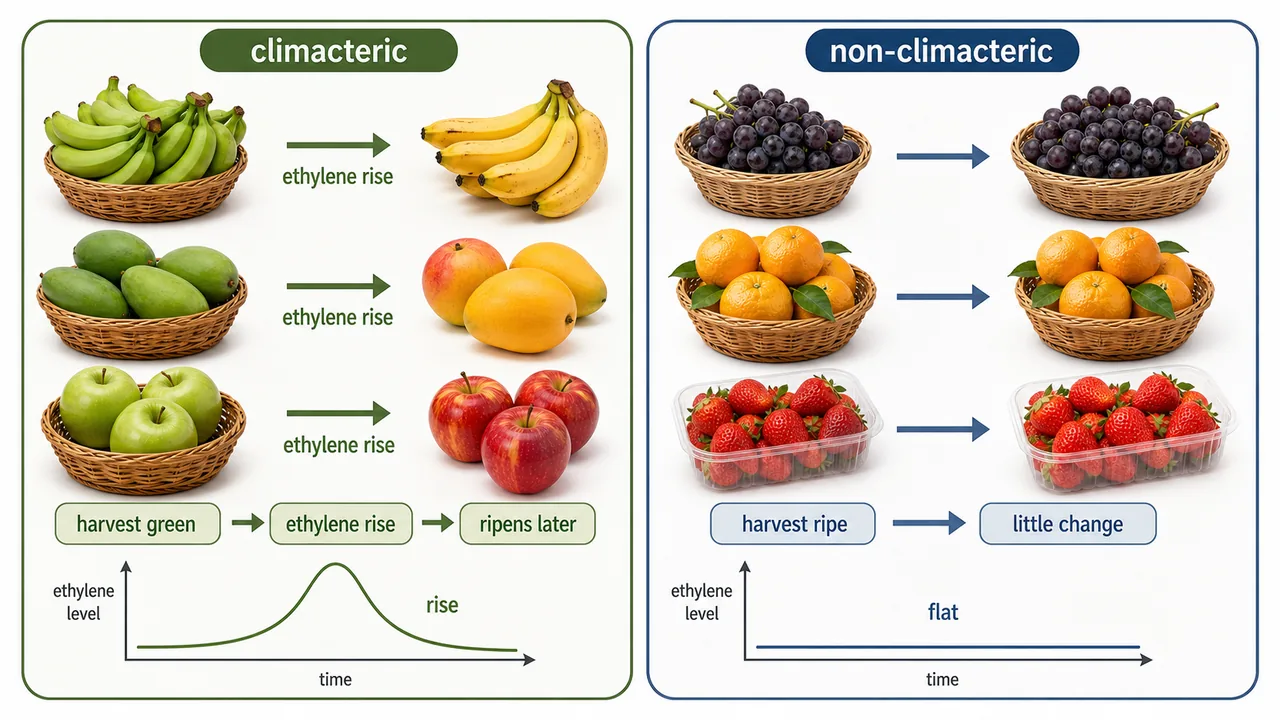
👉🏻 Based on this, the fruits can be classified as Climacteric fruits and Non-climacteric fruits. This is one of the most important classifications from a post-harvest management perspective.
- The climacteric fruits can ripe after removing them from the plants on the other hand non-climacteric fruits are those which don't ripe after picking. This fundamental difference determines how and when fruits should be harvested for best quality.
- Now, the ripening process is related to the production of ethylene in plants. Ethylene is a gaseous plant hormone that acts as a natural ripening agent.
- Climacteric species produce ethylene as they ripen, and the harvested produce is capable of ripening during the postharvest period. This means they can be harvested at the mature green stage and allowed to ripen during transport or storage.
- These commodities, such as bananas, apples, and peaches, tend to get sweeter and softer after harvest. The burst of ethylene production triggers a cascade of biochemical changes including starch-to-sugar conversion, softening of cell walls, and development of aroma compounds.
- Non-climacteric plants, such as leafy vegetables, do not continue to ripen after harvest; they will soften and rot, but this is due to moisture loss, decay, and tissue deterioration. Therefore, non-climacteric fruits must be harvested at optimum ripeness since they will not improve in quality after picking.
- Thus, Climacteric fruits produce much larger amount of ethylene than non-climacteric fruits. This is why climacteric fruits like bananas and mangoes can be artificially ripened using ethylene gas or calcium carbide.
Climacteric Fruits
| Climacteric Fruits (Fruit can ripe after removing from plants) | Non-Climacteric Fruits (Don't ripe after picking) |
|---|---|
| Sapota | Grape |
| Guava | Pineapple |
| Mango | Citrus |
| Papaya | Pomegranate |
| Banana | Litchi |
| Fig | Ber |
| Apple | Jamun |
| Pear | Cashew |
| Peach | Cherry |
| Plum | Strawberry |
Classification based on ethylene production
| Class | Micro-L C₂H₄/kg/hr | Crops |
|---|---|---|
| Very Low | < 0.1 | Grape, Citrus |
| Low | 0.1 — 1.0 | Pineapple, Watermelon |
| Medium | 1-10 | Banana, Mango, Guava, Fig, Tomato |
| High | 10 — 100 | Papaya, Avocado, Plum |
| Very High | >100 | Apple, Passion fruit, Sapota |
- Highest ethylene production seen in Apple (25— 2500 uL/L); Passion fruit (466-530 uL/L);
The rate of ethylene production determines how quickly a fruit will ripen and how long it can be stored. Fruits with very high ethylene production should be stored separately from other produce to prevent premature ripening. This is why ethylene scrubbers and controlled atmosphere storage are used in commercial fruit storage.
Classification based on Respiration
- Despite having been detached from the plant, fruits and vegetables remain as living organs after harvest. This is a key concept in post-harvest physiology -- the produce is still alive and carrying out metabolic processes.
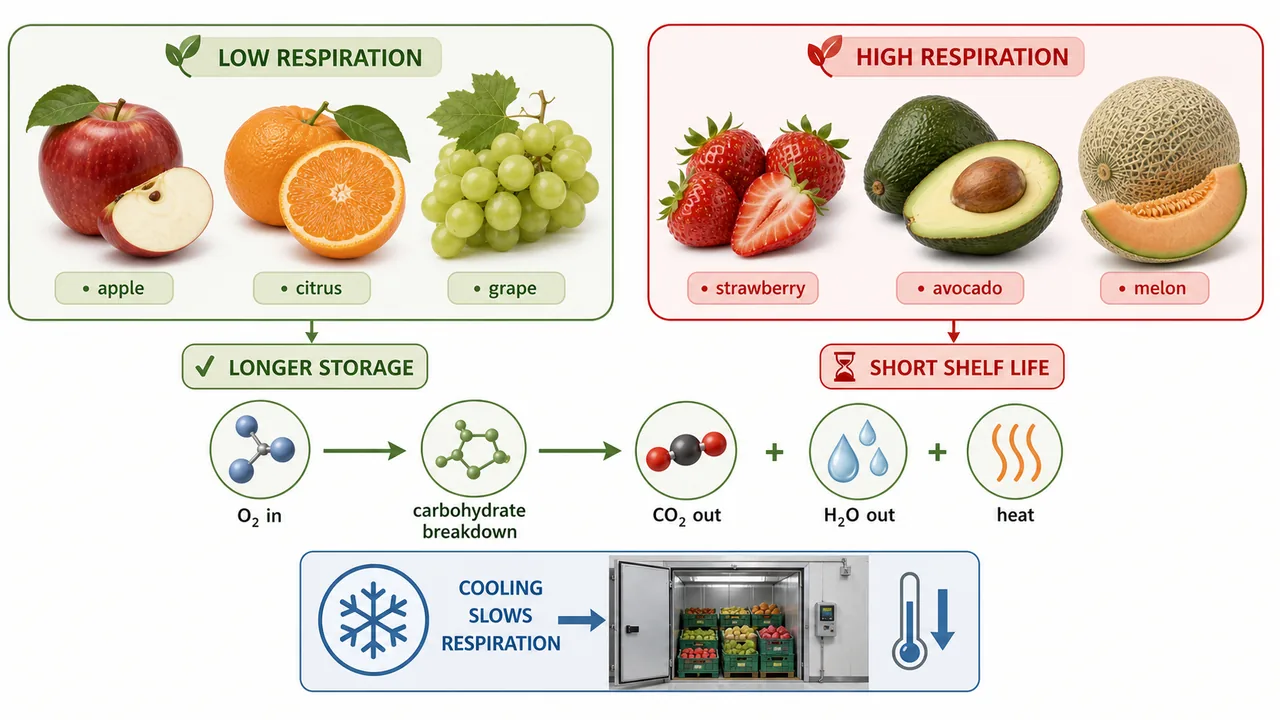
- Like all living tissues, harvested produce continues to respire throughout its postharvest life. Respiration is the process by which stored food is broken down to release energy for cellular activities.
- During the process of respiration, carbohydrates are broken down to their constituent parts to produce energy to run cellular processes, thus keeping the cells and organism alive. The basic equation is: C6H12O6 + 6O2 --> 6CO2 + 6H2O + Energy.
- Throughout this process, oxygen is consumed and water, carbon dioxide, and energy are released. This is essentially the reverse of photosynthesis.
- Because this process occurs from harvest to table, the carbohydrates stored in the harvested plant portion are continually "burned" as energy to keep the vegetable alive; as respiration continues, compounds that affect plant flavor, sweetness, weight, turgor (water content), and nutritional value are lost. This is why produce gradually loses quality after harvest.
- Thus, reducing the rate of respiration is an important consideration in extending the postharvest life of a fruit or vegetable and optimizing postharvest quality. The primary methods to achieve this include lowering temperature, reducing oxygen levels, and increasing CO2 levels in storage.
- Harvested fruits and vegetables of different plants have different rates of respiration; some respire at a faster rate (and thus are more perishable vegetables), while some respire at a relatively slow rate (less perishable vegetables) (see table below). Higher respiration rate = shorter shelf life.
- In addition, storage conditions affect respiration, with higher temperatures leading to a faster rate of respiration; for every 10°C (18°F) rise in temperature, the respiration rate will double or even triple. This principle is called the Q10 effect or temperature coefficient.
- Because of the significant effect of temperature on respiration, the amount of time a harvested product is exposed to heat should be minimized; the fruit or vegetable should be quickly brought to its optimal storage temperature. This practice is known as pre-cooling and is essential in the cold chain.
Classification based on the respiration rate
| Respiration Rate | Examples | Release of CO₂ |
|---|---|---|
| Very Low | Nut, Dried fruits | <5 mg |
| Low | Apple, Citrus, Grape | 5-10 mg |
| Medium | Mango, Banana, Peach, Pear | 10-20 mg |
| High | Strawberry, Avocado | 20-40 mg |
| Very High | Snap melon | 40-60 mg |
- In the case of Climacteric fruits, there is a sharp rise in respiration after harvesting. This sudden spike is called the climacteric peak and is associated with rapid ripening.
- In the case of Non-climacteric fruits, there is steady respiration at the time of harvesting. Their respiration rate gradually declines after harvest without any sharp peak.
Classification based on Photoperiodic responses
| Long Day Plants | Short Day Plants | Day Neutral Plants |
|---|---|---|
| Passion fruit, Apple | Strawberry, Pineapple, Coffee | Papaya, Guava, Banana |
Photoperiodism refers to the response of plants to the relative length of day and night. Some fruit crops are classified as short-day plants (flower when day length is shorter), long-day plants (flower when day length is longer), or day-neutral plants (flowering is not affected by day length). This knowledge is valuable for planning planting schedules and predicting flowering time.
Classification based on relative salt tolerance
| Highly tolerant | Medium tolerant | Less tolerant |
|---|---|---|
| Datepalm, Ber, Aonla, Guava, Coconut, Khirni | Pomegranate, Cashew, Fig, Jamun and Phalsa | Mango, Apple, Citrus, Pear, Strawberry |
Salt tolerance is an increasingly important characteristic as soil salinity is a growing problem in irrigated agriculture. Knowing which fruit crops can tolerate saline conditions helps farmers in salt-affected regions choose appropriate crops for cultivation.
Acid present in fruit crops
| Citric Acid | Malic Acid |
|---|---|
| Citrus, Guava, Pear, Pineapple | Apple, Banana, Cherry, Plum, Melon |
The type of organic acid present in a fruit is a frequently asked question in competitive exams. For example, citric acid is found in citrus fruits, tartaric acid in grapes, malic acid in apple, and oxalic acid in carambola (star fruit). These acids contribute to the flavour profile and TSS:acid ratio of the fruit, which determines its taste and quality.
Causes of colour/bitterness in fruits/vegetables
| Fruit/Vegetable (Property) | Responsible Compound |
|---|---|
| Papaya (Yellow Colour) | Caricaxanthin |
| Apple (Redness) | Anthocyanin |
| Tomato (Redness) | Lycopene |
| Chilli (Redness) | Anthocyanin |
| Chilli (Pungency) | Capsaicin |
| Carrot (Orange Colour) | Carotein |
| Carrot (Red Colour) | Anthocyanin |
| Turmeric (Yellow Colour) | Curcumin |
| Bitter Gourd (Bitterness) | Memordicocite |
| Cucumber (Bitterness) | Cucurbitacin |
| Onion (Yellow Colour) | Quercetin |
| Onion (Red Colour) | Anthocyanin |
| Onion (Pungency) | Allyl propyl di-sulphide exams |
| Garlic (Pungency) | Alycine/Amino Acid |
| Raphanus (Pungency) | Isocyanate |
| Mustard (Pungency) | Glucosilates |
| Potato (Green Colour) | Solanin |
| Gram leaves (Sour taste) | Malic/Oxalic Acid |
| Pepper (Pungency) | Oleoresin |
| Cabbage (Pungency) | Sinigrin |
The colour of fruits and vegetables is determined by specific pigments such as chlorophyll (green), carotenoids (yellow-orange-red), anthocyanins (red-blue-purple), and lycopene (red). Bitterness is typically caused by specific chemical compounds like alkaloids and glycosides. Understanding these pigments and compounds is important for quality assessment, processing, and nutritional evaluation of horticultural produce.
Summary Cheat Sheet
| Concept / Topic | Key Details / Explanation |
|---|---|
| Horticulture basics | Horticulture comes from hortus (garden) and cultura (cultivation) and covers production, processing, and marketing of fruits, vegetables, flowers, spices, plantation crops, and medicinal-aromatic plants. |
| Main branches | Key branches are pomology for fruits, olericulture for vegetables, floriculture for flowers, plantation crops, spices, medicinal and aromatic plants, and post-harvest management. |
| Important institutes | Repeated exam names from this lesson include CISH Lucknow, CITH Srinagar, IIHR Bengaluru, IIVR Varanasi, CPRI Shimla, NRC for Banana Trichy, NRC for Citrus Nagpur, and NRC for Onion and Garlic Rajgurunagar. |
| Boards and national bodies | Coffee Board is in Bengaluru, Coconut Board and Coir Board in Kochi, Tea Board in Kolkata, Spices Board in Cochin, National Medicinal Plants Board in New Delhi, and NHB in Gurgaon. |
| Nutrition leaders in fruits | Mango and papaya are rich in carotene, Barbados cherry and aonla are major vitamin C sources, cashew is noted for protein, walnut for fat and calories, and dry karonda/date palm for iron. |
| Nutrition leaders in vegetables | Bathua is rich in vitamin A, coriander leaves in vitamin C, peas in protein, agathi in calcium, amaranthus in phosphorus and iron, and tapioca in carbohydrates and calories. |
| Daily requirement | Per capita daily requirement given here is cereals 475 g, pulses 80 g, fruits 120 g, vegetables 285 g, milk 240 g, and sugar 40 g. |
| Fruit vs vegetable | Botanically, fruits develop from the flower and usually contain seeds, while vegetables come from roots, stems, leaves, or other plant parts; culinarily, fruits are usually sweet or tart and vegetables are mild or savory. |
Summary Continued
| Concept / Topic | Key Details / Explanation |
|---|---|
| Climate-based fruit groups | Tropical fruits include mango and banana, subtropical fruits include citrus and guava, and temperate fruits include apple and pear; arid fruits highlighted are ber, aonla, pomegranate, fig, and phalsa. |
| Shade and salt tolerance | Carambola is listed as highly shade tolerant, banana as moderately tolerant, and coconut-mango-guava-citrus as shade sensitive; highly salt-tolerant fruits include date palm, ber, aonla, guava, coconut, and khirni. |
| Climacteric vs non-climacteric | Climacteric fruits ripen after harvest and produce more ethylene, while non-climacteric fruits do not improve after picking; examples here include mango, banana, guava, apple, and pear as climacteric, versus grape, citrus, pineapple, litchi, and strawberry as non-climacteric. |
| Ethylene production classes | Very low ethylene producers include grape and citrus, medium group includes banana and mango, high group includes papaya and avocado, and very high group includes apple, passion fruit, and sapota. |
| Respiration classes | Low-respiring fruits such as apple, citrus, and grape store longer, whereas high to very high respirers such as strawberry, avocado, and snap melon are more perishable; climacteric fruits show a post-harvest respiration peak. |
| Photoperiod response | Long-day fruits listed are passion fruit and apple, short-day fruits are strawberry, pineapple, and coffee, and day-neutral fruits are papaya, guava, and banana. |
| Fruit acids | Citric acid is associated with citrus, guava, pear, and pineapple, while malic acid is associated with apple, banana, cherry, plum, and melon. |
| Pigments and pungency compounds | Key exam compounds include caricaxanthin in papaya, lycopene in tomato, quercetin in onion, curcumin in turmeric, capsaicin in chilli, cucurbitacin in cucumber, allyl propyl disulphide in onion pungency, and sinigrin in cabbage pungency. |