🏠 Types of Greenhouse: Classification by Shape, Material & Temperature
Types of greenhouse based on shape (lean-to, even span, ridge & furrow, quonset, sawtooth, gothic arch), covering material (glass, polyethylene, polycarbonate, FRP), temperature, and ventilation — with comparison tables for exams, NABARD, ICAR, and exams.
What is Protected Cultivation?
Protected cultivation is the technique of growing crops under a controlled or modified environment — shielding plants from adverse climatic conditions and both biotic (pests, diseases) and abiotic (temperature, wind, rain, hail) stresses.
IMPORTANT
Protected cultivation allows year-round production of high-value crops irrespective of season, making it a key topic in IBPS AFO, NABARD Grade A, and FCI exams.
Key Objectives
- Extend the growing season beyond natural limits
- Protect crops from extreme weather, pests, and diseases
- Improve yield quality and quantity
- Enable off-season production of vegetables, flowers, and fruits
- Efficient use of water, fertilizers, and land
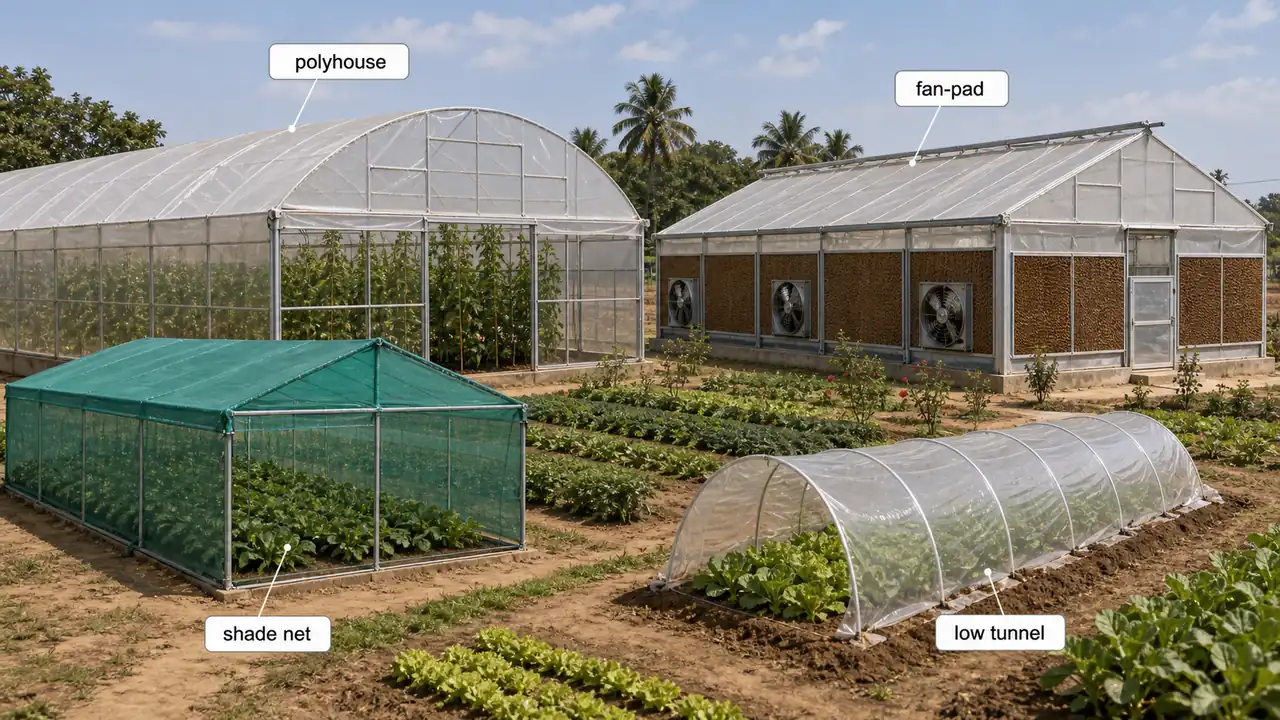
Greenhouse / Glasshouse
A greenhouse (also called a glasshouse) is a framed structure covered with transparent or translucent material (glass, plastic, polythene, or fiberglass) in which crops are grown under controlled conditions of temperature, humidity, and light.
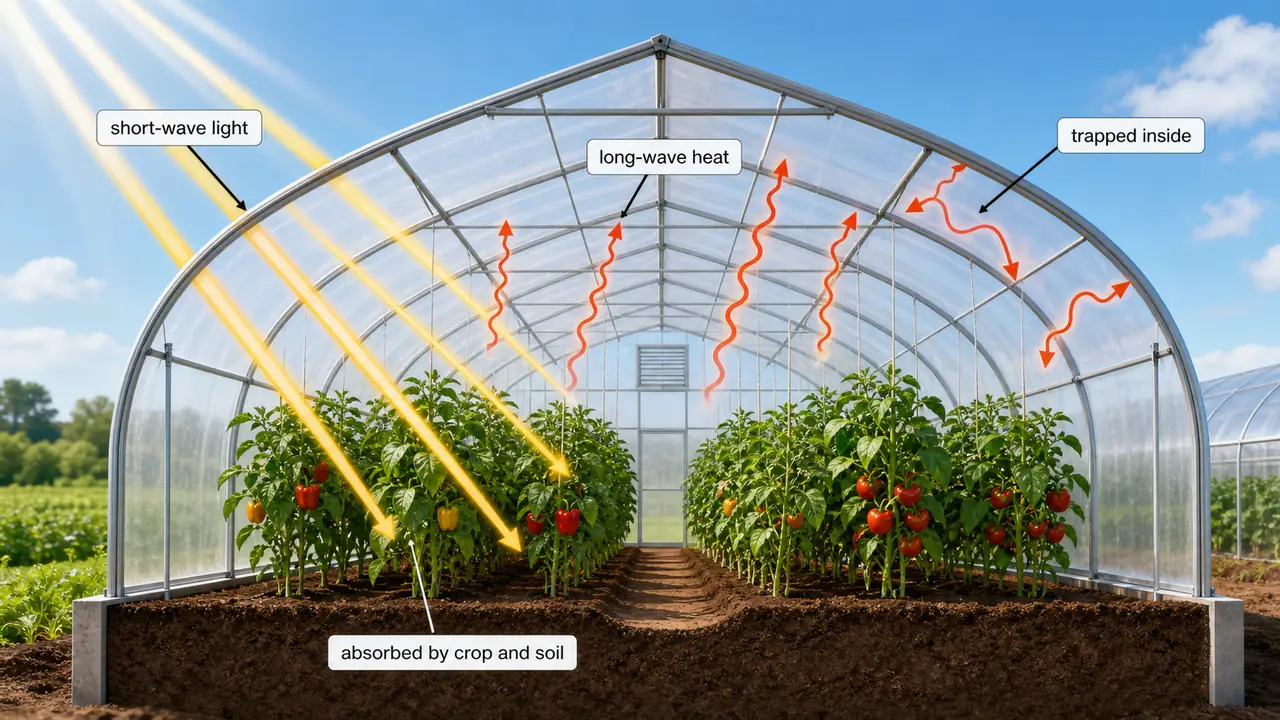
How a Greenhouse Works — The Greenhouse Effect
| Step | Process |
|---|---|
| 1 | Short-wave solar radiation passes through the transparent covering |
| 2 | Radiation is absorbed by plants, soil, and surfaces inside |
| 3 | These surfaces re-radiate energy as long-wave radiation (heat/infrared) |
| 4 | Long-wave radiation cannot pass back through glass/plastic — it is trapped inside |
| 5 | Temperature inside rises above ambient — the greenhouse effect |
TIP
Remember: Short wave enters → converted to long wave (heat) → trapped inside. This is the most frequently asked concept in exams.
Translucent Glass Type
- Provides uniform diffused light to all plants
- Preferred for high-value floriculture and vegetable crops
Temperature Management
| Season | Problem | Solution |
|---|---|---|
| Winter | Heat loss through roof | Double layer polythene sheeting over glass roof |
| Summer | Overheating | Large evaporative cooling units (fan-and-pad system) |
| Night | Temperature drop | Night temperature maintained at 13–15°C |
Types of Greenhouse Based on Shape
Greenhouses are classified by four main axes: shape/structure, covering material, temperature regime, and frame material. Shape-based classification is the most tested in exams.
| Type | Shape | Description |
|---|---|---|
| Lean-to | Right triangle | Built against an existing wall/building; one sloping roof side; cheapest; limited to small areas |
| Even Span | Symmetrical gable | Both roof slopes equal in length and angle; most common free-standing type |
| Uneven Span | Asymmetric gable | Two roof sides of unequal width; used on hillsides to maximize light capture |
| Ridge and Furrow | Joined gable series | Multiple even-span units connected at the eave/gutter; saves heating cost; large commercial operations |
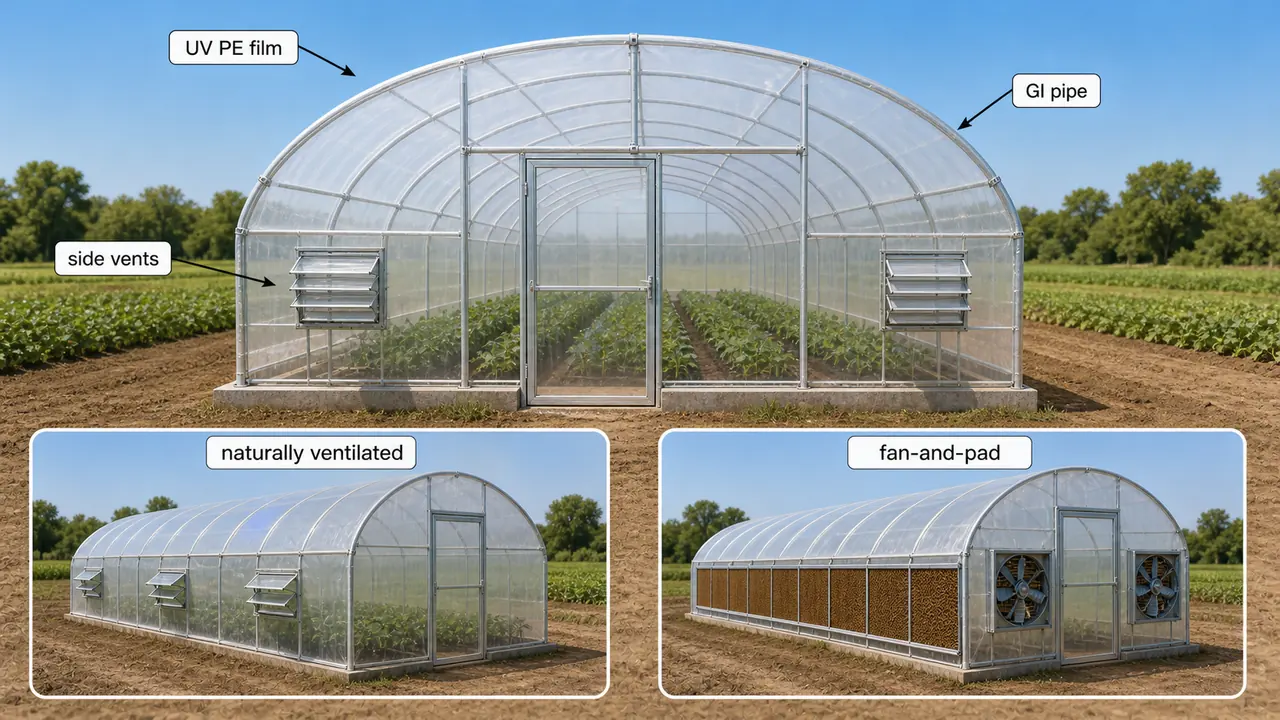
| Quonset (Hoop) | Semicircle | Half-moon arch; GI pipe frame; low cost; most common polyhouse shape in India |
| Gothic Arch | Pointed arch | Stronger than quonset; better rain and snow shedding; improved light at peak |
| Sawtooth | Asymmetric ridges | Series of roof ridges each with one near-vertical face; excellent passive ventilation; preferred for hot tropical climates |
NOTE
Even span is most common globally. Quonset is most common in India (polyhouse form). Sawtooth is ideal for India's hot plains — the near-vertical face acts as a chimney vent without fans. Ridge and furrow is preferred for large commercial farms as shared walls reduce heating cost.
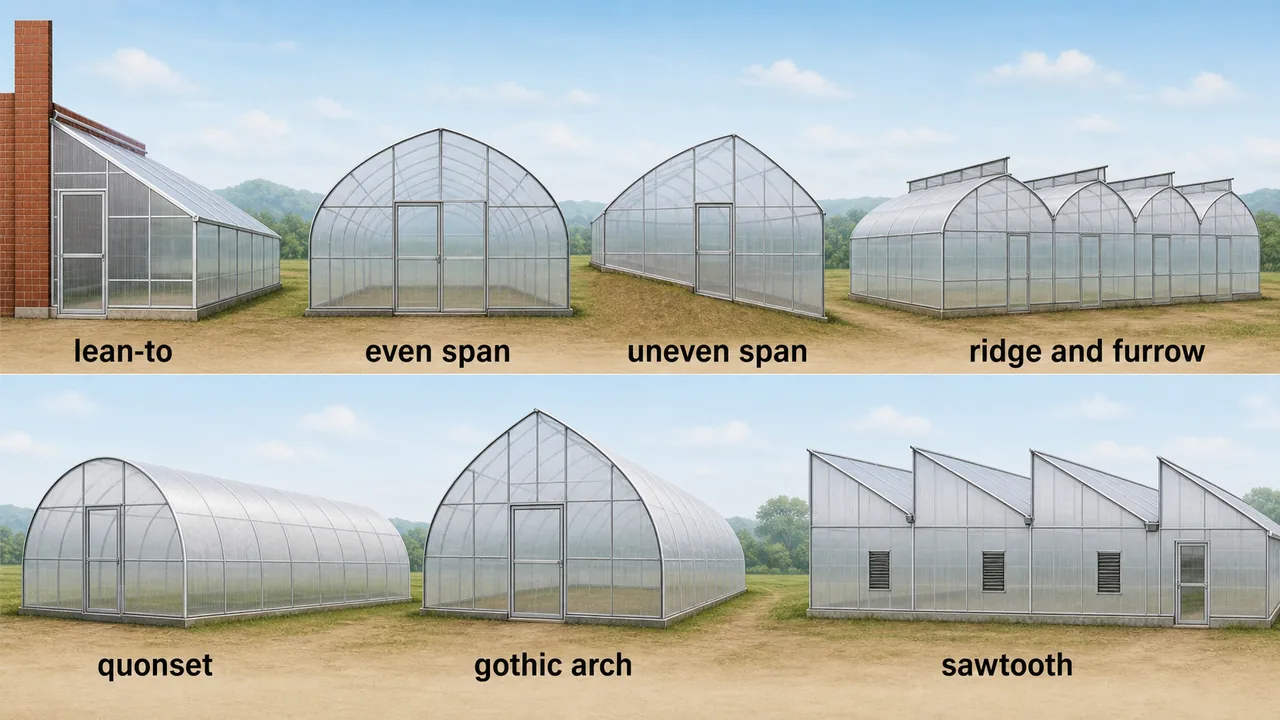
Shape Comparison — At a Glance
| Type | Relative Cost | Best Climate | India Usage |
|---|---|---|---|
| Lean-to | Lowest | Temperate | Small farms, home gardens |
| Even Span | Low–Medium | Universal | Common free-standing type |
| Uneven Span | Medium | Hilly/sloped terrain | Hill stations, NE India |
| Ridge & Furrow | High | Cool climates | Large commercial farms |
| Quonset | Low | All (with ventilation) | Most common in India |
| Gothic Arch | Low–Medium | Heavy rain/snow | Hills, flood-prone areas |
| Sawtooth | Medium | Hot tropical | Recommended for plains India |
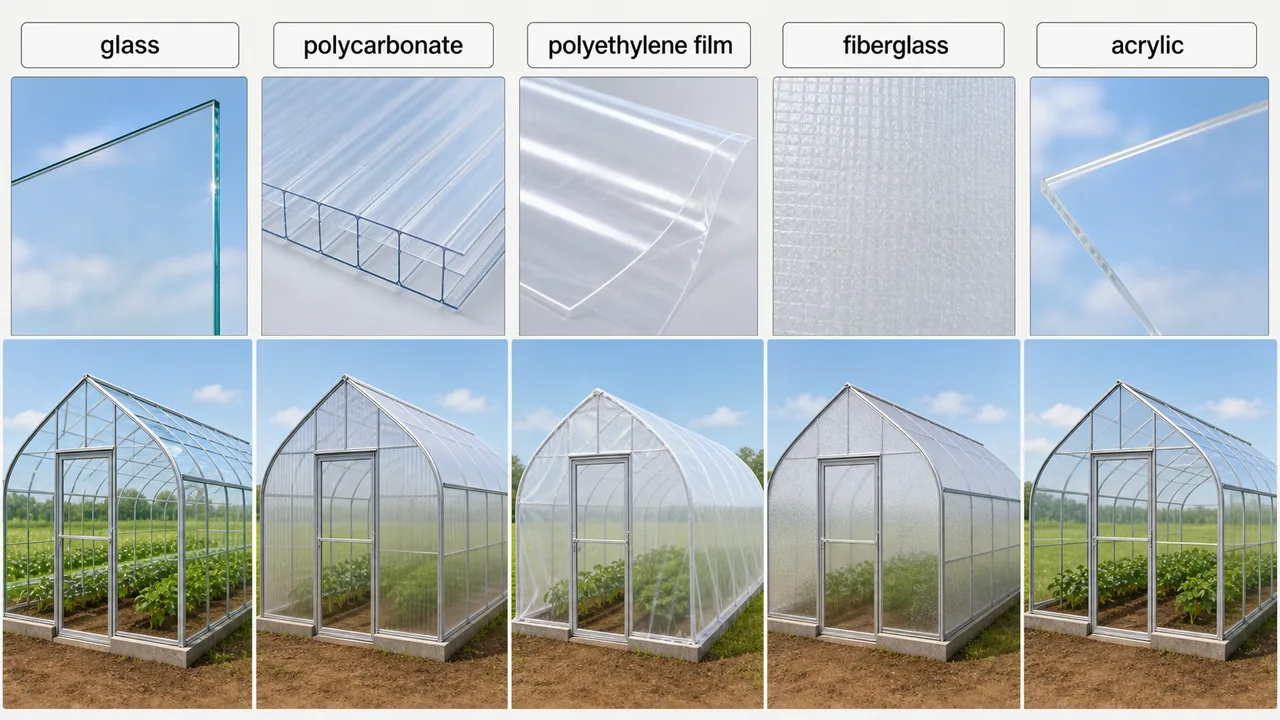
Types of Greenhouse Based on Covering Material
| Material | Durability | Light Transmission | Cost | Key Feature |
|---|---|---|---|---|
| Glass | 25+ years | ~90% | Very high | Best clarity; heavy; breakable; traditional |
| Polycarbonate (twin-wall) | 10–15 years | 80–85% | High | Strong; lightweight; excellent insulation |
| Polyethylene (LDPE/UV film) | 2–3 years | 85–88% | Lowest | Cheapest; most widely used in India; UV-stabilized |
| Fiberglass (FRP) | 15–20 years | 70–85% | Medium | Rigid; diffused light; yellows over time |
| PMMA / Acrylic glass | 10+ years | ~92% | Very high | Highest light transmission; costly; specialized use |
IMPORTANT
Polyethylene (PE) film — specifically 200-micron UV-stabilized LDPE film — is the most widely used greenhouse covering material in India. It lasts 2–3 years and is replaced periodically. Polycarbonate is used in high-end commercial greenhouses. Glass is reserved for export-quality floriculture and research greenhouses.
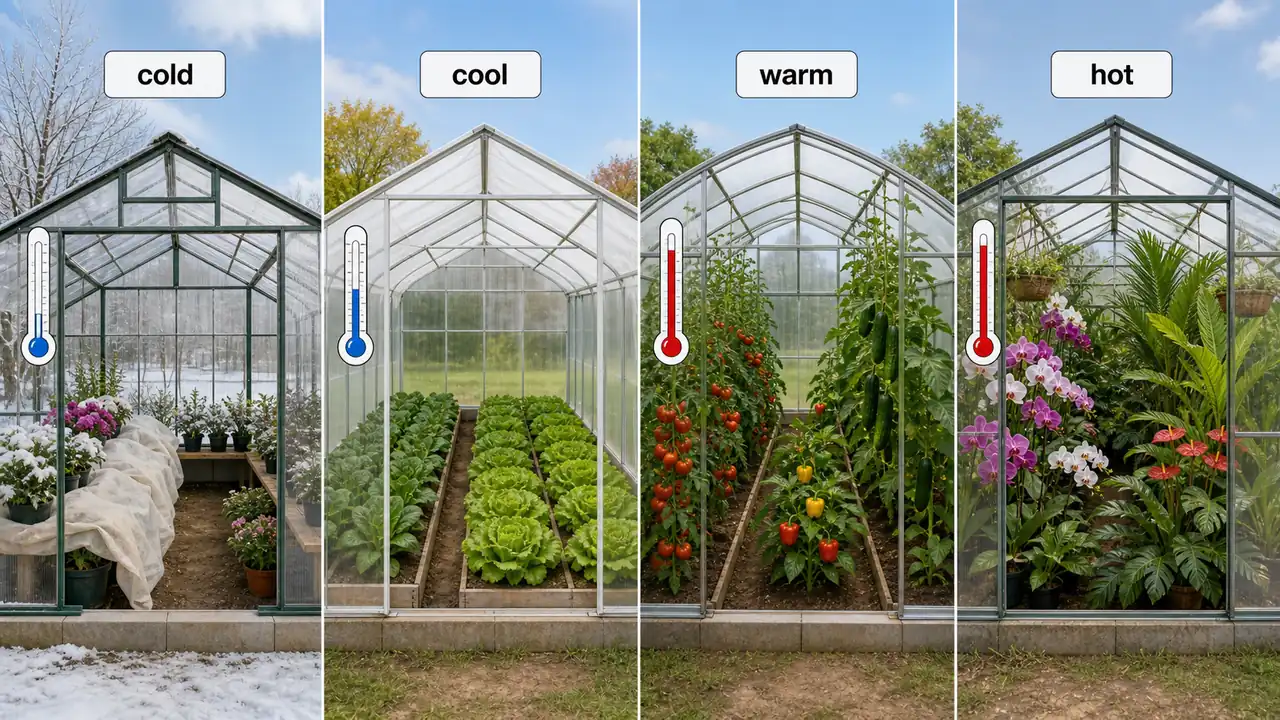
Types of Greenhouse Based on Temperature
| Type | Minimum Night Temp | Crops / Use |
|---|---|---|
| Cold / Unheated | Just above freezing | Frost protection only; hardy plants |
| Cool greenhouse | 4–7°C (or <15°C) | Lettuce, spinach, alpine plants, temperate flowers |
| Warm greenhouse | 13–16°C | Tomato, capsicum, cucumber, roses, gerbera |
| Hot / Tropical (Hothouse) | 18°C+ | Tropical orchids, anthurium, foliage plants |
TIP
A "hothouse" implies artificial heating; a "glasshouse" implies glass cladding. These terms are distinct in botany and often tested in exams.
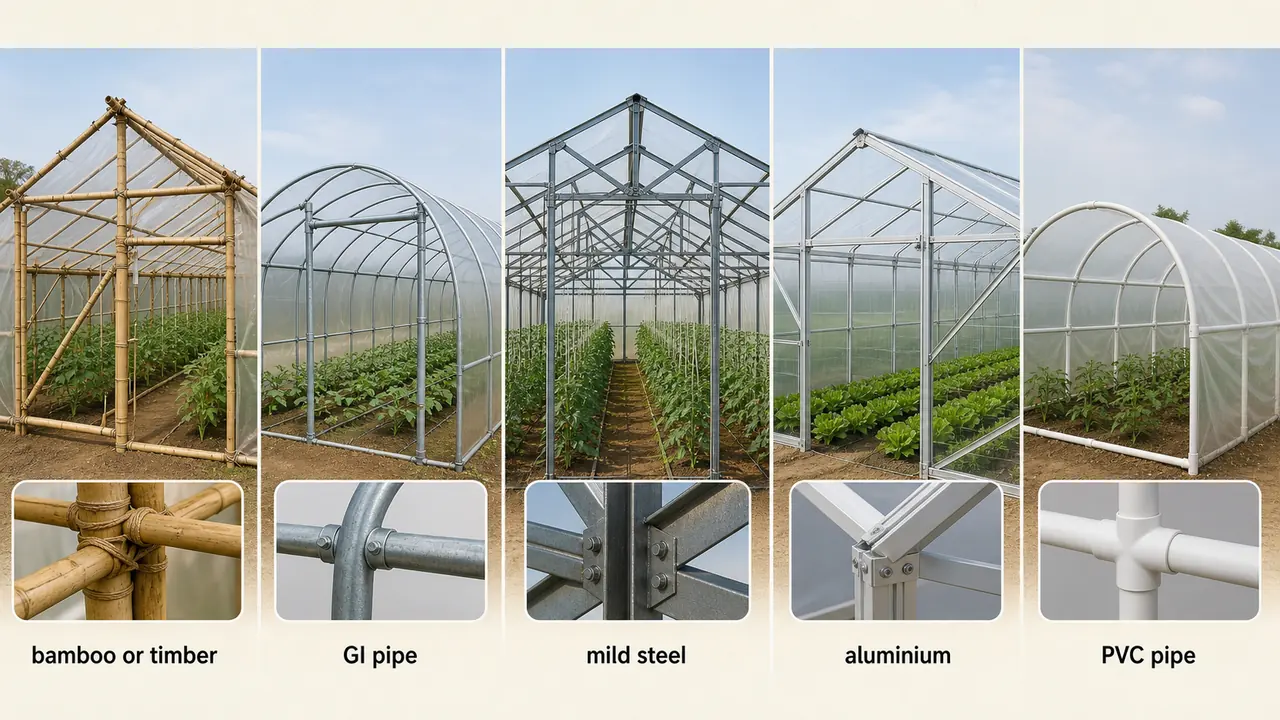
Types of Greenhouse Based on Frame Material
| Frame Material | Durability | Cost | Notes |
|---|---|---|---|
| Bamboo / Timber | ~5 years | Very low | Low-tech; widely used in tribal/hilly areas; biodegradable |
| GI (Galvanized Iron) Pipe | 15–20 years | Medium | Most common in Indian polyhouses; rust-resistant |
| Mild Steel (MS) | 20+ years | Medium–high | Stronger; suited for large structures |
| Aluminium | 25+ years | High | Corrosion-resistant; used in export-quality greenhouses |
| PVC Pipe | 5–8 years | Lowest | Ultra-low cost hoop houses; suitable for small farms |
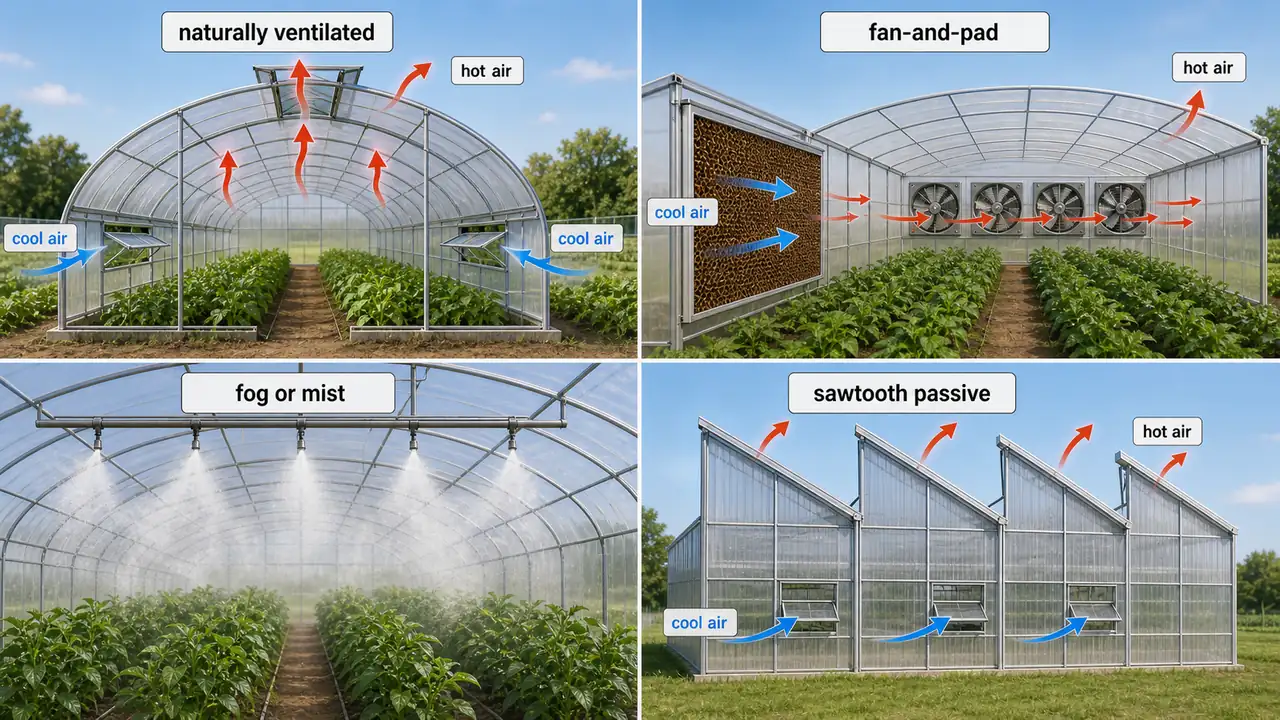
Types of Greenhouse Based on Ventilation
| Type | Mechanism | Cost | When to Use |
|---|---|---|---|
| Naturally ventilated | Passive — side vents + ridge vents; hot air rises and exits | Low | Most of India; adequate where summer temp <40°C |
| Fan-and-pad (Evaporative) | Exhaust fans pull air through wet cellulose pads; evaporation cools air | Medium–high | Arid zones (Rajasthan, Gujarat, Maharashtra plains) where temp regularly exceeds 40°C |
| Fog/Mist cooling | High-pressure nozzles mist water inside; evaporation cools air | High | High-value crops; tissue culture hardening labs |
| Sawtooth passive | Asymmetric roof creates chimney effect; hot air exits through near-vertical face | Medium | Hot, humid tropics; preferred over fan-pad for low running cost |
IMPORTANT
ICAR/NHB recommendation for India: Naturally ventilated polyhouses are recommended for most parts of India. Fan-and-pad systems are needed only in regions where summer temperatures regularly exceed 40°C.
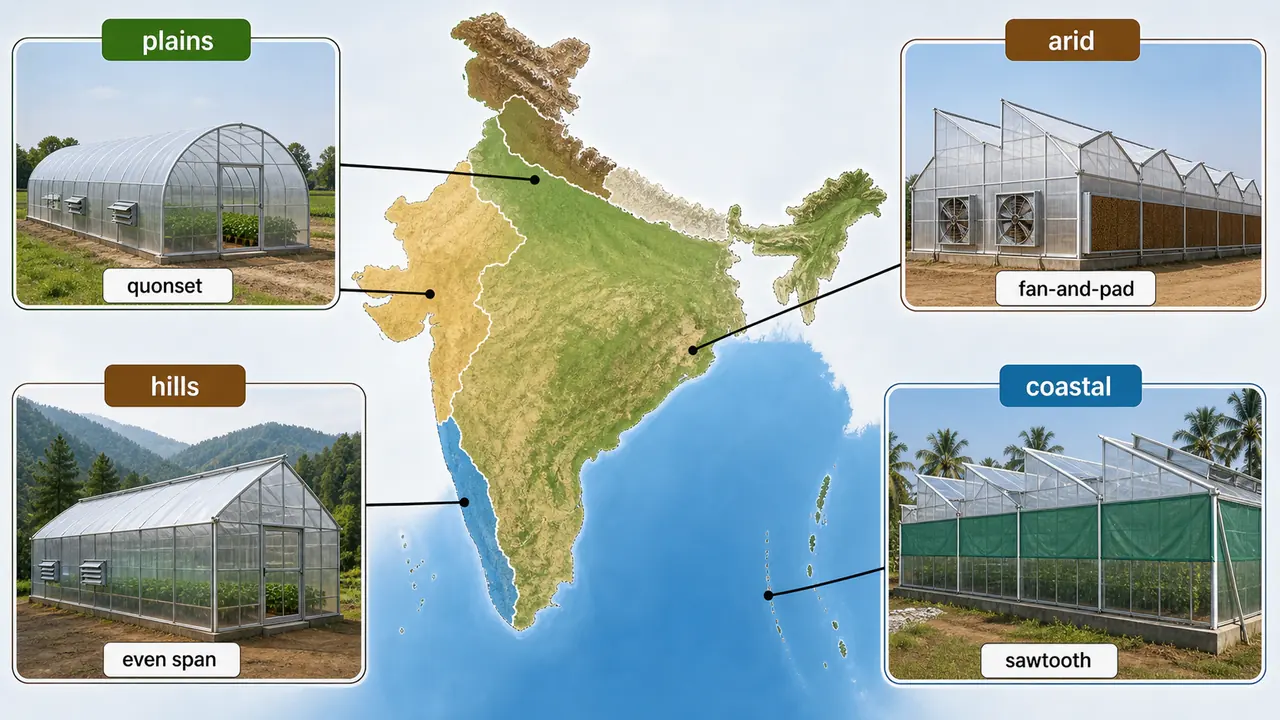
Which Type of Greenhouse is Best for India?
India's vast climate diversity means no single type suits all regions:
| Region | Recommended Type | Reason |
|---|---|---|
| Plains (UP, Bihar, MP) | Naturally ventilated Quonset polyhouse | Low cost; adequate passive ventilation |
| Arid zones (Rajasthan, Gujarat) | Fan-and-pad Quonset or Sawtooth | Active cooling needed in extreme heat |
| Hills (Himachal, Uttarakhand, NE) | Even span or Uneven span (glass/polycarbonate) | Temperature retention in cold winters |
| Coastal (Kerala, Tamil Nadu) | Sawtooth with shade net integration | High humidity + heat = max passive ventilation |
| Commercial floriculture | Even span or Gothic arch (polycarbonate) | Light uniformity + structural strength |
NOTE
The Quonset polyhouse with UV-stabilized PE film and GI pipe frame is India's de facto standard — low cost, NHM subsidy eligible, and suitable for 70% of the country.
Polyhouse
A polyhouse is the most common type of protected structure in India. It is a greenhouse covered with UV-stabilized polyethylene film.
Key Specifications
| Parameter | Detail |
|---|---|
| Covering material | UV-stabilized polyethylene (PE) film |
| Common thickness | 200 micron |
| Life of PE film | 2–3 years |
| Frame material | GI pipes / MS angle / bamboo |
Types of Polyhouses
| Type | Ventilation | Cost | Area | Best For |
|---|---|---|---|---|
| Naturally ventilated | Passive (side & top vents) | Low cost | < 1000 sq m | Tropical & subtropical India |
| Fan-and-pad | Active cooling (exhaust fans + wet cellulose pads) | Medium–high | Any | Arid/hot regions |
| Fog cooling | High-pressure fog nozzles inside | High | Any | High-value crops, tissue culture labs |
IMPORTANT
Naturally ventilated polyhouses are recommended for most parts of India by ICAR/NHB due to low cost and suitability to tropical conditions. Fan-and-pad systems are needed only where summer temperatures exceed 40°C regularly.
Advantages of Polyhouse Cultivation
- Year-round production independent of season
- 5–10 times higher yield compared to open-field cultivation
- Quality produce — uniform size, color, free from blemishes
- Water saving of 40–50% through drip irrigation integration
- Reduced pesticide use — physical barrier against many pests
- Premium market price for off-season produce
- Employment generation in rural areas
Shade Net House
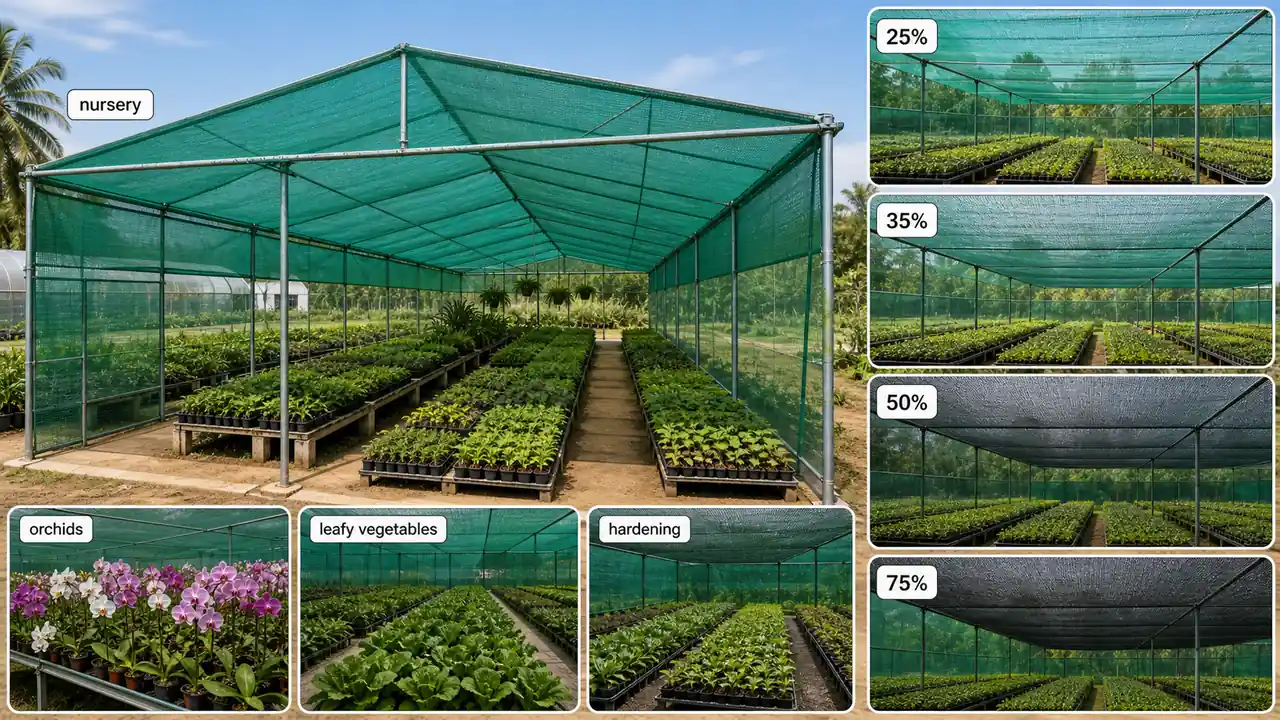
A shade net house is a structure covered with knitted nets made of HDPE (High-Density Polyethylene) or polypropylene that filters sunlight to reduce light intensity and temperature.
Shade Net Specifications
| Parameter | Options |
|---|---|
| Material | HDPE or polypropylene (UV-stabilized, knitted) |
| Shade intensity available | 25%, 35%, 50%, 75% |
| Most common color | Green |
| Temperature reduction inside | 5–8°C below ambient |
| Other colors available | Black, white, red, yellow |
Shade Intensity Selection Guide
| Shade % | Suitable Crops |
|---|---|
| 25% | Fruit vegetables (tomato, capsicum) in hot areas |
| 35% | Nursery raising, chrysanthemum, gerbera |
| 50% | Orchids, ferns, anthurium, leafy vegetables |
| 75% | Tissue culture hardening, foliage plants |
Uses of Shade Net House
- Nursery raising — most important commercial use
- Floriculture crops — gerbera, orchids, anthurium
- Leafy vegetables — spinach, lettuce, coriander
- Hardening of tissue-cultured plants
- Spice crops in tropical areas
TIP
Green shade net is the most commonly used. For exam purposes, remember: shade net reduces temperature by 5–8°C and comes in 25%, 35%, 50%, and 75% shade intensities.
Mulching
Mulching is the practice of covering the soil surface around plants with organic or inorganic material to conserve moisture, suppress weeds, and regulate soil temperature.
Types of Mulch
A. Organic Mulch
| Material | Source | Key Benefit |
|---|---|---|
| Straw/paddy husk | Rice harvest residue | Excellent moisture retention |
| Dry leaves | Tree leaf fall | Adds organic matter on decomposition |
| Grass clippings | Lawn/field trimming | Quick decomposition, adds nitrogen |
| Compost/FYM | Decomposed organic matter | Improves soil structure & fertility |
| Sawdust | Wood processing | Good for acid-loving crops (blueberry) |
| Coconut coir | Coconut husk fiber | Long-lasting; good water holding |
B. Inorganic/Plastic Mulch
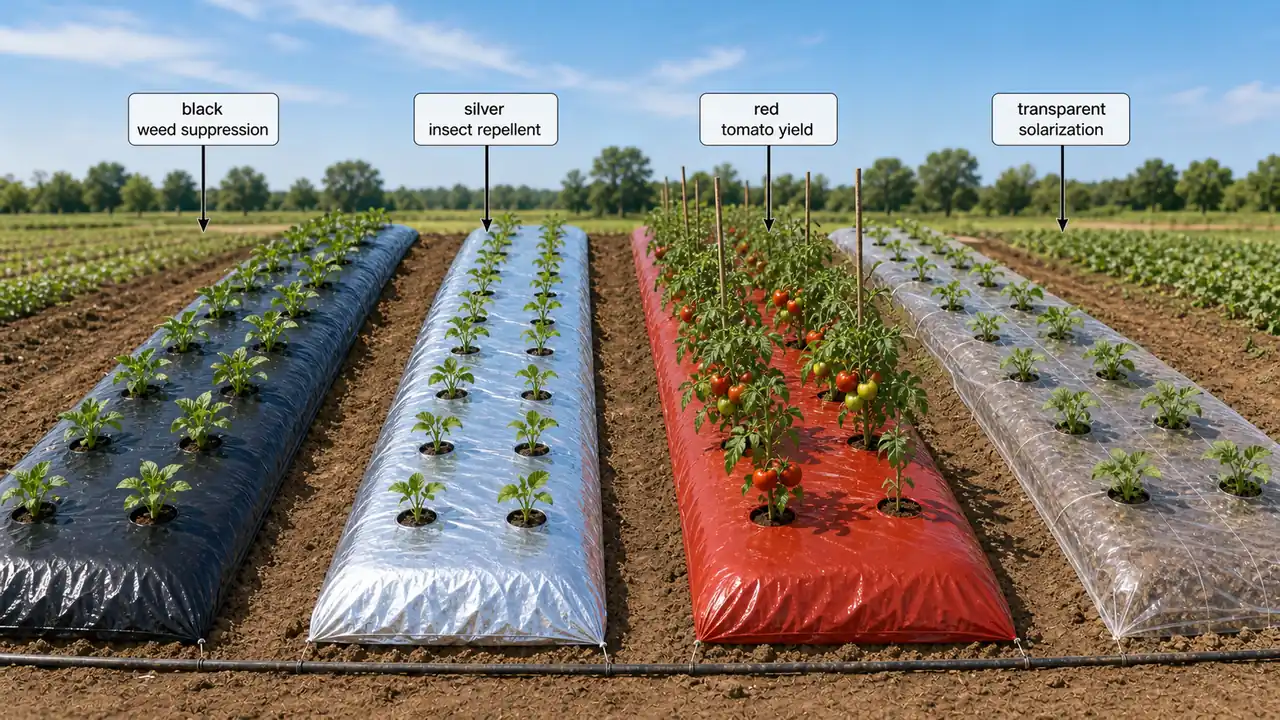
| Color | Key Function | Best Used For |
|---|---|---|
| Black | Weed suppression (blocks light completely) | Most commonly used; all vegetables |
| Silver/Reflective | Insect repellent (reflects light, confuses aphids/whiteflies) | Virus-prone crops (tomato, chilli) |
| Red | Reflects far-red light → increases tomato yield | Tomato, strawberry |
| Transparent/Clear | Soil solarization (heats soil to kill pathogens/weed seeds) | Pre-planting soil treatment |
| Yellow | Attracts & traps insects | Integrated pest management |
| Blue | Attracts thrips (used with sticky traps) | Floriculture |
IMPORTANT
Black plastic mulch is the most commonly used plastic mulch worldwide. It blocks sunlight completely, preventing weed growth. Transparent mulch is used specifically for soil solarization — it heats the soil to 50–60°C to kill pathogens and weed seeds.
Benefits of Mulching
- Moisture conservation — reduces evaporation by 25–50%
- Weed control — suppresses weed germination and growth
- Soil temperature regulation — keeps soil warm in winter, cool in summer
- Reduced fruit rot — prevents direct contact of fruit with wet soil
- Prevents soil erosion and crusting
- Improves fruit quality (cleaner, less disease)
- Enhances fertilizer use efficiency
Hydroponics
Hydroponics is the science of growing plants without soil, using a mineral nutrient solution in water.
NOTE
The term "Hydroponics" was coined by W.F. Gericke in 1929 at the University of California. The word comes from Greek: hydro (water) + ponos (labor) = "water working."
Types of Hydroponic Systems
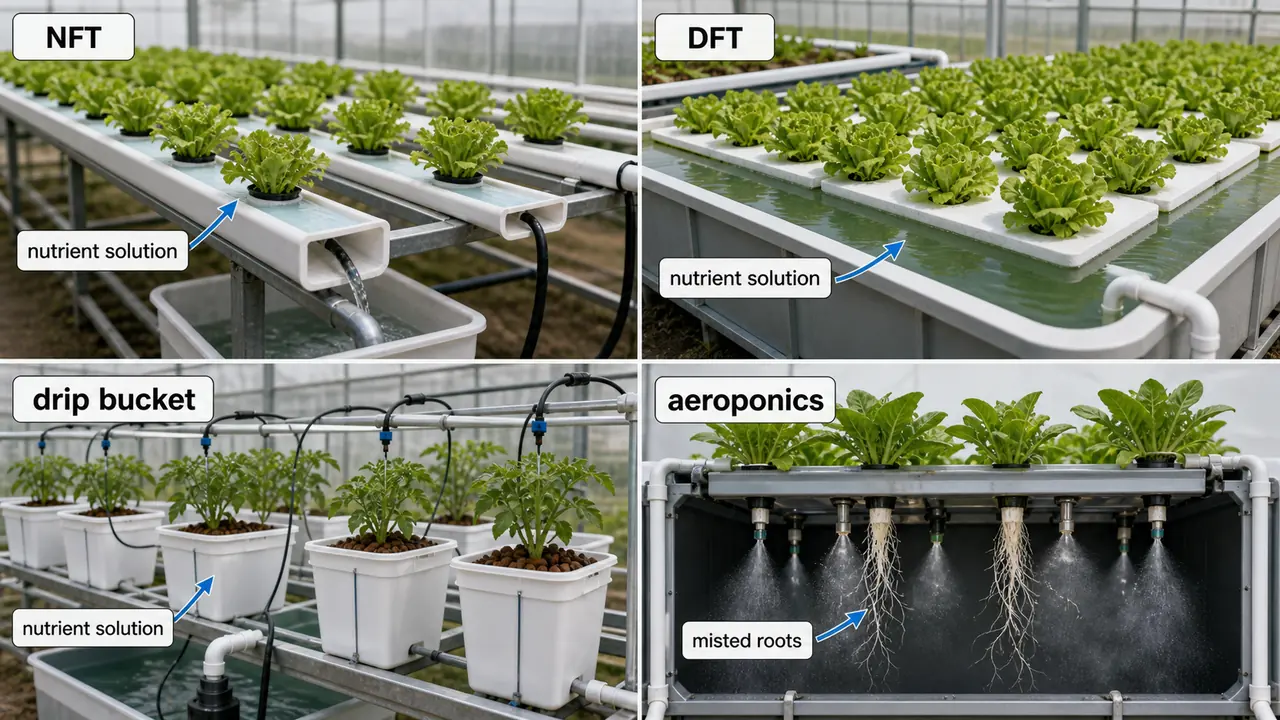
| System | Mechanism | Key Feature |
|---|---|---|
| NFT (Nutrient Film Technique) | Thin film of nutrient solution flows through shallow channels | Most widely used commercial system; continuous flow |
| DFT (Deep Flow Technique) | Plants float on deep pool of nutrient solution | Simple; good for leafy greens (lettuce) |
| Drip / Dutch Bucket | Nutrient solution dripped to individual plant containers | Best for large fruiting crops (tomato, cucumber) |
| Aeroponics | Roots suspended in air, misted with nutrient solution | Most advanced; highest oxygen to roots; fastest growth |
TIP
Aeroponics is the most advanced hydroponic technique — roots hang in air and are periodically misted with nutrients. It provides maximum oxygen to roots and is used for high-value crops and seed potato production.
Advantages of Hydroponics
- No soil required — can grow on rooftops, deserts, space stations
- Water saving up to 90% compared to soil cultivation (recirculating systems)
- No soil-borne diseases or nematode problems
- Precise control of nutrients — no nutrient wastage
- Higher plant density → higher yield per unit area
- Faster growth rate due to optimized nutrition and oxygen
Limitations
- High initial setup cost
- Requires technical knowledge and monitoring
- Power failure can damage crops quickly (pumps stop)
- Disease spreads rapidly through shared nutrient solution
Other Important Techniques
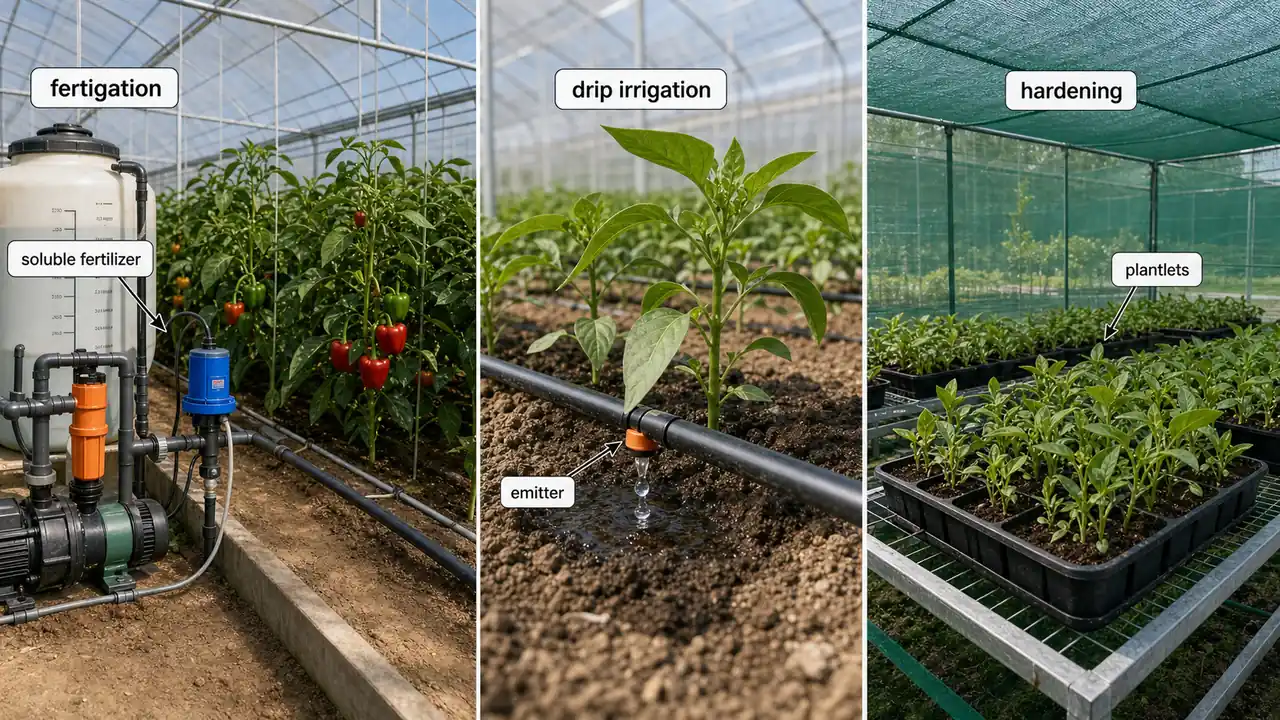
Fertigation
Fertigation is the application of fertilizers through the irrigation system, most commonly through drip irrigation.
| Parameter | Detail |
|---|---|
| Definition | Fertilizer + Irrigation = Fertigation |
| Most efficient method | Through drip irrigation |
| Fertilizer saving | 25–50% compared to conventional application |
| Water-soluble fertilizers used | MAP, MKP, potassium nitrate, calcium nitrate |
| Advantage | Uniform distribution, precise dosage, labor saving |
Drip Irrigation
Drip irrigation (also called trickle irrigation) delivers water directly to the root zone through emitters/drippers at low pressure.
| Parameter | Detail |
|---|---|
| Water use efficiency | 90–95% (highest among all methods) |
| Compared to flood irrigation | Saves 40–60% water |
| Compared to sprinkler | Saves 20–30% water |
| Invented by | Simcha Blass (Israel, 1960s) |
| Best suited for | Wide-spaced crops, orchards, vegetables |
NOTE
Drip irrigation has the highest water use efficiency (90–95%) among all irrigation methods. Sprinkler irrigation efficiency is 70–80%, and flood/surface irrigation is only 30–40%.
Tissue Culture / Micropropagation
Micropropagation is the technique of growing plants from very small plant parts (explants) under aseptic (sterile) conditions on an artificial nutrient medium.
| Parameter | Detail |
|---|---|
| Nutrient medium | MS Medium (Murashige & Skoog, 1962) |
| Key components of MS medium | Macro & micro nutrients, sucrose, vitamins, agar, growth regulators |
| Growth regulators used | Auxins (root), Cytokinins (shoot) |
| Important crops | Banana, orchids, strawberry, date palm, cardamom |
| Stages | Initiation → Multiplication → Rooting → Hardening |
IMPORTANT
MS medium (Murashige and Skoog) is the most widely used culture medium in plant tissue culture. Hardening is the final stage where tissue-cultured plantlets are acclimatized to field conditions — often done in shade net houses (50–75% shade).
Quick Reference
Complete Protected Cultivation Quick Reference Table
Comparison of Protected Structures
| Parameter | Greenhouse (Glass) | Polyhouse (PE film) | Shade Net House |
|---|---|---|---|
| Covering | Glass | UV-stabilized PE film | HDPE/PP knitted net |
| Cost | Very high | Low to medium | Lowest |
| Durability | 25+ years | 2–3 years | 5–7 years |
| Light control | Excellent | Good | Moderate (shade only) |
| Temperature control | Excellent (heating + cooling) | Good (natural/fan-pad) | Limited (5–8°C reduction) |
| Rain protection | Complete | Complete | Partial |
| Wind protection | Complete | Complete | Partial |
| Most used in | Europe, USA, Japan | India, Southeast Asia | India (nurseries) |
| Ideal crops | High-value flowers, vegetables | Vegetables, flowers, capsicum | Nursery, leafy vegetables, orchids |
Key Numbers to Remember
| Fact | Value |
|---|---|
| PE film thickness (polyhouse) | 200 micron |
| PE film life | 2–3 years |
| Polyhouse yield increase | 5–10x over open field |
| Water saving (polyhouse) | 40–50% |
| Shade net temperature reduction | 5–8°C |
| Shade net intensities | 25%, 35%, 50%, 75% |
| Drip irrigation efficiency | 90–95% |
| Hydroponics water saving | Up to 90% |
| Mulch evaporation reduction | 25–50% |
| Greenhouse night temperature | 13–15°C |
Key People & Dates
| Person/Term | Contribution |
|---|---|
| W.F. Gericke (1929) | Coined the term "Hydroponics" |
| Simcha Blass (1960s) | Invented modern drip irrigation (Israel) |
| Murashige & Skoog (1962) | Developed MS medium for tissue culture |
Plastic Mulch Color Functions
Summary Cheat Sheet
| Concept / Topic | Key Details / Explanation |
|---|---|
| Protected cultivation concept | Protected cultivation means growing crops under a modified environment to avoid biotic and abiotic stress and enable year-round high-value production. |
| Key objectives | The main goals are season extension, stress protection, better quality and yield, off-season production, and efficient use of water, fertilizer, and land. |
| Greenhouse basics | A greenhouse or glasshouse uses transparent or translucent covering so short-wave radiation enters, converts to long-wave heat, and gets trapped inside, producing the greenhouse effect. |
| Greenhouse classifications | Greenhouses are classified by shape, covering material, temperature regime, frame material, and ventilation type. |
| Shape-based greenhouse types | Important shape types are lean-to, even span, uneven span, ridge and furrow, quonset, gothic arch, and sawtooth; quonset is most common in India and sawtooth is preferred for hot tropical plains. |
| Covering and frame materials | Glass, polycarbonate, polyethylene, fiberglass, and acrylic are the main covering materials; 200 micron UV-stabilized polyethylene is most common in India, and GI pipe is the common frame material. |
| Temperature and ventilation classes | Temperature classes include cold, cool, warm, and hot greenhouse; ventilation may be natural, fan-and-pad, fog or mist cooling, or sawtooth passive ventilation, with naturally ventilated polyhouses recommended for most of India. |
| Best greenhouse choice in India | Quonset polyhouse with UV-stabilized PE film and GI pipe is the common Indian standard, while fan-and-pad suits very hot arid regions and sawtooth suits humid tropical climates. |
Summary Continued
Summary Continued
| Concept / Topic | Key Details / Explanation |
|---|---|
| Polyhouse | A polyhouse is the most common protected structure in India, usually covered with 200 micron UV-stabilized polyethylene and giving about 5-10x yield increase with 40-50% water saving. |
| Shade net house | Shade net houses use HDPE or polypropylene nets, usually green, with shade levels of 25%, 35%, 50%, and 75%, reducing temperature by about 5-8°C and mainly serving nurseries, floriculture, leafy vegetables, and hardening. |
| Mulching | Mulching may be organic or plastic; black mulch is the most common for weed control, transparent mulch is used for soil solarization, and silver reflective mulch helps insect management. |
| Hydroponics | Hydroponics is soilless cultivation; W.F. Gericke coined the term in 1929; major systems are NFT, DFT, Dutch bucket or drip, and aeroponics, with water saving up to 90%. |
| Fertigation and drip irrigation | Fertigation means fertilizer through irrigation, most efficiently drip; drip irrigation gives about 90-95% water-use efficiency and was developed in modern form by Simcha Blass. |
| Tissue culture and hardening | MS medium by Murashige and Skoog (1962) is the main tissue-culture medium; important crops include banana, orchid, strawberry, date palm, and cardamom; hardening is often done under 50-75% shade net. |
| Quick memory values | Important values from the lesson are greenhouse night temperature 13-15°C, PE film life 2-3 years, shade net temperature reduction 5-8°C, and mulch-driven evaporation reduction 25-50%. |
Lesson Doubts
Ask questions, get expert answers